THE EFFECT OF INVASIVE LIONFISH ON REEF FISH COMMUNITY STRUCTURE ALONG THE MESOAMERICAN BARRIER REEF
Serena Hackerott
A thesis submitted to the faculty at the University of North Carolina at Chapel Hill in partial fulfillment of the requirements for the degree of Master of Science in the Department of
Marine Sciences.
Chapel Hill 2014
iii ABSTRACT
Serena Hackerott: The effect of invasive lionfish on reef fish community structure along the Mesoamerican Barrier Reef
(Under the direction of John F. Bruno)
Lionfish are invasive predators, native to the Indo-Pacific, assumed to be negatively affecting Caribbean coral reefs. Small-scale studies suggest lionfish can reduce the
abundance and diversity of small prey individuals. However, it is unclear whether lionfish predation affects entire reef fish communities. Our goal was to assess the effect of lionfish on coral reef fish communities across a complex reef system. We quantified fish abundance, diversity, and community composition at sixteen reefs along ~250km of the Mesoamerican Barrier Reef in Belize over five years, including the onset of the invasion. Lionfish had no effect on reef fish community structure on our sites in Belize. The effects of lionfish may be density dependent, and current densities in Belize are likely due to a combination of natural factors and lionfish removals. Because current densities have no effect on reef fish
iv
v
ACKNOWLEDGEMENTS
Thank you to my advisor, John Bruno, and my fellow lab members, Abel Valdivia and Courtney Cox, for their continued assistance throughout this project and the
vi
TABLE OF CONTENTS
LIST OF TABLES...viii
LIST OF FIGURES...ix
LIST OF ABBREVIATIONS...x
THE EFFECT OF INVASIVE LIONFISH ON REEF FISH COMMUNITY STRUCTURE ALONG THE MESOAMERICAN BARRIER REEF...1
Introduction...1
Methods...4
2.1 Study Sites and Reef Fish Surveys...4
2.2 Reef Fish Community Structure...5
2.3 Prey Community Structure...5
2.4 Abiotic Covariates...6
2.5 Analysis of Effects of the Lionfish Invasion...7
Results...9
Discussion...11
Conclusion...19
vii
APPENDIX 1: SUPPLEMENTAL TABLES...26
APPENDIX 2: SUPPLEMENTAL FIGURES...33
APPENDIX 3: SUPPLEMENTAL TEXT...38
viii
LIST OF TABLES
Table S1. Site Information and Coordinates...26
Table S2. Prey Species and Sources...27
Table S3. Coefficient Estimates and p-values for Each Model...29
ix
LIST OF FIGURES
Figure 1. Location of Survey Sites...21 Figure 2. Average Lionfish Abundance from 2009 to 2013...22 Figure 3. Coefficient Estimates (mean ± 95% confidence interval)
for Each Model...23 Figure 4. Total Fish and Prey Fish Community Composition in
2010 and 2013...24 Figure 5. Lionfish Abundance in Native and Invaded Ranges and
Estimated Impact Threshold...25 Figure S1. Boxplots of Lionfish Abundance, Prey Fish Diversity,
and Total and Prey Fish Abundance...33 Figure S2. Lionfish Abundance from 2009 to 2013 on Each Site...34 Figure S3. Quantile-Quantile Plot of the Residuals of the Model
of Total Fish Species Diversity...35 Figure S4. Abundance of Native Competitors 2009-2013...36 Figure S5. Biomass of Lionfish and Native Competitors from
x
LIST OF ABBREVIATIONS AIC Akaike's “An Information Criterion” ANOSIM Analysis of Similarity
BACI Before After Control Impact
MBR Mesoamerican Barrier Reef
MPA Marine Protected Area
NMDS Non-metric Multidimensional Scaling
NTZ No-Take Zone
PERMANOVA Permutational Multivariate Analysis of Variance
SE Standard Error
TL Total Length
1
CHAPTER 1: THE EFFECT OF INVASIVE LIONFISH ON REEF FISH COMMUNITY STRUCTURE ALONG THE MESOAMERICAN BARRIER REEF Introduction
Invasive species are widely recognized as a major threat to biodiversity and an important conservation priority (Bax et al. 2003, Pimentel et al. 2005, Molnar et al. 2008, Vilà et al. 2011). While the qualities conferring invasiveness of a species or “invasibility” of an ecosystem have been thoroughly explored, mostly in terrestrial ecosystems (Rejmánek and Richardson 1996, Levine and D’antonio 1999, Lonsdale 1999, Richardson and Pyšek 2006, Van Kleunen et al. 2010), studies quantifying the factors influencing the impact of an invasive species on the recipient community are less represented (Parker et al. 1999).
Furthermore, the invasiveness of a species does not predict the impact it will have on invaded ecosystems (Ricciardi and Cohen 2007). Studies of invasion success can contribute to
policies aimed at preventing invasions, but impact-focused studies are essential to developing conservation strategies once an invasive species has already become established.
2
Indo-Pacific lionfish (Pterois volitans and Pterois miles, hereafter called “lionfish”) are one of the first exotic predators to invade an open marine system, and the first to become established across the Caribbean region (Schofield 2009). Several characteristics such as cryptic coloration (Kindinger 2014), undetectable chemical cues (Lönnstedt and McCormick 2013), and novel predation tactics (Albins and Lyons 2012), may increase their effectiveness as predators in their invaded range. Due to their generalist diet, consuming over 100
Caribbean species (Morris and Akins 2009, Green et al. 2012, Green and Côté 2014), and high consumption rates (Cote and Maljković 2010), lionfish have the capacity to affect numerous native species and drive changes in native fish communities. In fact, lionfish significantly decreased the abundance, species richness, and diversity of coral reef fish recruits (<5 cm TL) during eight weeks on experimental reefs off of Lee Stocking Island, Bahamas (Albins 2013). Additionally, increasing lionfish abundance has been associated with a significant decrease in the biomass of native prey individuals (<15 cm TL) over two years along a continuous reef in New Providence, Bahamas (Green et al. 2012). However, these and other previous studies have only demonstrated the negative effects (i.e., decline in abundance and diversity) of invasive lionfish on small, native prey individuals on relatively small, isolated systems and controlled experimental reefs (Albins and Hixon 2008, Green et al. 2012, Albins 2013). It has yet to be determined whether the predation pressure of lionfish on small prey individuals drives changes in the entire (i.e., all size classes) reef fish
community.
3
spatial scales (Albins and Hixon 2008, Green et al. 2012, Albins 2013) can be detected on the entire reef fish community on contiguous reef habitats, within the context of existing
variability. Specifically, we investigated the effects of lionfish abundance on reef fish abundance, diversity, and community composition. Our 16 fore-reef sites were along the Mesoamerican Barrier Reef in Belize, spanning ~250 km, across gradients of natural
environmental conditions as well as anthropogenic stressors. Our longitudinal study began in 2009, included the onset of the lionfish invasion in Belize (Schofield 2009), and continued until 2013. The design is a quasi-BACI design (Before After Control Impact) as we tracked changes in native fishes pre- and post-invasion and among sites varying in lionfish density over time. We hypothesized that reef fish abundance, species richness, and diversity would be negatively related with lionfish abundance due to the predation of invasive lionfish on small prey individuals (Albins and Hixon 2008, Green et al. 2012, Albins 2013). We also hypothesized that coral reef fish communities would experience a shift in composition due to the invasion as lionfish can differentially reduce the biomass of prey species (Green et al. 2012) by selectively feeding on species with certain morphological and behavioral traits (Green and Côté 2014).
Lionfish can potentially influence reef fish communities both directly through predation and indirectly through competition. Lionfish may also influence native fish communities by other indirect mechanisms such as acting as a disturbance that increases the availability of resources or niches for the remaining reef fish species (Ward and Stanford 1983). Therefore, to assess the effect of lionfish on native communities, we tested our
4
lionfish on reef fish. We then focused on the known prey fish community, or fish species previously documented as lionfish prey, to determine the direct effect of lionfish on reef fish communities.
Methods
2.1 Study Sites and Reef Fish Surveys
5 2.2 Reef Fish Community Structure
Reef fish abundance (individuals/m2) was calculated for each reef fish species and total reef fish abundance was defined as the sum of the abundances of each species (excluding lionfish) per transect. Species richness and species diversity of reef fish were calculated to quantify changes in alpha diversity. Species richness (S) was calculated as the total number of species present (excluding lionfish) per transect. Species diversity was calculated in terms of Shannon-Wiener diversity (H’), a metric that accounts for both species richness and evenness, was calculated as:
− ∑ 𝑝𝑖∙ ln(𝑝𝑖) 𝑆
𝑖=1
where S = species richness, and pi = the proportion of species i in the transect.
Community composition was quantified in terms of Bray-Curtis dissimilarity as:
2𝐶𝑖𝑗 𝑆𝑖 + 𝑆𝑗
where Cij = species in common between sites i and j, and S(i or j) = species in site i or j.
All indices of community structure and composition were quantified using the vegan (v2.0-10) package in R (R Development Core Team 2013).
2.3 Prey Community Structure
6
Albins 2013, Cote et al. 2013, Green and Côté 2014). Prey fish abundance, species richness, species diversity, and community composition were quantified using the same methods previously described for the total fish community.
2.4 Abiotic Covariates
To account for variability among sites, we included three site-specific abiotic covariates in our analysis: site protection status, reef complexity, and humans per area of reef. All three are known to affect reef fish diversity and abundance (Friedlander et al. 2003, Williams et al. 2008) and could influence the effect of lionfish on fish communities. Due to regulations on fishing, protected sites may have higher fish abundance, species richness, or diversity than unprotected sites. Yet lionfish could have a weaker effect on reef fish
communities on protected sites compared to unprotected due to lower abundances (Green et al. in press, Barbour et al. 2011, Frazer et al. 2012, Hackerott et al. 2013) or changes in lionfish behavior (Côté et al. 2014) due to lionfish culling. We split protected sites into either NTZ or MPA status as different protection levels may differ in influence on reef fish
communities and the effect of lionfish. We included reef complexity as a predictor because highly complex reefs may support higher reef fish abundances or diversity compared with less complex reefs (Friedlander et al. 2003). Although reef complexity may not influence lionfish abundance (Valdivia et al. 2014, Anton et al. 2014), it could alter predation success of lionfish on resident reef fish by decreasing predation risk due to higher refuge availability for prey (Beukers and Jones 1998). To estimate reef structural complexity, we used an index from 0 to 5, where “0” was a reef with no vertical relief and “5” was an exceptionally complex reef (Polunin and Roberts 1993, Valdivia et al. 2014). Reef complexity was
7
population per reef area (hereafter referred to as “humans/reef”) was used as a proxy for fishing pressure (Newton et al. 2007, Mora 2008). We hypothesized that fishing pressure could negatively affect reef fish abundance, species richness, and diversity, but would likely not influence lionfish abundance (Valdivia et al. 2014). Humans/reef was calculated as the human population within a 50 km radius of each site, divided by reef area within a 10 km radius of each site (details in Valdivia et al. 2014). A Spearman correlation matrix among the numerical explanatory variables indicated no correlation that could compromise
simultaneous modeling, therefore we included all three abiotic covariates in the analytical models.
2.5 Analysis of the Effects of the Lionfish Invasion
We used generalized linear mixed effect models (glmer) to evaluate the effect of lionfish abundance and time since invasion on reef fish (total fish and prey) abundance, species richness, and species diversity, accounting for site-specific abiotic covariates. All reef fish community responses were modeled separately using the lme4 (v1.1-5) package (R Development Core Team 2013). Total fish and prey fish abundance were modeled with a gamma log-link distribution, species richness with a gamma identity-link distribution, and species diversity with a Gaussian log-link distribution. Outliers, points outside of the
8
(Fig. S1). Site was included in each model as a random effect to account for within site variability. The number of years following the lionfish invasion, lionfish abundance, and the three abiotic covariates were coded as fixed effects in each model. We standardized (centered and divided by standard deviation) all numerical predictors in each model. We also included interactions between lionfish abundance, year, and each abiotic covariate in each global model. Global models were structured as:
𝑦 = 𝛽0+ 𝛽1∙ 𝑌𝑒𝑎𝑟𝑖+ 𝛽2∙ 𝐿𝑖𝑜𝑛𝑓𝑖𝑠ℎ 𝐴𝑏𝑢𝑛𝑑𝑎𝑛𝑐𝑒𝑖 + 𝛽3∙ 𝑃𝑟𝑜𝑡𝑒𝑐𝑡𝑖𝑜𝑛 𝑆𝑡𝑎𝑡𝑢𝑠𝑖
+𝛽4∙ 𝑅𝑒𝑒𝑓 𝐶𝑜𝑚𝑝𝑙𝑒𝑥𝑖𝑡𝑦𝑖+ 𝛽5∙
𝐻𝑢𝑚𝑎𝑛𝑠
𝑅𝑒𝑒𝑓 𝑖 + 𝛽6∙ 𝐿𝑖𝑜𝑛𝑓𝑖𝑠ℎ 𝐴𝑏𝑢𝑛𝑑𝑎𝑛𝑐𝑒𝑖: 𝑌𝑒𝑎𝑟𝑖
+𝛽7∙ 𝐿𝑖𝑜𝑛𝑓𝑖𝑠ℎ 𝐴𝑏𝑢𝑛𝑑𝑎𝑛𝑐𝑒𝑖: 𝑃𝑟𝑜𝑡𝑒𝑐𝑡𝑖𝑜𝑛 𝑆𝑡𝑎𝑡𝑢𝑠𝑖 + 𝛽8
∙ 𝐿𝑖𝑜𝑛𝑓𝑖𝑠ℎ 𝐴𝑏𝑢𝑛𝑑𝑎𝑛𝑐𝑒𝑖: 𝑅𝑒𝑒𝑓 𝐶𝑜𝑚𝑝𝑙𝑒𝑥𝑖𝑡𝑦𝑖
+𝛽9∙ 𝐿𝑖𝑜𝑛𝑓𝑖𝑠ℎ 𝐴𝑏𝑢𝑛𝑑𝑎𝑛𝑐𝑒𝑖:𝐻𝑢𝑚𝑎𝑛𝑠
𝑅𝑒𝑒𝑓 𝑖+ 𝜀𝑖 ≈ 𝑁(0, 𝜎𝑖 2)
where 𝑦 = log (𝑢𝑖) for abundance and species diversity and 𝑦 = 𝑢𝑖 for species richness of all fish and prey fish.
Each global model was dredged using the MuMIn (v1.9.13) package in R (R
9
colinearity among the covariates included in final each model. Quantile-quantile plots (car package v2.0-19) were used to check normality of the residuals of each final model.
Spline-correlograms (ncf package v1.1-5) using the location coordinates of each site with 1,000 resamples revealed no evidence of spatial autocorrelation of the residuals of each final model (R Development Core Team 2013).
Changes in reef fish (both total and prey fish) community composition in response to year (pre-invasion: 2010 and post-invasion: 2013) and lionfish abundance were first assessed using permutational multivariate analysis of variance (PERMANOVA) of the formula
[𝑇𝑟𝑎𝑛𝑠𝑒𝑐𝑡 𝑏𝑦 𝑆𝑝𝑒𝑐𝑖𝑒𝑠 𝐴𝑏𝑢𝑛𝑑𝑎𝑛𝑐𝑒 𝑀𝑎𝑡𝑟𝑖𝑥]~𝑌𝑒𝑎𝑟𝑖 ∗ 𝐿𝑖𝑜𝑛𝑓𝑖𝑠ℎ 𝐴𝑏𝑢𝑛𝑑𝑎𝑛𝑐𝑒𝑖
with 10,000 permutations, stratified by site i, using Bray-Curtis dissimilarity (vegan package v2.0-10). Pre-invasion (2010) and post-invasion (2013) community compositions across all
sites were quantified using an Analysis of Similarities (ANOSIM) with 10,000 permutations, grouped by year, using Bray-Curtis dissimilarity (vegan package v2.0-10). Reef fish
community composition across all sites, pre- and post-invasion, were then assessed visually in two-dimensional space using nonmetric multidimensional scaling (NMDS) ordination analysis of Bray-Curtis dissimilarity using the vegan (v2.0-10) package in R (R Development Core Team 2013). We used NMDS because this ordination technique does not assume linearity of species responses or that species responses are due to environmental gradients (Minchin 1987).
Results
10
lionfish were recorded on our sites in 2009 but by 2010, lionfish were present on two sites (Calabash and South Middle Caye) at relatively low abundances (6.7± 6.7 individuals/ha (mean ± SE) on both sites), marking the onset of invasion. By 2012 lionfish were observed on 14 of 16 sites and on all sites by 2013. Across all sites, the average lionfish abundance (mean ± SE) was 0.9 ± 0.7 individuals/ha in 2010, peaked to 21.27 ± 5.50 individuals/ha in 2011 and decreased slightly, but not significantly, in 2012 to 16.3 ± 5 individuals/ha and 11.1 ± 4.2 individuals/ha in 2013 (Fig. 2). The highest lionfish abundance found during our study was 70 ± 29.2 individuals/ha at Pampion in 2012. Due to the presence of lionfish on all 16 sites by the end of the study, our design was not a BACI design in a strict sense. However, lionfish density varied among sites over time and we used this variability to test the effects of lionfish over a gradient of potential impact levels (assuming the effects of lionfish are
density-dependent).
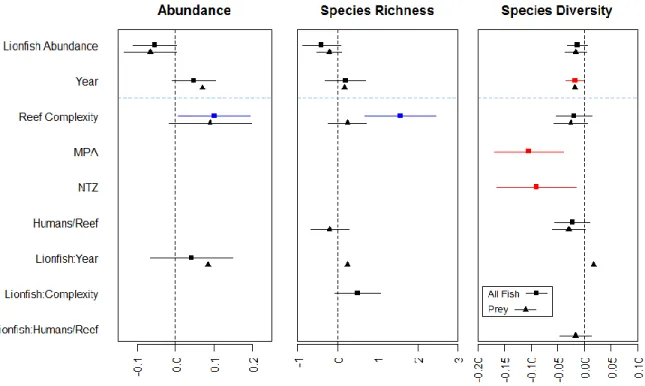
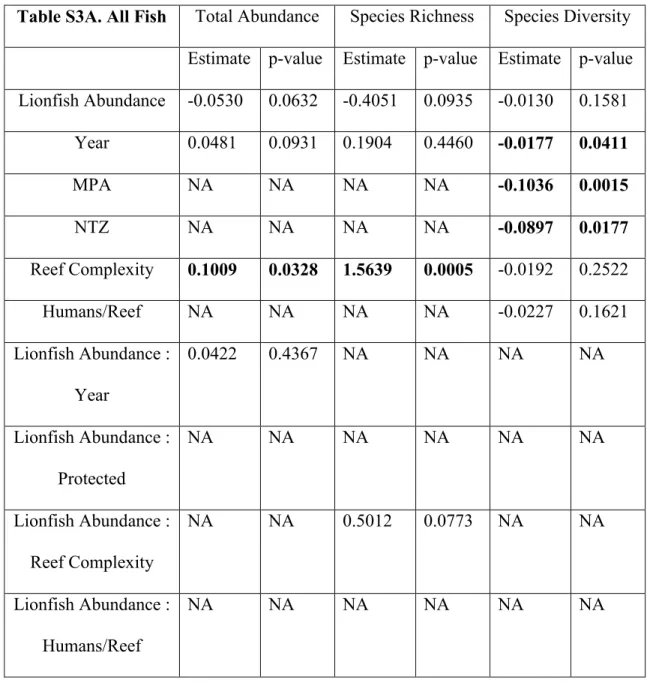
Lionfish abundance had no significant effect on the abundance, species richness, or species diversity of total fish or prey fish communities (Fig. 3, Table S3). Reef complexity was positively related to total fish abundance and species richness (Fig. 3, Table S3). For the analysis of prey fish species richness, the null model was retained during the model
11
that the residuals were slightly non-normal due to a few values at the extremes (Fig. S3), yet this was the best fit model for our available data.
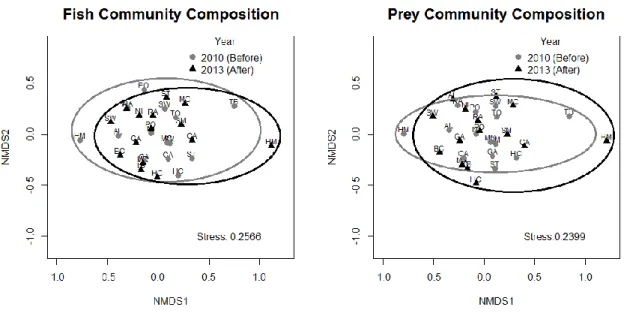
The PERMANOVA analysis indicated total fish and prey fish community
composition changed over time on some sites (p-value= 10.0e-5 and 10.0e-5, respectively) but community composition was not related to lionfish abundance (p-value= 0.87 and 0.83, respectively). Additionally, there were no clear patterns indicating changes in total fish or prey community composition from before (2010) to after (2013) the lionfish invasion across all sites (Fig. 4). This was confirmed by an analysis of similarity (ANOSIM) comparing communities across all sites between pre- and post-invasion for both total and prey fish (p-value= 0.61 and 0.53, respectively).
Discussion
We found no evidence supporting the hypothesis that predation of lionfish on small prey individuals (Albins and Hixon 2008, Green et al. 2012, Albins 2013) affects adult reef fish communities. Across sixteen fore-reef sites on the MBR in Belize, there was no
12
structure). Total fish diversity was lower on protected sites compared to unprotected, which is the opposite of the expected effect of fishing regulations on reef fish communities
(Friedlander et al. 2003). This difference in diversity is likely indicative of differences in species evenness, however, as species richness was not influenced by protection status. For example, differences in fishing regulations may influence the relative abundances of reef fish species, resulting in communities where species evenness, and therefore diversity, is lower on protected sites compared to unprotected sites. Although there was a significant effect of time since invasion on total fish diversity, this pattern was not related to lionfish abundance. Additionally, reef fish community composition changed significantly on some sites, but there was no overall shift in composition from pre- to post-invasion across the MBR. Lionfish abundance had no significant effect on reef fish community structure or composition, so these changes over time are not due to the lionfish invasion. Instead, this is likely indicative of inter-annual fluctuations in the reef fish community responses, potentially due to
stochastic population variation, recruitment success, or variability in unmeasured environmental drivers.
The specific effects of an invasive predator on native communities (i.e., declines in abundance/diversity or changes in community composition) can be estimated with controlled lab or field experiments. However, to properly inform management and conservation
13
and Price 1992, Power 1992). Additionally, anthropogenic stressors including exploitation, habitat degradation and fragmentation, pollution, and climate change are threatening natural communities (Halpern et al. 2008). These natural and anthropogenic forces could be more important for community structure than the effect of the invasive predator, suggesting conservation efforts should be focused on threats other than the invader. However, it is difficult to design controlled experiments that include the suite of factors influencing prey communities. Additionally, the relative importance of recruitment vs. post-recruitment processes cannot necessarily be extrapolated from isolated habitat patches to contiguous habitats in the marine environment (Ault and Johnson 1998). Our study design allowed us to use the lionfish invasion on the MBR as an “accidental” large-scale experiment to quantify the effects of invasive lionfish over time within a natural reef system. Our goal was to
determine if the effect of lionfish was apparent in reef fish communities within the context of the existing environmental and annual variability across our fore-reef sites. We found no evidence to support this. Instead, reef fish communities were structured by bottom-up effects of habitat complexity and stochastic processes (e.g., annual variability) rather than the top-down pressure of predation by lionfish on reef fish recruits.
14
scale, covering a ~250 km stretch of reef and a total surveyed area of ~48 km2 (~6 transects of 50 x 10 m area on 16 sites) including 16 different sites along the MBR in Belize Fig. 1, Table S1). In our large-scale and complex study system, reefs may be connected (Tang et al. 2006, Soto et al. 2009) and influenced by meta-population dynamics (Kritzer and Sale 2004). The underlying impact of lionfish on individual reefs could be counteracted by recruitment or immigration from surrounding reefs within the system (i.e., the “rescue effect” (Gotelli 1991)) depending on reef connectivity (Ault and Johnson 1998). Potential evidence of this is provided in the lionfish removal experiment by Green et al. (2014) where the effect of
lionfish on small prey biomass differed between low and high lionfish density treatments, yet this pattern was not apparent in the biomass of larger individuals between treatments.
Instead, the biomass of larger individuals increased across all lionfish densities treatments, which authors attributed to inter-reef movement of individuals offsetting the underlying effect of lionfish (Green et al. 2014). Isolated study systems, such as those used in previous studies (Albins and Hixon 2008, Albins 2013), are essential for experimentally quantifying the effect of an in-situ treatment (e.g., the presence of lionfish). However conclusions from such experiments may not necessarily be applicable to more complex systems without further investigation. Our study design allowed us to determine that the effect of lionfish on reef fish communities was not apparent within a complex reef system.
15
lionfish have been shown to have a greater effect on fish recruits than native predators on experimental reefs (Albins 2013)). However, this is not the case on our sites as the
abundance of piscivores that are ecologically similar to lionfish (species listed in Table S4) did not decrease across our sites from 2009 to 2013 (Fig. S4). Instead, average competitor abundance remained fairly constant, with a slightly positive trend over time (Fig. S4).
Therefore, the lack of apparent effect of lionfish on reef fish communities is likely not due to changes in native piscivore abundance. However, the effect of lionfish may be limited by the relative abundance of native predators. Native predators do not control lionfish (Hackerott et al. 2013, Valdivia et al. 2014), but proportionally lower lionfish biomass in comparison to native predators may limit the relative influence of lionfish on reef fish communities. On impacted reefs, lionfish can comprise a sizable portion of the total fish predator biomass, becoming one of the most important predators. For example, lionfish were reported to increase from 23% to 40% of the total predator biomass on reefs in New Providence, Bahamas from 2008-2010, coinciding with a decrease in biomass of small prey individuals (Green et al. 2012). During experiments that demonstrated a significant effect on reef fish recruits, lionfish comprised ~50-100% of the total predator biomass (Albins and Hixon 2008, Albins 2013). In contrast, lionfish biomass in our study peaked at ~27% of the total biomass of ecologically similar predators (Table S4) in 2011 and remained relatively low, ~10-11%, during 2012 and 2013 (Fig. S5). While previous studies showed that lionfish can control reef fish recruits when acting as one of the most important, or the only, predators, it is likely that the effect of lionfish on reef fish communities is context-dependent.
16
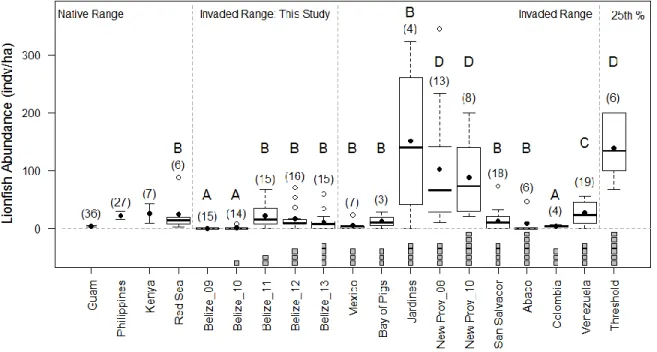
lionfish densities are reduced below a reef-specific threshold (Green et al. 2014). The lionfish densities across our sites post-invasion (2012 and 2013) were significantly lower (one-tailed t-test; t= 8.3; p-value=2.4e-6) than the lionfish densities (mean ± SE; ~138.9 ± 14.7
individuals/ha) in the 25th percentile of the thresholds predicted for patch reefs in Eleuthera, Bahamas (Green et al. 2014). While the values of threshold densities vary across different communities, site-specific “thresholds” for our larger fore-reef sites are more likely to be higher rather than lower than those estimated for smaller patch reefs, as reef fish
communities may be more strongly structured by recruitment on isolated patch reefs than on contiguous reef systems (Ault and Johnson 1998). Therefore, it is likely that the lionfish densities on our sites were lower than the site-specific “threshold” levels, which could explain why the predicted effects of lionfish were not apparent in our study.
The density of lionfish also differed between our study and previous studies testing the effects of lionfish on small prey individuals. On experimental reefs in Lee Stocking Island, Bahamas, lionfish treatments included one lionfish per ~1 m2, 3 m2, and 4 m2 reefs which scales to unrealistic densities of ~2500-10,000 individuals/ha (Albins and Hixon 2008, Albins 2013) which is 1-2 orders of magnitude higher than the maximum recorded density (Green and Côté 2009) and ~100-900 times higher than our average post-invasion densities. Again, such controlled experiments are essential to determine the potential effect of a treatment (e.g., the presence of lionfish). However, it is important to consider the
17
values of lionfish densities were not reported in that study, values reported on sites in New Providence during the time of the study (101.6 ± 28.6 individuals/ha in 2008 and 87.9 ± 24.2 individuals/ha in 2010 (Darling et al. 2011, Valdivia et al. 2014)) were significantly higher (one-tailed t-test; t=4.2; p-value=2.0e-4) than lionfish densities across our sites post-invasion (2012 and 2013). Additionally, maximum lionfish densities reached 393.3 ± 83.4
individuals/ha in 2008 on three sites in New Providence, Bahamas (Green and Côté 2009) while the highest lionfish density on our study sites was 70 ± 29.2 individuals/ha at Pompion in 2012. Even 4 years after the first lionfish was reported in each region (New Providence: 2005 and Belize: 2009 (Schofield 2009)), lionfish densities were significantly higher (one-tailed t-test; t=3.1; p-value=4.0e-3) in New Providence, Bahamas than on our sites in Belize, so time since invasion does not explain the difference in densities. It is possible that lionfish propagule pressure is lower in Belize compared to the Bahamas due to higher spatial
separation and/or lower connectivity with the point of origin of the invasion (Southern Florida (Schofield 2009)), similar to patterns documented in terrestrial invasions (Hastings et al. 2005, Alston and Richardson 2006).
18
Additionally, we suggest quantifying the importance of current removal efforts, relative to natural forces, on both lionfish densities and impacts to determine the necessary level of lionfish removals. This can increase reef management efficiency, which is essential in countries such as Belize where reef managers are often resource-limited. Lionfish densities and apparent impacts should also be monitored on our sites through time, as well as across other reef sites and different habitat types in Belize, to identify sites where targeted removal efforts may be necessary. It is unlikely that lionfish can be completely extirpated from invaded reefs, but our study suggests this may not be necessary to prevent impacts on reef fish communities. Therefore, future efforts should be focused on monitoring for apparent impacts of lionfish so that management resources are not wasted on extraneous lionfish removals in areas where they may not be necessary.
19
lionfish densities and apparent impacts should be continually monitored on these coral reef sites as well as on additional sites and habitats across the Caribbean.
Conclusions
Caribbean coral reefs face a growing list of current and future threats including overfishing of predatory fish (Stallings 2009), exploitation of herbivores (Mumby 2006), other local anthropogenic stressors (Mora 2008), as well as the stresses associated with global climate change (Hoegh-Guldberg et al. 2007). For reef managers tasked with conserving these ecologically and economically important ecosystems, conservation priorities must be applicable within the context of existing variability and stresses across reefs. Our study is the first to quantify the effects of lionfish on reef fish communities across a large-scale, complex reef system, within the context of existing variability. While lionfish were predicted to decimate native reef fish communities (Green et al. 2012, Albins and Hixon 2013) and have the potential to influence small prey individuals in experimental settings (Albins and Hixon 2008, Albins 2013), lionfish have had no apparent effect on reef fish communities in Belize. The level at which lionfish are currently controlled in Belize, due to lionfish culling or other factors, have been sufficient to prevent detectable changes in reef fish communities. Therefore reef managers in Belize may not need to increase their efforts to control lionfish. This management recommendation may be applicable to other regions in the Caribbean with comparable lionfish densities. Lionfish removal efforts are common
20
21
FIGURES
22
Figure 2. Average Lionfish Abundance from 2009 to 2013. Lionfish abundance
23
24
25
26
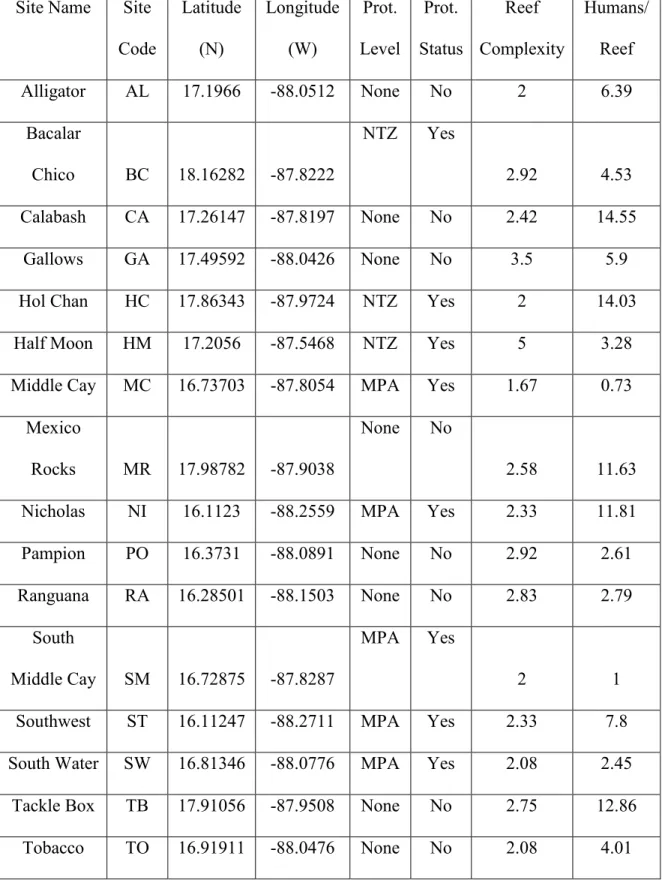
APPENDIX 1: SUPPLEMENTAL TABLES Table S1. Site Information and Coordinates.
Site Name Site Code Latitude (N) Longitude (W) Prot. Level Prot. Status Reef Complexity Humans/ Reef
Alligator AL 17.1966 -88.0512 None No 2 6.39
Bacalar
Chico BC 18.16282 -87.8222
NTZ Yes
2.92 4.53
Calabash CA 17.26147 -87.8197 None No 2.42 14.55
Gallows GA 17.49592 -88.0426 None No 3.5 5.9
Hol Chan HC 17.86343 -87.9724 NTZ Yes 2 14.03
Half Moon HM 17.2056 -87.5468 NTZ Yes 5 3.28
Middle Cay MC 16.73703 -87.8054 MPA Yes 1.67 0.73 Mexico
Rocks MR 17.98782 -87.9038
None No
2.58 11.63
Nicholas NI 16.1123 -88.2559 MPA Yes 2.33 11.81
Pampion PO 16.3731 -88.0891 None No 2.92 2.61
Ranguana RA 16.28501 -88.1503 None No 2.83 2.79
South
Middle Cay SM 16.72875 -87.8287
MPA Yes
2 1
Southwest ST 16.11247 -88.2711 MPA Yes 2.33 7.8
South Water SW 16.81346 -88.0776 MPA Yes 2.08 2.45 Tackle Box TB 17.91056 -87.9508 None No 2.75 12.86
27
Table S2. Prey Species and Sources. Fish species that are documented prey for lionfish in the Caribbean.
Family Species Name Sources
Acanthuridae Acanthurus bahianus 3
Acanthuridae Acanthurus chirurgus 6,8
Acanthuridae Acanthurus coeruleus 5
Aulostomidae Aulostomus maculatus 2,3,4,7
Cirrhitidae Amblycirrhitus pinos 3
Gobiidae Coryphopterus dicrus 3,5,7
Grammatidae Gramma loreto 1,2,3,4,7
Haemulidae Haemulon aurolineatum 7
Haemulidae Haemulon flavolineatum 1,7
Holocentridae Holocentrus rufus 2,7
Labridae Bodianus rufus 3,4,6,7,8
Labridae Clepticus parrae 2,3,4,7
Labridae Halichoeres bivittatus 2,3,4,7,8
Labridae Halichoeres garnoti 1,2,3,4,5,7,8
Labridae Halichoeres maculipinna 3,4,5,6
Labridae Halichoeres pictus 3,5,6
Labridae Thalassoma bifasciatum 1,2,3,4,6,7,8
Mullidae Pseudupeneus maculatus 3,4,7
Pomacentridae Abudefduf saxatilis 1,8
28
Pomacentridae Chromis insolata 3
Pomacentridae Chromis multilineata 2,3,4,7 Pomacanthidae Holacanthus ciliaris 6 Pomacentridae Stegastes leucostictus 3,6,8
Pomacentridae Stegastes partitus 1,2,3,4,5,6,7 Pomacentridae Stegastes variabilis 2,3,4,5,7
Scaridae Scarus iserti 1,3,7
Scaridae Scarus taeniopterus 1
Scaridae Sparisoma atomarium 5,6
Scaridae Sparisoma aurofrenatum 1,2,4,5,6,7
Scaridae Sparisoma viride 1,3,5,6
Scorpaenidae Scorpaena plumieri 6
Serranidae Cephalopholis cruentata 1,2,4,7
Serranidae Epinephelus striatus 3,4
Serranidae Serranus tigrinus 2,3,4,5,6,7
Tetraodontidae Canthigaster rostrata 3,5,6,7
29
Table S3. Coefficient Estimates and p-values for Each Model. Coefficient estimates and p-values for each model of (A) total fish and (B) prey fish abundance, species richness, and species diversity. Significant coefficient estimates are shown in bold at alpha 0.05. “NA” indicates that the predictor did not remain in the final model following model averaging. Table S3A. All Fish Total Abundance Species Richness Species Diversity Estimate p-value Estimate p-value Estimate p-value Lionfish Abundance -0.0530 0.0632 -0.4051 0.0935 -0.0130 0.1581
Year 0.0481 0.0931 0.1904 0.4460 -0.0177 0.0411
MPA NA NA NA NA -0.1036 0.0015
NTZ NA NA NA NA -0.0897 0.0177
Reef Complexity 0.1009 0.0328 1.5639 0.0005 -0.0192 0.2522
Humans/Reef NA NA NA NA -0.0227 0.1621
Lionfish Abundance : Year
0.0422 0.4367 NA NA NA NA
Lionfish Abundance : Protected
NA NA NA NA NA NA
Lionfish Abundance : Reef Complexity
NA NA 0.5012 0.0773 NA NA
Lionfish Abundance : Humans/Reef
30
Table S3B. Prey Fish Total Abundance Species Richness Species Diversity Estimate p-value Estimate p-value Estimate p-value Lionfish Abundance -0.0656 0.0555 -0.2097 0.177 -0.0159 0.1183
Year 0.0695 0.0514 0.1656 0.324 -0.0180 0.0649
MPA NA NA NA NA NA NA
NTZ NA NA NA NA NA NA
Reef Complexity 0.0900 0.0953 0.2372 0.324 -0.0253 0.1041
Humans/Reef NA NA -0.2016 0.392 -0.0294 0.0619
Lionfish Abundance : Year
0.0848 0.1507 0.3473 0.241 0.0170 0.3787
Lionfish Abundance : Protected
NA NA NA NA NA NA
Lionfish Abundance : Reef Complexity
NA NA NA NA NA NA
Lionfish Abundance : Humans/Reef
31
Table S4. Competitor Species. Fish species present on our surveys that are ecologically similar to lionfish based on diet from Green et al. (2012) and FishBase.
Family Species Name
Aulostomidae Aulostomus maculatus Carangidae Alectis ciliaris
Carangidae Carangoides ruber
Carangidae Caranx bartholomaei
Carangidae Caranx crysos
Carangidae Elagatis bipinnulata
Lutjanidae Lutjanus analis
Lutjanidae Lutjanus apodus
Lutjanidae Lutjanus cyanopterus
Lutjanidae Lutjanus jocu
Lutjanidae Lutjanus mahogoni
Lutjanidae Lutjanus synagris
Scorpaenidae Scorpaena plumieri Serranidae Cephalopholis cruentata
Serranidae Cephalopholis fulva
Serranidae Epinephelus adscensionis
Serranidae Epinephelus guttatus
Serranidae Epinephelus itajara
Serranidae Epinephelus morio
32
Serranidae Mycteroperca bonaci
Serranidae Mycteroperca interstitialis
Serranidae Mycteroperca tigris
33
APPENDIX 2: SUPPLEMENTAL FIGURES
34
35
36
37
38
APPENDIX 3: SUPPLEMENTAL TEXT
Text S1. Published Values of Lionfish Densities in Native and Invaded Range.
Lionfish density data was collected from published studies with methods comparable to ours. Only studies surveying coral reef habitats with belt transects of defined lengths and widths were included. Additionally, only studies that presented averages ± standard
deviation/error, or site-level data were included. Lionfish densities from a total of eight published studies, representing two regions of the Indo-Pacific (native range) and five
regions of the Caribbean (invaded range), were compared to our values from Belize. Lionfish densities in Belize were not significantly different than those measured in Mexico (two-tailed t-test; t=-2.0; p-value=6.4e-2), Bay of Pigs, Cuba (two-tailed t-test; t=-0.1; p-value=0.9), Jardines de la Riena, Cuba tailed t-test; t=-1.9; p-value=0.1), Abaco, Bahamas tailed t-test; t=-0.7; p-value=0.5) (Valdivia et al. 2014), and San Salvador, Bahamas (two-tailed t-test; t=-0.2; p-value=0.9) (Anton et al. 2014), and were significantly higher than those in Colombia (one-tailed t-test; t=-3.0; p-value=2.3e-3) (Bayraktarov et al. 2014) (Fig. 5). Lionfish densities in Venezuela (Agudo and Salas 2014) were higher than those in Belize (one-tailed t-test; t=-2.2; p-value=1.8e-3), but significantly lower than those reported in New Providence, Bahamas (one-tailed t-test; t=3.5; p-value=1.9e-3) (Darling et al. 2011, Valdivia et al. 2014) (Fig. 5). Furthermore, lionfish densities on our sites in Belize were not
39
REFERENCES
Agudo, E. A., and E. K. Salas. 2014. Lionfish abundance, size structure and spatial
distribution along the Venezuelan coast (Pterois volitans, Pteroinae: Scorpaenidae). Revista de Biologia Tropical 62:151–158.
Albins, M. A. 2013. Effects of invasive Pacific red lionfish Pterois volitans versus a native predator on Bahamian coral-reef fish communities. Biological Invasions 15:29–43.
Albins, M. A., and M. A. Hixon. 2008. Invasive Indo-Pacific lionfish Pterois volitans reduce recruitment of Atlantic coral-reef fishes. Marine Ecology, Progress Series 367:233– 238.
Albins, M. A., and M. A. Hixon. 2013. Worst case scenario: potential long-term effects of invasive predatory lionfish (Pterois volitans) on Atlantic and Caribbean coral-reef communities. Environmental Biology of Fishes 96:1151–1157.
Albins, M. A., and P. J. Lyons. 2012. Invasive red lionfish Pterois volitans blow directed jets of water at prey fish.
Alston, K. P., and D. M. Richardson. 2006. The roles of habitat features, disturbance, and distance from putative source populations in structuring alien plant invasions at the urban/wildland interface on the Cape Peninsula, South Africa. Biological
Conservation 132:183–198.
Anton, A., M. S. Simpson, and I. Vu. 2014. Environmental and Biotic Correlates to Lionfish Invasion Success in Bahamian Coral Reefs. PLoS ONE 9:e106229.
Ault, T. R., and C. R. Johnson. 1998. Spatially and temporally predictable fish communities on coral reefs. Ecological Monographs 68:25–50.
Barbour, A. B., M. S. Allen, T. K. Frazer, and K. D. Sherman. 2011. Evaluating the Potential Efficacy of Invasive Lionfish (Pterois volitans) Removals. PLoS ONE 6:e19666.
Bax, N., A. Williamson, M. Aguero, E. Gonzalez, and W. Geeves. 2003. Marine invasive alien species: a threat to global biodiversity. Marine Policy 27:313–323.
40
Beukers, J. S., and G. P. Jones. 1998. Habitat complexity modifies the impact of piscivores on a coral reef fish population. Oecologia 114:50–59.
Burnham, K. P., and D. R. Anderson. 2002. Model Selection and Multimodel Inference: A Practical Information-Theoretic Approach. Springer Science & Business Media.
Côté, I. M., E. S. Darling, L. Malpica-Cruz, N. S. Smith, S. J. Green, J. Curtis-Quick, and C. Layman. 2014. What Doesn’t Kill You Makes You Wary? Effect of Repeated Culling on the Behaviour of an Invasive Predator. PLoS ONE 9:e94248.
Cote, I. M., S. J. Green, J. A. M. Jr, J. L. Akins, and D. Steinke. 2013. Diet richness of invasive Indo-Pacific lionfish revealed by DNA barcoding. Marine Ecology Progress Series 472:249–256.
Cote, I. M., and A. Maljković. 2010. Predation rates of Indo-Pacific lionfish on Bahamian coral reefs. Marine Ecology Progress Series 404:219–225.
Cure, K., J. L. McIlwain, and M. A. Hixon. 2014. Habitat plasticity in native Pacific red lionfish Pterois volitans facilitates successful invasion of the Atlantic. Marine Ecology Progress Series 506:243–253.
Darling, E. S., S. J. Green, J. K. O’Leary, and I. M. Côté. 2011. Indo-Pacific lionfish are larger and more abundant on invaded reefs: a comparison of Kenyan and Bahamian lionfish populations. Biological Invasions 13:2045–2051.
Elton, C. S. 1958. The ecology of invasions by plants and animals. Methuen.
Frazer, T. K., C. A. Jacoby, M. A. Edwards, S. C. Barry, and C. M. Manfrino. 2012. Coping with the Lionfish Invasion: Can Targeted Removals Yield Beneficial Effects? Reviews in Fisheries Science 20:185–191.
Friedlander, A. M., E. K. Brown, P. L. Jokiel, W. R. Smith, and K. S. Rodgers. 2003. Effects of habitat, wave exposure, and marine protected area status on coral reef fish
assemblages in the Hawaiian archipelago. Coral Reefs 22:291–305.
Froese R, Pauly D (2011) FishBase. Available: www.fishbase.org. Accessed 2013 Aug.
41
Graham, M. H. 2003. Confronting Multicollinearity in Ecological Multple Regression. Ecology 84:2809–2815.
Green, S. J., J. L. Akins, A. Maljković, and I. M. Côté. 2012. Invasive Lionfish Drive Atlantic Coral Reef Fish Declines. PLoS ONE 7:e32596.
Green, S. J., and I. M. Côté. 2009. Record densities of Indo-Pacific lionfish on Bahamian. Coral Reefs 28:107–107.
Green, S. J., and I. M. Côté. 2014. Trait-based diet selection: Prey behaviour and morphology predict vulnerability to predation in reef fish communities. Journal of Animal
Ecology.
Green, S. J., N. K. Dulvy, A. M. L. Brooks, J. L. Akins, A. B. Cooper, S. Miller, and I. M. Côté. 2014. Linking removal targets to the ecological effects of invaders: a predictive model and field test. Ecological Applications 24:1311–1322.
Hackerott, S., A. Valdivia, S. J. Green, I. M. Côté, C. E. Cox, L. Akins, C. A. Layman, W. F. Precht, and J. F. Bruno. 2013. Native Predators Do Not Influence Invasion Success of Pacific Lionfish on Caribbean Reefs. PLoS ONE 8:e68259.
Halpern, B. S., S. Walbridge, K. A. Selkoe, C. V. Kappel, F. Micheli, C. D’Agrosa, J. F. Bruno, K. S. Casey, C. Ebert, H. E. Fox, R. Fujita, D. Heinemann, H. S. Lenihan, E. M. P. Madin, M. T. Perry, E. R. Selig, M. Spalding, R. Steneck, and R. Watson. 2008. A Global Map of Human Impact on Marine Ecosystems. Science 319:948–952.
Hastings, A., K. Cuddington, K. F. Davies, C. J. Dugaw, S. Elmendorf, A. Freestone, S. Harrison, M. Holland, J. Lambrinos, U. Malvadkar, B. A. Melbourne, K. Moore, C. Taylor, and D. Thomson. 2005. The spatial spread of invasions: new developments in theory and evidence. Ecology Letters 8:91–101.
Hoegh-Guldberg, O., P. J. Mumby, A. J. Hooten, R. S. Steneck, P. Greenfield, E. Gomez, C. D. Harvell, P. F. Sale, A. J. Edwards, K. Caldeira, N. Knowlton, C. M. Eakin, R. Iglesias-Prieto, N. Muthiga, R. H. Bradbury, A. Dubi, and M. E. Hatziolos. 2007. Coral Reefs Under Rapid Climate Change and Ocean Acidification. Science 318:1737–1742.
42
Kindinger, T. L. 2014. Behavioral response of native Atlantic territorial three spot damselfish (Stegastes planifrons) toward invasive Pacific red lionfish (Pterois volitans).
Environmental Biology of Fishes:1–12.
Van Kleunen, M., E. Weber, and M. Fischer. 2010. A meta-analysis of trait differences between invasive and non-invasive plant species. Ecology Letters 13:235–245.
Kritzer, J. P., and P. F. Sale. 2004. Metapopulation ecology in the sea: from Levins’ model to marine ecology and fisheries science. Fish and Fisheries 5:131–140.
Lang, J., K. Marks, P. Kramer, P. Richards Kramer, and Ginsburg RN. 2010. AGRRA Protocols version 5.4.
Layman, C. A., and J. E. Allgeier. 2011. Characterizing trophic ecology of generalist consumers: a case study of the invasive lionfish in The Bahamas. Marine Ecology, Progress Series 448:131–141.
Levine, J. M., and C. M. D’antonio. 1999. Elton revisited : a review of evidence linking diversity and invasibility. Oikos 87:15–26.
Lönnstedt, O. M., and M. I. McCormick. 2013. Ultimate Predators: Lionfish Have Evolved to Circumvent Prey Risk Assessment Abilities. PLoS ONE 8:e75781.
Lonsdale, W. M. 1999. Global patterns of plant invasions and the concept of invasibility. Ecology 80:1522–1536.
McTee, S. A., and J. R. Grubich. 2014. Native densities, distribution, and diurnal activity of Red Sea lionfishes (Scorpaenidae). Marine Ecology Progress Series 508:223–232.
Medina, F. M., E. Bonnaud, E. Vidal, B. R. Tershy, E. S. Zavaleta, C. Josh Donlan, B. S. Keitt, M. Le Corre, S. V. Horwath, and M. Nogales. 2011. A global review of the impacts of invasive cats on island endangered vertebrates. Global Change Biology 17:3503–3510.
43
Molnar, J. L., R. L. Gamboa, C. Revenga, and M. D. Spalding. 2008. Assessing the global threat of invasive species to marine biodiversity. Frontiers in Ecology and the Environment 6:485–492.
Mora, C. 2008. A clear human footprint in the coral reefs of the Caribbean. Proceedings of the Royal Society B: Biological Sciences 275:767–773.
Morris, J. A., and J. L. Akins. 2009. Feeding ecology of invasive lionfish (Pterois volitans) in the Bahamian archipelago. Environmental Biology of Fishes 86:389–398.
Mumby, P. J. 2006. The Impact Of Exploiting Grazers (Scaridae) On The Dynamics Of Caribbean Coral Reefs. Ecological Applications 16:747–769.
Newton, K., I. M. Côté, G. M. Pilling, S. Jennings, and N. K. Dulvy. 2007. Current and Future Sustainability of Island Coral Reef Fisheries. Current Biology 17:655–658.
Parker, I. M., D. Simberloff, W. M. Lonsdale, K. Goodell, M. Wonham, P. M. Kareiva, M. H. Williamson, B. V. Holle, P. B. Moyle, J. E. Byers, and L. Goldwasser. 1999. Impact: Toward a Framework for Understanding the Ecological Effects of Invaders. Biological Invasions 1:3–19.
Pimentel, D., R. Zuniga, and D. Morrison. 2005. Update on the environmental and economic costs associated with alien-invasive species in the United States. Ecological
Economics 52:273–288.
Polunin, N. V. C., and C. M. Roberts. 1993. Greater biomass and value of target coral-reef fishes in two small Caribbean marine reserves.
Power, M. E. 1992. Top-Down and Bottom-Up Forces in Food Webs: Do Plants Have Primacy. Ecology 73:733–746.
R Development Core Team. 2013. R: A language and environment for statistical computing. R Foundation for Statistical Computing, Vienna, Austria. ISBN 3-900051-07-0.
Rejmánek, M., and D. M. Richardson. 1996. What Attributes Make Some Plant Species More Invasive? Ecology 77:1655–1661.
44
Richardson, D. M., and P. Pyšek. 2006. Plant invasions: merging the concepts of species invasiveness and community invasibility. Progress in Physical Geography 30:409– 431.
Schofield, P. 2009. Geographic extent and chronology of the invasion of non-native lionfish (Pterois volitans [Linnaeus 1758] and P. miles [Bennett 1828]) in the Western North Atlantic and Caribbean Sea. Aquatic Invasions 4:473–479.
Soto, I., S. Andréfouët, C. Hu, F. E. Muller-Karger, C. C. Wall, J. Sheng, and B. G. Hatcher. 2009. Physical connectivity in the Mesoamerican Barrier Reef System inferred from 9 years of ocean color observations. Coral Reefs 28:415–425.
Stallings, C. D. 2009. Fishery-Independent Data Reveal Negative Effect of Human
Population Density on Caribbean Predatory Fish Communities. PLoS ONE 4:e5333.
Tang, L., J. Sheng, B. G. Hatcher, and P. F. Sale. 2006. Numerical study of circulation, dispersion, and hydrodynamic connectivity of surface waters on the Belize shelf. Journal of Geophysical Research: Oceans 111:C01003.
Valdez-Moreno, M., C. Quintal-Lizama, R. Gómez-Lozano, and M. del C. García-Rivas. 2012. Monitoring an Alien Invasion: DNA Barcoding and the Identification of Lionfish and Their Prey on Coral Reefs of the Mexican Caribbean. PLoS ONE 7:e36636.
Valdivia, A., J. F. Bruno, C. E. Cox, S. Hackerott, and S. J. Green. 2014. Re-examining the relationship between invasive lionfish and native grouper in the Caribbean. PeerJ 2:e348.
Vilà, M., J. L. Espinar, M. Hejda, P. E. Hulme, V. Jarošík, J. L. Maron, J. Pergl, U.
Schaffner, Y. Sun, and P. Pyšek. 2011. Ecological impacts of invasive alien plants: a meta-analysis of their effects on species, communities and ecosystems. Ecology Letters 14:702–708.
Ward, J. W., and J. A. Stanford. 1983. Intermediate-disturbance hypothesis: an explanation for biotic diversity patterns in lotic ecosystems. Dynamics of Lotic Systems, Ann Arbor Science:347–356.