WIRED FOR THE FUTURE?:
Creative Destruction and Continual Renewal of the Associated Press
Joseph Edgar Williams (Jed)
A thesis submitted to the faculty of the University of North Carolina at Chapel Hill in partial fulfillment of the requirements for the degree of Master of Arts in the
School of Journalism and Mass Communication.
Chapel Hill 2010
Approved by:
Chair: Professor Penny Muse Abernathy
Professor Leroy Towns
ii
© 2010
iii ABSTRACT
JOSEPH E. WILLIAMS (JED): Wired for the Future?: Creative Destruction and Continual Renewal of the Associated Press
(Under the direction of Penny Muse Abernathy, Leroy Towns, and Heidi Hennink-Kaminski)
iv
ACKNOWLEGMENTS
First and foremost, I am indebted to my adviser, chair, and mentor Penny Muse Abernathy, from whom so many of the project’s ideas originated. She motivated my work from the outset and relentlessly and enthusiastically championed the importance of the research all the way through to completion.
Many thanks also go out to my thesis committee – Leroy Town and Heidi Hennink-Kaminski – a committed and steadfastly supportive group that advanced the project in bold and exciting ways. Special thanks to reader Christine Shia, who invested richly in this endeavor and helped to sharpen its message.
So many faculty and staff in the School of Journalism and Mass Communication at UNC expressed great interest in this project, cultivated its ideas, and offered unyielding support during this 15-month journey. Thanks to each and every person in Carroll Hall who embraced both this author and this initiative.
v
TABLE OF CONTENTS
I. CHAPTER 1: INTRODUCTION ………. 1
A. Introductory Case Study ……….. 4
B. History/Literature Review ……… 4
1. Part I: Developing and Defining the Core Business ……….. 4
2. Part II: Protecting the Core from Competitive Threats ……….. 16
3. Part III: Reinventing the Core to Sustain and Survive ……… 28
C. Research Questions ……… 37
D. Methods ………. 38
E. Limitations ………. 41
II. CHAPTER 2: BUILDING THE CORE BUSINESS: A CASE STUDY EXAMINATION OF TWO NORTH CAROLINA DAILY NEWSPAPERS’ HISTORICAL – AND CHANGING – USE OF THE ASSOCIATED PRESS ………... 43
A. Charlotte and Fayetteville: Wired Differently ……… 46
B. “The Vanishing Newspaper” ………... 47
C. Going Local ………. 49
D. Analysis/Speculation/Conclusions ……….. 53
vi
III. CHAPTER 3: SHARING TO SURVIVE: OHNO AND EMERGING
INTERNAL THREATS TO AP’S CORE FOUNDATIONS ……….. 60
A. Part I: OHNO Sets the Precedent 1. Biting the Hand That Always Fed ………. 61
2. The Mechanics of Sharing ………. 62
3. OHNO Challenges, AP Responds ………. 64
4. Shared Success ……….. 67
5. The Bottom Line for OHNO ………. 68
B. Part II: Sharing Becomes a Maine Priority ……….. 70
1. Maine and OHNO: Similar, but Not the Same ……….. 72
2. Money to be Made? ……… 73
C. Part III: Coast to Coast Collaboration: The Emergence of McClatchy Regional News ………. 74
1. AP & McClatchy Regional News: Value Comparisons ……… 75
D. Part IV: Breaking Free or Holding On? ………... 76
1. AP’s Irresistible Value ……… 77
2. AP Reports, Members Decide ……… 80
E. Part V: Conclusion ……… 84
IV. CHAPTER 4: THE GATEWAY TO AP’S RE-IMAGINED BUSINESS MODEL ………. 85
A. Seeing the Future ……….. 85
B. From Surfing to Searching to the “Splinternet” ……….. 87
C. Planting the Seeds of Change ……….. 89
D. Tracking Use and Cracking Down on Misuse: Building a News Registry ………. 91
E. “Going Mobile” ………... 94
vii
G. Putting It All Together ……… 104
V. CHAPTER 5: CONCLUSION ………. 106
VI. APPENDICES ……….. 109
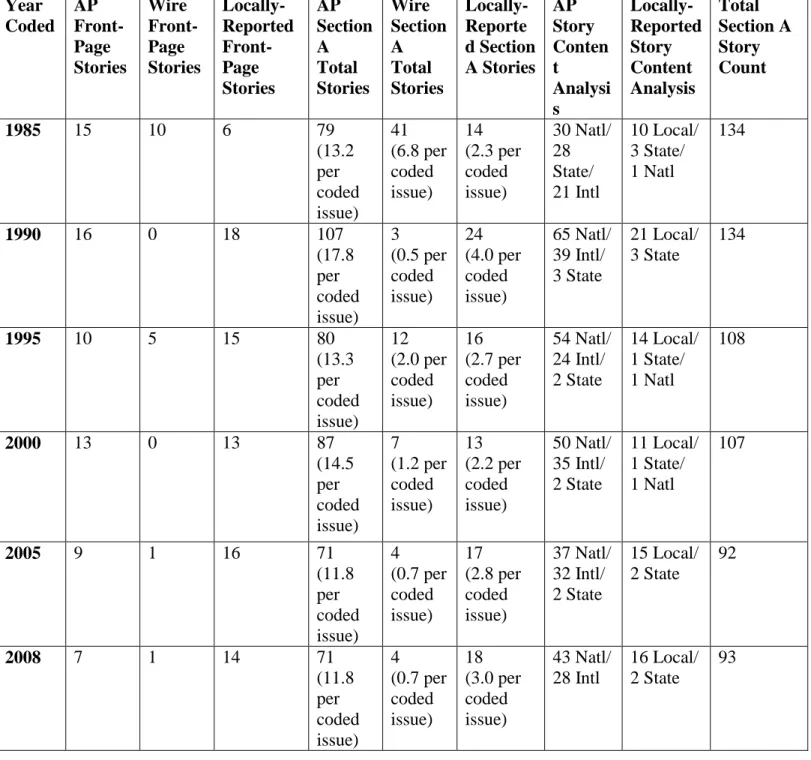
A. Appendix A: Fayetteville’s Associated Press Usage Patterns, 1985-2008………. 109
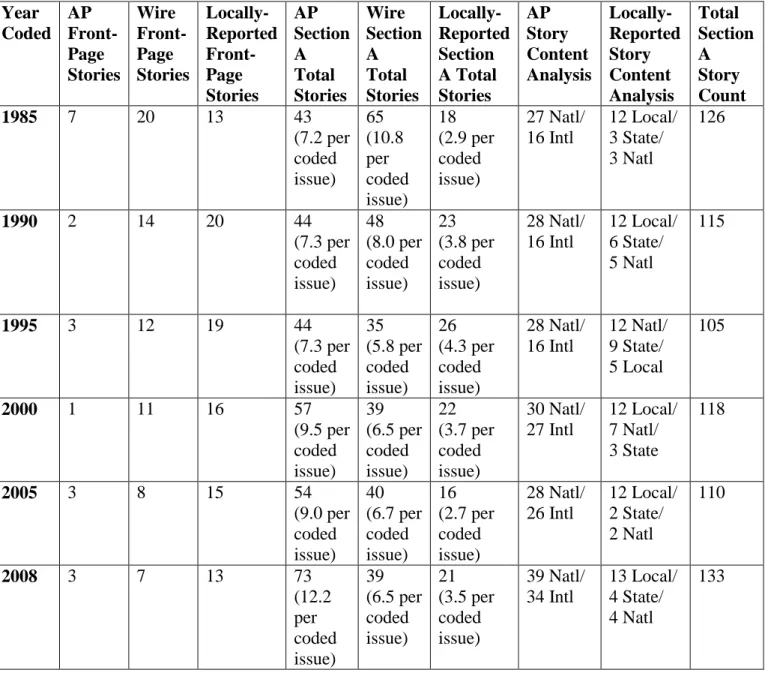
B. Appendix B: Charlotte’s Associated Press Usage Patterns, 1985-2008 ………. 112
C. Appendix C: Internet/”Splinternet” Platform Characteristics Chart ……… 116
D. Appendix D: “Web 2.0 Business Model” ……… 117
VII. SOURCES ………. 118
A. Bibliography ………. 118
B. Web Sites and Online Resources ……….. 123
CHAPTER 1
Introduction
Mark Twain once proclaimed: “there are only two forces that can carry light to all corners of the globe, only two – the sun in the heavens and the Associated Press down here.”1 Mahatma Gandhi declared: “I suppose when I go to the Hereafter and stand at the Golden Gate, the first person I shall meet will be a correspondent of the Associated Press.”2
Such has been the scope and influence of America’s foremost news wire, which for 164 years has pioneered news coverage, aggregation and distribution from coast to coast and beyond. Before The New York Times and The Wall Street Journal filled newsstands, there was the Associated Press. Long before radio and television signals first flickered, the AP stood supreme. Light years ahead of the advent of USA Today, Politico.com or The Huffington Post, the AP set the standard. Spanning three centuries as an agenda setter for national and international discourse, it is an institution. Its towering reign, however, is in peril. The reasons are both secular and cyclical.
The AP’s long, winding history of combating competitors and defending its market position falls into two distinct categories: stable business strategy and radical reform that embraces “creative destruction”3 - the process of transformation that accompanies radical
1
Mears, Walter. Breaking News; How The Associated Press Has Covered War, Peace, and Everything Else. New York, NY: Princeton Architectural Press, 2007: 403.
2
Matloff, Judith. “Can the AP Go Global?” Columbia Journalism Review. May-June 2004: 16. 3
2
innovation. Both are backed by economists and scholars who defend their merits. Today, the AP must fend off a wave of attackers, from Internet search portals to local blogs, which are vast in number and continually evolving. It must choose the prudent course for its own survival, while convincing its partners and the 19 members of its executive board (composed principally of newspaper executives)4 to adopt the new technology and business model that it has embraced. Emboldened by lowered barriers to entry, unencumbered by legacy costs and buoyed by their own technological breakthroughs – namely the dissolution of geographic monopolies through digital distribution platforms – new players threaten to undercut the AP’s differentiated advantage: global coverage that only its reporters can provide and re-purposed local content that only its members will share, all distributed across a cooperative wire that only it can operate.
The AP also sees its market position jeopardized as disruptive change batters the media at large, crippling once-dominant industry leaders. Formerly monopolistic newspapers are scaling back. Some are shuttering entirely. Local radio and television stations confront a similar fate. What many pegged as just another transient trend appears to be a revolution: media is digitizing, becoming increasingly user-interactive and user-generated, and going both social and viral. As it does, it disintermediates the resource and platform advantages that long allowed the old guard to stand apart. Secular changes in the industry are
compounded by a severe cyclical downturn, which has shrunk profitable advertising streams that paid for the AP membership freight for mid-sized and large metro papers.
As a member-owned cooperative, the AP draws heavily from its constituents – these same struggling media companies – as its lifeblood, namely to fund the $500 million required
4
3
to sustain its global news fleet of 3,000 journalists and editors.5 As they hemorrhage, the AP bleeds, too. And as they struggle to survive, these local outlets are forced to consider
alternative news suppliers. Digital aggregators, supplemental wires and multimedia platforms are all jousting to wrest away the AP’s clientele. In some cases, spurred by philosophical disagreements and cost concerns with the cooperative, existing members have created their own substitutes.
Judith Matloff, quoting a member of the wire, writes that the AP is “like a mother. She’s reliable. She’s always there for you. She’s easy to take for granted. But you need her.”6 Do its constituents agree? This paper analyzes the evolving relevance and value of the AP to its members and to the global media industry, as well as its response to the “gales of destruction,” an expression first coined by Austrian economist Joseph Schumpeter to describe seismic business and structural industry change.7 It employs a case study method to examine three fundamental business principles at play in the AP during an era of disruptive change: defining and developing the core business, identifying core threats from peripheral challengers, and re-inventing the core – both competencies and constituents – to combat competitors and ensure sustainability. The first case samples two North Carolina daily newspapers – the Charlotte Observer and The Fayetteville Observer. As larger circulation dailies paying a higher annual membership than the average news organization, they represent the company’s “bread and butter.” The second case explores statewide and regional news-sharing alliances, notably the Ohio News Organization, formed to diminish local newspapers’ dependence on AP. The final case studies how the AP is attempting to
5
Kennedy, Jim. “Newsgathering.” Message to Jed Williams. E-mail. 25 Feb. 2010. 6
Foster and Kaplan, supra note 3, at 17. 7
4
imagine its business model to counteract threats and survive in the rapidly-changing marketplace.
Ultimately, the company must confront a more prevailing question: in a
disintermediated, digital age, rife with competition from both aggregators and disaggregators, is there a need for a global news wire? How the AP frames its response will go a long way in providing the answer.
I. Introductory Case Study
To contextualize the challenges facing the AP, review the multimedia case study linked below, including a video interview with CEO Tom Curley:
http://www.unc.edu/~jedw/ap/
II. History/Literature Review
Part I – Building the Core Business
The advent of the telegraph fueled the explosive growth of nineteenth century American newspapers, and subsequently, the emergence of wire services such as the
Associated Press. Dating back to colonial America, newspapers held considerable local clout but were encumbered by geographical limitations on their circulation. In one technological boom, however, the telegraph changed that, giving editors “the opportunity to bring news into the community ahead of transportation systems.”8 Historians Jean Folkerts, Dwight
8
5
Teeter and Ed Caudill note that “the telegraph accelerated press cooperation.”9 In 1846, New York Sun proprietor Moses Yale Beach coalesced six New York newspapers to share reports. Soon after, The New York Times joined.10 The AP was born.
The initial arrangement was newspaper-exclusive. Radio and television were still decades from invention, while magazines were not mainstream until the early twentieth century.11 The new initiative galvanized contentious rivals around the idea of sharing, rather than outdueling, to augment their newsgathering and thus extend both their reach and
influence. Walter Mears contextualizes this as a radical departure for “the belligerent New York press. Newspapers competed aggressively, sometimes violently, to be the first with news. The telegraph revolutionized the race.”12 These northeastern metro dailies soon agreed to “broaden their cooperation to include the gathering of news from all over the United States,” but they consolidated all power among the original core.13 Not until Daniel Craig took the reins in 1851 did the AP implement the business model that guides the
cooperative even today. The AP’s pioneers originally crafted it for newsgathering purposes. Craig boldly redefined the service as a “news vendor. The AP would sell its news to out-of-town newspapers to defray costs and ask those papers to contribute news to the
association.”14 The modern blueprint took shape.
The AP’s fundamental business architecture – born of a clear mission and a
concentrated constituent base – mirrored business strategist Chris Zook’s insistence on “the
9
Folkerts, Jean, Edward Caudill, and Dwight L. Teeter, Jr. Voices of a Nation: A History of Mass media in the United States. Boston: Pearson, 2009: 136.
10
Mears, supra note 1, at 403-404. 11
McCombs, Maxwell, Donald L. Shaw and David Weaver. Communication and Democracy: Exploring the Intellectual Frontiers in Agenda-Setting Theory. Mahwah, NJ: Lawrence Erlbaum Associates, Inc., 1997: 216. 12
Mears, supra note 1, at 403. 13
Id. at 404. 14
6
extraordinary importance of creating a strong core business as a foundation for driving company growth.”15 This “profitable core” should gather around well-defined audience segments and delineate clear “business boundaries,” allowing the business to emerge as an industry leader in those focused areas rather than chase wild growth across multiple fronts.16 At the heart of this decision, a company must adopt a “clear point of view.”17 Absent that clarity of purpose, “it is difficult to determine the competitive position, the relative
importance of differently positioned competitors, or the relative strategic importance of different growth opportunities.”18 Craig’s bold direction for the nascent cooperative resembled the guide for building a strategic roadmap that Robert Kaplan and David Norton sketch in “The Balanced Scorecard.”19 Their process for “translating a mission into desired outcomes” begins with a precise mission – “why we exist” – and vision – “what we want to be” – before tactics are ever implemented.20 This is akin to Jim Collins’ “Hedgehog
Principle” – the “crystalline concept” that drives the essence of the business.21
Craig left no room for doubt: the AP existed for its newspaper owners not only to amass the news, but to sell it. It would scale this idea to newspapers beyond the northeast to assemble a wire cooperative of unmatched reach and influence. Its “strategy map” quickly
15
Zook, Chris. Profit from the Core: Growth Strategy in an Era of Turbulence. Boston, MA: Harvard Business School Press, 2001: 17.
16
Id. at 35. 17
Id. 18
Id.
19 Kaplan, Robert and David Norton. The Strategy-Focused Organization: How Balanced Scorecard Companies
Thrive in the New Business Environment. Boston, MA: Harvard Business School Press, 2001. 20
Id. at 73. 21
7
jumped from the “back of a napkin” to the heart of newsrooms across the country.22 Regional alliances soon formed in New England and to the south and west. All decision-making and pricing power remained bundled in New York, though, prompting outside publishers to bemoan lean news rations and exorbitant costs.23 The New York nucleus was highly protective of its members and restrictive of who could join.24 As Mears highlights, “the issues of exclusive services, franchises, restrictive rules on newspaper membership and conduct…led to the creation of the AP’s 20th century wire service competitors (see Part II: 15-16).”25 The AP’s weighty membership restrictions were finally struck down by the Supreme Court in 1945.26 The edict shook the company’s traditional core, but as Mears argues, for the better. “It was a defeat the Associated Press sorely needed. Bound by the strictures on serving rival newspapers, the service could not have expanded.”27
Just over a half-century old by the early twentieth century, the AP already operated its core business under the “assumption of continuity” that economists Richard Foster and Sarah Kaplan caution against.28 Exclusive service agreements and stringent membership rules reinforced the company’s “mental model,” composed of those principles that fostered its success to that point. Rooted in member loyalty, and in return, fierce defense of core
22
Kaplan and Norton, supra note 19, at 97. 23
Folkerts, Caudill and Teeter, supra note 9, at 138. 24 Mears,
supra note 1, at 406. Once enrolled, newspapers were prohibited from publicly criticizing the AP. 25
Id. at 408. 26
Associated Press v. United States. 326 U.S. 1 (1945). Justice Black delivered the Court’s opinion that the “inability to buy news from the largest news agency or any one of its multitude of members can have most serious effects on the publication of competitive newspapers, both those presently published and those which, but for these restrictions, might be published in the future” (13). As a result, the Court “adjudged the bylaws imposing restrictions on applications for membership to be illegal [and] enjoined the defendants from observing them, or agreeing to observe any new or amended bylaw having a like purpose or effect” (21). 27
Mears, supra note 1, at 411. 28
8
constituents, the model was designed “to ensure predictable goal achievement.”29 These authors suggest that the derivative of this assumptive line of thinking is “cultural lock-in – a state in which the corporation is effectively frozen in place.”30 When this occurs, managers can struggle to identify the challenges endemic to their life cycle stage and the strategies that befit it.31 Above, Mears states that the AP’s rigid mental model thwarted growth.32 Clayton Christensen pegs this as a malady afflicting many maturing businesses as “large companies adopt a strategy of waiting until new markets are ‘large enough to be interesting’ before entering.33 By doing so, they miss out on the opportunity to tap into soaring ventures at the pinnacle of their growth. Applying Foster and Kaplan, the sprawling behemoth lumbered behind a shield of operational continuity that undermined its ability to “innovate at the pace and scale of the market.” Focused on the need “to control existing operations,”34 such “companies resist doing anything to jeopardize their relationships with customers.”35
Even in the face of its own rigidity, the AP confronted little adversity until radio and television debuted. From 1914 to 1940, the cooperative blossomed, expanding its newspaper clientele by 1300 percent, from 100 to 1400 members.36 For hometown publishers, it offered unprecedented advantages, “making it possible for a small-town paper to publish a story from
29
Id. at 18. 30
Id. at 79. 31
Armstrong, Gary and Philip Kotler. Marketing, An Introduction. Ninth Edition. Upper Saddle River, NJ: Pearson Prentice Hall, 2009: 247.
32
Mears, supra note 1, at 411. 33
Christensen, Clayton. The Innovator’s Dilemma. New York, NY: HarperCollins Publishers, 1997: xxiv. 34 Kaplan and Norton,
supra note 19, at 15. 35
Foster and Kaplan, supra note 3, at 85. The authors call on corporations to “recognize and embrace the prospect of discontinuity.” Capital markets that by their very nature are discontinuous cannot be matched or outperformed by companies until they relinquish their operational habits. The authors suggest that this requires a willingness to destroy in order to create that spawns only from “divergent thinking” (22). 36
9
Europe or Asia as quickly as The New York Times or the Chicago Tribune.”37 As such, it became “indispensable…for a local editor striving to produce a complete and credible newspaper.”38
The value proposition that AP delivered to its newspaper core was robust enough to allow it to regularly increase member assessments because “publishers would rather pay for AP than switch.”39 However, these member assessment hikes were actually a form of price setting, not strategic pricing, as distinguished by Thomas Nagle.40 While the vast value that the AP bundled to subscribers enabled it to increase prices as it deemed necessary, market changes often forced the company’s hand because it could not escape “cost[s] of new technology” necessary to stay current41 This follows Foster and Kaplan’s aforementioned principle requiring firms to keep pace with the movement of the macro market or tumble into an “inevitable slide into mediocrity.”42 Ironically, Christensen suggests that the very entity – customers – that first powers a company later weakens it.43 He terms this “resource
dependence,”44 arguing that companies’ “freedom of action is limited to satisfying the needs of those entities outside the firm that give it the resources it needs to survive.”45 In the AP’s case, those outside entities were its longstanding newspaper partners, who mutually owned the cooperative and authored its initiatives to reflect their needs and values.
37
Id.
38 Cook, Gomery and Lichty,
supra note 8, at 148. 39
Id. at 152. 40
Nagle, Thomas. The Strategy and Tactics of Pricing. Third Edition. Upper Saddle River, NJ: Prentice Hall, 2002: 1. In price setting, a company reacts to current market forces, while in strategic pricing, it “proactively manag[es] them.”
41
Cook, Gomery and Lichty, supra note 8, at 151. 42
Foster and Kaplan, supra note 3, at 60. 43
Christensen, supra note 33, at 117. 44
Id. 45
10
By the 1920s, the AP began exploring adjacencies to its core business, but never at the risk of weakening its bond with newspapers. AP Radio launched in 1920, yet no wire service copy was offered to emerging radio networks (see Part II: 19-20).46 Meanwhile, local broadcasters were not granted membership status in the cooperative until 1947, more than a quarter-century after the AP first entered the radio market.47 Even then, as “radio news over the wire became an integral part of every AP bureau,”48 broadcast outlets were considered “associate members” as opposed to “regular members” – a badge reserved for daily newspapers. This membership structure holds true today, with non-daily newspapers also considered “associate members.”49 The AP finally expanded into television in 1994, more than three decades after the medium achieved mainstream saturation, with the launch of its international television division, AP Television News (APTN).
The AP’s gradual move into surrounding mediums equates with Zook’s evaluation of adjacency expansion opportunities. In marketing parlance, these adjacencies represent brand extensions, which transpose “a current brand name to new or modified products in a new category.”50 He encourages businesses to consider adjacency expansions only if the moves are into related segments “that utilize and…reinforce the strength of the profitable core.”51 Collins calls this the “single denominator” concept: that maximizing the growth and
46
Folkerts, Caudill and Teeter, supra note 9, at 368. Tension between the cooperative and the networks manifested itself in a full-fledged “press-radio war by the early 1930s.”
47
Mears, supra note 1, at 411. 48
Id. at 412. 49
“Consolidated Financial Statements: The Associated Press and Subsidiaries, Years ended December 31, 2008 and 2007.” <http://www.ap.org/annual09/media/APFinancials08.pdf>.
50 Armstrong, and Kotler,
supra note 31, at 218. “A brand extension gives a new product instant recognition and faster acceptance.”
51
11
profitability of a solitary business unit “tends to produce better insight than letting yourself off the hook with three or four denominators.”52 Kaplan and Norton, citing economist Michael Porter, see this as a systematic process in which each activity “reinforces the
others.”53 Here, those activities stem from and then solidify the defined business core, which fosters the value proposition and thus the strategy map.54
Whereas the aforementioned scholars see Zook’s adjacency expansion as measured growth, others argue that it has a stunting effect. The commitment to a concentrated core that Collins and Zook defend, Foster and Kaplan caution against, stressing that “loyalty to a flawed model can be costly.”55 A guarded approach to growth enfranchises new entrants, who can quickly overtake the incumbent’s position in the market.56 According to
Christensen, “established firms tend to be good at improving what they have long been good at doing.”57 In doing so, they ignore or fail to even identify emerging markets, where he suggests the greatest future windfall lies.58
The AP has long chased the proper balance between core innovation and
diversification that economists have debated for seemingly just as long. True to his core commitment, Zook forecasts the dangers of overdiversification in what he calls “the Alexander problem,” named for Alexander the Great’s insatiable hunger to conquer territories.59 Consequently, his conquests lacked “lasting value.”60 Corporations suffer a
52
Collins, supra note 21, at 104-105. 53
Kaplan & Norton, supra note 19, at 75. 54
Id. at 97. 55
Foster & Kaplan, supra note 3, at 69. 56
Id. at 47. 57
Christensen, supra note 33, at 35. 58
Id. at 146. “Firms that sought growth by entering small, emerging markets logged 20 times the revenues of the firms pursuing growth in larger markets.”
59
12
similar fate when adjacency expansion fails to “anchor in the core business.”61 Marketing scholars Gary Armstrong and Philip Kotler point out that such adjacencies, or extensions, “may confuse the image of the main brand.”62 Collins proposes that this inability to stick to a firm strategy often means making too many choices, consistent with his aforementioned “single denominator” theory.63 By contrast, Colin Hoskins, Stuart McFadyen and Adam Finn promote the advantages of diversification through “the portfolio effect.” They predict reduced risk for those businesses benefiting from “the diversifying effect associated with increased numbers of firms, stocks, or whatever the asset is.”64 Christensen implies that this means having the verve to venture into new markets, even when success is not guaranteed and short-term struggle is likely.65
Now, 164 years after acting as the first mover into the wire industry, the AP finds itself as the disintermediated rather than the disintermediator. This shift signifies a sharp turn in the wheel of retailing, which explains that “eventually, the new retailers become like the conventional retailers they replaced.”66 The rotations of the wheel are part of a retailer’s, or
60
Id. 61
Id. Strong cores are diluted “by virtue of premature abandonment, miscalculation, or overreaching in search of new growth.”
62
Armstrong and Kotler, supra note 31, at 218. “If a brand extension fails, it may harm consumer attitudes toward the other products carrying the same brand name.”
63
Collins, supra note 21, at 104-105.
64 Hoskins, Colin, Stuart McFadyen and Adam Finn. Media Economics: Applying Economics to New and
Traditional Media. Thousand Oaks, CA: Sage Publications, 2004: 134. 65
Christensen, supra note 33, at xviii. 66 Armstrong and Kotler,
13
product’s, life cycle, spanning four stages: introduction, growth, maturity and decline.67 With the AP descending toward decline, afflicted by lowering profits and lagging customers, an array of emerging competitors nip at the heels of the cooperative in hopes of displacing it.68 These forces challenge the AP’s long-held monopoly as “the essential global news network,” requiring it to consider radical changes to its core business blueprint in order to generate substantial value for its sputtering partners to bump it out of “decline” and back into “maturity.”
Its response, true to its history of counteracting secular destruction of its own business and that of its members, has been mixed. On the one hand, it continues to move into new adjacencies and diversify into completely new realms. Whereas historically the AP only shared content with its traditional members, in 1998 it struck a paid-content sharing partnership with Internet portal Yahoo!.69 In 2006, current CEO Tom Curley inked an agreement with Google that licensed the leading line online search provider to carry wire stories and pictures within its Google News service (see Part II: 25).70 The AP has opened new regional bureaus while shuttering others in an effort to streamline workflow. It has also released new products and services to better compete in the digital marketplace (see Part III: 31-32). The effects of this discontinuous line of thinking are more diverse constituents and
67
Id. at 246. Each stage in the “PLC” is marked by different characteristics and strategies across many variables, from sales to costs, customers to competitors, and distribution to advertising. See also Foster and Kaplan, supra note 3. The authors identify four stages in an industry life cycle: foundation (attack), growth, domination, and cultural lock-in. See also the BCG Matrix based on the product life cycle theory at
<http://www.valuebasedmanagement.net/methods_bcgmatrix.html>. 68 “Consolidated Financial Statements,”
supra note 46. According to the AP’s year-end consolidated statement of income, from 2007 to 2008, a 5.2 percent revenue increase was offset by a 7.2 percent increase in
operating expenses. This prompted a 32.3 percent decrease in operating income. Meanwhile, cash and cash equivalents fell 26.4 percent year-over-year.
69
Fahri, Paul. “A Costly Mistake?” American Journalism Review. April/May 2009. <http://www.ajr.org/Article.asp?id=4730>.
70
14
new revenue streams. Associate members now outnumber daily newspapers by a multiple exceeding three.71 Profits from newspapers, representing more than half of the revenue pie in the mid-1980s, now carve just a 27 percent sliver – still the largest sector, but dramatically declining.72
Even as the cooperative re-imagines its core competencies and constituents, though, it continues to vigorously protect its legacy assets – the newspaper members whose
relationships with the cooperative span generations. Newspapers retain full ownership of the cooperative, which has never been publicly traded or beholden to creditors, shareholders or private equity. Its Board mirrors this power construct. Of the 19 seats, 18 are filled by newspaper executives,73 highlighted by the Board’s Director – MediaNews Group, Inc. Chairman William Dean Singleton.74 Curley stresses that “the most important thing is to understand the core cultural success foundation and not only preserve it, but worship it to make sure that the Holy Grail is not messed with by anybody.”75
What the AP must avoid, says Porter, is an uneven strategy that gets “stuck in the middle (see also Part II: 22).”76 This turbulence, reflected by either an inability to launch necessary adjacency expansions or an over-exuberance to diversify, comes to roost in a firm’s “unwillingness to make choices about how to compete.”77 Rather than sustain institutional momentum by cultivating enduring value from a well-delineated mission, these
71 “Consolidated Financial Statements,”
supra note 46, at 15. 72
Adams, Russell. “New-Media Focus Splits Associated Press Members.” The Wall Street Journal 26 June 2008 <http://online.wsj.com/article/SB121444598979205887.html>.
73 AP.org. “AP Board of Directors.” <http://www.ap.org/pages/about/board>. 74
Seelye, Katherine Q. “Question: Who Is MediaNews’s Dean Singleton?” The New York Times 22 May 2006 <http://www.nytimes.com/2006/05/22/business/media/22singleton.html>
75
Curley, Tom. CEO, Associated Press. Personal Interview. 9 March 2009. 76
Porter, Michael. Competitive Advantage: Creating and Sustaining Superior Performance. New York, NY: The Free Press, 1985: 17.
77
15
firms instead slip into Collins’ “doom loop.”78 They lack the balanced strategy map that Kaplan and Norton stress as essential to any business.79 Christensen, however, distinguishes doomed thinking from divergent thinking. Just because a new invention or business sector fails to offer instant rewards does not necessarily condemn it as desultory . The challenge lies in ensuring that the “innovation - the disruptive technology that doesn’t make sense – is taken seriously within the company.”80
Moving forward, the AP confronts hard questions about its ideas of core and
constituents, about its definition of what it is and what it aspires to be. Matloff worries about the agility of the sprawling cooperative to re-position itself with the necessary efficiency to remain viable in the marketplace and valuable to its clientele.81 While its newspaper partners are shackled with cumbersome legacy costs such as printing presses and door-to-door
distribution, the AP is constrained by a different, more intangible legacy effect: it “finds change difficult, in part because it can never be free of the needs of its members.”82 This weighty responsibility has affected how the AP identifies and responds to competitive threats as well as how it approaches technological and business innovation. It has rendered the once-impregnable industry giant introspective of what exactly the proper response is…and if that response can ever again deliver value substantial enough to protect the stakeholders that have depended on it.
78 Collins,
supra note 21, at 178. The “doom loop” is marked by “reaction without understanding” that nets “no buildup; no accumulated momentum.” Companies in this loop stumble into a vicious cycle of “lurching back and forth,” grasping for new opportunities that they hope will energize them.
79
Kaplan and Norton, supra note 19, at 97. 80
Christensen, supra note 33, at xxx. 81
Matloff, supra note 2, at 16. 82
16
Part II: Protecting the Core from Competitive Threats
Formerly, in a media marketplace less stratified than present, the AP did not confront its first substantial competitive conflict until its twentieth year in existence. That threat bubbled up from within its own ranks. Regional AP alliances quickly grew agitated with cooperative’s power structure, decrying that the New York papers “overcharged local papers and dictated what news would be in the daily reports.”83 By 1866, irritation fomented into a full-fledged uprising over what Chicago Tribune Publisher Joseph Medill bemoaned as the AP’s “monopoly in the worst sense of the word.”84 Mears describes the Illinois-based Western AP bureau as being “in open rebellion.”85 The two factions ended the quarrel the next year by striking an agreement that respected each service’s territorial rights.86 It was more compromise than full resolution, though, as the two bureaus continued to operate separately until their merger in 1892. This marked one of the few instances that the AP, often noted for its territoriality, responded quickly and effectively to subdue a conflict.
The first signs of the AP’s inaction in combating competitors surfaced in 1882. In response to the AP’s hierarchical structure, the United Press formed to serve those
newspapers that were barred from receiving AP reports.87 This marked the first external threat from a rival news agency of any kind. The budding AP monopoly, largely
unchallenged since its inception in 1848, reacted with a “complacency that could lead to stodginess.88 Though the AP succeeded in “pushing UP toward failure” (it declared
83
Folkerts, Caudill and Teeter, supra note 9, at 176. 84
Mears, supra note 1, at 405. 85
Id. 86
Folkerts, Caudill and Teeter, supra note 9, at 209. 87
Mears, supra note 1, at 406. 88
17
bankruptcy in 1897),89 it failed to address its infrastructure or heavy-handedness. Rather, the local publishers of the AP of Illinois (the post-merger name adopted by the cooperative) simply pooled their money together in an aggressive campaign to outspend the UP for new contracts. The restrictive rules that angered current members and excluded potential new ones remained untouched, leaving an opening for future competitors to step through.
Collins would attribute the AP’s sluggish, stubborn response to its publishers’ inability to complete both ends of the “Stockdale paradox.”90 This principle argues that sound business managers in the throes of conflict must “maintain unwavering faith that you can and will prevail in the end, regardless of the difficulties, and at the same time have the discipline to confront the most brutal facts of your current reality, whatever they might be.”91 It must not hesitate, as Zook articulates, to ask defining business questions.92 Kaplan and Norton stress that Stockdale-esque conviction emanates not only from confidence in the overarching strategy, but also intricate knowledge of the strategy itself and how it may be challenged.93 While the AP embodied the first ideal Stockdale tenet with unfaltering resolve, it suffered from a skewed view of the second that enabled new wire services to serve the unmet needs of newspapers that the AP never embraced. Collins believes that firms must be “relentlessly disciplined” in objectively sizing up the internal and external challenges they
89
Id. at 407. 90
Collins, supra note 21, at 13. 91
Id. 92
Zook, supra note 15, at 32. These include, among others, “Which areas must be defended at all costs?, From which areas will future profits likely spring? From which areas will current profits likely diminish? [and] What is the true source of differentiation against competitors?”
93
18
face.94 Instead, through its domineering leadership and foundational arrogance, the AP fell into operational contentment.
Foster and Kaplan take a different slant. They would assert that the company engaged in “incremental” innovation, or change, rather than “substantial” or
“transformative.”95 Even though the AP ultimately survived its attacker, it underwent only incremental advancement by holding to its hard-and-fast rules. As a result, it sacrificed the potentially prodigious rewards that come with embarking on a more ambitious change initiative.96 Christensen again blames customers – in this case the newspapers comprising the cooperative – for wielding negative influence over the larger company by leading “their suppliers toward sustaining innovations and…provid[ing] no leadership in instances of disruptive change.”97
New instances of disruptive change arose in 1907 and 1909, when newspaper moguls E.W. Scripps and William Randolph Hearst assembled their own wires to vie with the AP. Scripps reincarnated the UP, while Hearst branded his service the International News Service (INS).98 Rather than acknowledge the danger presented by these threats, the AP instead initially reacted with “annoyance.”99 Peter Marzio notes that the AP’s attitude allowed the UP in particular, and later the UPI (a merger of the UP and INS), to “blossom.”100 Two cardinal events triggered the AP’s awakening from its malaise and more apt response to these legitimate competitors. First, under the leadership of Kent Cooper, who succeeded Melville
94
Collins, supra note 21, at87. 95 Foster and Kaplan,
supra note 3, at 106. “Incremental innovation is characterized more by what has not changed than what has changed.”
96
Id. at 108. 97
Christensen, supra note 33, at 53. See “resource dependence” in Part I: 9. 98
Mears, supra note 1, at 409. 99
Id. at 409-410. 100
19
Stone as General Manager in 1925, the cooperative commenced a series of technological advances that strengthened its differentiation advantage by revolutionizing existing systems and pioneering new markets (see Part III: 29). Second, the 1945 Supreme Court decision that forced the AP to drop its inflexible membership requirements breathed new energy into the cooperative (see Part I: page 7/footnote 26).101 These pivot points steered the AP toward renewed dominance, and by the 1970s sent UPI “sinking toward feared extinction.”102
While Christensen would define new entrants such as the UP, INS and later the UPI as attackers, and thus threats to the AP’s heretofore unimpeded monopoly, Porter suggests that they may have in fact been “good competitors.”103 He elaborates by defining a good competitor as “one that challenges the firm not to be complacent but is a competitor with which the firm can achieve a stable and profitable industry equilibrium.”104 While competing wires waged legitimate battle with the AP, the incumbent never relinquished its squeeze on the newspaper market. Cooper approached their presence opportunistically by using them to “enhance [the] firm’s ability to differentiate itself by serving as a standard of comparison.”105
Though the AP frustrated current and prospective members alike with its rigid practices, its “reputation as a…reliable wire” – a key differentiation advantage – helped to overcome this hindrance.106 This netted early-mover advantages.107 These included buyer
101
See Associated Press v. United States, supra note 23.
102 Stepp, Carl Sessions. “Redefining the News Service: An Analysis of Change at United Press International.”
Newspaper Research Journal. Fall 1984: 14. 103
Porter, supra note 76, at 201. 104
Id. at 212. “Bad competitors,” by contrast, interrupt industry balance, defeat competitive advantage and encourager attacker entry.
105
Id. at 203. 106
Sessions, supra note 102, at 15. 107
20
switching costs, defined as the costs consumers incur when they change suppliers.108 If competing products fail to deliver a greater value proposition for buyers, then odds are they will stick with the original. UPI never escaped its perception as “a number two service to AP.”109 The AP’s rebuff of competing wire services in the late nineteenth and early
twentieth century also coincided with a period of press dominance and limited technological disruption in the media industry. That would soon change.
The first challenge from one of Porter’s “bad competitors” (see footnote 94) arrived with the explosive growth of radio as a “worldwide force” by 1930.110 While the AP first introduced its own radio services in 1920, it blackballed emerging radio news networks such as CBS and NBC by “prohibiting networks from obtaining wire service copy.”111 This decision held many deleterious effects for the wire and its members. Rather than shrink from the resistance, news departments at CBS and NBC instead expanded.112 Meanwhile, the AP swung the door wide for domestic and international competitors to enter. The UP and INS both sold news reports to broadcasters.113 Transradio Press offered news to networks from Havas wire agency in France and Reuters in England. Faced with the prospect of relenting, the AP instead bowed its neck. It passed a formal resolution in 1933 that specifically forbade its members from selling news to the networks and even encouraged UP and INS members to follow its lead. Only when the force of the combined competition threatened AP’s market
108
Id. at 416. 109
Sessions, supra note 102, at 16. 110
Folkerts, Caudill and Teeter, supra note 9, at 368. 111
Id. 112
Id. 113
21
position did it finally back off and agree to provide radio service, “despite publishers’ opposition.”114
The AP’s publishers presided over this conflict with an intransigence that
underscored Christensen’s theory of resource dependence. The demands of its newspaper base rendered it incapable of entering emerging markets…or even spotting them.115 Its immobility sprung from the initial mental model that it still clung to (see Part I: 7). By this point, the early-mover advantages that once buoyed the cooperative were all but negated. According to Christensen, “when the same analytical and decision-making processes learned in the school of sustaining innovation are applied to enabling or disruptive technologies, the effect on the company can be paralyzing.”116 In this case, a once-disruptive strategy grown static became prohibitive.
The likely motive explaining the AP’s refusal to confer legitimacy upon emerging radio news networks, as Porter argues, is that “it is very common for firms to view the competitor that is closest to them in market share and has the most similar strategy as the greatest enemy.”117 The AP fixated on UP and INS, competitors of familiar complexion. In the process, it overlooked a new attacker “at the periphery,” as Foster and Kaplan
illustrate.118 Because strategic planning is often consumed by existing mental models, it glosses over outside threats that may be plotting to “capitalize on new capabilities, new
114
Id. at 369. 115
Christensen, supra note 33, at 186. 116
Id. at 166. 117
Porter, supra note 76, at 226. 118
22
technologies, and new ways of doing business” to better satisfy consumer needs.119 Even if the AP wanted to jump into radio at that stage, Christensen contends that it would have struggled due to its “delay in making the strategic commitment to enter” during the medium’s early, meteoric growth phrase.120
Radio’s rise signaled ominous times ahead for the AP in the defense of territory it had long-controlled. The emerging medium possessed many characteristics that undermined the cooperative’s credibility and undercut its differentiation advantage. In his recent book, Columbia University economist Eli Noam characterizes radio’s arrival from the periphery as an early glimpse into “one of the fundamental trends of the digital environment.” In this new sphere, “entrants are attracted by the growth characteristics and the lower entry barriers relative to the past (see Part II: 23).”121 Monopolies and duopolies are replaced by a perfectly competitive environment in which advantages are leveraged from businesses to consumers. This occurs as lowered entry walls, chiseled down by the technological
advantages of new firms, broaden the boundaries of substitutability. In the 1930s and 1940s as radio networks grew, they induced local broadcasters to switch over from wire service by giving them a dynamic, timely format by which to present news to consumers. Even though radio bore no physical resemblance to the newspapers of yesteryear, it became a “functional substitute”122 for the news wire by providing buyers with “more value relative to its price than the product currently being used.123
119
Id. 120
Christensen, supra note 33, at 19. 121
Noam, Eli. Media Ownership and Concentration in America. Oxford, England: Oxford University Press, 2008: 432-33.
122
Id. at 43. “The major question is whether different media are in the same market, that is, substitutes for each other.”
123
23
When the moat dries up and functional substitutes storm the gates, Nagle forecasts a shift in consumer psychology that hones in on price as a primary variable by which to distinguish among the growing field of competitors (see Part III: 35). The AP’s waning “differentiation value” lowers its overall “economic value.”124 Its status in the minds of potential consumers changes as the “fairness effect” comes into play. Buyers become increasingly sensitive to a product’s price if they believe it is outside the range that they perceive as reasonable when compared to the alternatives.125 Radio ushered in powerful change across three of Porter’s “Five Competitive Forces that Determine Industry Profitability”: the entry of new competitors, the threat of substitutes and the bargaining power of buyers.”126 In the process, it compromised the many of the AP’s advantages, turning the focus to price.
Television’s rapid saturation into the American home in the late 1950s and early 1960s also interrupted traditional wire service.127 Although the two platforms never clashed as directly as the AP did with radio in the first half of the century, they did jockey for consumers and relevance…and still do. TV networks’ ability to feed video news to local affiliates, and much later to Internet websites, originated another channel that the AP was slow to tap.128 TV’s rise also impaired newspapers’ position in the marketplace. The total number of daily newspapers stagnated throughout the 1960s and began a nosedive from that
124
Nagle, supra note 40, at 75-77. “Differentiation value is the value to the customer (both positive and negative) of any differences between your offering and the reference product.” Economic value is the price of the best alternative plus the differentiation value of the original product.
125
Id. at 100. 126
Porter, supra note 76, at 4-5. 127
Albarran, Alan B. Management of Electronic Media. Fourth Edition. Boston, MA: Wadsworth Cengage Learning, 2009: 8-9.
128
24
point forward.129 With the growth of its partners stunted, the AP saw its growth plateau. Phillip Cook, Douglas Gomery and Lawrence Lichty found that between 1960 and 1985, “the total contracts for major wire services fell by 12.3 percent,” while the number of newspapers buying multiple wire services declined by 15.6 percent.130
Seeing newspapers’ struggles, new competitors, emboldened by lowered entry barriers and heartened by a widening definition of substitutability, now attack the AP from every angle, even from within. In “Share and Share Alike,” Sherry Ricciardi cites several examples of daily newspapers that have created their own state news-sharing arrangements to lessen dependence on the AP. The most prominent is in Ohio, where, in April 2008, eight of the state’s largest newspapers “agreed to share content on a private Web site after publicly opposing a new AP rate structure.”131 The Ohio Newspaper Organization (OHNO) will be explored as part of one of the paper’s three case studies in which the origins of the news exchange, its long-range viability, its effect on AP’s value proposition, and the cooperative’s response will all be examined. Ohio is not alone, though. Florida, Maine, Montana New Hampshire and New York have all launched similar initiatives to act as AP substitutes.132 These syndicates are formed around common criticisms of the AP. First, according to Nashua Telegraph (NH) Vice President for News David Solomon, the AP’s price “does not correlate with the amount of syndicated material we actually use.”133 As its value
proposition wanes, there are fewer costs in switching than staying. Solomon continues, “life
129 “Daily and Sunday Newspapers: Number and Circulation,” Table 1093.
Editor and Publisher International Year Book, 2008.
130
Cook, Gomery and Lichty, supra note 8, at 155. 131
Ricciardi, Sherry. “Share and Share Alike.” American Journalism Review. Feb.-March 2009: 2. <http://www.ajr.org/Article.asp?id=4685>.
132
Id. at 5. 133
25
is possible without the Associated Press.”134 Meanwhile, rival newspapers in North Carolina and Texas have entered into modified sharing arrangements designed to minimize costs without wiping out entire reporting beats.135 The Charlotte Observer and Raleigh News & Observer, for instance, combined their feature and sports sections and statehouse coverage.136 These agreements have not entirely replace the AP, but they signal local outlets’ willingness to ask candid questions of value and look beyond full-service wires to fill their news holes.
Outside of the membership cooperative, supplemental wires began to consume a more prominent place in newspapers as dailies refused to pay for a second wire service and
searched for ways to bolster coverage without cutting too many corners. During the same twenty-five year window – 1960 to 1985 – that total newspapers and paid circulation stalled and then descended, directly undercutting wire service growth, supplemental wire contracts boomed by 196.9 percent.137 Services such as The New York Times News Service, The Los Angeles Times/Washington Post News Service and more recently McClatchy-Tribune Information Services provided cheaper alternatives; a newspaper could print stories by “dozens of dailies without paying for a full-service wire.”138 Often the difference in price is stark.139 This allows supplementals to wrest away wire business by “tailor[ing] a package that meets the editorial requirements of the smaller papers at a price they can afford.”140 Fused together, these advantages make “supplemental” a misnomer. NYTNS editor John
134
Id. at 8. 135
Id. at 4. 136
Morgan, Fiona. “The N&O cuts 70 jobs, consolidates coverage with Charlotte Observer.” Indyweek.com. 18 June 2008. <http://www.indyweek.com/gyrobase/Content?oid=oid%3A259874>.
137 Cook, Gomery and Lichty,
supra note 8, at 155. 138
Mears, supra note 1, at 412. 139
Cook, Gomery and Lichty, supra note 8, at 180. “According to the ANPA survey in 1989, the Eugene (Oregon) Register-Guard paid $7,800 to NYTNS and $12,700 to LAT/WP annually, in contrast to the $197,000 it paid annually for AP’s full news, sports, photo, and graphic services.”
140
26
Brewer restates the role of the supplemental wire as an “alternative to the AP,” not a sidekick.141
The greatest modern threat to the AP’s relevance and long-term survival may arise, ironically, from those who profit by amassing the AP and its members’ original work and then selling advertising against it. These digital aggregators are too profuse to list in full, though prominent names include Google, Yahoo!, The Huffington Post, and The Drudge Report. At the AP’s annual meeting in April 2009, Singleton, incensed by these aggregators’ perceived misappropriation of the AP’s highly-expensed work, lashed out: “We’re mad as hell, and we’re not going to take it anymore.”142
Yet for all its bluster, the AP previously brokered deals with certain online providers, Yahoo! and Google News among them, licensing its content for carry by these search portals (see Part I: 13).143 The Google News deal involved only AP-generated content. Local members were not included, albeit a small percentage of their material was re-purposed by the cooperative in the agreement. Certain subscribers protested. Curley defended it as digital survival: “If you don’t fill the void in the market, someone else will. Your competitor is enfranchised.”144 The fallout has been a fractured relationship between the AP and many of its longtime members, who fail to see eye-to-eye on the cooperative’s future strategy for defining its core business and defending its constituents.
The turbulence rocking the digital world resembles a technophile’s Wild West. New attackers spring forward in droves, defenders fight back, and law struggles to keep pace
141
Id. 142
AP.org. “Remarks by Dean Singleton.” AP Annual Meeting 6 April 2009 <http://www.ap.org/pages/about/pressreleases/pr_040609c.html>. 143
Fahri, supra note 69. 144
27
with the seismic shifts in the new-media landscape. Many traditional conglomerates, too preoccupied with “pursuing expensive acquisition and globalization strategies,”145 ignore what should be their most pressing concern – “barriers to entry [that] are the source of value creation for shareholders (see Part II: 21).”146 As a result, attackers are enabled, and their sustainability is bolstered.
Maxwell McCombs approaches sustainability differently through his amended study of “the relative constancy approach to consumer spending for media.”147 Upon conclusion of his original research in 1972, McCombs declared that “no new funds will be attracted to the mass communication marketplace by new products and services because the total mass media pie always is a constant proportion of the general economy.”148 This would have been damning for entrants, who would not enjoy much chance of survival if their only option is to steal existing advertising revenue from well-established firms. By 1988, noting the spike in spending on cable TV and VCRs, McCombs acknowledged that the increase “came largely from new money attracted to the marketplace by these innovations.”
Accordingly, digital attackers such as the aforementioned aggregators can take heart in the larger pie that potentially awaits them. Or, perhaps their competitive advantages enable them to steal slivers from existing media. Either way, the onus falls on the AP to reinvent to
145
Abernathy, Penelope Muse and Richard Foster. “The News Landscape in 2014: Transformed or
Diminished?” The School of Journalism and Mass Communication, University of North Carolina at Chapel Hill, Nov. 2009: 2.
146 Knee, Jonathan, Bruce Greenwald and Ava Seave. The Curse of the Media Mogul: What’s Wrong with the
World’s Leading Media Companies. New York, NY: Portfolio, 2009.
147
McCombs, Maxwell E and Jack Nolan. “The Relative Constancy Approach to Consumer Spending for
Media.” Journal of Media Economics. 1992: 43-52. 148
28
build its differentiation barriers and re-imagine to reinstate its intrinsic value. The seminal question is, “can it?”
Part III: Reinventing the Core to Sustain and Survive
The Associated Press has an uneven track record with regard to reform. At times, it pioneered new paths in wire delivery and news gathering, leading the crusade for
journalism at large. At others, it lagged behind, stubbornly opposing industry changes that challenged its core or barely recognizing them at all.149 More than just a series of random advances or roadblocks, the AP’s bumpy history of progress is inexorably tied to leadership. The culture of innovation, or lack thereof, perpetuated by particular leaders, laid the
groundwork for the technology and journalism that followed.
As previously noted, when Craig became general manager in 1851, he moved quickly to re-define the purpose of the company from “news gatherer” to “news vendor” (see Part I: 5-6).150 He backed his soaring mission with measures that solidified the AP’s ability to deliver on this strategy.151 Folkerts, Teeter and Caudill quote an 1854 memo that Craig circulated throughout the organization calling on improved news reporting through a singular focus only on the “material facts,” not “expressions of opinions.”152 The result was a more stringent demand for accuracy that raised the standard of the telegraphic reports.153
149 Porter,
supra note 76, at 313. 150
Mears, supra note 1, at 405. (see note 11) 151
Schwarzlose, Richard. The Nation’s Newsbrokers: The Rush to institution, from 1865 to 1920. Evanston, IL: Northwestern University Press, 1989: 158. Realizing the proliferation of telegraph companies jousting for market share, Craig negotiated an arrangement with F.O. Smith’s telegraph line to establish a “permanent scheme of rates, line priorities, and rights to the news dispatches as property.” This agreement positioned Craig’s AP to “secure…news before anyone else.” When challenged by competitors who felt jilted by the AP’s exclusive arrangement, Craig shielded his organization by directly leasing telegraph lines.
152
Id. 153
29
Craig saw the potential for what Harvard leadership scholar Ron Heifetz calls “adaptive work” – that there are a whole host of issues “that are not amenable to…standard operating procedures.”154 Adaptive change contradicts “technical” work, which Foster and Kaplan find many convergent-thinking managers obsessing over in an effort to control instead of innovate.155 They also stress that Heifetz’s adaptive process begins with mindset, and that innovation is the residue of this liberated mental model (see Part I: 7).156 The
process of innovation is values-driven. Christensen insists that leaders “need to do more than assign the right resources to the problem.” They must “scrutinize whether the organization’s processes and values fit the problem.”157 This relates to one of Collins’ chief theses: that technology is only as effective as the leadership strategy for its application. He hypothesizes that companies that make the leap to greatness “think differently about the role of
technology. They never use technology as the primary means of igniting a
transformation.”158 Craig’s “Hedgehog” (see Part I: 6) was that the AP blossom into a national news vendor. He used technology, primarily through the exclusive use of telegraphic lines, as a driver to execute this divergent business model.
Melville Stone was arguably the AP’s most prominent general manager, serving in that capacity for 29 years. Stone chased off the UP, aggressively recruited new publishers and articulated the AP’s guiding standard for who and how it would serve.159 To this day, a
154
Heifetz, Ronald and Marty Linsky. Leadership on the Line: Staying Alive through the Dangers of Leading.
Boston, MA:Harvard Business School Press, 2002: 13. 155
Foster and Kaplan, supra note 3, at 238. 156
Id. at 186. 157
Christensen, supra note 33, at 192. 158
Collins, supra note 21, at 13. “Technology can accelerate a transformation, but technology cannot cause a transformation.”
159
30
quote from Stone remains in the AP’s “Statement of News Values and Principles.”160 Stone, however, maintained the domineering strictures that would stunt the AP’s growth and allow formidable competitors to enter. Granted, he did galvanize the cooperative’s beliefs, but by catering so singularly to the needs of newspapers, he may have closed an ear to the call of new markets.161
His successor, Kent Cooper, proved superior in understanding how the proper application of technology could change the scale and scope of the wire business. These innovations enabled him to revolutionize the brand of journalism that the AP produced.162 To push transformation through the company, Cooper launched two paramount technological initiatives. First, in 1933, he fully converted the national news wire to Teletypes, which allowed transmission at a then-buzzing 60 words-per-minute. Then in 1935, “he took the AP into the picture business” through the wire delivery of news photos.163 The AP operated the first commercially successful system of photo distribution.164
When leadership was not as progressive, the AP failed to initiate change. Instead, it reacted to it. The cooperative’s frostiness toward new members has been widely blamed for limiting its formative growth. It similarly cut off potential new business lines in its slow, stubborn response to radio news networks (see Part II: 19-20). As television entered the mainstream in the 1960s, it not only weakened newspapers by offering services that the
160
AP.org. “The Associated Press Statement of News Values and Principles.” 16 Feb. 2006
<http://www.ap.org/newsvalues/index.html>. Stone, quoted in 1914: "I have no thought of saying the Associated Press is perfect. The frailties of human nature attach to it. The thing it is striving for is a truthful, unbiased report of the world's happenings, ethical in the highest degree."
161
Christensen, supra note 33, at 146-148. 162
Mears, supra note 1, at 410. Cooper “broadened the news report, added human interest stories, expanded sports reporting, interviews, and entertainment coverage.”
163
Id. at 411. 164
31
printed page could not, but in the process harmed the AP and spurred major technological changes to maintain the wire’s value proposition to its members. These included “massive expenditures for terminals, computers, and satellite stations”165 that would “centralize and speed up the handling of copy and reduce the cost of leasing landlines.”166 Television also had profound journalistic effects on the AP. Because television signals were immediate, and dynamic, they forced wire services to “reassess their devotion to spot-news coverage” and instead commit more heavily to enterprise reporting (see Part II: 22-23).167 This was both a concession and a survival tactic.
Curley, the AP’s current CEO since 2003, now finds himself wrestling with many of these quandaries: fending off a swarm of new attackers, battening down during economic and industry distress, reinventing his firm’s differentiated advantages while preserving its core mission to its traditional members, re-defining its future strategy map and
communicating this value system throughout every hallway and every bureau of the
sprawling company. Many of the issues are technological, as the wire struggles to counteract digital aggregators who face few barriers to entry and are saddled by no legacy costs or constituent demands. Upon arrival as CEO, however, Curley first focused on clearly
understanding the essence of the cooperative so that all technological innovations he unveiled would align with the central mission of the AP. He acknowledges that one of his early shortcomings as CEO was “failing to understand the core cultural success foundations.”168 He has since made significant efforts to better understand the journalistic passions of his staff and directly support their efforts.
165
Cook, Gomery and Lichty, supra note 8, at 149. 166
Id. at 150. 167
Id. at 149. 168
32
“I wish I’d been smart enough to figure this out, but when you come in from the outside, people check you out here. I was checked out thoroughly. You get branded, and so I was the business guy brought in to shore up the finances. But when I came out and said that the First Amendment was in peril and we need to fight for it, it really connected with the frontline journalists. That’s an important leadership point – how do you connect?”169
Such leadership initiatives gave him a measure of credibility within the
organization to introduce major technological changes that affect both the cooperative itself and the members it touches. The changes have taken two forms. The first are facilitators that enhance the speed, efficiency and usefulness of existing content. The second are new products and services offered to members that strive to increase the AP’s value proposition by either providing them with new revenue streams or protective barriers around their original work.
In April 2007, the cooperative rolled out the first of four regional editing desks in Atlanta, with future hubs planned for Chicago, Philadelphia and Phoenix. The chief goal was to streamline workflow. This would enable faster and more efficient story editing, improving the quality of the product that local members pulled. Recently, the AP updated its
storytelling protocol from “1-2-3” to “0-1-2-3-4” to allow for greater customization across every conceivable platform, thus boosting the usage value of content to members.170 These
169
Id. 170
33
advances embody the AP’s firm belief that the old business model no longer applies, that a “shift from supply push to demand pull” is mandatory as this is how media and their customers consume news.171
The AP is currently sampling two new products for members, one established to provide a new delivery platform that opens potential revenue streams, the other developed to ward off digital vultures from scavenging the original work that members spend time, money and human resources to produce. In April 2008, Curley unveiled AP Mobile News Network, a multimedia application for wireless devices. Mobile News Network marked the first product released as part of the AP’s Digital Cooperative, “a program designed to find new digital outlets for the news and information produced by AP members.”172 The new mobile platform launched as a brand extension that afforded local members opportunities to both showcase their content and sell local advertising against it. More than 1,000 sources currently subscribe, though the actual revenue generated from it remains spotty. While the AP authored its Mobile News Network to create advertising opportunities, it recently unfurled its pilot for a News Registry, or as Curley described, “a news map or guide to the authoritative source of news, which is to say, who breaks the news?”173 Over 1,400 members have agreed to participate in this “self-referring network,”174 which aims to “take back the night”175 and regain control of content from the aggregators – both search portals and
171 Kennedy, Jim. “A New Model for News.” Nov. 2009. Online PowerPoint. www.ap.org.
<http://www.ap.org/newmodel.pdf>. 172
AP.org. “AP announces formation of the Mobile News Network and further cost reductions for member newspapers.” 14 April 2008 <http://www.ap.org/pages/about/pressreleases/pr_041408a.html>.
173
Seward, Zachary M. “AP’s Tom Curley on the ‘oversupply’ of news and what he’s doing about it.” Nieman Journalism Lab 13 Oct. 2009: 3.
<http://www.niemanlab.org/2009/10/aps-tom-curley-on-the-oversupply-of-news-and-what-hes-doing-about-it/>.
174
Id. at 4. 175