WHEN DO REVOLUTIONS LEAD TO DEMOCRACY? THE CONFLICT BETWEEN DEMOCRACY AND GOVERNANCE IN GEORGIA AND TUNISIA
Josh McCrain
A thesis submitted to the faculty of the University of North Carolina at Chapel Hill in partial fulfillment of the requirements for the degree of Master of Arts in the Department
of Political Science, Concentration TransAtlantic Studies.
Chapel Hill 2013
Approved by:
Graeme Robertson
Milada Vachudova
ii ABSTRACT
JOSH MCCRAIN: When do Revolutions Lead to Democracy? The Conflict between Democracy and Governance in Georgia and Tunisia
(Under the direction of Graeme Robertson)
iii
TABLE OF CONTENTS
LIST OF TABLES………..………iv
Chapter I. INTRODUCTION……….1
II. LITERATURE AND THEORY………4
III. ARGUMENT: GOVERNANCE VERSUS DEMOCRACY……….12
Hypothesis………17
IV. CASE STUDIES: THE ROSE AND JASMINE REVOLUTIONS……….. 18
Georgia – The Rose Revolution……….. 19
Tunisia – The Jasmine Revolution……….. 22
V. ANALYSIS.……….29
Outcomes……….32
VI. CONCLUSION………37
iv
LIST OF TABLES
Table
1. Scores for Cases of Electoral Revolution………..15
2. Georgia Scores ………..19
3. Tunisia Scores………22
CHAPTER 1
INTRODUCTION
In December 2010, the self-immolation of a fruit vendor in Tunisia led to massive, popular protests that led to the ouster of authoritarian President Ben Ali. These protests quickly spread throughout the rest of the Arab world resulting in regime change in four countries (Tunisia, Egypt, Libya and Yemen) and substantial changes in the composition of governments in four others (Morocco, Jordan, Kuwait and Oman). The wave-like nature of these events – how they spread and the use of similar tactics – led many observers to note the similarities among the Arab Spring revolutions and the so-called Color Revolutions in the early- to mid-2000s in post-Communist Eurasia and the 1989 revolutions (Way, 2011).
The Color Revolution model, which most scholars note as beginning in Slovakia in 1998, led to democratic breakthroughs1 or challenges to the incumbent regime in most of the semi-authoritarian (also referred to as hybrid) regimes in the post-Communist sphere. The most notable of these cases are the Georgian Rose Revolution in 2003, the Orange Revolution in Ukraine in 2004, and the 2005 Tulip Revolution in Kyrgyzstan (although there were failed attempts at electoral revolution in other Eurasian states). These cases, frequently referred to as “electoral revolutions” (Bunce and Wolchik, 2006;
1 In this paper, I will use democratic breakthrough and revolution interchangeably. Since there is some debate, particularly in the context of the color revolutions, as to whether these events are truly
2
Orenstein and Kalandadze, 2009) because of their utilization of fraudulent elections as the focal point for contestation against the incumbent regime, serve as useful case studies for scholars and policy makers interested in understanding the challenges to
democratization that post-revolutionary regimes face. Optimism ran high after pro-West opposition leader Mikheil Saakashvili led his coalition in Georgia to overthrow
Communist-era holdover, President Eduard Shevardnadze. Similarly in Ukraine a year later, when autocratic President Leonid Kuchma’s hand-picked successor lost in Supreme Court-forced fair elections, pro-democracy actors were highly optimistic.
By the time protests spread to Kyrgyzstan, where they quickly turned violent, optimism began to temper. Saakashvili in Georgia cemented power within the
presidency winning his first election with 96 percent of the vote. Democrats in Ukraine soon realized that free and fair elections are only an ingredient of a democratic country, not democracy themselves. Scholars began to renege on their formerly optimistic predictions and started to question the ability of electoral revolutions to lead to real democracy. In recent years, there have been promising democratic developments in each of these countries, but they have been accompanied by authoritarian setbacks. The Color Revolutions taught scholars and observers to remain critical following revolutions in authoritarian and semi-authoritarian regimes. By recognizing these events as democratic breakthroughs, rather than democracy itself, scholars have begun to assess the
idiosyncrasies of post-revolution democratizing countries.
3
Tunisia, the country that ignited the Arab Spring, to the Georgian Rose Revolution, the beginning of the Color Revolution wave, this paper will examine two cases of democratic breakthroughs caused by revolutions. I will examine whether democracy from revolution is possible in cases such as these, and, if so, what determines success versus failure. Additionally, if I find that the existing theory is insufficient in explaining events in Tunisia, I will attempt to further develop the existing literature in light of the Arab Spring.
CHAPTER 2
LITERATURE AND THEORY
Shortly after the Rose Revolution in Georgia, scholars and observers were unreservedly optimistic about the future for democracy in Georgia and the region. Lincoln Mitchell wrote in 2004 that the ouster of Shevardnadze “represented a victory not only for the Georgian people but for democracy globally” (p. 342). Once this
revolutionary fervor began to spread to other countries in the region, such as Ukraine and Kyrgyzstan, Bunce and Wolchik noted that these events were “just as regionwide in [their] scope and just as powerful in [their] democratizing effects as the first wave that occurred during the years from 1988 to 1992” (2006, p.5). The optimism is easy to understand. Georgia, Ukraine and even Kyrgyzstan – all countries with no historical experience with democracy – experienced a change in regime that threw out autocratic strongmen of the former Soviet nomenklatura. Moreover, the wave-like nature of these protests, which included similar tactics and training by dissidents of the antecedent cases of revolution, seemed to many to be a successful model for other hybrid regimes to employ in overthrowing their autocratic leaders. Putin himself expressed concern about the ‘Orange model’ spreading to Russia (Levitsky and Way, 2010).
5
scholars to wonder about the ability of electoral revolutions to develop the preconditions for liberal democracy. Orenstein and Kalandadze note that electoral revolutions are insufficient in themselves in producing democracy (2009). The ‘electoral fallacy’ – that elections make a democracy (Schmitter & Karl, 1991) – was a tool that these opposition leaders used successfully in order to come to power. By focusing protests around clearly fraudulent elections, and promising the opposite if they were to be in power, they
convinced supporters of their democratic credentials (Orenstein and Kalandadze, 2009). In reality, “electoral revolutions are too narrow to address the full range of issues holding back democratization,” and Saakashvili in Georgia was able to legitimate and centralize his power through winning his first free and fair election with 96 percent of the vote – not an outcome characteristic of many liberal democracies (Orenstein and Kalandadze, 2009: p. 1404).
Orenstein and Kalandadze focus on the fact that electoral revolutions tend to fall short of addressing the underlying problems within authoritarian regimes, such as an “underdeveloped culture of political competition and party politics, power conflicts beyond the electoral circle, corruption, and lack of the rule of law” (2009: p. 1420). Essentially, the fraudulent elections serve as a focal point around which opposition
6
countries. Nonetheless, the flaw of ‘narrow aims’ inherent within electoral revolutions is also a trait within other revolutionary pushes for democratization, like those in the Arab Spring-affected countries.
Once the revolutionary regimes came to power, it quickly became evident that they would pursue agendas that did not vary all that much from their autocratic predecessors. As Henry Hale (2005; 2011) and others (Mitchell, 2008; Levitsky and Way, 2010; Bunce & Wolchik, 2011) have pointed out, the leaders of the successful opposition groups were often themselves, at some point, autocratic elites. Hale takes the concept a step further and develops a theory in which he sees these revolutions as cycles within the normal realm of political contestation in a regime (2005). In authoritarian regimes with strong presidents, ‘patronal presidents’ in his terminology, these cycles occur less frequently, and may not happen at all until a focal point is present. These focal points consist of term limits, old age or illness, elections, or the presence of a mass
protest movement that forces the elites to show their strength (and thus forces other elites to decide whether to stay allied with the incumbent regime or defect). He finds that many of the Color Revolution cases fall into this paradigm of regime realignment, and that when these focal points presented themselves, key pro-regime elites defected and led opposition movements (Hale, 2005).
7
where the opposition wins” will produce a more accurate understanding of the post-revolution outcomes (Hale, 2005: p. 161). He continues, “the political contestation is at root an elite affair where powerful groups compete to manipulate mass opinion through biased media and machine politics. That the masses are not infinitely manipulable, however, gives them an independent and often important role in deciding outcomes” (Hale, 2005: p. 162). Thus, analyzing regimes in this framework – in which the Arab Spring cases fit particularly well – provides us with a better understanding of why former pro-regime elites tend to dominate politics post-revolution, and how these regimes may break this cycle to produce more durable democratic outcomes.
Current theory tends to understate the inherent conflict between democratization and governance in post-revolutionary, democratizing countries. In Contention and Democracy, Charles Tilly sets the following assertions:
2) Trajectories of regimes within a two-dimensional space defined by (a) degree of governmental capacity and (b) extent of protected consultation significantly affect both their prospects for democracy and the character of their democracy if it arrives.
3) In the long run, increases in governmental capacity and protected consultation reinforce each other, as state expansion generates resistance, bargaining and provisional settlements, on one side, while on the other side protected consultation encourages demands for expansion of state intervention, which in turn promote increases in capacity.
4)At the extremes, where capacity develops farther and faster than consultation, the path to democracy (if any) passes through
authoritarianism; if protected consultation develops farther and faster than capacity and the regime survives, the path then passes through a risky zone of capacity building (2003: p. 7).
In effect, if capacity – in other words governance – increases faster than protected consultation develops – that is, “the breadth and quality of relations between
8
in many post-revolutionary democratizing countries. The revolutionary regime comes to power, quickly entrenches and consolidates this power, marginalizes potential
challengers, and in the process becomes a semi-authoritarian, illiberal democracy. On the other hand, as we have seen in countries like Kyrgyzstan, Egypt and Tunisia following revolution, protected consultation has seemed to develop ‘farther and faster’ than capacity. The ‘risky zone’ that Tilly notes in these countries is democratic chaos.
Stoner-Weiss and McFaul (2008) note some caveats to this line of thinking in The Myth of the Authoritarian Model,in which they attempt to debunk the idea that Putin’s increasingly authoritarian Russia is more stable than if it were a democracy. I believe, however, that cases that have recently experienced a revolution and find themselves in the volatile democratization stage that follows do not necessarily equate to Putin’s
Russia. Stability, or lack thereof, in these revolutionary cases, is linked more closely to a combination of factors discussed above.
Hale (2011) expands the literature of democratization in revolutionary regimes through developing a model that helps to explain the divergence in certain cases. His focus on the development of formal constitutions in democratizing regimes sheds light on how some regimes are able to overcome the challenge presented by the
9
power (divided-executive constitutions), will complicate coordination around a single patron, thereby working against the amassing of formal and informal power around the president” (Hale, 2011: p.582). Thus, according to Hale, constitutions and formal
institutions in young democracies have the ability to be very influential in the immediate phases of democratization precisely because they in turn affect informal institutions.
Empirically, Hale sees two salient examples of this model: Kyrgyzstan and Ukraine. Kyrgyzstan, on the one hand, established a constitution that focused power in a single executive, leading to yet another revolution after the initial Tulip Revolution. As Hale notes, this is not necessarily because the constitution is “obeyed” or “followed,” but it is more likely because it creates a formal focal point for elite contestation around a single, powerful office (Hale, 2011). Ukraine, however, initially established a
constitution where power is shared, which created a system where (sometimes autocratic) elites fought amongst themselves for power. This system was not wholly democratic, but it did lead to mostly free and fair elections and turn-overs in power – a first for post-communist Ukraine. Since the Orange Revolution, the Ukrainian constitution returned to one that gives asymmetrical power to the presidency, and as a result we have seen some renewed authoritarianism. Still, the existence of a divided-executive constitution resulted in real political competition. These cases embody two ‘typical’ trajectories that regimes may take after overthrowing an authoritarian government through a revolution. The model represented by Kyrgyzstan, and Georgia, as we will see later, increases the likelihood that a regime will first have to pass through a renewed period of
10
but it does not necessarily lead to democratic outcomes. I will examine whether Tunisia fits into this paradigm.
Finally, Steven Levitsky and Lucan Way make an important and relevant contribution to the literature regarding semi-authoritarian regimes (2010). The authors argue that semi-authoritarian regimes with both a high degree of linkage and leverage are those that are most likely to democratize. They find that in cases with a high degree of Western leverage – defined as a “governments' vulnerability to external democratizing pressure” (Levitsky and Way, 2010: p. 40) – and a high degree of linkage – the “density of ties and cross-border flows among particular countries” and the West (p. 42) – will democratize more quickly than those with a low degree of both. Specifically, leverage facilitates the West in using punitive action or the promise of an award to encourage democratic development. However, leverage alone can lead to illiberal democracy, but when combined with high linkage liberal democracy is more likely to be an outcome. This theoretical model helps explain the success of democratization in post-communist CEE, the lack of success in the color revolution cases, and it allows us to hypothesize for the Arab Spring revolutions.
To summarize the literature outlined above, revolutions in semi-authoritarian or authoritarian regimes after the fall of communism very rarely produced liberal
democracies. Orenstein and Kalandadze, as well as other scholars, argue that the
‘electoral’ model of revolution that many post-Soviet states experienced was insufficient for establishing the preconditions for democracy. However, and as we are seeing in the Arab world, many of the same reasons they saw this model as insufficient – an
11
in the Arab Spring cases. Further, Henry Hale states that these democratic breakthroughs are more likely, or more accurately, regime cycles, and it is inaccurate to characterize them as revolutionary events. If we view these events then as simply focal points or brief democratic openings along a more drawn-out process of democratization we are better equipped to analyze the events in the Arab world. It is possible for a revolution to lead to democratization, and eventually perhaps liberal democracy, as Hale (2011) argues2, but the trajectory of the process is path-dependent on the initial phases of development after the revolution. Further, the quality of democracy following revolution will be lacking because of one of two reasons: 1) democratization outpaces increases in governance or state capacity and the fundamental causes of revolution are not addressed (such as corruption, state weakness, etc.); or 2) governance develops faster and further than democracy, which may lead to substantial improvements in certain conditions (again, corruption, for example), but will likely lead to authoritarian backsliding. Finally, Levitsky and Way argue empirically that if a semi-authoritarian regime is to democratize at all, it will be in a context of a high degree of outside linkage and leverage.
CHAPTER 3
ARGUMENT: GOVERNANCE VERSUS DEMOCRACY
Based on the theory presented above, I develop my argument as follows:
authoritarian or semi-authoritarian states that have experienced democratic breakthroughs because of revolutionary movements or mass protest follow a typical model if they are indeed democratizing. The democratization process after revolution is characterized by two phases. First, these states undergo a pivotal period immediately after the change in power defined by a conflict between a strengthening of governance and a strengthening of democracy (Tilly’s argument). The nature of this conflict depends on conditions
within the state prior to the regime change (history of democracy, existence of democratic institutions, etc.) and the character of the opposition which initially seizes power. The nature of the opposition that comes to power, and the method through which it achieved its takeover, is highly determinative in defining the governance/democracy conflict which immediately develops. A unified opposition with massive popular support will likely pursue different policies and have more legitimacy than an elite-led opposition that deposes a weak president.
13
to the leverage of the European Union (Vachudova, 2005) – most countries, particularly those that experienced a color revolution, passed through, or are currently passing through (or stagnating in), authoritarianism on the way to democracy (again, we should not assume that all authoritarian regimes are democratizing). In the CEE cases, the EU was able to encourage a development of governance and democratization that was
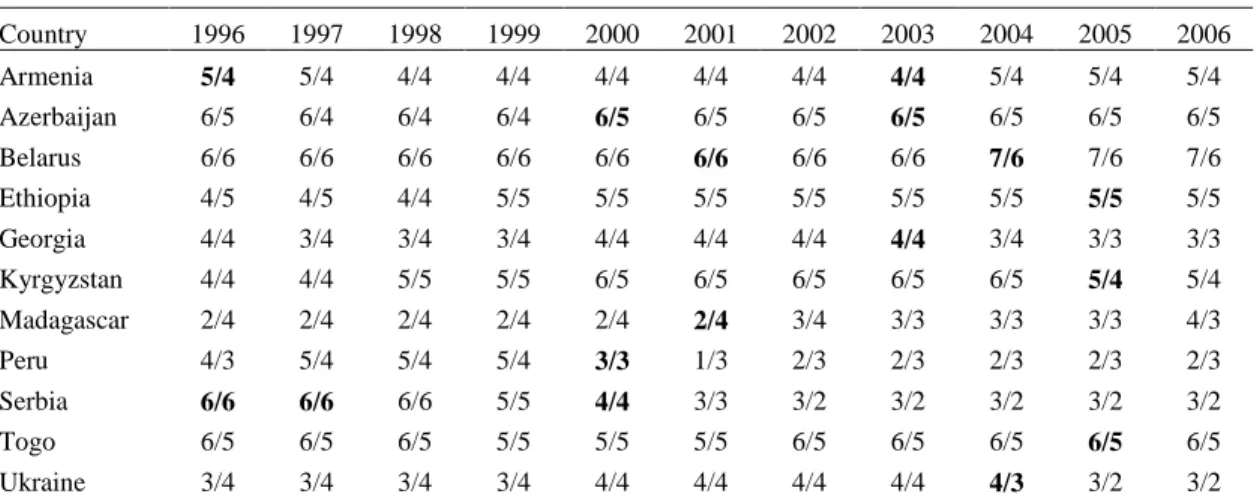
mutually reinforcing instead of contradictory.3 As Levitsky and Way (2010) demonstrate empirically in non-CEE cases, the countries with the highest degrees of linkage and leverage to the West were those with the highest likelihood of democratization. Further, in all of the post-communist cases of electoral revolutions, according to Orenstein and Kalandadze (2009), none led to real, liberal democracy in the immediate years following revolution (with the partial exception of Peru. See Table 1). It was only after a period of either democracy or governance outpacing the other that any progress occurred.
With this in mind, I argue that the only instances of democracy and governance developing in a reinforcing nature are where there exists a very substantial amount of linkage and leverage, as was the case in CEE. This leverage can enforce legitimacy of democratic development; it can promote the growth of democratic opposition
movements; it provides assurance that real change occurs through elections (particularly salient in Tunisia where street demonstrations are the preferred method of contestation); and in cases of very high leverage it can force institutional changes that promote
governance in concert with liberal democratic norms (rewriting the constitution or
3 As Vachudova (2005) argues, the reasons for the EU’s success in this period were multi-faceted. It was a
14
existing legislation, for example). Without a powerful actor like the EU which is able to utilize its leverage so effectively – through a combination of active leverage in the form of the accession process and passive leverage through the existence of the common market (and it is hard to imagine another instance such as the fall of communism in CEE where these unique conditions exist) – it is very unlikely that a post-revolutionary, democratic regime will effectively establish democracy and governance in a reinforcing manner. Thus, we can assume the default trajectory for post-revolutionary regimes in this first phase – in the absence of outside leverage as strong as the EU’s after
communism – is a period of conflict between democracy and governancewhere one is likely to prevail at the cost of the other.
One possible counterpoint to this argument is that the CEE states had high levels of effective governance by the end of communism. When these regimes opened up, then, all that was left was a maturation of democracy and the entrenchment formal democratic institutions. The EU, however, was imperative in the trajectory of these cases. The ability of authoritarian-minded elites to take advantage of the strong governance to build institutions that consolidated their control over power and their ability to seek rents was severely mitigated by the presence of the EU. Further, the EU provided legitimacy and credibility for democratic opposition parties and eventually reformed illiberal, rent-seeking elites through forcing them to contest power in a democratic political climate. Without the EU, the strong governance that existed in these states may have facilitated a new series of moderately effective but highly illiberal regimes (such as Malaysia,
15
its progression and facilitated a mutually enforcing development of democracy and governance that would not have occurred in its absence.
Table 1 – Scores for Cases of Electoral Revolution
Country 1996 1997 1998 1999 2000 2001 2002 2003 2004 2005 2006
Armenia 5/4 5/4 4/4 4/4 4/4 4/4 4/4 4/4 5/4 5/4 5/4
Azerbaijan 6/5 6/4 6/4 6/4 6/5 6/5 6/5 6/5 6/5 6/5 6/5
Belarus 6/6 6/6 6/6 6/6 6/6 6/6 6/6 6/6 7/6 7/6 7/6
Ethiopia 4/5 4/5 4/4 5/5 5/5 5/5 5/5 5/5 5/5 5/5 5/5
Georgia 4/4 3/4 3/4 3/4 4/4 4/4 4/4 4/4 3/4 3/3 3/3
Kyrgyzstan 4/4 4/4 5/5 5/5 6/5 6/5 6/5 6/5 6/5 5/4 5/4 Madagascar 2/4 2/4 2/4 2/4 2/4 2/4 3/4 3/3 3/3 3/3 4/3
Peru 4/3 5/4 5/4 5/4 3/3 1/3 2/3 2/3 2/3 2/3 2/3
Serbia 6/6 6/6 6/6 5/5 4/4 3/3 3/2 3/2 3/2 3/2 3/2
Togo 6/5 6/5 6/5 5/5 5/5 5/5 6/5 6/5 6/5 6/5 6/5
Ukraine 3/4 3/4 3/4 3/4 4/4 4/4 4/4 4/4 4/3 3/2 3/2
Selected cases are cases of electoral revolutions according to Orenstein and Kalandadze (2009). Scores are from the annual Freedom in the World report; years of revolution are in bold. The first number is Political Rights and the second Civil Liberties.
The second phase is essentially what Hale (2011) describes in the development of
16
opposition and legitimacy through their recent arrival to power, will establish
authoritarian policies that entrench the regime’s position of power (Hale, 2011: p. 582). Thus, I find Hale’s (2011) theory to be most applicable once the revolutionary turmoil has subsided and governance has improved. While a divided-executive
constitution that takes effect shortly after the revolutionary regime comes to power may set more promising conditions for democracy than a single-executive constitution, neither model is likely to produce democratization until the democracy/governance conflict has settled. After the first phase has had time to play out the impact of a formal constitution is much more decisive in the trajectory of the regime. At this point elections can produce lasting results, institutions are more difficult to ignore, an opposition has had time to develop, and international pressure is likely to be more effective. However, if the first phase was characterized by too little democratic development, the state and regime may be so far down the road to authoritarianism that any changes in formal institutions are only worth their face value.
17
opposition began to form, a new constitution came into power and has had a substantial impact on the democratic trajectory of the country.
Hypothesis
My expectations are that, through an examination of the events up to, during, and following the Jasmine Revolution, Tunisia is currently in the first phase outlined above. Specifically, Tunisia is experiencing a period of turmoil after the revolution characterized by a few idiosyncratic factors: 1) the sudden collapse of a particularly strong
authoritarian regime with extensive clientelistic ties; 2) the lack of a unified opposition movement that was primarily responsible for the turnover in power (such as Saakishvili’s Rose Coalition in Georgia or the Orange Coalition in Ukraine); and 3) the existence of a formerly marginalized but very sizeable political element in the form of the Ennahda, the Islamist party. In effect, due to these factors and the massive popular support for
democracy during the revolution, democratic development has far outpaced the
development of governmental capacity in the early stages of the post-Ben Ali era. The period of political development currently underway in Tunisia is a pivotal point for setting the foundation for further democratization. Finally, for liberal democracy to eventually flourish in Tunisia there must first be a period of strengthening the quality of governance in the country, and this is likely to be accompanied by authoritarian
CHAPTER 4
CASE STUDIES: THE ROSE AND JASMINE REVOLUTIONS
This section will examine two cases of revolution that led to regime change: Georgia and Tunisia. I argue that Georgia is a typical case of regime change and democratization through revolution. Specifically, it is typical because of the following characteristics: a) the Georgian state under Shevardnadze was not a liberal democracy and had characteristics of a semi-authoritarian regime; b) as Orenstein and Kalandadze (2009) note, there was an absence of certain necessary democratic pre-conditions when Saakashvili took power after the Rose revolution; c) immediately after the revolutionary leadership came to power, democratic development was mixed with authoritarian backsliding; and d) eventually the conflict between democratization and governance begins to stabilize and we see, following Hale’s (2011) model, the formal and informal entrenchment of more promising democratic principles in the context of improved
19
Georgia – The Rose Revolution
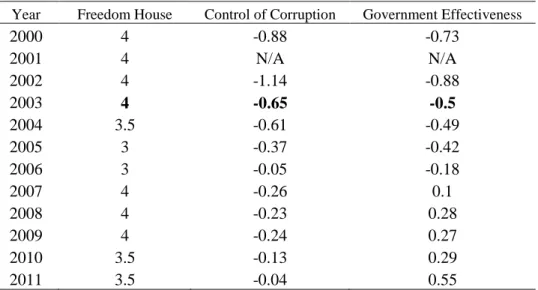
Table 2 – Georgia Scores
Year Freedom House Control of Corruption Government Effectiveness
2000 4 -0.88 -0.73
2001 4 N/A N/A
2002 4 -1.14 -0.88
2003 4 -0.65 -0.5
2004 3.5 -0.61 -0.49
2005 3 -0.37 -0.42
2006 3 -0.05 -0.18
2007 4 -0.26 0.1
2008 4 -0.23 0.28
2009 4 -0.24 0.27
2010 3.5 -0.13 0.29
2011 3.5 -0.04 0.55
Sources: Freedom House scores come from Freedom in the World reports. Control of Corruption and Government Effectiveness are available through the World Bank Governance Indicators. Year of revolution is in bold.
After the fall of communism, the newly-independent Georgian state, led by former members of the Soviet nomenklatura, quickly turned into a typical post-communist semi-authoritarian regime. Former Soviet Foreign Minister Eduard
Shevardnadze, who seized the presidency after a coup in 1992, cemented his position as president through establishing informal clientelistic ties among the Georgian elites and through other typical authoritarian means such as fraudulent elections and marginalizing opposition movements. However, the booming economy in the 1990s served to placate the citizenry while satiating rent-seeking elites, limiting any serious challenge to
Shevardnadze’s rule (Levitsky and Way, 2010). By the late 1990s, the ubiquity of corruption, which existed in the “very fabric of the state,” began to dismantle the Shevardnadze regime (Wheatley, 2005: p. 135).
20
elites. Seeing an opening to vie for control over Georgia’s extensive clientelistic network of resources, elites began to defect from Shevardnadze and an opposition movement – led by Shevardnadze’s Justice Minister, Mikheil Saakashvili – began to take shape. In response to the fraudulent outcome of the 2003 parliamentary elections, protestors gathered in Tbilisi, and on November 23, 2003, Saakashvili and his supporters stormed parliament while Shevardnadze was delivering a speech, forcing the president to flee.
Immediately following the Rose Revolution, Saakashvili and his allies continued what Bunce and Wolchik call the “unfortunate tradition in post-Soviet Georgian politics … wherein power is seized through extra-constitutional means, citizens then rally around the new leader, and elections are finally held to legitimate the transfer of office” (2011: p. 235). Once Saakashvili cemented his position through elections, by winning 96 percent of the vote, his ruling coalition began to undertake constitutional reforms that
concentrated power in the presidency while marginalizing the role of the parliament (Mitchell, 2006). Members of parliament were “reportedly coerced” into supporting constitutional changes; positions at all levels of government were tied to loyalty to Saakashvili; the media became less independent than under Shevardnadze; and NGO leaders, many of whom were government watchdogs, received positions in Saakashvili’s government (Mitchell, 2006). Previously, despite these worrying signs for the
development of future democracy, Saakashvili successfully reduced corruption and improved some economic conditions (Mitchell, 2006).
21
through improvements that had “strong effects on people’s everyday lives” (Mitchell, 2008: p. 84). By 2008, however, things began to get worse for Saakashvili. The August 2008 war with Russia over the breakaway regions of South Ossetia and Abkhazia
catalyzed some of Saakashvili’s Rose Revolution allies to challenge his presidency. While this conflict did draw the United States into announcing its support for Saakashvili, it also served to increase outside scrutiny of his regime. Also during this period the European Union began using its (albeit softer) leverage to encourage democratization in Georgia through including it in the European Neighborhood Policy agreements. The post-revolutionary grace period was over for the Saakashvili and his supporters, and the semblance of an opposition began to form backed by Western legitimization. Sporadic protests, albeit small in size, began on the streets of Tbilisi, with some facing violent opposition by the government.
22
On October 1, 2012, billionaire Bidzina Ivanishvili – who was initially barred from running for office because he held a Russian passport – and his Georgian Dream coalition received 54 percent of the vote, defeating Saakashvili’s UNM coalition. Not only did Ivanishvili’s victory surprise observers – he was up comfortably in polls only two weeks prior to the election (Financial Times, 2012) – the defeat of Saakashvili will be the first peaceful turnover of power in Georgia since gaining independence from the Soviet Union. There are still many concerns surrounding this outcome, however. Ivanishvili’s Dream Coalition is a tenuous collection of disparate parties and groups, some of which are overtly supported by Russia. There is certainly some concern about this coalition’s ability to remain unified, particularly once Saakashvili is out of the picture. Further, Ivanishvili will have to share power with Saakashvili until the October 2013 presidential elections. Saakashvili has been highly critical of Ivanishvili since the elections, and Dream Coalition MPs have already overturned a Saakashvili veto
(Economist, 2012). This political infighting has the potential to crescendo before a new president is elected in October. Nonetheless, the October 2012 peaceful transition of power is a very promising sign for the future of Georgian democracy: governance has improved to such a point where, as I developed in my argument, formal institutions should have a lasting impact.
Tunisia – The Jasmine Revolution
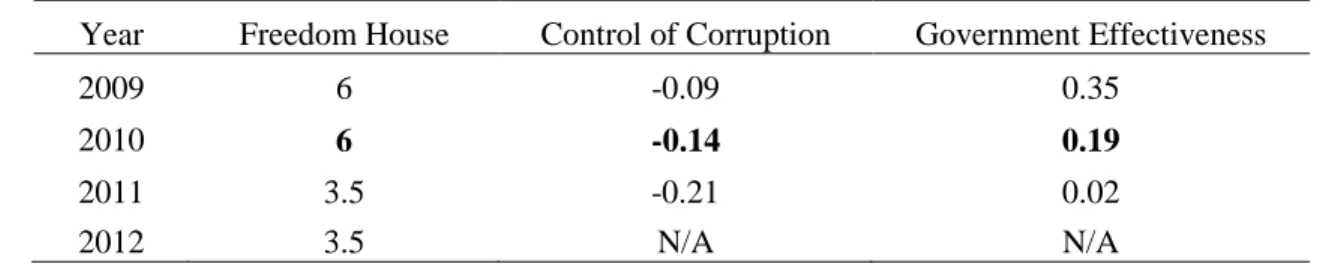
Table 3 – Tunisia Scores
Year Freedom House Control of Corruption Government Effectiveness
2009 6 -0.09 0.35
2010 6 -0.14 0.19
2011 3.5 -0.21 0.02
23
Tunisia is a logical choice for comparison when considering post-communist revolutions that produced democratic breakthroughs. Tunisia’s pre-revolutionary regime, led by President Ben Ali, was highly authoritarian; elections were meaningless, and Ben Ali’s regime had tight control over all aspects of the political culture within the country (Freedom House has Tunisia with a 6 ‘Freedom Rating’ in the year prior to revolution, where Georgia has a score of 4). Moreover, Tunisia has no historical experience with democracy, and its political history since gaining independence from France in 1956, until the 2011 ouster of Ben Ali, is characterized by two strongman presidents and a lack of meaningful political competition – even at the elite level. Largely due to
underdevelopment of democratic institutions, and for other reasons I will examine below, once Ben Ali was removed from power democratic development was mixed with
authoritarian backsliding (although, as we will see, the causes for this vary from what happened in Georgia). Finally, I will examine the potential for consolidating liberal democracy – or at least the mitigation of further authoritarian developments – based on empirical observations.
24
conception of women’s rights (Freedom House, 2012), his regime quickly demonstrated its lack of commitment to democratization. Along with the typical semi-authoritarian practices – repressing opposition groups, silencing independent journalists, etc. – Ben Ali began to establish a durable autocratic regime through the creation of a “strong neo-corporatist state” and a pervasive intelligence-based police force (Schraeder and Redissi, 2011: p. 6).
Ben Ali’s presidency became a textbook example of Henry Hale’s (2005) model of patronal presidentialism: “The key to personal success [during Ben Ali’s reign] was not achievement in a given field, but links to the extended family of the ubiquitously photographed president” (Schraeder and Redissi, 2011: p. 6). Rent-seeking elites tied themselves to his regime, and members of Ben Ali’s extended family occupied almost every position of power within the government (Goldstone, 2011). As a result, state capture in Tunisia “trickled down through state institutions and state-run industries to petty corruption, including bribes, at the lowest level” (Freedom House, 2012). The more these elites relied on Ben Ali for their positions and for economic rents, the less likely they were to oppose his enduring reign.
Moreover, Ben Ali’s substantial security forces were responsible for
25
war against terrorism in a region where al-Qaeda was making inroads.” Thus, as
Tunisia’s authoritarian tendencies increased the necessity of having a non-Islamic ally in the region for the West continued to outweigh the desire to criticize Ben Ali’s regime. In this climate, Ben Ali won five consecutive presidential elections – the most recent, before his fall, in October 2009 with 89 percent of the vote – and breezed through a
constitutional three-term term-limit in 2002 by handing an amendment off to the “rubber stamp” Chamber of Deputies (Schraeder and Redissi, 2011: p. 8).
The preceding paragraphs should explain, then, why Ben Ali’s ouster through popular protest surprised so many. His security forces, numbering around 130,000 (this number does not include the roughly 8,000 in the Presidential Guard and 20,000 in the National Guard), had successfully quelled a sizable protest as recently as 2008 (Schraeder and Redissi, 2011: p. 6). Further, Tunisia did not ride the wave of protest that spread throughout the Arab world – it began it.
26
unemployed Tunisians had to deal with blatantly corrupt officials, at all levels of
government, their frustrations began to reach a tipping point (Freedom House, 2012). For one 26 year old fruit vendor, who was the sole income earner for a family of eight, the daily harassment for petty bribes by local police officers pushed him over that tipping point. On 17 December 2010, the fruit vendor Mohamed Bouazizi lit himself on fire in the small town of Sidi Bouzid, and he eventually died in the hospital on the fourth of January.
Protests quickly spread throughout the country, and Ben Ali authorized his security forces to use violence to quell the uprisings. Between 17 December and the end of January, at least 300 were killed and more than 700 were wounded in these
demonstrations (Schraeder and Redissi, 2011). On January 13, President Ben Ali, in the face of overwhelming opposition to his continued rule by protestors and mounting international pressure against his security apparatus’ use of violence, went on TV and announced that he would step down by the end of his term in 2014. The next day, however, after violence continued against the protestors, the military stepped in and chased off the remaining pro-Ben Ali security forces (Bloomberg, 2011). That day, Ben Ali fled the country and sitting Prime Minister Mohamed Ghannouchi took over as acting president. Thus, the second determining factor in the relatively quick ouster of Ben Ali, and the avoidance of a drawn out situation such as in Syria, or what could have been in Libya without Western involvement, was the existence of a highly professional,
independent military in Tunisia (Barany, 2011).
27
Deputies, took control over the interim government, which ignited new unrest (Schraeder and Redissi, 2011). Following violent clashes with riot police, protestors forced acting Prime Minister Ghannouchi and the entire Ben Ali cabinet to resign, leaving 84 year old Béji Caïd Essebsi to take over as Prime Minister. Essebsi, a critic of Ben Ali’s regime during his tenure of power, banned Ben Ali’s RCD party, ordered the arrest of key pro-Ben Ali elites, and dismantled the massive political police apparatus (Schrader and Redissi, 2011). Additionally, Essebsi took steps to combat the rampant corruption in his country and “confiscated the properties, assets and businesses of 110 members of Ben Ali’s family, including the ex-president and his wife” (Schraeder and Redissi, 2011: p. 15). Finally, the media began to open, further steps were taken to begin addressing corruption, and elections were scheduled for October 2011.
28
CHAPTER 5
ANALYSIS
The examination of the cases of Georgia and Tunisia highlighted some
similarities and differences in their trajectories after pro-democracy revolutions. Georgia and Tunisia were authoritarian regimes with little semblance of democracy prior to revolution. Each state was characterized by a patronal president (Hale, 2005) with extensive clientelistic and informal political networks. Additionally, each state experienced a protest-supported revolution which resulted in the removal of the
authoritarian president from power. As Orenstein and Kalandadze (2009) note, Georgia did not possess certain characteristics that are favorable for the establishment of liberal democracy following a revolution. Tunisia clearly lacked the same characteristics (see Table 3). Georgia and Tunisia similarly experienced a pivotal period of political
development in the months following each of their respective revolutions, although these periods produced different outcomes. In Georgia, Saakashvili pursued policies that greatly increased government capacity – a stark contrast to the weakness of the
Shevardnadze regime (see Table 2) – which led to the noticeable improvement in the day-to-day life of many Georgians (Mitchell, 2008). However, democratization stalled and Saakashvili’s regime began to backslide towards authoritarianism.
30
state capacity. Georgia and Tunisia both exhibited many similar characteristics prior to the revolutions that overthrew their authoritarian regimes. In 2002, the year prior to the Rose Revolution, Georgia ranked 85th in terms of corruption according to Transparency International. In 2009, Tunisia ranked 65th according to the same index. In Georgia and Tunisia, partly due to rampant corruption, the economy was struggling. Similarly, elections were meaningless in each state; political power was almost completely consolidated in the presidency (and thus elites relied on the presidency for their positions); and the first semblance of a unified opposition in both Tunisia and Georgia only appeared immediately prior to the revolution (unlike, for example, Solidarity in Poland prior to the fall of communism). Additionally, the first regimes to takeover power after the revolution in each state were comprised of former elites with extensive ties to the authoritarian regime that was just removed: Saakashvili, a former Justice Minister in Georgia, and Ben Ali’s Prime Minister Mohamed Ghannouchi taking over the interim government in Tunisia. Why, then, were the initial periods of development once the new regime came to power so different?
31
demonstrations, combined with the elite-led quality of the opposition movement, led some scholars to observe that the Rose Revolution was, in reality, little more than a coup (Tudoriou, 2007).
In Tunisia, the story was quite a bit different. According to reports, up to 100,000 people were on the streets prior to Ben Ali’s ouster, and 40,000 to 100,000 continued to protest the Ghannouchi government once he came to power (PressTV, 2011). Not only were these protests larger, but they were also sustained and continued to demand change after the regime fell. In Georgia, once Saakashvili calls for democracy ceased as his regime claimed legitimacy through its rise to power and quickly held elections. The continued protests in Tunisia led to the resignation of the entire Ben Ali cabinet, essentially wiping the slate clean and creating an environment for a true turnover in power as opposed to a recycling of elites.
32
political organizing, particularly if it is contrary to the government’s interests, thus Islamic-led civil society fills the void. It is not surprising then that in the first real political opening in Tunisia we see the most organized political group manifest in the form of an Islamic political party, Ennahda.
Finally, and largely because of the impact of the new politically-relevant Islamic element, Tunisia’s first elections produced substantially different outcomes than
Georgia’s first elections after the Rose Revolution. In Georgia, Mikheil Saakashvili united all the relevant elites who supported Shevardnadze, and when he held elections to completely legitimize his position, there was no opposition. He won with 96 percent of the vote. In Tunisia, on the other hand, the secular parties were unable to unite in the same way as Ennahda, thus Ennahda won a plurality of the vote. Unable to form a government, Ennahda entered into a disparate coalition with a left-wing nationalist party and a social democratic party (Cavatorta, 2012).
Outcomes
As Tilly states in these cases, when protected consultation develops faster than government capacity, and if the regime survives – something that has not been certain in Tunisia – the country passes through a “risky zone of capacity building” (2003: p. 7). In Tunisia, the democratic experiment since revolution has been tumultuous. The
33
little experience with democracy and saw the most effective means of political change as public demonstrations. In December 2012, for example, a conflict between leftists and Islamists left 250 protestors wounded. As The Economist writes, “The rallying cry of the revolution, “Dégage!” (“Clear off!”), is again being heard, only this time in connection not with a widely loathed dictator, Zine el-Abidine Ben Ali, but with a provisional government that Tunisians themselves proudly voted into office only a year ago” (2012).
Empirical measures support the assertion that following revolution, either democracy or governance tends to flourish. As we see in Table 2, democracy scores stagnated near pre-revolution levels in Georgia, but government effectiveness and control of corruption saw significant improvements. In Ukraine, democracy improved but the other two measures did not. In Tunisia, the early data seems to indicate a trend similar to Ukraine, and empirical observations of political conditions support that. It is important to note, though, that Ukraine’s development has significantly different causes than that of Tunisia. Following the removal of Kuchma and his oligarchic, authoritarian regime, political competition became much more open and competitive. However, this competition was largely among the same elites without much influence from a truly democratic opposition, and other institutions more or less remained the same from the Kuchma era. As explained by the theory, some democratization occurred, but
34
Nonetheless, the question remains as to whether Tunisia will be able to make it to the second phase of democratization as described above. According to Hale’s theory, the electoral outcomes in Tunisia are an inherently positive development for the country. Power is formally divided, and informal politics are unable to center on a single position of power. However, as I have argued, divided power at this stage of the process is not necessarily helpful in establishing liberal democracy, and governance must develop before these liberal norms and institutions are entrenched. An increase in governance is most likely to occur through a phase of authoritarianism, which will likely have the effect of limiting the amount of competition that currently exists in Tunisia. So, in contrast to Georgia where Saakashvili was the sole purveyor of political power, Tunisia not only had a divided government, but one with a disparate ruling coalition and in a context where only one party received more than 8 percent of the vote. Georgia passed through an initial phase of authoritarian development – with a single, strong executive – which facilitated an increase in governance by limiting openings for a democratic challenge to the legitimacy of its actions. On the other hand, Tunisia’s current path is better
characterized by a substantial democratic opening but very little progress in building governance and state capacity.
35
described by Levitsky and Way, Georgia authorized a divided-executive constitution and governance has matured enough during the semi-authoritarian years that this new
constitution might have a substantial impact on the future of Georgian democracy. Based on my theory presented above, I expect recent developments in Georgia to be very positive in regards to its democratic development. As Table 1 demonstrates, during the years after the Rose Revolution, democratization stagnated, but control of corruption and governmental capacity both increased significantly. According to Transparency International, Georgia improved from 124th in 2003 in its control of corruption (out of a total of 133) to 51st in 2012. This period of semi-authoritarianism allowed for the maturation of a democratic opposition and the development of
36
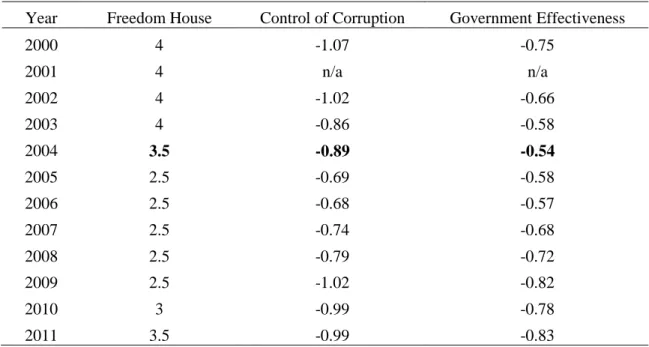
Table 4 – Ukraine Scores
Year Freedom House Control of Corruption Government Effectiveness
2000 4 -1.07 -0.75
2001 4 n/a n/a
2002 4 -1.02 -0.66
2003 4 -0.86 -0.58
2004 3.5 -0.89 -0.54
2005 2.5 -0.69 -0.58
2006 2.5 -0.68 -0.57
2007 2.5 -0.74 -0.68
2008 2.5 -0.79 -0.72
2009 2.5 -1.02 -0.82
2010 3 -0.99 -0.78
CHAPTER 6
CONCLUSION
The revolution that began in December 2010 in Tunisia and spread throughout the Arab World represents fertile grounds for further academic studies on regime change and democratization. Just as the color revolutions in the early 2000s fostered academic debates on regime change and semi-authoritarianism (Bunce and Wolchik, 2009; Silitski, 2009; Way, 2008, 2009), the Arab Spring events have led many to wonder if liberal democracy is possible in a region where few thought it would ever occur. The early stages of development in many of the afflicted countries – Tunisia, Egypt, and Libya – have seen mixed results. On the one hand, the regimes in these countries prior to the Arab Spring were highly authoritarian, often Western-supported, and had little-to-no historical experience with democracy. Contested elections and openings in media freedom, for instance, have been huge steps forward in these cases. On the other hand, the post-revolutionary regimes have either taken up some of the same authoritarian practices as their predecessors (Egypt) or had little success in promoting true liberal democracy (Tunisia).
Once the initial optimism faded in post-communist Eurasia, scholars and
38
(Way, 2011), few expect the democratization period that is currently underway to be anywhere near as successful. However, as demonstrated by Georgia, substantial democratization is possible following a democratic breakthrough or revolution, but it is unlikely to be quick or easy. Analyzing the events in the early- to mid-2000s in Eurasia and the literature that followed serves to provide key insight into the question of whether revolution truly can produce liberal democracy.
In this paper, I have compared Tunisia, the country that ignited the Arab Spring, to the Georgian Rose Revolution, the case that began the color revolution ‘wave’ (Bunce and Wolchik, 2006). This paper did not seek to add to the substantial body of literature of why semi-authoritarian regimes succumb to or outlast democratic challenges (Bunce and Wolchik, 2006; Hale, 2005; Levitsky and Way, 2010; for example); instead, I chose to analyze how a revolutionary regime may democratize through a comparison of Georgia and Tunisia. I established a theoretical framework that suggests in post-revolutionary regimes – except in the CEE cases after communism (because of the role the EU played) – there necessarily exists a risky zone that sees either democracy or governance progress at the cost of the other. Furthermore, I alter Hale’s (2011)
framework of formal constitutions determining informal politics to rely on an imperative improvement of governance before a formal constitution can make a lasting impact on the political environment within a country. If this development of governance is absent and democratic openings occur instead then, assuming the regime survives, formal institutional changes are likely to have little impact on democratization. In short,
governance must improve – which is most likely to occur through a period of renewed
39
I argue Georgia is a ‘typical’ case for democratization after a democratic breakthrough in the period after the fall of communism. As such, Georgia exemplifies the following stages: 1) a highly path-dependent period when the revolutionary regime first comes to power characterized by a conflict between the developments of governance and democracy (the ‘risky zone’); 2) governance outpaces democratization (Tilly, 2003); 3) formal constitutions and institutions have a much more determinative impact on the longer-term democratization in the country (Hale, 2011). Moreover, democracy in Georgia has a more positive future than democracy in Ukraine – where many thought democracy had actually succeeded due to revolution – precisely because Georgia has succeeded in dividing power after a period of improvement in governance (Table 4).
Tunisia is currently in the first phase: the contradictory development of
democracy and governance. Because of different conditions surrounding the turnover in power in Tunisia when compared to Georgia, this phase seems to indicate democratic openings are succeeding at the cost of improvements in governance, and empirical measures support this claim (Table 3). The political openings created by the fall of Ben Ali have led to an abundance of political contestation often marred by violence and street demonstrations. Without improvements in the political process that see disagreements resolved through voting and debate instead of on the street, it is unlikely any real improvements will occur in the poor quality governance of Tunisia. Tunisia is on the verge of a vicious cycle of unrest, leading to further political ineffectiveness, leading to further unrest and potential new revolutions.
40
41 Works Cited
Barany, Zoltan. 2011. The Role of the Military. Journal of Democracy, 22(4), 24-35. Berman, Sheri. 2003. Islamism, Revolution and Civil Society. Perspectives on Politics,
1(2), 257-272.
Bloomberg. 2011. Egypt's Military Leaders Tighten Six-Decade Government Grip Amid
Protests. 31 January 2011.
http://www.bloomberg.com/news/2011-01-31/egypt-s-military-leaders-tighten-six-decade-government-grip-amid-protests.html (Accessed 1 April 2013).
Bunce, V.J. & Wolchik, S. 2006. International Diffusion and Postcommunist Electoral Revolutions. Communist and Post-Communist Studies, 39(3), 283-304
———. 2009. Debating the Color Revolutions: Getting Real About "Real Causes."
Journal of Democracy, 20(1), 69-73.
———. 2011. Defeating Authoritarian Leaders in Post-Communist Countries. New York, NY: Cambridge University Press.
Cavatorta, F. 2012. Beyond Ghannouchi: Islamism and Social Change in Tunisia. Middle East Report 262, 20-25.
Carothers, Thomas. 2002. The End of the Transition Paradigm. Journal of Democracy, 13(1), 5-21.
Countries at the Crossroads. 2012. Tunisia.
Economist. 2012. Democracy and Riots. 8 December 2012 .
Freedom House. 1997-2013. Freedom in the World.
———. 2012. Tunisia – Freedom in the World Report.
Goldstone, J. 2011. Understanding the Revolutions of 2011. Foreign Affairs, 90(3), 8-16. Hale, H. E. 2005. Regime Cycles: Democracy, Autocracy, and Revolution in Post-Soviet
Eurasia. World Politics, 58, 133-65.
———. 2011. Formal Constitutions in Informal Politics: Institutions and Democratization in Post-Soviet Eurasia. World Politics, 63(4), 581-617.
42
Levitsky, Steven and Lucan Way. 2010. Competitive Authoritarianism: Hybrid Regimes
after the Cold War. New York, NY: Cambridge University Press.
Mitchell, L. 2004. Georgia’s Rose Revolution. Current History. 103(675), 342-348. ———. 2006. Democracy in Georgia Since the Rose Revolution. Orbis, 50(4), 669-676. ———. 2008. Uncertain Democracy. Philadelphia, PA: University of
Pennsylvania Press.
PressTV. 2011. Tunisians want PM Ghannouchi gone. 25 February 2011. http://www.presstv.ir/detail/167012.html (Accessed 1 April 2013).
Schmitter, P. and Karl, T. 1991. What Democracy Is…and Is Not. Journal of Democracy,
2(3), 75-88.
Schraeder, Peter and Redissi, H. 2011. Ben Ali’s Fall. Journal of Democracy, 22(3), 5-19.
Silitski, V. 2009. What Are We Trying to Explain? Journal of Democracy, 20(1), 86-89. Tilly, Charles. 2003. Contention and Democracy in Europe, 1650-2000. Cambridge
University Press.
Stoner-Weiss, K. and McFaul, M. 2008. The Myth of the Authoritarian Model. Foreign Affairs, 87(1), 68-84.
Tudoroiu, T. 2007. Rose, Orange, and Tulip: The Failed Post-Soviet Revolutions.
Communist and Post-Communist Studies, 40(3), 315-342.
Vachudova, Milada Anna. 2005. Europe Undivided. Oxford University Press. Washington Post. 2011. In Tunisia, Freedom Blossoms. 24 January 2011.
http://www.washingtonpost.com/wp-dyn/content/article/2011/01/23/AR2011012304126.html (accessed 1 April 2013). Way, Lucan. 2008. The Real Causes of the Color Revolutions. Journal of Democracy,
19(3), 55-69.
———. 2009. A Reply to My Critics. Journal of Democracy, 20(1), 90-97. Welt, Cory. 2006. Georgia’s Rose Revolution: From Regime Weakness to Regime
Collapse. Working Paper. Stanford, CA: Center of Democracy Development, and
43
Wheatley, Jonathan. 2004. Elections and Democratic Governance in the Former Soviet Union: The Case of Georgia. Free University of Berlin.
http://www.oei.fuberlin.de/cscca/Publications/boi_jw_elections_and_democratic_ governance.pdf
World Bank. 2011. Governance Indicators. Available at