PROMOTING FOUNDATIONS FOR INTERPROFESSIONAL COLLABORATIVE PRACTICE: ORAL HEALTH IN NURSING EDUCATION
Roxanne Mariola Dsouza
A thesis submitted to the faculty at the University of North Carolina at Chapel Hill in partial fulfillment of the requirements for the degree of Master of Science in the Department of Dental Ecology in the
School of Dentistry (Dental Hygiene Education).
Chapel Hill 2018
©2018
iii ABSTRACT
Roxanne Mariola Dsouza: Promoting Foundations for Interprofessional Collaborative Practice: Oral Health in Nursing Education
(Under the direction of Jennifer Brame)
This study evaluates knowledge, confidence, and practice behaviors of 64 Accelerated Bachelor of Nursing first–year students at the University of North Carolina at Chapel Hill regarding preventive oral health services. Using a pre–post survey–study design, students completed oral– health–related–questionnaires following didactic and clinical–simulation on oral health principles and preventive services. Fifty–five (86%) students completed the pre–survey, 49 (77%) completed the post–survey following clinical rotations five months later; 44 (69%) completed both. Participants’ showed a significant increase in knowledge from pre–post–questionnaires for two of five questions (p=0.04; p<0.0001). Confidence for screenings (p<0.0001) and counseling (p=0.006) increased; while referrals decreased (p=0.718). Post–intervention, 37% reported performing screenings, 45%
v
ACKNOWLEDGEMENTS
I would like to thank my thesis committee, Professor Jennifer Brame, Dr. Rocio Quinonez, and Dr. Sara Hubbell, for your time, commitment, and support on this project. You have all provided guidance that I will forever be grateful for. I have been pushed to accomplish more than I ever thought possible and for that, I am thankful. Thank you to Dr. Ceib Phillips and Ms. Pooja Saha for the provision and analysis of the Teleform questionnaires, to the students and staff at the University of North Carolina School of Nursing for their participation in the project.
A special thank you to my classmates: Kayla Cunningham, Yuri Oh, and Jackie Smith. I have been so blessed to have been able to share countless memories with you during our educational journey. Thank you for always laughing at my puns. I know that the future of dental hygiene is safe in our hands. Thank you to my incredible professors for your guidance and support during the past two years. To my mentors, Professor Jennie Brame and Ms. Jan Holland, you have both helped me grow so much and I am so happy to know you will always be part of my life.
TABLE OF CONTENTS
LIST OF TABLES ... vii
LIST OF FIGURES ... viii
LIST OF ABBREVIATIONS ... ix
CHAPTER I: INTRODUCTION AND REVIEW OF THE LITERATURE ... 1
Introduction ... 1
Review of the Literature ... 2
Role of the Nurse ... 2
Existing Oral Health in Nursing Curriculum ... 2
Existing Oral Health Programs to Incorporate in Nursing Curricula ... 3
Interprofessional Education ... 3
Purpose and Specific Aims ... 4
CHAPTER II: PROMOTING FOUNDATIONS FOR INTERPROFESSIONAL COLLABORATIVE PRACTICE: ORAL HEALTH IN NURSING EDUCATION... 5
Introduction ... 5
Background ... 5
Methods ... 7
Results ... 9
Discussion ... 11
Concluding Comments ... 15
APPENDIX... 16
vii LIST OF TABLES
Table 1 Oral health knowledge change of University of North Carolina at Chapel Hill (UNC) Accelerated Bachelor of Nursing Program
(ABSN) students ...16 Table 2 UNC ABSN students’ self-reported confidence change in providing
preventive oral health services (screen, counsel, refer) ...17 Table 3 UNC ABSN students’ self-reported preventive oral health services
LIST OF FIGURES
ix
LIST OF ABBREVIATIONS ABSN Accelerated Bachelor of Nursing
WHO World Health Organization SFL Smiles for Life
IPE Interprofessional Education IPC Interprofessional Collaboration IPL Interprofessional Learning
UNC University of North Carolina at Chapel Hill
CHAPTER I: INTRODUCTION AND REVIEW OF THE LITERATURE Introduction
In the constantly changing world of health care, providers are encouraged to work collaboratively and provide person–centered care. Despite the statement released by the World Health Organization (WHO) regarding the importance of interprofessional collaboration (IPC) and interprofessional education (IPE), true integration has not been achieved at the student level, specifically relating oral health to overall health. Nurses play a crucial role in the provision of routine oral screenings and counseling to identify conditions that may need further dental care and lessen health disparities. However, optimal oral health education is limited in nursing curricula (Dolce, Haber, & Shelley, 2012; Pai, Ribot, Tane, & Murray, 2016) and may therefore, not translate as a priority for nurses in patient care. Health care accreditation standards are increasingly incorporating IPE components; therefore, oral health in nursing curriculum is a logical way to incorporate
interprofessional learning (IPL). Students and faculty must utilize resources available to them by introducing collaborative practice at the educational level.
2 Review of the Literature
Role of the Nurse
Nurses are an integral aspect of the primary health care team, and should be trained to provide oral screening, counseling, and referrals. According to the WHO, “Nursing encompasses autonomous and collaborative care of individuals of all ages, families, groups and communities, sick or well and in all settings. It includes the promotion of health, the prevention of illness, and the care of ill, disabled and dying people” (“WHO | Nursing,” n.d.). This definition of the nursing profession charges nurses with the role of providing comprehensive, promotional, and preventive care that encompasses oral health. Nurses are frequently the first member of the primary care team seen by patients and are in a prime position to complete oral health assessments and provide screenings, counseling and referrals for their patients.
Existing Oral Health in Nursing Curriculum
Existing Oral Health Programs to Incorporate in Nursing Curriculum
As a deficiency in oral health education for the primary care team has been identified, programs such as the Smiles For Life (SFL) National oral health curriculum (Douglass et al., 2007) have developed to disseminate peer–reviewed oral health curriculum in primary care disciplines; however, oral health concepts are still lacking in curricula (Clark, Quinonez, Bowser, & Silk, 2017; Dolce, 2014; Douglass et al., 2007). Additional frameworks, such as the Qualis Oral Health Delivery Framework, for providing oral health services for primary care providers have been developed to simplify and provide a calibrated and structured process. (Hummel, Phillips, Holt, & Hayes, 2015).
A recent four–part report in Teaching and Leaning in Nursing released oral health content for nursing educators to add to curriculum (J. K. Mitchell, May, & Riggs, 2017; J. Mitchell & Shoemaker, 2017). These resources provide specific content for nurses treating patients at various stages in their life with content focusing on the integrated health team and the role of the nurse in providing preventive oral health services such as observing, counseling and providing referrals in a timely manner (J. K. Mitchell et al., 2017; J. Mitchell & Shoemaker, 2017). The report further discussed common oral health manifestations, disease processes, oral health effects of systemic disease, and preventive oral health services a nurse can provide for each of the four stages of life (J. K. Mitchell et al., 2017; J. Mitchell & Shoemaker, 2017). Additional existing programs such as the Oral Health
Nursing Education and Practice program at New York University (Dolce et al., 2012) should be used as
a model for bridging the oral-systemic educational gap and introducing oral health education in curricula.
Interprofessional Education
IPE is essential for health care professionals and has evolved to become a required
4
guidelines and improves quality of patient care (Abou El Fadl, Blair, & Hassounah, 2016; Czarnecki et al., 2014; Furgeson, Kinney, Gwozdek, Wilder, & Inglehart, 2015; Haber et al., 2017; Otsuka et al., 2016; Sharif, Saddki, & Yusoff, 2016; Silk, 2018; Wooten, Lee, Jared, Boggess, & Wilder, 2011). Health care seems to also be moving towards a collaborative practice model working in teams to focus on whole-patient-centered care delivering dental and medical services simultaneously (Silk, 2018; Weintraub, 2017). Therefore, incorporating IPC in the health care curricula may be an effective method of promoting both oral and systemic health in the medical and dental professions (Abou El Fadl et al., 2016; Dolce, 2014; Silk, 2018).
Health disciplines must utilize resources such as the Core Competencies for Collaborative
Practice to help achieve the best possible comprehensive person-centered health care approach
(“Core Competencies for Interprofessional Collaborative Practice: 2016 Update,” n.d.). Inclusion of this information in nursing curricula would enhance translation of knowledge, increase confidence, and provide information for referrals. IPE would be a logical method to provide knowledge regarding preventive oral services such as oral screening, oral health counseling, and dental referrals.
Purpose and Specific Aims
The specific aims of the study are:
1. Assess the knowledge of nursing students regarding oral health at baseline and after an oral health training intervention.
2. Evaluate students’ level of confidence in providing: (1) oral screening; (2) oral counseling; and (3) referrals to a dental home post intervention.
CHAPTER II: PROMOTING FOUNDATIONS FOR INTERPROFESSIONAL COLLABORATIVE PRACTICE: ORAL HEALTH IN NURSING EDUCATION
Introduction
In the constantly changing world of health care, providers are encouraged to work collaboratively and provide person–centered care. Despite the statement released by the World Health Organization (WHO) regarding the importance of interprofessional education (IPE) and collaboration (IPC), true integration has not been achieved at the student level, specifically relating oral health to overall health. Nurses play a crucial role in the provision of routine oral screenings and counseling to identify conditions that may need further dental care and lessen health disparities. However, optimal oral health education is limited in nursing curricula (Dolce et al., 2012; Pai et al., 2016) and may therefore, not translate as a priority for nurses in patient care. The purpose of this study was to evaluate knowledge, confidence, practice behaviors, and perceived barriers of nursing students to provide preventive oral health services.
Background
6
a calibrated and structured process. (Hummel et al., 2015). A recent four–part report in Teaching and
Leaning in Nursing released oral health content for nursing educators to add to curriculum (J. K.
Mitchell et al., 2017; J. Mitchell & Shoemaker, 2017). These resources provide specific content for nurses treating patients at various stages in their life with content focusing on the integrated health team and the role of the nurse in providing preventive oral health services such as observing, counseling and providing referrals in a timely manner (J. K. Mitchell et al., 2017; J. Mitchell & Shoemaker, 2017). The report further discussed common oral health manifestations, disease processes, oral health effects of systemic disease, and preventive oral health services a nurse can provide for each of the four stages of life (J. K. Mitchell et al., 2017; J. Mitchell & Shoemaker, 2017).
provide information for referrals. IPE would be a logical method to provide knowledge regarding oral screening, oral health counseling, and dental referrals.
Methods Research Design
The study employed a pre–, immediate–post–, and post–intervention quasi–experimental survey research design evaluating oral health education in nursing curriculum.
Data Collection
The study included 64 first–year nursing students enrolled in the accelerated undergraduate nursing program (ABSN) at the University of North Carolina at Chapel Hill (UNC) registered in a Health Assessment Course. Pre–, immediate–post, and post–intervention surveys were modified using a survey developed for the Prenatal Oral Health Program at UNC School of Dentistry. The original survey, utilized for medical students with a similar intervention, was revised and tailored towards a general oral health assessment for nursing students. Survey questions were focused on the
constructs of knowledge, attitudes and behaviors and did not exceed one-page front and back. Individual question formatting included: basic demographic questions; true/false questions on oral health knowledge; four-point Likert scale–type questions (1=strongly disagree, 4=strongly agree) on confidence in providing oral health services, level of agreement regarding their oral health
8
All ABSN students enrolled in the Health Assessment Course offered in spring 2017 were asked to participate (n=64). This course, based on the initiation of caring and decision making in nursing practice, addressed concepts and methods of comprehensive health assessment of children, adults, and geriatric patients. The Health Assessment Course is three–credit–hours consisting of two lecture credits and one lab credit. The former precedes the clinical simulation component which both have a two–hour duration. Surveys administered were coded to maintain anonymity, and students were informed that participation in the research was voluntary. Students that did not complete the surveys still received the didactic lecture and clinical simulation and did not have any negative consequences for not participating in the research. Clinical simulation groups included approximately eight to ten students and were held in laboratories in the nursing school. All qualifying students were asked to complete a written consent form to voluntarily participate in the intervention. Once written consent was obtained, a pen and paper pre–survey containing questions regarding knowledge of basic oral health and confidence of providing general oral health counseling was given at the
beginning of a class period. A didactic lecture–based intervention was then presented via PowerPoint during the lecture component of the class period. The presentation included (1) extraoral and intraoral anatomy, (2) oral diseases such as oral cancer, gingivitis, periodontitis, and dental caries, (3) common oral health manifestations through the life course, and (4) expectations of health care providers in providing oral health services. A short instructional video from SFL (Douglass et al., 2007; Quinonez et al., 2017) was shown demonstrating the Qualis framework for oral screenings by primary care providers (Hummel et al., 2015; “Oral Health Integration | Qualis Health,” n.d.). Students then dispersed into lab groups held in the laboratories in the nursing school.
case–based learning and utilizing uniform terminology when presenting the oral screening demonstration to the nursing students.
Upon completion of the demonstrations, students practiced performing an oral screening on one another. Each laboratory was equipped with all the necessary materials including gloves,
flashlights, and tongue depressors for each student. DH facilitators then provided instructional content on fluoride varnish application that included verbal instructions, viewing of a SFL instructional video, and a demonstration using fluoride varnish using paper mouth drawing (Douglas et al, 2007). Following laboratory learning activities, an immediate post–survey assessing nursing student’s confidence in providing oral health screenings after receiving the oral health training was
administered. In July 2017, upon completion of ABSN student’s first semester of clinical rotations during their second semester of nursing school, the same students were asked to complete a delayed post–survey addressing the same concepts as the pre–survey.
Data Analysis
All statistical analyses were performed using the software SAS 9.4 (SAS Institute Inc., Cary, NC, USA). Univariate and bivariate analyses were performed. McNemar’s tests were performed on questions of interest to assess change in the proportion of correct answers at pre– and delayed–post–intervention knowledge questions. Wilcoxon signed rank tests were performed on variables of interest to assess median differences in responses at pre– and delayed–post–intervention. Alpha was set at p < 0.05. Ethical Considerations
This study was reviewed by the University of North Carolina at Chapel Hill Office of Human Research Ethics and was determined to be exempt from further review (IRB# 16–3087).
Results
Fifty–five (86%) ABSN students completed the pre–survey, 63 (98%) completed the
10
response rate between the pre– and delayed post survey was 69% (n=44). On average, students were 30 years old (standard deviation: 6.7); 73.8% were females and 26.2% males.
Pre–survey results showed that 77% (n=33) of respondents reported having a poor or very poor level of oral health in nursing education. Previous experience with oral screenings were low, at 3.6% (n=2). Similarly, 7.3% (n= 4) reported providing oral counseling, and 7.4% (n = 4) dental referrals prior to the intervention.
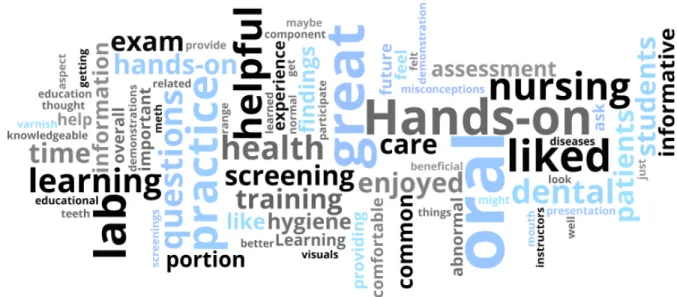
The immediate–post–survey gathered qualitative data to gauge nursing student’s opinions of the intervention using open–ended questions. Figure 1 depicts the most common themes derived from the student’s comments, including benefits of having hands–on learning experiences with oral screening, counseling, fluoride varnish application, and referrals. Students also expressed gratification of the IPE experience by learning from the DH educators. Students appreciated the opportunity to interact with the DH dental hygienists by asking questions about what is considered “normal” and “abnormal” and other questions related to oral health.
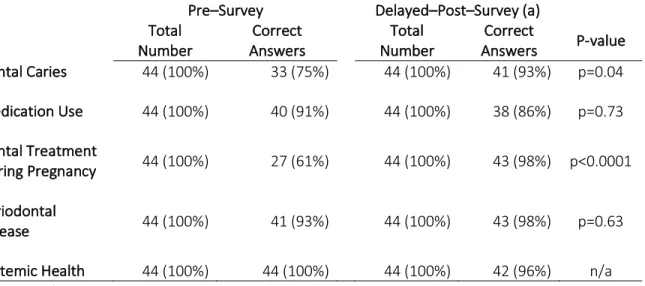
Table 1 illustrates change in proportion between correct answers for knowledge questions about dental caries, medication use, dental treatment during pregnancy, periodontal disease, and systemic health. Knowledge scores showed a statistically significant increase from pre– to delayed– post–survey in questions regarding dental caries (p = 0.04) and dental treatment during pregnancy (p < 0.0001). Knowledge scores for periodontal disease showed a slight increase but was not statistically significant (p = 0.63).
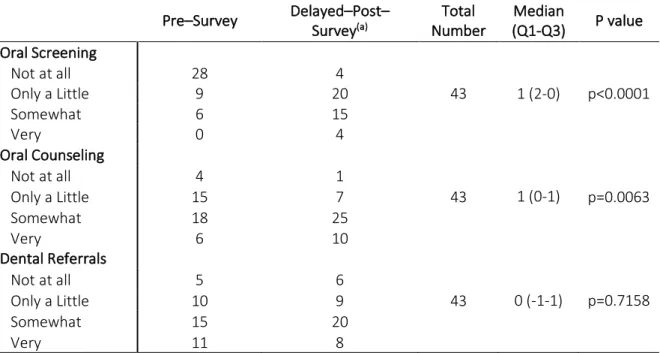
statistically significant decrease from pre– to delayed–post–surveys (p<0.0001). However, when asked specifically about the oral health training increasing their willingness to provide preventive oral health services, delayed–post–survey respondents reported being at least “a little” willing to provide oral screenings, oral counseling, and dental referrals (95.7%, 97.9%, 95.7%). Questions regarding the nurse’s role in providing oral screening and counseling remained neutral (p=0.73, p=0.49), but did show a statistically significant increase for providing dental referrals (p=0.02) from pre– to delayed– post–survey responses.
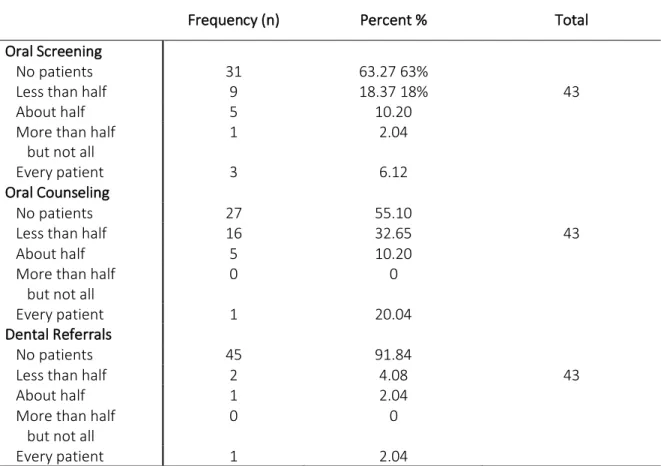
Table 3 shows behaviors reported on delayed–post–survey responses. 36.7% reported providing oral screening for at least one of their patients during clinical rotations, 44.9% reported providing oral counseling for at least one patient, and 8.2% reported providing at least one dental referral when indicated.
Discussion
This study aimed to evaluate knowledge, confidence, practice behaviors, and perceived barriers of nursing students regarding preventive oral health services before and after a didactic and clinical simulation intervention. Study investigators first gathered baseline information about
12
al., 2013). Research shows that students have a higher level of motivation in providing services when they feel they have received adequate instruction (Golinveaux et al., 2013).
Immediate–post–survey results demonstrated that students viewed the IPE experience as very positive. They enjoyed the multifaceted approach through the didactic and clinical simulation components. Students expressed that working through the clinical simulation case along with the DH educators allowed them to grasp a true understanding of the roles of the dental hygienist and the nurses’ scope of practice in regard to oral health delivery. These findings remain consistent with IPE research regarding the cultivation of the collaborative team environment (Anders et al., 2016; Haber et al., 2017). This aspect is important as the success of interprofessional practice is dependent upon the ability of health care professionals to work in teams, which should begin with an understanding of roles and responsibilities and potential contributions to the team from each individual discipline. The delayed–post–intervention showed an increase in knowledge among students in concepts of oral health. Self–reported levels of confidence and willingness also increased for oral screenings and counseling, meaning students may be more likely to provide preventive oral health services.
Although the intervention proved successful on many aspects, there were a few identified areas of weaknesses and barriers in the delayed–post–intervention survey primarily in reference to the provision of dental referrals. Due to the design as a pilot study, each of the various clinical rotation sites were equipped with limited resources and calibration for providing dental referrals for patients. Student rotations were primarily held in the hospital medical–surgical nursing setting in various services, which means that student/patient interaction varied greatly. This setting does not afford many opportunities for the provision of these specific preventive oral health services.
opportunities arose. Additional perceived barriers to take into consideration would be a lack of oral hygiene supplies, lack of oral health calibration between nursing clinical faculty, and limited time for provision of oral health services.
This IPL experience allowed the investigators to examine the feasibility of incorporating IPE and prompts future studies to include a learning environment for both nurses and DH students to collaborate on patient care. This study thus provides a model for IPE activities and could influence improved patient health outcomes. IPE activities may increase competence of health care providers as they are able to truly understand their roles in practice and the roles of other health care
providers. These concepts can be taken into the workforce as health care is so quickly approaching an integrated model of collaborative practice. Future studies should include more interaction between students in both health disciplines. Such interaction may include pre–assigned case study reviews accompanied with round–table discussion of roles and responsibilities of each discipline. Students from other health disciplines may also be included to expand students’ understanding of roles of health care providers. Future studies must also include an ongoing evaluation of oral health content in health disciplines to make sure that all students are receiving calibrated information.
The inclusion of the concepts of IPL in students’ first year of nursing school should be
considered a strength as these students are able to include the received information throughout their program and upon graduation. Having DH educators delivering the information was very well–
received as students were able to understand the relevance and importance of preventive oral health services and the relationship to systemic health.
14
routine care. These environments present opportunities to provide oral care services that may otherwise not be provided. This places the burden of identifying and treating oral complications on the primary care providers. Inadequate or inaccurate training may result in lack of or misdiagnosis of oral findings that could delay or prolong care and could cause unnecessary pain to the patient. It is important to provide resources for primary care providers such as SFL (Douglass et al., 2007; Quinonez et al., 2017) as programs like these can be easily incorporated into nursing curricula. Not only do these programs add oral health content to nursing curricula but are also resources that can be taken to practice and can be used for patient care.
Another example is access to dental care services for children. Most children are covered by private or public insurance and receive regular well–child visits. The US Preventive Service Task Force reviewed and supported fluoride in the medical home (Chou et al., 2014). These appointments with primary care providers can serve as an opportune time to provide oral screening, educational counseling about oral health, and possible referrals, when indicated. As the students were provided with the unique opportunity of practicing fluoride application, they are now equipped with the knowledge to provide fluoride varnish therapy as well. Thinking from a broader perspective and a more comprehensive person–centered approach to care will enhance patient outcomes and ultimately improve delivery of care for patients.
move us towards predictors of success in oral health education, which can further inform more personalized education. Although inclusion of interprofessional teamwork so early in nursing
curriculum may be a benefit, it may also be considered a limitation as student had not yet had patient interaction prior to the intervention. Future studies should also consider an IPE experience to include students from additional disciplines with opportunities to teach one another and learn together, to provide a more expanded IPE experience. Additionally, reporting–bias may have played a role in the data from the questionnaires.
Concluding Comments
Interprofessional didactic and simulated oral health educational opportunities increased knowledge and confidence among ABSN students to deliver preventive oral health services in practice. Incorporating IPL in nursing curriculum is recommended to increase student willingness to participate in collaborative practice in their future profession as intervention can have a positive impact on behavior. IPE allows students to develop optimistic attitudes towards open communication between health disciplines. This study supports IPE as a method to increase students’ self–confidence to provide preventive oral health services in the medical home. Future IPE research should include multiple disciplines so true collaborative practice and recognition of the value of individual
16 APPENDIX
Table 1. Oral health knowledge change of University of North Carolina at Chapel Hill (UNC) Accelerated Bachelor of Nursing Program (ABSN) students
Pre–Survey Delayed–Post–Survey (a) Total
Number Answers Correct Number Total Answers Correct P-value Dental Caries 44 (100%) 33 (75%) 44 (100%) 41 (93%) p=0.04
Medication Use 44 (100%) 40 (91%) 44 (100%) 38 (86%) p=0.73
Dental Treatment
During Pregnancy 44 (100%) 27 (61%) 44 (100%) 43 (98%) p<0.0001
Periodontal
Disease 44 (100%) 41 (93%) 44 (100%) 43 (98%) p=0.63
Systemic Health 44 (100%) 44 (100%) 44 (100%) 42 (96%) n/a
Table 2. UNC ABSN students’ self-reported confidence change in providing preventive oral health services (screen, counsel, refer)
(a) Five months post intervention following clinical rotations.
Pre–Survey Delayed–Post–Survey(a) Number Total (Q1-Q3) Median P value
Oral Screening
Not at all 28 4
Only a Little 9 20 43 1 (2-0) p<0.0001
Somewhat 6 15
Very 0 4
Oral Counseling
Not at all 4 1
Only a Little 15 7 43 1 (0-1) p=0.0063
Somewhat 18 25
Very 6 10
Dental Referrals
Not at all 5 6
Only a Little 10 9 43 0 (-1-1) p=0.7158
Somewhat 15 20
18
Table 3. UNC ABSN students’ self-reported preventive oral health services performed during clinical rotations
(a) Five months post intervention following clinical rotations.
Frequency (n) Percent % Total
Oral Screening
No patients 31 63.27 63%
Less than half 9 18.37 18% 43
About half 5 10.20
More than half
but not all 1 2.04
Every patient 3 6.12
Oral Counseling
No patients 27 55.10
Less than half 16 32.65 43
About half 5 10.20
More than half
but not all 0 0
Every patient 1 20.04
Dental Referrals
No patients 45 91.84
Less than half 2 4.08 43
About half 1 2.04
More than half
but not all 0 0
20 REFERENCES
Abou El Fadl, R., Blair, M., & Hassounah, S. (2016). Integrating Maternal and Children’s Oral Health Promotion into Nursing and Midwifery Practice- A Systematic Review. Plos One, 11(11), e0166760. doi:10.1371/journal.pone.0166760
Anders, P. L., Scherer, Y. K., Hatton, M., Antonson, D., Austin-Ketch, T., & Campbell-Heider, N. (2016). Using standardized patients to teach interprofessional competencies to dental students. Journal of Dental Education, 80(1), 65–72.
Chou, R., Cantor, A., Zakher, M. H. S., Mitchell, M., Mir, & Pappas. (2014). Prevention of Dental Caries in Children Younger Than 5 Years Old: Systematic Review to Update the U.S. Preventive Services Task Force Recommendation. Evidence Synthesis No. 104. Agency for Healthcare Research and Quality, AHRQ Publication No. 12-05170-EF-1.
Clark, M., Quinonez, R., Bowser, J., & Silk, H. (2017). Curriculum influence on interdisciplinary oral health education and practice. Journal of Public Health Dentistry, 77(3), 272–282.
doi:10.1111/jphd.12215
Coker, E., Ploeg, J., Kaasalainen, S., & Carter, N. (2017). Nurses’ oral hygiene care practices with hospitalised older adults in postacute settings. International Journal of Older People Nursing, 12(1). doi:10.1111/opn.12124
Core Competencies for Interprofessional Collaborative Practice: 2016 Update. (n.d.).
Costello, T., & Coyne, I. (2008). Nurses’ knowledge of mouth care practices. British Journal of Nursing, 17(4), 264–268. doi:10.12968/bjon.2008.17.4.28716
Czarnecki, G. A., Kloostra, S. J., Boynton, J. R., & Inglehart, M. R. (2014). Nursing and dental students’ and pediatric dentistry residents’ responses to experiences with interprofessional education.
Journal of Dental Education, 78(9), 1301–1312.
Dolce, M. C. (2014). Integrating oral health into professional nursing practice: an interprofessional faculty tool kit. Journal of Professional Nursing : Official Journal of the American Association of
Colleges of Nursing, 30(1), 63–71. doi:10.1016/j.profnurs.2013.06.002
Dolce, M. C., Haber, J., & Shelley, D. (2012). Oral health nursing education and practice program.
Nursing Research and Practice, 2012, 149673. doi:10.1155/2012/149673
Douglass, A. B., Gonsalves, W., Maier, R., Silk, H., Stevens, N., Tysinger, J., & Wrightson, A. S. (2007). Smiles for Life: A National Oral Health Curriculum for Family Medicine. A model for
curriculum development by STFM groups. Family Medicine, 39(2), 88–90.
Golinveaux, J., Gerbert, B., Cheng, J., Duderstadt, K., Alkon, A., Mullen, S., … Zhan, L. (2013). Oral health education for pediatric nurse practitioner students. Journal of Dental Education, 77(5), 581–590.
Haber, J., Hartnett, E., Allen, K., Crowe, R., Adams, J., Bella, A., … Vasilyeva, A. (2017). The Impact of Oral-Systemic Health on Advancing Interprofessional Education Outcomes. Journal of Dental Education, 81(2), 140–148.
Hein, C., Schönwetter, D. J., & Iacopino, A. M. (2011). Inclusion of oral-systemic health in
predoctoral/undergraduate curricula of pharmacy, nursing, and medical schools around the world: a preliminary study. Journal of Dental Education, 75(9), 1187–1199.
Hummel, J., Phillips, K. E., Holt, B., & Hayes, C. (2015). Oral Health: An Essential Component of Primary Care. Qualis Health.
Mattheus, D., Shannon, M., Gandhi, K., & Lim, E. (2018). Oral health knowledge and practices of pediatric and family nurse practitioners. Journal of Pediatric Health Care : Official Publication of National Association of Pediatric Nurse Associates & Practitioners.
doi:10.1016/j.pedhc.2017.12.005
Mitchell, J. K., May, R., & Riggs, B. (2017). Oral health care for nurse educator, part 2: the school year: 6 years old to young adult. Teaching and Learning in Nursing, 12(2), 165–169.
doi:10.1016/j.teln.2017.02.001
Mitchell, J., & Shoemaker, A. (2017). Oral health care for nurse educators, part 1: birth to 6 years old.
Teaching and Learning in Nursing, 12(1), 69–72. doi:10.1016/j.teln.2016.10.008
Oral Health Integration | Qualis Health. (n.d.). Retrieved February 20, 2018, from
http://www.qualishealth.org/our-services/practice-transformation/oral-health-integration Otsuka, H., Kondo, K., Ohara, Y., Yasuda, M., Kishimoto, N., Sunaga, M., … Shinada, K. (2016). An Inter-
and Intraprofessional Education Program in Which Dental Hygiene Students Instruct Medical and Dental Students. Journal of Dental Education, 80(9), 1062–1070.
Pai, M., Ribot, B., Tane, H., & Murray, J. (2016). A study of periodontal disease awareness amongst third-year nursing students. Contemporary Nurse : A Journal for the Australian Nursing
Profession, 52(6), 686–695. doi:10.1080/10376178.2016.1222241
Quinonez, R. B., Padilla, R., Steiner, M., Lampiris, L., Gilliand, K., Kowlowitz, V., … Stepp, W. (2017). Oral Health for Primary Care Providers. Videomedia. Retrieved March 27, 2018, from http://www.smilesforlifeoralhealth.org
Sharif, S., Saddki, N., & Yusoff, A. (2016). Knowledge and Attitude of Medical Nurses toward Oral Health and Oral Health Care of Pregnant Women. The Malaysian Journal of Medical Sciences : MJMS, 23(1), 63–71.
Silk, H. (2018). The expanding dental workforce: the impact of nondental providers. Dental Clinics of
22
Weintraub, J. A. (2017). What should oral health professionals know in 2040: executive summary.
Journal of Dental Education, 81(8), 1024–1032. doi:10.21815/JDE.017.055
WHO | Nursing. (n.d.). Retrieved October 31, 2017, from http://www.who.int/topics/nursing/en/ Wooten, K. T., Lee, J., Jared, H., Boggess, K., & Wilder, R. S. (2011). Nurse practitioner’s and certified