1
Heritability of Perinatal Depression and Genetic Overlap with Non-perinatal
Depression
Alexander Viktorin MSca, Samantha Meltzer-Brody MD, MPHb, Ralf Kuja-Halkola PhDa, Patrick F. Sullivan MD, FRANZCPa,b,c, Mikael Landén MD, PhDa,d, Paul Lichtenstein PhDa, Patrik KE Magnusson PhDa
Abstract previously presented at the 44th Behavior Genetics Association meeting,
Charlottesville USA, June 18 to June 21 2014.
a Department of Medical Epidemiology and Biostatistics, Karolinska Institutet,
Stockholm, Sweden
bDepartment of Psychiatry, University of North Carolina School of Medicine, Chapel
Hill, North Carolina, USA
c Department of Genetics, University of North Carolina School of Medicine, Chapel Hill,
North Carolina, USA
d Institute of Neuroscience and Physiology, University of Gothenburg, Gothenburg,
Sweden
Corresponding Author: Alexander Viktorin, Department of Medical Epidemiology and
Biostatistics, Karolinska Institutet, Stockholm, Sweden. Postal address: Karolinska
Institutet, PO Box 281, SE-171 77 Stockholm, SWEDEN. E-mail:
2
I, as the corresponding author, affirm that I had access to all data from the study, both
reported and unreported. I also affirm that I had complete freedom to direct the analysis and
reporting, without influence from the sponsors. I also affirm that all listed authors have
contributed to the study according to the three conditions listed in the “Guidelines for Authors
on Preparing Manuscripts”, and that all authors agree to submission and copyright transfer.
The authors report no conflicts of interest.
Alexander Viktorin, Samantha Meltzer-Brody, Ralf Kuja-Halkola, Patrick F. Sullivan, Paul
Lichtenstein, and Patrik K.E. Magnusson declare no other financial support other than the
supporting grants.
Mikael Landén declares that, over the past three years, he has received compensation for
lectures from AstraZeneca, Bayer, Biophausia, Bristol Myers-Squibb, Lundbeck
pharmaceuticals, Eli Lilly Sweden, Wyeth, Servier Sweden, and served at advisory board for
AstraZeneca and Lundbeck pharmaceuticals. No other equity ownership, profit-sharing
agreements, royalties, or patent.
Funding/Support: The Swedish Twin Registry is financially supported by Karolinska
Institutet. This specific study was supported by grants from the Swedish Medical
Research Council (K2014-62X-14647-12-51 and K2010-61P-21568-01-4), the Swedish
foundation for Strategic Research, the Swedish Brain foundation, and the National
3
ABSTRACT
Objective: To investigate the relative importance of genetic and environmental
influences on perinatal depression, and the genetic overlap between perinatal depression
and non-perinatal depression.
Method: Analyses were conducted using structural equation modeling for (1) a validated
self-rated screening tool for perinatal depression, the lifetime version of the Edinburgh
Postnatal Depression Scale, in 3,427 Swedish female twins, and (2) clinical diagnoses of
depression separated into perinatal depression and non-perinatal depression in a Swedish
population-based cohort of 580,006 sisters.
Results: In the twin study, the heritability of perinatal depression was estimated at 54%
(95% CI, 35-70%) with the remaining variance attributable to non-shared environment
(46%; 95% CI, 31-65%). In the sibling design, the heritability of perinatal depression was
estimated at 44% (95% CI, 35-52%), and the heritability of non-perinatal depression at
32% (95% CI, 24-41%). Bivariate analysis showed that 14% of the total variance (or
33% of the genetic variance) in perinatal depression was unique for perinatal depression.
Conclusions: The heritability estimate is higher for perinatal depression than for
non-perinatal depression. Further, a third of the genetic contribution is unique to non-perinatal
depression and not shared with non-perinatal depression, suggesting only partially
overlapping genetic etiologies for perinatal depression and non-perinatal depression. We
suggest that perinatal depression constitutes a more homogenous subset of depression
4
translational impact that can assist clinicians in the counsel of their patients regarding risk
5
INTRODUCTION
Perinatal depression, defined as depressive illness occurring during pregnancy (antenatal
depression) or following childbirth (postpartum depression), impacts at least 10-15% of
women, and confers substantial morbidity, mortality, and personal and societal
costs.(1-4) The clinical presentation of perinatal depression features low mood, anxiety,
rumination, and in severe cases suicidal or infanticidal ideation.(5) Historically, perinatal
depression has been conspicuously under-studied as compared to major depressive
disorder.(6)
Major depressive disorder is defined as marked and persistent depressed mood associated
with physical and cognitive signs and symptoms.(7) Depression is common, costly, and is
projected to be the second leading cause of disability worldwide by 2020.(8-11) The
heritability of major depressive disorder has been estimated at 31–42%.(12,13) In
contrast to other major psychiatric disorders, discerning the genetic basis of depression
has proven to be more challenging. Genome-wide linkage studies, candidate gene studies,
and genome-wide association studies have not been successful in identifying risk loci that
meet contemporary standards for replication.(14) The relatively modest heritability of
depression, as compared to other major psychiatric disorders, may be one reason for the
substantially lower yield of identified genetic loci.(15) Another reason is that depression
is a markedly heterogeneous disorder.
In contrast, perinatal depression may represent a more homogenous disorder. Perinatal
depression occurs in women of reproductive age and is coupled to pregnancy and
childbirth. The limited literature on the genetic basis of perinatal depression suggests a
heritable component that may be greater than in major depressive disorder.(16-18) There
6
reported odds ratios for prediction of sibling status for perinatal depression or postpartum
depression between 2.28-3.96.(17) Forty et al. studied female siblings and described
familiality for postpartum depression maximized with a postpartum onset definition of 6– 8 weeks following childbirth (tetrachoric correlation coefficient=0.62, 95% CI=0.16-0.88; p=0.01) in women with recurrent depression.(18) Finally, an Australian study of 1,676 twins estimated heritability of lifetime postpartum depression at 25%.(16)
Some have argued that perinatal depression is partly or wholly distinct from major
depressive disorder. According to this view, the biological underpinnings of perinatal
depression differ from those in non-perinatal depression in that sensitivity to the dramatic
fluctuations in gonadal hormone serum concentrations during the perinatal period
probably play a pathogenic role.(19,20) This implies that perinatal depression and
non-perinatal depression are at least partially different disorders where non-perinatal depression
features distinctive genetic and environmental etiological risk factors. The alternative
viewpoint is that perinatal depression is merely an episode of major depressive disorder
occurring in the temporal period beginning during pregnancy or the immediate
postpartum. Given the uncertainty about the degree to which perinatal depression and
non-perinatal depression are distinct and the limited literature on the genetic basis of
depression during the perinatal period, there is a great need for improved understanding
of the genetic basis of perinatal depression, and the extent to which perinatal depression
and non-perinatal depression overlap genetically. In this study, we used data from a
validated screening tool for perinatal depression in 3,427 twins from the Swedish Twin
Registry to estimate the relative contributions of genetic (heritability) and environmental
risk factors to the liability to perinatal depression in a classical twin design. We then used
Swedish population data from over 580,000 sisters and national treatment registers to
7
depression, and the genetic and environmental overlap between the two.
METHODS
Classical twin study
Study population. The Swedish Twin Registry contains almost 200,000 Swedish twins
born between 1886-2008.(21) The sub-study “Screening Across the Lifespan Twin study:
the Younger” (SALTY) was conducted between 2009-2010 and included 11,372 twins
from the Swedish Twin Registry with a median birth year of 1950 (54.3% female). The
SALTY study included an extensive self-report questionnaire that covered many different
areas, including perinatal depression.(22) The sample consisted of females from the
SALTY study who reported having given birth to a living child, and who completed the
lifetime Edinburgh Postnatal Depression Scale. This included 3,427 individual twins
(1,516 female monozygotic and 1,911 female same-sex dizygotic twins) and both
members of 1,106 twin pairs. Zygosity was determined using DNA for 27% of the twin
females. For the remainder, zygosity was assigned based on questions about intra-pair
physical similarities in childhood.(21)
Perinatal depression classification. We assessed onset of mood symptoms both during
pregnancy and postpartum using a retrospective lifetime version of the Edinburgh
Postnatal Depression Scale, previously described in detail.(23) The Edinburgh Postnatal
Depression Scale is the most widely used patient-rated assessment instrument for
perinatal depressive illness in the world and has demonstrated good sensitivity and
specificity in both antenatal and postpartum depression.(2,24) The lifetime version of the
Edinburgh Postnatal Depression Scale includes the same 10 items used in the original
scale, but was modified to assess previously experienced (or lifetime) perinatal
8
depressive illness and has been widely used in the literature, and was used in this study to
define a binary outcome.(24,25)
Statistical analysis. The classical twin methodology relies on the different relatedness
between monozygotic and dizygotic twins. Monozygotic twins are considered genetically
identical whereas dizygotic twins share an average of 50% of their segregating alleles. If
genes influence a trait, there will be more pronounced twin similarity within monozygotic
than within dizygotic pairs. By modeling twin covariance structures in monozygotic and
dizygotic pairs, the variation in a phenotype is decomposed into additive genetic (A),
shared environmental (C), and non-shared environmental (E) factors.(26) We used a
liability-threshold approach, assuming that the observed binary variable came from an
underlying continuous liability of the trait.(26) A threshold was assumed, where a 1 was
assigned if an individual had a liability greater than the threshold, and 0 otherwise. The
distribution of underlying liabilities were assumed normal, and the correlations between
these underlying normal distributions could be estimated.(27) The resulting tetrachoric
correlations form the basis of the heritability analysis. Note that the key assumptions of
normally distributed liability and equal-environments have strong empirical support.(28)
Sibling design
Study population. To evaluate genetic and environmental influences on perinatal
depression and non-perinatal depression in a larger and more generalizable setting, we
included a population-based cohort from Swedish national register data. We used the
Swedish personal identification numbers to link national Swedish longitudinal registries
with high accuracy. The Swedish Medical Birth Register covers 99% of all births since
1973,(29) and was linked to the Multi-Generation Register that contains information of
9
Multi-Generation Register were linked to the Swedish Twin Registry to obtain
information on twins and their zygosity. All parous women who had given birth to their
first child after 1973 were included. Further, the women had to be born in Sweden, could
not have emigrated and moved back to Sweden more than once, and had to have at least
one sister fulfilling the same criteria. Due to the low observed occurrence of perinatal
depression in the registers (0.6%; Table 2), we opted for a design that included up to four
full or half-siblings per nuclear family, covering 99.8% of the eligible population. We
identified a total of 580,006 parous female siblings from 260,384 unique families. This
allowed for comparisons in 313,632 full-sister pairs, 28,568 maternal half-sister pairs,
33,931 paternal half-sister pairs, 2,104 dizygotic twin sister pairs, and 2,225 monozygotic
twin sister pairs. A total of 1,572 twin sisters overlapped between the two different
designs.
Disease classification. We linked all subjects in the study population to the Swedish
National Patient Register, containing all Swedish psychiatric inpatient admissions since
1973, and psychiatric specialist outpatient treatment contacts since 2001.(31) The register
contains admission dates along with the main discharge diagnosis code, and up to eight
secondary diagnosis codes in accordance with the International Classification of Disease
(ICD). Treatment contacts for depression were defined using diagnostic codes: ICD-8
296.00, 296.40, 296.41, 790.20; ICD-9 296.2, 296.3, 296.9, 298.0, 300.4, 309.0, 309.1,
and 311; or ICD-10 F32.0, F32.1, F32.2, F32.3, F32.8, F32.9, F33.0, F33.1, F33.2, F33.3,
F33.4, F33.8, F33.9, F34.1, and F41.2. These diagnostic codes were selected to capture as
many women with perinatal depressive symptoms as possible. The perinatal period was
defined as any point from estimated date of conception through six-months postpartum.
Although the onset of postpartum depression is often within 4-6 weeks of childbirth,(7)
10
months postpartum, as treatment onset may be substantially delayed from symptom
onset. Many women delay seeking treatment due to concerns of stigma of mental health
treatment,(32) uncertainty about the nature of symptoms (postpartum “blues” or a normal
transition to motherhood versus an illness state requiring treatment), or perceived lack of
time for self-care.(33)
The conception date was calculated using the birthdate of the child and gestational age at
delivery. Perinatal depression was defined as ≥1 inpatient or outpatient treatment contact
for unipolar depression within a perinatal period. Non-perinatal depression was defined
as unipolar depression at any other time in a woman’s life.
The perinatal period was further separated into an antenatal and a postnatal period to
allow heritability estimation of antenatal and postnatal depression respectively. For this
purpose, the postnatal period was extended to 12 months.
Statistical analysis. To estimate the relative importance of genetic and environmental
effects, we considered up to four female siblings simultaneously in family clusters. The
family clusters included siblings who shared at least one parent, allowing full and
half-siblings within a family. No individual was included in more than one cluster and no
known sibling relations existed between clusters. If half siblings were clustered into more
than one family, only the largest family was included to avoid duplicate entries. If a
family cluster consisted of more than four individuals, four individuals were randomly
selected.
As in the classical twin design, monozygotic and dizygotic twins were assumed to share
100% and 50% of their additive genetic factors, A; the corresponding values were 50%
for full siblings, and 25% for maternal and paternal half siblings. The shared
11
siblings were it was assumed unshared as Swedish half siblings are much more likely to
live with their mother.(34) Individual specific environment (E) was modeled to be unique
to each individual. Relying on these assumptions we could determine the expected
correlation structures for each specific type of family cluster depending on the sibling
types were included. We again used the liability-threshold approach for analysis of the
binary traits. We fitted univariate models where the variance in each disease separately
were modeled to be due to A, C, and E. We then fit bivariate models where the variance
and covariance in each trait were simultaneously modeled to be due to A, C, and E. To
estimate how much of the variance in perinatal depression that could be attributed to A,
C, and E in common with non-perinatal depression and A, C, and E unique to perinatal
depression we used a Cholesky decomposition approach.(26) As this was modeled in a
regression framework, we adjusted the prevalences for whether the family included
half-siblings as well as for birth year (both linear and squared). Non-perinatal depression was
additionally adjusted for time at risk (linear and squared) and perinatal depression for
number of offspring.
Statistical software
Data were prepared using SAS v9.3. Analyses were performed using the OpenMx
package in R 3.0.2. In the twin-only analysis, missing values were handled by full
information maximum likelihood. No missing values existed for the diseases and
covariates in the sibling analyses.
Role of the Sponsor: The sponsors had no role in the design and conduct of the study;
collection, management, analysis, and interpretation of the data; preparation, review, or
12
Ethical approval
The study was approved by the regional ethics committee in Stockholm.
RESULTS
Classical twin design
The observed occurrence of perinatal depression in the twin sample (lifetime Edinburgh
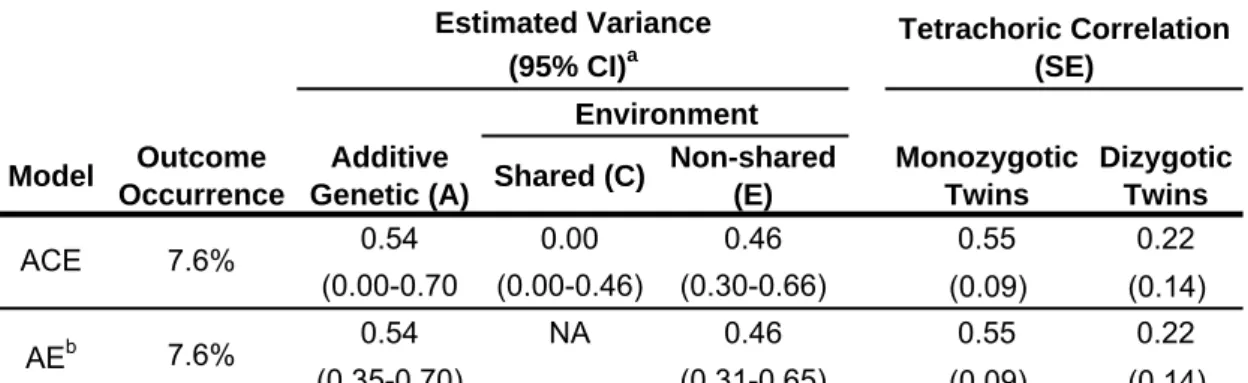
Postnatal Depression Scale total score ≥12) was 7.6% (Table 1). In the ACE model, there
was no significant common environmental effect, and therefore we fitted a model where
C-parameter was fixed at zero (AE model) that did not fit the data significantly worse
(χ2=0.00, degrees of freedom=1, p-value=1.00). The heritability of perinatal depression based on the lifetime Edinburgh Postnatal Depression Scale was estimated at 54% (95%
CI, 35-70%) with the remaining variance due to non-shared environment (46%) (Table
1).
Sibling design
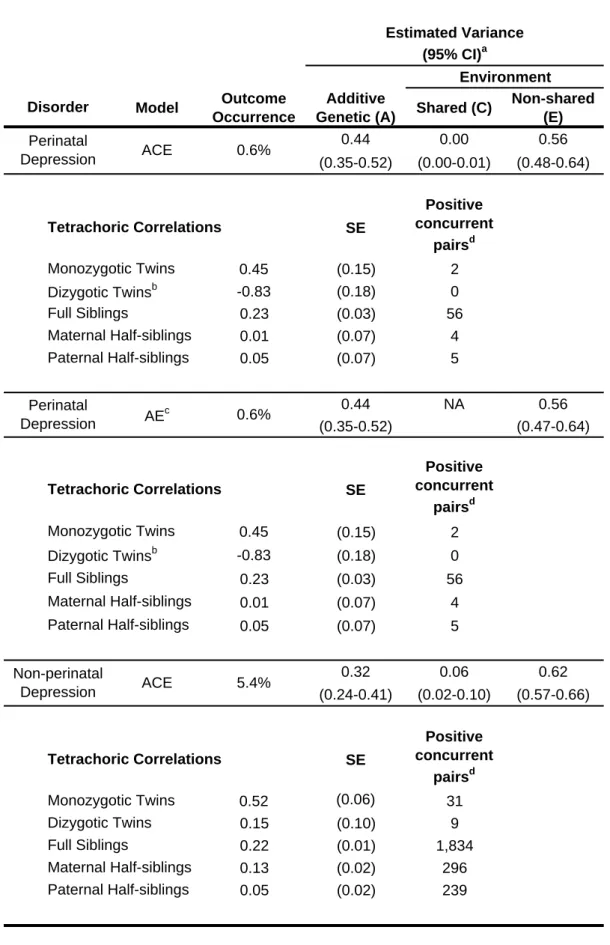
Based on treatment contacts, the observed occurrence of perinatal depression was 0.6%
(Table 2). The heritability of perinatal depression was estimated at 44% (95% CI,
35-52%), with the remaining variance attributable to non-shared environment (Table 2). The
heritability of non-perinatal depression was estimated at 32% (95% CI, 24-41%), with the
remaining variance attributable to shared environment (6%), and non-shared environment
(62%) (Table 2).
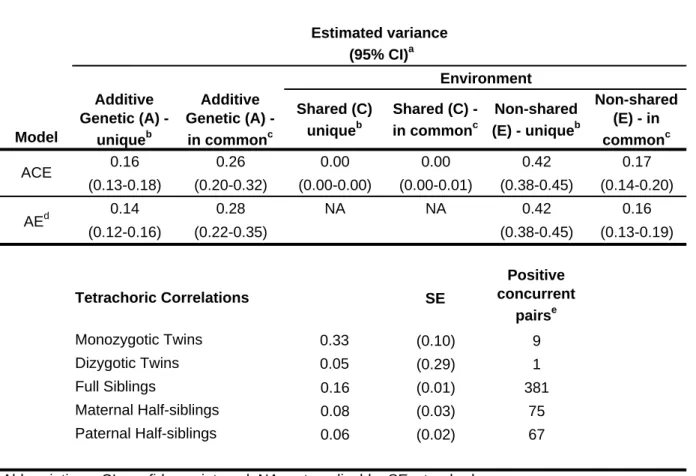
In a bivariate model all C-parameters, except C-unique for non-perinatal depression, was
estimated close to zero. Therefore, we fitted an AE model where these parameters were
13
genetic variance) in perinatal depression was unique for perinatal depression and not in
common with non-perinatal depression (Table 3 and Figure 1).
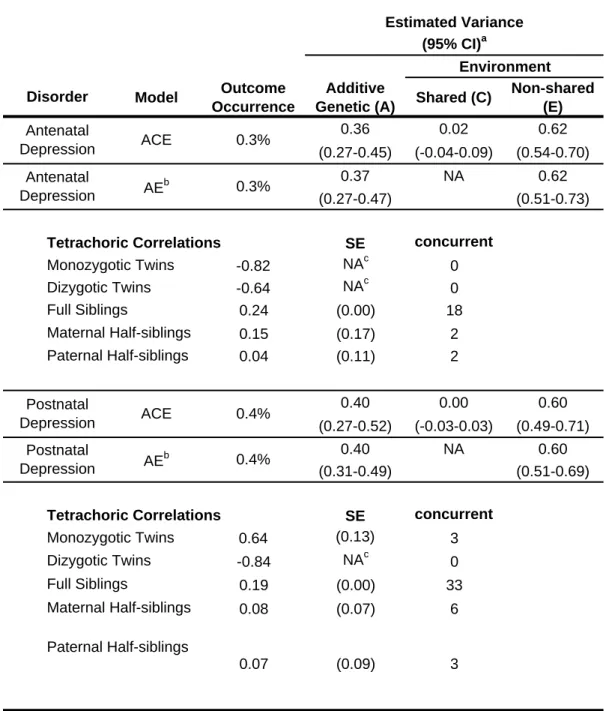
The heritability of antenatal depression was estimated at 37% (95% CI, 27-47%), with
the remaining variance attributable to non-shared environment, while the heritability of
postnatal depression was estimated at 40% (95% CI, 31-49%) with the remaining
variance attributable to non-shared environment (Table 4).
DISCUSSION
This is the largest and most comprehensive genetic epidemiological study of perinatal
depression yet reported. Using Swedish national cohorts, we estimated the heritability of
perinatal depression with two different approaches. Our classical twin design estimated
the univariate heritability of perinatal depression at 54% (95% CI, 35-70%) and the
sibling study estimated it at 44% (95% CI, 35-52%). Despite the marked difference in
observed occurrence of perinatal depression in the two designs (0.6% and 7.6%), the
heritability estimates are similar and the confidence intervals overlap, which suggests that
both approaches capture the same underlying liability for perinatal depression. The
different observed occurrence rates are likely explained by the different methodologies;
self-report in the twin design, and register based treatment contacts in the sibling design.
Thus, the sibling design did not account for women who did not seek treatment for
perinatal depression but who would endorse symptoms on a self-report questionnaire.(35)
To our knowledge, there has only been one previous heritability study of depression
around pregnancy.(16) This Australian twin-study (N=1,676) estimated the heritability of
lifetime postnatal depression at 25% (95% CI, 13-42%). Our estimates for lifetime
14
35-52%) in the sibling design, indicate a larger genetic contribution than in the Australian
study.
Division of the perinatal period allowed estimating the heritability of antenatal depression
at 37% (95% CI, 27-47%) and postnatal depression at 40% (95% CI, 31-49%) (Table4).
The variance of both antenatal and postnatal depression displayed a similar pattern as the
variance of perinatal depression as a whole with variance explained by additive genetics
of similar size and non-shared environment only, without contribution of shared
environment.
We estimated the heritability of non-perinatal depression at 32% (95% CI, 24-41%),
which is slightly lower than previous estimates of major depressive disorder.(13)
However, we only included parous women, and separated the perinatal and non-perinatal
depressive episodes.
In a bivariate heritability analysis of perinatal depression and non-perinatal depression,
14% of the variance in perinatal depression was explained by genetic factors unique for
perinatal depression and 28% by genetic factors shared with non-perinatal depression. In
other words, of the total genetic variation for perinatal depression, 2/3 is shared with
non-perinatal depression and 1/3 is unique for non-perinatal depression.
The heritability estimates of perinatal depression in these two analyses may have
particularly important implication. A critical issue in genetic research in unipolar mood
disorders is etiological heterogeneity. It is likely that there are multiple “types” of
persistent depressive disorders. Considering these disorders as a single entity may
effectively combine different sets of genetic and environmental etiological processes
resulting in higher prevalence and lower heritability.(36-38) This combination is arguably
15
Thus, we hypothesize that perinatal depression represents a form of unipolar mood
disorder that could be prioritized for genomic discovery efforts. In effect, we suggest a
“divide and conqueror” approach to understanding the genomics of unipolar mood
disorders. Appropriately powered studies of perinatal depression could deliver genomic
findings important to disentangling its etiology as well as of potential relevance to major
depressive disorder. We note that women with perinatal depression are readily
ascertained clinically enabling efficient accrual of large samples. Ultimately, improved
identification of women at risk for perinatal depression could lead to targeted
interventions to prevent, identify, and more effectively treat perinatal depression in order
to minimize adverse sequelae for mother and child.
The current study has several strengths. The study uses both classical twin and sibling
designs. Two designs with different tools to measure perinatal depression; the validated
Edinburgh Postnatal Depression Scale in 3,427 female twins, and treatment contacts from
national Swedish registers in over 580,000 sisters that allowed for separation of
depressive illness into perinatal depression and non-perinatal depression, and perinatal
depression further into antenatal and postnatal depression. Additionally, sensitivity
analyses suggested that the unique genetic component seen in perinatal depression was
not explained by bipolar disorder or schizophrenia (see Supplement SA1), and that the
unique genetic component was linked to the actual pregnancy (see Supplement SA2).
This study also has limitations. The Swedish National Patient Register does not include
outpatient admissions before 2001 and no primary care data. The percentage of women
being treated for depression exclusively by the primary care in Sweden is not known, but
the observed occurrence of perinatal depression based on treatment contacts is likely an
underestimation of the true prevalence. Further, depression identified using the National
16
identified using the Edinburgh Postnatal Depression Scale. If the assumption of an
underlying continuous liability in the threshold model is true this should not affect the
heritability estimates. Indeed, increasing or decreasing the Edinburgh Postnatal
Depression Scale cut-off to capture more or less severe depressive illness did not change
the heritability estimates (see Supplement SA3). The observed outcome occurrence of
perinatal depression among the twins using the Edinburgh Postnatal Depression Scale
was 7.6%, which is lower than observed in other studies (10-15%).(1-4) This could be
due to the participants being exclusively twins and the retrospective assessment, rather
than being assessed at a maternal healthcare unit. When estimating the heritability of
antenatal and postnatal depression respectively, the postnatal period had to be expanded
to 12 months to include enough cases to allow estimation. While this deviates from the
definition of perinatal depression that includes a six-month postnatal period, analysis of
perinatal depression using a 12-month postnatal period revealed almost identical results
with the heritability estimated at 43% (95% CI, 34-51%) and the remaining variance
explained by non-shared environment (57%; 95% CI, 49-66%). We were not able to
restrict the postnatal period to the first four or six weeks. However, an early onset
depression might not lead to contact with the healthcare within this period and could
therefor remain undetected when using treatment contact data. Examination of
differences regarding timing of onset of symptoms in pregnancy versus postpartum has
been a central issue in recent work,(40) and future research should focus on further
elucidating the genetic and biological contributions to the timing of onset of symptoms.
These findings provide important information that will assist clinicians as they counsel
their patients regarding the risk and prognosis of perinatal mood disorders. For example,
the heritability of a disorder has a direct translational impact in discussions between
17
perinatal depression?”, “was it my fault?”, “what’s the risk next time?”. This study
highlights the critical need for clinicians providing obstetrical care to obtain detailed
information regarding the patient’s personal and family history of psychiatric illness that
began in the perinatal period. Integration of genetic risk with environmental influences is
vital for the appropriate tailoring of individual treatment and discussions of prognosis.
In conclusion, we report the largest heritability studies of perinatal depression to date,
indicating a larger heritability of perinatal depression than that for depression occurring
outside of the perinatal period, and the first bivariate heritability study of perinatal and
non-perinatal depression, revealing a third of the genetic variance unique for perinatal
depression. We believe that perinatal depression represents a form of unipolar mood
disorder that can be utilized by clinicians in discussions with their patients and could be
18
References
1. Flynn HA, Davis M, Marcus SM, Cunningham R, Blow FC: Rates of maternal depression
in pediatric emergency department and relationship to child service utilization. Gen Hosp
Psychiatry 2004; 26:316-322.
2. Gavin NI, Gaynes BN, Lohr KN, Meltzer-Brody S, Gartlehner G, Swinson T: Perinatal
depression: a systematic review of prevalence and incidence. Obstet Gynecol 2005;
106:1071-1083.
3. Marmorstein NR, Malone SM, Iacono WG: Psychiatric disorders among offspring of
depressed mothers: associations with paternal psychopathology. Am J Psychiatry 2004;
161:1588-1594.
4. Meltzer-Brody S, Stuebe A: The long-term psychiatric and medical prognosis of perinatal
mental illness. Best Pract Res Clin Obstet Gynaecol 2014; 28:49-60.
5. Bernstein IH, Rush AJ, Yonkers K, Carmody TJ, Woo A, McConnell K, Trivedi MH:
Symptom features of postpartum depression: are they distinct? Depress Anxiety 2008;
25:20-26.
6. Wisner KL, Moses-Kolko EL, Sit DK: Postpartum depression: a disorder in search of a
definition. Arch Womens Ment Health 2010; 13:37-40.
7. Association AP: The Diagnostic and Statistical Manual of Mental Disorders: DSM 5,
bookpointUS; 2013.
8. Lecrubier Y: The burden of depression and anxiety in general medicine. J Clin Psychiatry
2001; 62 Suppl 8:4-9; discussion 10-11.
9. Murray CJ, Lopez AD: Alternative projections of mortality and disability by cause
1990-2020: Global Burden of Disease Study. Lancet 1997; 349:1498-1504.
10. Murray CJ, Lopez AD: Evidence-based health policy--lessons from the Global Burden of
19
11. Ekman M, Granstrom O, Omerov S, Jacob J, Landen M: The societal cost of depression:
evidence from 10,000 Swedish patients in psychiatric care. J Affect Disord 2013;
150:790-797.
12. Wray NR, Gottesman, II: Using summary data from the danish national registers to
estimate heritabilities for schizophrenia, bipolar disorder, and major depressive disorder.
Front Genet 2012; 3:118.
13. Sullivan PF, Neale MC, Kendler KS: Genetic epidemiology of major depression: review
and meta-analysis. Am J Psychiatry 2000; 157:1552-1562.
14. Levinson DF, Mostafavi S, Milaneschi Y, Rivera M, Ripke S, Wray NR, Sullivan PF:
Genetic Studies of Major Depressive Disorder: Why Are There No Genome-wide Association
Study Findings and What Can We Do About It? Biol Psychiatry 2014; 76:510-512.
15. Major Depressive Disorder Working Group of the Psychiatric GC, Ripke S, Wray NR,
Lewis CM, Hamilton SP, Weissman MM, Breen G, Byrne EM, Blackwood DH, Boomsma
DI, Cichon S, Heath AC, Holsboer F, Lucae S, Madden PA, Martin NG, McGuffin P, Muglia
P, Noethen MM, Penninx BP, Pergadia ML, Potash JB, Rietschel M, Lin D, Muller-Myhsok
B, Shi J, Steinberg S, Grabe HJ, Lichtenstein P, Magnusson P, Perlis RH, Preisig M, Smoller
JW, Stefansson K, Uher R, Kutalik Z, Tansey KE, Teumer A, Viktorin A, Barnes MR,
Bettecken T, Binder EB, Breuer R, Castro VM, Churchill SE, Coryell WH, Craddock N,
Craig IW, Czamara D, De Geus EJ, Degenhardt F, Farmer AE, Fava M, Frank J, Gainer VS,
Gallagher PJ, Gordon SD, Goryachev S, Gross M, Guipponi M, Henders AK, Herms S,
Hickie IB, Hoefels S, Hoogendijk W, Hottenga JJ, Iosifescu DV, Ising M, Jones I, Jones L,
Jung-Ying T, Knowles JA, Kohane IS, Kohli MA, Korszun A, Landen M, Lawson WB,
Lewis G, Macintyre D, Maier W, Mattheisen M, McGrath PJ, McIntosh A, McLean A,
Middeldorp CM, Middleton L, Montgomery GM, Murphy SN, Nauck M, Nolen WA, Nyholt
20
SI, Sigurdsson E, Slager SL, Smit JH, Stefansson H, Steffens M, Thorgeirsson T, Tozzi F,
Treutlein J, Uhr M, van den Oord EJ, Van Grootheest G, Volzke H, Weilburg JB, Willemsen
G, Zitman FG, Neale B, Daly M, Levinson DF, Sullivan PF: A mega-analysis of
genome-wide association studies for major depressive disorder. Mol Psychiatry 2013; 18:497-511.
16. Treloar SA, Martin NG, Bucholz KK, Madden PA, Heath AC: Genetic influences on
post-natal depressive symptoms: findings from an Australian twin sample. Psychol Med
1999; 29:645-654.
17. Murphy-Eberenz K, Zandi PP, March D, Crowe RR, Scheftner WA, Alexander M,
McInnis MG, Coryell W, Adams P, DePaulo JR, Jr., Miller EB, Marta DH, Potash JB, Payne
J, Levinson DF: Is perinatal depression familial? J Affect Disord 2006; 90:49-55.
18. Forty L, Jones L, Macgregor S, Caesar S, Cooper C, Hough A, Dean L, Dave S, Farmer
A, McGuffin P, Brewster S, Craddock N, Jones I: Familiality of postpartum depression in
unipolar disorder: results of a family study. Am J Psychiatry 2006; 163:1549-1553.
19. Bloch M, Rubinow DR, Schmidt PJ, Lotsikas A, Chrousos GP, Cizza G: Cortisol
response to ovine corticotropin-releasing hormone in a model of pregnancy and parturition in
euthymic women with and without a history of postpartum depression. J Clin Endocrinol
Metab 2005; 90:695-699.
20. Bloch M, Daly RC, Rubinow DR: Endocrine factors in the etiology of postpartum
depression. Compr Psychiatry 2003; 44:234-246.
21. Lichtenstein P, De Faire U, Floderus B, Svartengren M, Svedberg P, Pedersen NL: The
Swedish Twin Registry: a unique resource for clinical, epidemiological and genetic studies. J
Intern Med 2002; 252:184-205.
22. Magnusson PK, Almqvist C, Rahman I, Ganna A, Viktorin A, Walum H, Halldner L,
Lundstrom S, Ullen F, Langstrom N, Larsson H, Nyman A, Gumpert CH, Rastam M,
21
Pedersen NL, Lichtenstein P: The Swedish twin registry: establishment of a biobank and
other recent developments. Twin Res Hum Genet 2013; 16:317-329.
23. Meltzer-Brody S, Boschloo L, Jones I, Sullivan PF, Penninx BW: The EPDS-Lifetime:
assessment of lifetime prevalence and risk factors for perinatal depression in a large cohort of
depressed women. Arch Womens Ment Health 2013; 16:465-473.
24. Cox JL, Holden JM, Sagovsky R: Detection of postnatal depression. Development of the
10-item Edinburgh Postnatal Depression Scale. Br J Psychiatry 1987; 150:782-786.
25. Wisner KL, Parry BL, Piontek CM: Clinical practice. Postpartum depression. N Engl J
Med 2002; 347:194-199.
26. Neale MC, Cardon LR, North Atlantic Treaty Organization. Scientific Affairs Division.:
Methodology for genetic studies of twins and families. Dordrecht ; Boston, Kluwer Academic
Publishers; 1992.
27. Divgi DR: Calculation of the Tetrachoric Correlation-Coefficient. Psychometrika 1979;
44:169-172.
28. Kendler KS, Neale MC, Kessler RC, Heath AC, Eaves LJ: A test of the
equal-environment assumption in twin studies of psychiatric illness. Behav Genet 1993; 23:21-27.
29. Cnattingius S, Ericson A, Gunnarskog J, Kallen B: A quality study of a medical birth
registry. Scand J Soc Med 1990; 18:143-148.
30. Ekbom A: The Swedish Multi-generation Register. Methods Mol Biol 2011;
675:215-220.
31. Ludvigsson JF, Andersson E, Ekbom A, Feychting M, Kim JL, Reuterwall C, Heurgren
M, Olausson PO: External review and validation of the Swedish national inpatient register.
BMC Public Health 2011; 11:450.
32. Sharma V, Sharma P: Postpartum depression: diagnostic and treatment issues. J Obstet
22
33. Beck CT: Theoretical perspectives of postpartum depression and their treatment
implications. MCN Am J Matern Child Nurs 2002; 27:282-287.
34. Holmberg M: Fakta om den svenska familjen : sammansättning och förändringar från
barndom till ålderdom. Örebro ;, Statistiska centralbyrån (SCB); 1994.
35. Leung SS, Leung C, Lam TH, Hung SF, Chan R, Yeung T, Miao M, Cheng S, Leung SH,
Lau A, Lee DT: Outcome of a postnatal depression screening programme using the
Edinburgh Postnatal Depression Scale: a randomized controlled trial. J Public Health (Oxf)
2011; 33:292-301.
36. Lewis CM, Ng MY, Butler AW, Cohen-Woods S, Uher R, Pirlo K, Weale ME, Schosser
A, Paredes UM, Rivera M, Craddock N, Owen MJ, Jones L, Jones I, Korszun A, Aitchison
KJ, Shi J, Quinn JP, Mackenzie A, Vollenweider P, Waeber G, Heath S, Lathrop M, Muglia
P, Barnes MR, Whittaker JC, Tozzi F, Holsboer F, Preisig M, Farmer AE, Breen G, Craig IW,
McGuffin P: Genome-wide association study of major recurrent depression in the U.K.
population. Am J Psychiatry 2010; 167:949-957.
37. Sullivan PF: The psychiatric GWAS consortium: big science comes to psychiatry.
Neuron 2010; 68:182-186.
38. Wray NR, Pergadia ML, Blackwood DH, Penninx BW, Gordon SD, Nyholt DR, Ripke S,
MacIntyre DJ, McGhee KA, Maclean AW, Smit JH, Hottenga JJ, Willemsen G, Middeldorp
CM, de Geus EJ, Lewis CM, McGuffin P, Hickie IB, van den Oord EJ, Liu JZ, Macgregor S,
McEvoy BP, Byrne EM, Medland SE, Statham DJ, Henders AK, Heath AC, Montgomery
GW, Martin NG, Boomsma DI, Madden PA, Sullivan PF: Genome-wide association study of
major depressive disorder: new results, meta-analysis, and lessons learned. Mol Psychiatry
2012; 17:36-48.
39. Sullivan PF, Daly MJ, O'Donovan M: Genetic architectures of psychiatric disorders: the
23
40. Postpartum Depression: Action Towards Causes and Treatment (PACT) Consortium:
Heterogeneity of postpartum depression: a latent class analysis. Lancet Psychiatry 2014;
24
FIGURES AND TABLES
Table 1. Univariate heritability estimate of perinatal depression using classical twin
design (N=3,427)*
Table 2. Univariate heritability estimates of perinatal depression and non-perinatal
depression using sibling design (N=580,006)*
Table 3. Estimated variance in perinatal depression
Table 4. Univariate heritability estimates of antenatal depression and postnatal
depression using sibling design (N=580,006)*
Figure 1. Estimated variance in perinatal depression*
* Variance accounted for by genetic, shared environmental, and non-shared environmental
effects for perinatal depression, either unique for perinatal depression or in common with
Model Outcome Occurrence
Additive
Genetic (A) Shared (C)
Non-shared (E)
Monozygotic Twins
Dizygotic Twins
0.54 0.00 0.46 0.55 0.22
(0.00-0.70 (0.00-0.46) (0.30-0.66) (0.09) (0.14)
0.54 NA 0.46 0.55 0.22
(0.35-0.70) (0.31-0.65) (0.09) (0.14)
b An AE model, were the C parameter was fixed at zero, was considered as the estimate of C
was zero in the ACE model.
a Profile likelihood confidence intervals.
Table 1. Univariate heritability estimate of perinatal depression using classical twin design (N=3,427)*
Abbreviations: CI, confidence interval. SE, standard error. NA, not applicable.
* Perinatal depression was defined using the lifetime Edinburgh Postnatal Depression Scale, where a score of ≥12 was used to define a binary outcome. The C component was not significant in the initial ACE model, and an AE model excluding the C component was fitted.
7.6%
Environment Estimated Variance
(95% CI)a
Tetrachoric Correlation (SE)
7.6% ACE
Model Outcome Occurrence
Additive
Genetic (A) Shared (C)
Non-shared (E)
0.44 0.00 0.56
(0.35-0.52) (0.00-0.01) (0.48-0.64)
SE
Positive concurrent
pairsd
0.45 (0.15) 2
-0.83 (0.18) 0
0.23 (0.03) 56
0.01 (0.07) 4
0.05 (0.07) 5
0.44 NA 0.56
(0.35-0.52) (0.47-0.64)
SE
Positive concurrent
pairsd
0.45 (0.15) 2
-0.83 (0.18) 0
0.23 (0.03) 56
0.01 (0.07) 4
0.05 (0.07) 5
0.32 0.06 0.62
(0.24-0.41) (0.02-0.10) (0.57-0.66)
SE
Positive concurrent
pairsd
0.52 (0.06) 31
0.15 (0.10) 9
0.22 (0.01) 1,834
0.13 (0.02) 296
0.05 (0.02) 239
Paternal Half-siblings
Abbreviations: NA, not applicable. CI, confidence interval. SE, standard error. Full Siblings
Maternal Half-siblings
Table 2. Univariate heritability estimates of perinatal depression and non-perinatal depression using sibling design (N=580,006)*
Non-perinatal Depression Perinatal Depression Environment Estimated Variance
(95% CI)a
ACE
ACE
AEc 0.6%
Tetrachoric Correlations Disorder Perinatal Depression 0.6% Monozygotic Twins Dizygotic Twins Tetrachoric Correlations Tetrachoric Correlations 5.4% Monozygotic Twins
Dizygotic Twinsb Full Siblings
Maternal Half-siblings
Paternal Half-siblings Monozygotic Twins
Dizygotic Twinsb Full Siblings
e
Number of pairs consisting of two individuals positive for the disorder.
* Register based data on hospital admissions for depression was used to define perinatal depression and non-perinatal depression (see Methods).
a
Wald type confidence intervals, standard error calculated using the delta method.
c
An AE model, were the C parameter was fixed at zero, was considered as the estimate of C was zero in the ACE model.
b
Model
Additive Genetic (A)
-uniqueb
Additive Genetic (A) -
in commonc
Shared (C) uniqueb
Shared (C) - in commonc
Non-shared (E) - uniqueb
Non-shared (E) - in commonc
0.16 0.26 0.00 0.00 0.42 0.17
(0.13-0.18) (0.20-0.32) (0.00-0.00) (0.00-0.01) (0.38-0.45) (0.14-0.20)
0.14 0.28 NA NA 0.42 0.16
(0.12-0.16) (0.22-0.35) (0.38-0.45) (0.13-0.19)
SE
Positive concurrent
pairse
0.33 (0.10) 9
0.05 (0.29) 1
0.16 (0.01) 381
0.08 (0.03) 75
0.06 (0.02) 67
e
Number of pairs consisting of one individual positive for perinatal depression, and the other positive for non-perinatal depression. Each pair contributes with two combinations; perinatal depression sibling 1 vs. Non-perinatal depression sibling 2, and vice versa.
d
An AE model, were the C parameter was fixed at zero, was considered as the estimate of C was zero in the ACE model (except C unique for non-perinatal depression).
a
Wald type confidence intervals, standard error calculated using the delta method.
Environment
b
Variance explained in perinatal depression by component unique for perinatal depression and not in common with non-perinatal depression.
c
Variance explained in perinatal depression by component in common with non-perinatal depression.
Tetrachoric Correlations Monozygotic Twins Dizygotic Twins Full Siblings Maternal Half-siblings Paternal Half-siblings
Table 3. Estimated variance in perinatal depression
ACE
AEd
Abbreviations: CI, confidence interval. NA, not applicable. SE, standard error.
Model Outcome Occurrence
Additive
Genetic (A) Shared (C)
Non-shared (E)
0.36 0.02 0.62
(0.27-0.45) (-0.04-0.09) (0.54-0.70)
0.37 NA 0.62
(0.27-0.47) (0.51-0.73)
SE concurrent
-0.82 NAc 0
-0.64 NAc 0
0.24 (0.00) 18
0.15 (0.17) 2
0.04 (0.11) 2
0.40 0.00 0.60
(0.27-0.52) (-0.03-0.03) (0.49-0.71)
0.40 NA 0.60
(0.31-0.49) (0.51-0.69)
SE concurrent
0.64 (0.13) 3
-0.84 NAc 0
0.19 (0.00) 33
0.08 (0.07) 6
0.07 (0.09) 3
AEb 0.3%
Postnatal Depression AE b 0.4% Dizygotic Twins Tetrachoric Correlations 0.4% c
Problems with standard error estimates. No standard errors were obtained. Full Siblings
Maternal Half-siblings Monozygotic Twins
Table 4. Univariate heritability estimates of antental depression and postnatal depression using sibling design (N=580,006)*
Postnatal Depression Antenatal Depression Environment Estimated Variance
(95% CI)a
ACE ACE Tetrachoric Correlations Disorder 0.3% Monozygotic Twins Dizygotic Twins Full Siblings Maternal Half-siblings Paternal Half-siblings Antenatal Depression d
Number of pairs consisting of two individuals positive for the disorder. Paternal Half-siblings
Abbreviations: NA, not applicable. CI, confidence interval. SE, standard error.
* Register based data on hospital admissions for depression was used to define antenatal depression (during pregnancy) and postnatal depression (within 12 months postpartum) (see Methods).
a
Wald type confidence intervals, standard error calculated using the delta method.
b