REVIEW
The Flipped Classroom – From Theory to Practice in Health Professional
Education
Adam M. Persky, PhD, Jacqueline E. McLaughlin, PhD, MS
Eshelman School of Pharmacy, University of North Carolina at Chapel Hill, Chapel Hill, North Carolina Submitted January 22, 2016; accepted June 28, 2016; published August 2017.
The flipped classroom is growing in popularity in health professional education. As such, instructors are experiencing various growing pains in functionalizing this model, from justifying the approach to managing time inside and outside of class to assessing impact on learning. This review focuses on some key theories that support the flipped model and translates those key theories into practice across core aspects of the flipped classroom: pre-class preparation, in-class activities, after-class activities and assessment of student learning.
Keywords:metacognition, critical thinking, active learning, flipped classroom, assessment
INTRODUCTION
Flipping the classroom represents an ongoing para-digmatic shift in education from teacher-centered instructional strategies (eg, lecturing) to learning-centered instructional strategies (eg, active student engage-ment). The flipped classroom (also called reverse, inverse, or backwards classroom) is a pedagogical approach in which basic concepts are provided to students for pre-class learning so that class time can apply and build upon those basic concepts.1
While the term “flipped classroom” has garnered considerable attention in recent years, learner-centered pedagogies that effectively engage students in the learn-ing process have a long and rich history. Approaches such as problem-based learning (PBL) and case-based learning (CBL) reflect many of the same learning-centered princi-ples as flipped learning. Within PBL and CBL, students apply a specific problem-solving process using real-world problems or case narratives to acquire new knowledge.2 This process may or may not require pre-class learning. However, the flipped classroom may vary from PBL or CBL in the level of guidance provided by an instructor and the types of activities used to facilitate learning, according to the following key flipped classroom ele-ments: pre-class offloaded content, described as the process of packaging and delivering key foundational content to students prior to class; in-class active learning, represented by a wide range of well-developed and
evidence-based, active-learning strategies; assessment, including diverse approaches to evaluating and provid-ing feedback to student learnprovid-ing and holdprovid-ing students accountable for learning pre-class and in-class mate-rial; and exploration, characterized by student-initiated inquiry.1,3,4
A growing body of research in pharmacy education describes various strategies for offloading content, de-signing active learning, and assessing student outcomes in the flipped classroom.5-9Additional flipped approaches are described across a wide range of disciplines, including medicine, economics, and physics.10,11While technology is not required, it is commonly used to deliver pre-class learning materials to students (eg, captured video lectures, podcasts, web-based modules, and animated e-books). However, static materials such as traditional texts, articles or websites also can be effective tools for class preparation.
In the digital age, learners are able to independently access more content than ever before, making learning (or self-regulated learning) and the placement of information critical to promoting learning outcomes. By blending the strengths of computer-mediated instruction (eg, digital interfaces, self-paced learning, online engagement) and face-to-face class time (eg, collaborative opportunities, applied problem-solving, instructor and peer engage-ment), the flipped classroom can effectively improve student outcomes, increase student engagement, and en-hance critical thinking development.12-15Providing stu-dents with key foundational content prior to class enables students to engage with content at their own pace, con-trolling when and how much content they view. When designed effectively, this pre-class work provides the
foundation for in-class applied learning, which is then reinforced through after-class work and exploration.
Evidence and research aimed specifically at devel-oping guidelines for flipping the classroom continue to emerge.16 The purpose of the review is to explore best practices for designing flipped classrooms, presented in the context of educational theory and using evidence-based practice.
Evidence-Based Design and Recommendations
Theoretical Frameworks.The flipped classroom re-quires a systematic and evidence-based approach to de-signing instruction, starting with a clear definition of learning objectives and ensuring that all activities are aligned to achieve the desired objectives. The idea of in-structional alignment was described by Cohen in the 1980s,17and then further developed by Biggs as an appli-cation of constructivist learning theory to instructional design.18,19Constructive alignment provides a framework for designing and implementing a course or lesson to support high-level learning objectives;18 this alignment begins with the objectives (ie, what students should be able to do or know as a result of this course). Once the objectives are set, assessments should be designed to monitor student learning and determine the extent to which students achieved or are achieving the objectives. Activities for in-class, pre-class, and post-class learning should then be determined and designed to facilitate prog-ress toward desired objectives. Alignment principles can be found in a number of course design models and taxon-omies, including Fink’s (2003) integrated course design, which proposes assessment of course content and higher-ordering thinking in six taxa: foundational knowledge, application, integration, human dimension, caring, and learning how to learn.20
While constructive alignment will inform the syn-chronicity of the goals of course materials and activities, successful flipped design may require a more nuanced understanding of educational theories that elucidate how and why students learn. A wide range of learning theories and educational models can be used to specifi-cally design, operationalize, and evaluate a flipped class-room, including but not limited to constructivism,21 connectivism,22,23 and andragogy.24 In the interest of space and time, three salient and widely cited models directly related to course design are described below: mastery learning, deliberative practice, and cognitive apprenticeship.
Mastery learning was first suggested by Benjamin Bloom25and is an approach to competency-based educa-tion that can promote long-term reteneduca-tion and transfer of knowledge and skills.26 The activities used in mastery
should transfer to practice, whether that is clinical practice, scholarly inquiry, or other pharmacy or health professional relevant skills. Transfer to practice demon-strates that skills acquired in the flipped classroom gen-eralize to real clinical settings. The seven features of master learning include:26baseline testing; clear learning objectives, sequenced as units ordered by increasing dif-ficulty; engagement in educational activities (eg, skills practice, data interpretation, reading) that are focused on reaching the objectives; establishment of a minimum passing standard (eg, test score, checklist score) for each educational unit; formative assessment to gauge unit completion at a preset minimum passing mastery stan-dard; advancement to the next educational unit given measured achievement at or above the mastery standard; or continued practice or study on an educational unit until the mastery standard is reached.
Deliberative practice is defined as engaging in struc-tured activities created specifically to improve perfor-mance in a domain. Certain criteria must be met for deliberate practice to be effective. Borrowing from the simulation literature, these factors include: highly moti-vated learners with good concentration (eg, student-pharmacists); engagement with a well-defined learning objective or task, at an; appropriate level of difficulty, with; focused, repetitive practice, that leads to; rigorous, precise measurements, that yield; informative feedback from educational sources (eg, instructors, activities), and where; trainees also monitor their learning experi-ences and correct strategies, errors and levels of under-standing, engage in more deliberate practice and continue with; evaluation to reach a mastery standard, and then advance to another task or unit.26
scaffolding, articulation, reflection, and exploration; keys to ordering learning activities (sequencing): increasing complexity, increasing diversity, and global to local skills; and social characteristics of learning environments (sociology): situated learning, community of practice, in-trinsic motivation, and cooperation.
While these theory-based approaches to designing and operationalizing the flipped classroom vary, they all incorporate the use of progressive problem-solving that engages learners in increasingly complex problems. This approach is critical to the development of expertise28,29 and is easily accommodated by the flipped classroom. Increased complexity can be achieved with simpler tasks shifted to pre-class study and class time dedicated to more complex tasks through applied active learning. Incorpo-rating sequencing and scaffolding principles also can help bridge the gap between pre-class learning (eg, acquisition of foundational knowledge) and in-class learning (eg, de-velopment of strategic knowledge). Further, various in-class active learning strategies can support learners as they move to more complex problem-solving during class time.30
In addition to these design-based theories, it may be useful to consider a theoretical framework aimed at un-derstanding human behavior within the context of the flipped classroom. Self-determination theory (SDT) re-flects human motivation and our inherent growth tenden-cies and innate psychological needs. SDT identifies autonomy (or freedom of choice), relatedness, and self-efficacy/competence as the three innate needs for intrinsic motivation.5By design, the flipped classroom can facili-tate student motivation in a number of ways, including but not limited to: allowing students to learn material on their own time at their own pace before class (autonomy); pro-viding flexibility for due dates or choice of practice activ-ities (autonomy); using active learning that requires in-class discussions with peers (relatedness); incorporat-ing practice activities related to future applications of clin-ical practice (relatedness); embedding self-assessments that enable students to determine their own strengths and weakness (competence); and administering assessments that allow students to demonstrate progress toward achieve-ment of desired outcomes (competence).
Throughout this design process, course alignment should be revisited to ensure that the content, materials, activities, and assessments are positioned to optimize stu-dent learning. For example, if the goal of a lesson is to foster critical thinking skills, but in-class time is dedicated to passive instruction (ie, the instructor lectures), it is unlikely that students will develop the intended skills because lecturing is misaligned with critical think-ing.31-35Informing classroom design with theory-based
educational principles can further ensure that assign-ments and activities are educationally purposeful, timely, and motivating for students. The remaining sec-tions provide recommendasec-tions for designing and imple-menting a flipped classroom, informed by the literature and the evidence-based theories described above. They are organized as follows: course objectives; pre-class signments; in-class activities; after-class work; and as-sessments. Each of these factors can be adopted in isolation of the others as part of general course improve-ment but the flipped classroom is more than the sum of its parts. The alignment and integration of these factors can lead to higher functioning courses because of the synergy gained.
Course Objectives. Course objectives communicate expectations to students and guide the design of the class. Objectives need to be high but achievable to achieve op-timal motivation and, per the SMART acronym, should be specific, measurable, actionable, relevant and timely.36,37 “High” means challenging and is a relative term that is dependent on the learners’ knowledge or skill state (ie, where they are vs where they need to be) and can be reflective of higher order learning (eg, upper level of Bloom’s Cognitive Taxonomy), competency level (eg, must achieve 85% correct on multiple occasions), skill or attitude level, or depth or breadth of processing. For relevancy, objectives should be framed to pharmacy practice – even it is foundational science (ie, a patient at the end of every lesson). Students need to see the rele-vance of what they are learning because the goal is to develop skills within courses that transfer to real-world settings, and relevancy is critical to motivation. Further, given the growing need for professional development amid a rapidly evolving health care system, these objec-tives should extend beyond content knowledge to address contemporary workforce skills, such as teamwork, prob-lem-solving, communication skills, adaptability, and learning how to learn.
required.40Self-regulated learning refers to processes that en-able individuals to guide their goal-directed learning activities over time. It maximizes the long-term best interest of an in-dividual and allows the learner to develop self-regulated be-haviors (eg, planning, monitoring, metacognition, attention) to control what and how much is learned.38,41-44 Learners regulate the amount of effort devoted to learning by monitor-ing behavior and feedback on their performance.43 Taken together, these learning theories suggest that pre-class learn-ing activities must have clear goals, allow for self-paclearn-ing to optimize attention and effort, and provide self-assessment to help students monitor learning gains.
A growing body of evidence suggests that students can effectively learn material on their own through a va-riety of modalities.7,8,13,45 Bligh33 summarizes studies that compared various instructional approaches to lecture for the acquisition of knowledge and described a self-directed approach, termed personalized system of instruc-tion (PSI), as effective. Murad46performed a meta-analysis on self-directed learning on acquiring knowledge and found a moderate effect size of 0.4, indicating that the average students learning in a self-directed environment perform 0.4 standard deviations above the control (lecture or instructor-controlled environment). This translates to a moderate effect size suggesting self-paced learning has a practical significance beyond the effects of lecture in helping in the acquisition of knowledge. In addition to learning more, self-paced instruction may increase efficiency up to 30%; that is, students can learn mate-rial one-third faster in a self-paced environment than an instructor-controlled environment.47,48Some of the mo-dalities that have been used for pre-class learning include:
commercial textbooks, instructor-developed reading mate-rial, instructor-developed videos (eg, narrated PowerPoint, lecture capture), or animations.7,9,13,15,45,49-52 As exam-ples, Dupuis and Persky used a variety of formats when transitioning to a flipped model, and students indicated that annotated PowerPoint slides were their preferred re-sources, followed by commercial textbook readings with guided questions and narrated PowerPoint presentations.45 However, Wong and colleagues used narrated PowerPoints for pre-class learning, and 39% of students favored this mode because of its navigation and use.50
Because the flipped classroom model relies on ac-tive engagement during class that extends concepts learned before class, student preparedness for class can-not be overstated. Table 1 provides evidence-based tips for designing and developing pre-class video or reading material. Most notably, the following theory-based tips may motivate students to complete pre-class learning: Help students plan out-of-class learning by being trans-parent about expectations, objectives, and resources; provide embedded self-assessment questions or study guide questions that enable students to assess mastery; use relevant examples, pictures, or videos to help focus student attention;53 and hold students accountable for learning. Assessments for accountability are described in more detail in later sections.
In addition, a common challenge in the design and delivery of pre-class learning is recognizing student time required to complete pre-class activities. Textbooks are written by experts for experts and may be written above the comprehension level of the student. As an example, Fuller and colleagues54found that the reading level of the
Table 1. Evidence-based Tips for Developing Video or Reading Material83-90
Tips for Video Tips for Reading Material
Divide longer lectures into 3- to 12-minute segments for recording. This will make the material more accessible to students, as well as help prioritize and organize the topics for the students.
Images1adjacent text is better for retention and learning
Use a more informal tone to make the listening experience more personal for students.
Have students answer guided questions PRIOR to reading
Keep the language simple and cohesive
Post note sets that correspond to the lecture so that students can fill in missing information in their own notes. This can also give students an alternative to watching videos.
Focus on important points, avoid extraneous information
Use bullet points when appropriate. They are remembered better
Combine pictures, graphs or figures with narrated explanations. Avoid non-essential pictures or animation or text on screen with narrated text.
Avoid things that may draw attention away from the main text (eg, side bars or hyperlinks)
Have user controls to rewind, fast forward or slow/ accelerate the speed of the video
standard pharmacy textbook or treatment guidelines was three grade levels higher than their ability. If students have difficulty understanding the jargon or language of the discipline, they may lose motivation (relatedness, competence).
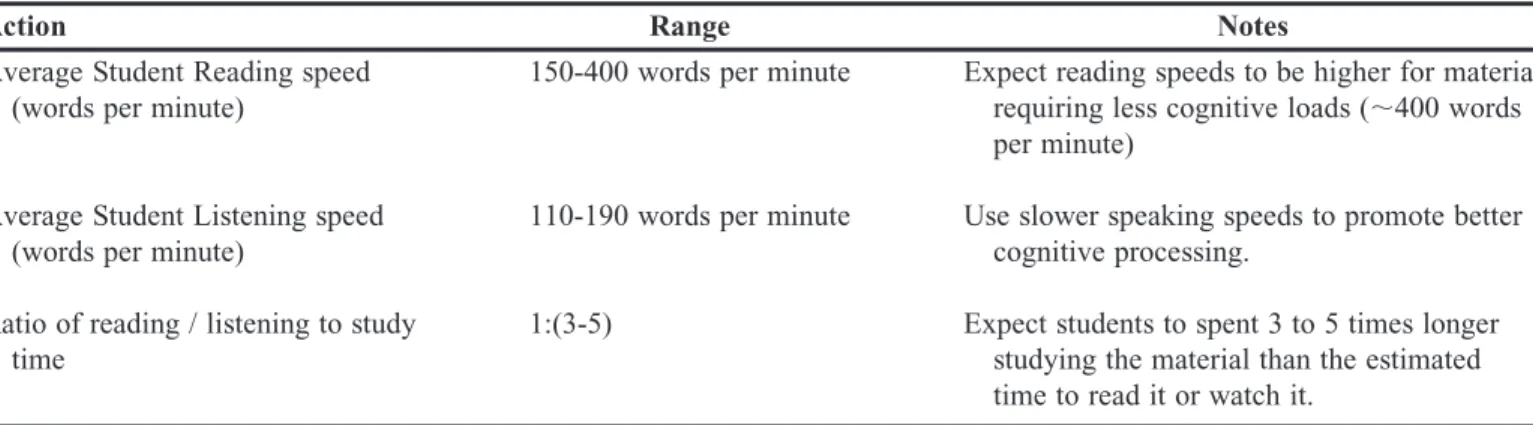
Since students must come to class with foundational content to engage, pre-class material should enable stu-dents to learn efficiently and effectively. As a general rule of thumb, a 1:2 ratio for in-class to out-of-class time can be used to minimize excessive stress and is in line with the some studies of flipped courses.13,15,51,52 This ratio as-sumes a 15-17 hour credit load, and we estimate students may only have up to 35 hours a week to study and prepare for courses based number of hours students spend on ac-tivities of daily living (eg, eating, traveling to school), sleeping, in-class and co-curricular activities.55 Since out-of-class time may include studying and completing homework, thoughtful consideration should be given to how much time is expected for students to prepare for class (eg, three hours of in-class time per week means six hours a week preparing for class, completing home-work, and studying for exams). Table 2 provides esti-mates for the amount of time students might spend reading and watching videos when learning new material. For example, a scholarly article of 3000 words takes ap-proximately 15 minutes to read, and a book chapter of 10,000 words takes approximately 50 minutes to read. If that 3000 word count is part of a script for a narrated video, the video will be at least 30 minutes long. Based on conversions in Table 2, this means that a 3000 word article requires approximately 45 to 60 minutes of reading and studying, the 3000 word narrated video takes 90 to 150 minutes to watch and study, and the 10,000 word chapter demands about three hours to read and study. In addition, learners may take an estimated two to five times longer than a faculty member to complete a given task, depending on the task, and this is consistent with differ-ences between experts and novices.56-65
To summarize, evidence suggests students can learn foundational content (ie, definitions and concepts) on their own before class and that student engagement may be encouraged when the instructor communicates expec-tations, uses accountability for preparation, provides en-gaging and interactive activities, and ensures the material is student-friendly and efficient.
In-class Activities. Once students have a founda-tional knowledge of key definitions and concepts, class time can be used to reinforce and extend learning through application and problem-solving. A growing body of evidence demonstrates the effectiveness of active-learning.30 In general, evidence suggests that well-designed active learning can foster higher-order thinking skills, collaborative skills, and self-awareness.66 A wide range of active learning exercises are described in the literature and selecting or designing an activity for the flipped classroom should be guided by its alignment with pre-class learning and the course objectives, as described by constructive alignment.18Communicating explicit links between pre-class learning and in-class activities can help students appreciate the importance of learning foundations before class and the importance of extending those basic concepts to think deeply and critically about a problem or challenge. In addition, using real world examples and chal-lenges can further illustrate the relevance of the pre- and in-class activities. These real world problems should provide student opportunities to practice and assess mastery or pro-ficiency during class, particularly for the development of higher order thinking skills. Some common examples in-clude case vignettes, higher order think-pair shares, student or student group presentations or role play involving patient – pharmacist interaction.13,45,49-51,67
Students may need scaffolding or support intellec-tually to transition from simple concepts learned prior to class toward complex ideas and application during class. As experts, instructors will play a critical role during class by helping students make sense of the material,
Table 2. Average Times of Reading and Listening and Conversion to Student Study Time56-59
Action Range Notes
Average Student Reading speed (words per minute)
150-400 words per minute Expect reading speeds to be higher for material requiring less cognitive loads (;400 words per minute)
Average Student Listening speed (words per minute)
110-190 words per minute Use slower speaking speeds to promote better cognitive processing.
Ratio of reading / listening to study time
responding to questions, and providing feedback concern-ing progress (eg, clicker questions). This may require iterative processes that enable students to develop, test, and correct their own ideas and answers based on frequent instructor or peer feedback. This is best accomplished when instructors are trained in facilitation skills. Strate-gies for instructor development may include workshops, one-on-one meetings with experts, or texts that provide support for the development of instructional and interper-sonal skills, flipped pedagogy, writing higher level learn-ing outcomes, and course design.
Of note, instructors should adhere to the flipped model during class. Double lecturing, which occurs when pre-class material is re-lectured during class or new ma-terial is lectured, limits opportunities for student engage-ment and directly contradicts the flipped model. While a “time for telling” (eg, micro or mini lectures) may be necessary to explain complex concepts or clarify miscon-ceptions, long and passive lecturing should be minimized. If class time is redundant and repetitive of pre-class learn-ing, there is very little incentive for students to prepare for or attend class.
After-Class Work.The majority of flipped classroom discussion and research has focused on pre-class and in-class activities However, it is important to remember that learning does not stop after the class session ends and that learning is optimized with ongoing practice. After-class work that is aligned with course objectives can support self-determination and promote intrinsic motivation. In-structors can optimize motivation by having flexible learning opportunities either with timing of when practice assignments are due or choice of practice activities. These assignments can extend the relevance of what they are learning and should provide feedback they are moving towards proficiency within the course goals. Further, after-class work should provide feedback to students on areas of strength and improvement and opportunities for more practice.
Complexity, spacing, and time constraints are crit-ical design components for after-class work. Starting with simpler or more straightforward practice and build-ing complexity over time can help with developbuild-ing mas-tery. Focused, repetitive practice can also facilitate transfer of learning, which is the process of solving new problems in the same topic (eg, dosing aminoglyco-sides in two patients with different indications), the same problem in a different topic domain (eg, adjusting therapy for two patients on different drugs), or both.68 After-class work should be diverse enough to help stu-dents generalize their skills sets and transfer them to other problems and courses. With regards to spacing, individuals who mass their practice (practice all at once)
perform poorer on later assessments than individuals who space their practice (practice over time).69,70Other criteria also influence retrieval of knowledge and skills (see 71), and consideration should be given to recom-mendations and requirements for after-class practice. For a 1:2 ratio for in-class to out-of-class, and an esti-mated 0.75 to 1.0 hours of pre-class work for every hour in class, there is approximately 1 hour of out of-class time remaining. First, we must remember studying (eg, reviewing, practice texting, transcribing notes) is a time-consuming behavior. We can reduce pre-exam study time immediately proximal to an exam because of the time spent learning during pre-class work and in-class activities. Spending sufficient time practicing is impor-tant, but we have to be selective in our exercises because time is limited. Based on differences between experts and novices and the impact of practice on speed, we may assume it takes students at least 1.5 (maybe up to 5) times longer to complete a practice problem as it would take an instructor (or expert).56-65Therefore, if you design out-of-class cases that might take you 15 minutes to answer, that could be 60 minutes for the student.
Typically, after-class work is used to reinforce the prior learning in a structured way through additional programs that helps student practice near (problems close in structure to the original) or far transfer (prob-lems more dissimilar to the original) conditions.68 Other options can include more inquiry-based ap-proaches (eg, problem-based learning) or self-directed activities – both of which can help students explore aspects of the content beyond the scope of the class.40,46,72,73These exploration activities may be more instructor-driven as in the case with more inquiry-based models where the instructor gives more robust cases to be explored or student-driven, as in the case with SDL because students are identifying their learn-ing goals.
Assessment
flipped classroom, and assessment can be used as a mech-anism for encouraging students to learn foundational ma-terial prior to coming to class. An additional benefit to frequent low-stakes assessments of student understanding (ie, retrieval or testing effects)77is it allows instructors to keep abreast of what concepts or skills are particularly challenging for students to master.78However, it is im-portant to consider the frequency of quizzes within a sin-gle course and within a given semester as quizzes can alter motivation (to focus more on grades) and can take away from time on other class activities.79,80
Various formative and summative assessment methods can be used to provide feedback to faculty and students. Assessments can be used during interaction with peers, instructors, and other educationally relevant people (eg, standardized patients), for example, as a means of demonstrating competence and enabling self-assessment of mastery. In addition, self-assessments embedded within pre-class online learning modules can help stu-dents gauge mastery of content prior to class. Active learning exercises can be designed to provide real-time formative assessments to students and immediate feed-back to faculty concerning misconceptions or gaps in student knowledge (eg, minute paper, muddiest point). The flipped classroom is designed to develop higher order thinking in students81 and, as such, graded assessments should provide students the opportunity to demonstrate the development of these skills (eg, open text, essay, pa-pers, etc).
The type and weight of an assessment can signifi-cantly impact how students learn because assessments often signal to students what is important in the class. Student assessment should be tied to course objectives and key principles, and provide feedback to instructors and students. It may be worth noting that traditional
methods such as paper and pen exams may not effectively reflect achievement of all learning goals. For example, communication skills or teamwork cannot be fully assessed in a paper and pen exam and, therefore, other approaches are required that are clearly matched to learn-ing goals. Instructors should clearly communicate expec-tations and specify how the assessment will be evaluated at the time it is assigned. Regardless of format, assess-ments should enable students to demonstrate meaningful understanding and application of essential knowledge and skills.
Redesigning learning environments is a complex un-dertaking that often takes multiple iterations of imple-mentation and refinement to achieve desired outcomes. When used correctly, assessments can provide: feedback about student learning and instructional design; and on-going quality improvement feedback for the iterative pro-cess of course development. Thoughtful consideration should be given to collecting, analyzing, and using data to select relevant content, inform instructional design, manage classroom activities, and improve student learning.
Time for development
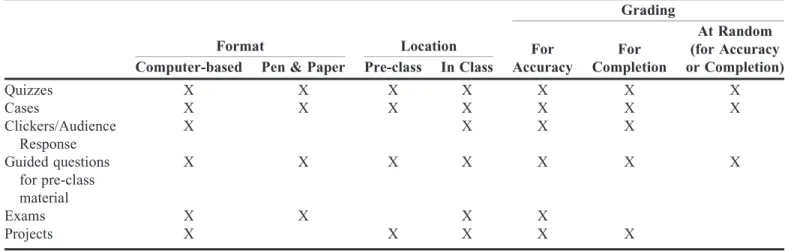
As others consider implementing the flipped class-room, a final recommendation is to consider the time and resources required for flipping. From a student perspec-tive, the time required to learn in the flipped classroom is not trivial and should be managed carefully. We estimate a ratio of 0.75:1.0 to 1.0:0.5 for pre-class to in-class to directed post-class activities (Table 4). Thus, for a 3-hour credit course in a 15-week semester, that is ,3 hours a week of pre-class preparation, 3 hours of in-class activ-ities, 1.5 hours of after-class practice and 1.5 hours of study for a total of 1:2 in-class to out-of-class time. Table 3. Common Assessment Approaches in the Flipped Classroom. Most Activities Can Be Completed Individually, in Pairs or Small Groups10,74,75,78
Format Location
Grading
Computer-based Pen & Paper Pre-class In Class
For Accuracy
For Completion
At Random (for Accuracy or Completion)
Quizzes X X X X X X X
Cases X X X X X X X
Clickers/Audience Response
X X X X
Guided questions for pre-class material
X X X X X X X
Exams X X X X
From a faculty perspective, the flipped classroom can take a significant amount of time and energy to de-velop initially. McLaughlin and colleagues13reported an additional 127% of time to redesign and implement a basic pharmaceutics course into a flipped classroom (from 250 hours for a lecture-based course to 567 hours for the first iteration of the flipped course). Appropriate fac-ulty support and development could help institutions fully
realize the potential of engaged classrooms. Further, having access to experts in instructional design, active learning, assessment and cognitive or educational psy-chology could further advance flipped models.82 Align-ing promotion and tenure policies with pedagogical innovation also may incentivize faculty engagement in the flipped model. Before implementing a flipped class-room, faculty should ensure that technological support for Table 4. Summary of Recommendations, Including Proposed Time Allocation Ratios, for the Flipped Classroom. (Derived from literature citation in this paper)
Course Section
Proposed Time
Ratio Allocation Recommendation
Course Objectives — Course objectives should focus on higher order thinking (eg,
Bloom’s Cognitive Taxonomy of application and above) and include skills such as critical thinking, communication, and teamwork. These objectives should be aligned with real-world pharmacy situations.
Pre-class Activity (can include assessments)
0.5-1.0 Pre-class materials should orient student to foundational definitions and concepts that will be built upon during class. This material should be direct, relevant, efficient,
experience-level appropriate (eg, novice, advanced beginner), accountability-driven, and provided to students well in advance of the due date.
(eg, 1.5 to 3 hours per week for 3 credit course)
In-class Activity (can include assessments)
1.0 Class time should emphasize active engagement through
structured activities guided or facilitated by the instructor. The instructor should provide support for activities that extend pre-class learning to apply concepts, solve complex problems, interpret information, or otherwise engage in real-life practices that develop higher-order skills.
(eg, 3 hours per week for 3 credit course)
After-class Activity (can include assessments)
0.25-0.5 (instructor directed) After-class work should reinforce the course objectives and be increasing in complexity and integration of material. Topics should be relevant to future course work, spaced
appropriately, and diverse in nature to increase transferability.
0.5-0.75 (student-directed) (eg, 1.5 to 3 hours per week
for a 3-credit course)
Assessment Included in ratios above Assessments should be designed to fully reflect the depth and breadth of learning in the flipped classroom. Diverse approaches should be used in an effort to provide formative and summative feedback to students and faculty regarding progress toward achieving course learning objectives.
Overall Course 1(in-class learning):2 (out-of-class learning)
Course objectives, pre-class and in-class activities and assessments should be designed according to sound instructional alignment principles. Resources (eg, time, personnel, training) should be identified and secured prior to implementation of the flipped model. Consideration should be given to how the course and its requirements fit into the larger curriculum and co-curriculum. (eg, 6 hours of out-of-class
the development and management of material and within classrooms is available and accessible.
CONCLUSION
The flipped classroom has garnered significant at-tention in recent years and represents a growing shift from teacher-centered to learning-centered instructional strategies. This pedagogical approach is a highly trans-latable and flexible model characterized by a wide range of approaches to pre-class assignments, in-class activities, after-class practice, and assessments. Mov-ing foundational course content outside of class pro-tects instructor-student contact time for higher level learning – learning that cannot simply happen by read-ing a book.
The flipped classroom represents an important and exciting advancement in health professions education. However, whether flipped classrooms will become a dom-inant paradigm in pharmacy education over the coming decades remains to be seen. Further development and evaluation of flipped models is crucial for optimizing outcomes and ensuring that the model remains flexi-ble, transferaflexi-ble, and relevant. Research concerning cost-effectiveness, non-cognitive skill development (eg, teamwork, empathy, communication, adaptabil-ity), optimal strategies and modalities, learning space design, long-term impact, and faculty development could help further advance the impact and effectiveness of the flipped classroom.
REFERENCES
1. Bergmann J, Sams A.Flip Your Classroom: Reach Every Student in Every Class Every Day. Eugene, OR: International Society for Technology in Education; 2012.
2. Aditomo A, Goodyear P, Bliuc AM, Ellis RA. Inquiry-based learning in higher education: principal forms, educational objectives, and disciplinary variations.Stud Higher Educ.2013;38 (9):1239-1258.
3. Mok HN. Teaching tip: the flipped classroom.J Inform Sys Educ. 2014;25(1):7.
4. Schmidt SMP, Ralph DL. The flipped classroom: a twist on teaching.Contemp Issue Educ Res.2016;9(1):1.
5. Deci EL, Ryan RM. An overview of self-determination theory. In: Deci EL, Ryan RM, eds.Handbook of Self-Determination Research. Rochester, NY: University of Rochester Press; 2002:3-33.
6. McLaughlin JE, Griffin LM, Esserman DA, et al. Pharmacy student engagement, performance, and perception in a flipped satellite classroom.Am J Pharm Educ.2013;77(9):Article 196. 7. McLaughlin JE, Rhoney DH. Comparison of an interactive e-learning preparatory tool and a conventional downloadable handout used within a flipped neurologic pharmacotherapy lecture.Curr Pharm Teach Learn.2015;7(1):12-9.
8. Persky AM, Dupuis RE. An eight-year retrospective study in “flipped” pharmacokinetics courses.Am J Pharm Educ.2014;78(10): Article 190.
9. Pierce R, Fox J. Vodcasts and active-learning exercises in a “flipped classroom” model of a renal pharmacotherapy module.Am J Pharm Educ.2012;76(10):Article 1.
10. Deslauriers L, Schelew E, Wieman C. Improved learning in a large-enrollment physics class.Science.2011;332(6031):862-864. 11. Lage MJ, Platt GJ, Treglia M. Inverting the classroom: a gateway to creating an inclusive learning environment.J Econ Educ. 2000;31(1):30-43.
12. Eddy SL, Hogan KA. Getting under the hood: how and for whom does increasing course structure work?CBE-Life Sci Educ. 2014;13(3):453-468.
13. McLaughlin JE, Roth MT, Glatt DM, et al. The fipped classroom: a course redesign to foster learning and engagement in a health professions school.Acad Med.2014;89(2):236-243.
14. Persky AM, Pollack GM. Transforming a large-class lecture course to a smaller-group interactive course.Am J Pharm Educ. 2010;74(9):Article 170.
15. Persky AM, Pollack GM. A modified team-based learning physiology course.Am J Pharm Educ.2011;75(10):Article 204. 16. Khanova J, Roth MT, Rodgers JE, McLaughlin JE. Student experiences across multiple flipped courses in a single curriculum. Med Educ.2015;49(10):1038-1048.
17. Cohen SA. Instructional alignment: searching for a magic bullet. Educ Res.1987;16(8):16-20.
18. Biggs J. Enhancing teaching through constructive alignment. Higher Educ.1996;32(3):347-364.
19. Biggs J, Tang C.Teaching for Quality Learning at University. 4th ed. UK: Open University Press; 2011.
20. Fink LD.Creating Significant Learning Experiences : An Integrated Approach to Designing College Courses. Revised and updated edition. San Francisco, CA: Jossey-Bass; 2013.
21. Piaget J.Main Trends in Psychology. London, UK: Allen and Unwin; 1973.
22. Foroughi A. The theory of connectivism: can it explain and guide learning in the digital age?J High Educ Theory Pract.2015;15(5):11. 23. Siemens G. Connectivism: a learning theory for the digital age. http://www.elearnspace.org/Articles/connectivism.htm. Accessed January 19, 2016.
24. Knowles MS.The Modern Practice of Adult Education: From Pedagogy to Andragogy. Revised and updated edition. Chicago, IL: Association Press; 1980.
25. Bloom BS. Recent Developments in Mastery Learning.Educ Psychol.1973;10(2):53.
26. McGaghie WC, American College of Chest Physicians H, Science Policy C. Lessons for continuing medical education from simulation research in undergraduate and graduate medical education: effectiveness of continuing medical education: American College of Chest Physicians evidence-based educational guidelines. Chest.2009;135(3 Suppl):62S-68S.
27. Collins A, Brown JS, Newman SE. Cognitive apprenticeship: teaching the craft of reading, writing and mathematics. In: Resnick LB, ed.Knowing, Learning, and Instruction: Essays in Honor of Robert Glaser. Hillsdale, NJ: L. Erlbaum Associates; 1989. 28. Kuhlmann DO, Ardichvili A. Becoming an expert: developing expertise in an applied discipline.Eur J Train Develop.2015;39(4):262-276.
29. Schmidt HG, Norman GR, Boshuizen HPA. A cognitive perspective on medical expertise: theory and implications.Acad Med. 1990;65(10):611-621.
31. Abrami PC, Bernard RM, Borokhovski E, et al. Instructional interventions affecting critical thinking skills and dispositions: a stage 1 meta-analysis.Rev Educ Res.2008;78(4):1102-1134. 32. Beyer BK.Improving Student Thinking:A Comprehensive Approach. Boston, MA: Allyn and Bacon; 1997.
33. Bligh DA.What’s the Use of Lectures?San Francisco, CA: Jossey-Bass Publishers; 2000.
34. Gotesky R. The lecture and critical thinking.Educ Forum. 1966;30(2):179-187.
35. Pascarella ET, Terenzini PT.How College Affects Students: Findings and Insights From Twenty Years of Research. San Francisco, CA: Jossey-Bass Publishers; 1991.
36. Emery M, Bush C, Bounds R, Gillett B, Santen S, Aghera A. Enhancing learning with simulation: setting “SMART” learning goals during debriefing improves self-directed learning.Annal Emerg Med.2014;64(4):S116.
37. Conzemius A, O’Neill J.The Power of SMART Goals: Using Goals to Improve Student Learning. Bloomington, IN: Solution Tree Press; 2005.
38. Nelson TO, Leonesio RJ. Allocation of self-paced study time and the “labor-in-vain effect.”J Exp Psychol Learn Mem Cogn. 1988;14(4):676-686.
39. Rehder B, Hoffman AB. Eyetracking and selective attention in category learning.Cogn Psychol.2005;51(1):1-41.
40. Gureckis TM, Markant DB. Self-directed learning: a cognitive and computational perspective.Persp Psychol Sci. 2012;7(5):464-481.
41. Dunlosky J, Kubat-Silman AK, Hertzog C. Training monitoring skills improves older adults’ self-paced associative learning.Psychol Aging.2003;18(2):340-345.
42. Kanfer R, Ackerman PL. Motivation and cognitive abilities – an intergrative aptitude treatment interaction approach to skill acquistion.J Appl Psychol.1989;74(4):657-690.
43. Pintrich PR. An achievement goal theory perspective on issues in motivation terminology, theory, and research.Contemp Educ Psychol.2000;25(1):92-104.
44. Zimmerman BJ. Self-efficacy: an essential motive to learn. Contemp Educ Psychol.2000;25(1):82-91.
45. Dupuis RE, Persky AM. Use of case-based learning in a clinical pharmacokinetics course.Am J Pharm Educ.2008;72(2):Article 29. 46. Murad MH, Coto-Yglesias F, Varkey P, Prokop LJ, Murad AL. The effectiveness of self-directed learning in health professions education: a systematic review.Med Educ.2010;44(11):1057-1068. 47. Clark RE. Reconsidering research on learning from media.Rev Educ Res.1983;53(4):445-459.
48. Kulik C-LC, Kulik JA. Effectiveness of computer-based instruction: an updated analysis.Comput Human Behav. 1991;7(1):75-94.
49. Wong TH, Ip EJ, Lopes I, Rajagopalan V. Pharmacy students’ performance and perceptions in a flipped teaching pilot on cardiac arrhythmias.Am J Pharm Educ.2014;78(10):Article 185. 50. Munson A, Pierce R. Flipping Content to Improve Student Examination Performance in a Pharmacogenomics Course.Am J Pharm Educ.2015;79(7):Article 1.
51. Ferreri SP, O’Connor SK. Redesign of a large lecture course into a small-group learning course.Am J Pharm Educ.2013;77(1): Article 13.
52. Evans KH, Thompson AC, O’Brien C, et al. Impact on student satisfaction and performance.Acad Med.2016.
53. Sarter M, Gehring WJ, Kozak R. More attention must be paid: the neurobiology of attentional effort.Brain Res Rev. 2006;51(2):145-160.
54. Fuller S, Horlen C, Cisneros R, Merz T. Pharmacy students’ reading ability and the readability of required reading materials.Am J Pharm Educ.2007;71(6):Article 111.
55. Statistics BoL. Time use on an average weekday for full-time university and college students. http://bethelsuccess.net/pdf/ AmericanTimeUseSurvey.pdf. Accessed March 23, 2016. 56. Carver RP. Reading rate: theory, research, and practical implications.J Read.1992;36(2):84-95.
57. Megehee CM, Dobie K, Grant J. Time versus pause manipulation in communications directed to the young adult population: does it matter?J Advert Res.2003;43(3):281-292.
58. Rayner K, Schotter ER, Masson ME, Potter MC, Treiman R. So much to read, so little time: how do we read, and can speed reading help?Psychol Sci Public Interest.2016;17(1):4-34.
59. Rodero E. A comparative analysis of speech rate and perception in radio bulletins.Text Talk.2012;32(3):391-411.
60. Haji FA, Khan R, Regehr G, Drake J, de Ribaupierre S, Dubrowski A. Measuring cognitive load during simulation-based psychomotor skills training: sensitivity of secondary-task performance and subjective ratings.Adv Health Sci Educ. 2015;20(5):1237-1253.
61. Kim S, Aleven V, Dey A. Understanding expert-novice differences in geometry problem-solving tasks: a sensor-based approach; 2014. http://www.cs.cmu.edu/;sjunikim/publications/ CHI2014_WIP_Geometry_Learning.pdf
62. Passerotti CC, Franco F, Bissoli JCC, et al. Comparison of the learning curves and frustration level in performing laparoscopic and robotic training skills by experts and novices.Int Urol Nephrol. 2015;47(7):1075-1084.
63. Priest AG, Lindsay RO. New light on novice – expert differences in physics problem solving.Brit J Psychol.1992;83(Aug 92):389-405.
64. Wright MJ, Gobet F, Chassy P, Ramchandani PN. ERP to chess stimuli reveal expert-novice differences in the amplitudes of N2 and P3 components.Psychophysiology.50(10):1023-1033.
65. Ericsson KA, Charness N, Feltovich PJ, Hoffman RR.The Cambridge Handbook of Expertise and Expert Performance. Cambridge, UK: Cambridge University Press; 2006.
66. Freeman S, Eddy SL, McDonough M, et al. Active learning increases student performance in science, engineering, and mathematics.Proc Nat Acad Sci.2014;111(23):8410-8415. 67. Dupuis RE, Persky AM. Use of case-based learning in a clinical pharmacokinetics course.Am J Pharm Educ.2008;72(2):Article 29. 68. Dinsmore DL, Baggetta P, Doyle S, Loughlin SM. The role of initial learning, problem features, prior knowledge, and pattern recognition on transfer success.J Exp Educ.2014;82(1):121-141. 69. Carpenter SK, Cepeda NJ, Rohrer D, Kang SHK, Pashler H. Using spacing to enhance diverse forms of learning: review of Recent Research and Implications for Instruction.Educ Psychol Rev. 2012;24(3):369-378.
70. Dempster FN. Spacing effects and their implications for theory and practice.Educ Psychol Rev.1989;1(4):309-330.
71. Larsen EJ, Butler AC. Test-enhanced learning. In: Walsh K, ed. Oxford Textbook of Medical Education. Oxford, UK: Oxford Univeristy Press; 2013:443-452.
73. Murad MH, Coto-Yglesias F, Varkey P, Prokop LJ, Murad AL. The effectiveness of self-directed learning in health professions education: a systematic review: effectiveness of self-directed learning.Med Educ.2010;44(11):1057-1068.
74. Caldwell JE. Clickers in the large classroom: current research and best-practice tips.CBE Life Sci Educ.2007;6(1):9-20.
75. Gleason BL, Peeters MJ, Resman-Targoff BH, et al. An active-learning strategies primer for achieving ability-based educational outcomes.Am J Pharm Educ.2011;75(9):Article 186.
76. Hodges LC, Anderson EC, Carpenter TS, et al. Using reading quizzes in STEM classes – the what, why, and how.J College Sci Teach.2015;45(1):49.
77. Karpicke JD, Roediger HL. The critical importance of retrieval for learning.Science.2008;319(5865):966-988.
78. Ambrose SA.How Learning Works:Seven Research-based Principles for Smart Teaching. San Francisco, CA: Jossey-Bass; 2010.
79. Jarmolowicz DP, Hayashi Y, St. Peter Pipkin C. Temporal patterns of behavior from the scheduling of psychology quizzes.J Appl Behav Anal.2010;43(2):297-301.
80. Davis BG.Tools for Teaching. 2nd ed. San Francisco, CA: Jossey-Bass; 2009.
81. Anderson LW, Krathwohl DR.A Taxonomy for Learning, Teaching, and Assessing: A Revision of Bloom’s Taxonomy of Educational Objectives. Complete edition. New York, NY: Longman; 2001.
82. Blouin RA, Riffee WH, Robinson ET, et al. Roles of innovation in education delivery.Am J Pharm Educ.2009;73(8):Article 154. 83. Cromley JG, Snyder-Hogan LE, Luciw-Dubas UA. Cognitive activities in complex science text and diagrams.Contemp Educ Psychol.2010;35(1):59-74.
84. Florax M, Ploetzner R. What contributes to the split-attention effect? The role of text segmentation, picture labelling, and spatial proximity.Learn Instruct.2010;20(3):216-224.
85. Mayer RE. The promise of multimedia learning: using the same instructional design methods across different media.Learn Instruct. 2003;13(2):125-139.
86. Mayer RE, Moreno R. Nine ways to reduce cognitive load in multimedia learning.Educ Psychol.2003;38(1):43-52.
87. Torcasio S, Sweller J. The use of illustrations when learning to read: a cognitive load theory approach.Appl Cogn Psychol. 2010;24(5):659-672.
88. Lei SA, Rhinehart PJ, Howard HA, Cho JK. Strategies for improving reading comprehension among college students.Read Improv.2010;47(1):30-42.
89. Pressley M, Tanenbaum R, McDaniel MA, Wood E. What happens when university students try to answer prequestions that accompany textbook material?Contemp Educ Psychol. 1990;15(1):27-35.