THE ROLE OF RELATIONSHIPS IN CRISIS COMMUNICATION: THE IMPACT OF AGENCY-CLIENT RELATIONSHIPS AND
PERCEPTION OF CRISIS STRATEGIES
ON CRISIS-RELATED TASK CONFLICT, PERFORMANCE, AND SATISFACTION
Jin Hong Ha
A dissertation submitted to the faculty of the University of North Carolina at Chapel Hill in partial fulfillment of the requirements for the degree of Doctor of Philosophy in Mass Communication in the School of Journalism and Mass Communication.
Chapel Hill 2013
© 2013 Jin Hong Ha
ABSTRACT
JIN HONG HA: The role of relationships in crisis communication: The impact of agency-client relationships and perception of crisis strategies on crisis-related task
conflict, performance, and satisfaction (Under the direction of Lois Boynton)
The main purpose of this dissertation is to examine the effect of the public relations agency-client relationship on crisis communication effectiveness. To do so, 18 hypotheses were developed, based on the links among the status of relationships, agreement perception of crisis communication strategies, crisis-related task conflict, performance, and satisfaction. The sample of this study is Korean public relations practitioners working at public relations agencies or client organizations. An online survey was conducted for data collection, and Structural Equation Modeling statistics (i.e., Amos) was employed for data analyses.
First, the results of this study revealed that two relationship variables (trusting and mutual relationships) had statistically significant effects on all three endogenous variables
(perceived task conflict, performance, and satisfaction) as an expected direction, except for the effect of trusting relationship on perceived task conflict. Agreement perception positively affected perceived task conflict, which is inconsistent with the direction of the hypothesis. This research found no direct effects of perceived task conflict on perceived task performance and satisfaction.
Second, with regard to indirect effects, two indirect effects of trusting
task performance were statistically significant. However, trusting and mutual relationships’ indirect effects on perceived task satisfaction through perceived task conflict were not statistically significant. This suggests that perceived task performance has a more significant mediating role between the agency-client relationship and perceived task satisfaction than does perceived task conflict.
Third, according to the results of EFA and CFA, two factors (trust and control mutuality) were extracted for the relationship construct, and a single factor was yielded for the agreement perception construct. This means that Korean public relations
practitioners are not likely to differentiate the concept of commitment from trust and control mutuality. Also, Korean practitioners do not seem to separate crisis strategies into three stages; rather, they perceive the strategies for a single crisis stage.
ACKNOWLEDGEMENTS
I know that nothing as big as dissertation happens without a number of people who help bring it to fruition. My dissertation is through the amalgamation of many efforts from the people to whom I need to thank.
Sincere appreciation is due to Dr. Lois Boynton, my dissertation chair. She has encouraged and guided me with creative comments on an early draft of my dissertation. I thank her for wholehearted support and inspiration that helped me grow as a meticulous scholar. This dissertation would not be what it is without her contributions.
I am indebted to other members of my committees for their helpful and cogent critiques of the initial proposal as well as demanding comments on my dissertation, which broadened my intellectual horizons and made this dissertation more
interdisciplinary. I would like to thank to Dr. Daniel Riffe for exhorting me to think conceptually and theoretically as well as for providing me with rigorous and
comprehensive methodological knowledge. Dr. Mary Beth Oliver and Dr. Francesca Carpentier are extraordinary professors who introduced me the world of structural
gratitude to Dr. Rhonda Gibson and Dr. Anne Johnston for their offering me many supports over three years.
As always, I thank to my family – parents, siblings, and nephews and niece – for their endless and unconditional trust toward me. Finally, I must acknowledge the
TABLE OF CONTENTS
LIST OF TABLES... x
LIST OF FIGURES... xi
Chapter I. INTRODUCTION………... 1
II. LITERATURE REVIEW AND HYPOTHESES………... 4
Crisis Stage Models and Communication Strategies... 4
Relationships and Crisis Communication... 9
Relationship Management Theory... 9
The Importance of Relationships in Crisis Communication... 15
Agency-Client Relationships………... 19
Organizational Task Conflict…………... 23
Organizational Task Performance………... 26
Organizational Task Satisfaction………... 27
III. METHOD…..……... 32
Survey Procedure..……... 32
Sample……...……….………... 33
Web Survey………... 34
Measurement………... 37
Agency-Client Relationships…... 37
Agreement on Perception of Crisis Strategies……... 38
Task Conflict………...…... 39
Task Performance... 39
Task Satisfaction………... 40
IV. RESULTS………... 41
Descriptive Statistics... 41
Preliminary Analyses…... 44
Assumptions... 44
Construct Reliability.…... 44
Measurement Model (CFA)………... 47
Construct Validity………...………... 48
Convergent Validity…………... 48
Discriminant Validity…………... 49
Structural Model………...………... 50
Research Model Fits and Modification…... 52
Modified Research Model Fits... 54
Hypotheses Test………...………... 55
Direct Effects………... 55
Indirect Effects………... 57
V. DISCUSSION AND CONCLUSIONS……... 60
Theoretical Implications………... 62
Practical Implications…...…... 68
Limitations……... 72
Future Research……….………... 74
Conclusions………...…...…... 76
TABLES……... 77
FIGURES……... 89
APPENDICES... 93
Appendix A: Pre-notice E-mail Letter... 93
Appendix B: Invitation Mail Letter... 94
Appendix C: Reminder E-mail Letter………...…... 95
Appendix D: Web Survey Questionnaire….……….…... 96
Appendix E: Study Consent Form……….…... 101
LIST OF TABLES
Table 1. Crisis Stage Models………... 77
Table 2. Observation Farthest from Centroid (Mahalanobis Distance)... 78
Table 3. Mean, SD, and Correlations between Each Variable………...…………... 79
Table 4. Exploratory Factor Analysis (EFA) and Reliability……….…….. 80
Table 5. Composite Reliability (CR) and Average Variance Extracted (AVE) of Each Construct………..…... 81
Table 6. Measurement Model………... 82
Table 7. Convergent Validity between Each Construct (Φ)... 83
Table 8. Discriminant Validity………... 84
Table 9. Results of Tests for Direct Effect Hypotheses………... 85
Table 10. Results of Tests for Indirect Effect Hypotheses………... 86
Table 11. Results of Indirect Effects………...……….. 87
LIST OF FIGURES
Figure 1. Initially Hypothesized Research Model... 89
Figure 2. Confirmatory Factor Analysis (CFA) of Measurement Items... 90
Figure 3. Newly Hypothesized Research Model………... 91
CHAPTER ONE
INTRODUCTION
Effectiveness in public relations can be found at the level of individual
practitioners, organizations, or society (Dozier & Broom, 2006; Hon, 1997). Building positive and long-term relationships with publics throughout each of these levels is a key factor to consider when evaluating the effectiveness of public relations (Ledingham, 2006).
As public relations has focused on building relationships, public relations scholars have focused on examining factors that influence how relationships are built (e.g.,
Grunig, Grunig, & Ehling, 1992; Hon & Grunig, 1999; Huang, 2001; Ledingham, 2003). This research trend resulted in considering the relationship only as the outcome or
ultimate goal of public relations processes. Public relations scholars have also focused on the relationships between organizations and the general publics (e.g., Broom, Casey, & Ritchey, 2000; Bruning & Galloway, 2003; Bruning & Ledingham, 1999; Grunig & Huang, 2000). As a result, the relationships between organizations have been overlooked.
Accordingly, as one of organizational relationships, the agency-client relationship is very important when a company facing a crisis makes efforts to overcome the crisis.
As organizations become more complex and tasks become more specialized, clients need to maintain a positive relationship with their agencies to foster a more effective completion of tasks and goals (Stanford, 2008). In a crisis, for example, client and agency practitioners are supposed to share a goal of dealing with the crisis event effectively and should work together as partners to achieve the goal (Veil, 2012). To do so, a public relations agency can provide its client with additional human resources with objective counsel during a crisis (Swann, 2010).
The agency-client relationship in a crisis situation can influence the effectiveness of crisis communication. A favorable relationship between partners creates a synergy that not only multiplies the reach and effectiveness of each partner but also enhances the opportunity for the partners to complete their tasks together (Fam & Waller, 2008). Therefore, it can be said that the status of the agency-client relationship can also affect the process and effectiveness of crisis communication. For example, a good agency-client relationship in a crisis can lead to clear and rapid communication, increasing the quality of decisions, whereas a bad relationship can cause breakdowns in communication increasing harm and prolong chronic effects of the crisis (Henke, 1995).
Second, crisis communication in South Korea is quite a new field, so that there is plenty of freedom to study the role of relationships in a crisis, as well as crisis communication strategies and their effectiveness.
CHAPTER TWO
LITERATURE REVIEW AND HYPOTHESES
This section reviews crisis communication strategies introduced in crisis stage models, looks into the agency-client relationship, and outlines their impacts on crisis communication effectiveness. Also, it suggests research hypotheses that explicate the links among perceived task conflict, performance, satisfaction, perceived status of relationships and perceived agreement on crisis communication strategies by agency and client practitioners.
Crisis Stage Models and Communication Strategies
In 1963, Herman specified three conditions of organizational crisis: 1) threat to high priority values of organizations; 2) presentation of a restricted amount of time to manage a crisis and close media attention; and 3) unexpectedness. These characteristics and conditions of crises indicate the need for and importance of strategic crisis
communication. Crisis communication enables organizations to monitor their
Crisis scholars have taken biological perspectives about crisis development. In other words, each crisis is treated as though it has its own life cycle and goes through different phases. This perspective reflects time-ordered dimensions of a crisis, which describe a crisis event as a series of interrelated phenomena developing over time (Fink, 1986; Guth, 1995). This approach is useful to provide crisis managers with a better sense of how to appropriate a and how to select appropriate crisis communication strategies (Seeger et al., 2003). Another advantage of this approach is that the development of a crisis can be described regardless of the crisis or type of industry (Pauchant & Mitroff, 1992). There are several models of the crisis lifecycle that have been studied.
First, Turner (1976) suggests a six-stage model. Stage I refers to a point of normal operations in which members have culturally accepted beliefs about the world and its hazards, and have associated precautionary norms (i.e., set of laws, codes of practices, and folkways). Stage II is the crisis incubation period, during which the crisis is usually ignored because crisis cues are largely unrecognized or perceived as unimportant. In Stage III, the crisis is first recognized through a trigger event that disrupts normal, routine operations but is still difficult to define in terms of causes and problems. Stage IV
cause, blame, and responsibility. This leads to a return to a new Stage I, a point of normal operations and procedures.
Second, Fink’s (1986) crisis lifecycle model separates crisis development into four stages using a medical illness metaphor: prodromal, acute, chronic, and resolution. The prodromal stage is when the first warning signs or clues forewarn of matters to come. The acute stage is defined in terms of when a crisis-triggering event began and ended. In the chronic stage, the crisis continues as the organization responds to the matter and newspaper exposes, interviews, congressional investigations, or audits occur. Finally, the resolution stage is the goal of all initial stages, in which a clear signal marks the end of the crisis event.
Third, Pauchant, and Mitroff’s (1992) five-phase model consists of signal
detection, preparation/prevention, containment/damage limitation, recovery, and learning. These five phases are classified into three crisis management strategies: proactive,
reactive, and interactive. The first phase, signal detection, concerns recognition of early-symptoms of a crisis and identification of crisis cues. A crisis-prone organization is likely to block out the signals of crisis, while a crisis-prepared organization is able to recognize even very weak signals. The second phase, preparation and prevention, is closely related to the first stage because both preparation and prevention are possible not only when the signals have been detected but also when the crisis situation is still under control. So, the first and second phases are grouped as a proactive crisis management strategy. The third phase, containment/damage limitation, involves the efforts to control damage. Pauchant and Mitroff emphasized the need to control not only physical damage but also the
media, damage could be intensified. In the fourth phase, recovery, the organization aims to return to normal operations by recovering the losses of tangible and intangible assets and repairing relationships with internal and external publics. The third and fourth phases are classified as reactive crisis management strategies because organizations are reacting to a crisis already in progress. The final phase, learning, involves assessment of all earlier stages in order to “review and critique so as to learn what was done well and what was done poorly so that the organization can handle crises better in the future” (pp. 107). So, the learning stage is identified as an interactive crisis management strategy.
The crisis stage models discussed here reflect three stages of a crisis: pre-crisis, crisis, and post-crisis (Coombs, 2012; Ray, 1999; Seeger et al., 2003; Ulmer, 2001). Table 1 summarizes the crisis stage models. The pre-crisis stage is a point of preparation, and an understanding of risks and procedures for crisis mitigation. In this sense, as the time of the normal operation, preparation, and sensing before the onset of a trigger event, Turner’s (1976) stage I and II, Fink’s (1986) prodromal stage, and Pauchant and
Mitroff’s (1992) first two phases (signal detection; preparation and prevention) can be collapsed into the pre-crisis stage. The crisis stage is the period when harm is initiated and where a majority of the direct harm occurs with a trigger event. So, organizations are forced to respond to the crisis with offering explanations about causes, blame,
momentum of self-organizing and renewal initiated in the crisis stage. In this sense, the post-crisis stage encompasses Turner’s last two stages (rescue and salvage;
readjustment), Fink’s resolution stage, and Pauchant and Mitroff’s last two stages (recovery and learning).
Because crisis communication strategies required for each crisis stage differ, a perception gap of the crisis-related strategies between agency and client may impact the effectiveness of crisis communication. The perception discrepancy may result in task conflict. In addition to the perception gap, this study suggests that the status of
Relationships and Crisis Communication
As established in the previous section, an organizational crisis is defined as a specific, unanticipated, complex, and non-routine based series of events that create uncertainty and are a threat to organizations’ assets, reputation, and goals (Perrow, 1984; Seeger et al., 2003). Pauchant and Mitroff (1992) described the characteristics of
organizational crises as increasing, unanticipated, unknown, unforeseeable, widespread, complex and threatening. In organizational crisis communication, the inter-organizational relationship is emphasized in order to deal effectively with a crisis. The following section explains the relationship management theory in public relations, and describes how it relates to crisis communication.
Relationship Management Theory
As the core theory of public relations, relationship management theory
emphasizes the role of relationships in public relations academy and practice (Ledingham & Bruning, 2000). This theory posits that public relations is valuable when public
relations activities help an organization develop good relationships with the publics, which “establishes and maintains mutually beneficial relationships between an
organization and the publics on whom its success or failure depends” (Cutlip, Center, & Broom, 1994, pp. 2).
relationship management. Also, many have tried to define the concept of relationships and explore its role in public relations. For example, Ferguson (1984) called for attention to relationships within the study and practice of public relations. After her suggestion, Ehling (1992) suggested a shift from manipulation of public opinion to a focus on
building, nurturing, and maintaining relationships as the core function of public relations. Cutlip, Center, and Broom (1994) and Grunig (1992) also defined the purpose of public relations as building relationships with publics that enhance the ability of an organization to reach its goal. More recently, Ledingham (2003) emphasized the roles of relationships in public relations, and explained that the relationship management theory has clarified the function of public relations within an organizational structure and has provided a framework for determining the contribution of public relations to achieve organizational missions.
Public relations scholars have conducted several studies in the last decade that quantitatively measure relationships to demonstrate the relationship management theory’s contribution to achieving organizational goals (e.g., Bruning & Galloway, 2003; Bruning & Ledingham, 1999; Ferguson, 1984; Grunig & Ehling, 1992; Grunig & Huang, 2000; Hon & Grunig, 1999; Huang, 2001). Through those studies, common elements of relationships have emerged: trust, openness, understanding, commitment, satisfaction, and control mutuality.
and is committed to the welfare of the community in which it operates” (pp. 173). Commitment was defined as “the extent to which each party believes and feels that the relationship is worth spending energy to maintain and promote” (Hon & Grunig, 1999, pp. 3). Satisfaction referred to “the extent to which each party feels favorably toward the other because positive expectations about the relationship are reinforced” (pp. 3). Control mutuality referred to “the degree to which parties agree on who has the rightful power to influence one another” (pp. 3).
These elements of relationships have been applied in public relations on both individual and organizational levels. At the individual level, interpersonal communication research has revealed that “trust” can influence the quality of relationships among people (Brehm, 1992; Miller & Rogers, 1976; Roloff, 1981). For instance, Veil (2012) found that the relationship between individuals deteriorated due to a lack of trust, which
ultimately inhibited their collaboration. The application of relationship elements has also been expanded to the level of organizations. In that context, relationships have been broadly studied to explore the roles they play and how they affect organization-public relationships (Ledingham, 2006).
Bruning (2001) also conclude that the key to managing successful relationships is to “understand” what both organizations and publics must do for each other in order to initiate, develop, and maintain their relationships. This means that to be effective and sustaining, relationships need to be seen as “mutually beneficial,” which is based on a mutual interest between an organization and its significant publics.
It cannot be denied that Ferguson’s (1984) suggestion of attention to relationships initiated new thinking about relationships in public relations fields. However, as
mentioned before, relationships were usually as the outcome or ultimate goal of public relations processes, which means that relationships have been mainly studied as a dependent variable in public relations studies. Furthermore, previous studies of
relationships have focused primarily on the organization-public relationships (OPR). In other words, previous research has scarcely examined relationships through the lens of inter-organizational relationships (IOR).
Since Ferguson’s suggestions, public relations research has centered mainly on OPR. Research needs to explore the influence of relationships that exist in a different context: that of inter-organizational relationships. Although many studies in business and marketing areas have looked at the functions of business relationships, there has been little research in public relations. Some business scholars suggested the relationship dimensions that predict consumer behavior could be used to predict the purchasing patterns in business-to-business relationships (e.g., Carlston & Mae, 2007; Kotler & Mondak, 1985; Pryor, Reeder, & Monroe, 2012). Furthermore, business scholars insisted that if the cornerstone on which business relationships are built is trust, and if it is
managed based on trust, the business relationship can ultimately maximize the potential for mutual benefit (Wong & Sohal, 2002). This suggestion reflects the notion that the OPR indicators such as trust, control mutuality, and commitment could be extended to the IOR context.
guidance, each coalition members must be expected to work closely with other coalitions, and media should be watched closely by civil society organizations.
Likewise, public relations research also needs to explore the effect of IOR created in a specific organizational situation, such as crisis or risk situation. With regard to relationship management theory and crisis communication, it is true that the concept of relationships has not been a main research topic in crisis communication (Ha & Boynton, 2012). Previous studies on crisis communication have focused mainly on identifying the characteristics of crisis that predict the selection of appropriate crisis communication strategies (i.e., studies on crisis type, response type, and crisis responsibility).
However, some crisis scholars (e.g., Birch, 1994; Coombs & Holladay, 2001; Payne, 2006) have focused on how the influence of a previous relationship with corporations might affect the perception of the crisis situation. The crisis scholars
considered the relationship variable as an antecedent factor, not an outcome variable. So, they studied how the relationship would affect the public’s perception of the crisis itself and the public’s acceptance of various crisis response strategies.
These results have found evidence of halo and buffering effects of the
other words, a good relationship with stakeholders may buffer the reputation damage and attribution of crisis responsibility.
Moreover, a favorable relationship also has a halo effect as a bank account of “goodwill” in a crisis situation (Coombs & Holladay, 2001). In a crisis, for example, once a positive perception of an organization is established, people tend to ignore information contrary to that favorable reputation and are likely to seek messages supporting their beliefs toward the organization (Choi & Lin, 2009; Ha & Ferguson, 2011; Kim, Kim, & Cameron, 2009; Nielsen & Dufresne, 2005).
The Importance of Relationships in Crisis Communication
The concept of relationships has some crucial contributions not only to public relations in general but also to crisis communication specifically. Relationship
management theory helps public relations professionals understand management
practices including goal setting, program planning, and evaluation (Ledingham, 2003). In this sense, the roles of relationship management in public relations can also exist in crisis communication. Specifically, the concept of relationships can be applied to crisis
communication in terms of relevance to, theoretical framework of, and potential contribution to crisis communication (Coombs, 2000).
relationships with their publics cannot achieve their goals, at least in part, because their publics are not willing to support the organizations’ management efforts. Public
opposition to management goals and decisions frequently results in “issues” that may become “crises” (Hon & Grunig, 1999). Thus, developing and maintaining relationships with strategic publics is a crucial component of strategic crisis communication because relationships affect the effectiveness of organizational management, which in turn, influences the ability to address crises or issues.
The second point is a theoretical framework for applying the concept of relationships to crisis communication. A relational approach can provide a coherent perspective from which to analyze crisis episodes (Coombs, 2000). For instance, Attribution Theory can be used to explain how the concept of relationships fits to crisis communication. This theory assumes that people are likely to search for the causes of an event – why the event occurred (Weiner, 1985; Wong & Weiner, 1981). People naturally attribute causes to events, particularly failures or unexpected events, in order to cope with them effectively. This is relevant because a crisis is defined as a specific, unpredictable and non-routine organizational event, which may significantly damage an organization’s employees, reputation, and high priority goals (Barton, 1993; Fink, 2002; Seeger et al., 2003; Zaremba, 2010).
control, referring to “whether or not the actor could control the cause of the event” (pp. 79); and stability, referring to “the frequency of an event” (pp. 78). Beyond these dimensions of attribution theory, the relationship history of the public and organization also provides a value context for interpreting the current crisis (Coombs, 2007).
Relationship history is concerned with whether an organization has had good
relationships with its publics based on desirable performances and how it has treated its publics in the past. So, the organization may determine the most appropriate crisis response strategy depending on how people perceive the relationship history with the organization (Coombs, 2007).
Third, the concept of relationships can contribute to the study of crisis
communication. The relationship can affect not only the development of a crisis itself but also the crisis communication process (Bridge & Nelson, 2000). This means that the relationship can influence the manner in which how publics perceive the crisis. The relationship can also guide communication practitioners about the public’s perception of an organizational crisis, thereby helping them select a proper crisis communication strategy (Lee, 2007). Accordingly, Grunig and Huang’s (2000) notion that public relations is valuable when it contributes to building good relationships with publics supports the importance of a relational approach to crises and its function to help organizations withstand crises.
Despite the importance and attention given to the relationship in crisis
Agency-Client Relationships
Agency–client relationship literature has defined the agency–client relationship, identified a good agency–client relationship, identified factors causing agency–client splits, and compared client perceptions to agency perceptions on specific issues (Henke, 1995). To define the agency-client relationship, Resource Dependence Theory (Aldrich, 1976; Lincoln & McBride, 1985) and Social Exchange Theory (Cook, 1977; Levine & White, 1961; Liska & Cronkhite, 1995; Roloff, 1981) have been used. These two theories are useful to explain why and under what conditions relationships are formed,
maintained, and ended. Under the two theories, the agency-client relationship can be defined as a set of expectations two parties have for each other’s behavior based on their interaction patterns (Broom, Casey, & Ritchey, 2000).
The resource dependence theory posits that relationships form in response to an organization’s need for resources (Pfeffer & Salancik, 1978). This theory supports the idea that people tend to develop relationships in which profits are maximized. Those relationships are usually maintained as long as rewards exceed costs and terminated when costs become greater than rewards (Boyd, 1990). Likewise, the social exchange theory states that voluntary transactions lead to mutual benefit, as well as to mutual goal achievement (Roloff, 1981). When the expectations one holds for another are met, the relationship endures; when those expectations are not met, one may seek other means for fulfilling expectations (Standford, 2008).
environment, or when there is a voluntary necessity to associate (Broom, Casey, & Ritchey, 2000). Thus, the continuation of an organizational relationship depends on whether those needs and expectations are met. The interaction between agency and client practitioners is a delicately negotiated relationship, with each party hoping to achieve their goals and maintain their organizational status (Berkowitz, 2009).
Seeger (2006) pointed out that effective relationships between crisis practitioners of agency and client are likely to be limited. The agency-client relationship is frequently short-lived because one of the parties quickly becomes dissatisfied with the other (Davies & Prince, 2005). It is not unusual for agency-client relationships to terminate after a year or less (Pincus, Acharya, Trotter, & Michel, 1991). One reason that clients are
increasingly less willing to establish long-term relationships with their agencies is that organizations’ reliance on outside firms seems to be increasingly more selective. This means that there are many different agencies with which clients are able to have short-term project relationships. However, Fam and Waller (2008) found that client
practitioners tend to maintain their current agency when they have a good agency-client relationship.
other to function in specific roles. The agency is likely to depend on client practitioners for information and access to the crisis situation, and the client tends to depend on the agency practitioners to get information and networks to communicate with the public (Davies & Prince, 2005).
Likewise, the agency-client relationship can also vary depending on the industrial environment of each country. For instance, in South Korea the public relations industry is growing dramatically. Eight out of the top 10 global public relations firms have entered the Korean public relations market (Park, 2005). Korean public relations firms have enjoyed about 30% growth each year for the last decade (Lee & Kim, 2007). However, the relationship between the agency and client is still a hierarchical relationship where the client is in charge, rather than horizontal partnership. Also, rather than two-way
communication systems, the relationship is usually maintained based on one-way communication processes from the client to the agency, which may cause
misunderstandings. In fact, Kim, Kim, and Han (2009) found that there is perception gap between Korean public relationspractitioners from both the agency and the client sides in terms of agency practitioners’ ability and professionalism. For instance, client
practitioners tend to underestimate the abilities of agency executives (Kim, Kim, & Han, 2009).
In this sense, Korean agency and client practitioners are hardly expected to have a positive relationship with each other. Rather, there seems to be conflict, low performance quality, and a low level of satisfaction between the agency and its client. As business partners, agency and client practitioners are required to create and maintain a good
understanding how the relationship between a Korean agency and its client operates is important. It is also important to explore how the agency-client relationship contributes to the development of the Korean public relations industry.
Many scholars have tried to identify measurement scales for the agency-client relationship. Fam and Waller (2008) found that trust, honesty, commitment, and
closeness are conducive to building a long-term relationship with an agency. Ledingham (2001) tested the Bruning-Ledingham Relationship Scale (e.g., trust, investment,
mutuality, openness, honest, and commitment) to see whether it could serve in another context (i.e., personal, community, and professional relationships). They found that the scale is an effective tool for assessing relationships between organizations and
community groups, as well as between organizations and individuals. This means that the scales for OPR can be applied to the measurement of IOR.
Organizational Task Conflict
Guetzkow and Gyr (1954) defined conflict as intellectual opposition deriving from the content of an agenda. Task conflict is a perception of disagreements and differences in viewpoints, ideas, and opinions related to the task (Jehn, 1994, 1995; Simons & Peterson, 2000). Thus, conflict can be conceptualized as an interactive process manifested in incompatibility, disagreement, or dissonance within or between social entities (i.e., individual, group, organization, etc.).
Roloff (1987) noted that organizational task conflict could occur “when members engage in activities that are incompatible with those of colleagues within their network, members of other collectivities, or unaffiliated individuals who utilize the services or products of the organization” (pp. 496). For example, organizational task conflict may occur when a party is required to engage in an activity that is incongruent with its needs or interests, or a party wants some mutually desirable resource that is in short supply. Therefore, the causes of the organizational task conflict are related to organizations’ relationships because the concepts of needs, expectation, and mutuality are key factors of formation of relationships.
Hypothesis 1: The perceived relationship between the public relations agency and client will be negatively associated with perceived task conflict about crisis management.
Figure 1 presents the proposed research model.
Pincus et al. (1991) noted that the main type of relationship-ending conflict is agency practitioners’ deviation from the expectations that client professionals have, which likely stems from the difference in role expectations between agencies and clients. For example, public relations agency practitioners usually play the role of either a
communication technician or a broader-based management role or some combination of both, depending on the client’s need.However, clients tend to view them as technicians only, and the client may only allow an agency to play a technician role (Acharya, 1985; Broom & Smith, 1979; Smith, 1978). Yet, technical communication services may not be the answer to the client’s specific problems. So, the client may be disappointed in the agency’s ability, but the client is unable to understand why. This incongruous view may cause a conflict over expectations between client and agency.
Hypothesis 2: The perceived agreement on crisis communication strategies
Organizational Task Performance
There have been contentions that organizational conflicts might be functional or dysfunctional depending the situation (McShane & Von Glinow, 2000; Robbins, 2000; Rollinson, 2000; Simons, & Peterson, 2000; Stewart, 1981). However, empirical evidence has supported the negative relationship between task conflict and a number of unfavorable organizational outcomes in terms of productivity, adaptability, and flexibility (De Dreu & West, 2001; Gladstein, 1984; Jehn & Mannix, 2001; Lovelace, Shapiro, & Weingart, 2001; Saavedra, Earley, & Van Dyne, 1993; Wall & Nolan, 1986). Task performance in groups and teams has repeatedly been linked to conflict that produces tension, antagonism, and distracts team members from performing the task (Houser & Rizzo, 1972; Rahim, 1983). The findings indicate that in general, task conflict is negatively associated with task performance (De Dreu & Weingart, 2003, Jehn, 1995; Rahim, 2001). Specifically, De Dreu and Weingart's (2003) meta-analysis found that there is a stable and negative relationship between task conflict and performance. Therefore, this study suggests the third hypothesis:
Hypothesis 3: The perceived task conflict about crisis management between the public relations agency and client will be negatively associated with perceived task
Organizational Task Satisfaction
Public relations research has shown that the elements of relationships, such as investment, commitment, trust, involvement, and openness influenced the public’s evaluations of satisfaction (Bruning & Ledingham, 1998; Bruning & Ralston, 2000). Mutual satisfaction is one of the variables that can quantify the contribution of
relationships to the bottom-line of organizational activities, which means that perceived relationships can affect perceived satisfaction with each other (Bruning & Ledingham, 2000; Hon & Grunig, 1999). For example, in student-university relationships, perceived relationships are positively related to students’ perceived satisfaction in terms of
educational services and values, social experiences, and recreational opportunities (Bruning, 2002). Also, the city-resident relationship influences perceived satisfaction with housing and city services (Bruning, Demiglio, & Embry, 2006).
Business literature also supports the positive linkage between relationships and satisfaction. As tasks performed by individuals become more interrelated, cooperative and supportive relationships with coworkers can influence employee job satisfaction (Ellickson, 2002; Ting, 1997). It means that individuals that had a better relationship with their coworkers are more likely to have a higher level of job satisfaction (Moon &
Hypothesis 4: The perceived relationship between the public relations agency and client will be positively associated with perceived task satisfaction of crisis management.
The literature on conflict and team member satisfaction suggests that task conflict should be negatively associated with team member satisfaction (De Dreu & Weingart, 2003). De Dreu and Weingart (2003) conducted a meta-analysis of research on the associations between task conflict, team performance, and team member satisfaction. They found strong and negative correlations between task conflict and team performance and team member satisfaction, and also found a positive relationship between team performance and team member satisfaction. Following the aforementioned review of the literature, this study posits the following hypotheses:
Hypothesis 5: The perceived task conflict of crisis management between the public relations agency and client will be negatively associated with perceived task
satisfaction of crisis management.
Hypothesis 6: The perceived task performance of crisis management between the
public relations agency and client will be positively associated with perceived task satisfaction of crisis management.
and Muir (1995) found that task conflict actually improved both member acceptance of group decisions and overall group satisfaction. This evidence indicates that there could be moderators in the linkage of conflict-satisfaction.
Additionally, it is important to note that task conflict might have positive effects on performance and satisfaction given particular types of groups or tasks (Amason, 1996; Jehn, 1995; Schwenk, 1990), and that an intermediate level of conflict may optimize task performance (Hatch & Cunliffe, 2006). There has been a growing tendency in the
literature to assume that the benefits of task conflict may be contingent on a variety of factors, such as trust and understanding, which are elements of relationships (Simons and Peterson, 2000).
The presence of not only the links among relationships, agreement perception, and task conflict, but also the effects of task conflict on performance and satisfaction implies that task conflict may mediate the effects of relationships and agreement perception on task performance and satisfaction. In other words, the agency-client relationship and task conflict ultimately have implications for task performance and satisfaction, which introduces task conflict as another group-process related mechanism by which the relationship and agreement perception can influence task performance and satisfaction. As we have already predicted the effects of the relationship and agreement perception on conflict, and the effects of task conflict on task performance and
Given this, the present study hypothesizes the indirect effect of the agency-client relationship and agreement perception on task performance and satisfaction, through task conflict:
Hypothesis 7: The effect of perceived relationship between the public relations agency and client on perceived task performance will be mediated by perceived task conflict.
Hypothesis 8: The effect of perceived relationship between the public relations
agency and client on perceived task satisfaction will be mediated by perceived task conflict.
Hypothesis 9: The effect of perceived agreement perception between the public relations agency and client on perceived task performance will be mediated by perceived
task conflict.
Hypothesis 10: The effect of perceived agreement perception between the public
relations agency and client on perceived task satisfaction will be mediated by perceived task conflict.
CHAPTER THREE
METHOD
Survey Procedure
To measure people’s opinions about a specific issue or topic, sample surveys are considered an efficient and useful tool (Dillman, Smyth, & Christian, 2009). For
Sample
The population of this study is Korean public relations practitioners, 1) who are working at public relations agency or client organizations, 2) who have experienced crisis management projects, and 3) who are enrolled in a public relations association in 2012, i.e., Korea Public Relations Association (KPRA). Using a probability-sampling method, an online survey was employed to collect data.
The ideal sample size is subject to change depending not only on the size of the population from which the samples are drawn, but also on a confidence level and margin of error (Dillman et al., 2009). To determine the number of respondents needed for this study, a formula, NS = [(NP)(P)(1-P)] / [(NP-1)(B/C)2-(P)(1-P)] was used (Dillman et al.,
2009). NS refers to the sample size needed for the size of the survey population. NP is the
number of people in the survey population from which the sample is to be drawn. The number of members of KPRA is about 35,000, according to its officer. P is the proportion of the population expected to choose one of the two response categories. The term (P)(1-P) was set at the most conservative value possible with a 50/50 split. B represents margin of error, and was set within ± 3 percentage points. C is the corresponding Z score
associated with the confidence level, and was set at 95%, which yielded C = 1.96. Thus, for a question with a 50/50 split in a population of 35,000 people, a completed sample size of 380 cases is needed to be sure that the estimate of interest will be within ± 3 percentage points 95% of the time.
200 or 5-20 times of the number of parameters to be estimated, whichever is larger (Lei & Wu, 2007). In this study, there are 63 parameters to be estimated, which suggests that the sample size should fall between 315 and 1,260. In this sense, the researcher desired to collect at least 400 public relations practitioners for this study.
Web Survey
A survey was conducted exclusively on the Internet using a web platform, Qualtrics. The Internet is a useful mode for conducting surveys targeted at very specific populations such as college students and certain professionals (Dillman et al., 2009). It is also true that using a mixed-mode and offering a second or even third mode to non-respondents can improve response rates and reduce error by getting responses from people who may be difficult to reach via the first mode of data collection (Groves, 2006). However, conducting mixed-mode surveys also raises the fundamental question of whether reductions in coverage and nonresponse error may be offset by increase in measurement error when data collected from different modes are combined or compared (Dillman et al., 2009).
Multi Contacts
When conducting web survey applications alone, a mail pre-notice is
recommended to increase response rates (Dillman et al., 2009). According to one meta-analysis, a web survey application has achieved a response rate comparable to a mail hard copy questionnaire when the web survey was preceded by an advance mail notification (Kaplowitz et al., 2004).
In fact, the number of contacts, personalized contacts, and pre-contacts are the dominant factors affecting response rates (Cook et al., 2000). In this sense, multiple contacts via e-mail and postal mail were used for the present study. First, a standard pre-notice e-mail letter was initially sent to randomly selected samples by the officer of KAPR. One week later, the samples received a postal mail invitation letter including the web survey URL and instructions. Finally, one week later, a reminder e-mail letter was sent to non-respondents. Appendix A, B, and C provide the pre-notice, invitation, and reminder letters.
Cash Incentive
Measurement
Exogenous variables, which are analogous to independent variables, in the model of this study are relationship and agreement perception. Endogenous variables, which are analogous to dependent variables, are task conflict, task performance, and task
satisfaction. The task conflict and task performance variables are both exogenous and endogenous variables in this model. These five latent variables were measured using multiple indicators studied by previous research. In fact, a single indicator is susceptible to measurement error. So, using multiple measures of each construct can reduce the effect of measurement errors in any individual indicator, which implies that scores across a set of measures tend to be more reliable and valid than scores on any individual measure (Kline, 2005). Each of question items was measured on seven-point Likert scales ranging from 1 (strongly disagree) to 7 (strongly agree), with the exception of the items for agreement perception, which were scaled from 1 (strongly different) to 7 (strongly alike). Appendix D provides the full web survey questionnaire.
Agency-Client Relationships
client/agency has the ability to accomplish what it says it will do,” and “My client/agency does not mislead my company.” The commitment variable consists of “I can see that my client/agency wants to maintain a long-term commitment to my company,” “There is a long-lasting bond between my client/agency and my company,” and “I feel a sense of loyalty to my client/agency.” Also, the control mutuality variable has “My client/agency believes my opinions are legitimate,” “When I have an opportunity to interact with my client/agency, I feel that I have some sense of control over the situation,” and “I believe I have influence on the decision-makers of my client/agency.”
Agreement on Perception of Crisis Strategies
The level of agreement on perception of crisis communication strategies is defined as the degree to which agency and client perceive that they possess the same opinion about each statement of crisis communication strategies. To measure this agreement perception, practitioners were asked to rate the questionnaire item based on previous studies on crisis communication strategies suggested by crisis stage models (e.g., Coombs, 2012; Ray, 1999; Seeger et al., 2003; Ulmer, 2001). The questionnaire consists of three categories, which include pre-crisis, during-crisis, and post-crisis communication strategies, each of which has two items. The pre-crisis communication strategy items consist of “An organization should have a crisis communication plan and crisis manual,” and “A crisis communication manual should be update and revised regularly.” The during-crisis communication strategy items include “Once a crisis
information about the crisis through mass media as soon as possible.” The post-crisis communication strategy items have “Post-crisis communication strategy should focus mostly on rebuilding relationships with the public” and “Post-crisis communication strategy should focus mostly on repairing image and reputation damages of an organization.”
Task Conflict
Task conflict refers to agency and client practitioners’ perceived task conflicts toward their partners. Four items from Rahim’s (1983) and Jehn’s (1995) studies were used to measure the degree of conflict the agency and client practitioners perceive. They include “My client/agency withholds information necessary for the attainment of my company tasks,” “There is lack of mutual assistance between my client/agency and my company,” “There are personality clashes between my client/agency and my company,” and “My client/agency creates problems for my company.”
Task Performance
Task Satisfaction
CHAPTER FOUR
RESULTS
To test the hypotheses of this study, statistical techniques are needed for
multivariate data analysis combining aspects of multiple regression and factor analysis to simultaneously estimate a series of interrelated relationships. In this sense, SEM is an appropriate statistical method for the model analysis in that can be used to study the relationships among latent constructs that are indicated by multiple measures (Lei & Wu, 2007). Furthermore, SEM is able to accommodate measurement error directly into the estimation of a series of dependent relationships, unlike multiple regressions (Kline, 2005). The statistical package used for model estimation was AMOS 18.0. The
estimation method was full information maximum likelihood. To assess data-model fit, Brown and Cudeck’s (1993), Hu and Bentler’s (1999), and Kline’s (2005) criteria for model fit indices were employed.
Descriptive Statistics
purposes, the 1,800 practitioners were asked to answer three questions: 1) Have you ever handled organizational crisis communication or management?; 2) What is your current or most recent professional environment?; and 3) Has your company ever hired public relations agencies?
Of the 1,800 practitioners, 829 (46.05%) answered yes, 512 (28.44%) no, and 459 (25.51%) did not respond to the first question. Thus, the initial cooperation rate was 74.50%. Again, of the 829 practitioners, 296 (35.70%) work at an agency, 261 (31.48%) at client, and 272 (32.82%) at neither. From this response, the secondary cooperation rate was 63.45%. At this step, agency respondents proceeded to the main survey, and 246 out of the 296 agency respondents completed a full questionnaire. The third question was given to the client practitioners. Of the 261 respondents, 230 (88.12%) answered they have co-worked with an agency, and 31 (11.88%) have not. At this step, the 230 respondents proceeded to the main survey and 189 out of the 230 client respondents completed the full questionnaire. Finally, 435 questionnaires were ultimately collected, all of which were usable for the study. Thus, the final completion rates among screened respondents were 83.11% for agency respondents and 82.17% for client respondents.
Preliminary Analyses
Before undertaking the main analysis, a series of descriptive analyses were conducted. Table 3 provides the means and standard deviations of key variables and the correlations between each variable. In preliminary analyses, the researcher also checked not only important SEM assumptions in terms of univariate and multivariate normality and multicollinearity, but also construct reliability in terms of exploratory factor analysis (EFA), composite reliability (CR) coefficient, and average variance extracted (AVE).
Assumptions
First, the sample (N=433) data were univariate and multivariate normal. Overall, the univariate assessment of skew and kurtosis was good. Neither absolute values of the skew index greater than 3.0 nor kurtosis index greater than 10.0 were found. Mardia’s coefficient (208.279) of these sample data was smaller than the cut-off point of 624, which can be calculated from the formula of p (p+2), where p indicates the number of observed variables (N = 24). This means that the assessment of multivariate normality met SEM assumptions. Second, Pearson correlations for variables revealed significantly positive and negative associations from .096 to .775 (see Table 3), all of which are below the absolute value of .85, suggesting that multicollinearity was not a problem.
Construct Reliability
to explore the dimension in terms of each construct. Table 4 reports the factor loadings and reliability information. Items were retained if they had eigenvalues greater than 1.0 (Howell, 2010). An examination of the eigenvalues and scree plot suggested two factors for the relationship construct, accounting for 70.50% of the variance. One-factor
solutions were confirmed on other constructs: agreement perception, accounting for 56.36%; perceived conflict, accounting for 64.53%; perceived performance, accounting for 72.29%; and perceived satisfaction, accounting for 77.82%, respectively.
The researcher initially expected that the relationship construct would be grouped into three factors – trust, commitment, and control mutuality. Also, it was anticipated that the agreement perception construct would be divided into three factors – pre-, during, and post-. However, the results suggested the extraction of two factors for the
relationship construct and one factor for the agreement perception construct.
To identify and exclude poor questions from the original set, Hayes, Glynn, and Shanahan’s (2005) criteria were used. First, questions with especially small initial communalities in a principal axis factor analysis (< .70) were excluded. Second, when including a question in the final scale substantially lowered Cronbach’s alpha relative to when it was excluded the question was deleted. These criteria resulted in the exclusion of 3 questions – Rel5 (“There is a long-lasting bond between my client/agency and my group”), Rel6 (“I feel a sense of loyalty to my client/agency”), and Perc6 (“Post-crisis communication strategy should focus mostly on repairing image and reputation damages of an organization,” see Table 4).
In addition, to crosscheck the construct reliability, CR coefficients and AVE were calculated after deleting the three items (see Table 5). As the measure of scale reliability, CR assesses the internal consistency of a measure by using the formula, (Σ standardized loading)2 / [(Σ standardized loading)2 + (Σ measurement error)] (Fornell & Larcker, 1981). AVE is the variance in the indicators explained by the common factor, which is calculated by the formula of Σ (standardized loading2) / n, where n is the number of question items of the factor (Hair, Black, Babin, Anderson, & Tatham, 2006). CR should be equal to or greater than .70 and AVE should be greater than .50 (Fornell & Larcker, 1981; Hair et al., 2006). The results revealed that perceived conflict’s CR is .693 and agreement perception’s AVE is .440. However, they could be marginally accepted
Measurement Model (CFA)
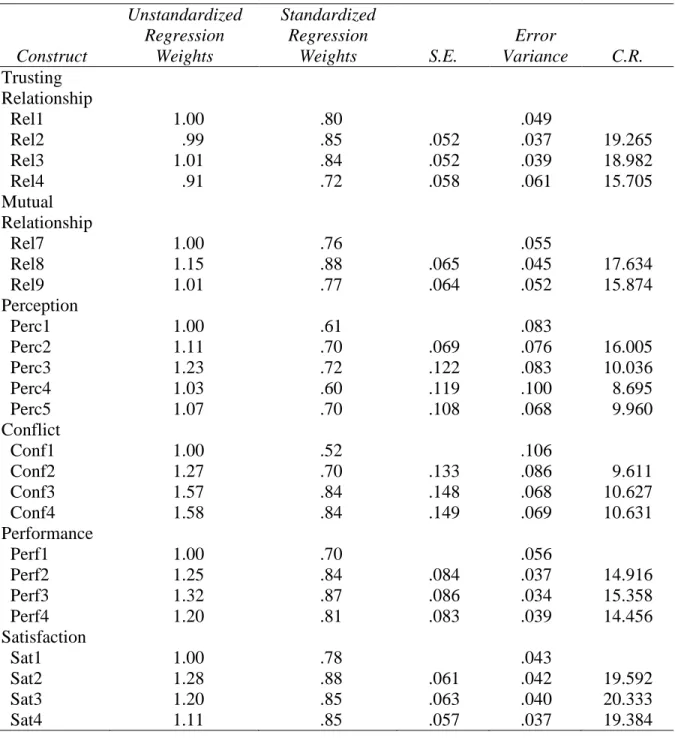
The measurement model is visualized in Figure 2. Byrne (2005) suggested that a typical combination of the evaluative criteria for CFA estimation might include χ2 value, Comparative Fit Index (CFI), Root Mean Square Error of Approximation (RMSEA) along with its 90% confidence interval, and Standardized Root Mean Square Residual (SRMR). A rule of thumb for a well-fitting model requires a CFI value equal to or greater than .90 (Hu & Bentler, 1999), a RMSEA value of less than .08 (Brown & Cudeck, 1993), and a SRMR value of less than .10 (Kline, 2005).
The measurement model was estimated and the result indicated a satisfactory fit,
Construct Validity
As mentioned earlier, construct reliability assesses “how much statistical error or noise a measurement instrument produces” (Hayes et al., 2005, pp. 309). On the other hand, construct validity concerns whether a set of question items “is serving its function as a measure of what we claim” (pp. 309). To test for construct validity, the researcher examined two kinds of validity. One is convergent validity, the extent to which the measure is associated with other theoretical constructs. The other is discriminant validity, the extent to which the measure is distinct from other theoretical constructs.
Convergent Validity
Discriminant Validity
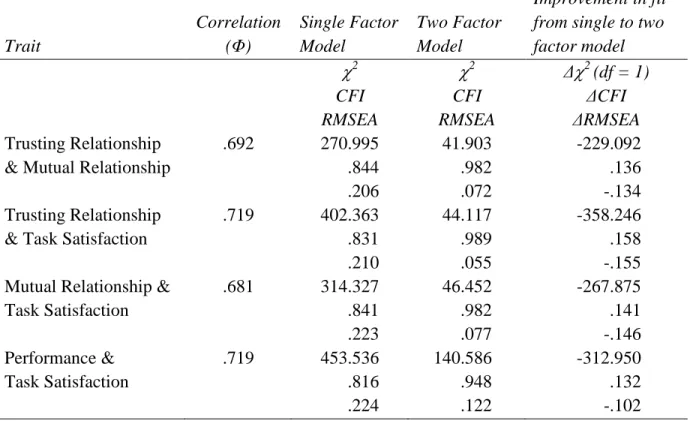
According to the construct’s correlation matrix (see Table 7), four pairs’
correlations were significantly high (i.e., .692 between TR and MR; .719 between TR and SAT; .681 between MR and SAT; and .719 between PERF and SAT), relative to other correlations. This indicates the possibility that the two constructs might measure the same concept. To assess discriminant validity of these four pairs, a χ2 difference test between a single-factor model and two-factor model was conducted such as confirmatory factor analysis. For example, if the TR scale and the MR scale measure different concepts, a single-factor model (constrained model), where the four TR indicators and the three MR indicators are forced to load on a single factor, should not result in a substantial reduction in fit, compared to a two-factor model (unconstrained model), where the indicators are forced to load only on their respective factors. As the single-factor solution is a nested model of the two-factor solution, their model fit can be compared statistically with a χ2 difference test with one degree of freedom (Kline, 2005). Also, the single- and two-factor models were compared descriptively using standard measures of fit, such as CFI and RMSEA.
Structural Model
In the initial research model, there were two higher-order factors with three sub-factors (i.e., relationship and agreement perception). However, the relationship construct turned out two factors and the agreement perception construct appeared as a single factor. Furthermore, the two factors of relationship construct (i.e., trusting relationship and mutual relationship) showed discriminant validity, so they should be considered as
mutually distinctive constructs.
Therefore, the hypotheses regarding the relationship construct should be divided into two separate hypotheses in terms of two constructs, trusting relationship and mutual relationship. Accordingly, Hypothesis 1, 4, 7, and 8 were changed as follows:
Hypothesis 1a: The perceived “trusting relationship” between the public relations agency and client will be negatively associated with perceived task conflict
about crisis management.
Hypothesis 1b: The perceived “mutual relationship” between the public relations
agency and client will be negatively associated with perceived task conflict about crisis management.
Hypothesis 4a: The perceived “trusting relationship” between the public
relations agency and client will be positively associated with perceived task satisfaction
Hypothesis 4b: The perceived “mutual relationship” between the public relations
agency and client will be positively associated with perceived task satisfaction of crisis management.
Hypothesis 7a: The effect of perceived “trusting relationship” between the public relations agency and client on perceived task performance will be mediated by perceived
task conflict.
Hypothesis 7b: The effect of perceived “mutual relationship” between the public relations agency and client on perceived task performance will be mediated by perceived task conflict.
Hypothesis 8a: The effect of perceived “trusting relationship” between the public
relations agency and client on perceived task satisfaction will be mediated by perceived task conflict.
Hypothesis 8b: The effect of perceived “mutual relationship” between the public relations agency and client on perceived task satisfaction will be mediated by perceived
task conflict.
Research Model Fits and Modification
To assess the fit of the new structural model, a nested model comparison was conducted with a χ2 difference test between the new research model and the measurement model. As the two models are nested in each other, a χ2 difference test is appropriate. The χ2 value of the structural model was 725.218, df = 239. The χ2 value of the measurement
model was 565.093, df = 235. Thus, the χ2 difference is statistically significant, ∆χ2 = 160.125, df = 3, p < .001. This result suggests that the structural model could use some improvement.
However, it should be noted that researchers should consider two criteria at the same time when modifying a model (Kline, 2005). In other words, the model should be re-specified not only on the basis of statistical criteria (e.g., improved model fit), but also on the basis of theoretical considerations. Use of statistical criteria alone can result in illogical models. Therefore, model modification must be conducted on the basis of theory guided by statistical considerations. Also, if there is a need for path deletion, dropping every path that is not statistically significant from the model is not a good idea because removing such paths may affect the overall solution in an important way (Kline, 2005).
evidence to support the deletion of those paths. Finally, the modified model was developed (see Figure 4).
Accordingly, four hypotheses regarding the direct and indirect effects of trusting relationship and mutual relationship on perceived task performance and satisfaction were
added as follows:
Hypothesis 11a: The perceived trusting relationship between the public relations
agency and client will be positively associated with perceived task performance of crisis management.
Hypothesis 11b: The perceived mutual relationship between the public relations agency and client will be positively associated with perceived task performance of crisis
management.
Hypothesis 12a: The effect of perceived trusting relationship between the public relations agency and client on perceived task satisfaction will be mediated by perceived task performance.
Hypothesis 12b: The effect of perceived mutual relationship between the public
Modified Research Model Fits
To assess the model fit of the revised structural model, a χ2 difference test was also conducted between the new model and the modified model because the two models are nested in each other. If the χ2 difference test indicates a non-significant difference between the new and the modified models, a more parsimonious model (the new model) should be chosen.
Hypotheses Test
Because the modified model was selected as the better model, the results of the hypotheses tests using this model are reported in this section (see Table 9 and Figure 4).
Direct Effects
H1a: Effects of trusting relationship on perceived task conflict. As the path H1a
in Figure 4 indicates, there was no significant association between the trusting relationship and perceived task conflict about crisis management, β = -.114, ns. This suggests that the trusting relationship between the public relations agency and the client does not influence the level of task conflict about crisis management that the agency and the client perceive.
H1b: Effects of mutual relationship on perceived task conflict. As the path H1b
in Figure 4 indicates, this hypothesis was supported, β = -.340, p < .001. The better the mutual relationship between the public relations agency and the client, the less the parties perceive task conflict about crisis management.
H2: Effects of agreement perception of crisis management strategies on
perceived task conflict. As the path H2 in Figure 4 indicates, this hypothesis was not
supported, β = .143, p < .05. Unlike the direction of the hypothesis, the more the agency and the client perceive agreement on crisis management strategies, the more they
perceive task conflict about crisis management.
H3: Effects of perceived task conflict on perceived task performance. As the
suggests that task conflict between the agency and the client does not affect the level of task performance that they estimate.
H4a: Effects of the trusting relationship on perceived task satisfaction. As the
path H4a in Figure 4 indicates, this hypothesis was supported, β = .375, p < .001. This suggests that the better the trusting relationship between the agency and the client, the more they perceive task satisfaction with crisis management.
H4b: Effects of the mutual relationship on perceived task satisfaction. As the
path H4b in Figure 4 indicates, this hypothesis was supported, β = .156, p < .05. This suggests that the better the mutual relationship between the agency and the client, the more they perceive task satisfaction with crisis management.
H5: Effects of perceived task conflict on perceived task satisfaction. As the path
H5 in Figure 4 indicates, there was no significant association between perceived task conflict and perceived task satisfaction with crisis management between the agency and the client, β = -.042, ns. This suggests that task conflict between the agency and the client does not affect the level of task satisfaction that they perceive.
H6: Effects of perceived task performance on perceived task satisfaction. As the
path H6 in Figure 4 indicates, this hypothesis was supported, β = .403, p < .001. This suggests that the higher the agency and the client estimate perceived task performance of crisis management, the more they perceive task satisfaction.
H11a: Effects of the trusting relationship on perceived task performance. As the