MANURE POLITICS:
MAKING SPACE FOR MODERN AGRICULTURE IN THE LANDSCAPES OF EVERYDAY LIFE
Christopher Neubert
A thesis submitted to the faculty of the University of North Carolina at Chapel Hill in partial fulfillment of the requirements for the degree of Master of Arts in the Department of Geography
Chapel Hill 2017
Approved by:
Sara H. Smith Scott Kirsch John Pickles
ii
iii
ABSTRACT
Christopher Neubert: Manure Politics: Making Space for Modern Agriculture in the Landscapes of Everyday Life
(Under the direction of Sara H. Smith)
This thesis focuses on the presence of livestock waste in the Raccoon River watershed in
northwest Iowa. In particular, I examine the liquefied mixture of feces and urine that pools underneath these animals in Concentrated Animal Feeding Operations (CAFOs) that is collected
and then sold to local farmers. These farmers then use this waste as manure for spreading onto crop fields. The process through which hog waste re-enters the agricultural economy as “manure” relies on interwoven networks of power that continually produce the landscape and
conceal the everyday, lived experience of this waste when it is spread near homes and communities. Relying on fieldwork completed in 2015, this thesis examines how seemingly
iv
ACKNOWLEDGEMENTS
Many thanks are owed to the staff and members of Iowa Citizens for Community
Improvement. I left my job at CCI in 2012, but in the four years that have passed I’ve always felt welcome and at home when I return to Iowa. I am constantly amazed by the meaningful
friendships and commitments I developed, and am grateful that this project has allowed me to deepen those connections even as the process of research changed my understanding of life in
Iowa in many ways. I could not have comprehended the stories of rural life without my mentors and collaborators among the ranks of CCI. Special thanks to Katie Bryan, who opened her home to me in the summer of 2015, Hugh Espey who gave me open access to the CCI archive, and Jess
Mazour, Matthew Covington, Adam Mason and everyone else who listened to me stumble through my explanations for what I was witnessing. Finally to the members who welcomed me
into their homes and allowed me to interview them – who remain anonymous in these chapters – I am deeply grateful for the time you all shared with me.
I feel tremendously fortunate to have found a committee at UNC that is not only willing to entertain this project but encourage it, and me, as I’ve changed my ideas, struggled to write, and grappled with what will end up being the longest document I’ve written to date – thanks to
Scott Kirsch, John Pickles and Kumi Silva. I have also found in Sara Smith a wonderful mentor, whose support always seems to keep me confident in my abilities and excited about my ideas. I have found a wonderful circle of graduate friends whose encouragement and critical eyes have
v
Pavithra Vasudevan, Ben Rubin, Michael Hawkins, Jim Kuras, Sertanya Reddy, Cory Keeler, Anusha Hariharan, Mabel Gergan, Nathan Swanson, and Mike Dimpfl for all their support.
This project would never have been completed without the support of my family in Sioux Falls, my dad, sister, and aunt whose love and encouragement never fails to lift my spirits. My partner,
Spencer, has been an invaluable source of patience, wisdom and kindness.
The idea for this project was formed in a hospital room in December 2014, when my mother was diagnosed with cancer and it became clear to me that I needed to be closer to home.
She died just one month later before any of these ideas could be realized. She loved CCI, she loved my work in Iowa, she loved me, and I loved her. When I returned to Iowa last summer I
vi
TABLE OF CONTENTS
INTRODUCTION... 1
Outline of this Thesis ... 7
The Invention of the CAFO ... 10
The Raccoon River and the Des Moines Lawsuit ... 15
CHAPTER 1: METHODOLOGY ... 19
Activist Orientations ... 21
Materialist Orientations ... 24
Ethnographic Methods ... 28
CHAPTER 2: CREATING THE MODERN AGRICULTURE APPARATUS ... 31
Truth, Political Economy, Art of Government ... 33
Early Government Interventions ... 38
HF 519 and the Emerging “Modern Ag’ Apparatus ... 43
Articulating Activist Concerns to the Apparatus ... 49
Conclusion to Chapter Two... 57
CHAPTER 3: PRODUCING A MODERN LANDSCAPE ... 59
Defining Discourse ... 61
Spatial Codes, Representations of Space, and the Landscape ... 64
The Farm Bureau and the Modern Ag Discourse ... 67
The Rural and the Urban in the Production of Abstract Space ... 77
vii
Conclusion to Chapter Three... 82
CHAPTER 4: MATERIALITY, INTIMACY, AND RESISTANCE ... 84
Materiality and Geography... 87
Matter out of Place ... 89
Manure and the Dissolution of Public/Private Distinctions ... 92
Remainders and Possibilities for Resistance ... 94
Conclusion to Chapter Four ... 97
CONCLUSIONS ... 98
APPENDIX A... 103
1
INTRODUCTION
Fifteen years ago, Elle and her husband Karl bought a small, two-acre homestead in rural
Guthrie County, Iowa. Both Elle and Karl grew up on small farms, and though both now work in larger towns they missed the rural life. Elle especially wanted to live somewhere where she could be around animals. On the day I visited their small home on a long gravel road in early May,
horses wandered around aimlessly, cats scattered to escape my car tires, and a peacock stood watch from his perch in a solitary tree. For Elle and Karl, this home was supposed to be the place where they could live the rest of their lives in relative comfort, where their grandkids might be
able to experience a piece of the rural world they once lived. They invested all their savings into their home and settled into a quiet country life away from the city.
One morning, soon after they had moved in, Karl noticed their neighbors had begun clearing land, installing new utility poles, and putting up power lines. One call to the County revealed that their neighbor had received a permit to build a new kind of building to house 2,400
hogs – a Concentrated Animal Feeding Operation (CAFO) – less than a half mile from their home. That phone call led to others in a desperate search for help. The County told them it was
too late, they had missed the permit notice in the paper, had lost their one opportunity to protest, and construction was underway. A local lawyer told them that for $25,000 it might be possible to
2
Within months, the new CAFO was up and a few years after that, a new one was built, also less than a half mile away from Elle and Karl’s home. Each CAFO was constructed above a
concrete pit designed to collect the excrement that falls through the slatted floors over which the hogs live out their lives. This waste is regularly mixed with water to keep it in a liquid state.
When the pits fill up – usually every six months or so – the putrid mixture is collected and distributed to nearby corn and soybean producers as manure. This manure is then spread on the fields, sometimes in combination with other chemical fertilizers. Corn and soybeans long ago
surpassed other commodity crops as the most profitable per yield, and maximizing yields by any means possible has become the main objective for commodity growers in this area. The first
CAFOs began to appear in Iowa in the late 1980s, but their popularity increased dramatically with the passage of laws in the early 90s that eased environmental regulations and established a bureaucratic framework through which CAFOs could be constructed and protected by the state
from angry neighbors like Elle and Karl.
Elle and Karl’s biggest concern was the stink produced by this mixture of feces, urine,
water and other excreta. Many in the small town near their home told them to get used to this “smell of money.” Their concerns were denigrated by politicians who told them “if you don’t
like it, move to a different state.” The fields surrounding their home, up to the fence-line 100 feet
from their back door, came to receive most of the manure from these two CAFOs. Eventually, the open pasture across the gravel road from their front door was plowed to make way for more
corn fields, which also received manure. Elle and Karl’s dreams of outdoor cookouts with the grandkids playing outside disappeared. They stopped fishing in the nearby creek, which runs green and frothy at certain times of the year, including the winter when it no longer freezes.
3
that wandered onto their property. There’s really no place for them to go, but as she told me:
“this isn’t the farm life we were hoping for.”
Both Elle and Karl grew up on small farms. They expected some smell when they moved to the rural countryside. But the regular spreading of manure on the fields near their home was unlike anything they’d experienced. They were stunned by the realization that in the years
between their childhoods and their return to rural Iowa, “farming” had become completely unrecognizable to them. When I asked how they would explain the differences they’ve seen and
lived, Karl simply replied, “It’s not your grandfather’s shit anymore.” In a landscape dominated by discourses that claim Iowan farmers are simultaneously linked to traditional notions of family
farming as they embrace modern technological efficiency, such crude statements pose a
challenge to the politics behind the discourse. This politics is rooted in a moralistic vision – that Iowans must be allowed to “feed the world” – and, as I will show, these discourses have been an
extremely powerful tool aiding the production of an industrializing landscape in rural Iowa today.
Sitting in their living room in May 2015, between squawks of peacocks and mews of kittens, I could hear the grunts and groans of hogs – a constant hum, one of the new markers of everyday life in the Raccoon River Watershed where they’ve made their home. The processes
that have transformed the landscape are always present in everyday life in rural Iowa, usually as little more than background noise until they overwhelm the senses.
Less than an hour’s drive to the northwest, in Sac County, IA, Ro tells me a very similar
story. She and her husband Dean run a business from the small town near their rural farmstead. Their ties to the community stretch back further and deeper than Elle and Karl’s. They moved to
4
a family. Today they have mostly retired from the day-to-day operation of their business, and Ro spends much of her time protesting the construction of new CAFOs and working with local
conservation groups to maintain a creek near her home. Her outspoken views on industrialized farming are well known in the community and she is a frequent presence at meetings of the
County Board of Supervisors.
Several years ago, Dean suffered a heart attacked and required long-term hospitalization in Des Moines. Ro spent most of her time with him, and on their return home they spotted stakes
on the side of the road indicating new construction. Ro was livid – the stakes meant a CAFO had been permitted and construction was underway. Worse, once the stakes are in the ground it
becomes nearly impossible to stop construction. She called supervisors who she thought she could trust and demanded an explanation. They pointed her to a notice printed in a local weekly paper which appeared when she and Dean were in Des Moines. “Well we just thought you’d see it,” the supervisor explained. Ro called other neighbors, demanded an explanation from the
County Sanitarian, but found little support. “Nobody wants to walk up to you and say something about it,” she explained, “Later people said, ‘oh, we saw that. We wondered why you didn’t say anything...’ I think I could have stopped that one.”
Now, Ro and Dean have adjusted to life near a CAFO. Others have moved near their
home since, and Ro pointed out three CAFOs that can be easily spotted from the end of her driveway. Like life at Elle and Karl’s home in Guthrie County, these CAFOs spread manure
right up to the edge of Ro and Dean’s property line. The spreading can begin at any time, sometimes in the middle of the night, but any time Ro spots the “armies” of manure spreaders rolling down the gravel road she rushes to seal every window in their house. For several weeks
5
then, Ro says, “I’ll be driving down the road and I’ll realize – my hair smells like hog shit.”
Depending on the time of year, the smell can be worse. In the winter, the sun shines all day and it
melts, freezes, and then melts again. In the summer, a layer of warm air in the morning can trap manure particles close to the ground in an inversion effect similar to smog in larger cities. Ro
worries about what the hydrogen sulfide and ammonia released into the air by the waste is doing to her husband’s health. Neighbors have written to her, telling her she should leave. She tells me,
“I mean, maybe we should leave, but that would just break my heart.”
The transformations that have occurred on the land in and around the homes of Elle, Ro and others in rural Iowa are the most recent expressions of industrializing trends in agriculture
since at least the beginning of the twentieth century. Particularly in the last three decades, complex state bureaucracies have emerged alongside new technologies of agricultural production, including the CAFO, but also larger tractors, manure spreaders, and genetically
modified foods that populate the landscape. Thousands of hogs, cattle, and poultry are
concentrated together to produce an animal population that far surpasses the human population in
all of Iowa. The new technologies also produce new wastes, and the institutions participating in the industrialization of agriculture also work to manage the wastes that are produced – indeed to reclaim this waste and return it to the market as a new sort of quasi-commodity: liquid manure.
Because the concentrated waste of these animals produces such a sensory, bodily reaction in the humans who encounter it in and around their homes in rural Iowa, efforts to
commoditized, transform, or otherwise eliminate it have led to tense political debates since at least the early 1990s. In general, the response of the state has been to support the efforts of livestock producers to give this waste value as “manure,” regardless of the actual benefits to the
6
liquefied waste reaches capacity in the pits below each CAFO, it is collected by the CAFO operators (who are not necessarily the owners of the livestock1) and distributed to nearby crop
farmers under pre-arranged agreements mandated by state law. These agreements are contractual obligations that vary significantly from CAFO to CAFO. Occasionally, crop growers will pay
CAFO operators for this manure; however the details of these agreements are not always
disclosed in required state documents. Thus, livestock excrement is imbued with value, though it is not exactly commoditized as is not bought or sold on an open market. Instead, interlocutors
emerge to design Manure Management Plans (MMPs) and connect livestock producers to crop growers.
These relationships play a key role in the complicated and complex network of actors and institutions that form the Iowa agricultural apparatus of political and economic interests which are in turn influenced by dramatic changes occurring outside the borders of Iowa. The emergence
of this apparatus will be discussed in detail in chapter two. In this apparatus, however, the material characteristics of excreted animal waste disappear in the discourse, a process I will
discuss in chapter three. The waste then becomes implicated in the trend toward concentration: of animals in confinements, of manure in pits, of people who flee to cities and towns when this concentration via confinement fails to contain particles in the air, in the soil, in the water, and
eventually in the home and body. The consequences and possibilities found in this material failure will be discussed in chapter five.
1
7
Outline of this Thesis
This project, then, seeks to recover what has been lost in the production of “manure,” a
process that I argue is fundamental to the most recent transformations that have occurred in the
Iowa landscape since the invention of CAFO space. Occasionally, I will give particular attention to hog waste given the crucial role that the hog industry has played in these transformations, and because of the uniquely onerous qualities of hog waste that is collected in confinement pits. This
project explores how this waste of industrial agriculture is re-assigned value in the marketplace and the implications of that value on the socio-cultural landscape in rural Iowa. The answer to that question exists in understanding the state’s role in these processes of production (of
“manure,” of a particular landscape, etc.) and its relationship to the representatives of capital and
industry.
Chapter one begins with a review of the methods and methodological orientations that I employed in this project. This research is grounded in activist and materialist ethnographic
methodologies, and I conducted the bulk of the field research over several months in the summer of 2015. It is also important to note that I have previously worked in rural Iowa as a community organizer and those experiences informed and shaped this project, both methodologically and
analytically.
In chapter two I begin politicizing the history of manure management in Iowa, focusing
on the apparatus of modern agriculture that emerged in roughly the last three decades in an attempt to concentrate, contain and transform waste into valuable manure. This history has roots that begin long before the introduction of CAFOs in Iowa, and will inevitably be an incomplete
8
introduce a very different history of the transition to CAFO-style agriculture in Iowa following the farm crisis of the 1980s and the laws and regulations passed under the guise of environmental
protections beginning in the 1990s and continuing today.
Throughout this history, I will be giving special attention to the representations of
agriculture in the discourse that equate agricultural concentration with modernity. This discourse, in many ways, emerges as the element that holds these processes of transformation together. Resisting these changes then becomes fundamentally antiquarian, anti-progress, anti-modern,
and thus un-Iowa and unsettlingly pro-hunger.
In chapter three, I then chart how this apparatus produces the landscape in its own
modern image and the continued work this vision of modernity does today. From here I am able to deepen a theory of the operation of power in this landscape, examining interventions that produce the landscape to offer an alternative understanding of where that political history leaves
us. Essentially, I argue that the long, gradual process of creating CAFO space by producing manure through these complex apparatuses simultaneously recreates the landscape through
urbanization. Concepts such as rurality and nature dissolve as commodity crops intended for livestock feed or automotive fuel expand into previously uncultivated spaces, as the livestock fed by those crops is carried away by trucks fueled by those crops to the cities where they are
slaughtered before being shipped to a global urbanizing elite. At the same time the waste of these animals that is not absorbed by the disintegrating soil washes off and enters the drinking water of
urban centers downstream.
Chapter four then concludes this thesis by returning to a discussion of the materiality of the waste itself to reiterate the fundamental failure of these attempts at concentration because
9
mingle, intertwine and subvert boundaries and confinements. Here I turn toward how these changes in the Iowa landscape are experienced bodily through the odor the manure produces – as
it collects in the CAFO itself, but more commonly when the collection pits are full and the manure must be spread onto nearby fields. This experience of waste tells an important story of
how power networks in governmentality are enacted on the body; in other words, how this particular experience of waste is also an expression of the apparatus that emerges to regulate and confine hog waste. In this landscape, confinement is inextricably linked to modernity.
Confinement is a marker of technologies (of power) that are modern. And yet, this thesis is ultimately about the remainders that escape confinement, namely the livestock excretions that
refuse attempts at commodification, spill over boundaries, and enter communities, lives, and bodies in varied ways. The apparatus is therefore flawed because it intends to contain the uncontainable. Perhaps the apparatus is flawed because rather than attempting to manage
processes of concentration or urbanization, they work to reproduce the irreproducible. Concluding with a return to materiality, then, works toward two aims – first to
demonstrate that the problem of manure is about more than just its offensive odor, it is about the power it carries when it penetrates the most intimate spaces of the home and the body. This power leads to new everyday practices: attempts to avoid and adapt to the putrid matter that
seeps in at night, that confronts you when you open the front door, that forces you in a mad sprint to your car, that you find in your hair on your way to work, that causes you to shut up your
10
concepts of boundaries and space in an effort to craft a fuller understanding of the operations of state and capitalist power.
The Invention of the CAFO
In the early 1980s, when agricultural states across the United States faced a crisis unheard of since the Great Depression, prices on most crops and livestock fell to levels not seen in
generations. The resultant hardship forced millions of farmers off the land – most due to debt and foreclosure. While prices would stabilize by the end of the decade and the agriculture economy would recover, the landscapes of these rural areas were forever altered. By the end of the 1980s,
the smallholding family farmer was quickly being replaced by large-scale, corporate and industrialized factory farming. The social, economic and cultural consequences of the rapid depopulation and impoverishment during the “farm crisis” have been well documented
(Murdock et al 1988; Foley 2015), as has the rise of new capitalist modes of production (Grey
2000; Mayda 2004). It was in this context that the CAFO began to emerge as the primary mode of livestock production.
While the farm crisis of the 1980s presented an opening for the rapid acceleration of
CAFO construction, the transition from the hog barn of smallholding farmers to the large corporate CAFO was a gradual process represented in the changing architecture of livestock
spaces. Mayda (2004) identifies the 1960s as a key period in the transition from simple structures intended to house only a few hogs to the massive confinement. Experiments were conducted (mostly at Purdue University, a public institution) that introduced open-front buildings, enclosed
11
the least cost in various stages of the production process. With the implementation of these changes, the required space per hog dropped, exercise was no longer considered important for
the hog or sow, and the production process was separated into three stages to maximize
efficiency: farrowing, nursing, and finishing, which correspond to the different types of CAFO
buildings that exist today (Mayda 2004, 26).
While keeping pigs in these uniform, physically separated and distinct groups, the CAFO also produced technologies to fully manage the body of the pig. Animals are now kept within
their age group and size range to maintain uniformity and efficiency. Breeding, for example, becomes the primary objective of the farrowing group, and artificial insemination is a common
practice. Feeding is a fully mechanized process enabled by the development of automated self-feeders and waterers which give the hogs continuous access to food, maximize intake, and significantly reduce human labor costs: “no longer were hogs fed the garbage or leftovers of
former years; in fact this became forbidden by CAFOs. Their diet was exacting,” including vitamins, minerals, and antibiotics (Mayda 2004, 29, 37). Thus the CAFO introduces several new
borders, both conceptual and physical, between different groups of pig, between the pig and certain sources of food, and between the pig and the farmer or laborer.
By the 1990s, the CAFO was the clearly dominant space of hog production and the means of production of buildings and livestock had shifted from smallholders to “construction
firms or large vertically-integrated, hog production companies” (Mayda 2004, 31). Hog housing became “standardized, uniform, and consistent” though this dominating process did not occur
without significant resistance. Outrage was rampant as hog farmers transitioning to CAFO production “often alienated their neighbors over concerns of air and water quality” (Mayda 2004,
12
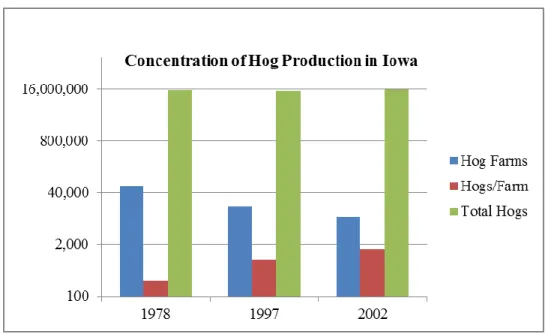
sharp and significant decrease in the number of hog farms overall, and an increase in the number of hogs produced. In 1945, there were over 3 million hog farms producing around 46 million
hogs across the United States. In 2002, there were just 75,000 hog farms remaining in the entire U.S., producing nearly 60 million hogs (Mayda 2004, 28). Thus the transformation of the hog
economy was achieved through the production of the CAFO space, demanding replication to maximize efficiency.
Similar trends were occurring in Iowa. In 1980 in Iowa, 80,000 hog farms across Iowa
produced an average of about 250 hogs per farm. By 2002, only 10,000 hog farms remained, with an average of 1,500 hogs per farm. Between 1974 and 2002, the greatest increases in
average annual hog production per farm occurred between 1992 and 1997 (doubling from 400 hogs per farm to 800), and then again between 1997 and 2002 (from 800 hogs per farm to more than 1,500). In contrast, the average farm in 1974 produced about 200 hogs, and in 1982 only
about 300 (Flora et al. 2007, 1-2). Thus, in less than a decade the hog economy of Iowa was fundamentally altered.
13
Waste management quickly became an issue for these new factory farms, engendering new spatial practices. Historically, waste had been used either as manure on fields or drained into
nearby streams, but the increased concentration of hogs required new methods to dispose of unprecedented amounts of waste. The manure pit thus enters the architectural construction of the CAFO: “seldom discussed previously, [manure pits] were now so large that they needed to be managed. The pit became an important part of the hog housing structure.” The waste problem
was becoming such an immediate and visible consequence of the CAFO construction that as
early as 1969, U.S. Department of Agriculture warned that animal wastes could eventually “exceed wastes from any other segment of the industrial-domestic complex” (Mayda 2004, 27).
Despite these efforts to confine waste within the space of the CAFO, it exceeds its boundaries and also requires the domination over spaces beyond the CAFO: “land requirements
for buildings were small, but more land was required to spread the manure from these intensive hog operations” (Mayda 2004, 33). This waste is spread across this land beyond the CAFO
wherever these confinements exist (such use of waste is integral to hog production), and
eventually this waste makes its way into watersheds. The problem of the dead zone in the Gulf of Mexico, for instance, has been well documented as a consequence of manure runoff from
CAFOs (Spellman & Whiting 2006, 499).
Today, the CAFO has become the defining feature of the contemporary meat industry, unceasing in its concentration and intensification, constantly demanding “fewer but bigger farms or factories, with more specialization of feed and other inputs, and fewer farm workers” (Emel &
Neo 2011, 68). This is certainly true in Iowa and elsewhere. Most of these CAFOs are operated under contract agreements, where “contract farmers” are essentially hired hands, offering land
14
go into significant debt to build these buildings – the corporation only offers the livestock to populate them. Under other arrangements, the contract farmer will assume the deed to the CAFO
after several years have passed – but in every instance the corporation maintains complete ownership over the hog itself. Such is the economic logic of a Fordist regime, where a market demands “standardized meat” and “commodification and intensification are thus presented as a ‘natural’ development and essential for survival” (Emel & Neo 2011, 69-70).
The livestock sector globally now occupies 30 percent of the ice-free terrestrial surface of
the planet, much of this through its connection to cropland for feed (Emel & Neo 2011, 70). In Iowa, this connection between cropland growing corn and soy for animal feed with the animals
in turn providing fertilizer for the crop closes a cycle that appears entirely natural in its operation on the landscape.
15
The Raccoon River and the Des Moines Lawsuit
Most of my research in the summer of 2015 was conducted in the watersheds of the North and South Raccoon rivers. As the map in figure 1 demonstrates, while the regions with the most concentration of CAFOs in Iowa are outside of the watershed, there are still a significant
number of CAFOs operating close to rivers and streams that flow directly into the Raccoon River. This river is the primary source of drinking water for nearly a million people, most of
whom live in the Des Moines metro area. However, because of the tremendous
transformations to the physical landscape of the Raccoon River watershed over the last century, namely the introduction of a widespread
drainage system that made the land suitable for cultivation, pollutants such as nitrates enter the
drinking water. This drainage system is essentially a series of large pipes (called “tiles”) that run deep underneath the ground,
siphoning water from the surface directly into waterways. Before this region was cultivated,
much of this watershed was a long, flat,
swampy wetland – the site of the “Des Moines Lobe” of the Wisconsinian Glacier. These tiles made it possible to drain the water and prevent it from collecting again. When nitrates are
applied to the surface as manure or chemical fertilizer they can also runoff into these tiles. It is then the responsibility of the Des Moines Water Works to run a denitrification facility at
16
tremendous cost to taxpayers in order to comply with the standards of the federal Safe Drinking Water Act. The problem, the Water Works contends, is that when it rains the liquefied mixture of
livestock waste mixes with the water and runs off into these tiles. Thus in early 2015 the Water Works filed suit against several of these drainage districts in Sac, Pocahontas and Buena Vista counties, arguing that the drainage tiles themselves were “point-source polluters” and thus
subject to regulation under the federal Clean Water Act (CWA).
This lawsuit immediately became a source of unprecedented political conflict in Iowa
(even compared to the historically divisive politics of Iowa agriculture), with the director of the Des Moines Water Works, Bill Stowe, receiving death threats and the Governor of Iowa, Terry Branstad, publically declaring that “Des Moines has declared war on rural Iowa. When I
interviewed Stowe in May 2015 about the lawsuit he said simply that they had “reached a point
where talk without action is no longer acceptable from a public health standpoint, from an
economic standpoint, from a leadership standpoint.” Nitrate levels were, he claimed, “alarmingly higher than we’ve seen in our history” and he placed the blame for those high levels directly with
industrial agriculture. This lawsuit came at a time when activist groups like Iowa Citizens for Community Improvement (Iowa CCI) were organizing to stop a “surge” in CAFO construction across Iowa. CCI has been fighting CAFOs (“factory farms” to use their term) since the early
1990s through protests, legislation, and lawsuits, though victories had been few and far between. For them, an institution like the Des Moines Water Works led by a charismatic figure like Stowe
17
The agricultural industry counters that it is already too regulated, that nitrates are a natural part of the soil, that excesses are caused by towns upriver or migrating geese, and that
livestock waste from CAFO pits is a valuable and necessary product. Stowe counters that, for the city of Des Moines, “getting rid of [this waste] is the issue, not purchasing it or managing it under some economic model.” He also added, quite frankly, that he wasn’t buying the arguments
coming from supporters of industrial agriculture, groups like the Iowa Farm Bureau, who claim that voluntary efforts were successfully cleaning water in the region: “In spite of all the
pronouncements from folks in industrial ag, we’re not seeing any reduction, any hope, any sense
that nitrate concentrations are being viewed seriously by the producers.”
But my project very quickly became less about the implications of the lawsuit and the potential changes it could bring about, and more focused on how such a situation came into existence. As it evolved, it also became much less about what happens to this waste when it
appears in Des Moines and much more about what happens at the moment it exits the pit and is spread on fields throughout the watershed. To explain some of these transformations in the
landscape, in chapter two I will look at how an apparatus has emerged composed of a complex network of actors and institutions which work together to produce an idea of agriculture that is modern and technological, while still linked to a nostalgic past even as vertical integration
becomes economic reality. In trying to understand the relationship between apparatus and landscape, I also turn to questions in chapter three about discourse which I understand as
something that people do – it is active, emergent, and practiced. This discourse appears not simply in political speeches or ads on television, but also in newspaper articles, emails, stories in a bar, photographs and other images, but this idea of agriculture that then emerges – as modern,
18
they appear in everyday life. In chapter four, then, I return to the everyday, lived, material experience of this waste to emphasize that this problem is not just about changing definitions or
19
CHAPTER 1: METHODOLOGY
Almost eight years ago, as a community organizer fresh out of college, I was sent to a rural Iowa town on a warm July day to help run my first public meeting. Our “target”
for the evening was a young bureaucrat from the Iowa Department of Natural Resources (DNR) who was there to discuss with the fifty or so activists gathered at a local diner the
implications of spreading liquid manure on frozen and snow covered ground. The activists wanted the DNR to completely ban the practice, citing the federal Clean Water Act and sharing stories of the manure-filled creeks that flowed near their homes every
spring. The bureaucrat patiently explained the impossibility of such a ban without state legislative action, absolving the DNR of any responsibility for the practice while tactfully
avoiding any acknowledgment that spreading manure on frozen ground was actually occurring. I sat in the corner and wondered when the exciting, less repulsive activism was going to begin – I had not signed up to listen to stories about shit fields in the winter. Had
it not been for a massive, global financial crisis that was emerging around the same time, I likely would have left that job as soon as possible.
Instead I stuck with the organization and their members for four years, and my conversations began sharing similar themes: “Do you know what it means to spread manure on frozen ground?” I would demand in complete earnestness, “Do you know how
dumb that is, to spread warm liquefied waste on top of snow and frozen soil?” I found myself increasingly intrigued by the question of how such a world, an entire reality, could
20
possible, I would ask, that there are people out in this supposedly homogenous landscape of ‘rural Iowa’ who are confronted, every day, with the toxic odors, fumes, particulates and other
matter that appear in their most intimate spaces without their consent? When I returned to Iowa in 2015 in the wake of the Des Moines Water Works lawsuit, this question began to seem much
more important and is, essentially, the guiding question of this thesis.
In many ways, this research is motivated by my own experiences living, working, studying and organizing in Iowa for more than eight years. As an organizer at Iowa CCI, I was
continually struck by the extraordinary mutual unintelligibility between the people I organized and the media, policymakers, and agribusiness interests who held so much power over decisions
that would impact their everyday livelihoods. This unintelligibility was not, I maintain, due to a lack of intelligence or articulation on the part of the activists but rather the result of two very different and conflicting understandings of the Iowa landscape that have emerged with regard to
agriculture in Iowa over the last few decades. One perspective, defined by a certain idea of technocratic objectivity, looks to the generally steady increase in livestock prices and agricultural
products since the introduction of the CAFO and sees a healthy economy in a healthy state populated by healthy people. The other perspective is that of the small farmers who were recently marginalized, who either refused or were unable to transition to industrialized
agriculture, and who now live in rural spaces surrounded by factory farm wastes and excess. It is in this second view of the rural Iowa landscape, and with those people, that I position my
research.
21
voice” to understand how certain phenomena and polices have been created and
transformed overtime. Ultimately, “such a method provides in-depth, thick descriptions
of contextual and personal experience” (LeGreco & Tracy 2009, 1522). Given that this study explores a material object (livestock manure), which appears as an expression of
power in everyday life, and the political implications of that materiality, discourse tracing is a fitting form of analysis. This also allowed me to include a variety of methods, such as interviews, observation, and archival analysis. A detailed discussion of these techniques
and their use in this project follows a brief explanation of the methodological orientations in which this study is situated.
Activist Orientations
Working with activists does not mean that the knowledge produced in the course
of this research is inherently “activist” – a project that actualizes activist goals must prioritize certain new objectives. Thus, in this research, I am seeking to make deliberate
interventions with this project in line with the goals of social science as LeGreco and Tracy (2009) understand them, to “clarify and deliberate about the problems and risks we face and to outline how things may be done differently” (2009, 1537). Further, practicing activist research asks that the researcher identify their “deepest ethical-political
convictions, and to let them drive the formulation of our research objectives” (Hale 2001, 14). Such research privileges “dialogue and collective work” in shaping research
questions and objectives and encourages active participation at all levels of research (Hale 2001, 14). This is fully in line with a decolonial notion that knowledge emerges “out of sustained, critical dialogues with those who are the subjects of that knowledge”
22
As such, an activist orientation to my research means that I privilege the voices of the people who have been marginalized by the most recent phase of industrial transformation in
Iowa. Nagar (2002) outlines at least three questions that must be examined in such research. The first is the “question of accountability and the specific nature of our political commitments: who
are we writing for, how, and why?” (2002, 179). In this project, I am accountable to the activists I have approached with the suggestion of collaborative possibilities, who expect that this
research would contribute to efforts to improve their degraded landscape. These voices include
farmers who have witnessed a remaking of the rural Iowa landscape in the last 30 years, live near and around the animal wastes that are applied to the croplands, and have theorized critical
responses.
Nagar also raises the question of what it means to seriously engage and produce research collaboratively: “what does it mean to co-produce relevant knowledge across geographical,
institutional, and/or cultural borders?” (2002, 179). For this project, collaboration emerges in my commitment to co-producing knowledge through my interviews and informal discussion groups.
My interviews were structured very loosely. I reached out to my contacts before we met with a general list of topics that I wanted to discuss and looking back at my transcripts I am struck by how few questions I ever actually ask in ninety minutes of recording. Most often, my
interviewees were people who were excited to talk and share their ideas about the changes they’ve seen in the Iowa landscape. For me, stepping in only to guide a conversation along and
23
Of course, these interviews would not have been possible if I had not previously made my commitment to their concerns known. Several of my participants either knew
that I had worked at CCI previously or had worked with me in that capacity. I had also, by that time, agreed to work on a collaborative project to map the fields receiving manure
in several counties – a project that I document in the next chapter. In addition I was a frequent participant at protests and other events organized throughout the summer of 2015 where I would discuss my project with anyone interested. This participation was
about more than fulfilling my obligations to participant-observation, it was about demonstrating my continued commitment to this community of activists and my
willingness to also put my body in the struggle – in one case even donning a cow costume to protest at a gathering of presidential candidates.
Nagar’s final question moves the researcher toward an “explicit interrogation of
the structure of the academy... as well as our desire and ability to challenge and reshape those structures and values” (2002, 179). As a researcher with an activist orientation, I
was regularly confronted with supposedly objective studies produced by institutions of higher learning that claim factory farms pose no harm to communities, and indeed are necessary to feed a growing global population. These institutions receive significant
funding from agribusiness and produce research that reflects those ideologies. Of course, in the production of this type of knowledge the ideology is obscured and given an
appearance of objectivity where none really exists. Still, that research produced with support from major donors often exercises more power than those knowledges produced by local peoples and activists. These conflicts between knowledges reappear constantly,
24
production of space. In the process, in using my own research to bring marginalized voices into the academy, my explicit objective is to speak back to these powerful dominating discourses.
To summarize this examination of activist research, I turn to the question of validation posed by Hale (2001), who asks: “Has the research produced knowledge that helps to resolve the
problem, to guide some transformation, which formed part of the research objectives from the start? Is the knowledge useful? If so, to whom” (2001, 15). This question of validation serves for
me as a final recognition that while research can be collaborative, can include non-dominant
voices, and requires certain ethical and political commitments. It must also suggest some
resolution. In other words, activist-oriented research must also be solutions-oriented. This is not
the same as prescription. Rather, research under an activist orientation should point toward possible interventions. In a study like this, which analyzes the political forces that are producing space in the Raccoon River watershed, such interventions can emerge through the efforts to
explain patterns and reveal the operations of power that are concealed by the discourse. If a research is practicing collaboration, thoroughly incorporating marginalized voices,
and engaging with these political commitments, then I believe the interventions can emerge. They are not always easy, they are sometimes reckless and seemingly impossible, but they can also be astonishingly clear and forthright. Throughout this thesis, I will then be looking for these
opportunities for intervention, using the theories productively to explain patterns and undo some of the concealment that is such an important part of the dominating reality in Iowa today.
Materialist Orientations
25
qualitative investigation of the things that make up everyday life can illuminate the “links and connections between objects that cannot speak, yet nevertheless bear messages”
(Prior 1997, 77). In making those connections speak, certain powers that govern human relations are revealed. Such a methodology echoes Foucault’s archaeologies of things that
investigate “the innumerable accidents and myriad twists and turns of human practice that have brought the text to its present form” (Prior 1997, 66). In this project, the “text” I am
working with is the rural Iowa landscape itself, a “discourse materialized” in which
messages have been normalized and naturalized as social and cultural practices to continually reproduce the discourse (Schein 2010, 225).
In the face of an ever more complex scientific understanding of the natural world, social scientists must be constantly concerned with how these materials-of-nature are part of the human production of the social world. How are technologies such as discipline and
biopower utilized on bodies that can be understood as various configurations of cellular molecules or subatomic particles? Such a question at the very least demands that social
scientists actively engage with this physical world of matter. Understanding how these material interactions then contribute to the production of given places, spaces, and societies forms the basis of material analyses. In the following examination of how
materiality has emerged as a methodological practice in geography, Prior’s understanding of using Foucauldian methods as tools for examining and uncovering power is central to
my understanding as well, and indeed complementary to my activist orientation. Thus, I start with the question raised by Kirsch (2013) as the primary concern facing geographers engaging with materiality: how do insights from materialist
26
“materials in production, including the material and symbolic production of new objects,
knowledges, and forms of life?” (440). To being answering this question, I work in this section
to articulate a useful methodology that can thoroughly and thoughtfully examine the materials of everyday life in particular spaces and places. Such a methodology emerges from Tolia-Kelly
(2004) and is picked up (among other studies) in an examination of everyday sustainability in long-distance Australian families by Klocker et al (2012). Their methodology begins with interviews exploring decisions made about material resources and their interactions with
everyday, lived spaces. They focus these interviews on the values on which these decisions were based and the motivations for spatial and material distributions and arrangements. To supplement
these interviews, they asked participants to guide them through their homes, discussing the “rhythms of everyday life… [which] triggered new topics of discussion, offering deeper insights
into participants’ ways of living” (Klocker et al 2012, 2244). This materialist methodology
focuses deeply on the everyday interactions between interviewees and the materials that inhabit the spaces of their lives. It is also a collaborative methodology, which asks participants to reflect
on the materials of their everyday lives in ways that have not been considered before. Moreover, there is a larger contextual question at hand; in this case, it is the question of sustainability and the difficulties of maintaining sustainable practices over long distances.
Cook (2004) also represents a crucial employment of what could be called a deep materialist analysis, examining the connections formed through, within, and across space as humans buy, import, farm, pack, and consume papaya. In following “papaya” and its constituent
materials as they physically moves in and out of spaces and places across the globe, Cook brilliantly traces the various points of intersection with various other actors and materials within
27
care to describe the color of a ripe papaya, the height of the trees, the other materials created to remove papaya from the tree and move the fruit across distances. However,
this is not a mere fetishization of papaya by any means. From his immediate grounding in the production of papaya as a commodity, he moves to a description of the everyday life
of the papaya buyer, buying stock for London grocers.
His analysis expands further, weaving the various structures that are being constructed to support a papaya economy with additional stories of the everyday lives of
the participants who interact with the papaya as a material at various points within the economy. He moves from production to the buyer, to the political economy and then the
importer, to the plant as a commodity and then the farmer of that plant, he traces the global market routes and interviews the farm foreman, he discusses papaya payments and the papaya packer. He concludes with the capitalist consumption of the papaya,
interviews an unwitting papaya consumer, and concludes with the full transformation of papaya from product to commodity, where it enters the everyday lives of countless
consumers as “papain,” a commercially extracted ingredient in “Face-lift treatments. Slipped disc operations. Beer clarification. Chewing gum. Toothpaste. Contact lens cleaning materials. Indigestion remedies. Canned meats. Leather goods. Shrink-resistant
woollen fabrics. Vegetarian cheese” and so on (2004, 662).
Here, while Cook minimizes his engagement with materialist theory, he has still
28
countless people’s lives. In countless ways… Because they’re not discrete things. By any means.
Like anything you could try to follow. Unravelling and becoming more entangled in the process.
Attempts to de-fetishise commodities raise tricky but important questions” (Cook 2004, 662-663). My goal in this project, then, has been to “de-fetishize” hog manure, understanding the
complexities and networks that lead to it being valued as manure, following it back to its source in the landscape and the people who live in and around it, who must live with the material consequences from the moment of its excretion.
Ethnographic Methods
Within this methodological framework I employed qualitative, ethnographic methods including semi-structured interviews, discussion groups, and archival analysis. Semi-structured interviews provided a key opening for gathering important information and opening new lines of
questioning for the project. These interviews were not meant to be formulaic, but were designed for me as the interviewer and the participants to develop knowledge collaboratively, through a
deep engagement with these issues. My most successful interviews were several hours long, ranging from childhood experiences and memories of the farm crisis to the embodied experience of living with livestock waste today. However, while the individual focus of these in depth
interviews allowed personal and intimate life details to be discussed they were “less useful for examining structural, systemic, and ideological practices that shape human experience” (Pollack
2003, 462). Therefore, throughout this project I worked to employ interviews strategically, recognizing their importance in understanding individual livelihoods and revealing some of the potential openings for discussions of power, while working in tandem with other methods,
29
In addition to the fourteen in-depth, recorded interviews I also conducted an informal discussion group with members of a local organization in the Raccoon River
watershed. Throughout the summer of 2015 I participated in and observed several meetings and formal events where the Des Moines Water Works lawsuit and other water
issues of concern to the Raccoon River watershed were discussed. All told, I estimate that I connected with several dozen individuals at these events, where I talked about my research, listened to reactions and shaped my project accordingly.
The data that I collected through the ethnographic methods outlined above was supplemented with analysis of various historical documents, including media accounts,
State of Iowa legislative archives, archival documents from Iowa CCI, formal
descriptions of the history in published materials, websites, and films about the topic. The goal with this archival analysis was to understand how the experienced impacts of this
production of a landscape, influenced by livestock waste, compares with how these transformations are represented in the media and in state, academic and activist archives.
Stoler (2002) has written that the archives must be activated, treated not simply as “as sites of knowledge retrieval but of knowledge production, as monuments of states as
well as sites of state ethnography” (90). In the process of recording events, certain ideas
and people are concealed, as are relations of power. Thus by examining the archives of Iowa CCI my goal is to recover the events, people and ideas that are written out of other
recordings of the history of the emergence of contemporary agriculture in Iowa.
In addition to these ethnographic methods, in mid-2015 I joined an ad hoc group working to document where manure was being spread by CAFOs across Iowa. My role in
30
fields receiving manure using ArcGIS. Thus, this project brings together participant observation of a working group with rudimentary GIS analysis. I will discuss this project further in chapter
two, and the final maps are included here in Appendix A.
Importantly, I maintain that each of these methods was required to provide a more
complete and comprehensive examination of how livestock manure is managed, talked about, and ultimately appears in everyday life. In practice, the methods did not unfold as distinctly as they ware articulated here. I interviewed members of the RRWA and the ad hock working group,
brought archival materials to my discussion with the RRWA, and ultimately relied on my interviews with rural Iowans to inform and contextualized the maps I eventually produced. The
point here, of course, is that in each method certain ideas and knowledges emerged that informed the knowledge being produced through other methods, in regular conversation with participants, informants, and collaborators. The result is just the sort of deeper analysis and collaboratively
31
CHAPTER 2: CREATING THE MODERN AGRICULTURE APPARATUS In this chapter, my goal is to demonstrate how actors and institutions work
together to produce a particular understanding of everyday life in Iowa in which CAFO
farming has quickly come to replace other practices and has become associated closely with modernity. To do this, I begin by exploring the meaning of an apparatus within a Foucauldian biopolitical framework and then using that analysis to reinterpret the history
of the emergence of the CAFO in Iowa and the practices of government that were created to manage the waste of those CAFOs. At the center of this politicized history is House
File 519 (HF 519), a bill passed in 1995 which, for activists in the region, marks a turning point in the proliferation of CAFOs across the landscape. While the introduction of the CAFO occurred decades before the passage of HF 519, this bill represents the first
attempt by the Iowa legislature to address problems raised by activists and others in the region. In the process, the Iowa legislature codified a definition of the CAFO for the first
time in Iowa and attempted to regulate the excess wastes that it produces. To perform this deep analysis, I am relying on interviews and the archives of CCI, the official archive of
the State of Iowa and media reports from 1995 onwards.
Excreted waste figured prominently in these early debates about the CAFO as a new technology of agriculture, as the collected feces and urine produced by animals in
confinement has a markedly different odor than that produced by animals raised in smaller barns or allowed to freely roam in fields. This change occurs due to four specific
32
structures positioned underneath the animals (the manure pit); 2) the dramatically increased numbers of animals being raised in a single building from a few hundred to several thousand (in
the case of hogs and cattle) or even millions (in some poultry confinements); 3) the changes in feed these animals receive (to a corn and soy based diet); and 4) the introduction of constant
antibiotics, which changes the bacterial composition of animal waste. HF 519’s most significant contribution was to establish the framework through which that waste becomes manure and thus able to be spread onto crop fields. With this bill the Manure Management Plan (MMP) first
comes into existence, and the Iowa Department of Natural Resources (DNR) is made responsible for administering those plans. Since 1995, the DNR has become a focal point of activism as the
only agency in Iowa responsible for regulating factory farming, despite their previous,
longstanding role in maintaining state parks, or issuing gaming and fishing licenses. By placing such regulatory power in a body unaccustomed to such a role, activists at the time charged that
the state policy makers were making an intentional decision to mitigate the actual regulatory authority of that agency. Thus from the start, the state’s commitment to regulation in favor of
social and environmental protection was questioned.
The CCI archives from the time support this contention, and the DNR appears as a bureaucratic institution within this emerging CAFO-based agricultural apparatus that is very
much an expression of governmentality and its attempts to manage populations. Toward the end of this chapter I will examine a project that I participated in that articulated concerns directly to
the DNR. The failure of those concerns to be understood as truthful articulations of life in rural Iowa highlights the DNR’s prime role in the maintenance of the apparatus of modern agriculture and the reality that it produces. Where on the surface the DNR is only concerned with managing
33
position in the apparatus is very much about managing the practices of Iowans in their everyday life. This is done both through the discourse and in the role that the DNR plays
in selectively refusing to regulate CAFOs. For activists who claim that the waste from factory farms destroys livelihoods to the point of causing health ailments like asthma or
cancer, this can be seen very much as a biopolitical practice of letting die (Foucault 2008).
Truth, Political Economy, Art of Government
The problem that I work to understand beginning with this chapter is two-fold: 1) a certain landscape has emerged, characterized by the CAFO architecture and
simultaneous monoculturing, that produces significant embodied harm in the everyday lives of people living in that landscape, and 2) this landscape is maintained, embedded,
and naturalized by institutions that repeat a specific narrative about agriculture and Iowa living that also appears in everyday life. The two sides of this problem are not inseparable – in fact they can be tremendously difficult to conceptualize separately – but the attempt
leads to a series of questions: how is this landscape produced? Who is producing it and toward what end? Why is this narrative about agriculture so powerful and how does it
contribute to this production? Answering these questions requires a deep analysis of the function of power in Iowa, moving beyond concepts that work to separate state and
industry. Such a separation, I argue, obscures how power operates within everyday life, and understanding the state as a monolithic entity of power makes it difficult to articulate an alternate reality. In this section then, I will work with Foucauldian concepts of
34
concentrated, embodied and enacted through complex networks, actors, and institutions that together constitute an emerging reality.
In The Birth of Biopolitics (2008), Foucault articulates how an art of government interacts with political economy in order to produce a specific regime of truth. This regime guides powers,
actions, and discourses as they circulate through the world. Foucault asserts that an art of government “must fix its rules and rationalize its way of doing things by taking as its objective the bringing into being of what the state should be” (Foucault 2008, 4, emphasis added). In the
case of Iowa, the state emerges to manage the population within the borders of Iowa, working to promote and protect an agricultural economy that becomes inextricably linked to the vitality of
the population. As such, bills like House File 519 work to create the state in a particular way – it crafts new bureaucracies, endowing them through legislation with new regulatory abilities that serve to manage the environment and the economy.
Political economy offers a way to fix these rules by discovering “a certain naturalness specific to the practice of government itself” – though importantly, this does not mean that
political economy discovers “natural rights that exist prior to the exercise of governmentality”
(Foucault 2008, 15). Thus, within a few short years after the passage of HF 519, the practice of government to regulate waste through documents such as the submission of Manure
Management Plans (MMPs) becomes thoroughly naturalized. This practice of government is thus inextricably linked to the functioning of the economy, in such an embedded way that
understanding waste as anything except “manure” is no longer possible (is no longer true). The
35
then the possibility of limitation) are “introduced into governmental reason through political economy” (Foucault 2008, 17): excrement is no longer waste, it is a valuable
product. It is now manure, a perfectly natural piece of the landscape, a raw material and natural resource which the state is obligated to protect so that it can maintain a healthy
livestock economy – agriculture in Iowa being essential to the vitality of the population. The question for the art of governing then becomes a question of judging
practices not by a moral standard (as under a sovereign power, for instance), but by a division between true and false. Here the “regime of truth” is established, that when
coupled with governmental practice produces an apparatus of power/knowledge that “effectively marks out in reality that which does not exist [a market] and legitimately submits it to the division between true and false” (Foucault 2008, 19). In other words, this
apparatus can produce a “site of truth” where previously no site existed. For Foucault, the
site of truth he is working with here is the market, which having emerged as a site of truth must now be left to function “with the least possible interventions precisely so that it can
both formulate its truth and propose it to governmental practice as rule and norm” (Foucault 2008, 30). The market allows “natural” mechanisms to appear – the natural
price, for instance – that then also becomes a true price. As such the market “constitutes a site of veridiction” – a truth-telling, which is a “site of verification-falsification for
governmental practice” (Foucault 2008, 32).
Thus with the MMP, the state Legislature created the framework in HF 519 through which a market for manure could emerge. The MMP requires only that CAFO operators report which fields that have contracted to receive manure, but in so doing it
36
not waste. Further, the details of costs exchanged for land rent or receipt of manure are not set by the state, nor required to be disclosed. Thus a market for manure emerges unregulated by the
state that also simultaneously obscures is material characteristics. However, because the materiality of manure is particularly onerous, an apparatus must constantly work to maintain excrement’s value as manure – indeed, the vitality of livestock production depends on this
apparatus functioning property to deal with contradictions and obscure the materiality of everyday life.
To expand on this notion of apparatus, I turn here to Agamben, (2009), who conceives of an apparatus as the network established between discourses, institutions, buildings, actors, or
matter that has a “concrete strategic function... in a power relation” (3). An apparatus thus “appears at the intersection... of power and knowledge,” enabling the relationship between the
two. However, an apparatus is also to be understood as a “pure activity of governance devoid of any foundation in being,” thus the apparatus must also produce a subject (Agamben 2009, 11). In
producing this subject, the apparatus then appears as a set of practices that aim to “manage,
govern, and orient... the behaviors, gestures, and thoughts of human beings” (Agamben 2009, 12). Importantly, the apparatus must appear useful or meaningful for human life, since “at the
root of each apparatus lies an all-too-human desire for happiness” (Agamben 2009, 17).
Here then the connection between an apparatus and biopower becomes clearer. Again following Foucault, Rabinow and Rose (2009) establish that biopower “ serves to bring into view
a field comprised of more or less rationalized attempts to intervene upon the vital characteristics of human existence” (Rabinow and Rose 2006, 197), and thus offer three criteria that biopower
must include: 1) truth discourses about the “‘vital’ character of living human beings, and an
37
“upon collective existence in the name of life and health [involving]... populations that
may or may not be territorialized,” and; 3) modes of subjectification “through which
individuals are brought to work on themselves” (Rabinow and Rose 2006, 197). In each of these criteria, Rabinow and Rose reassert the idea that biopower is not simply about a biopolitics of death, but rather that “the economy of contemporary biopolitics operates
according to logics of vitality, not mortality... letting die is not making die” (Rabinow and Rose 2006, 211). These ideas will reappear throughout this discussion of the emergence
of industrialized hog farming in Iowa.
If we consider modern agriculture in Iowa as an orienting reality that has emerged
from a biopolitical apparatus of power/knowledge, here too we can see the subsequent necessity for the emergence of a market for livestock waste – the response to the question “what do we do with all this shit” being so naturalized that creating a market was the only
possible answer in this truth regime produced by the apparatus. Further, in
conceptualizing the state as a collection of institutions, each performing a strategic
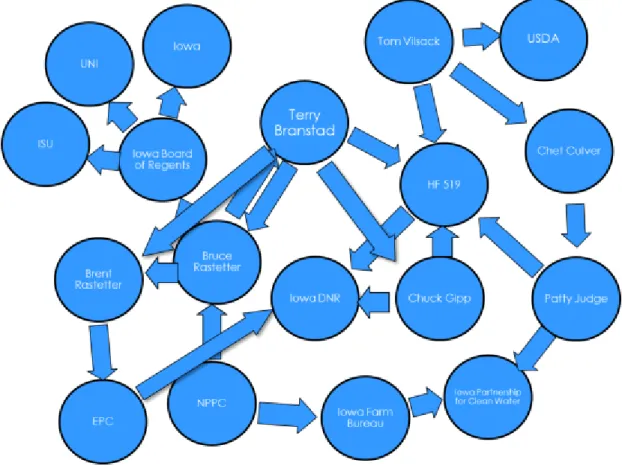
function as part of an apparatus, and following how each thus treats the matter of manure, it also becomes possible to populate the apparatus with other actors, networks and
institutions beyond the state, to offer, if not offering a complete portrait of the networks
of power operating here (such a task would be impossible), then at least providing a few threads within the mesh of power that provide moments of clarification where a
38
to also bring the concept of apparatus out of a certain abstraction, showing that power is indeed embodied and practiced in everyday life.
In Iowa, this can be seen in how the state’s allowance of manure enables its access into
the intimate spaces of home, family and body – it is a very embodied expression of biopower
within those spaces and on those bodies. This power is not separable from the governmentality that exists, however. This appearance of waste in everyday life would not be possible without
the simultaneous appearance of an apparatus designed to regulate manure, which in its apparent attempts to regulate actually enable the passage of waste through the borders intended to contain it. Thus by following the manure as it travels conceptually through the apparatus it becomes possible to understand it as an expression of biopower on the body, and also indicates how the apparatus as a whole employs techniques of governmentality through its attempts to control waste. The ultimate goal is to produce a subject in Iowa that will support this
apparatus.
Early Government Interventions
In the early nineties, Iowa state leaders were concerned about the dramatic growth in hog production in North Carolina, led by Democratic State Senator Wendell Murphy and the
confinements being put into widespread operation by Murphy Farms2. A group of Iowa legislators led by then-Senate Agriculture Committee Chair Berl Priebe traveled to North
Carolina to meet with Murphy and other agricultural officials and returned to Iowa with a plan to introduce “model legislation” in 1995. In the summer of 1994, the legislature and the Branstad
Administration held a series of public meetings across the state, where smaller hog producers
2 Murphy Farms is now owned by Smithfield Foods, which in 2013 was itself purchased by a Chinese agricultural