IMPLEMENTING THE BIOPSYCHOSOCIAL APPROACH OF THE ICF-CY TO PREDICT SECONDARY CONDITIONS AND QUALITY OF LIFE
IN INDIVIDUALS WITH SPINA BIFIDA
Fikriye Eda Karacul
A dissertation submitted to the faculty at the University of North Carolina at Chapel Hill in partial fulfillment of the requirements for the degree of Doctor of Philosophy in the School of
Education (School Psychology).
Chapel Hill 2017
Approved by
Rune J. Simeonsson
Janey Sturtz McMillen
Harriet Able
Steve Knotek
ABSTRACT
FIKRIYE EDA KARACUL: Implementing The Biopsychosocial Approach Of The ICF-CY To Predict Secondary Conditions And Quality Of Life In Individuals With Spina Bifida
(Under the direction of Rune J. Simeonsson)
Spina Bifida (SB) is a complex neurogenetic disorder, diagnosed before or at birth that is
caused by the defective closure of the backbone and the spinal cord (Antolovich &Wray, 2008).
The condition is associated with many physical, or mental health conditions at varying severity
levels. Additional health conditions that occur as a result of having a primary disabling condition
are considered as secondary conditions.
The present study examined the nature of secondary conditions; the individual
characteristics associated with their prediction and quality of life (QoL) and used ICF –CY
(WHO, 2007) as a frame of reference to discuss their functioning. The findings suggested several
significant small and medium strength relations among variables. After reaching a consensus
between raters on linkage of the Secondary Conditions with ICF –CY codes, multiple
hierarchical linear regression analyses were used to assess the ability of developmental and
family characteristics to predict difficulty with body functions, activities participation and
perceived QoL. The findings affirmed the overall predictor quality of the given characteristics,
and direction of significant predictions, however there was variability of predictors for each
ACKNOWLEDGEMENTS
Special thanks to my committee chair, Dr. Rune Simeonsson, for his invaluable guidance,
constant support, and encouragement throughout the doctoral program. He has been like a family
member to me, and an inspirational role model. His kindness, patience, and continual coaching
are greatly appreciated.
Thanks also to my dissertation committee Dr. Janey Sturtz McMillen, Dr. Harriet Able,
Dr. Sandra B. Evarrs, Dr. Steven Knotek, for their kindness, support, feedback, consultation, and
time throughout the dissertation process. I would also like to express my appreciation for Dr.
Leigh Anna Hutchison, and many of my friends and colleagues for taking the time to offer
editorial and emotional support.
Last, but not least, I wish to express my deepest gratitude to my mother, Esma Gokkaya,
for her unconditional love and encouragement. She has always been the main supporter of my
TABLE OF CONTENTS
LIST OF TABLES ... vii
LIST OF FIGURES ... viii
LIST OF ABBREVIATIONS ...ix
CHAPTER I –INTRODUCTION ... 1
Statement of the Problem...1
Literature Review ...4
Development of the Child with Spina Bifida ...4
Secondary Conditions ...5
Quality of Life ... 10
Biopsychosocial Approach to Spina Bifida ... 11
Limitations of Research on Spina Bifida ... 21
Research Questions ... 23
CHAPTER II –METHODOLOGY... 24
Procedures ... 27
Research Design and Data Analysis ... 29
CHAPTER III –RESULTS... 35
Research Question 1 ... 35
CHAPTER IV –DISCUSSION ... 66
Limitations ... 71
Implications for School Psychology... 72
Conclusion ... 76
APPENDIX ... 78
LIST OF TABLES
Table 1 Summary of Variables ... 28
Table 2. Descriptive Statistics of Study Variables... 37
Table 3. Distribution of levels of Bladder Independence of Study Population ... 38
Table 4. Distribution of levels of Bowel Independence of Study Population ... 38
Table 5. Distribution of levels of Mobility of Study Population ... 38
Table 6. Distribution of levels of Gender of Study Population ... 39
Table 7. Distribution of levels of Age Ranges of Study Population ... 39
Table 8. Correlational Matrix of Study Variables ... 46
Table 9. Secondary Conditions (SC) and ICF –CY Linkage ... 51
Table 10. Model Summary for Prediction of Body Functions & Structures ... 56
Table 11. ANOVA for Prediction of Body Functions & Structures ... 57
Table 12. Regression Coefficients for Body Functions & Structures ... 58
Table 13. Model Summary for Prediction of Activities and Participation ... 61
Table 14. ANOVA for Prediction of Activities and Participation ... 61
Table 15. Regression Coefficients for Activities and Participation ... 62
Table 16. Model Summary for Prediction of Quality of Life ... 63
Table 17. ANOVA Model for Prediction of QoL ... 64
LIST OF FIGURES
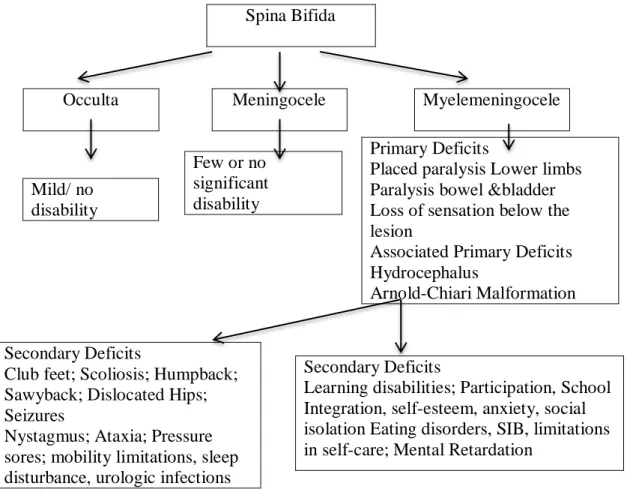
Figure 1. Disabilities associated with Spina bifida ...7
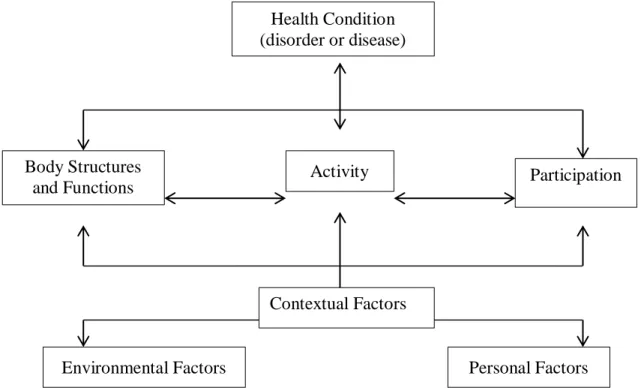
Figure 2. Interactions between the components of the ICF-CY Model ... 13
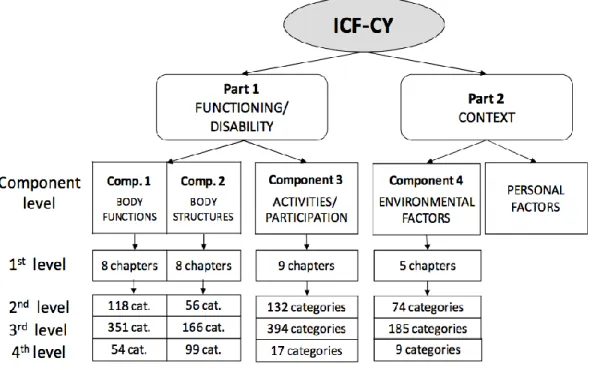
Figure 3. Hierarchically listed components of the ICF-CY ... 14
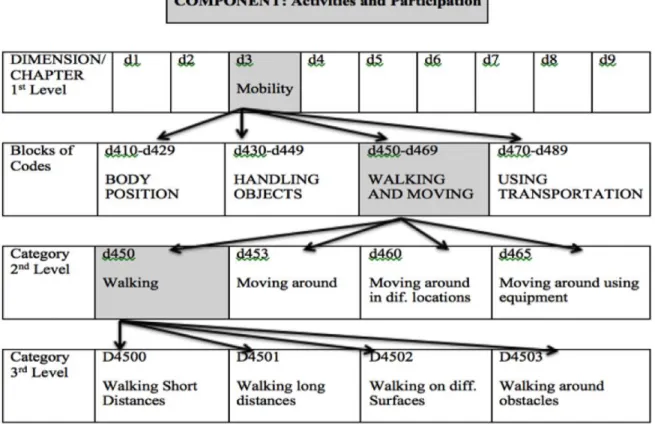
Figure 4. Activities and Participation Components ... 15
Figure 5. Regression Model for 3rd Question ... 34
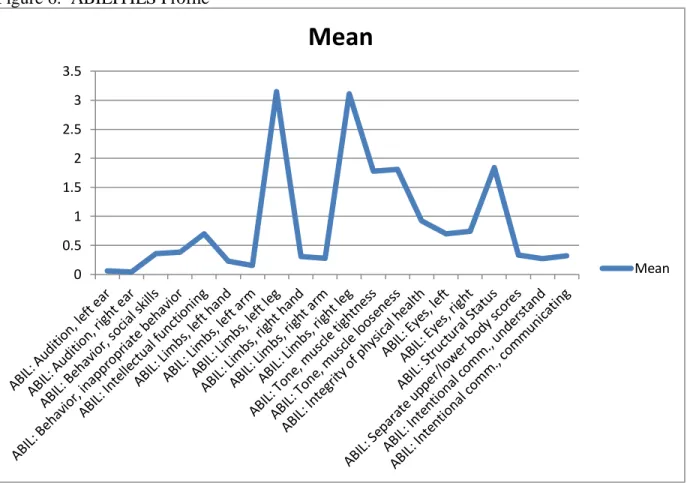
Figure 6. ABILITIES Profile ... 41
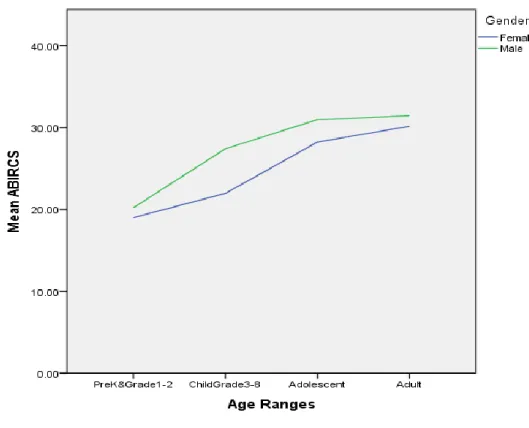
Figure 7. ABIRCS by Age Ranges and Gender ... 42
Figure 8. Bladder Independence by Age Ranges and Gender ... 42
Figure 9. Bowel Independence by Age Ranges and Gender ... 43
Figure 10. Mobility by Age Ranges and Gender ... 43
Figure 11. Psychosocial- Perceived Cognitive Competence by Age Ranges and Gender ... 44
Figure 12. Psychosocial- Perceived Physical Competence by Age Ranges and Gender ... 44
Figure 13. Psychosocial- Perceived Social Competence by Age Ranges and Gender ... 45
LIST OF ABBREVIATIONS
Spina Bifida –SB
Secondary Conditions –SC
Survey of Family Characteristics –SFC
Quality of Life –QoL
World Health Organization –WHO
International Classification of Functioning –ICF
International Classification of Functioning for Children and Youth – ICF–CY
Body Functions – b
Body Structures –s
CHAPTER I –INTRODUCTION
Statement of the Problem
Spina Bifida (SB) is a complex neurogenetic disorder, diagnosed before or at birth that is
caused by the defective closure of the backbone and the spinal cord (Antolovich &Wray, 2008).
The condition is associated with many limitations at varying severity levels such as congenital
malformations of the brain, hydrocephalus, Chiari II malformation, spinal curvatures or humps,
neurogenic bladder, or muscle weaknesses. Additional physical or mental health conditions that
occur as a result of having a primary disabling condition (spina bifida) are considered as
secondary conditions. Recent research however has emphasized the need to measure secondary
conditions and promote the quality of life of children with spina bifida.
Secondary conditions can be in the form of a variety of physiological, behavioral and
psychological manifestations. At the physiological level, they may include primary health
conditions such as pressure sores or scoliosis as well as mobility limitations, sleep disturbance,
urologic infections, and pressure ulcers (Antolovich & Wray, 2008; Adriaansen, et al., 2012). It
may be also expressed in eating disorders, self-injurious behaviors, learning disorders, and
limitation in self-care. Of particular significance are behavioral and psychological, and cognitive
manifestations related to participation, school integration, self-esteem, anxiety, and social
isolation (Adrianansen, et al., 2012, Simeonsson, et al., 2002; Krahn, et al., 2009). Secondary
life through limitations in physical, academic, personal and social functioning, despite, limited
research on this phenomenon in individuals with spina bifida (Guilcher et al., 2012; Simeonsson
et al., 2002; Adriaansen, et al., 2012). Thus, understanding the relationships between
psychological, social and physical functioning and environment would improve engagement of
children with SB and their life fulfillment.
The purpose of this research is to investigate the nature of secondary conditions, the
individual characteristics associated with their prediction and quality of life (QoL) and to use
ICF-CY (WHO, 2007) as a frame of reference to discuss their functioning. Growing up with
spina bifida can be challenging due to complex and demanding nature of the condition. The
multifaceted nature of the physical and developmental problems of spina bifida makes it difficult
to predict identification of the problems that are of secondary conditions. Therefore, a
comprehensive holistic framework is needed for identifying key factors associated with
functioning and development of children with SB. The biopsychosocial model of the ICF-CY
provides a framework relating functioning characteristics at the body, person and societal
domain, and the mediating role of the environment on such functioning (WHO ICF-CY, 2007).
There is minimal research that evaluates secondary conditions from a multidimensional
perspective in individuals with SB. To date, much of the literature has focused on medical
aspects of their activities and participation and functioning, and most known studies used spinal
cord injury or orthopedic disability groups and included very few individuals with SB.
Furthermore, there are no known studies that examine the underlying influences of secondary
conditions and their dynamic relations by linking with ICF-CY. With the availability of the
ICY-CY, there are growing efforts to define, not only the medical condition but also to describe the
universal, standard language. Thus, this study attempts to measure the health and functioning of
individuals with spina bifida using the ICF-CY as a frame of reference and items from secondary
conditions questionnaire as a measurement tool. Linking the secondary conditions questionnaire
to the ICF-CY provides information on the scope of the instrument; helps to estimate the
characteristics of spina bifida with a standard language.
In sum, the nature of living with SB is not well researched; hence learning about the
adjustment of the individuals with spina bifida and how they perceived the associated secondary
deficits needs to be investigated. The current study describes and discusses health and
functioning in individuals with spina bifida based on the results of the linkage between the
secondary conditions and ICF-CY classification. It is expected that this study contributes to the
description of risk and resilience factors to promote the quality of life and prevent secondary
Literature Review
Development of the Child with Spina Bifida
The development of children with SB is affected by primary as well as secondary
conditions. Spina Bifida (SB) is a complex neural tube condition diagnosed before or at birth that
is caused by the defective closure of the backbone and the spinal cord (Antolovich &Wray,
2008). It is the most common permanently disabling birth defect occurring in 1to 2 of every 1000
live births in the world and 0.3 to 0.5 of 1000 live births in U.S. (CDC, 2015). Over the years,
the prognosis, survival rate, cognitive functioning and quality of life has changed with use of
different treatments such as an implantable one-way shunt to hydrocephalus, use of clean
intermittent catherization, prenatal surgical correction of myelomeningocele, promotion of folic
acid consumption and improvements in prenatal testing (Zabel et al., 2011).
Spina bifida is classified into three types as “Spina bifida Occulta, Meningocele, and
Myelomeningocele”. Spina Bifida Occulta is the “closed” form, Spina Bifida Meningocele, and
Myelomeningocele are classified as “open” neural tube defects (CDC, 2015). Spina bifida
occulta (hidden) is the mildest form caused by defective formation of backbones. It is the most
common type, usually lacks physical sign or any complication so many individuals do not realize
it by appearance. In some instances, the malformation may cause incomplete paralysis with
urinary and bowel dysfunction and/or marked by malformations of fat, bone, or meninges
(NINDS, 2015). In the spina bifida meningocele, spinal fluid and meninges protrude through an
abnormal vertebral opening; the malformation contains no neural elements and may or may not
be covered by a layer of skin with little or no nerve damage. Some individuals with meningocele
may have few or no symptoms while others may experience such symptoms as paralysis with
characterized by a lesion in which the spinal cord and nerves poke through the open part of the
spine in a sack, that creates a barrier for the transmission of motor and sensory information at
and below the lesion level. The severity of the spina bifida depends on the spinal level of the
lesion (thoracic, lumbar, sacral) and shunting (Lomax-Bream et al., 2007) such that, higher
lesions cause more significant nervous system damage than lower lesions (Rintoul et al., 2002).
Hydrocephalus (fluid on the brain) as caused by Arnold-Chiari- II malformation (malformations
of the hindbrain) is the most common neurological complication among children with SBM with
80% rate (Zabel, et al., 2011). Hydrocephalus has effects on the orthopedic, cognitive, behavioral
and communication development (Tuminello, 2012).
Spina bifida does not have a single defining characteristic, and represents a complex
multifactorial neurodevelopmental disorder. Some of the common sensory, motor or medical
complications are difficulties with bladder and bowel control, ambulation difficulties, and skin
infections due to pressure sores or burns, faecal and urinary incontinence, spasticity,
contractures, deformity, scoliosis, epilepsy, constipation, renal impairment, hypertension,
obesity, impairment of sexual function, chronic pain. In addition to the aforementioned
conditions they experience cognitive impairments, communicational or psychosocial
complications such as issues with school integration, socialization, psychological, social and
family issues that affect their daily life (Antolovich & Wray, 2008; Brislin, 2008).
Secondary Conditions
Individuals with disabilities are at risk for “secondary conditions,” preventable health
issues influenced directly or indirectly by the characteristics of their primary conditions
“occur as a result of a primary condition and can either be a pathology, an impairment, a
functional limitation or an additional disability” (Pope & Tarlov, 1991, p. 214). The primary
deficit can only be a risk factor, however is not enough to account for the expression of the
secondary condition (Simeonsson & Leskinen, 1999, p. 53). They are not specific to people with
disabilities, but more prevalent in individuals with disabilities (Rimmer et al., 2011). The
difference between personal and environmental interaction and developmental stages account for
variations in the nature and extent of expressed secondary conditions (Simesonsson, McMillen &
Huntington, 2002). Secondary conditions greatly impact the child’s quality of life through
limitations in physical, academic, personal and social functioning and even require frequent
re-hospitalizations in some cases (Guilcher et al., 2012; Simeonsson et al., 2002).
It has been well documented that youth with spina bifida experience difficulty with
executive functioning, cognitive and language skills that are important for managing social and
academic performance (Lindquist et al., 2008). Their cognitive performance is “complex,
dynamic, and at times unstable” (Zabel et al., 2011). Poor performance in cognitive abilities
includes abstraction, sequencing, planning, problem solving, use of social inference, use of
contextual language, visual-motor and spatial skills, mathematical performance, and attentional
tasks (Lomax-Bream, et al., 2007). Executive functioning and social language difficulties in the
early years cause school age issues and social problem solving difficulties that impact through
adulthood (Landry et al., 2013). Learning difficulties in preschool children with SB has a strong
association with slower cognitive growth (Lomax-Bream, et al., 2007). As an indicator of
cognitive abilities, fine motor skills and self-perception, preschool children were asked to draw
self-portraits. The spina bifida group drew less complicated figures, with fewer body parts and
typically developing peers (Mobley et, al., 1996).
Spina Bifida
Occulta Meningocele Myelemeningocele
Figure 1. Disabilities associated with Spina bifida (Adopted and modified from Singh, D. K.,
2003)
A common strength for children with SB frequently reported to be on verbal measures
and rote memory abilities as compared to their performance IQ (Barnes, et al., 2014). Spina
bifida presents mixed difficulties that can be presented in verbal or nonverbal abilities. In some
individuals, the verbal deficits are often described as “cocktail party chatter syndrome”, in which
the production of meaningful speech might be relatively reduced (Zabel et al., 2011).
Among academic skills, they are known to demonstrate better reading skills than math
and about half of children with SB are diagnosed with a math disability (Barnes, et al., 2014). Few or no
significant disability Mild/ no
disability
Primary Deficits
Placed paralysis Lower limbs Paralysis bowel &bladder Loss of sensation below the lesion
Associated Primary Deficits Hydrocephalus
Arnold-Chiari Malformation
Secondary Deficits
Learning disabilities; Participation, School Integration, self-esteem, anxiety, social isolation Eating disorders, SIB, limitations in self-care; Mental Retardation
Secondary Deficits
Club feet; Scoliosis; Humpback; Sawyback; Dislocated Hips; Seizures
Math related cognitive abilities are defined as phonological awareness, working memory and
fine motor/ finger skills (English et al., 2009). Challenges on nonverbal measures (perceptual and
motor tasks), reading comprehension, math and writing are exhibited as young as age three and
continue through adulthood (Barnes et al., 2014). Children with spina bifida may not necessarily
have skill deficits in all those areas, however their abilities may develop later than their TD peers
during preschool years.
In a longitudinal study, Barnes, et al. (2014) tested the differences in the impact of
math-related cognitive abilities on children with SB in comparison to TD peers, on their academic
abilities and school related outcomes. They used cognitive abilities of children at 36 and 60
months of age and school related outcomes at 8.5 and 9.5 years of age. While visual spatial
working memory effect was specific to mathematics, phonological awareness impacts both math
and reading scores at 8.5 and 9.5 years of age. Also difficulties with staying on task, task
initiation, time management, planning, organization, perception and orientation, motor control,
visual perception are reported that is similar to children with ADHD (Janeslätt, et al., 2014;
Burmeister, et al., 2005).
Children and youth with SB who have more difficulty on tasks assessing mental
flexibility and switching as an indication of their executive functions, are predicted to have less
autonomy, lower intrinsic motivation and higher parent involvement suggesting a relation
between the three constructs (Tuminello et al., 2012). Social competence (social adjustment,
social performance, and social skills) and executive function deficits also present increased risk
for internalizing symptoms (Lennon et al., 2014). Positive, supportive social experiences with
peers and parents are considered as a catalyzer for unpleasant health care rituals; however, lack
Compared to TD adolescents, lack of positive peer and school contexts makes youth with SB
more susceptible to internalizing disorders, particularly depression (Friedman et al., 2004; Essner
& Holmbeck, 2010). Support, acceptance, and adaptive functioning in the family and school
contexts is a stronger preventative condition for psychological risks (Holmbeck&Devine, 2010).
Their limitation in movement, communication, and challenges with self-care tasks
becomes a barrier for developing positive social and environmental interactions. To function
independently, individuals should be able to self-manage medical, physical and psychological
consequences of spina bifida. Reducing the risk of secondary conditions while increasing
self-efficacy would improve the likelihood that young people will function independently throughout
their lifespan. Due to the impact of functional limitations, family related issues have higher
impact during childhood years, but as they grow older, the areas of concern include peer
relations followed (Stubberud et al., 2013).
Secondary conditions make it difficult to make and keep friends for youth with SB
especially with TD peers. During adolescence, the experience of peer rejection would likely
disturb other areas of functioning more severely. The individual would compare the self with the
typically developing peers; they would feel a deep lack of worth, or confidence that is persistent
through adulthood. Contrary to common research and beliefs, Zukerman et al. (2011) claim that
children with SB are resilient in peer relations and by emerging adulthood they have similar
quantity of peer friendships with TD peers. When the characteristics and quality of friendship in
children with SB is compared to their TD peers and to youth with other chronic conditions,
children with SB report the quality of proximity of their friends lower than that of other groups
(Zukerman et al., 2011). They demonstrate the need of more social support and are more likely
al., 2012). Their feelings in a group of peers are different than when they are matched with a
specific peer. In that case, youth with SB don’t report feeling as close or as comfortable to others
besides reporting lack of support (Devine et al., 2012). It is possible that lack of self-confidence
and lower self-esteem would impact their perception of social environment (Brislin, 2008).
As individuals with spina bifida age their expectations and needs change and they are at
higher risk for presenting lower self-esteem, confidence, body image, depression, poor social
skills, isolation, exclusion, and poor relationships. It is well documented that these issues are
presented as a reflection of their interaction with the environment and as secondary to their social
difficulties. These emphasize the importance of participation in daily activities.
Quality of Life
Quality of Life is defined as “an individual’s perception of their position in life in the
context of the culture and value systems in which they live, and in relation to their goals,
expectations, and concerns” (The WHOQOL Group, 1995, p.1405). Most individuals with
myelomeningocele reported lower perceived Health Related Quality of Life (HRQoL) ratings
when their participation levels were lower (Verhoef et al., 2007). Due to the complicated nature
of the condition, there may be unique considerations to assess QoL (Sawin & Bellin, 2010).
Challenging expectations, being independent in mobility was found to be a higher
predictor of QoL than other functional abilities such as being independent in self-care or being
wheelchair dependent (Schoenmakers et al., 2005). Rendeli et al. (2005) used both parent and
child reports to assess the health-related quality of life of children with SB, and reported
continence problems as the main factor affecting QoL. Interestingly, higher disability predicted
mindset. An individual with less severe impairments may have a mental aspect of aiming to
perform better, resulting in lower satisfaction of QoL. Despite both having similar physical
impairments children and adolescents with SB reported lower “school and overall QoL” and
participation in activities compared to those with spinal cord injury (Flanagan, Kelly, &Vogel,
2013). It is suggested that the presence of shunt may result in cognitive and executive
functioning impairments, which have a chain effect on their school performance causing anxiety
and self- consciousness, then their concentration (Flanagan, et al., 2013). Rofail et al. (2014)
reviewed studies on HRQoL on individuals with SB, and reported the significance of low levels
of QoL, and the need for a consistent communication intervention to support them. The
qualitative part of this study also reflected the issues such as bullying, isolation, being hesitant in
school activities.
The review of literature highlights the difficulties associated with Spina bifida and
negative impact of those on their QoL reported by parents or the individuals. It is noteworthy
that their perception had a key role on their QoL ratings regardless of who reported it. Studies
also reflect the differences in parent and individual reports on which impairment affects their
QoL. It is possible that parent characteristics would impact on their rating on the perception of
the QoL of the individual with spina bifida. Despite the decrease in SB prevalence, they need to
be understood and society should be more aware of their unmet medical and social needs to
increase sensitivity and find better solutions for their behavioral and social challenges
Biopsychosocial Approach to Spina Bifida
Previous review demonstrates the complex nature of spina bifida and physical, social,
difficulties that is associated with activities and participation, body functions and structures and
environmental factors as framed by International Classification of Functioning, Disability and
Health: Children & Youth (ICF-CY). It is a widely-used framework for conceptualizing and
measuring the nature and consequences of disability (WHO ICF-CY, 2007). It focuses on
classification of the four aforementioned components that are specific to children and youth,
whose age range from birth to 18 years old. ICF-CY is based on the “biopsychosocial model”,
which assesses children and youth functioning in the context of their stages of development and
the environments in which they live and their interaction with each other (WHO ICF-CY, 2007).
The “biopsychosocial model” presents the interactional role of biological, psychological, and
social (socio-economical, socio-environmental, and cultural) factors, on human functioning.
Within this framework, functioning is explained as an “umbrella term that encompasses
all body functions/structures, activities, and participation”, whereas disability is defined as an
“umbrella term for impairments, activity limitations and participation restrictions” (Gan et al.,
2014, p. 25). ICY-CY is a function-focused model, and addresses the level of ability in
functional areas, such as learning, mobility, communication, self-care, social relationships, and
other similar characteristics. It encourages the development of interventions that targets at the
development of individual’ functioning in relation to their environment and personal conditions.
The ICF-CY functioning codes are grouped into b- body functions (i.e., physiological and
psychological), s- body structures (i.e., anatomical parts such as organs, limbs and their
components), d- activities (i.e., execution of a task or action), and participation is defined as “the
involvement in life situations” such as learning, applying knowledge, self-care, communication,
relationships or participation in school activities (WHO ICF-CY, 2007, p. 129). Contextual
the individual’s functioning. Environmental factors- e is extrinsic to the individual (e.g. social
support, relations, the attitudes of the society, the legal system). Personal Factors (e.g. gender,
race, age, lifestyle, habits, coping styles) do not have categories within the ICF-CY, and open to
the subjective view of the users (WHO ICF-CY, 2007).
Figure 2. Interactions between the components of the ICF-CY Model
Each of the four domain is also divided into multiple chapters (1st level) than
hierarchically listed categories (2nd level) such as (a) Mental functions; (b) Sensory functions and
pain; (c) Voices and speech functions; etc. under the Body Functions domain. In level 3 and 4
the details of the categories gradually increase (Figure 4). Each of the components are quantified
using a 0 to 4 scale that is defined as: 0- no problem; 1- mild problem (a problem is present less
than 25% of the time); 2- moderate problem, (present less than 50% of the time); 3- severe
problem, (present more than 50% of the time); and 4- complete problem, (present more than 95% Body Structures
and Functions
Activity Participation
Environmental Factors Personal Factors
Health Condition (disorder or disease)
of the time).
ICF-CY has been increasing used as a standard for content comparison or examination of
instruments, in order to select the most appropriate items or instruments or to report individuals
functioning with a standard language for clinicians and researchers (Hwang et al., 2014;
Krasuska et al., 2012; Sommer et al., 2015). Previous studies suggested the identification of
reliable and valid instruments and mapping items based on linking rules such as the ones
described by Cieza et al. (2004) (Ellignsen, K., 2011& Björck-Åkesson et al., 2010).
Figure 3. Hierarchically listed components of the ICF-CY (Pless &Granlund, 2011).
In the previous studies, linkage of ICF-CY codes is conducted on quality of life measures
(Krasuska et al., 2012; Peterson et al., 2013; Sommer et al., 2015), environmental factors
(Hwang et al., 2014), and on autism measures (Castro et al., 2013). Studies on linking the
relevant domains from a well-being and functioning perspective” as well as making it easier to
compare and better understand the domains of the instruments (Sommer et al., p. 439).
Quantifying ICF-CY categories provide reliable and valid information about the functioning and
well-being of the individual with health condition(s) (Krasuska, et al., 2012).
Figure 4. Activities and Participation Components
In the recent research ICF-CY is used as a framework to examine how quality of life
measures are represented as well as providing a basis for a standard language for comparing and
contrasting the nature and extent of the health conditions. Most studies used linking rules defined
by Cieza et al. (2005), by first deriving meaningful concepts within the items, then linking those
concepts with the ICF-CY by two raters. Castro et al. (2013), linked the ASD diagnostic
and identify functional characteristics of the tool. They also proved that linking existing
measurements used for diagnosis, with the ICF-CY classification system could be possible.
Through that study functional aspects of these tools were identified which in turn improved the
documentation of child’s functioning. Sommer et al. (2015), linked a health-related quality of life
measure to the ICF-CY, which proved the scope and comparability of both the parent and child
versions, provided a universal language and is expected to help to estimate the prevalence of the
related disabilities. Krasuska et al. (2012) tried a different approach by applying linking process
on a QoL measure and a disease specific module. Krasuska et al. (2012) followed the rules:
“only items that were linked to one ICF/ICF-CY category was considered, and among the items
confirming this requirement, the items that have been assigned to a particular ICF/ ICF-CY
category with the higher inter-rater agreement were selected” (pg.78). As a result, health module
presented content density, meaning more than one ICF-CY category was assigned to many items,
and most important categories among the domains were recreation and leisure. The importance
and need for considering the emotional aspect of functioning as well as the linking and validity
studies on ICF-CY were emphasized.
A universal, standard language is needed to explain the health and well-being of
individuals with spina bifida. The ICF-CY model is feasible and useful for research, clinical and
policy purposes to develop effective interventions by taking all child and adolescent
characteristics in consideration instead of focusing solely on the disability identifications. Each
individual with or without a disability represent different strengths and limitations, hence having
a complete picture of each individual with needs is of importance to improve their capacity and
encourage independence in everyday activities. It also contributes to the description of risk and
prevent secondary conditions in individuals with spina bifida.
This proposed study aimed to measure the health and functioning of children with spina
bifida using the ICF-CY as a frame of reference and items from secondary conditions
questionnaire as a measurement tool. Linking the secondary conditions questionnaire to the
ICF-CY is provides information on the scope of the instrument; helps to estimate the characteristics
of spina bifida. The implication of this study is not only to describe or classify the medical aspect
of spina bifida, but also present how this can be applied to the secondary conditions. Thus,
linking secondary conditions with ICF-CY would be an important contribution to understand
these characteristics.
Participation: It is well established that participation has been linked with positive
outcomes such as improved academic performance, better relationships and a more fulfilling life.
However, individuals with myelomeningocele are reported to be hesitant to participate due to
limitations of primary and secondary conditions. Given the difficulty of transition from
childhood to adolescence, there are developmental differences in participation preferences of
children and youth with SB in recreational, physical, social, skill-based, and self-improvement
activities. In an assessment of age related differences, younger children participated more often
in physical and skill-based activities than all other youth, and whereas older youth (12-18 years)
participated less in recreational, physical, and skill-based activities Kelly et al. (2011). Other
defining factors for improved participation were caregiver employment and shunt absence. Also
more caregivers reported bladder and bowel needs as barriers to participation for children
between the ages six to twelve.
Despite those findings, there is some disagreement among studies regarding the effect of
family support, athletic competence, and physical appearance correlated with physical activity,
but not the level of ambulation (Buffard et al., 2009). The perception of restriction is independent
from the level of severity, because each individual is in a different environment and their
expectations increase with milder disability presentation (Barf et al., 2009). Some common areas
of reported restriction were leisure activities, going to school or work and visiting family or
friends, mostly caused by the lack of accessibility of buildings, or transportation and own
emotional barriers, pain, or fatigue (Barf et al., 2009).
In a recent study, it was found that interventions that focus on environmental factors had
significantly promising results for community involvement of children with physical disabilities
(Law et al., 2015). In order to encourage participation of individuals with disabilities
environmental factors such as familial (e.g. family functioning), physical (e.g. built environment,
accessibility), physical task demands (i.e., balancing, getting on and off the bike), social (e.g.
social and peer support), attitudinal (e.g. perceptions towards disability), institutional (e.g.
policies and availability of programs), and cultural expectations (i.e., expectation to sit quietly
during mass) are reported to be important (Law et al., 2006).
Contextual Factors: The outcomes of an interaction between spina bifida and
environmental and personal factors form the concept of the disability. Contrary to peer relations,
adolescents continue to have closer relationship with their parents. Parental overprotection is
commonly mentioned as a meaningful reason of the behavioral and emotional dependence
among children and youth with SB. Intrusive parents set lower expectations and get over
concerned about their children’s abilities in tasks, causing lack of confidence, and
self-reliability (McKernon et al., 2001). It is possible that executive function (EF) deficits among
transitioning harder from being highly dependent on parents, to autonomous actions during
adolescence (Tumineallo et al., 2012).
Mothers and fathers also differ in amount of parental fostering of independence between
TD adolescents versus adolescents with spina bifida. Mother intrusiveness was consistent
between both groups of adolescents; however, fathers were intrusive only to youth with SB,
(Tuminello et al., 2012). Results on intrusiveness are consistent with the parental stress
differences among mothers and fathers of preadolescents with SB (Friedman et al., 2004). There
is considerable support for the assertion that parents of youth with chronic illnesses experience
higher stress than parents of other groups (Gras et al., 2009). Even at lower levels, paternal stress
nevertheless has a significant effect on child psychosocial adjustment along with marital
functioning (Friedman et al., 2004). Despite greater levels of stress but families of children with
a chronic condition were also highly resilient (Horton &Wallander, 2001). In order to develop
resiliency, they use various coping methods that isolate the possibility of psychological
maladaptation (Holmbeck et al., 2006; Gras et al., 2009). Among parents of children with SB,
those coping methods include seeking social support, positive reappraisal as the most frequent
style, whereas the internally focused thinking style, reflective and systematic thinking style and
innovation-seeking were used the least (Gras et al., 2009).
The interplay of the factors effecting family stress and how families adapt and cope with
those is well reflected in the Double ABCX Model of Stress and Adaptation by McCubbin and
Patterson (1983). The Double ABCX Model describes the interplay between the pile-up of
stressors (aA), such as a life event or transition impacting the whole family, the internal and
external resources one has to address the stressor (bB), and the meaning of the stressor to the
used to examine the well-being and QoL of the families, behavior problems, and the severity as
well as the support from the family and friends are found to be significantly related with the
ability for adaptation and coping strategies (Sarria & Briosso, 2014). Several studies point that
severity of the behavior and the deficits in social skills, or child-externalizing behaviors are more
of a stressor than the disability itself (McStay, Trembath, and Dissanayake, 2014). Through the
use of the same model perception towards stressors is reflected to be an identifying factor for
child behaviors and (Saloviita, Italinna, & Leinonen, 2003).
There is not any methodologically valid, randomized, longitudinal and theory driven
studies on the family functioning of children and youth with SB (Holmbeck et al., 2006). Most
recent studies using this model focus on ASD, for example Paynter et al., (2013) found that the
severity of the ASD behaviors, the support received from family and friends, their self-esteem,
optimism, self-efficacy, social support, their perception of the stressor, family perception of the
stressor and resilience in coping with the stressors were all linked with their adaption. Among
those, social support was the most important resource to parents, however, families using
active-avoidance style, is likely to increase the frequency or the severity of the challenging behavior,
and this in turn increases family stress as well as building a barrier for reaching the social
support (Paynter, Beamish, Davies, & Milford, 2013). Hope and social support contributes to the
perceived stress by mothers as well as affecting each other. If a mother is satisfied with number
of people supporting her as well as the quality of support, she presents higher hope that is
defined as “the assessment of agency and pathways related to individuals’ goals” (Horton &
Wallander, 2001; p.383). As families are satisfied with the social support, they had a better
experience of having a child with disability that are all integral to coping with a child with a
disability (Pakenham, Sofronoff, & Samios, 2004).
Being the parent of a child with a spina bifida has its own hardships, however there are
no known studies on the family stress and coping of individuals with spina bifida based on
Double ABCX Model that includes all stressor components in the same model of adaptation.
Thus, the difficulties they face and the impact of those stressors needs to be investigated. It is
also necessary to consider a reverse perspective, investigating the impact of family stressors on
the child and adolescent with the disability. The studies up to date have not considered the
impact of family stressors, (e.g. child problem behavior, severity, adaptive behavior, and pile-up
of family characteristics) on the outcomes of the individual with disability. There is not yet
sufficient information about the impact of family stress, or strength on the perceived quality of
life of individual with the disabling condition. Furthermore, interventions to promote adaptive
family functioning and better psychosocial outcomes are still a necessity with this population.
Limitations of Research on Spina Bifida
Historically, most of the research on SB has focused on the physical and neurocognitive
domains, with less attention paid to the psychological and social domains of functioning
(Holmbeck &Devine, 2010). Overall, studies reflect that children and youth with SB experience
difficulties in developing peer relations due to restrictions in activities and participation, or
deficits in social language. They are usually overly attached to their parents due to need of
assistance in daily life. Similar issues have been the subjects of a few intervention studies.
Outcomes of those studies suggest the need for variety of programs that can improve the
their participation in social life and enhance their quality of life.
There is minimal research for the development of independence and increased
participation in children with SB (Friedman et al., 2004). Gender, parental support of autonomy
achievement, and verbal abilities were only a few factors found that contributed to the
differences in the autonomy trajectory of youth with spina bifida. In order to prevent secondary
conditions or the contributing factors it is necessary to understand how they differ among variety
of populations, besides developing assessment measures for secondary conditions (Simeonsson
et al. 2002). More research is needed to find other possible factors contributing to autonomy
development and also clarify the impact of specific family or social characteristics and how they
mediate future outcomes of children with spina bifida (Friedman et al., 2004; Essner &
Holmbeck, 2010).
Secondary conditions of the individuals with spina bifida plays a key role in their school,
social, and family life, however there is no research that evaluates it from a multidimensio nal
perspective. Based on biopsychosocial approach ICF-CY provides a framework to investigate
various associated factors and characteristics. There is a need for research using a holistic
framework and not only focusing on medical aspects of spina bifida but also use a standard
language as defining the characteristics of those conditions. As recent research on ICF-CY
suggests, providing a standard language for determining the nature and extent of spina bifida is
needed (Sommer et al., 2015). A standard language would raise awareness and understanding
Research Questions
1. What are the relationships among developmental characteristics, secondary conditions,
and QoL of children & adults with Spina bifida?
2. Is there a difference in the distribution of secondary conditions within the domains of the
ICF-CY model?
3. To what extent do developmental characteristics and family characteristics predict
domains of the secondary conditions and QoL ratings in individuals with spina bifida?
a. Do developmental (functional) characteristics of the individuals as measured by
Abilities Index and Demographics Questionnaire significantly predict secondary
condition domains and higher QoL ratings?
b. Do developmental (psychosocial) characteristics of the individuals as measured by
Harter’s perceived competence scales significantly predict secondary conditions domains
and QoL ratings over and above developmental characteristics?
c. Do family characteristics (strength) of the individuals significantly predict the
secondary conditions domains ratings and QoL ratings over and above developmental
CHAPTER II –METHODOLOGY
To address research questions of this study a quantitative research design was used. Data
for this study was drawn from the longitudinal research project named Spina Bifida: Surveillance
of Secondary Conditions and Quality of Life (Simeonsson, McMillen, Huntington, 2002).
Details about the participants, measures and data analysis are detailed below.
Participants
This study was conducted as a secondary data analysis on a de-identified data set of
approximately 100 participants and their families. At the time of the original study participants
were recruited through the University of North Carolina Hospitals’ Physical Medicine and
Rehabilitation Clinic, the Lenox Baker Children’s Hospital Myelomeningocele Clinic at Duke
University, and the North Carolina Spina Bifida Association. Data were collected from
individuals, family members, or caregivers and/or teachers. The participants varied in levels of
impairments and cognitive abilities. For this study, data for children, adolescents and adults were
analyzed.
Instrumentation
A variety of measures were administered to the individuals with spina bifida and their
primary caregivers, or family members in this study. The specific measures administered varied
on the basis of the age of the individual, a standard battery of measures was given to all subjects
regardless of the individual’s age. The data analyzed in this study were drawn from the measures
Demographic and Medical History Questionnaire. This questionnaire includes
individual’s age, bladder and bowel methods, continence, and independence as well as mobility
status to describe the demographic characteristics of the children in the study. Information was
obtained from the subjects’ medical records and from parent or primary caregiver responses.
ABILITIES Index. The ABILITIES index (Simeonsson & Bailey, 1991) provides a
profile of an individual's functional abilities across nine domains (ABILITIES), including
Audition (i.e., hearing left and right ear), Behavior and social skills, Intellectual function, Limbs
(i.e., right and left hand, arm, and leg), Intentional communication (i.e., understanding and
communication with others), Tonicity (i.e., tightness and looseness), Integrity of physical health,
Eyes (i.e., vision right and left eye), and Structural status. The ABILITIES Index rating scale
consists of 19 items related to the nine domains. Each item is scored on a 6-point likert scale
ranging from (0) normal ability to (5) profound lack of ability by primary caregivers or parents
asked 40 teachers were to complete the index a second time, an average of 34 days after the first
rating for the stability of ratings. The inter-rater agreement for 130 parent-teacher pairs was
68.5%; for 130 parent-specialist pairs was 65.5%; and for 125 teacher-specialist pairs was 67.8%
(Bailey, et al., 1993).
Secondary Conditions Questionnaire: This questionnaire (Simeonsson, 1995)
manifestation of secondary conditions by an individual with primary condition in the physical,
academic, personal, and social domains. The scale captures the intensity of secondary condition
problems on a 51 item, likert rating scale ranging from 0 (never a problem) to 5 (always a
problem). Reliability estimates for the four subscales ranged from .76 to .87 using Cronbach’s
alpha as an index of internal consistency (McMillen, 1997). In this study only the first item was
Quality of Life Rating. The Quality of Life Rating (Simeonsson, 1995) is part of the
Secondary Conditions Questionnaire with the parent or primary caregiver providing ratings of
the child’s quality of life on a 5 –point scale (1 –Poor; 2 –Fair; 3 –Good/Very Good; 4 –
Excellent).
HARTER Perceived Competence Scales: There are four different Harter Scales targeting
different age groups beginning with the Pre-K scale to the Adulthood scale. Each of these scales
consists of many subscales, however for the purpose of this study only means of scales that
reflect Physical Competence, Social Competence and Cognitive Competence subscale means are
used.
Pictorial Scale of Perceived Competence and Social Acceptance for Young Children
(PSPCSC) (Harter, S. & Pike, R., 1984): This instrument is designed for children of
Preschool and Kindergarten age. It taps four specific self-concept domains: Cognitive
Competence, Peer Acceptance, Physical Competence, Maternal Acceptance. There are a
total of 24 items, 6 for each subscale. Higher scores reflect a greater sense of competence
or social acceptance. Alpha coefficients for the subscales ranged from .53 for Physical
Competence in the Grades 1-2 sample to .83 for the Maternal Acceptance subscale in the
Preschool-Kindergarten sample (Harter & Pike, 1984).
HARTER’S Perceived Self-Competence Scale for Children (Harter, 1982): This 28 item
instrument taps into three competence domains, Cognitive, Social and Physical as well as
a subscale measuring general feelings of Self-worth. It is designed for children over age 8
and has also been adapted specifically for adolescents. The subscale reliabilities range
HARTER’S Perceive Self-Competence Scale for Teens (Harter, 1988): This instrument
taps nine specific self-concept domains: Scholastic Competence, Athletic Competence,
Social Competence, Physical Appearance, Job Competence, Romantic Appeal, Close
Friendship and Behavioral Conduct. In addition, a separate, subscale, taps Global
Self-Worth. There are a total of 45 items, five for each subscale. The same subscales with the
children version of the scale are utilized for the purposes of this study. The internal
Cronbach alpha internal consistency values ranged from .58 to .91 (Harter, 2012).
HARTER’S Perceive Self-Competence Scale for Adults (Messer & Harter, 1986): This
50 item scale taps twelve specific domains: Intelligence, Job Competence, Athletic
Competence, Physical Appearance, Sociability, Close Friendship, Intimate Relationships,
Morality, Sense of Humor, Nurturance, Household Management, and Adequacy as a
Provider. A thirteenth subscale taps Global Self-Worth with six items. The internal
consistency reliabilities ranged from .63 to .92 (Messer &Harter, 2012).
The Survey of My Family Characteristics. In this instrument (Simeonsson, 1987),
parents/primary caregivers report characteristic of their family on a five-point scale ranging from
0 (not at all like my family) to 4 (very much like my family) among 35 items. The scale
represents family strength. Internal reliability of the survey was found to be .93 using Cronbach’s
alpha as an index (McMillen, 1997).
Procedures
Following the submission of the study and approval by the IRB all the data was examined
for missing values and cleaned. For the missing values, initially raw data files were checked and
during the analysis procedures. The Statistical Package for the Social Sciences (SPSS) version
24.0 was used for the data analysis. Summary of the variables analyzed in the study are presented
at Table 1.
Table 1. Summary of Variables
Variables Measure Scale Type Subscales
Developmental Characteristics (Demographic Ch.) Demographic and Medical History Questionnaire Bladder control Bowel control Mobility status Gender Age Developmental Characteristics (Psychosocial Ch.) HARTERs perceived self-competence scale- Pre-K, Child,
Teen, Adult versions
- Likert scale 1 to 4
- Individual ratings
Subscales: Cognitive Social Physical Developmental Characteristics (Functional Characteristics) ABILITIES index
- Likert scale 0 to 5 Normal to Profound
- Parent ratings
-Audition (Hearing) -Behavior& Social skills -Intellectual Functioning -LIMBS
-Intentional Communication -Tonicity
-Integrity of Physical Health
-Eyes (Vision) -Structural Status
Family
Characteristics
Survey of My Family Characteristics
- Mean total score - Likert scale 0-4 - Parent ratings - 35 items
Secondary Conditions
Secondary Conditions Scale
- Likert scale (0-5) Subscales: Physical Academic Personal Social
Quality of Life QoL item of the Secondary Conditions Scale
Research Design and Data Analysis
The datasets for each measure was initially on different .sav and excel files; therefore the
initial step was to combine the files on a single dataset. In the data folder, there are many data
files for each scale so the ones with the highest number of participants were chosen. First an
excel sheet was formed with all the scales and participants which were then copied into an SPSS
file. The Demographics file did not include the variables proposed for analysis so they were
obtained (bladder and bowel control, mobility) from raw files at Frank Porter Graham Child
Development Institute. Some family numbers had more than one entry for each questionnaire,
given collection at different dates. Only the initial date entries were kept for each family number
(participant) and the rest was not included. As there were more than one “family number”
entries, only the cases with the initial dates are used. For example, there were entries for years
97, 99, and 00 for Family #608 so the variables for year 97 were used thereby limiting potential
confusion. Also, when cases such as child#102 were not included they were found and added to
the database. For the Harter Scales if data for Family# XX was used during Pre-K it wouldn’t be
used for further age/grade groups. This applied to each age/grade group from Pre-K to Adult.
Data for the Survey of Family Characteristics was cleaned up based on the rules below for
choosing the respondents:
1. Always use the respondent with the first contact number because focusing on who filled
the given questionnaire is not important for the purpose of this study. Eventually at the
time whoever was available or knew the child the best, filled the form.
2. If there are more than one, 1st respondent, use the 1st contact# then (e.g. Contact#1
3. If there is no Contact#1 then use the Contact#2. In the case of more than one Contact #2,
Mothers are the initial choice.
Here is the order of whom to choose: 1 –Mother, 2 –Father, 3 –Self, 4 –Teacher.
Analysis Plan for Research Question 1: What are the relationships among developmental
characteristics, secondary conditions, and QoL of children & adults with Spina Bifida?
First, to understand the nature of the variables, descriptive statistics (mean, frequency
distributions) were generated for nine subscale domain scores for ABILITIES index; for each
demographic areas (age, gender, bladder and bowel independence, mobility); each subscale
domain weighted mean scores for Harter’s Perceived Competence Scales for (peer, cognitive,
physical scales); each subscale ICF-domain scores of Secondary Conditions (a- Body Functions
and Structures, b- Activities &Participation) and for the ratings on the Quality of Life item.
Bivariate Correlation analysis were used to examine if there were any significant relationships
among the variables.
Analysis Plan for Research Question 2: Is there a difference in the distribution of
secondary conditions within the domains of the ICF-CY model?
The correspondence of the items of the secondary conditions scale with the ICF-CY
biopsychosocial model were examined by linking codes with the domains of the body functions
and structures, activities, participation and contextual factors (environmental factors & personal
factors). The linking was done by two professionals and rate of agreement was calculated before
the linked items are analyzed for their distribution across the components of the ICF-CY.
Analysis Plan for Research Question 3: To what extent do developmental (psychosocial
secondary conditions and QoL in children and adults with Spina Bifida?
It was expected that developmental characteristics, and family characteristics would
significantly predict secondary conditions domains and the quality of life. The primary predictor
was expected to be developmental (functional) characteristics as measured by the ABILITIES
index. Secondary conditions scale captured the perceived intensity of secondary condition
problems on a likert rating scale ranging from 0 (never a problem) to 5 (always a problem).
Secondary Conditions Questionnaire items were regrouped in ICF domains of “body
functions & structures” and “activities & participation” based on the two-rater agreement. The
means of each domain was calculated for every participant. The prediction of these two domains
by the three subdomains of Harter was calculated by using a regression model. After two-rater
agreement there were 16 items for body functions and one item identified for body structures
codes. For that reason, these were combined as Body Functions & Structures and were obtained
means of 17 items for each individual. While calculating means for each Secondary Conditions
ICF domain, the rule was to have at least half of the Secondary Conditions inventory items
answered (e.g. mean body functions for individual number xx= pain+ weight+ bladder control+
bowel control+ skin breakdown+ latex energy)/6). The mean calculations were done based on
how many items were answered. For Body Functions and Structures calculations, 17/2=8.5 a
decision rule was set to be at least answers to 8 with no items missing. The same procedure
applied for the 11 items identified with Activities & Participation domain codes. For Activities &
Participation, 11/2=5.5, the decision was set to be at least answers to 5 items with a valid value.
The prediction of these two domains by the three subdomains of Harter was calculated by using a
regression model.
weighted scores are calculated based on guidelines (Simeonsson, 2014) about how to obtain
weighted scores for each of the nine subindexes. The recommended weighted values are
presented below. An aggregate score for the whole index was named Abilities Index Research
Composite Score (ABIRCS) derived by multiplying the rating for each domain with the weight
for that domain and summing the products for a total score. To calculate the ABIRCS, a scale of
0- normal to 5- extreme difference/ disability must be used.
ABIRCS= SUM (Audition left* 1.8; Audition right* 1.8; Behavior/ social* 1.4;
Behavior/Inapprop.*1.7; Intelligence*2.0; Left Hand*1.5; Left Arm*1.4; Left Leg*1.6;
Right Hand*1.5; Right Arm*1.4; Right Leg* 1.6; Receptive/ comm.*1.2; Expressive/
comm.*1.0; Tone/hyper*1.5; Tone/hypo*1.4; Health*1.5; Left Eye*1.7; Right Eye*1.7;
Structure/form*1.3)
For this study, ABILITIES Index data was grouped into four indexes, because neither the use of
each of the nine areas separately nor using Abilities Index Research Composite Score (ABIRCS)
was seen as an effective way to capture individuals functioning.
o Index I- Intellectual & Communication= [Intellectual Functioning * 2.0 + Intentional
Communication (Receptive Comm.*1.2+ Expressive Communication * 1.0)] / 3
o Index II- Behavior & Social Skills= [Behavior/ social* 1.4 + Behavior/Inappropriate
*1.7] / 2
o Index III- Eyes & Audition= [Audition left* 1.8 + Audition right* 1.8 + Left Eye*1.7
+ Right Eye*1.7]/4
o Index IV- Physical= [Left Hand*1.5+ Left Arm*1.4 + Left Leg*1.6+ Right
Hand*1.5+Right Arm*1.4+ Right Leg* 1.6 +Tone/hyper*1.5+ Tone/hypo*1.4+
a. Do developmental (functional) characteristics of the individuals as measured by Abilities
Index and Demographics Questionnaire significantly predict secondary condition domains and
higher QoL ratings?
It is hypothesized that level of functional characteristics would predict the extent of secondary
conditions. In order to test the hypothesis, multiple linear regression was conducted. Initially a
check was made to examine whether the data meet the assumptions of multiple linear regression.
b. Do developmental (psychosocial) characteristics of the individuals as measured by Harter’s
perceived competence scales significantly predict secondary conditions domains and QoL ratings
over and above developmental characteristics?
It is hypothesized that increased perceived competence significantly predicts lower scores on the
domains of secondary condition and higher QoL ratings.
c. Do family characteristics (strength) of the individuals with SB significantly predict the
secondary conditions domains ratings and QoL ratings over and above developmental and
psychosocial characteristics?
It is hypothesized that higher scores on family characteristics will significantly predict lower
scores on secondary condition domains and higher QoL ratings.
Survey of Family Characteristics (SFC) Means was calculated for each individual. SFC is
composed of 35 items, so at least 17 items should have a value (not missing) to have the mean
calculated. Calculation of the mean for each individual was based on the number of items with
not missing values and with a valid entry. All individuals had at least 29 valid entries so none of
the individuals were excluded. Multiple hierarchical linear regression analysis was used to
(independent) variables were child developmental (psychosocial and functional) characteristics
measured by ABILITIES index and demographical questionnaires, HARTER subscales and
Survey of My Family Characteristics. The mean scores were used for each scale. Dependent
variables were Secondary Conditions domain mean scores and QoL ratings. The scale captures
the intensity of secondary condition problems on a likert rating scale ranging from 0 (never a
problem) to 5 (always a problem) and the QoL ratings range from 0 (poor) to 4 (excellent).
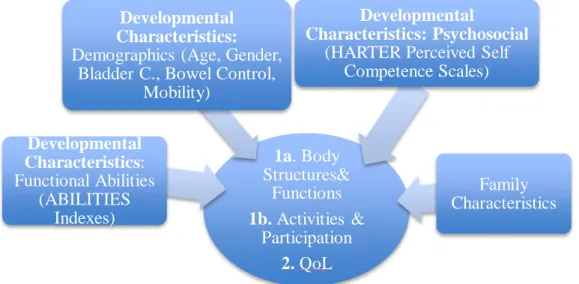
A hierarchical multiple regression was conducted by using the predictor variables in the
following block order.
Block 1: Age, Gender, Bladder Independence, Bowel Independence, Mobility, Four Functional
Ability Indexes
Block 2: Psychosocial Characteristics (Harter Perceived Cognitive/ Social/ Physical Competence
Scales)
Block 3: Family Characteristics
Figure 5. Regression Model for 3rd Question
1a. Body Structures&
Functions 1b. Activities &
Participation 2. QoL Developmental
Characteristics: Functional Abilities
(ABILITIES Indexes)
Developmental Characteristics: Demographics (Age, Gender,
Bladder C., Bowel Control, Mobility)
Developmental
Characteristics: Psychosocial (HARTER Perceived Self
Competence Scales)
CHAPTER III –RESULTS
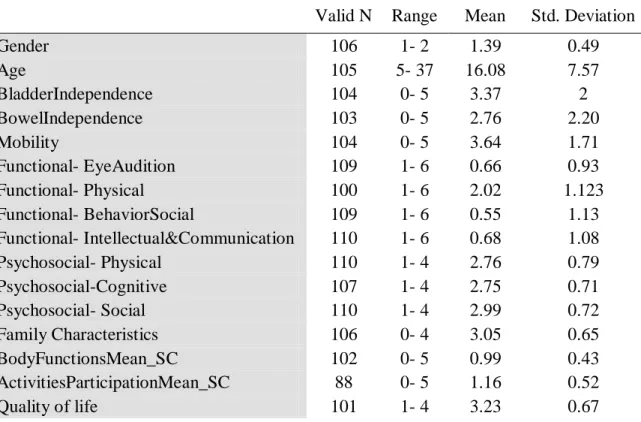
The demographic characteristics of the study population and the mean scores of the
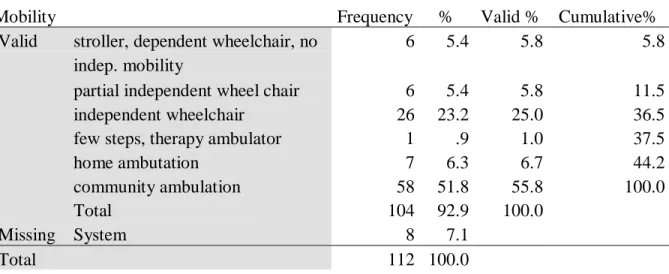
fourteen variables are presented in Table I. Distribution of level of independence of bladder,
bowel and mobility are presented in Tables 2 -4
Research Question 1
What are the relationships among developmental characteristics, secondary conditions,
and QoL of children & adults with Spina bifida?
Pearson product moment correlation coefficients were calculated to examine the
relationship between the functional abilities measured by ABILITIES index, perceived
competence in physical, social and cognitive abilities as measured by Harter scales, Family
Characteristics and ICF components of the secondary conditions (Body Functions, Activities &
Participation), perceived Quality of Life, gender, age, bladder and bowel independence. The
matrix of correlation coefficients is presented in Table 5. Note that the number of cases used for
each correlation was determined on a "pairwise" basis. The Body Functions and Structures
component of the Secondary Conditions Questionnaire such as how much of a problem the
condition (pain, weight, bladder control, bowel control, skin breakdown, latex allergy, pressure
sores, balance, strength, endurance, osteoporosis, breathing, sexuality, depression, lack of
confidence, poor body image) was significantly positively correlated with age (r=.391) and
physical functional abilities (r=.283), behavioral& social abilities (r=.276), and intellectual &
.01 level. The Body Functions Structures component was negatively correlated with perceived
Quality of Life, Family Characteristics, and all three of the perceived self-competence areas
(p<.05). The significance levels are all at the .05 except the correlation with Psychosocial –
Social (p< .01), however the Pearson values were low ranging between r=.206 to r=.461. The
strongest correlation with body functions was psychosocial- cognitive competence with a
negative correlation of .461 indicating that lower values of the body functions variable was
associated with higher values of the psychosocial cognitive variable. Knowing that psychosocial-
cognitive competence is significantly associated with body functions, we might predict that it
would be a statistically significant predictor variable in the regression model.
The Activities & Participation component of Secondary Conditions Questionnaire with
items assessing how much of a problem or difficulty the condition presents significant positive
relationship with functional abilities in the Behavioral and Social area and in the Intellectual &
Communication area. It was found to have a strong negative relationship with perceived Quality
of Life, Body Functions, perceived social competence and cognitive competence (p<.05).
A significant positive relationship was found between Perceived Quality of Life and
perceived competence in cognitive, physical and social areas, and negative relationship with
Functional abilities for the Behavioral & Social area with age (p<.05) and with bladder
independence (p<.01). The strongest relationship with Quality of Life was the
psychosocial-cognitive variable with a correlation coefficient of .376. Based on the significance level,
psychosocial-cognitive was expected to be a statistically significant predictor in the regression
model of Quality of Life. Family Characteristics was found to be significantly correlated with
perceived competence in physical and social areas, and with intellectual& communicative