The Results Of Prototype Test Media Of
Mathematical Electronic Reflective Book In
Mathematics Learning
Hery Suharna, Abubakar Kadir, Nurningsih Hi AbdullahABSTRACT: Students 'mathematics learning difficulties are often experienced, especially in algebraic material, namely: (1) difficulty connecting between concepts in mathematics, (2) the occurrence of thinking barriers caused by incomplete information about previous mathematical concepts, (3) students' inability to accept objects direct mathematics, so that students do not master the concept correctly, (4) students are not able to understand a mathematical problem correctly when solving mathematical problems, and (5) students do not use operations and procedures correctly. On the basis of these student difficulties resulting in problem solving results, students' mistakes when solving the mathematical problem need to get the attention of all circles. Electronic books are books that can be used to overcome student difficulties. This learning media can be used by students independently, to help facilitate learning, especially mathematics. In the trial of this research and development product, the author chooses an individual test, namely by taking a sample of 6 students who have not taken algebraic material with regard to high, medium, and low abilities. The results of the overall data analysis, this learning media can be categorized as valid because it meets the criteria for validation in terms of content (material) of 85.4% and in terms of (media) appearance of 84.4%. In addition, the average overall response given by subjects tried to meet the practical criteria of 80.6%.
Keywords: prototype, electronic book, mathematics learning
————————————————————
A.
INTRODUCTION
Mathematics subjects are subjects that are considered difficult for most students when solving mathematical problems. Mathematical errors that are often done by students are misconceptions, procedures, and others. Mathematics is a difficult material for students in high school mathematics. Mathematics is expected to be the basis of other sciences, so it is important to learn and understand. Some high school students are difficult material. Students 'mathematics learning difficulties are often experienced, especially in algebraic material, namely: (1) difficulty connecting between concepts in mathematics, (2) the occurrence of thinking barriers caused by incomplete information about previous mathematical concepts, (3) students' inability to accept objects direct mathematics, so that students do not master the concept correctly, (4) students are not able to understand a mathematical problem correctly when solving mathematical problems, and (5) students do not use operations and procedures correctly. On the basis of these student difficulties resulting in problem solving results, students' mistakes when solving the mathematical problem need to get the attention of all circles. These mistakes have an impact on students' understanding of the next mathematical concept.
Electronic books are books that can be used to overcome student difficulties. This learning media can be used by students independently, to help facilitate learning, especially mathematics. Independent learning based on multimedia technology according to Ariani, et al. (2010: 67) is the interaction between teacher and students is not only done through face-to-face relationships, but also as an educational medium that can be done using communication media such as computers, internet, blogs, and so on. Therefore, it is expected that using interactive multimedia will give more impression to its users.
B.
Research and Development Methods
The research and development model carried out by researchers in the form of procedural models. The procedural model is a descriptive model, which outlines the steps that must be followed to produce a product (PPKI: 2010). In research and development in making this interactive learning media researchers use a model that has been developed by Alessi and Trollip (1991: 245-248) which consists of determining development needs and objectives, collecting references, studying the contents of the material, initial design, making program flow charts , making program structure, making storyboard programs, making programs, making supporting materials, evaluating and revising programs. In addition, to find out whether this learning media is appropriate or needs to be revised, media validation is needed. Media validation developed by the author in the form of a questionnaire that will be validated by a team of experts namely media experts (lecturers), material experts (lecturers and teachers), and users (students).
C.
Product Trial
This electronic reflective thinking book trial takes a sample ___________________________
Hery Suharna, Abubakar Kadir, Nurningsih Hi Abdullah Department of Mathematics Education. Khairun
University of Ternate
82
∑ ∑
With:
: presentation
∑ : number of assessment scores (validator answers)
∑ : highest number of scores
Validation criteria used in validation are presented in table 1 below:
Table 1 Program Validation Criteria
Presentation (%) Validation Criteria
76-100 Valid
56-75 Valid enough
40-55 Invalid (revisi)
0-39 Invalid (revised)
Adopted from Arikumto (2009: 245)
The conclusions are taken by using the criteria in table 1, that is, if the results of validation on electronic books think reflective is done to reach more than equal to 56%, this means that the learning media program can be used in learning activities independently.
D.
Results and Discussion
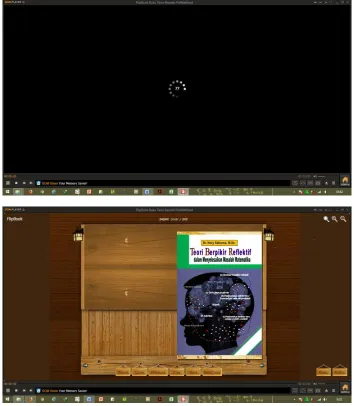
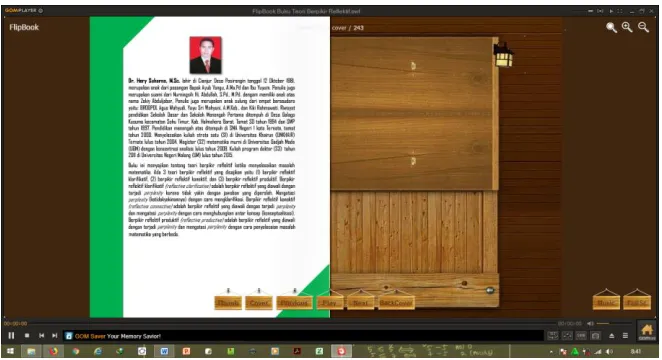
This Electronic Book Media Mathematical Reflective Thinking for High School Students is a learning medium developed to help students in learning mathematics. The following are the media views that the author made.
Final view
Figure. Display of the use of electronic media books on mathematical reflective thinking
1. Validation Results Data,
a. Material Expert Validation Results Data
Data from the validation of material experts was obtained from a Mathematics Lecturer at Khairun University, and a high school teacher. In addition to quantitative data, qualitative data is obtained in the form of criticism and suggestions from material experts. Following are the suggestions and criticisms provided by the material validator.
Table 2 Comments and Suggestions by Material Experts
Validator to Comments and Suggestions
1
Views are quite interesting for students, especially in
mathematics learning.
Must be given training according to students' mathematical abilities.
2 Very suitable with the development of science and technology now. Need to be developed using HP. Validator 1 with the initials HS is a lecturer in mathematics education at Khairun Ternate University. Validator 1 with the initials AB has a degree in mathematics education and an expert in the field of mathematics education psychology. Furthermore, validator 2, is a teacher at a senior high school who has teaching experience over 20 years.
b. Media Expert Validation Results Data
Data from the validation of material experts was obtained from a Khairun University Mathematics Education lecturer and Ukhair computer lab head. In addition to quantitative data, qualitative data obtained in the form of criticism and suggestions from media experts. Following are the suggestions and criticisms provided by media expert validators.
Validator 3 with the initials JKS is a lecturer in mathematics education and also has expertise in programming mathematics education and information technology-based learning design. Validator 4 with initials NHA is an expert in mathematics learning media with qualified qualifications based on educational qualifications taken
c. User Result Data (Students)
Students who are the subject are 6 students with a predetermined criteria. Here are some suggestions and criticisms given by students.
Table 4 Comments (Suggestions) of users (students)
Validator to Comments and Suggestions
1 Already according to current conditions, so I feel interested in learning mathematics.
2 Good for current conditions
3 Learning mathematics is more relaxed and can be done anywhere
4 Ok
5 If learning is like this, math is easier to learn. 6 With electronic books, we don't need to bring books
physically anymore. Ok
E.
Data analysis
The following are the results of data analysis from the material expert validator, media expert validator and trial of 6 students. The analysis used is to use presentations and be modified with reference to table 1 validation criteria. Discussion of data analysis as follows:
86 b. Media Expert Validation Results Analysis
The results of the expert validation analysis obtained a total percentage of 84.4% which means that it includes valid criteria. While the percentage of each item obtained is the lowest percentage is 75% and the highest is 100% so that it includes the criteria that are quite valid and valid.
c. Analysis of Student Assessment Results
Analysis of students' assessment results obtained a total percentage of the total is 80.6% means that it includes practical criteria. While the percentage of each item obtained the lowest percentage of 75% and the highest percentage is 100% so that the criteria are quite practical and practical so that it can be used for independent learning.
F.
Conclusion
The results of the overall data analysis, this learning media can be categorized as valid because it meets the criteria for validation in terms of content (material) of 85.4% and in terms of (media) appearance of 84.4%. In addition, the average overall response given by subjects tried to meet the practical criteria of 80.6%.
G.
Bibliography
[1] Ariani, N. & Haryanto, D. 2010. Pembelajaran Multimedia Media di Sekolah (Ardhiawan, Ed.). Jakarta: Prestasi Pustaka.
[2] Arikunto, S. 2009. Dasar-dasar Evaluasi Pendidikan. Jakarta : Bumi Aksara.
[3] Trollip, Stanley, R. & Alessi, Stepen, M. 1991. Computer based Instructional: Method and Development. Prentice Hall.
[4] National Research Council.1989. National Council of Teachers of Mathematics. Curriculum and evaluation standards for school mathematics. Reston, VA: The Author.
[5] Nicol, J. 2002. An Aspect of Mathematical Understending: The National of “Connectes Knowing”. Doctoral thesis, La Trobe University, Australia.
[6] Council of Teacher Mathematics (NCTM). 2000. Principle and Standards for School Mathematics. Reston: The National Inc.
[7] Suharna, Hery. 2014. Proses Berpikir Koneksi Antar Konsep Siswa dalam Menyelesaikan Masalah Aljabar. Prosiding ini telah dipresentasikan dalam acara Seminar Nasional Pendidikan Matematika LSM XXI. Yogyakarta
[8] Suharna, Hery. 2014. Berpikir Koneksi Relatif Melalui refleksi dalam Menyelesaikan Masalah Matematika. Prosiding Konferensi Nasional Penelitian Matematika dan Pembelajarannya II (KNPMP II) Jurusan Pendidikan .Matematika Universitas Muhammadiyah Solo.
[9] Suharna, Hery. 2014. Proses Berpikir Koneksi Antar Konsep Siswa dalam Menyelesaikan Masalah Aljabar. Prosiding ini telah dipresentasikan dalam acara Seminar Nasional Pendidikan Matematika LSM XXI. Yogyakarta.