Introduction
Savings and investment play a significant role in capital accumulation. Variations in these variables have a major impact on economic growth. Savings are the key to increasing a country’s capital-output ratio. It has neglected the one very important source: migration and worker remittances in particular because migration has an important role by integrating developing countries into the global economy. Specifically, through remittances, migration has brought new opportunities for economic and social changes in rural areas and changes their social activities. The worker remittances are an important component of national savings, increased enormously at the rate of 30 percent per annum during the last eight years and be around $ 5.5 billion by June, 2007. With higher increase in worker remittances and rate of return on deposits the level of national savings would increase more.
Remittances remain the second-largest financial flow to developing countries after foreign direct investment, and are more than double the size of net official finance. Worker remittances are defined as that quantity of currency that migrants earn abroad and then send to their families in their home countries. Studies related with remittances have often focused on their wealth generating capacity through savings and investment, the factors influencing their flow and their effects in the recipient economies at the household level. Migrant remittances provide the direct, instantaneous and extensive benefit to overseas workers, their families, and their country of origin. Remittances are often invested by the recipients, particularly in countries with sound economic policies. Improvements in policies and relaxation of foreign exchange controls in the 1990s may have encouraged the use of remittances for investment.
The Effect of Workers’ Remittances on Private Savings Behavior in Pakistan
Abstract
Author Rahila Munir
Ph. D Student, Department of Economics, University of Sargodha, Pakistan
Maqbool H. Sial
Dean and Professor, Department of Economics, University of Sargodha, Pakistan
Ghulam Sarwar Ph. D Student, Department of Economics, University of Sargodha, Pakistan E-mail: [email protected]
Samina Shaheen
Ph. D Student, Department of Economics, University of Sargodha, Pakistan
Keywords
ARDL Co-integration, Error Correction Model, Private Savings, Remittances
Foreign direct investment (FDI) is also a source of external finance for many developing countries. Even more unexpected, in terms of value, remittances are rapidly approaching FDI flows to developing countries. Asian countries are among the biggest recipients. India was the top recipient, getting US $27billion, followed by China with US $25.7billion and the Philippines are in fourth number with US $17billion.1
Recent research suggests that household members who migrate can facilitate investments in new activities by providing their families with liquidity, in the form of remittances, as well as income security in the event of an adverse income shock. Remittances augment the recipient individuals’ incomes and increase the recipient country’s foreign exchange reserves. If remittances are invested, they contribute to output growth, and if they are consumed, then also they generate positive multiplier effects (Stahl and Arnold, 1986).
Pakistan received a significant amount of workers’ remittances, during the last three decades which are received by Pakistanis working abroad. For capital deficient economies, like Pakistan, workers’ remittances are considered to be an important source of foreign exchange. These remittances have a positive impact on Pakistan’s economy through improved balance of payments position and by reducing dependency on external borrowing. Remittances are also helped the Pakistan to recover from the adverse effects of oil price shocks, unemployment problem, and improved standard of living of recipient households.
In Pakistan, many studies found that majority of remitted flows were spent on consumption. However, some evidences also found that significant portion of remittances were used into productive investment. However, a number of researchers have suggests that even if remittances are totally spent on consumption of imported and domestically produced good and services, there is still benefit to the receiving countries (Iqbal and Sattar, 2005).
The role of workers’ remittances in domestic resource mobilization of recipient countries is considered to be an important area of research. In particular, sound research in this area is necessary in order to make policies to channel these flows into productive investment.
1Leveraging migrant worker remittances for development in Asia,
An Economist Intelligence Unit white paper, 2008(western union)
While acknowledging the ongoing debate over migrant issues, and their role in the promotion of savings and investment, the objective of this study is to view remittances as a source of capital accumulation and source of income for Pakistan. i. To determine the relationship between remittances and private savings. ii. To analyze the effectiveness of remittances and foreign direct investment in promoting savings.
Literature Review
The literature on the relationship between worker remittances, foreign capital inflows, savings and investment in developing countries has been very abundant during the last thirty years, studies examining both micro and macro level as well as regional or national level.
Remittances are believed to have a positive impact on savings and investment. Household surveys in Pakistan indicated that in the 1980s and early 1990s, the marginal propensity to save for income was higher from international remittances than from domestic remittances (Adams, 1998, 2002).
The study showed that domestic interest rate and worker’s remittances and export earnings had a positive effect on household savings (Iqbal, 1993) and negative and declining relationship between foreign loans and domestic savings (Khan and Rahim, 1993).The impact of dependency ratio, foreign capital inflows on the national savings rate in Pakistan was analyzed by using time series data .There exist positive effect of per capita income and interest rate on national savings rate, but the dependency ratio and foreign capital inflows negatively influenced the saving ratio (Khan et al. 1992).On the other hand, Ahmad and Qazi (2002) examined that Pakistan emphasized on foreign capital inflows to fill the gap of current account deficit and there exists negative relationship between saving rate and foreign capital inflows in the long run by using time series data for the period 1972-2000.
A recent study empirically examines the effect of remittances, exports, money supply on economic growth in Pakistan. The short-run effect of remittances and exports is significant, contributing to about 0.034 and 0.078% to economic growth while money supply was found insignificant to contribute to economic growth (Ahmed et al. (2011)).
has significantly affected and maintained the Pakistan’s financial sector. Moreover remittances are stable source of development finance rather than capital flows that put different checks on policies makers (Shahbaz et al., 2008).
Khan and Hye (2010) analyzed the effect of financial sector reforms, per capita income, agriculture sector GDP, remittances on household savings in Pakistan by using time series data. The remittances, per capita income and agriculture GDP positively affected the household savings both in short and long run while financial liberalization negatively affected the household savings both in short and long run and real deposit rate negatively affected the savings in long run but positive impact in the short run.
The current debate on migration and development, many researchers have pointed out that the way in which migrants and households spend remittances have a significant effect on the development of home countries. In the 70s and until late 80s, the economic literature has not found a positive relationship between remittances and development, arguing that remittances are mainly used for subsistence consumption (food, clothing), non-productive investments, repayment of debts, and these expenditures tend to have little positive impact on local economies development. Remittances are mainly devoted to daily consumption needs (Rempel and Lobdell (1978), Lipton (1980) and Massey et al. (1987)).
Remittances are beneficial at one hand but societies incur socio-economic cost due to these. The people spent them on conspicuous consumption; this unnecessary consumption caused inflation in the remittances receiving countries. The investment in the productive projects slows downed and the problems of brain drains and moral hazards in the developing countries were also observed by these effects (Buch and Kuckulenz, 2002).
The study examines the internal labor migration and remittance behavior of Botswana citizens. By using primary data, the level of poverty and factors influencing remittances are examined. The results indicate that migrants maintain links with their home-based households through remittances in cash and goods. This is generally done in order to reduce poverty, especially in rural areas. However, the remittances do not have a significant effect on poverty in Botswana (Campbell, 2008).
The study used the time series data for examining the behavior of the balance of payments (Employee compensation and migrant transfers) that are
conceptually different and behave differently than workers’ remittances. In particular, employee compensation is frequently related to either seasonal labor or the employment in embassies, while migrant transfers submit to the one-time movements in funds associated with changes in home. The results suggest within countries, correlations between worker remittances and employee compensation tend to be small and negative in many cases (Chami et al., 2008).
There is very little evidence that official transfers have contributed much to the growth of developing economies. The result of this study also concluded that private income transfer (remittances) have contributed little to economic growth in remittance-receiving economies and retarded growth in some cases. There does not exist strong and positive significant effect of remittances on long-term growth, and find a negative relationship between remittances and growth (Chami et al. 2009) and the effect of remittance flows on growth appears to be inconclusive, covering the full range from negative effects to positive effects (Catrinescu et al., 2006). However, more recent studies conducted in most cases for Latin America, Sub Saharan Africa and Asia found that migrants and households spend a share of remittances on savings and investment ( Mesnard (2001), Mishra (2005), Adams et al. (2008), and Balde (2010)).
Methodological Framework
For the empirical analysis, time series data will be used for Pakistan for the time period 1973-2007.The sources of data are Economic Surveys of Pakistan (various issues), State Bank of Pakistan, IFS (International Financial Statistics) and Fifty Year Handbook Statistics of Pakistan.
Variables of the Study
LPS:Private Savings (Rs. Millions)
LTRM: Total Real remittances by Pakistanis emigrants (Rs. Millions)
FDI:Foreign direct investment (Rs. Millions) RRID :Real deposit rate (%)
LRGDPC:Real GDP Per Capita (Rs. Millions)
is constructed as (Interest rate on deposits-inflation rate). All variables will be converted into log form except FDI and real rate of deposit (RRID) because it is already in percent and have smooth trend.
Methodology
The use of an appropriate technique was considered as the center of any research study, without making a right choice for empirical analysis, the impact of study seems futile exercise. Therefore adoption of an appropriate technique was very important.
To analyze the connection between worker remittances and savings, one would need to use an appropriate model for empirical analysis. To examine the relationship between the variables in long and short run, many studies adopted the Johansen-Juselius (1992) and Engle Granger (1987) co-integration technique for checking the co-co-integration between variables in the long run. By using Johansen-Juselius technique, for co integration analysis, all variables deemed integrated at same order.
Therefore, to solve this issue, this study utilize Autoregressive Distributed Lag model (ARDL) developed by Pesaran, et al. (1997).This was a relatively new econometric technique used to estimate the relationship between savings and worker remittances and among other variables which are used in the study. This technique tests the co integration relationship without considering the same order of integration of all variables, either they were integrated of 1(0), 1(1) or mutually integrated. Before following to other steps, the modeling strategy will be as follows:
1) Firstly the order of integration and stationary of the variables has been checked by using the Dickey-Fuller (DF) and Augmented Dickey-Fuller (ADF) test.
2) If the variables were integrated of the different order, then one can apply the ARDL (Autoregressive distributed lag model) developed by Pesaran, et al. (2001) to determine the co-integration for analyzing the long run relationship between variables. 3) If the variables showed the co integration
relationship in the long run, then next one can apply the error correction mechanism (ECM) for analyzing the short run dynamics of the variables.
The Unit Root Test
For checking the stationary of time series data unit root test is very influential. The time series which
move slowly upwards and downwards around its mean with out any specific pattern are called random walks and the series which go upward and downward with a specific trend are called random walks with drift.
Autoregressive process generated the time series. This procedure AR for the time series was given as:
t t-1 t
Y = + Y +µ
(1) Where; µt is normally distributed with constant mean and variance . The AR process will be stationary, If │
│<1 and when
=1 and
=0 then this procedure of auto regression was converted in to non stationary arbitrary random walk series such as:t t-1 t
Y = Y +µ
(2) If
=1 and α≠0 then the AR process was transformed in to a non stationary series and called a random walk with a drift such as:t t-1 t
Y = + Y +µ
(3) Many tests were applied to establish the integration order of time series in econometrics literature but most commonly was unit root test. Dickey and Fuller (1981) developed the unit root test. Augmented Dickey Fuller test is more favored over the Dickey Fuller because it gave more consistent results.Dickey and Fuller have developed a modified model of (DF), known as (ADF) Augmented Dickey Fuller test in such a form:
1 2
1
...(4)
mt o t i t i t i
Y
a
Y
a t
y
Where Yt is the series for which, the order of integration is checked, t is the time period, m is the
no of lags and
t is the white noise error term. Co- integrationThe basic idea of co-integration is to identify the equilibrium in long run or relationship among the variables in long run. For illustration, the series Yt and Xtwill be co-integrated of order I (1) when the variables Y t and X t will be stationary at first difference I (1) (Johansen and Juselius, 1992). By using Johansen-Juselius and Engle Granger techniques, in order to test for the co integration, all variables were integrated at same order.
Developed by Pesaran, et al. (1997) was used. This technique checked the co integration connection without considering the same integration order of all variables, either the variables are integrated of 1(0), 1(1) or jointly integrated. The Autoregressive Distributed Lag model following unrestricted error-correction model in such a general form is given as:
k k
0 1 t-1 2 t-1 3 t-i 4 t-i t
i=1 i=0
Yt= + Y + X +
Y +
X +
(5)
The private savings equation was specified in the form of ARDL (Autoregressive Distributed Lag) model in such a general form.
0
1 1 1
1 1 2 1
1 1
3 1 4 1 5 1 1
...(6)
m m m
i t i i t i i t i
i i i
m m
i t i i t i t t
i i
t t t t
LPS
LPS
RRID
LTRM
LRGDPC
FDI
LPS
RRID
LTRM
FDI
LRGDPC
EC
The expressions with the summation represents the error correction terms whereas the λs represents the long run relationship among variables. First of all at different lags, of the first difference of every variable, F-Statistics will be calculated for checking the co-integration between variables in the long run for the joint significance of variables. At start, the null hypothesis will be tested of having no co-integration against the existence of a long run relationship by applying F-test such as:
H0=λ1……. λn=0
H1=λ1……. λn ≠0
If the calculated F-statistics lies above the upper critical bound value of F-tabulated developed by Pesaran, then hypothesis (null) of no co-integration will be rejected and there will be co integration
existed in long run among variables. If it lies under the lower critical bound, then null hypothesis will be accepted. Finally, if it lies within the critical bound values, the result seemed inconclusive.
Error correction model (ECM)
When two variables has been co integrated in long run, then in the second step, the error correction mechanism will be used to examine the dynamics of the model in short run. This technique was first analyzed by (Sargan, 1964) and after this was famous by (Engle and Granger, 1987).
The basis of error correction model was Granger representation theorem. In error correction model, the short-term dynamics of the variables in the system were influenced by the deviation from the equilibrium. ECM model was best for co-integration as it included both long-run and short run information and ECMs were formulated in the terms of first differences, which eliminated the trends from variables and resolved the problem of spurious regression and it also measured the correction from disequilibrium of the previous period.
The equation of ECM is stated as:
* * 1 1 0 1 1 1 1 1
(1, )
i p kt t i it t j t j
i j
q k
ij it j t i j
y
p EC
x
w
y
x
(7) Where;EC
t1is the error correction term.1
1
k
t t i it t i
EC
y
x
w
(8)* *
i j
j and
, the coefficients of the short run model (ECM).Empirical Results
The results of DF and ADF Unit Root tests for checking the stationary of the data are shown in Table1a. In order to scrutinize the integrating level of variables, standard tests like DF and ADF (Dickey & Fuller, 1979) are applied. The results of Dickey Fuller and Augmented Dickey Fuller tests show that the three variables are stationary at level (RRID, FDI and LTRM) because null hypothesis of the existence of unit root is rejected showing stationary of series I
(0). The remaining variables (LRGDPC and LPS) are non-stationary at level but become stationary after taking their first difference .i.e. I (1).
(1997)) at the 5 percent significance level. It is concluded from F-statistics that there exists a long run relationship among the variables.
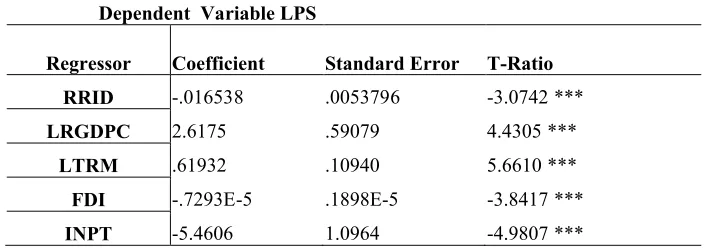
Given the existence of long run relationship among the variables, ARDL model is estimated to find the long run and short run dynamics of the variables in equation (6). The long run and short run results are reported in table 2 and table 3 respectively. The long run statistics shows that coefficient of RRID (Real deposit Rate) is -.0165. It showed that a 1 percent increase in real rate deposit rate tend to decrease the private savings by 1.65 percent. The coefficient of LRGDPC (log of real GDP Per Capita) is 2.62 which show positive effect of GDP per capita on private savings.
The coefficient of LTRM (Log of total worker remittances) is .619 which shows positive relationship between worker remittances and private savings. It showed that a 1 percent increase in worker remittances increase the private savings by .62 percent approximately. While coefficient of FDI (Foreign direct investment) is -.7293E-5 which reflects negative impact of foreign direct investment on private savings and are highly significant at 1 percent level. The findings are consistent with the findings of recent studies conducted in most cases for Latin America, Sub Saharan Africa and Asia found that migrants and households spend a share of remittances on savings and investment (Mesnard, 2001), (Mishra, 2005), (Adams et al. (2008)), (Balde, 2010). Some studies analyze that if remittances are totally spent on consumption of imported and domestically produced good and services, but there is still benefit to the receiving countries (Iqbal and Sattar, 2005).A recent studies also finds the positive impact of remittances on savings and growth(Khan and Hye,2010),(Ahmed et al,2011). The results of Error Correction Model are given in Table 3. The lagged error correction term Ecmt-1 is negative and highly significant at 1 percent level. Its co-efficient (-1.55) indicates a very rapid adjustment process indicating that disequilibria of the previous period shock will be rapidly adjusted to long run equilibrium(155% discrepancy is corrected in every year) in the current year. This result is consistent with khan and Hye (2010) study in which the error correction term indicates the high speed of adjustment from the short-run fluctuation to the long-run equilibrium (201% discrepancy is corrected each year).
While results of the short run show that change in RRID (Real rate of interest on deposits) has positive impact on change in private savings but its impact is
not significant. The co-efficient of change in gross domestic product has also positive effect on change in private savings in short run. The co-efficient of change in total remittances has also positive effect on change in private savings in short run which confirms the positive impact of worker remittances on private savings in both long run and short run. But the co-efficient of change in foreign direct investment has negative effect on private savings.
Conclusion
Table1a: DF & ADF Unit Root Test at Level
Variables Without trend With trend Order of Integration
RRID -3.11 -3.63 1(0) stationary
LTRM -3.671 -3.59 1(0) stationary
LRGDPC -0.925 -1.454 1(0) non stationary
FDI 7.422 5.681 1(0) stationary
LPS -1.569 0.621 1(0) non stationary
Table1b: DF & ADF Unit Root Test at 1st Difference
Variables Without trend With trend Order of integration
DLRGDPC -3.948 -3.889 1(1) stationary
DLPS -5.663 -6.219 1(1) stationary
Table 2: Long Run Coefficients of ARDL (1, 1, 4, 0, 2) Based on Schwarz Bayesian Criterion Dependent Variable LPS
Regressor Coefficient Standard Error T-Ratio RRID -.016538 .0053796 -3.0742 *** LRGDPC 2.6175 .59079 4.4305 ***
LTRM .61932 .10940 5.6610 *** FDI -.7293E-5 .1898E-5 -3.8417 ***
INPT -5.4606 1.0964 -4.9807 ***
Table 3: ARDL (1, 1, 4, 0, 2) Error Correction Mechanism (Short run Dynamics) Dependent Variable DLPS
Regressor Coefficient Standard Error T-Ratio
dRRID 0.0020052 0.009361 0.2142
dLRGDPC 15.6639 4.4602 3.5119***
dLTRM 0.96286 0.19414 4.9597***
dFDI -2.27E-05 1.97E-06 -11.5229***
dINPT -8.4897 1.8969 -4.4754***
Ecm(-1) -1.5547 0.15848 -9.81***
*** shows the coefficient is significantly different from zero at (0.01 p) level.
R2= .96 R2 adj= .94 F-stat= 56.8775 Log. L= 28.7371 AIC= 15.7371 SBC= 6.4162 DW= 2.13
References
Adams, H. R. (1998)“Remittances, Investment and Rural Asset Accumulation in Pakistan” Economic Development and Cultural Change, pp. 155-73. Adams, H. R. (2002) “Precautionary Savings from Different Sources of Income: Evidence from Rural Pakistan” World Bank Policy Research working paper number 2761.
Ahmad, H. M. and Qazi, A.M. (2002) “Foreign Capital Inflows and Domestic Savings in Pakistan: Cointegration Techniques and Error Correction Modelling” The Pakiatan Development Review Vol. 41, No.4,pp. 825-836.
Ahmed, J. Khalid, Z. and Iqtidar, A. S. (2011)“An empirical Analysis of Remittances-growth Nexus in Pakistan using Bounds Testing Approach” Journal of Economics and International Finance Vol. 3, No. 3, pp.176–186.
Balde, Y. (2010) “The Impact of Remittances and Foreign Aid on Savings/Investment in Sub-Saharan Africa” Laboratory of Economic Analysis and Prospective University of Limoges, France.
Buch, C. M. and Kuckulenz, A. (2002) “Worker Remittances and Capital Flow. Kiel Institute for World Economic working paper number 1130. Chami, R. Barajas, A. Cosimano, T. Fullenkamp, C. Gapen, M. and Montiel, P. (2008) “Macroeconomic Consequences of Remittances” IMF occasional paper number 259.
Catrinescu, N. Ledesma, M. Piracha, M. and Quillin, B. (2006) “Remittances, Institutions and Economic Growth” IZA discussion paper number 2139.
Chami, R. Barajas, A. Gapen, M. Fullenkamp, C. and Montiel, P. (2009) “Do Workers Remittances Promote Economic Growth?” IMF working paper number 153.
Campbell, K. E. (2008) “Moderating Poverty: The Role of Remittances from Migration in Botswana” Africa Development Vol. 33, No. 2, pp. 91–111. Engle, R. F. and. Granger, C. W. J. (1987) “Co-integration and Error correction: Representation, Estimation and Testing” Econometrica Vol. 55 No. 3, pp. 251-276.
Griffiths, W. E. Carter, R. H. and Judge, G. G. (2001) Undergraduate Econometrics, John Willey and Sons: New York.
Gujarati, D. N. (2005) Basic Econometrics, McGrawHill: New York.
Iqbal, Z. andSattar, A. (2005)“The Contribution of Workers’ Remittances to Economic Growth in Pakistan” Pakistan Institute of Development Economics, Research report number 187.
Iqbal, Z. (1993) “Institutional Variations in Saving Behavior in Pakistan” The Pakistan Development Review Vol. 32, No. 4, pp. 1293-1311.
Analysis of the PPP and UIP for UK” Journal of Econometrics Vol. 53,No. 2, pp. 211-44.
Khan, A. H. Hasan, L. and Malik, A. (1992) “Dependency Ratio, Foreign Capital Inflows and the Rate of Savings in Pakistan” The Pakistan Development Review Vol. 31 No. 4, pp. 843-856. Khan, N. Z. and Rahim, E. (1993) “Foreign Aid, Domestic Savings and Economic Growth” The Pakistan Development Review Vol. 32, No. 4, pp. 1157-1167.
Khan, R. E. and Hye, Q. (2010) “Financial Sector Reforms and Household Savings in Pakistan: An ARDL approach” African Journal of Business Management Vol. 4, No. 16, pp. 3447-3456.
Lipton, M. (1980) “Migration from Rural Areas of Poor Countries: The Impact on Rural Productivity and Income Distribution” World Development, Vol. 8, pp.1-24.
Massey, D. S.(1987) “Return to Aztlan: The Social Process of International Migration from Western Mexico, Berkeley and Los Angeles” University of Californi Press.
Mesnard, A. (2004)“Temporary Migration and Self-Employment: Evidence from Tunisia” Brussels Economic Review Vol. 47, No. 1, pp.119-138. Mishra, P. (2005) “Macroeconomic Impact of Remittances in the Caribbean” International Monetary Fund: Washington DC.
Pesaran, H. M. and Pesaran, B.(1997) Working with Microfit 4.0: Interactive Econometric Analysis, Oxford University Press: UK.
Stahl, Charles, W. and Arnold, F. (1986) “Overseas Workers’ Remittances in Asian Development” International Migration Review Vol. 20, No. 2, pp.899-925.
Sargan, J. D. (1964)Wages and Prices in the United Kingdom: A Study in Econometric Methodology, Quantitative Economics and Econometric Analysis: Oxford.