ANALYSIS OF FIBER LASER CLADDING OF
TITANIUM NITRIDE ON SS304 SUBSTRATE
Rashi Tyagi
1, Manowar Hussain
1, Alok Kumar Das
11
Department of Mechanical Engineering, Indian School of Mines, Dhanbad, (India)
ABSTRACT
To improve the surface characteristics of metallic mechanical parts, such as the resistance against wear, laser
cladding was performed. Laser cladding coating of TiN and stainless steel304 powder was efficiently
synthesized with the help of fiber laser system on a stainless steel304 substrate. The stainless steel304 powder
was added to increase the bond strength between clad and the substrate. Poly Vinyl Alcohol was used as a
binder for mixing the powders. The microhardness and microstructure was inspected by the vicker hardness
test, and Scanning electron microscope (SEM) technique respectively. The microhardness was found to be more
than seven times of the substrate hardness. The microstructure of cladding was free of crack and pores. The
clad thickness analysis was also done with the help of optical microscope. The wear test was performed on ball
on disc friction and wear tester. Laser cladding of TiN had highly results in reducing the wear rate.
Keywords- Microhardness, Microstructure, Stainless steel, TiN cladding, Wear rate.
I. INTRODUCTION
In recent research development composite coating have been demanded by many tribological systems in order
to reduce friction and wear [1]. The unique surface properties such as hardness, wear, resistance to oxidation can
be achieved by the use of ceramics. Ceramics have high melting points and needed higher laser energy input.
Titanium nitride (TiN) is a very hard ceramic material, frequently used as a coating on titanium alloys, steel,
carbide, and aluminium components to improve the substrate's surface properties. TiN has a low coefficient of
friction, high hardness, resistance to corrosion and adhesive wear [2-3].
Ceramic coatings commonly tend to fail as a result of huge thermal stress at high temperature environment
[4,5,6]. Laser cladding technology has been proven a promising method for ceramic coating preparation, due to
its low power consumption, short time and high efficiency [7,8,6]. The repeated problem faced by
manufacturing industry is wear. Some machine parts fail only due to the slight damage on the surface produce
by the wear; hence regular repair and replacement are needed to increase the service life of such components,
hence increasing productivity, their wear resistance should be increased. The wear resistance of such
components can be improved by using the different methods such as thermal spraying in which layer of hard
alloys is fused onto the substrate [9].
Laser cladding is a commonly used technique, as laser radiation is capable to melt a large range of different
alloys onto a metallic substrate, and coatings exhibit very low porosity, minimal dilution and a perfect union
with the substrate. Additionally, quick solidification generates refined and new microstructures with improved
The extensive feature of laser cladding to synthesize the hard facing layer with high resistance to wear,
corrosion, high temperature oxidation has become interesting in research [13,14].
The preplaced powder technique is used in the experiment. Laser cladding with preplaced powder is the
ordinary technique. The powder is mixed with a chemical binder to ensure that it will stick to the substrate
during the process. As the laser beam passes a melt pool forms in the surface of coating material which extends
to the interface with the substrate. A strong fusion bond is attained due to continuous heating. The heat input
must be well controlled to anticipate the deep melting of the substrate to achieve a strong fusion bond.
However, the laser cladding coating has some advantages owning to its high hardness and wear resistance [15].
There were few research done on ceramic coatings.There is no information available on the effects of scanning
speed and power on TiN coating with fibre laser processing system. This paper describes the experimental
results on microstructure, wear behavior and hardness of the TiN coating on stainless steel304 substrate at
different scanning speed and power.
II. EXPERIMENTAL
The Stainless steel substrate with 6mm in diameter and 30mm in height was used. Before cladding clad samples
were washed with acetone and polished in MECTO machine and cleaned in ultrasonic vibrator. A mixture of
TiN and Stainless steel 304 powder with 90% TiN and 10% Stainless steel powder as an additive was prepared.
The Stainless steel powder was added as a binder to increase the bond strength between the substrate and clad
layer so that there should be no gap and crack generate during the laser cladding process. An organic binder (4%
by weight PVA and distilled water solution) was used for mixing the powder to form a layer of approximately
0.9mm thick and kept inside a furnace at 40˚C for 2hr for drying. Slow heating was used to prevent the paste
from cracking.
TABLE 1. Experimental parameters selected for cladding
Sample No Power
(w)
Scanning
speed(mm/min) Hardness(HV.5)
Clad
thickness(mm)
1 100 180 234.9 0.5
2 100 240 221.6 0.48
3 100 300 253 0.46
4 140 180 301.5 0.56
5 140 240 262.1 0.55
6 140 300 420 0.52
7 180 180 412.2 0.6
The binder was used to prevent a powder not be blown away by the shielding gas. After cooling in air laser
cladding was done with continuous wave fiber laser processing system with power range 40-400watt.The argon
gas was used as a shielding atmosphere with laser power 100-220watt of spot dia 1mm and scanning speed of
180-300mm/min. The process was started with the formation of melt pool as the laser beam passes through the
substrate. The complete cladding was observed on the substrate in the area of 6mm diameter. The resulting
coating with approximately 0.6mm average thickness was observed.
III. MICROSTRUCTURE CHARACTERIZATION
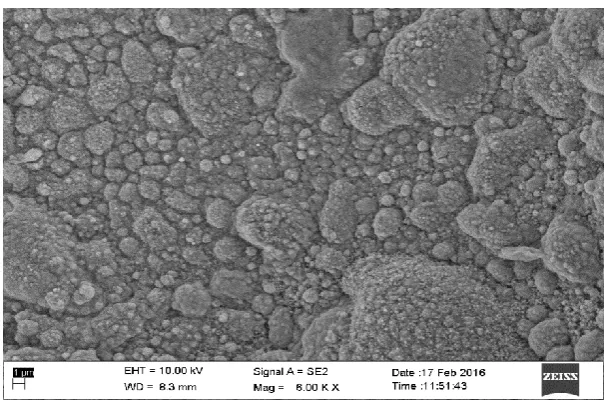
The microstructure was evaluated by FESEM analysis. Before the characterization all the samples were washed
with acetone. FESEM images were taken at 6KX on the top surface. The top surface was examined for the
presence of pores, cracks and impurities. The Titanium particles having an irregular conical shape reached deep
down to the melt pool due to high density.
In the Fig. 1 it can be seen that a uniform clad on the substrate was achieved. As the power increased, the more
uniform cladding was obtained. No pores and crack were observed in the samples.
Fig. 1. FESEM image for power 140watt and scanning speed 180mm/min at the top surface.
IV. MICROHARDNES
Before the hardness test samples were polished on polishing machine to make its surface clearly visible during
testing. The microhardness of the laser cladding was measured using a vicker hardness machine under 0.5kg
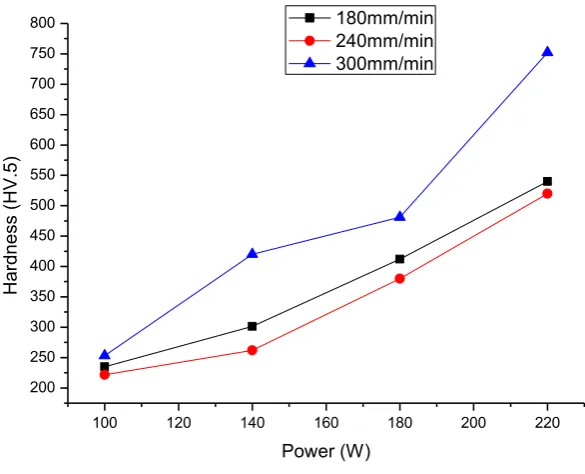
load for a dwell time of 10second. Substrate hardness was 121 HV at 0.5 load. The hardness was evaluated at
100 120 140 160 180 200 220 200 250 300 350 400 450 500 550 600 650 700 750 800 H ard ne ss (H V. 5) Power (W) 180mm/min 240mm/min 300mm/min
Fig. 2. Microhardness profile of the laser cladding for different process parameters.
The maximum hardness was found with the power of 220 watt with the speed of 300mm/min which was more
than seven times of the substrate hardness. As shown in the Fig. 2 given above as the power increases hardness
increases. It can be suggested that more heat input may cause the quenching process to take place, resulting in a
finer grain structure. Hardness value decreases with speed and then again increases.
V. CLAD THICKNESS ANALYSIS
The clad thickness was examined on optical microscope. It was seen that different thickness of clad was
observed at different scanning speed and power.
Fig. 3 given above shows that clad thickness is directly dependent on power. As the value of power increased
more amount of substrate melts and thickness of the clad increases. The successful cladding was observed in the
samples. Some non uniform cladding was observed, but the substrate clad interface was clearly visible. Non
uniform cladding was observed due to gas evolution while cladding. No visual pores were present in the clad
samples.
VI. WEAR RATE ANALYSIS
A ball on disc friction and wear test was performed to evaluate high temperature friction and wear behavior of
the laser cladding coating. The test was carried out at a normal load of 2kgf with a sliding speed of 300rpm for
duration 300sec. The wear rate of substrate was measured on mapping profile coupler. All the samples show
very good results. Some sample shows the little higher value. The wear rate of substrate was found to be
679.15µm as shown in Fig. 4. Fig. 5 shows the minimum value of wear 39.14µm, which is more than
seventeen times better than the wear of stainless steel substrate.
0 50 100 150 200 250 300
-100 0 100 200 300 400 500 600 700
W
ea
r
(mi
cro
me
te
r)
Time (sec)
Wear
0 50 100 150 200 250 300 0
10 20 30 40 50 60 70
W
ea
r
(mi
cro
me
te
r)
Time (sec)
Wear
Fig. 5. Variation in wear rate at for 300 sec at 300rpm under 2kgf load with power of 220w and
scanning speed 300mm/min.
VII. CONCLUSION
(1) Laser cladding applications include better wear resistance of diesel engine exhaust valves, gas turbine
blades and the repair of inserts and dies. The high-quality surface layers that can be generated by laser
cladding only, make it an excellent technique.
(2) It can be seen that the laser cladding of TiN results in cladding without any pores, crack and porosity. A
uniform clad layer is synthesized in most of the samples by selecting the optimum parameters which can
contribute to a satisfactory cladding.
(3) Most of the sample shows the excellent hardness which increases as the power increases. In this research
TiN cladding results in improving the wear resistance.
REFERENCES
[1] Shitang Zhang, jiansong Zhou, Baogang Guo, Huidi Zhou, Yuping Pu,Jianmin Chen, journal of alloys
and compound , 473(2009) 462-466.
[2] D.B. Lewis, S.R. Bradbury, M. Sarwar, Surf. Coat. Technol. 82 (1996) 187.
[3] S. Chatterjee, T.S. Sudarshan, S. Chandrashekhar, J. Mater. Sci. 27 (1992) 3409.
[4] WANG Y L, JIANG Z H, YAO Z P. Microstructure, bonding strength and thermal shock resistance of
[6] GAO Xue-song, TIAN Zong-jun, LIU Zhi-dong, SHEN Li-da, Interface characteristics of
Al2O3_13%TiO2 Aceramic coatings prepared by laser cladding, Trans. Nonferrous Met. Soc. China
22(2012) 2498_2503.
[7] ZHU C, LI P, JAVED A, An investigation on the microstructure and oxidation behavior of laser
remelted air plasma sprayed thermal barrier coatings, Surface & Coatings Technology, 206(18):
37393746.
[8] BAI PK, CHENG J, LIU B. Selective laser sintering of polymer-coated Al2O3/ZrO2/TiC ceramic
powder ,Transactions of Nonferrous Metals Society of China, 2005, 15(2): 261265.
[9] L.C. Lim, Laser cladding of nickel-based hardfacing alloys, Surfacez and Coatings Technology 106
(1998) 174–182.
[10] J.M. Yellup, Laser cladding using the powder blowing technique, Surf. Coat. Technol. 71 (1995) 121–
128.
[11] R. Vilar, Laser cladding, Int. J. Powder Metall, 37 (2001) 34–38.
[12] M. Cadenas et.al, Wear behaviour of laser clad NiCrBSi coating, Wear 259 (2005) 870–875.
[13] Y. Li, S. Wen, J. Ma, Laser induced deposition of ceramics on aluminium substrate, C-MRS
Symposium’96, November 17– 21, 1996, Chemical Industry Press, Beijing, 1997, pp. 736– 740.
[14] J. Mazumder, Laser-assisted surface coatings, in: K.E. Stern (Ed.), Metallurgical and Ceramic
Protective Coatings, Chapman and Hall, London, 1996, pp. 74–111.