152
EUDRAGIT A VERSATILE POLYMER : A REVIEW
Vikrant K Nikam*1, Kiran B Kotade2, Vinayak M Gaware3, Ramdas T Dolas1,
Kiran B Dhamak3, Sachin B Somwanshi1, Atul N Khadse3, Vivekanand A. Kashid1 1. Department of Pharmaceutics, College of Pharmacy Chincholi, Sinnar, Nashik, M.S,
422101.
2. Department of Pharmacology, College of Pharmacy Chincholi, Sinnar, Nashik, M.S, 422101.
3. Department of Pharmaceutical Chemistry, College of Pharmacy Chincholi, Sinnar, Nashik, M.S, 422101.
Corresponding author*:
Vikrant K. Nikam
Lecturer, Department of Pharmaceutics,
College of Pharmacy, Chincholi, Sinnar, Nashik, M.S (422101) E-mail: [email protected]
Summary
One would always like to have an ideal drug delivery system that will possess three main properties: (a) It will be a single dose for the whole duration of treatment. (b) It will deliver the active drug directly at the site of action. (c) It will possess possible fewer side effects. Above approaches are achieved with the help of suitable choice of polymer. This review focuses on recent literature regarding use of Eudragit polymer in different drug delivery systems with special attention to used in its fabrication along with their physiochemical properties.
Keywords: Eudragit, Gastroresistance, Glass transition, Polymer, Sustained release.
Introduction
153
History
Until the 1950s, all oral medication, even the most modern, had one big disadvantage: It was not possible to control the time or the release location of the active substances. The development of EUDRAGIT by Röhm & Haas GmbH in Darmstadt was the solution to this problem. When the first drugs came onto the market in a EUDRAGIT coating, a new chapter in pharmaceutical history had begun. EUDRAGIT products are special polymers with varying degrees of solubility. The Research department at Röhm made use of this property. The first drug coatings developed in 1953 were alkaline soluble and therefore resistant to stomach acids. The active substances were therefore not released in the stomach, but in the intestine, where they were to be activated. Variants of this kind of EUDRAGIT are still used to coat solid drugs taken orally, such as tablets, capsules or granules. The first enhancement to EUDRAGIT came at the end of the 1950s, when a pill coating that dissolves in stomach acid came onto the market. In the meantime, other variants of EUDRAGIT have become available, which can also control the time at which substances are released. These are called retard preparations, are resistant to stomach acid and continue to work throughout the intestinal tract, increasing considerably the efficiency of certain therapies and applications EUDRAGIT research and manufacturing are today part of the Chemicals BusinessArea of Evonik Industries AG. Production takes place at Darmstadt, Weiterstadtand Worms sites.5 Eudragit is trademark of Rohm GmbH & Co. KG. Darmstadt in Germany, first marketed in 1950s. Eudragit prepared by the polymerization of acrylic and methacrylic acids or their esters, e.g., butyl ester or dimethylaminoethyl ester. Eudragit introduced in USPNF, BP, PhEur, Hand book of pharmaceutical excipients6. The eudragit acrylic polymers have a long history of use, the individual types and grades being introduced in the following chronological order.
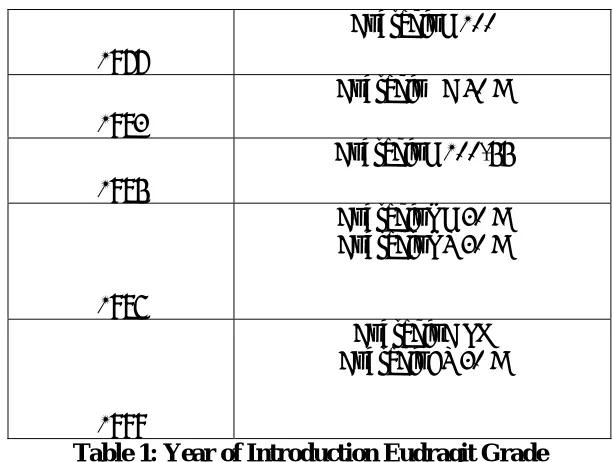
Year of Introduction
Eudragit Grade
1954
Eudragit L 12.5 Eudragit S 12.5
1959
Eudragit E 12.5
1961
Eudragit E 100
1968
Eudragit RL 100 Eudragit RS 100
1972
Eudragit NE 30 D (formerly Eudragit E 30 D) Eudragit L 30 D-55 (formerly
154 1977
Eudragit L 100
1983
Eudragit NE 40 D
1985
Eudragit L 100-55
1986
Eudragit RL 30 D Eudragit RS 30 D
1999
Eudragit E PO Eudragit FS 30 D
Table 1: Year of Introduction Eudragit Grade
EUDRAGIT POLYMERS – PHARMACEUTICAL PROPERTIES
155
Table 2: Properties of Eudragit Polymer
GASTRORESISTANCE AND GI TARGETING
If you need to protect your active from the gastric fluid and would like to improve drug effectiveness – EUDRAGIT® L and S polymers are your preferred choice of coating polymers. They enable targeting specific areas of the intestine. Pharma Polymers offers a broad product portfolio of anionic EUDRAGIT® grades which dissolve at rising pH values. In addition, the different grades can be combined with each other, making it possible to adjust the dissolution pH, and thus to achieve the required GI targeting for the drug. Targeted drug release in the colon is required for local treatment of intestinal disorders such as Crohn’s disease, ulcerative colitis or intestinal cancer. It is also required for drugs that are poorly soluble in the upper gastrointestinal tract. Moreover, the gastroresistance of the coating ensures that the oral dosage form is patient compliant. The preferred coating is EUDRAGIT® FS 30 D, which combines release in the colon with the following technical advantages:
• aqueous processing
• highly flexible coatings
• suitable for multiparticulate tablet preparation
• •
GLASS TRANSITION TEMPERATURE (TG)
The glass transition temperature is an important factor for describing the physical properties of polymers. On a macroscopic level it describes the solidification of an anisotropic polymer melt. The glass transition temperature has far-reaching consequences, e.g. for film formation, melt processing and storage of finished pharmaceutical dosage forms. Plasticizers, solvents or residual solvents (including water) that act as plasticizers usually cause a reduction in glass transition temperature, which is specifically exploited in application formulations. Most common plasticizer for EUDRAGIT polymers is triethyl citrate (TEC).
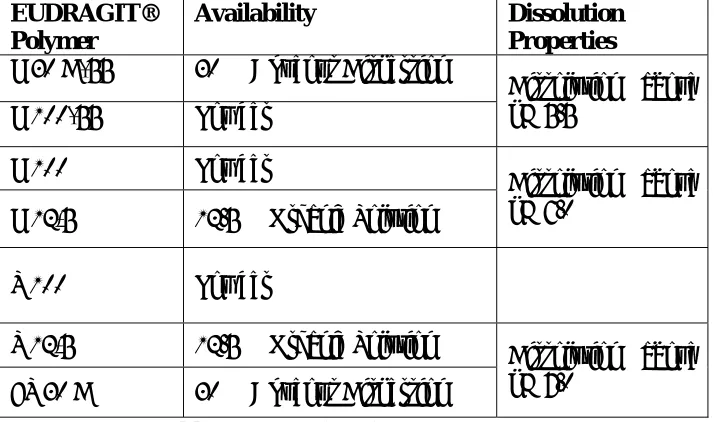
EUDRAGIT® Polymer
Availability Dissolution
Properties
L 30 D-55 30 % Aqueous Dispersion
L 100-55 Powder
Dissolution above pH 5.5
L 100 Powder
L 12,5 12.5 % Organic Solution
Dissolution above pH 6.0
S 100 Powder
S 12,5 12.5 % Organic Solution FS 30 D 30 % Aqueous Dispersion
156
Trade Name5 Solubility5 Description Applications5
Eudragit E 100 Soluble in gastric fluid- to
pH 5 Cationic, Yellow in Colour6 Film coating
Eudragit E 12.5 Soluble in gastric fluid- to pH 5
Cationic, Yellow in Colour6
Film coating
Eudragit NE 30 D Swellable, permeable Cationic, Yellow in Colour6
Sustained release
Eudragit L 100 Soluble in intestinal- fluid from pH 6
Anionic, white freeflowing
Powders6
Enteric coatings
Eudragit L 12.5 Soluble in intestinal- fluid
from pH 6 Anionic, white freeflowing Powders6
Enteric coatings
Eudragit L 12.5 P Soluble in intestinal- fluid from pH 6
Anionic, white freeflowing
Powders6
Enteric coatings
Eudragit L 30
D-55 Soluble in intestinal- fluid from pH 5.5 Anionic, white freeflowing Powders6
Enteric coatings
Eudragit L 100-55 Soluble in intestinal- fluid from pH 5.5
Anionic, white freeflowing
Powders6
Enteric coating
Eastacryl 30D Soluble in intestinal- fluid from pH 5.5
- Enteric coatings
Kollicoat MAE 30 D
Soluble in intestinal- fluid from pH 5.5
Anionic, Milky White, Low Viscosity7.
Enteric coatings
Kollicoat MAE 30 DP
Soluble in intestinal- fluid
from pH 5.5 - Enteric coatings
Eudragit S 100 Soluble in intestinal-fluid from pH 7
Anionic, white freeflowing
Powders6
Enteric coatings
Eudragit S 12.5 Soluble in intestinal-fluid from pH 7
Anionic, white freeflowing
Powders6
157 Eudragit S 12.5 P Soluble in intestinal- fluid
from pH 7
Anionic, white freeflowing
Powders6
Enteric coatings
Eudragit RL 100 High permeability Cationic,
nonbiodegradable8 Sustained release
Eudragit RL PO High permeability Cationic, nonbiodegradable8
Sustained release
Eudragit RL 30 D High permeability Cationic, nonbiodegradable8
Sustained release
Eudragit RL 12.5 High permeability Cationic, nonbiodegradable8
Sustained release Eudragit RS 100 Low permeability Cationic,
nonbiodegradable8
Sustained release
Eudragit RS PO Low permeability Cationic, nonbiodegradable8
Sustained release
Eudragit RS 30 D Low permeability Cationic, nonbiodegradable8
Sustained release
Eudragit RS 12.5 Low permeability Cationic,
nonbiodegradable8 Sustained release
158
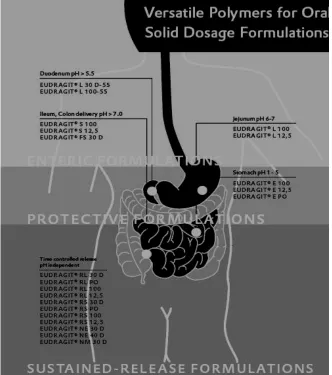
Fig 1: Different grades of Eudragit in oral solid dosage formulation
DRUG RELEASE MECHANISM
Oral preparation for controlled release can be sub divided in systems where drug release from the dosage form is governed by the following principles:
Dissolution Diffusion
Osmotic Pressure Ion-Exchange Other Principle8
• Dissolution
159
Fig 2: Dissolution • Diffusion
Diffusion is driving force where the movement of drug molecules occurs from high concentration in the tablet to lower concentration in gastro intestinal fluids. This movement depends on surface area exposed to gastric fluid, diffusion pathway, drug concentration gradient and diffusion coefficient of the system.
Fig 3: Diffusion release pattern
• Osmosis
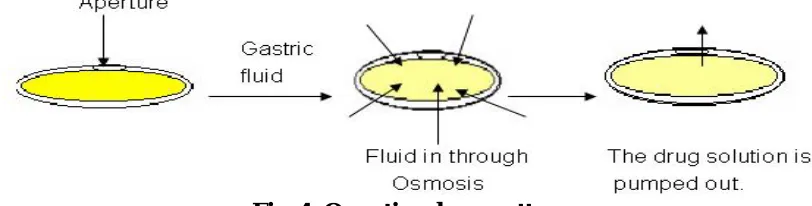
Osmosis is a phenomenon in which the flow of liquid occurs from lower concentration to higher concentration through a semi permeable membrane which allows transfer of liquid only. The whole drug is coated with a semi permeable membrane with a hole on one end of tablet made by a laser beam. The gastric fluid penetrates through the membrane, solubilizes the drug and increases the internal pressure which pumps the drug solution out of the aperture and releases the drug in gastric environment. The delivery rate is constant provided that the excess of drug present inside the tablet. But, it declines to zero once the concentration drops below saturation9.
Fig. 4: Osmotic release pattern
160 of defined thickness so as the portion of drug slowly diffuse through the polymer to maintain constant drug level in blood.
• Ion-Exchange
Ion exchangers are water insoluble resinous materials containing salt forming anionic or cationic groups. While manufacturing, the drug solution is mixed with resin and dried to form beads which are tableted. The drug release depends upon high concentration of charged ions in gastro intestinal tract where, the drug molecules are exchanged and diffused out of the resin into the surrounding fluid. This mechanism relies upon the ionic environment of resin and not pH or enzyme on absorption site. Dissolution controlled dosage forms can be divided into reservoir and matrix system. Reservoir principle is given by a controlled release formulation comprising 400mg 5-ASA within an acrylic resin coat, eudragit S10. Mechanism of drug release from pellets coated with polymer eudragit E 30 D, was governed by diffusion through water-filled pores in the film coat11. The release of propanolol HCL from a monolithic matrix (Eudragit NE 30 D) by a combination of diffusion through the polymer and pores or chanels12. A desirable release profile of diphenhydramine was achieved by incorporating Eudragit L in a carnauba wax matrix. The drug release from these polymer-wax matrices is described by a combination diffusion/erosion mechanism13. Eudragit RS PO release the carbamazepine drug by complex mixture of diffusion and erosion mechanism14
.
Eudragit RS 30 D-coated theophylline beads proved ion exchange to be the responsible mechanism of controlling polymer permeability as a function of anionic species and concentration16.
APPLICATIONS OF EUDRAGIT POLYMERS
• Ophthalmic Drug Delivery
A major problem being faced in ocular therapeutics is the attainment of an optimal concentration at the site of action. Poor bioavailability of drugs from ocular dosage forms is mainly due to the tear production, non-productive absorption, transient residence time, and impermeability of corneal epithelium. Eudragit exhibits favorable behavior, such as no toxicity, positive charge and controlled release profile this make them suitable for opthalic application15-19.
• Buccal and Sublingual Drug Delivery
The oral mucosae in general are some what leaky epithelia intermediate between that of the epidermis and intestinal mucosa. It is estimated that the permeability of the buccal mucosa is 4-4000 times greater than that of the skin20-21. In general, the permeabilities of the oral mucosae decrease in the order of sublingual greater than buccal, and buccal greater than palatal22. At physiological pH the mucus network carries a negative charge (due to the sialic acid and sulfate residues) which may play a role in mucoadhesion. At this pH mucus can form a strongly cohesive gel structure that will bind to the epithelial cell surface as a gelatinous layer23. Major limitation of the buccal route of administration is the lack of dosage
161 duration. To prevent discomfort, swelling of the film should not be too extensive. The mechanical, bioadhesive, and swelling properties of buccal films are critical and must be evaluated. Various mucoadhesive devices, including tablets, films, patches, disks, strips , ointments, and gels, have recently been developed 25--31. Eudragit providing good drug release barier with good adhesive strength.
• Gastrointestinal Drug Delivery
The need for gastroretentive dosage forms has led to extensive efforts in both academia and industry towards the development of such drug delivery systems. These efforts resulted in gastroretentive dosage forms that were designed, in large part, based on the following approaches,Low density form of the dosage form that causes buoyancy in gastric fluid, High density dosage form that is retained in the bottom of the stomach, Bioadhesion to stomach mucosa, Slowed motility of the gastrointestinal tract by concomitant administration of drugs or pharmaceutical excipients, Expansion by swelling or unfolding to a large size which limits emptying of the dosage form through the pyloric sphincter . All these techniques we can achieved with different grades of eudragit35.
• Intestinal Drug Delivery
Sustained intestine delivery of drugs was developed that could bypass the stomach and release the loaded drug for long periods into the intestine by coating of eudragit polymer. Eudragit L & Eudragit S are two forms of commercially available enteric acrylic resins. Both of them produce films resistant to gastric fluid. Eudragit L & S are soluble in intestinal fluid at pH 6 & 7 respectively. Eudragit L is available as an organic solution (Isopropanol), solid or aqueous dispersion. Eudragit S is available only as an organic solution (Isopropanol) and solid. Sodium para aminosalicylate Pellets were coated with Eudragit L 30 D-55 using fluidized bed processor and evaluated for in vitro dissolution behavior in 0.1 N HCl for two hours and then media was changed to phosphate buffer pH 6.8. A 60% w/w coating level of Eudragit L30 D 55 has produced the most acceptable results against the gastric attack36
• Colon Drug Delivery
Colonic drug delivery is a relatively recent approach for the treatment of diseases like ulcerative colitis, Crohn's disease, and irritable bowel syndrome. pH-sensitive polymers that dissolve, or above pH 7 used for colonic drug delivery37.Tegaserod maleate was used as a drug for irritable bowel syndrome, whereas Eudragit L 100 and S100 mixture (1:1, 1:2, and 1:3) were used39.
• Transdermal Drug Delivery
The mechanical properties of casted Eudragit E-100 films were tested for the combined effect of two cohesion promoters (succinic or citric acid) and triacetin as a plasticizer38. The prepared films were elastic, self-adhesive, transparent and pale yellow in colour. Eudragit E100 polymer was found to result in wrinkle-free transparent films with good adhesion to skin. Release kinetics from transdermal therapeutic system was observed due to erosion of hydrophilic Eudragit E100 polymer, and 100% release was observed within 20 minutes40.
• Vaginal Drug Delivery
162
• Gene Delivery
The course of many hereditary diseases could be reversed by gene delivery. In addition, many acquired diseases such as multigenetic disorders and those diseases caused by viral genes could be treated by genetic therapy43. Nanoparticles prepared by blending PLGA with methacrylate copolymer (Eudragit(R) E100) can efficiently and safely deliver plasmid DNA encoding mouse interleukin-10 leading to prevention of autoimmune diabetes44. New Anionic nanoparticles were prepared by Eudragit L100/55 provide a versatile platform for protein surface adsorption and a promising delivery system particularly when the maintenance of the biologically active conformation is required for vaccine efficacy. Antisense oligodeoxynucleotides were successfully delivered by nanoparticles prepared by Eudragit RL100, RS100.
• Vaccine Delivery
Anionic surfactant-free polymeric core-shell nanospheres and microspheres were prepared by Eudragit L100-55. Vaccines were administered by different routes, including intramuscular, subcutaneous or intranasal and the results were compared to immunization with Tat alone or with Tat delivered with the alum adjuvant. The data demonstrate that the nano and microspheres/Tat formulations are safe and induce robust and long-lasting cellular and humoral responses in mice after systemic and/or mucosal immunization45. Weight ratio of
Noveon and Eudragit S-100 had a significant effect on adhesion time of bilayer films. Postloaded plasmid DNA and beta-gal remained stable after being released from bilayer films (release of -60-80% in 2 h for both). Buccal immunization using novel bilayer films (109 +/- 6-microm thickness) containing plasmid DNA led to comparable antigen-specific IgG titer to that of subcutaneous protein injection. All rabbits immunized with plasmid DNA via the buccal route but none by the subcutaneous route with protein antigen demonstrated splenocyte proliferative immune responses.
CONCLUSION
The large variety of applications as well as the steadily increasing number of research workers engaged in studies of Eudragit polymers due to their unique properties, have made significant contributions to many types of formulations and suggest that the potential of Eudragit as novel and versatile polymer will be even more significant in future.
163 1. Sintze M.B., Bernatchez S. F., Tabatabay C. and Gurny R, Eur. J. Pharm. Biopharm,
1996, 42: 358– 374.
2. Nagai, T., Machida, Y., Pharm. Int. 1985, 6:196-200.
3. Bodde, H.E., De Vries, M.E., and Junginger, H.E., J. Control. Rel, 1990, 13:225-231. 4. Le Bourlais C. A., Treupel-Acar L., Rhodes C.T., Sado P. T., Leverge R., Drug Dev.
Ind. Pharm, 1995, 21: 19– 59.
5. Ray C. Rowe., Paul J. Sheskey., Paul J. Weller., Hand Book of Pharmaceutical excipients, 3rd ed., American Pharmaceutical Association Washington DC, USA & Pharmaceutical press, London U.K.
6. http://www.scribd.com/doc/5682786/Kollicoat-MAE-grades.
7. Jiao YY , Ubrich N, Hoffart V, Marchand-Arvier M, Vigneron C, Hoffman M, Maincent P., Drug Dev Ind Pharm. 2002, 28:1033-41.
8. Riley, S.A., Tavares, I.A., Bennett, A. Mani, V., Br. J. clin. Pharmac., 1988, 26: 173-177.
9. Gheber-Sellassie I., Gordon R.H., Nesbitt R.U. Fawzi M.B., Int. J. Pharm., 1987, 37 :211-218.
10.Bodmeier, R., Paeratakul O., Pharmaceutical Research. Res., 1989, 6: 725-730.
11.Hua-Pin Huang, Surendra C. Mehta , Galen W. Radebaugh, Mahdi B. Fawzi., J. Pharm. Sci., 2006, 83 :795 – 797.
12. Apurba Sarker Apu, Atiqul Haque Pathan, Dilashan Shrestha, Golam Kibria and Reza- ul Jalil., Trop. J. Pharm. Res., 2009, 8: 145-152.
13.Karl G. Wagner., James W. McGinity., J.Controlled Release, 2002, 82: 385-397. 14. Rosario Pignatello.,Claudio Bucolo., Piera Ferrara.,Adriana Maltese.,Antonina Puleo
and Giovanni Puglisi., Euro.J. Pharm. Sci. 2002,16: 53-61.
15. Duarte A.R ., Roy C., Vega-Gonzalez A, Duarte C.M., Subra-Paternault P., Int J Pharm. 2007, 332:132-9.
16. Pignatello R , Bucolo C, Puglisi G., J Pharm Sci. 2002, 91: 2636-41. 17. Khopade AJ , Jain NK., Pharmazie. 1995, 50: 812-4.
18.Bucolo C., Maltese A., Maugeri F., Busa B., Puglisi G., Pignatello R., J. Pharm. Pharmacol., 2004, 56: 841-846
19.Galey, W.R., Lonsdale, H.K., Nacht S., J. Invest. Dermat. 1976, 67: 713-717. 20.Harris D., Robinson J.R., J. Pharm. Sci., 1992, 81:1-10
21.Gandhi, R.E. and Robinson, J.R.., Ind. J. Pharm. Sci., 1988, 50:145-152.
22.Ch'ng, H.S., Park, H., Kelly, P., and Robinson, J.R.., J. Pharm. Sci., 1985, 74:399-405. 23.Ali J, Khar RK, Ahuja A.,Pharmazie. 1998, 53:329-334.
24.Kohda Y, Kobayashi H, Baba Y, et al., Int J. Pharm.1983,15:147-155.
25.Nair MK, Chien YW. Development., Drug Dev. Ind. Pharm. 1996, 22:243-253. 26. Chen WG, Hwang G., Int. J. Pharm. 1992,82:61-66.
27. Hango R, Kavimani S, Mullaicharam AR, Jayakar B., Ind. J. Pharm. Sci. 1997, 59:232-235.
28. Bremecker KD, Strempel H, Klein G., J. Pharm. Sci. 1984, 73:548-552. 29.Shin SC, Bum JP, Choi JS., Int. J. Pharm. 2000; 209:37-43.
30. Ashwini Madgulkar, Shivajirao Kadam, Varsha Pokharkar., Asian j. pharm, 2008; 2. 57-60.
31.Gloria Ruiz.Y., Evone S. Ghal.Y., Vitae., Revista De La Facultad De quimica Farmaceutica., 2006; 13. 31-39.
32. Mona Semalty, A Semalty, G Kumar., Ind. J. Pharm. sci. 2008; 70. 43-48. 33. R Garg., GD Gupta., Trop. J. Pharm. Res. , 2008; 7: 1055-1066.
164 36.Jain SK, Chourasia MK, Dengre R.,Ind. J. Pharm. Sci. 2005; 67:43-50.
37. D Nagasamy Venkatesh, Ajay Kumar Reddy, MK Samanta, B Suresh., Asian J. Pharm., 2009; 3: 50-53.
38. Dnyanesh Tipre, Dr. Pradeep Vavia., Drug del. Tech. 2002, 2:44
39.Degim IT , Tugcu-Demiroz F, Tamer-Ilbasmis S, Acarturk F., Drug Deliv. 2008 :4:259-65.
40. Małolepsza-Jarmołowska K , Kubis AA, Hirnle L., Pharmazie. 2003; 58(5): 334-6. 41. RC. Mulligan, Science.1993;260:926-932.
42. Basarkar A , Singh J., Pharm Res. 2009 ; 26(1):72-81. Epub 2008 Sep 9.
43. Voltan R , Castaldello A, Brocca-Cofano E, Altavilla G, Caputo A, Laus M, Sparnacci K, Ensoli B, Spaccasassi S, Ballestri M, Tondelli L., Pharm Res. 2007 ;24: 10:1870-82.
44.Wang WX , Chen HL, Liang WQ., Yao Xue Xue Bao. 2003 ;38:4:298-301.