REVIEW ON CLOUD COMPUTING DESIGN
CHALLENGES
Jyoti
1, Dr. Deepti Sharma
21
Student,
2Research Guide, JJT University, Jhunjhunu, Rajasthan, (India)
ABSTRACT
Now a days for complex and large data storage a powerful network architecture is used which is termed as
cloud computing. Cloud computing is independent of location customers can use resources from any device and
any time when they needed, they can use free or pay basis. In this paper we are describe concept and
architecture of cloud computing.
I. INTRODUCTION
In past few years, cloud computing spread all over the world as a new paradigm for giving some useful features like on demand infrastructure, SAAS and flexibility[1]. As the name suggests cloud computing is a technology by which information exchange and software management done by virtual means, like in any programming language.
It is on demand computing for everyone with access to cloud. It offers large amount of it services which ranging from software to storage to security, which can make available at anytime, anywhere and from any device which is connected to the cloud or we can say that it is on demand access to computing resources like network, storage, application and such services which are developed and made available by cloud provider with less management[2]. Here basically the world cloud does not means only internet, cloud may be public private or hybrid.
II. ARCHITECTURE OF CLOUD COMPUTING
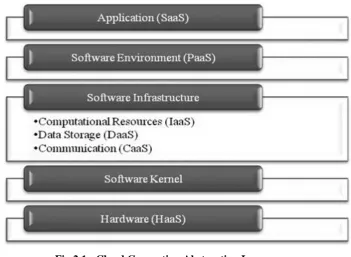
To understand the cloud computing we have to study its abstraction layers starting at the bottom and working higher layers[3,4]. The bottom layer is physical hardware layer, it is cloud provider owned server which act as backbone. This layer are used by big corporations who need large amount of underlease hardware as a service (HaaS) [5]. Cloud provider upgrade its underleased hardware time to time so that they can overcome some issues like efficiency any easy allocation of HaaS for their customers. These issues are also solved by remote scriptable remote boot- loader. It is a set of stack software that can be implemented remotely data centre servers.
Second layer is cloud software kernel it is bridge between cloud hardware layer and software infrastructure layer. It is abstraction’s lower level [6]. It is implanted by cloud ‘s software. When other programs are running, server’s hardware resources are maintained by this layer.
Third layer is software infra structure it includes services such as computational resources, data storage and communication. Customers can use computational resources in form of virtual machines.
Fig 2.1 : Cloud Computing Abstraction Layers
III. STRATEGIES TO MANAGE MULTIPLE CLOUDS
Multiple clouds may be consisting of combination of public clouds or it may be combination of public and private clouds to make hybrid cloud [11]. There are many strategies which include inter cloud protocol and cloud federation method. Inter cloud protocol consist of:
Fig:2.2 Inter Cloud Protocol Layer
They have some issues regarded quality of service, storage space, monitoring [12,13]. for standardization cloud have some specific elements for example format of virtual images to achieve interoperability enhanced standard are used. the main building block for resource management are abstract computational resource[17,18]. To identify each computational resource a set of operations are defined such as identified, started, stopped, or query of resource manager. To view, modify and checked that how much recourses are used by them, the resource manager interact with IT employees [19]. The data given by IT services by different clouds provider the resource manager map the resource of connected clouds from a genric and take out and map each resource computation [20]. When a resource is mapped the cloud provider uses the same mapping scheme and use another cloud ported by the resource manager to make genric computation resource representation [24]. By this representation of resources, we can find out each available resource from resource managers algorithm, the power utilized at the time of processing. Then we can initialize or stop resources so that we can maximize cloud resources available for company under his target budget.
Dodda, Mooorse, Smith observed such example of hybrid cloud resource [25]. They manage their cloud management in Amazon EC2 by query and by use of a interface named representational state transfer to manage its own cloud [26]. To manage the working of resource manager query interface of EC2 use a query string in URL.A defined set of parameters and its value which are include in query string are given by Amazon [27]. The cloud manager then sent these Query strings to URL if any operation want to called out these they can called out by HTTP GET .The resource manager can manipulate EC2 interface and mapped to a generic interface. The soap interface operations are same when it uses the Query interface the HTTP GET sent to perform operations of cloud management. But the parameters of both the interfaces are different for each operation [27].
REFERENCES
[1] B. ROCHWERGER, D. BREITGAND, E. LEVY, A. GALIS, K. NAGIN, I. M. LLORENTE, R. MONTERO, Y. WOLFSTHAL, E. ELMROTH, J. CACERES, M.BENYEHUDA, W. EMMERICH, F.
Actual physical layer Physical metaphor layer Platform metaphor layer Communication layer
[2] G. GRUMAN, E. KNORR, What cloud computing really means. InfoWorld, (2009, May). [Online]. Available: http://www.infoworld.com/d/cloudcomputing/ what-cloud-computing-reallymeans-031
[3] L. SIEGELE, Let it rise: A survey of corporate IT. The Economist, (Oct., 2008).
[4] P. WATSON, P. LORD, F. GIBSON, Panayiotis Periorellis, and Georgios Pitsilis. Cloud computing for e-science with carmen, (2008), pp. 1–5.
[5] R. M. SAVOLA, A. JUHOLA, I. UUSITALO, Towards wider cloud service applicability by security,privacy and trust measurements. International Conference on Application of Information and Communication Technologies (AICT), (Oct., 2010), pp. 1–6.
[6] M.-E. BEGIN, An egee comparative study: Grids and clouds – evolution or revolution. EGEE III project Report, vol. 30 (2008).
[7] L. M. VAQUERO, L. RODERO-MERINO, J. CACERES, M. LINDNER, A break in the clouds: towards a cloud definition. SIGCOMM Comput. Commun. Rev., 39, 1 (December 2008).
[8] OPENQRM. [Online]: http://www.openqrm.com
[9] AMAZON ELASTIC COMPUTE CLOUD (AMAZON EC2) [Online]. Available: http://aws.amazon.com/ec2/
[10] L. WANG, G. VON LASZEWSKI, A. YOUNGE, X. HE, M. KUNZE, J.TAO, C. FU, Cloud Computing: A Perspective Study. NewGenerationComputing, vol. 28, no. 2 (2010), pp. 137–146.
[11] J. MURTY, Programing Amazon Web Services: S3, EC2, SQS, FPS, and SimpleDB, O’Reilly Media, 2008.
[12] E. CIURANA, Developing with Google App Engine, Spring, 2010.
[13] C. D.WEISSMAN, S.BOBROWSKI, The design of the force.com multitenant internet application development platform. In Proceedings of the 35th SIGMOD international conference on Management of data, (SIGMOD ’09), (2009) pp. 889–896.
[14] R. T. DODDA, A. MOORSEL, C. SMITH, An Architecture for Cross-Cloud System Management, unpublished.
[15] H. CHEN, G. JIANG, A. SAXENA, K. YOSHIHIRA, H. ZHANG, Intelligent Workload Factoring for A Hybrid Cloud ComputingModel, unpublished.
[16] M. M. HASSAN, E. HUH, B. SONG, A Framework of Sensor – Cloud Integration Opportunities and Challenges. Presented at the International Conference on Ubiquitous Information Management and Communication (ICUIMC), (January 15-16, 2009), Suwon, South Korea.
[17] D. BERNSTEIN, E. LUDVIGSON, K. SANKAR, S. DIAMOND, M.MORROW, Blueprint for the Intercloud – Protocols and Formats for Cloud Computing Interoperability. In Proceedings of the 2009 Fourth International Conference on Internet and Web Applications and Services (ICIW ’09). Washington, DC, USA, pp. 328–336.
[18] J. POWELL, Cloud computing – what is it and what does it mean for education?, unpublished. [19] SERVER VIRTUALIZATION FAQ(online) available :http://www.itmanagement.com
[21] A. LENK, M. KLEMS, J. NIMIS, T. SANDHOLM, What’s inside the Cloud? An architectural map of the Cloud landscape. ICSE Workshop on Software Engineering Challenges of Cloud Computing, (2009), pp. 23–31.
[22] GIDEON SAMID SCHOOL OF ENGINEERING CASE WESTERN RESERVE UNIVERSITY, Encryption-On- Demand: Practical and Theoretical Considerations, 2008.
[23] FEI, MEIKANG QUI, JIAYIN LI, TRAVIS GRANT, DRAW TYLOR, SETH MCCALEB, LEE BUTLER AND RICHARD HAMNER, A review on cloud computing: design challenges in architecture and security, Journal of Computing and Information Technology - CIT 19, 2011, 1, 25–55
[24] E. Y. CHEN, M. ITOH, Virtual smartphone over IP. In Proceedings of IEEE International Symposium on A World of Wireless, Mobile and Multimedia Networks, (2010), pp. 1–6.
[25] B. SOTOMAYOR, R. MONTERO, I. LLORENTE, I. FOSTER, Resource Leasing and the Art of Suspending VirtualMachines. In IEEE InternationalConference on High Performance Computing and Communications (HPCC09), (June 2009), pp. 59–68.
[26] K. KEAHEY, T. FREEMAN, Contextualization: Providing One-Click Virtual Clusters. IEEE International Conference on eScience, (2008), pp. 301– 308.