IJEDR1704147
International Journal of Engineering Development and Research (
www.ijedr.org
)
902
Comparative Analysis of IEEE 802.15.4 Mobile
ZigBee Networks with Stationary ZigBee
1Anchal Nayyar, 2Rajesh Kochher 1Dept. of Computer Science &Engineering
2Dept. of Information Technology
DAV institute of Engineering and Technology, Jalandhar,India
________________________________________________________________________________________________________
Abstract: To provide efficient network access with overall geographical area control of sensor nodes in WSN deprived of distraction of services in aggregation with optimal Quality of Service, the ZigBee nodes mobility is the foremost requirement in current era of highly dependent WSN world. The mobility in ZigBee networks persuaded link failures, which are required to overwhelmed significantly in WSNs. This research work reported in this paper is an effort to reveal the inclusive inspection to regulate the effect of mobility of mobile ZigBee nodes over the performance of IEEE 802.15.4 ZigBee Networks, not reported in aforementioned efforts. The research efforts are performed using ZigBee Network along with DCF-MAC standard execution under diverse network load by dint of OPNET Modeler.
Keywords: IEEE 802.15.4 ZigBee Networks, Mobility, QoS.
_______________________________________________________________________________________________________
INTRODUCTION
Technical progression & rivalry among mobile operative companies increases the growth of wireless equipment like mobile phones and mobile WSN networks, results in increased growth of mobile gadgets nearly to 2500 million in 2015 and is prophesied this evolution will endure to increase swiftly 5000 million on 2020 [1]. The wireless automation infrastructure started to connect sensors and actuators of commercial products a few years ago. ZigBee is one of the leading technologies, developed in 2003, provides the functionalities expected for a Wireless Sensor and Actuator Network (WSAN). Point-to-point connections, as well as star networks can be built using ZigBee [2]. The routing capabilities are the main feature of ZigBee, thus, can also be used to build mesh networks. Whenever WSANs are used in automation, they are expected to reliably provide their functionality. However, most of the wireless protocols in this context are based on indeterministic media access mechanisms [3]. This can lead to sudden system failures. Due to this unintended behavior, a new approach for predicting WSANs’ message transfer is required. In the past decades, wireless communications have promoted the development of protocol standardizing. ZigBee protocol has been proposed in order to meet the needs of long lifetime, low cost and low data rate in short range sensing network which is known as Wireless Sensor Network (WSN) based on the IEEE 802.15.4 [4].
IJEDR1704147
International Journal of Engineering Development and Research (
www.ijedr.org
)
903
Figure1: ZigBee Network Topology [10]The ZigBee network has deficiency of QoS as their short range, less data rate and absence of mobility in ZigBee nodes. Many researchers working on retrieving the identical ZigBee Coordinating stations, which causes network congestions, and it is very hard to maintain high QoS. Thus, degrade the overall performance of the ZigBee network. So, in this research paper, we work on Mobile ZigBee networks and to improve traffic congestion in mobile Zigbee networks [11]. Mobile ZigBee has a Mandatory handoff that contributes to the overall end-to-end communication delay, so proper routing mechanism should have to be chosen for proper traffic management and data delivery in ZigBee networks [12]. By working on mobile ZigBee networks under adhoc routing performance of the network may be improved extremely, which is not recorded in previous work. Accurate routing in mobile Zigbee networks is very hard because at the cell boundary mobile terminal experiences signal from serving ZigBee coordinator as well as from neighboring coordinator [13]. In this situation mobile terminal fluctuates between ZigBee coordinators due to which unnecessary handoff occur and loss of ZigBee traffic.
SIMULATION SETUP
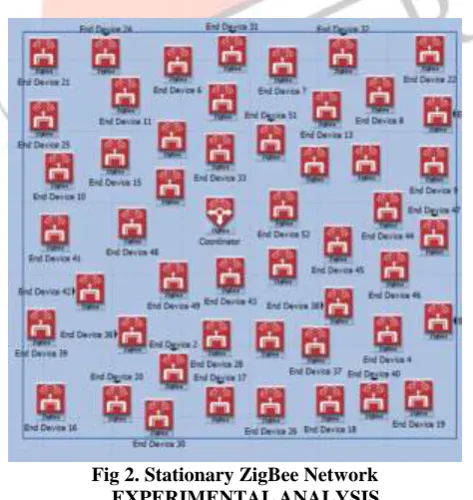
The basic network model consists of a 50 ZigBee End Devices communicating with in the network using a coordinator. Two identical networks were made for Stationary and Mobile ZigBee Network. Figure 2 & 3 shows the Stationary and mobile ZigBee Network models respectively. The majority of the nodes have been configured with Random traffic; where nodes are configured as to send explicitly multimedia (video) information to the coordinator node for both networks as in present scenario maximum WSN network are working on multimedia applications [14]. The PAN in the mobile network is configure with a mobility of uniform 0.6-1 m/s as shown in figure 2 using Random Waypoint mobility. Routing scenario in both networks are constructed in form of Mesh Network. After mesh routes establishment, network traffic routes to smallest probable path to the coordinator in the simulation as a relay as shown in figure 3.
Fig 2. Stationary ZigBee Network
EXPERIMENTALANALYSIS
IJEDR1704147
International Journal of Engineering Development and Research (
www.ijedr.org
)
904
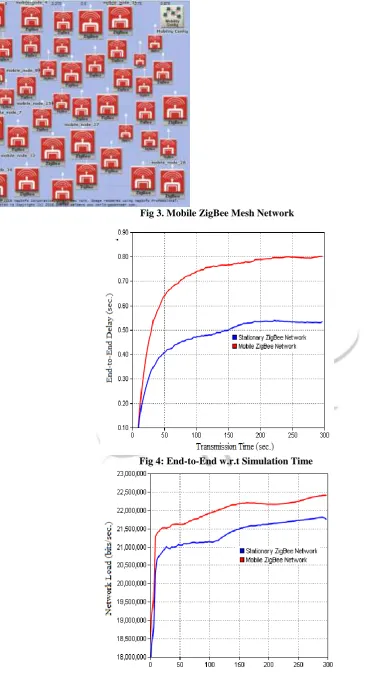
From the graph, it is clear that mobile network has maximum End-to-End Delays (nearly 0.69 sec.) as compare to Mesh networks (0.48 sec.).Fig 3. Mobile ZigBee Mesh Network
Fig 4: End-to-End w.r.t Simulation Time
IJEDR1704147
International Journal of Engineering Development and Research (
www.ijedr.org
)
905
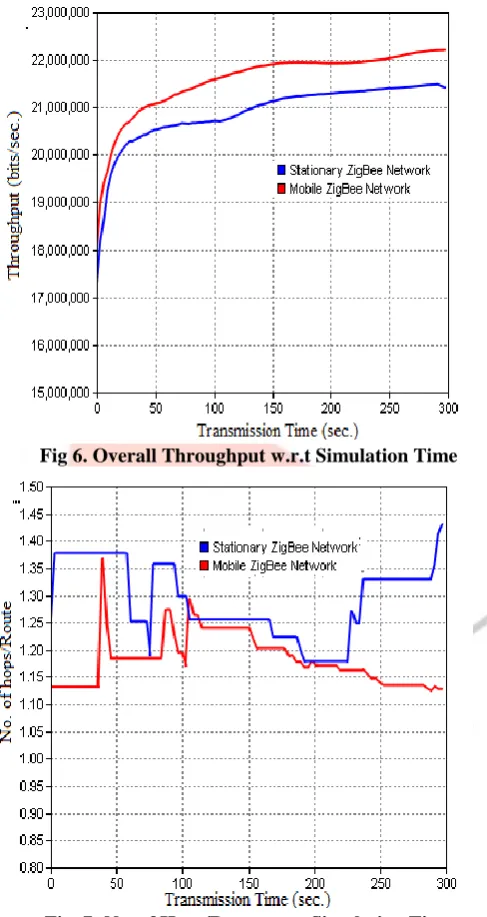
The extra delays in mobile topology are usually caused by connection loss between end device and coordination due to the mobility of mobile nodes. Further connection interruption results in beacons loss to other ZigBee nodes that emit them queue route request messages before transmitting them which adds an extra delay [19]. ZigBee network Load is defined as the load(bits/sec) acquiesced to IEEE 802.15.4 Medium Access Layer through all upper layers of Wireless Personal Area Network stations of the simulated system [17]. Diagram 5 shows the comparative graph for overall Network Load w.r.t simulation time in both routing schemes.Fig 6. Overall Throughput w.r.t Simulation Time
Fig. 7: No. of Hops/Route w.r.t Simulation Time
It has been observed from graph that the network traffic load is minimum in mobile ZigBee topology (nearly 21413.04 Kbits/sec.) is more as compare to stationary ZigBee Network (nearly 20795.88 Kbits/sec.) the higher network load in case of mobile ZigBee network is due to the reason that the interlinks within the itinerant ZigBee stations vary very fast, which results in recurrent changes in stations of Mobile ZigBee Network, resulting in frequent disparity of ZigBee setup results in network load on higher side [18]. Figure 6 describes Throughput comparison of ZigBee networks, depicts the total bits collected at receiver transport layer, which imitates the comprehensiveness and exactness of routing algorithm [15]. It has been observed from the graph that the Mobile ZigBee network scheme delivered higher throughput (21062.99) than the stationary ZigBee network (20390.74). Throughput is maximum in case of mobile topology as the nodes gets evenly clustered around the coordinator, which results in lesser collisions and lesser packet drops and maximum throughput in case of mobile topology [19]. It is worth to note that even traffic distribution can be seen by lesser no. of hops/route as in case of mobile ZigBee networks as shown in figure 7. Figure 6 depicts the stationary network uses only 1.29 hops/route on average as compare to mobile networks which use 1.18 hops/route, which results in lower throughput in case of stationary ZigBee topology.
Table 3: QoS parametric Comparison between Mesh & Tree ZigBee Networks
Network Size
Stationary ZigBee Network
IJEDR1704147
International Journal of Engineering Development and Research (
www.ijedr.org
)
906
End-to-EndDelay (sec.)
0.461 0.693
Throughput
(Kbits/sec.) 20390.74 21062.99
Overall Network
load (Kbits/sec.)
20795.88 21413.04
No. of hops/rou
te
1.29 1.18
CONCLUSION
We analyze the performance of mobile ZigBee Network with stationary ZigBee network schemes. From the simulation results, it is concluded that the node mobility in ZigBee networks result in more delays and system load due to the reason that the node connections of mobile ZigBee nodes changes very fast, due to the fast-varying ZigBee stations in the mobile ZigBee systems, which results route failures. Though results are in terms of throughput and Hops/Route gets better with mobility as nodes gets evenly distributed over the entire network, which makes end nodes easier to communicate with coordinator.
REFERENCES
[1] Perkin C., Bhagwat P., “Highly Dynamic Destination Sequenced Distance Vector Routing for mobile computers”, ACM
SIGCOMM, computer communication review, vol. 24, issue 4, pp. 234-244, 1994.
[2] Hushaidan W., Qatawneh A., Sliet A., Qatawneh M., “ A cluster-Based Approach for supporting QoS in Mobile Ad Hoc Networks”, International Journal of Digital Content Technology and its Applications(JDCTA), vol. 5, no. 1, 2011.
[3] “802.15.4- IEEE Standard for Information Technology -Telecommunications and Information Exchange between Systems -
Local and Metropolitan Area Networks Specific Requirements Part 15.4: Wireless Medium Access Control (MAC) and Physical Layer (PHY) Specifications for Low-Rate Wireless Personal Area Networks (LR-WPANs),” IEEE Computer Society, 2009.
[4] ZigBee Alliance -ZigBee Specification, 2009.
[5] Harminder kaur, Harsukhpreet Singh, Anurag Sharma,“Geographic Routing Protocol: A Review,” International Journal of
Grid & Distributed Computing, vol.9, issue 3, pp.254-256,2015.
[6] Elizabeth M., Toh C., “A Review of Current Routing Protocols for Ad Hoc Mobile Wireless Networks”, pp. 1-22, Ad Hoc
Networks 2, 2004.
[7] Perkins C., Royer E. B., Das S., “Ad hoc On-Demand Distance Vector (AODV) Routing - Internet Draft,” IETF Network
Working Group, RFC 3561, pp.1-38, 2003.
[8] Harsukhpreet Singh, Vishal Sharma, Shashi Kant, “Challenges in VANET and its Routing- An Analysis,” Proceedings of
ACEEE, International Conference on Advances in Communication andComputing, DOI 03.LSCS.2013.1.515, vol. 1, pp. 48-51, 2013.
[9] Wang L., Shu Y., Dong M., Zhang L., Yang W., “Adaptive Multipath Source Routing in Ad Hoc Networks”, IEEE
International Conference on Communications, ICC-2001, 2001.
[10] Camp T., Boleng J., Davies V. “A Survey of Mobility Models for Wireless Network Research,” Wireless Communication & Mobile Computing (WCMC): vol. 2, no. 5, pp. 483-502, 2002.
[11] Perkins C., Royer E., Das R. , “Performance Comparison of Routing Protocols for Wireless Sensor Networks,” pp. 16- 28,
IEEE Personal Communications, 2001.
[12] IETF MANET Working Group, Mobile Ad Hoc Networks (MANET). Working Group charter, available: http://www.ietf.org/html.charters/manet-charter.html.
[13] Wang L., Shu Y., Dong M., Zhang L., Yang W., “Adaptive Multipath Source Routing in Ad Hoc Networks”, IEEE
International Conference on Communications, ICC-2001, 2001.
[14] Suresh A., “Performance Analysis of Ad Hoc On-demand Distance Vector Routing(AODV) Using OPTNET Simulator”
University of Bremen- 11, 2005.
[15] Vishal Sharma, Jagjit Malhotra, Harsukhpreet Singh, “Quality of Service (QoS) Evaluation of IEEE 802.11 WLAN using
Different PHY-Layer Standards,” OPTIK, Elsevier, DOI 10.1016/j.ijleo.2011.12.009, ISSN 0030-4026, Vol. 124, 2013, pp. 357-360.
[16] Perkins C., Royer E., Das R. , “Performance Comparison of Two On-Demand Routing Protocols for Ad Hoc Networks,” pp.
16- 28, IEEE Personal Communications, 2001.
[17] Mu-Sheng L., Jenq-Shiou L., Wen-Chi Y., Min-Chieh Y., Wu J., “On transmission efficiency of the multimedia service over IEEE 802.15.4 wireless sensor networks, Proc. of IEEE, ICACT, pp. 184-189, 2011.
[18] Pan S., Tseng C., “ZigBee-based long-thin wireless sensor networks: address assignment and routing schemes,” Int. J. Ad
Hoc and Ubiquitous Computing, Vol. 12, No. 3, 2013.
[19] Singh P., Kumar M., Jaiswal K., Saxena R., “Analysis of ZigBee (IEEE 802.15.4 standard) for Star Topology with AODV