Success in Two Languages: An Analysis of the Passing Rate of Texas Bilingual Teachers
Lynn S. Freeman (School of Education and Human Development, University of Houston-Victoria University of Houston System at Cinco Ranch)
Hsin-Hui Lin (School of Education and Human Development, University of Houston-Victoria University of Houston System at Cinco Ranch)
Ling-Ling Tsao
(School of Family and Consumer Sciences, University of Idaho)
International Journal of Asian Social Science, 2(5), pp.697-703
697 Author (s)
Lynn S. Freeman, Ed. D School of Education and Human Development, University of Houston-Victoria University of Houston System at Cinco Ranch
E-Mail.: [email protected]
Hsin-Hui Lin, Ph. D School of Education and Human Development, University of Houston-Victoria
University of Houston System at Cinco Ranch
E-mail: [email protected]
Ling-Ling Tsao, Ph. D School of Family and Consumer Sciences, University of Idaho
E-mail: [email protected]
Success in Two Languages: An Analysis of the Passing Rate of Texas Bilingual Teachers
Abstract
This study analyzed the competency of bilingual teachers as it pertains to the passage of the TExEs Content Exam. Texas is in a state of transition; not only are its’ certification requirements changing, from EC-4 to EC-6, but its’ population continues to change, creating an increasingly diverse student body. There are multiple issues that educators and teacher certification entities must address, among them: to continue to identify and implement strategies to educate a very heterogeneous k-12 population of students, and how to prepare teachers to face these challenges. This study represents one of the last comprehensive analyses of teacher success under the former TEA certification guidelines. It can therefore serve as a basis of comparison for the passing rates of teachers in the fall of 2010 and beyond, when the state phases out previous bilingual and supplemental exams EC-4 and 4-8 exams, and offers the TExES Bilingual Education Supplemental Exam (164) and the TExES Bilingual Generalist Exam (192). With the accountability standards imposed by NCLB, the “highly qualified” teachers are determined by the results of standardized tests. The results of this study may guide policy makers when seek solutions to improve school bilingual teacher preparation by determining the areas in which effort and support is most needed.
Key Words: Standardized Testing; Teacher Education Programs; Texes Exams; State Certification; English As Second Language Teacher
Jel Codes: C11, J12
Introduction
There is a growing population of children in the United States whose first language is not English. Many early childhood professionals who have taught English Language Learners (ELLs) know that special accommodations must be made to provide an appropriate language environment (Lake & Pappamihiel, 2003). In 2000, 16% of all children in pre-kindergarten were children of immigrants, but only 2% were foreign-born. Fifty-three percent of the children of immigrants were Latino, and 18% were Asian-American (Capps, Fix, Murray, Ost, Passel, Herwantoro, 2005). It was projected that by the year 2010, more than 30% of all school-aged children will come from a home where the primary language is not English (NAEYC, 2005). There are still proponents of the “immersion method” of
learning, in which a student is immersed in the classroom to learn both the English and the content matter without adjustment in teaching strategies or initial expectations. The acknowledgement of the success rates of students who are able to learn in both their primary languages and English was an integral factor in the creation of bilingual education. The preparation of bilingual teachers is therefore an important factor in the education and socialization of a growing population of students.
698 emotional relationships with peers and adults in
the classrooms.
Research indicates that a student’s teacher influences student achievement more than class size and class composition (Darling-Hammond, 2004, Rivkin, Hanushek, & Kain, 2000; Sanders & Rivers, 1996; Wright, Horn, & Sanders, 1997). Research conducted by Chang et al. (2007) discussed the correlation between the increased teacher - child language interactions in Spanish with the increased teacher ratings of children’s peer social skills and assertiveness. Spanish- speaking children with teachers who spoke some Spanish in the classroom were rated by their teachers as having better social skills and closer relationships with their teachers than children whose teachers did not speak Spanish in the classroom.
The researchers believed that the reasons why Spanish speaking children who experienced more Spanish language interactions in the classrooms are rated higher in peer social skills and assertiveness by their teachers might be (1) the teacher’s own perceptions of that child may change when he/she interacts with children in his/her home language, and (2) the inclusion of ELL home language in the classroom may increase children’s social status among peers and create more opportunities for learning by peer interactions (Chang, et al., 2007).
In spite of the fact that the student population in Texas is increasingly diverse, the teaching profession is predominately non-Hispanic, Anglo-American females. Research has suggested that teachers are generally more effective with students with whom they share backgrounds and characteristics. Teachers who had diverse backgrounds in culture and language tended to teach more ethnically heterogeneous and linguistically diverse students (Green, Tran, & Young, 2005). The increasing number of Hispanic students in Texas indicates the need for more bilingual teachers. Given the importance of certified teachers in education, it is appropriate to examine the requirements for becoming a
A person must have a bachelor’s degree from an accredited college or university.
The only exemption from the degree requirement is for individuals seeking Career and Technology certification to teach Vocational courses such as welding.
A person must complete teacher training through an approved program. These programs are offered through colleges and universities, school districts, regional service centers, community colleges, and other entities.
A person must successfully complete the appropriate tests for the subject and grade level for which certification is sought. These two tests are the TExES Content Exam, which tests the knowledge of the content area being taught, and the Pedagogy and Professional Responsibility (PPR), which tests the candidate’s knowledge of such competencies as classroom management and knowledge of legal issues.
When school districts hires teachers who have not completed all the requirements listed above, these non-certified teachers would be allowed to use probationary certification and teach in the area in which they are seeking certification. (SBEC, 2009b)
Purpose of the Study
International Journal of Asian Social Science, 2(5), pp.697-703
699 content areas teachers do well and in which
areas they need additional support. Analyzing these certification exams provide the overlapping information for fifth and sixth grades, which are the grades which the new certification standards will include with Early Childhood. An examination of the present status of the pass/fail ratio on the TExES Generalist exams may enable teacher certification entities to better prepare candidates to pass the TExES EC-6 Generalist exams.
Research Questions
In order to examine the present status of the pass/fail rate of teachers taking the TExES Bilingual Education Supplemental EC-4, Bilingual Generalist EC-4, Bilingual Education Supplemental 4-8, and Bilingual Generalist 4-8, the following research questions were posed:
What were the passing rates of the
TExES Bilingual Education
Supplemental EC-4 exam of teachers? What were the passing rates of the
TExES Bilingual Generalist EC-4 exam of teachers?
What were the passing rates of the
TExES Bilingual Education
Supplemental 4-8 exam of teachers? What were the passing rates of the
TExES Bilingual Generalist 4-8 exam of teachers?
What were the numbers of the attempt that the teachers made to pass the
TExES Bilingual Education
certification exams? Methodology
This study investigates the TExES test scores during a four and one-half year period. Data for this study was obtained from Texas State Teacher Certification test records, which were posted on websites broadcasted on the ABC news network (ABC 13, 2007) in Houston and KDFW Fox News in Dallas (KDFW, 2007) in 2007. By accessing these websites, the authors were able to obtain the TExES scores and numbers of testing attempts of all teachers who took the TExES test in 82 school districts throughout the state. This study utilized the testing records to investigate the teachers’ test results in the content areas of Bilingual
Education Supplemental EC-4, Bilingual Generalist EC-4, Bilingual Education Supplemental 4-8, and Bilingual Generalist 4-8 (Texas Education Agency, 2007).
Data file
The original data included last name, first name, middle name, the district where the individual worked, position held within the district (such as teacher), test description (such as Bilingual Education Supplemental EC-4, Bilingual Generalist EC-4, Bilingual Education Supplemental 8, and Bilingual Generalist 4-8), test date, test results (passed or failed), and test scores. At each attempt an individual took the test, (s)he would have one line of data in the spreadsheet. If a person took a test five times, (s)he would have each testing encounter recorded on a separate line, for a total of five lines.
The testing records obtained from the websites were pdf files. The researchers used pdf software - professional version to convert the file form pdf format to Excel files. Then, Microsoft Access software was used to develop an identification number for each individual. Using the ID, the researchers were able to build a relational database to prepare the data files for further statistical analyses.
Independent variables
There were two independent variables; certification test and test group. Certification tests included Bilingual Education Supplemental EC-4, Bilingual Generalist EC-4, Bilingual Education Supplemental 4-8, and Bilingual Generalist 4-8. Three test groups were created based on the results of the individual’s most recent test performance on the each certification exam.
“Passed” is the group of people who took the certification exam and were able to pass at their first attempts. “Failed/Passed” is the group of
people who took the certification exam and have failed at least one attempt, before they finally passed the exams. “Failed” is the group of people who
700 the dependent variable.
Analyses
All the statistical analyses were conducted by using Statistical Package for Social Science (SPSS 16.0) for Windows. Descriptive analyses, chi-square test, and ANOVA test were conducted for studying the research questions. Chi-square test was conducted to test the independent distribution among the three test groups within each certification exam. A two-way ANOVA model was applied to the two main effects (certification test and test group), and the interaction effect (certification test x test group) on the attempts of taking certification exams.
Results
Table 1 indicated the descriptive analyses of elementary and middle Teachers’ TExES bilingual education exam results. Four hundred and forty-eight individuals took the Bilingual Education Supplemental EC-4 certification exam. There were 2,524 individuals took Bilingual Generalist EC-4 certification exam. Ninety-eight people took Bilingual Education Supplemental 4-8 certification exam. Two hundred and six individuals took Bilingual Generalist 4-8 certification exam.
The distributions among the three test groups; passed, failed/passed, and failed in each certification test were listed as below.
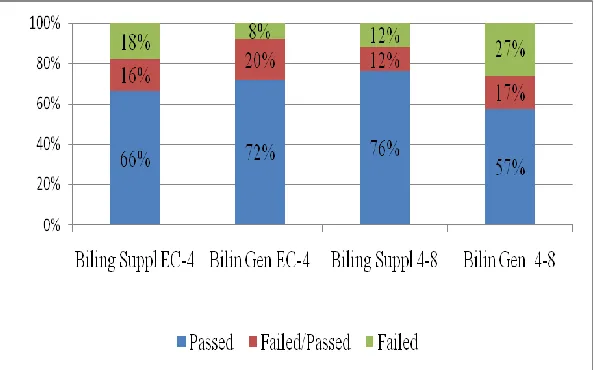
Bilingual Education Supplemental EC-4 Sixty-six percent of the teachers taking the Bilingual Education Supplemental EC-4 exam passed the first time (passed group 66%). Failed/passed group was 16% and failed group was 18%.
Bilingual Generalist EC-4. Seventy-two percent of the teachers taking the Bilingual Generalist EC-4 exam passed the first time (passed group 72%). Failed/passed group was 20% and failed group was 8%.
Bilingual Education Supplemental 4-8. Seventy-six percent of the teachers taking the Bilingual Education Supplemental 4-8 exam passed the first time (passed group 76%). Failed/passed group was 12% and failed group was 12%.
57%). Failed/passed group was 17% and failed group was 27%.
Chi-square test was conducted to test the independent distribution among the three test groups within each bilingual certification exam. The results showed statistically significant (X2 =103.43, df (6), p < .001).
Table 2 showed the number of attempts that each individual made on the bilingual education certification exams. For the passing group, the average of attempt was one. In other word, they passed the test on their first attempt. However, for the failed/passed and failed groups the results were varied. Detailed results were reported as follows:
Bilingual Education Supplemental EC-4. For the failed/passed group, the mean of attempts of taking Bilingual Education Supplemental EC-4 exam was 3.15 with the range of 2 to 9. While, the failed group had the mean of attempts equal to 2.23.
Bilingual Generalist EC-4. For the failed/passed group, the mean of attempts of teaching Bilingual Generalist EC-4 exam was 2.91 with the range of 2 to 17. While, the failed group had the mean of attempts equal to 1.97.
Bilingual Education Supplemental 4-8. For the failed/passed group, the mean of attempts of taking Bilingual Education Supplemental 4-8 exam was 2.58 with the range of 2 to 6. While, the failed group had the mean of attempts equal to 1.42.
Bilingual Generalist 4-8. For the failed/passed group, the mean of attempts of taking Bilingual Generalist 4-8 exam was 2.91 with the range of 2 to 8. While, the failed group had the mean of attempts equal to 1.31.
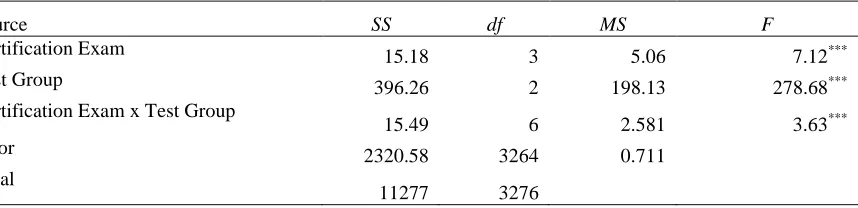
In order to test the two main effects (certification type and test group) and the interactions between them, an ANOVA test was done. Results show that type of certification and test group correlated significantly with number of attempts of taking the test, in other words, the differences between type of certifications and test groups were noteworthy. The comparison of type of certification tests was statistically significant [F (3, 3264) = 7.12,
International Journal of Asian Social Science, 2(5), pp.697-703
701 statistically significant [F (2, 3264) = 278.68, p
< .001]. Finally, the comparison of the interaction between type of certification tests and test groups was statistically significant [F
(6, 3264) = 3.63, p < .001] (see table 3).
Discussion
Comparing all the bilingual education certification exams, most people took the Bilingual Generalist EC-4 test (n=2,524), while least among of the teachers took Bilingual Supplemental 4-8 test (n=98). Comparing the passing rate for these four certification tests, the group of Bilingual Education Supplemental 4-8 had the highest first time passing rate (76%) with additional 12% of failed/passed rate. Bilingual Generalist EC-4 group had 72% of first time passing rate, plus with 20% of failed/passed rate. While the group of Bilingual Generalist 4-8 had the lowest first time passing rate (57%) and 17% of failed/passed rate. Compared to the other three groups, the Bilingual Generalist 4-8 group had the highest failure rate (27%), with one of every four having initially failed the Bilingual Generalist 4-8 certification exam (See figure 1).
When we investigated the numbers of attempts to pass the TExES bilingual certification tests, the failed/passed groups averaged three attempts before passing the tests. Within these three tests, people who took the Bilingual Education Supplemental 4-8 had the lowest
average number of attempts (M=2.58), while the Bilingual Education Supplemental EC-4 had the highest average number of attempts (M=3.15).
Conclusion
A careful analysis of test takers in previous bilingual exams may indicate areas that should be strengthened during the transition period to the current bilingual exams.Overall, the research results suggest that the individuals did not do well on the TExES Bilingual Education Supplemental EC-4, Bilingual Generalist EC-4, Bilingual Education Supplemental 4-8. The finding also indicated that the Bilingual Generalist 4-8 teachers had the most difficulties to pass the certification test. Teacher preparation programs should examine their curriculum to include adequate, quality preparation of generalist as well as bilingual education. The lower bilingual education certification passing rates indicates that more resources may need to be added to this subject area.
Given the higher percentages of teachers who have failed the Bilingual Generalist 4-8 content exam at least once and perhaps multiple times, school districts should consider intensive and continuous professional development for the middle school bilingual teachers.
702 Table2: Number of attempts of taking the TExES bilingual certification exam for the comparison
groups
Failed/Passed Failed
Certification Test M SD Min Max M SD Min Max
Bilingual Education
Supplement EC-4 3.15 1.56 2 9 2.23 2.16 1 11
Bilingual Generalist EC-4
2.91 1.54 2 17 1.97 1.43 1 8
Bilingual Education Supplement 4-8
2.58 1.24 2 6 1.42 0.67 1 3
Bilingual Generalist 4-8 2.91 1.38 2 8 1.60 1.31 1 9
Table 3: Two-way ANOVA test the effects of certification type and test group on attempts of taking bilingual certification exams
Source SS df MS F
Certification Exam 15.18 3 5.06 7.12***
Test Group 396.26 2 198.13 278.68***
Certification Exam x Test Group
15.49 6 2.581 3.63***
Error 2320.58 3264 0.711
Total
11277 3276
NOTE.—R2 < .454 (adjusted R2 < .452). ***p < .001
Passed
Failed/P
assed Failed
Certification Test
Total
Records Individual n M n M n M
Bilingual Education
Supplement EC-4 702 448 295 66% 71 16% 82 18%
Bilingual Generalist
EC-4 3671 2524 1824 72% 496 20% 204 8%
Bilingual Education
Supplement 4-8 122 98 74 76% 12 12% 12 12%
International Journal of Asian Social Science, 2(5), pp.697-703
703 References
ABC 13, (2007). 13 undercover investigates teachers' test scores. Retrieved May 15, 2007 fromhttp://abclocal.go.com/ktrk/story?section =investigative&id=5290451.
Capps, R., Fix, M., Murray, J., Ost, J., Passel, J., & Herwantoro, S. (2005) The new
demography of America’s schools:
Immigration and the No Child Left Behind Act. Washington, DC: The Urban Institute.
Retrieved May 4, 2009, from
http://www.urban.org/UploadedPDF/311230_ new_demography.pdf
Chang, F., Crawfor, G., Early, D., Bryant, D., Howes, C., Burchinal, M., Barbarin, O., Clifford, R., & Pianta, R. (2007) “Spanish speaking children’s social and language development in pre-kindergarten classrooms.” Early Education and Development, Vol. 18, pp. 243-269.
Cummins, J. (1991)“Interdependence of first and second language proficiency in bilingual children.” In E. Bialystok (Ed.), Language processing in bilingual children (pp. 70-89). New York:
Cambridge University Press.
Darling-Hammond, L (2004)“Inequality and the Right to Learn: Access to Qualified Teachers in California's Public Schools.” Teachers College Record, Vol. 106, No.10, pp. 1936-1966.
Green, T. D., Tran, M.,& Young, R. (2005) “The impact of ethnicity, socioeconomic status, language, and training program on teaching choice among new teachers in California.” Bilingual Research Journal, Vol. 29, No.3, pp. 583-598.
KDFW (2007) KDFW Fox News in Dallas: Educators repeatedly flunk required exams. Retrieved June 23, 2007 from
http://www.myfoxdfw.com/myfox/pages/H
me/Detail;
jsessionid=707BC28CFF69375439C05169B3 9AB8C0?contentId=3205107&version=9& locale=EN
US&layoutCode=TSTY&pageId=1.1.1&sfl =1.
Lake, V. E., & Pappamihiel, E. (2003)“Effective practices and principles to support English language learners in the early childhood classroom.” Childhood Education, Vol. 79, pp. 200-204.
National Association for the Education of Young Children (NAEYC) (2005) Screening and assessment of young English-language learners: Supplement to the NAEYC position statement on
early childhood curriculum, assessment, and program evaluation.Washington, DC:Author. Rivkin, S. G., Hanushek, E. A., & Kain, J. F. (2000) Teachers, schools, and academic achievement (Working paper No. 6691).” Cambridge, MIA: National Bureau of Economic Research.
Sanders, W. L., & Rivers, J. C. (1996)Cumulative and residual effects of teachers on future student academic achievement. Knoxville: University of Tennessee Value-Added Research and Assessment Center.
Santos de Barona, M., & Barona, A. (1991) “The assessment of culturally and linguistically different preschoolers.” Early Childhood Research Quarterly, Vol.6, pp. 363-376.
State Board of Education (SBEC) (2009a)How to become a teacher in Texas?
Retrieved April 16, 2009 from
http://www.sbec.state.tx.us/SBECOnline/certi nfo/routescertif.asp.
State Board of Education (SBEC) (2009b) “Study guides and preparation manual.” Retrieved April 16, 2009
http://www.sbec.state.tx.us/SBECOnline/stand test/guidprepman.asp.