INTERNATIONAL RESEARCH JOURNAL OF PHARMACY
www.irjponline.com
ISSN 2230 – 8407
Research Article
PHYTOCHEMICAL STUDIES AND TLC FINGER PRINT PROFILING OF DIFFERENT BIOACTIVE
COMPOUNDS FROM CARISSA CARANDAS L. A MEDICINALLY IMPORTANT PLANT
P. Kasturi, B. Satyanarayana, P. Subhashini Devi *
Department of Biochemistry, Andhra University, Visakhapatnam, India
*Corresponding Author Email: [email protected]Article Received on: 05/08/18 Approved for publication: 20/09/18
DOI: 10.7897/2230-8407.0910237
ABSTRACT
Plants and plant-based products such as secondary metabolites are the basis of modern pharmaceuticals that are current in use today for various diseases. The objective of the study was to explore the bioactive components and TLC finger printing of methanolic leaf extract of Carissa carandas. The preliminary phytochemical screening of methanolic extract showed the presence of secondary metabolites such as alkaloids, flavonoids, saponins, phenols, tannins, phytosterols, terpenoids, quinones and carbohydrates. Quantitative analysis of the extract indicates that the leaf extract was rich in phenols, tannins and flavonoids than the other plant parts. TLC finger printing profile of extract of Carissa carandas showed presence of different compounds with distinct Rf values with different solvent systems.
Key words: Carissa carandas;Apocynaceae; leaf extract; secondary metabolites; TLC studies
INTRODUCTION
Medicinal plants are a big source of information for a wide variety of chemical constituents which could be developed as drugs with precise selectivity. These plants serve as the reservoirs of potent useful chemical compounds which could serve as bioactive leads and clues for modern drug design1. The most important of these bioactive constituents of plants are terpenoids, alkaloids, tannins, flavonoids and phenolic compounds2. It is desirable to know the correlation between the phytoconstituents and the bioactivity of the plant in order to use the plant products for disease treatment3.
Carissa carandas Linn. (F. Apocynaceae) is also known as ‘Christ’s thorn’ which grows wild in bushes. In India it is cultivated in a limited way in the tropical and subtropical Mediterranean region 4. It is widely used medicinal plant by tribals throughout India and popular in various indigenous system of medicine like Unani, Ayurveda and Homoeopathy. For a long time, the plant has been used in the treatment of scabies, intestinal worms, diarrhoea, intermittent fever and reputed for its aphrodisiac, antipyretic, appetizer, antiscorbutic, anthelmintic, and astringent properties5,6.
C. carandas is known to possess extensive range of phytochemicals in its fruits that impart enormous medicinal value to the plant. These active constituents offer medicinal value to the plant. Pharmacological importance of the plant fruits has been evaluated by several researchers through in vitro and in vivo studies 7,8. These activities of C. carandas have been reported from the crude extract, their different fractions and isolates from fruits, leaves and roots. Unripe fruit is good appetizer; astringent, antiscorbutic, cooling, acidic, stomachic, anthelmintic and leaf decoctions are given in the commitment of remittent fever7.
The methanolic extracts of the fruit showed the presence of reducing sugar, flavonoids, protein, cardinolides, terpenoids, steroids, phenolic compounds, saponins and acids 8. The chemical investigations of C. carandas had led to the isolation of several
substances including β-sitosterol, lupeol, glucosides of odoroside-H, ursolic acid and a new cardioactive substance9. The present study was initiated by considering the importance of plant as well as fruit. Since there were number of reports on fruits of C. carandas, the study was aimed in finding out bioactive principles from methanolic leaf extracts of C. carandas.
MATERIALS AND METHODS
Collection of plant material
Fresh leaf material of Carissa carandas was collected in and around Visakhapatnam, Andhra Pradesh, India. Taxonomic identification of the collected plants was carried out with the herbarium present in the Department of Botany, Andhra University, Visakhapatnam (Voucher specimen No. 22289).
Extraction of plant material
The plant material was washed thoroughly with running tap water and air dried under shade. After complete shade drying the plant material was grinded and the powder was kept in small plastic bags with paper labeling. The extraction was done by using soxhlet extraction method with analytical grade methanol as refluxing solvent. After the completion of extraction process, the plant extract was recovered from the mixture by distillation and stored at 4°C until further use. Methanolic extract was used for the phytochemical and TLC profiling studies. The percentage yield of crude methanol extract was calculated by using standard formula (% Yield = Final weight of extract/ Initial weight of extract× 100).
Phytochemical studies
Test for Alkaloids
About 50mg of solvent free extract was stirred with little quantity of dilute hydrochloric acid and filtered. With the above filtrate the following test was done.
Mayer’s test
To a few ml of filtrate, two drops of Mayer’s reagent was added along with the sides of test tube, appearance of white or creamy precipitate indicates presence of alkaloids
Test for Flavonoids
Shinoda test
A little quantity of extract was dissolved in alcohol and few fragments of magnesium turnings and conc. Hydrochloric acid were added drop wise. Appearance of pink or crimson- red color indicates the presence of flavonol glycosides
Test for Saponins
Froth test
A small quantity of the extract was diluted with distilled water to 20 ml. The suspension was shaken in graduated cylinder for 15 minutes. A two centimeter layer of foam or froth which is stable for 10 minutes indicates the presence of saponins.
Test for Phenols
Ferric chloride test
About 50 mg of extract was dissolved in distilled water and to this few drops of neutral 5% ferric chloride solution was added. Formation of blue, green and violet color indicates the presence of phenolic compounds.
Test for Tannins
Lead acetate test
A small quantity of extract was dissolved in distilled water and to this; 3 ml of 10% lead acetate solution was added. Appearance of white precipitate was observed. This may be due to the presence of phenolic compounds.
Test for Phytosterols and Triterpenoids
Liebermann- Burchard test
The extract was dissolved in acetic anhydride, heated to boiling, cooled and then 1 ml of concentrated sulphuric acid was added along the sides of the test tube. Red, pink or violet color at the junction of the liquids indicates the presence of steroidal triterpenoids and their glycosides.
Salkowski test
Few ml of extract was taken in a test tube, to these three to four drops of concentrated H2SO4 was added and mixed well. This upon standing, if shows red color in the bottom it indicates steroids or if it forms golden yellow color it indicates triterpenoids.
Test for Glycosides/Anthroquinones
For the detection of glycosides, about 50 mg of extract was hydrolyzed with concentrated hydrochloric acid for 2 hours in a water bath, filtered and filtrate was subjected to following tests
Borntrager’s test
About two ml of the above filtrate was taken, to this about three ml of chloroform was added and after shaking chloroform layer was separated and to this 10% ammonia solution was added. If
pink color is formed, it indicates the presence of anthraquinone glycosides.
Test for Carbohydrates
About 100mg of the extract was dissolved in 5ml of distilled water and filtered. The filtrate was subjected to the following tests.
Molisch’s test
To 2 ml of filtrate, two drops of alcoholic solution of α- napthol was added. The mixture was shaken well and 1 ml of concentrated sulphuric acid was added slowly along the sides of the test tube, the test tube was cooled in ice water and allowed to stand. A violet ring at the junction of two liquids indicates the presence of carbohydrates.
Fehling’s test
One ml of filtrate was boiled in water bath with 1 ml each of Fehling’s solution A and B. Formation of red precipitate indicates the presence of sugar.
Quantitative phytochemical analysis
Total phenolic content
The total phenolic content was determined spectrophotometrically by the method described by Sadasivam and Manickam10 after precipitation of proteins. Two ml of plant extract was taken and to this 1ml of Folin Ceo-calteau reagent was added. To this thirteen ml of distilled water was added after three minutes. Later two ml of sodium carbonate (7.5%) solution was added and the volume was made up to 20 ml. The above mixture was kept for 1 hour for colour development and absorbance was recorded at 630 nm. The concentration of total phenolic content in plant extracts was calculated from the calibration curve of Gallic acid and it was expressed as Gallic acid equivalents/gram fresh weight. Each experiment has three replicates and the experiment was repeated thrice.
Total flavonoid content
Total flavonoid content was measured by aluminum chloride colorimetric assay described by Marinova 11. Ten ml of volumetric flask was taken and to this one ml of plant extract and four ml of distilled water were added. To the above mixture, 0.3ml of 5% sodium nitrite was added. To this 0.3ml of 10% AlCl3 was added after 5 minutes and to this 2 ml of 1 M NaOH was added and the volume was made up to 10 ml with distilled water. The solution was mixed well, and the absorbance was measured against prepared reagent blank at 510 nm. The total flavonoid content in the given plant extract was calculated from the calibration curve of catechin and it was expressed as Gallic acid equivalents/gram fresh weight. Each experiment has three replicates and the experiment was repeated thrice.
Tannin content
Qualitative analysis by thin layer chromatography
The methanolic leaf extract was subjected to thin layer chromatography (TLC) as per conventional one-dimensional ascending method using silica gel 60F254, 7X6 cm (Merck). The pre-coated plates were cut with scissors and marked with pencil about 1cm from the bottom of the plate. Glass capillaries were used to spot the sample for TLC. The plates were developed in a chromatographic tank using different solvent systems where ethyl acetate and methanol were used in different combinations. Solvent system (1) methanol (100%), (2) ethyl acetate(100%), (3)
ethyl acetate: methanol (9:1), (4) ethyl acetate: methanol (8:2),
(5) ethyl acetate: methanol (7:3), (6) ethyl acetate: methanol (6:4),
(7) ethyl acetate: methanol (5:5), (8) ethyl acetate: methanol (4:6),
(9) ethyl acetate: methanol (3:7), (10) ethyl acetate: methanol (2:8), (11) ethyl acetate: methanol (1:9). After run, the plates were dried and visualized under normal day light, ultraviolet light (254nm & 366nm) and by spraying with 5% sulfuric acid followed by heating at 105OC for 5-10minutes in an oven [12,13]. The retention factor Rf was calculated for each fraction using the following formula;
Rf = Distance moved by the solute /Distanced moved by the solvent
RESULTS
Percentage yield
The percentage of extract after soxhlation was found to be 8% for
Carissa caranadas.
Phytochemical Screening
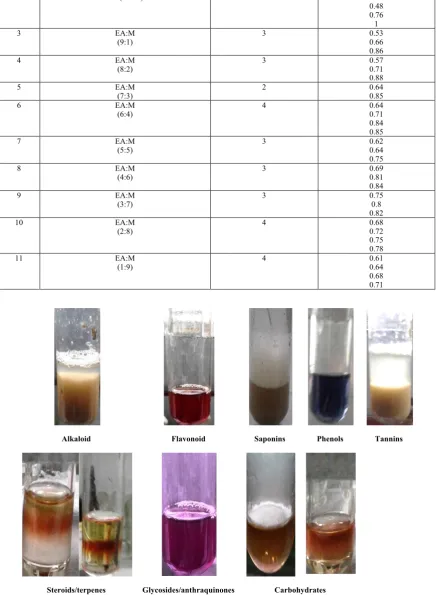
The phytochemical active molecules of Carissa carandas were qualitatively analyzed for methanolic leaf extract and the results were presented in Table 1. The leaf extract contains all the major secondary metabolites namely alkaloids, flavonoids, saponinis, phenols, tannins, phytosterols, terpenoids, quinones and carbohydrates.
Quantitative photochemical analysis
The results of quantitative analysis showed the content of Phenols, tannins and flavonoids 240.33 mg/gm, 255.49 mg/gm, 264.03 mg/gm respectively (Table 2).
Thin layer chromatographic studies
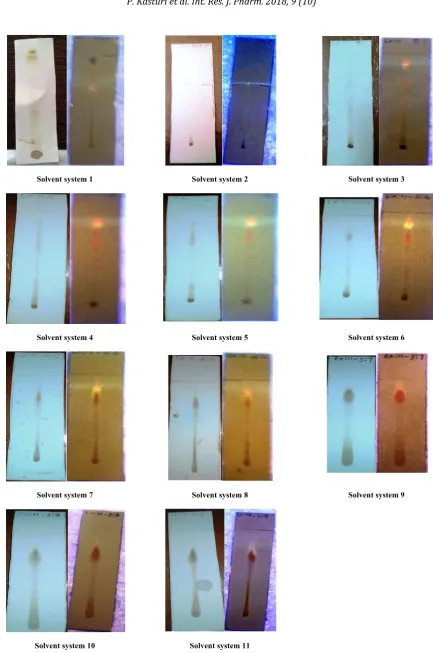
TLC studies of the methanol extract of Carissa carandas showed presence of different compounds with different Rf values. Solvent system (1) showed the presence of three spots with different Rf values, (2) showed four spots with different Rf values, (3) showed three spots (4) showed three spots (5) showed 2 spots (6) showed four spots (7), (8),(9)showed three spots with different Rf values, (10) and (11) showed four spots with different Rf values respectively (Fig 2 and Table 3).
Table 1: Phytochemical constituents of the Methanolic Leaf Extract of Carissa carandas
Constituents Test Observation
1.Alkaloids Mayer’s White-cream ppt
2.Flavonoids
3.Saponins
Shinoda test
Froth Test
Pink or Crimson red ppt
Foam formed
4.Phenols FeCl3 Bluish black color
5.Tannins Lead acetate Cream ppt
6.Steroids & Terpenes Lieberman-Buchard
Salkowski
At inter phase Reddish or pink
At inter phase Reddish color and Golden yellow
7.Glycoside/Anthraquinones Bontrager’s Pink or violet
8.Carbohydrates Molisch’s
Fehling’s
Reddish ring
Red
Table 2: Quantitative analysis of phytochemicals in Carissa carandas
S. No Phytochemical leaf*
1 Phenols (mg/gm) 240.33±5.51
2 Tannins (mg/gm) 255.49±4.70
4 Flavonoids (mg/gm) 264.03±6.42
Table 3: Rf values of TLC with different solvent systems for Methanolic Leaf extract of Carissa carandas
S. No Solvent Systems Ethyl Acetate: Methanol No of Spots Identified Rf Values
1 Methanol (100%) 3 0.59
0.73 0.90
2 EA (100%) 4 0.38
0.48 0.76 1
3 EA:M
(9:1) 3 0.53 0.66
0.86
4 EA:M
(8:2) 3 0.57 0.71
0.88
5 EA:M
(7:3) 2 0.64 0.85
6 EA:M
(6:4)
4 0.64
0.71 0.84 0.85
7 EA:M
(5:5)
3 0.62
0.64 0.75
8 EA:M
(4:6) 3 0.69 0.81
0.84
9 EA:M
(3:7) 3 0.75 0.8
0.82
10 EA:M
(2:8)
4 0.68
0.72 0.75 0.78
11 EA:M
(1:9) 4 0.61 0.64
0.68 0.71
Alkaloid Flavonoid Saponins Phenols Tannins
Steroids/terpenes Glycosides/anthraquinones Carbohydrates
Solvent system 1 Solvent system 2 Solvent system 3
Solvent system 4 Solvent system 5 Solvent system 6
Solvent system 7 Solvent system 8 Solvent system 9
Solvent system 10 Solvent system 11
DISCUSSION
The results of preliminary phytochemical screening of the crude methanol extract revealed the presence of all the constituents tested including; alkaloids, flavonoids, saponins, tannins, phenols, glycosides, anthraquinones, steroids, terpenes and carbohydrates. These constituents are responsible for most pharmacological activities of plants14,15. The multiple uses of this plant and its parts in treating various ailments was reported by several researchers where leaves contain triterpenoids16 the root extract17, and the fruit extract18,19 were also reported to be used in various disease treatments. Keeping in view of the medicinal importance of this plant and based on literature the present study was initiated in order to know any unknown compounds in leaves of Carissa carandas. For this preliminary phytochemical analysis was done and the results weres similar to fruit extract of Carissa carandas8, indicating that leaf material is also rich in medicinal value similar to fruit. The quantitative analysis also revealed that the plant contains high amounts of phenols, tannins and flavonoids.
Thin-layer chromatographic analysis carried out with the methanolic leaf extract of Carissa carandas gave different Rf values in different solvent systems. In the present study mixture of two polar solvents Ethyl acetate and Methanol were used in various combinations. The solvents Ethyl acetate and Methanol were proved as preferable mobile phase in different plant species 20,21. Maximum number of spots with different Rf values were observed in solvent system 6, 10 and 11 respectively. Presences of different phytochemicals were observed primarily by qualitative analysis and this was further confirmed by doing TLC which shows different Rf values from the same extract.
CONCLUSION
Carissa carandas is an evergreen, deciduous shrub having immense medicinal properties. The present study suggests that the leaf material of C. carandas is also rich in several phytochemicals like fruits and roots. The TLC studies also reveals there might be several unknown compounds, which can be identified by further studies focusing on isolation, purification and characterization of compounds using chromatographic and spectroscopic studies.
REFERENCES
1. Vijyalakshmi R and Ravindran R. Preliminary comparative phytochemical screening of root extracts of Diospyrus ferrea (Wild.) Bakh and Arva lanata (L.) Juss. Ex Schultes. Asian Journal of Plant Science and Research.2012;2:581-587. 2. Doss A. Preliminary phytochemical screening of some Indian
medicinal plants. Ancient Science of Life. 2009;29:12-16. 3. Pandey P, Rakesh M, Ravi U. Physico-chemical and
preliminary phytochemical screening of Psoralea corylifolia. Archives of Applied Science Research 2013;5:261-265. 4. Bankar GJ, Verma SK, Prasad RN. Fruit for the arid region:
Karonda. Indian Horticulture 1994; 39 (1): 46-47.
5. Jain SK. Dictionary of Indian Folk Medicines and Ethnobotany: A Reference Manual of Man-plant Relationships, Ethnic Groups & Ethnobotanists in India. Deep Publications, New Delhi, INDIA. 1991.
6. Jayaweera DMN. Medicinal plants used in Ceylon. The national science council of Sri Lanka, 1981, p 95.
7. Trivedi PC and Sharma NK. Ethanomedicinal plants. Pointer publisher,Jaipur (Raj.) India; 2004, p38.
8. Arif M and Fareed S. Pharmacognostical and preliminary phytochemicalanalysis of Carissa carandas fruits. Journal of Medicinal &Aromatic Plant Sciences 2011; 33(1): 53-58. 9. Rastogi RC, Rastogi RP, Dhar ML. Studies on Carissa
carandas Linn. II. Polar glycosides. Indian Journal of Chemistry 1967; 5(5): 215-221.
10.Sadasivam and Manickam. Biochemical methods. 2nd edition. New Age International Pvt.Ltd. publisher, New Delhi 1996. 11.Marinova D, Ribarova F, Atanassova M. Total phenolics and
total flavonoids in Bulgarian fruits and vegetables. Journal of University of Chemical technology and Metallurgy 2005; 40(3):255-260.
12.Geiss F. Fundamentals of thin layer chromatography (planar chromatography). Heidelberg, Dr. A. Hüthig Verlag, 1987, 482 S., 202 Abb., 40 Tab., DM 192,–, ISBN 3‐7785‐0854‐7. 13.Touchstone JC. Practice of thin layer chromatography. 3rd
edition. New York: Wiley; 1992. ISBN: 978-0-471-61222-3. 14.Harbone JB. Phytochemical Methods-A Guide to Modern Techniques of Plant Analysis. Chapman and Hall, London, pp.182-190. 1998.
15.Kokate CK. Practical Pharmacognosy. 4th edition. New Delhi, India: Vallabh Prakashan, New Delhi, India, 54. 1994. 16.Siddiqui BS, Usman Ghani, Syed Tahir Ali, Shahid Badar Usmani, Sabira Begum. Triterpenoidal Constituents of the leaves of Carissa Carandas. Natural Product Research 2003; 17 (3):153-158.
17.Hedge K and Joshi AB. Hepatoprotective effect of Carissa carandas Linn. Root extract against Carbon Tetra Chloride and Paracetamol Induced Hepatic Oxidative Stress Indian Journal of Experimental Biology 2009; 47(8):660-667. 18.Mishra CK, Sasmal D, Shrivastava B. An in vitro evaluation
of the anthelmintic activity of unripe fruits extract of Carissa carandas Linn. International Journal of Drug Development and Research 2012; 4(4):393-397.
19.Jigna P, Rathish N, Sumitra C. Preliminary screening of some folklore medicinal plants from western India for potential antimicrobial activity. Indian Journal of Pharmacology 2005; 37(6):408-409.
20.Alebiosu CO and Yusuf AJ. Phytochemical screening, thin-layer chromatographic studies and UV analysis of extracts of Citrus lanatus. Journal of Pharmaceutical, Chemical and Biological Sciences 2015; 3(2):214-220.
21.Hassan IA, Nasiru IA, Malut AM, Ibrahim AS, Ali AS. Phytochemical studies and thin layer chromatography of leaves and flower extracts of Senna siamea Lam for possible biomedical applications. Journal of Pharmacognosy and Phytotherapy 2015; 7(3): 18-26.
Cite this article as:
P. Kasturi et al. Phytochemical studies and TLC finger print profiling of different bioactive compounds from Carissa carandas L. a medicinally important plant. Int. Res. J. Pharm. 2018;9(10):115-120 http://dx.doi.org/10.7897/2230-8407.0910237
Source of support: Nil, Conflict of interest: None Declared