University of Pennsylvania University of Pennsylvania
ScholarlyCommons
ScholarlyCommons
Publicly Accessible Penn Dissertations
1992
Decomposition and Parallel Solution of Network-Structured
Decomposition and Parallel Solution of Network-Structured
Optimization Problems
Optimization Problems
Mustafa Çelebi Pinar
Follow this and additional works at: https://repository.upenn.edu/edissertations
Recommended Citation Recommended Citation
Pinar, Mustafa Çelebi, "Decomposition and Parallel Solution of Network-Structured Optimization Problems" (1992). Publicly Accessible Penn Dissertations. 3545.
https://repository.upenn.edu/edissertations/3545
Problems
Problems
Abstract Abstract
Optimization problems characterized by an embedded network structure in the constraint matrix are frequently used as a modeling tool in many diverse application areas such as transportation, logistics, finance, telecommunications and so on. We develop techniques that exploit the special structure present in this class of problems. A solution methodology where we propose to place the complicating or side constraints into the objective function using the 1-norm penalty function is developed. Thus we obtain a nondifferentiable penalty problem with network constraints. We develop smoothing techniques for the 1-norm penalty function and establish their properties. By using a quadratic smoothing term we obtain a nonlinear nonseparable problem with network constraints. The penalty problem is solved iteratively using a decomposition technique based on a simplicial decomposition of the network constraint set. This decomposition scheme induces separability in the objective function through linearization in the subproblem phase and a nonlinear nonseparable master problem is solved based on the information obtained from the subproblem phase. We develop two specializations of the algorithm: (1) for the network flow problem with side constraints, (2) for the multicommodity flow problem. We present numerical results with Patient Distribution System (PDS) multicommodity flow problems and with network flow problems with side constraints derived from matrix estimation problems and the NETLIB Linear Programming Library problems.
The decomposition is particularly suitable for vector multiprocessor systems. We develop a parallel implementation of the linear-quadratic penalty algorithm. Numerical results with a set of large linear multicommodity network flow problems drawn from a military planning application are presented. The impact of parallel decomposition is investigated using a CRAY Y-MP supercomputer system and a Connection Machine CM-2. The parallelism is exploited both at the tightly coupled linear algebra level in the master problem and at a loosely coupled level with the network subproblems. Data-level parallel computing is explored on a massively parallel SIMD system, the Connection Machine CM-2.
As alternatives to simplicial decomposition, two decomposition techniques (1) based on the truncated Newton algorithm (2) on a cyclic decomposition are also considered. The truncated Newton based decomposition is developed for the single commodity case.
We conclude the thesis with an application from Naval Personnel Assignment formulated as a large network model with side constraints and solved using the penalty algorithm.
Degree Type Degree Type Dissertation
Degree Name Degree Name
Doctor of Philosophy (PhD)
First Advisor First Advisor Stavros A. Zenios
I I
:
.
Supervi
Decomposition and Parallel Solution
of Network-Structured Optimization Problems
MUSTAFA QELEBI PINAR
A DISSERTATION
IN
SYSTEMS
Presented to the Faculties of the University of Pennsylvania in Partial Fulfillment of the Requirements for the Degree of
Doctor of Philosophy
1992
�I(�
qradu_a�e G_ro':}�- Cha_i�p�r_so�
LIBRARIES
ii
Acknowledgements
I want to express my gratitude to a number of individuals who provided help and support during my doctoral studies. Special thanks are due to:
Stavros A. Zenios, the supervisor of this disser,tation. Stavros provided support for the project for four years. He supplied many ideas and encouragement at moments of distress. Through his energy and relentless mentoring he pushed me to the finish line. For everything he has done for me, I remain grateful.
Monique Guignard-Spielberg. Monique taught me many things on optimization in the classroom and outside on numerous occasions. She was always willing to listen and help. For everything she has done, I am grateful. Mes tres sinceres remerciements!
Edward K. Morlok and Irvin Lustig. They took time from their schedules to serve as readers of this disser,tation. For their co�structive criticism and valuable feedback, I am grateful.
Ron Dembo. Ron served as the spiritual father of the smoothing ideas developed in this thesis. He made his expertise on nonlinear programming available at the beginning of the project. For his help, I remain grateful.
Patrick Harker and Keith Ross. They served as readers in the proposal phase of this dissertation. Keith was a true friend from my first day in the Engineering School. Pat provided several suggestions during the proposal phase.
I met some of my best friends during those four years. I want to mention Soren, Vipul, Leonora, Manos, Kooka, Rui-Jin, Nuri and Zeynep. And, also everyone in Decision Sci-ences especially Marge, Cynthia, Kim and Kass. I thank them all for their friendship and courtesy.
Abstract
Optimization problems characterized by an embedded network stru�ture in the constraint matrix are frequently used as a modeling tool in many diverse application areas such as transportation, logistics, finance, telecommunications and so on. We develop techniques that exploit the special structure present in this class of problems. A solution methodology where we propose to place the complicating or side constraints into the objective function using the 1-norm penalty function is developed. Thus we obtain a nondifferentiable penalty problem with network constraints. We develop smoothing techniques for the 1-norm penalty function and establish their properties. By using a quadratic smoothing term we obtain a nonlinear nonseparable problem with network constraints. The penalty problem is solved iteratively using a decomposition technique based on a simplicial decomposition of the network constraint set. This decomposition scheme induces separability in the objective function through linearization in the subproblem phase and a nonlinear nonseparable master problem is solved based on the information obtained from the subproblem phase. We develop two specializations of the algorithm: (1) for the network flow problem with side . constraints, (2) for the multicommodity flow problem. We present numerical results with Patient Distribution System (PDS) multicommodity flow problems and with network flow problems with side constraints derived from matrix estimation problems and the NETLIB Linear Programming Library problems.
The decomposition is particularly suitable for vector multiprocessor systems. We de velop a parallel implementation of the linear-quadratic penalty algorithm. Numerical results with a set of large linear multicommodity network flow problems drawn from a military planning application are presented. The impact of parallel decomposition is investigated using a CRAY Y-MP supercomputer system and a Connection Machine CM-2. The par allelism is exploited both at the tightly coupled linear algebra level in the master problem and at a loosely coupled level with the network subproblems. Data-level parallel computing is explored on a massively parallel SIMD system, the Connection Machine CM-2.
As alternatives to simplicial decomposition, two decomposition techniques (1) based on the truncated Newton algorithm (2) on a cyclic decomposition are also considered. The truncated Newton based decomposition is developed for the single commodity case.
Contents
1 Introduction and Background
1.1 A Review of Algorithms for Multicommodity Network Flows
1.1.1 Model Formulation ' .
1.1.2 Traditional Approaches to Multicommodity Network Flows
1.1.3 Recent Approaches to Multicommodity Network Flows ...
1
6 7
8
10
2 A Quadratic Smoothing of the I-Norm Exact Penalty Function for Con-vex Constrained Optimization
2.1 Introduction ...
2.2 Preliminaries
2.2.1 A Smooth Approximation
2.3 Approximate or s-Exactness .
2.4 Conclusions .
19
19
21 22
29
39
3 A Smooth Penalty Function Algorithm for Constrained Network Flows 41
3.1 Introduction... 41
3.2 The Linear-Quadratic Penalty Algorithm for Multicommodity Flows. . 42
3.2.1 Problem Definition. . . 42 3.2.2 Linearization via Simplicial Decomposition 45
3.3 Numerical Issues .. . . 46
3.3.1 Penalty Parameter Adjustments
3.3.2 Alternative Linesearch Procedures
3.3.3 Computing Directions of Descent .
3.3.4 Termination Criteria .
46
50
52
54
3.4 Computational Results. . . . . 3.4.1 Test Problems . 3.4.2 Solving the Master Problem.
3.4.3 Performance of Linesearch Procedures
3.4.4 Restart Procedures for the Network Subproblems.
57 58 59
60
60
62 633.4.5 Performance of the Algorithm .
3.5 Solving Large Scale Models .
3.6 Solving Constrained Network Flow Problems Using the Linear-Quadratic
Penalty Technique . . . .. 65 3.7 The Linear-Quadratic Penalty Algorithm for Networks with Side Constraints
and Variables . 3.7.1 Problem Formulation
3.7.2 Numerical Experience with Constrained Network Flows
3.8 Conclusions .
67 67
69
74
4 Alternative Block-Decomposition Techniques for the Nonlinear Network'
Problem 76
4.1 Introduction... 76 4.2 The Truncated Newton Algorithm and Active Sets 78 4.2.1 Model Truncated Newton Algorithm for Unconstrained Optimization 79 4.2.2 Model Active Set Algorithm for Constrained Optimization. 80 4.3 Block-partitioning of Newton's Equations . . . 81 4.3.1 The structure of I Bt+S"] 82 4.3.2 Partitioning of (B-1
S)
for Pure Networks. . 86 4.3.3 Partitioning of (B-1S)
for Generalized Networks. . 87 4.3.4 Extensions to Non-Separable Problems 90 4.4 Computational Experiments .4.4.1 Test Problems . 4.4.2 Solving Pure Network Problems
4.4.3 Solving Generalized Network Problems. 4.4.4 Parallel Implementation .
4.4.5 Comparison with Alternative Parallel Implementations.
4.4.6 Solving the Test Problems on a CRAY X-MP /48 .
4.5 Concluding Observations. . . 99 4.6 A Cyclic Decomposition Technique for the Solution of the Penalty Problem 100
5 Coarse Grain Parallel Decomposition of Multicommodity Network Flowsll0 5.1 Overview of Parallel Computing Concepts . . . .. 111 5.2 The Linear-Quadratic Penalty Method for Multicommodity Network Flows 113
5.2.1 Overview of Simplicial Decomposition Computations . 5.3 Vector and Parallel Computations with the Master Problem .
5.3.1 5.3.2 5.3.3 5.3.4
Computing Descent Directions .... Function and Gradient Evaluations .. Other Linear Algebra Computations Numerical Results . . . .
5,4 Parallel Decomposition of Network Subproblems 131 5.5 Conclusions... 136
.
6 Data-Level Parallelism for the Solution of Multicommodity Flows 139 6.1 An Overview of Data-level Parallelism on the Connection Machine System. 141
6.2 Master Problem Computations 142
6.3 Subproblem Computations. . . . 153 6.3.1 The Proximal Minimization Algorithm with D-functions (PMD) 153
-,
6.3.2 Solving the Strictly Convex Network Programs 155 6.3.3 Numerical Results and Discussion 156
7 Naval Personnel Assignment: An Application of Linear-Quadratic Penalty
Methods 158
7.1 Introduction... . . . 158 7.2 The Naval Personnel Assignment Problem . . 159 7.3 Application of the Linear-Quadratic Penalty (LQP) Method to Naval
Per-sonnel Assignment 7.4 Numerical Results
7.4.1 7.4.2
Solution Strategies
Solving the Naval Assignment Problem
7.5
Conclusions . 171 7.4.3 Comparison and Integration with Linear Programming Solvers 1708 Conclusions and Extensions 173
II
List of Figures
2.1 Linear-quadratic smooth penalty function ..
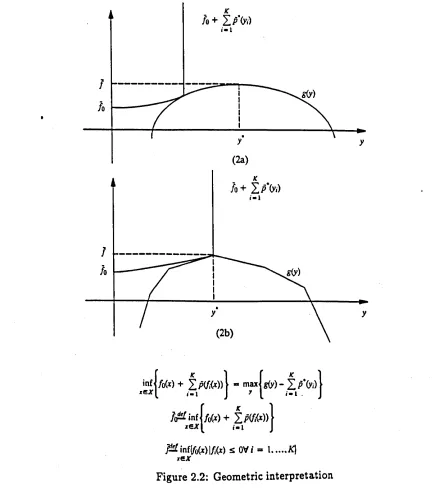
2.2 Geometric interpretation .
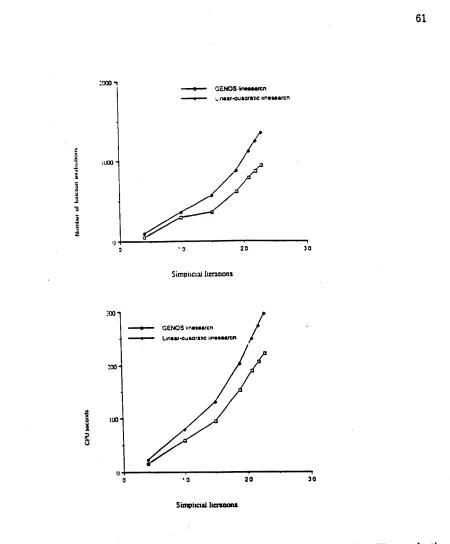
3.1 Comparison of1.The piecewise linear/quadratic linesearch with 2.The quadratic
interpolation with safeguards. . . .. .. 61
3.2 Variation of the solution time for constrained matrix estimation problem
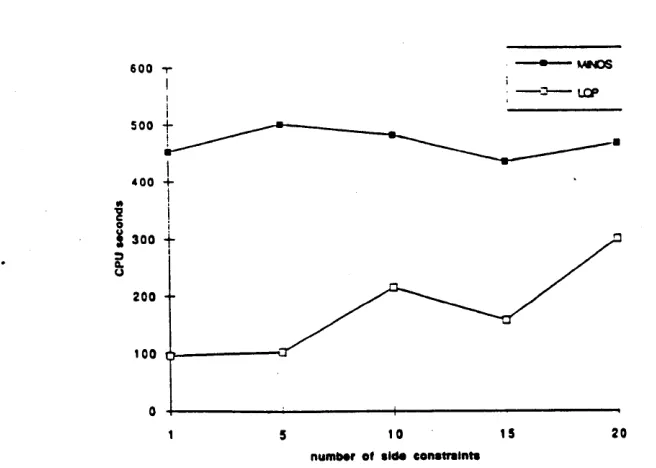
SAMBOT as a function of the number of side constraints with GENOS/LP
and MINOS. .. 71
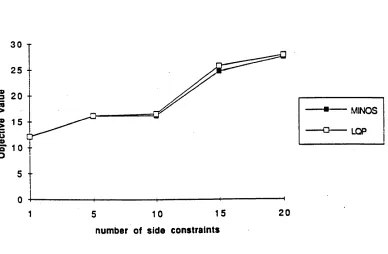
3.3 Variation of the optimal value for constrained matrix estimation problem
SAMBOT as a function of the number of side constraints with GENOS/LP
'and MINOS. .. .. 72
4.1 Pure network basis: matrix and graph representation, and an example of a
basic-equivalent-path. . . ... . . . .. .. 84
4.2 Generalized network basis: matrix and graph representation, and an example
of a basic-equivalent-graph. . . .. .. .. 85
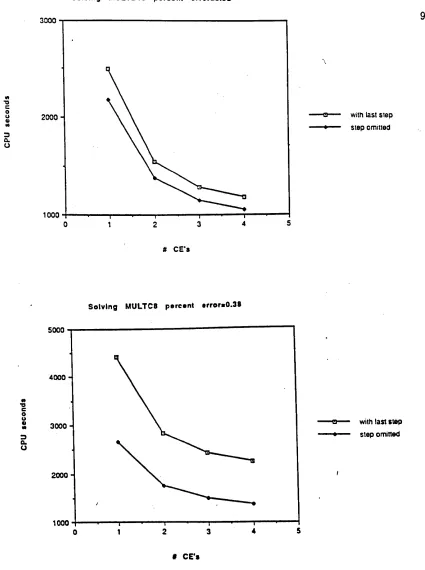
4.3 Solution times with and without the superbasic partitioning step at the last
iteration of PTN. . . .. ... 95
4.4 Parallel solution of the block-partitioned equations. 106
4.5 Speedup factors of the linesearch. . . .. .. 107
4.6 Comparison of MPTN and BPTN under different parallel architectures. 108
4.7 Comparative chart of Solution times. . . 109
5.1 Upper triangular representation of the matrix C and the indirect addressing
scheme for the matrix B. . . . . . . . .. 118
viii
23
40
I I
,
I
f
t
1
I
-&...~
t:
!
5.2 Evolution of the master problem functions on the CRAY Y-MP with l.scalar
computing (no vectorization) 2.compiler vectorization a.user vectorization
(through restructuring of the FORTRAN code and use of SCILIB routines
as discussed throughout section 5.3) ... '. . . .. 124
5.3 Components of the total solution time for the LQP algorithm on serial (VAX
6400) and vector (CRAY Y-MP) computers. 125
5.4 Percentage distribution of the total solution time for the LQP algorithm on
serial (VAX 6400) and vector (CRAY Y-MP) computers. 127
5.5 Performance of the algorithm with parallelized master problem computations
with respect to Amdahl's law . . . .. 130
5.6 Performance of the parallel decomposition with respect to Amdahl's law .. 133
5.7 Number of network simplex pivots for each commodity with PDS20 and
components of the solution time .
5.8 Evolution of solution times. . .
5.9 Comparison of the parallel decomposition with OBI
134
137
138
6.1 The Structure of the Matrix H .. . . . 144
6.2 Computing the product H D on the CM . 146
6.3 The Components of the Master Problem on the Front End and on the CM. 150
6.4 The Distribution of Solution time between the Subproblem and the master
problem on the Front End and on the eM . . . .. 151
6.5 The Evolution of Solution Times . . . .. 152
6.6 Infeasibility Improvement with 1. QPPRA 2. Network Simplex for PDS1 . 157
7.1 The structure of the network for Naval Personnel Assignment
7.2 Convergence of lower and upper bounds for NAVY ...
7.3 Convergence of lower and upper bounds for HUGENAVY
161
168
Chapter
1
Introduction and Background
The objective of this research is to design, analyze, and implement decomposition algorithms for large scale optimization problems with embedded network structures. The central theme of the material presented here is the design of a decomposition method based on the notion of linear-quadratic smooth penalty (LQP) functions. Traditionally, the constrained network flow problems have been attacked using basis partitioning or Lagrangean/subgradient meth-ods. These methods proved to be effective for problems where only a few non-network con-straints are present. In this thesis, we follow a different route. We develop a decomposition method based on the use of a smooth penalty function to eliminate the side (non-network) constraints from the constraint set and thus obtain a problem with flow conservation con-straints. A sequence of penalty problems is solved to get a solution to the original problem. The efficiency of the penalty method hinges upon efficient solution of the nonlinear network penalty problems.
The first part of the thesis is devoted to the development of a smooth penalty algorithm for network-structured problems. To eliminate non-network constraints, we consider the 1-norm exact penalty function, Luenberger [1970]. However, this function is not differentiable everywhere. To obtain a differentiable penalty problem we consider a. smooth approxima-tion to the I-norm exact penalty funcapproxima-tion. Properties of the approximation are analyzed and an approximate exactness property is established. Bounds on the approximation error are developed. Having a differentiable penalty function at hand, we seek to design efficient algorithms for the solution of the resulting network penalty problem. We develop two spe-cializations of the penalty algorithm, (1) for multicommodity flow problems (2) for network
problems with side constraints.
The goal of this thesis is to develop effective and efficient solution methodologies for a broad class of large-scale optimization problems. Although the development here is con-fined to the domain of network structured problems, the methodology developed remains applicable to a larger class of problems where there is exploitable structure. At a more technical level, this thesis seeks answers to the following questions:
1 Are exact penalty functions useful computational tools for large scale optimization?
2 For what classes of problems the penalty function based decomposition developed in this study perform best?
3 Can parallel processing have a substantial impact on the solution of special structured problems?
With respect to the above questions, this thesis touches three seemingly distinct subjects: penalty functions, network optimization and parallel computing. It is rather surprising to find very few articles on applications of exterior penalty functions to large scale optimiza.-tion problems. On the network optimizaoptimiza.-tion side, the constrained network problems have been solved using basis partitioning or Lagrangean techniques and Dantzig- Wolfe decom-position in the multicommodity case. The application of penalty functions to the solution of constrained network flow problem appears to be non-existent except for a. few recent articles, see Brown et ale [1989]. The contents of this thesis bring together techniques from penalty function literature and network optimization to take advantage of the rich sparsity structure that the network problems possess. In this respect, it should be of interest to . both communities. It also considers alternative forms of parallel computations for efficient
solution of large instances.
3
and the problem decomposes into independent network flow problems for each commod-ity. Linearization based decomposition can be achieved using the Frank-Wolfe algorithm or variants thereof, such as simplicial decomposition, von Hohenbalken [1977]. This decom-position scheme fits naturally into coarse grain parallel architectures as well as fine-grain architectures. This is the approach taken in this research for the solution of the penalty problem. Numerical results reported in this thesis using test problems from a Military Airlift Command application indicate the effectiveness of this approach. We also special-ize the linear-quadratic penalty technique to solve constrained matrix estimation problems and NETLIB linear programming problems. The algorithm remains robust and efficient for most of the problems solved from this class.
Another alternative for the solution of network penalty problem is to use a reduced gra-dient type method or a truncated Newton method. The truncated Newton method can take advantage of the special structure of the constraint set by identifying independent descent cycles and operating simultaneously on these cycles. A decomposition technique based on this idea has been developed and tested for the single commodity case. A description of the techniques and numerical results on a vector multiprocessor Alllant FX/B are given in this thesis.
Inthe second part of the thesis we investigate parallel decomposition opportunities using the LQP algorithm. By virtue of linearization, the subproblem phase in simplicial decom-position consists of solving as many linear network flow problems as there are commodities. The master problem phase involves dense linear algebra operations which are suitable for parallel computations. Based on these observations a parallel implementation on a CRAY Y~MP shared memory multiprocessor system is developed. The linear network flow prob-lems are solved in parallel using a network simplex algorithm. Very encouraging numerical results are given on problems with sizes of up to 150,000 variables.
We address this research question in this thesis. We investigate the potential of a lead-ing data-level parallel computer system, the Connection Machine CM-2, for the solution of multi commodity flow problems in contrast to our work on a control-level parallel super-computer, the CRAY Y-MP where fewer parallel processors can operate independently on different portions of data in an asynchronous fashion. Inthis respect We remark that not only the dense linear algebra operations of the master problem phase can be performed on the Connection Machine but also the subproblem phase can be performed on the Con-nection Machine using a combination of proximal point and row-action algorithms, Nielsen and Zenios [1991]. Since row-action algorithms require strict convexity, a vanishing prox-imal term is added to the objective function to solve the linear network problems on the Connection Machine. Preliminary computational results are given.
In the final part of the thesis we develop and solve an application drawn from a Navy manpower planning problem using the linear-quadratic penalty technique. The problem consists of maximizing Navy fleet readiness subject to personnel availability constraints. The problem is posed as a constrained network flow problem. The model also involves a side variable. It attains very large sizes and defies solution with existing network codes. Very large instances of this problem are solved and results are reported in Chapter 7 along with the model and a specialization of the linear-quadratic penalty technique to its solution.
Finally, a word on what is to follow and organization. Insection 1.1, we give an overview of literature on multicommodity flows. For penalty functions and network problems with side constraints, brief reviews are given at the beginning of the chapters or in the appropri-ate section. We study the smooth approxima.tion to the l-norm exact penalty function in Chapter 2. We introduce and describe the linear-quadratic penalty method in Chapter 3 and specialize the algorithm for (1) multi commodity flows, and (2) for network flows with side constraints. We present computational results with a set of large linear multicommodity network flow problems drawn from a military application and constrained matrix estimation problems as well as NET LIB problems. InChapter 4 we study alternative parallel decem-position techniques for the solution of the network penalty problem. The first technique we consider is a truncated Newton algorithm specialized for single commodity nonlinear net-work problems. Computa.tional results with a set of nonlinear netnet-work problems are given. We then consider an alternative technique to solve the network penalty problem that we
5
decompositions with the linear quadratic penalty method are discussed in Chapter 5 and computational results on a CRAY Y-MP vector multiprocessor are given. In Chapter 6, we discuss data-level parallelism for the solution of multi commodity flow problems and details of an implementation on a Connection Machine CM-2 system are presented. We present an application of the linear-quadratic penalty technique to a Naval Personnel Assignment prob-lem in Chapter 7. The report concludes in Chapter 8 with extensions and future research issues. A flowchart of the thesis organization is given below.
Analysis
Decomposition Techniques and numerical results
Parallel Computations
Application
FLOW OF THESIS
Smooth Approximation Error Analysis
T
.~
Penalty AlgOrithm for Multicommodity flows and networks with side constraints
Simplicial decomposition
-~
Alternative methods
Truncated Newton Cyclic Decomposition
T
Coarse-grain parallelism
CRAYY-MP
•
Fine-grain parallelism
Connection Machine
I
-.
1.1
A Review of Algorithms for Multicommodity Network
Flows
In this section we will briefly review algorithms previously developed for the solution of mul-ticoinmodity network flow problems. Multicommodity network flows are used as a modeling tool in many applications that arise in such diverse areas as financial modeling, telecommu-nications, logistics and transportation among many others. The problem usually consists of finding minimum cost flows of multiple commodities over a network with given demand and supply requirements and link capacity restrictions. The presence of link capacities translate into a set of constraints known as Generalized Upper Bound (GUB) constraints which com-plicate the structure of a problem which would otherwise have a block angular structure. A different version of the multicommodity flow problem is where a nonlinear congestion func-tion is used as the objective funcfunc-tion. In this model, the capacity constraints are absent but the coupling terms in the objective function still makes the problem non-separable, see for instance Bertsekas and Gafni [1983}.
The above features make the considerable amount of tools and knowledge available from network optimization literature hardly applicable to the multi commodity network flow problem. Furthermore, the problem instances that are encountered as real applications tend to be fairly large, which prohibits the use of well-known algorithms like the simplex method. However, with the emergence of interior point methods, these problems become
•
tractable, see for instance -the paper by Lustig et ale [1990], although at the expense of high computation times. It is, therefore, a worthwhile effort to consider methods that would take advantage of the embedded block angular structure of these problems. Shared memory multiprocessor architectures constitute an ideal computing environment for the implementation of algorithms which would allow the decomposition of the multi commodity network flow problem into min-cost network :flowproblems of equal size for each commodity. This would also allow the use of network optimization tools which have been developed over the past twenty years, see for example the text by Kennington and Helgason [1980].
7
particular we will describe a decomposition method based on logarithmic barrier functions by Schultz and Meyer [1990], an algorithm based on the notion of coercion functions by Zenios, Qi and Armstrong [1991] and review approaches based on augmented Lagrangian penalty functions.
1.1.1
Model Formulation
We consider the multicommodity network flow problem (MCNFP) with the following struc-ture: commodities flow over a network such that the aggregate flow on each arc does not exceed some joint capacity. Let
9
=
{V, e} be a graph with a set of vertices V=
(m) (where the notation {m} represents the set{1,2, ...
,m}) and a. set of edgese
=
{(i,j)1
i,j EV},
where
lei
=
n. Let (K) be the set of commodities flowing ong.
We will use the following formulation :[MCNFP]
minimize
x
/(z)
subject to
Az
=
bEz
s
dO~x
~ 1.£where:
f: ~Kn --+ ~ is the cost function, assumed to be convex and at least twice continuously differentiable
x E ~Kn is the vector of arc flows,
E is the oS X Kn coupling constraint matrix,
d is the vector of length s of coupling arc capacities,
A is a block-diagonal matrix of dimension Km X Kn with component submatrices Ak
along the diagonal,
b is the vector of dimension Km of supplies and demands for each commodity,
u is the vector of dimension Kn of upper bounds on the :flowsfor each commodity on each arc.
The matrix E from the coupling constraints has a generalized upper bounding (GUB) structure:
1 1 1
1 1 .. · 1
1 1 1
By relaxing the coupling constraint, the problem decomposes into K independent subprob-lems (one for each commodity) since A has a block-angular structure
and the vectors :z: decomposes by commodity:
Each Zk has dimension n x 1 and is the vector of flows of commodity k , The vectors b
and 1.£ decompose similarly by commodity.
Transposition is indicated with a superscript T, gradient vector with the symbol V,
and second derivative matrix by ·V2. The interior of a set S is denoted intS .
1.1.2
Traditional
Approaches
to Multicommodity
Network Flows
9
Decomposition methods proceed by splitting the solution procedure into two phases: a subproblem phase and master problem phase. A master problem is solved to coordinate the results of subproblems where each subproblem is a minimum cost network flow problem for a single commodity. Two main decomposition algorithms have been studied in the literature: price-directive decomposition and resource-directive decomposition. In price-directive decomposition, the coordination between the master program and the subprograms is achieved through a pricing mechanism which changes the objective functions (prices) of the subprograms. The objective is to obtain a set of prices (dual variables) so that the subprograms yield an optimal solution to the original problem. This principle is at the heart of the Dantsig- Wolfe decomposition. Some of the primary references for this method are Bazaraa and Jarvis [1977], Tomlin [1966] and Wollmer [1972] among others. Recently, due to the development of parallel supercomputers, price-directive decomposition received renewed interest, see for example Ho and Gnanendran [1989] and Wu and Lewis [1989].
An alternative decomposition scheme is the resource-directive decomposition. The idea is to distribute the arc capacity among individual commodities in such a way that solving the K decoupled network subprograms yields an optimal solution to the original probe lem. At each iteration, a resource allocation is performed and the network subprograms are solved. The sum of the capacities allocated to an arc is leas than or equal to the total arc capacity specified in the original problem. Therefore, in this scheme the subprograms produce feasible solutions to the original problem. However, resource directive decompo-sition is not guaranteed to produce an optimal solution to the multicommodity flow probe lem. Tangential approximation and sub gradient optimization techniques have been used in resource-directive decomposition to solve the nondifferentiable convex master problem, see for instance Kennington [1978], Kennington and Shalaby [1971].
convex nonlinear objective function and trust regions. They report computational results on a multiprocessor parallel computer with very large traffic assignment problems.
Recently, Brown et ale [1989] developed a decomposition method based on the use of penalty and augmented Lagrangian functions. These methods place the arc capacity con-straints into the objective function through a penalty term and try to solve the resultant linearly constrained nonlinear problem for increasing values of the penalty parameter. The linear-quadratic penalty method developed in this manuscript is very similar in spirit to the development of these methods. However it presents certain advantages by virtue of the choice of the penalty function. Moreover, parallel decomposition opportunities are not exploited in Brown et ale [1989].
1.1.3
Recent Approaches to Multicommodity
Network Flows
In this section we consider recently developed methods for the solution of multicommodity network problems. Some of these ideas were well-known but their use in multicommodity literature appears to be a novelty. Barrier functions and multiplier methods have been stud-ied in depth, see for instance Fiacco and McCormick [1968] and Bertsekas [1982]. Some, however, are new such as the decomposition method based on the notion of coercion func-tions, Feinberg [1989], Zenios, Qi and Armstrong [1991]. Numerical results reported with these methods seem to be the most promising in the literature so far along with the linear-quadratic penalty method which will be described in subsequent chapters. Therefore a detailed review of these methods here appears to be a worthwhile undertaking.
By placing the mutual capacity constraints into the objective function via a penalty or barrier function, the block angular structure of the constraint matrix can be exploited. This goal can be achieved in a variety of ways. We will discuss here a barrier method by Schultz and Meyer [1990], methods based on Augmented Lagrangians, Brown et ale [1989] and a decomposition method based on the notion of coercion functions, Zenios, Qi and Arm-strong [1991]. Before we do so, however, we also want to mention the thesis by Schneur [1991] where an e-scaling algorithm is developed for the solution of multi commodity flow problems and network problems with side constraints.
11
In this section, we present a decomposition method based on barrier functions for solv-ing block angular linear programs due to Schultz and Meyer [1990].
The algorithm begins by finding xO as the solution of the rela.xed problem [RMNF]
minimize
f(
x )x
subject to Ax
=
bO~x ~ u
A two-phase barrier method, described next, starts with XO and produces a solution that
is optimal within a specifed tolerance.
Define the feasible set of the network constraints as
•
min¢(x,T,9)
=
/(x) - T L:ln(9j - Ejx)~EB j=1
where 0
<
T E ~ and 0<
9 ER'
are parameters and In is the natural logarithm. Notethat ¢(X,T,()) is convex in
x
with domain dom ¢(.,T,())=
{xlEx
<
d}. Allowing 9f:;
d has the property of shifting the barrier. For this reason, the penalty portion of¢
is called (1.1) B=
{xlAx
=
band0::;
x ::;
u],
and the feasible set of capacity constraints
C
=
{xlEx
s
d}.Suppose xi is given. At each iteration, the original problem is approximated by the bamer problem
a shifted logarithmic barrier function.
After finding xO as the solution of
[RMNF]
the parameters9°
and TO are specified bytaking TO
>
0 and9~
= {
dj if EjxO<
djEixo
+
0 if Eixo ~ djwhere
0 ~
o.
This will have the effect of making Xo E B an interior point of dom¢(.,
T, 9).problem (1.1). If EXi+l
<
d, a feasible interior point has been obtained. Ifnot, then 0 is modified by taking{d,
O~+l
=
'
A8E;xi+l
+
(1 - As )OJ
if E;xi+l ~ d;if E'x
,
i+
1<
d·,
where AE (0,1) is a constant, while maintaining 7'i+l
=
7". Then set i+- i+
1 and repeatthe process.
Schultz and Meyer [1990] have shown that if a point x E B n intC exists, then such a point may be found in a finite number of iterations. Inorder to achieve this, however, the barrier problems (1.1) must be solved accurately.
Once the method has
ri'
=
d so thatx'
E BnintC, (1"=
dis maintained and the effect of barrier terms in if>is gradually relaxed. This is accomplished by letting 7'i1
o.
Convergence results for barrier methods, see Fiacco and McCormick [1968], state that minimizers of (1.1) converge to minimizers of the original problem as 7'1
O. InSchultz and Meyer [1990], a sequence{Ti}
generated by the recurrencei+l {' i }
7' +-max "T'T '71nf
is used, where 7'0,71nf
>
0 and AT' E [0,1). The following result can then be used to choose a suitable 7'inf'Theorem 1Let x· be an optimal solution of
{rvfCNFP
J,
and sayx
is a minimizer of(1.1
J
with T>
0 and 0=
d. Then f (e) ~
f (
x·) ~ f (x) -
7's, (Recall that s is the numberof rows in E.J
A proof of the result can be found in Fiacco and McCormick [1968, p. 102] or in Me-Cormick [1983, p.341]. So if the user chooses 11nf
=
e] s
then solving the barrier problem (1.1) in the limit produces limit pointsx
EB
n intC such thatIf(x) -
f(x·)1
~
E.In
summary, this method is a three phase process. The first phase may be called therelaxed phase. It consists of solving the problem
[RMNF].
If this problem is infeasible,reported. The same problems were used in our study and more will be said about ihem in
subsequent chapters.
Multiplier Methods for M ulticommodity Flows.
Inthis section we consider a related class of methods usually referred to as method of
multipliers. A primary reference in this subject is the text by Bertsekas [1982].
Consider the nonlinear program
Minimize
I(x)
subject to
g(x)
=
0where
I
is a real valued function andg(x)
=
0 is a system of m equality constraints. Theaugmented Lagrangian penalty problem for the above problem is
min Li»,
u, y)
=
minI(x)
+
yg(x)
+
e.2I1g(x)ll~
:I: :I:
where y E ~m and p.
>
0 is a scalar. A typical iteration of the method of multipliers wouldbe to solve for given Jll and yl
l
~nL(x,p.l,
yl)
=
~n!(x)
+
ylg(x)
+ ~
IIg(x)lI~
followed by updates of the multiplier vector according to
where ~ is the minimizer of
L(x, p.l, yl)
in (1.3). Necessary modifications to handlein-equality constraints are given in Bertsekas [1982]. Using this conversion, we consider, for
a positive penalty multiplier Jl
>
0, the augmented Lagrangian corresponding to problem[MCNFP]
1 r. .
L,,(x,
y)
=
I(x)
+
2 L[(max(O,
y'
+
P.(EiX -
dt»)2 -
(y')2]
IJi=l
where yi denotes the ith coordinate of the vector y E ~ •• The method of multipliers we
consider consists of the minimization step
13
(1.2)
(1.3)
(1.4)
where
x
=
{xlAx=
band 0 ~ x~.u},
and the multiplier update
(1.6)
The starting vector Yo is arbitrary and
{PAJ
is a non-decreasing sequence of positive numbers. We note that an exterior penalty method with the quadratic penalty function¢(t)
=
(ma.x{O,
t})2
(1.7)
can be seen as a special case of the method of multipliers without the multiplier update (1.6). The method of multipliers is known to possess some theoretical advantages over ex-terior penalty methods based on the quadratic penalty function (1.7). This has also been supported by computational testing, see Bertsekas [1982]. Furthermore, the elimination of a subset of constraints gives one the incentive to consider this method as a candidate for the solution of multicommodity network flow problem. As is shown in Bertsekas [1982], con-vergence in the method of multipliers can usually be attained without the need to increase the penalty multiplier J1. to infinity as is the case with sequential exterior penalty methods, thereby alleviating the ill-conditioning associated with penalty methods. Inaddition, the multiplier iteration (1.6) converges to a Lagrange multiplier vector of the original problem as defined in Rockafellar [1970].
As in the case of the linear. quadratic penalties, the nonseparability constitutes an im-portant issue in the minimization of the augmented Lagrangian. Linearization methods can also be applied in this context to induce separability and to exploit the block angular structure of the multicommodity flow matrix. This approach has been proposed in the Ph.D. thesis by Liu [1988] and tested on large scale multi commodity network problems by Brown et ale [1989]. A linearization scheme allows the decomposition of the augmented Lagrangian minimization step (1.5) into independent subproblems for each commodity that can be solved in parallel. Brown et ale [1989] report promising computational results with a set of large multi commodity ammunition distribution problems. No computational testing on parallel architectures is available with these methods.
15
The coercion function method was first proposed by Feinberg [1989] for linear programs. It was later extended by Zenios, Qi and Armstrong [1991] for linearly constrained nonlin-ear programs. Similar to the classical Dantzig- Wolfe decomposition algorithm, the coercion function method decomposes a multicommodity network flow problem into a series of master and subproblems. Inthe classical Dantzig- Wolfe decomposition, the subproblems generate proposals which are feasible to the overall problem and the master problem generates prices
for these proposals. However, the master problem must dictate the most recent optimal dual solution to each of the subproblems. Unlike the Dantzig-Wolfe decomposition, the master problem does not dictate the optimal dual solution to each of the subproblems. Instead, a coercion function is added to the objective function of the subproblems to coerce the subproblems to generate the optimal solution to the original problem in the limit. The information about the newly generated optimal solution to the master problem is passed to the subproblems through a parameter vector a. At each iteration, the master problem uses subproblem proposals to generate new values for a and pass it to the subproblem. And the subproblem will generate new feasible solutions which converge in the limit to the optimal solution of the original problem.
We now introduce the notion of coercion function and describe the decomposition algo-rithm.
Subproblem Formulation
The dual problem corresponding to
[MCNFP]
can be formulated as :[MCNFD] :
Maximize { Minimize
[F(x)
+
4>(Ex - d)
+
lr(Ax - b)
+
1(X -
u) -IX]}
~,1r,1"1.
x E RKnSubject to :
rp
ER+
1,1.
ERfn
where ~,11',
f, 1.
are vectors of dual variables corresponding to constraintsAx
=
b, Ex ~
16
The coercion function decomposition method consists of two phases: the subproblem phase and the master problem phase. The subproblem constraint set is composed of the network flow balance constraints Az
=
b and the bounds 0 ~ z ~ 'U. The subproblem can be posed as follows:[SP]
Minimize
F(z)+f(a,z)
'1
Subject to : Az=b
where J(
a, z)
is the coercion function we added to the subproblem objective. Ifthe objective function for the original multicommodity network flow problemF(z)
is block-separable byK
commodity, that is
F(z)
=L:Fk(Zk),
and the coercion functionf(a,x)
is chosen sok=l
K
as to retain block-separability, that is
J(a,x)
=
L:fk(a,zk),
where zk is the flow fork=l
commodity k ,then the subproblem can be decomposed into K independent subproblems. For k
=
1, 2, ... ,K :'Uk
Subject to : AkYk
=
bleo
s
'Uks
'Uk MinimizeA nonlinear function
f(a, x)
is called acoercion function
with respect to[MCNFP]
if there exists some a- such that x· minimizes the subproblem, where x- is the optimal primal solution for the original problem. That is, if the subproblem is solved with a
=
a·,
17
Theorem 2 Let
z·
be an optimal solution to the original problem. If J(a, z)
is strictlyconvex in z for all a and V:t:f(a·,z·)
=
cp·A, then f(a,z) is a coercion function. Thatis, given
a
=
a·
the optimal solution to the subproblem isz·.
See Zenios, Qi and Armstrong [1991] for details.
An example of coercion function is the quadratic function used by Feinberg [1989]. It is particularly attractive for multicommodity network flow problems since it separates by commodity:
1
f(a,z)
=
211z - all
2liz - all
2=
IIzl - a1112+
IIz2 - a2112+ ... +
IIZK - aKII2
Calculating
a
for this function is also simple. Since V:t:J(a,z) =V:t:lllz - all
2=
z - a,
from equation z - a
=
q,A, we have a=
z - cpA.Master Problem Formulation
The master problem phase can be seen as a coordination phase which gives the optimal solution for the overall multicommodity network flow problem based on the convex
com-I
bination of the subproblem proposals. Let S denote the feasible set for the subproblems, S
=
{zlAz
=
b,0 ~z ~ u},
then the original problem can be expressed as[MP]
Minimize
Subject to
Ez ~
dzeS
Since S is a polyhedral convex set, any convex combination of points in S is still in S
1-1 I-I
(Le. If YiES for i
=
0,1, ... ,1- 1, and z=
L~iYi such that~i~
0 andL~i
=
1, theni=O .=0
[MP]
Minimize
,=0
Subject to :
1-1
E"Aoy.
<
dL..J ' ,
-,=0
1-1
LAi= 1
i=O
Ai ~ 0
It is known from theorem 2that given
x·
and4>.
we can finda·
by solving V~f(
a·,
x·)
=
cp.
A. But if x· was known, the solution of the problem would not be attempted at all.Therefore the following iterative procedure is used to find the optimal
x·,
cp.
and a· basedon the relation
V~f(a,x)
=
cPA.
Suppose1
subproblem proposals y, for i=
O,I, ••.
,l-11-1
given, solving the master problem one gets x =
EA,y"
the primal optimal solution and,=0
I-I
cp,
the dual optimal solutions corresponding to the coupling constraints set EEAiY,S
d.i=O
The parameter a is computed such that V
~f(
a,x)
=
cPA
and passed to the subproblem.Then the subproblem generates a new proposal YI and presents it to the master problem.
It can be shown that the new proposal generated by the subproblem will always provide a
descent direction for the master problem. Hence in the subsequent iteration the solution to
the master problem will be improved. For more details the reader should consult Zenios,
Chapter
2
A Quadratic
Smoothing of the
I-Norm Exact Penalty Function
for Convex Constrained
Optimization
2.1
Introduction
Inthis chapter we develop a smoothing technique for the I-norm exact penalty function for convex constrained optimization. We analyze the exactness properties of the smooth penalty function. In subsequent chapters, the smooth penalty function is used to eliminate the non-network (side) constraints from the constraint set and thus to obtain an optimization problem with network flow conservation constraints. This chapter paves the way to the analytical development of this methodolgy in a general setting.
The idea of using penalty function methods to simplify optimization problems is proba-bly as old as the field of nonlinear programming itself. Starting with the work of Fiacco and McCormick [1968] on penalty functions, attempts were made to solve general purpose non-linear programming problems by reducing the problem to a sequence of problems with either no constraints or with simple constraints. Improvements on this work came later in the form of Augmented Lagrangian and exact penalty functions which were explored by a number of
authors (for a complete account of the subject refer to the book by Bertsekas [1982]). It is well known that a solution to a convex program. can be obtained by solving the exact penalty problem for a certain value of the penalty parameter provided that it is larger than a threshold value characterized by the largest, in magnitude, of the Lagrange multi .. pliers of the original problem, Bertsekas [1975]. However, this assertion is equivalent to a nondifferentiability requirement on the penalty function as shown in Bertsekas [1975], which rules out a straightforward application of gradient based descent methods for the solution of the penalty problem. On the other hand, it is possible to obtain a Lagrange multi .. plier to the original problem in a finite number of minimizations even with a differentiable penalty function provided the penalty function is "steep" enough and some special structure is present in the original problem. These conditions are made precise in Bertsekas [1975] and illustrated with the quadratic penalty function. It is shown that for polyhedral convex programs, for a certain threshold value of the penalty parameter, it is possible to obtain a Lagrange multiplier vector to the original problem provided that one exists. But with the quadratic penalty function, the characterization of the threshold value in terms of the Lagrange multipliers is lost.
This chapter contains the following results. First we examine the properties of the f ..
smooth penalty function as an approximation to the i1 exact penalty function. We show that an a priori upper bound to the approximation error can be computed as a function of the penalty parameters. We prove that although an optimum point to the original problem is not necessarily an optimum of the penalty problem for values of the penalty parameter larger than the threshold, its sub optimality can be bounded by a computable constant. This,,· result is a partial generalization of the classical result, see for instance Charalambous [1980], which states that if the original problem is solvable, then the penalty problem is solvable and that the optimal solutions coincide provided that the penalty parameter is larger than a threshold. Then we show that for an s-smccthlng of the nondifferentiable i1 penalty function it is possible to obtain a feasible solution of an O(
f)
perturbation of the original problem, Le., the maximum degree of infeasibility in any constraint is bounded by a term linear in E provided that the penalty parameter is larger than a threshold value characterized21
the chapter is that it is possible to compute a f feasible solution ifthe penalty parameter
is specified as a constant multiple of the threshold value for the nondifferentiable case. This result removes the e dependency of the threshold value for f exactness as proved
in Truemper [1975] for the quadratic penalty function. It is also shown that due to the differentiability property the solution to the smooth penalty problem yields the Lagrange multiplier vector to a linear program assuming it is unique and provided that the penalty parameter is specified larger than the Lagrange multiplier vector. Therefore it is possible to compute the Lagrange multiplier to a linear program in a finite number of minimizations. Thus we recover the precise characterization of the threshold value, which was well known for the nondifferentiable case, with a differentiable penalty function. Assuming at least once continuous differentiability of the problem functions, the penalty minimizations can be carried out using any gradient based descent method. The rest of this chapter is devoted to making these ideas precise.
2.2
Preliminaries
[NLP]
We consider the problem
minimize foe z )
x
eX
subject to
fi(X)
~
0 V i=
1,••.,Kwhere the functions
Ii :Rn
t-+ R are convex and at least once continuously differentiableand
X
is a convex and compact subset ofRn.
We further assume thatAI. [NLP]
has a non-empty and compact optimal solution set and,A2.
[NLP]
has at least one Lagrange multiplier vector.Consider the penalty function p : R H R such that
p( t) {
>
0 fort
>
0=
0 otherwisewhere t is a scalar variable. We want to obtain a solution to [NLP] by solving the following penalty problem
[EP]
K
minfo(z)
+
LP(fi(Z»
zeX i=1
In this document we will focus on the l1 penalty function defined as
(2.2)
p(t)
=
~max{O,t}.
(2.3)where ~ is a positive scalar which determines the slope of the function and the severity of the penalty. It is known that for a threshold value of the penalty parameter p. characterized in terms of some Lagrange multiplier vector of the original problem, the solutions to [EP] and
[NLP]
coincide, Bertsekas[1975].
2.2.1
A Smooth Approximation
The function p defined by (2.3) is not continuously differentiable at t
=
o.
In order to gain access to gradient based minimization techniques to solve [EP] we consider an e-smoothing of the function p. Let the e-smoothed functionp
be the following:p(t)
=
I
:t.
p.(t -
t)
if
t,
SO
if 0S
tS
Eif t ~ E
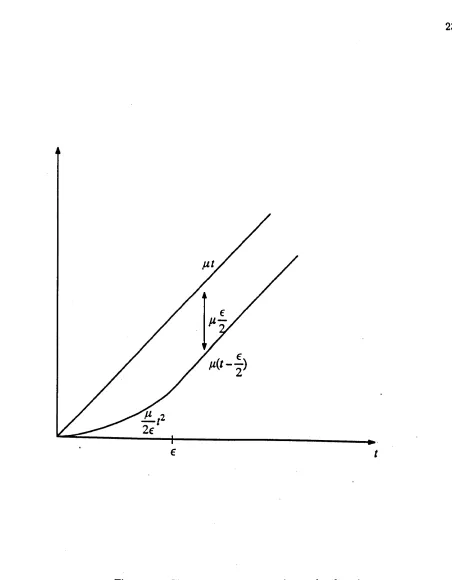
(2.4)
where E is a 'positive scalar, see Figure 2.1. We note that the smooth penalty function
introduced here can be obtained as a special case of the smoothing technique introduced in Bertsekas
[1973]. A
similar technique was used in Zang[1980]
for min-max problems extending the work in Bertsekas[1973].
The smoothing technique introduced in Zang[1980]
is symmetric around the kink while our smoothing approximation is asymmetric. The following can be easily verified:
limp(t)
=
p(t)
e
Figure 2.1: Linear-quadratic smooth penalty function.
23
Let us define
K
F(x,p.)
=lo(x)
+
Ep(/,(x))
,=1
and
K
F(X,P.,f)
=
lo(x)
+
L:p(/,(x))
,=1
(2.6)
(2.7)
We can now state the following result which gives an a priori upper bound on the smoothing approximation error.
Lemma 1. Let the functions F and
F
be as defined by (2.6) and (2.7). Then- f
o
s
ri«,
p.) - F(x, p.,f)
s
Kp."2for any x E
~n,
J.L>
0 and f2:
o.
Proof. Using the definitions of P and
p,
we getV'i
=
1, ... ,K
and x E~nAdding up for all i and multiplying with p.
>
0 we obtainK K E
o
s
Ep(/,(x))
- Ep(/,(x))
s
KI-'"2
1=1 ,=1
V i=l, ... ,K and xE~n
Then the result immediately follows from the definitions of
F
andF.
We propose to solve the following smoothed penalty problem
[SEP)
min
F(:c,
J.L,f)
:t:eX
instead of solving
[EP].
Before we proceed we need the following definition.Definition 1. A vector
x
is e-feasible if'V
i
=
1, ... ,K.(2.8)
(2.9)
(2.10)
•
25
Definition 2. A constraint iis e-violated at
x
if/,(x)
>
ENow we can prove the following result which gives an a priori upper bound on the error in-curred by solving the smooth penalty problem [SEP] in lieu of the nondifFerentiable penalty problem [EP].
Proposition 2. Let x· be an optimal solution of [EP] and
x
be an optimal solution of [SEP] for some p. and E. Then(2.12)
- E
F(x,
1-')
s
F(X,I-',E)+
KJ.'2' (2.13) Proof. Using (2.8), we can immediately rewrite the right inequality asTaking the infimum, we obtain
inf F(x,
1-')
s
lnf F(x,1-', E)
+
KI-'-2E•:EX :EX (2.14)
which proves the right hand inequality. The left hand inequality can be proved similarly
and is omitted.
•
An immediate consequence of Proposition 2 can be obtained if in addition to the assump-tions stated in the proposition, we assume tha.t x· is a feasible thus optimal solution to ~NLP] and
x
is e-feasible for the original problem.(2.15) Proposition 3. Let x· be an optimal solution of [EP] and
x
be an optimal solution of [SEP] for some I-' and E. Furthermore let x· be a feasible solution to [NLP] andx
beProof. By hypothesis,
x
is e-feasible which implies the followingK E
L:p(f,(z»
s
KP.2·i=l
(2.16)
Again by hypothesis, x· is a solution to
[NLP],
which implies thatK
Ep(f,(x·»)
=
O.,=1
(2.17)From Proposition 2, we have
K K
o
s
fo(x·)
+
Ep(f,(x·))
- fo(z) - Ep(f,(x))
s
Kp.~,=1
,=1
(2.18)Substituting (2.16) and (2.17) into (2.18) and rearranging terms the result is established.
-The above assertion does not specify conditions for the penalty parameter p.. It is known, Bertsekas [1975], that for p. larger than the largest of Lagrange multipliers of the original problem
[NLP],
an optimal solution x· to[NLP]
is also an optimal solution for[EP].
This result provided the motivation for designing exact penalty methods, Bertsekas [1982]. The question we address next is how this result is affected by the e-smoothing of the exact penalty function? The answer, as we show, is that although an optimal solution to
[NLP]
does not necessarily coincide with an optimal solution to
[SEP],
its sub optimality can be bounded as a function of the penalty and smoothing parameters. We proceed with a precise statement and proof of this result.Proposition 4. Let
(x·, y.)
be a primal-dual optimal pair for[NLP].
Then for some E2!
°
(2.19)
provided that p.
>
v;
for i=
1, ..• ,K.Proof. For simplicity of exposition, we assume
X
=
R" and defineBy convexity of
Ii
for i=
0, ... ,K we have for a fixed but arbitrary:t
E~nfi (
:t) ~
fi (:t.)
+
\It.(
x· )T
(:t -
x·)
27
(2.20)
Since
(x·, y.)
is a primal-dual optimal pair, by the first-order optimality conditions we have the following:K
\I
fo(x·)
= -E
y;\If,(:z;·)
,=1
y; ~
0 V i=
1, ... ,KUsing (2.20)-(2.21)-(2.22) and the definition of F, we obtain
K
F(x,p.)
~
fo{:t·)
+
\Ifo(x·)T{x
- :t.)
+
p.L
f,+(x)
,=1
K . K
=
fo(z·)
-
E
y;Vf,(:z;·)T(z
- x·)
+
J.'E
ft{:z;)
(using (2.21)),=1
,=1
K K
~
fo{:t·) - Ly;(fi(X)
- f,(x·»
+
p.L
ft(x)
(using (2.20)),=1
i=1
K K
=
fo(:t·) - Ey;
fi(x)
+
P.L
It(x)
(using (2.22)),=1
,=1
Since
f,(x)
~ ft(z)
we haveK
F(:t,p.) ~ fo(x·)
+
L(p,
- y;)ft(x)
,=1
Thus, for p. ~
v;
for i=
1, ... ,K, we getHowever, from Lemma 1, we have
Rewriting (2.24) as
(2.21)
(2.22)
(2.23)
(2.24)
(2.25)
we observe that since x· is also feasible, then
Thus adding up inequalities (2.25) and (2.26) we obtain
-(. ) -( e
F x ,p.,f - F X,p.,f)
s
Kp.'2 (2.27) which establishes the result.•
Therefore the suboptimality of x· in [SEP] is bounded by the quantity Kp.!. It can be observed that as f vanishes one recovers the classical assertion that an optimal solution
to the original problem coincides with an optimal solution to the penalty problem for a finite value of the penalty parameter
u,
Thus, Proposition 4 partially generalizes Proposition 1 of Bertsekas [1975] in this respect. An immediate corollary of Proposition 4 can be stated as follows.Corollary 5. Let
z
be a minimum point ofmin
F(z,
1',f)
z€X
and x· be an optimal point for the original problem
[NLP].
Then(2.28)
provided that J..L
>
yl
fori
=
1, ... ,K.Proof. Immediate from Proposition 4.
•
Proposition 4 also engenders an important consequence together with the following re-sult which is identical to Proposition 3.5 of Zang [1980].
(2.29) Proposition 6. Let {fA:} -+ 0 be a sequence of positive numbers and assume tha.t ZA:
29
for some p,
>
o.
Also letx
be an accumulation point of the sequence{x
k}, thenF(z,p,)
=
F(x(p,),p,)(2.30)
where x(p,) is an optimal solution to
minF(x, p,).
zEX
Proof. The result follows directly from the continuity of F, (2.5), and (2.12). •
Therefore if the penalty parameter p,in Proposition 5 was specified larger than the thresh.
old value p,*, the solutions to
[EP]
and[NLP]
would coincide. Hence, we could hope toobtain a solution to the original problem
[NLP]
in the limit by solving smooth penalty problems for decreasing smoothing parameters fie and increasing penalty parameters ILksince the threshold value p,* is not known in practice. Also, driving E to 0 is not desirable since we recover the nondifferentiable
it
penalty function. On the other hand, we lose the "exactness" property by solving the smooth penalty problem instead of the nondifferen-tiable penalty problem. But we will show in the next section th~t an optimal solution to the smooth penalty problem will violate the constraints at most by a quantity which is a linear function of E if the penalty parameter p,is larger componentwise than some Lagrange multiplier vector of the perturbed problem componentwise. This result is developed in the next section. The main result of the chapter is also given in the next section. We will show that e-feasibility is attained if the penalty problem[SEP)
is solved using a penalty parameter value equal to a constant multiple of the threshold value for the nondifferentiableit
penalty function.2.3
Approximate or e-Exactness
Remark 1. Any primal-dual pair (xt
y)
wherex
is a solution to [SEP] for some f andLagrange multiplier estimate
y
is obtained fromV i
=
1, ... ,K.(2.31)
satisfies the first order optimality conditions with the exception of the complementary slack. ness condition. However, it can be easily shown that the error in complementary slackness is bounded by the quantity JLf. To see this, observe that all constraints are satisfied to within e and that the Lagrange multiplier estimates are given by
V i
=
1, ••• ,K.where
Therefore we have
-2
Yii'Li
=
max{O, J.L'Ui }
V i=
1, ••. ,Kf
However since
il& ::;
E for i=
1, ... ,K the following holds(2.32)
Hence, the assertion is verified.
Remark 2. For e small enough, the pair
(i, y)
almost satisfies the first order optimality conditions by virtue of Remark 1 above. Applying the Standard Implicit Function Theorem to the system of nonlinear equationsh(:z:,y} -
z=
031
for all
z
such thatIzl
:5
J.LE by virtue of the complementary slackness error.The above remarks motivate the effort to compute an e-feasible solution to the original problem by solving the smooth penalty problem [SEP]. We will frequently refer to e or 6-perturbation of problem [NLP] in the sequel. We' allude to the following problem:
minimize
x
«
x
subject to
lo(z)
li(z)
:5
6 V i=
1,... ,Kwhere 6 is a positive scalar. We begin by stating a result which gives a partial charac-terization of an optimal solution to the smooth penalty problem with regard to f-feasibility.
minF(x, J.L,
f)
zeX
Proposition 7. Let £ be an optimal solution to
Proof. We will argue by contradiction. Assume £ is a point such that all constraints are violated beyond E at £. By simple algebraic manipulation,
K K
lo{i)
+
P.~(/i{i)
-
i)
=
lo{£)
+
P.~(/i{£)
- E)
+
Kp.~
1=1 1=1
(2.34) Suppose also that
(s,
y)
is a primal-dual optimal pair for a E perturbation to [NLP]. Thenthere is at least one i
e
I=
{I, ... ,K} such thatprovided that
p.
>
Yi V
i
=
1, ... ,K (2.33)Using (2.33), the definition of a Lagrange multiplier Rockafellar [1970], and the e-feasibility of
x
we have the followingK E