RESEARCH
ZNF300 tight self-regulation
and functioning through DNA methylation
and histone acetylation
Feng‑Juan Yan
1†, Jingyi Fan
2*†, Zan Huang
1and Jun‑Jian Zhang
3*Abstract
Background: Accumulating evidence demonstrates that the KRAB‑ZNFs involve in various biological processes. As a typical member of KRAB‑ZNFs, dysregulation of ZNF300 contributes to multiple pathologies such as leukemia and cancer. However, mechanisms underlying ZNF300 tight regulation and its pathophysiological function remain largely unknown.
Methods: The effect of ZNF300ZFR on gene transcriptional activity was measured by Dual luciferase reporter system. ChIP‑PCR assay were performed to detect the enrichment of ZNF300 protein and H3K9Ac in the ZNF300 gene. Co‑ immunoprecipitation assays followed by western blot were performed to detect the interaction between ZNF300 and KAP1. The DNA methylation in the ZNF300 gene promoter was analyzed by BSP. ZNF300 function on K562 cell differentiation was analyzed by flow cytometry.
Results: In this study, we found that the zinc finger domain‑encoding region (ZFR) of ZNF300 functioned as a repressor possibly by mediating DNA methylation and ZNF300 bound to its ZNF300ZFR, suggesting a potential auto‑inhibition mechanism. To support this, DNA methylation inhibition upregulated ZNF300 expression and ZNF300 overexpression inhibited endogenous ZNF300 expression. More importantly, DNA methylation inhibition restored megakaryocyte differentiation in K562 cells suppressed by ZNF300 downregulation, suggesting an important role of DNA methylation in ZNF300 function. Interestingly, ZNF300 knockdown restored global H3K9Ac that was reduced in K562 cells undergoing megakaryocyte differentiation.
Conclusions: Our study revealed novel features of ZNF300 that possibly mediate its regulation and function by modulating epigenetic modifications.
Keywords: KRAB‑ZFP, ZNF300, DNA methylation, Histone acetylation
© The Author(s) 2017. This article is distributed under the terms of the Creative Commons Attribution 4.0 International License
(http://creativecommons.org/licenses/by/4.0/), which permits unrestricted use, distribution, and reproduction in any medium,
provided you give appropriate credit to the original author(s) and the source, provide a link to the Creative Commons license,
and indicate if changes were made. The Creative Commons Public Domain Dedication waiver (http://creativecommons.org/
publicdomain/zero/1.0/) applies to the data made available in this article, unless otherwise stated.
Background
Krüppel-associated box-containing zinc finger pro-teins (KRAB-ZFPs) belong to the largest gene family of transcription factors in eukaryotes [1], which makes up approximately one-third of the zinc finger proteins iden-tified in human genome. Typical KRAB-ZFPs contain KRAB domain and zinc finger domain linked by a spacer
region. The KRAB domain consists of one or both of A box and B box [2], of which the A-box is highly conserved and plays a key role while the B-box is less conserved and plays an auxiliary role [3]. The KRAB domain acts as a transcriptional repressor by recruiting corepressor pro-teins such as KAP1, HP1, HDAC and Setdb1 [4–7] and induces heterochromatin formation through DNA meth-ylation, histone modifications [8–10], and nucleosome remodeling [11]. The zinc finger domain of KRAB-ZNFs contains 4–30 zinc finger motifs (C2H2 type) and binds to DNA. In addition, two adjacent zinc finger motifs are usually connected by a highly conserved sequence “TGEKPYX” [12].
Open Access
*Correspondence: [email protected]; [email protected] †Feng‑Juan Yan and Jingyi Fan contributed equally to this work 2 Department of Pediatrics, Zhongnan Hospital of Wuhan University, Wuhan 430072, Hubei, People’s Republic of China
3 Department of Neurology, Zhongnan Hospital of Wuhan University, Wuhan 430072, Hubei, People’s Republic of China
Accumulating evidence demonstrates that different members of the KRAB-ZNFs involve in various biologi-cal processes such as stem cell biology [13], cell cycle regulation [14], methylation of imprinted genes [15], suppression of endogenous retroviruses [16], and sper-matogenesis [17]. Dysregulation of KRAB-ZFPs has been indicated in multiple pathological processes including tumor and leukemia formation. For instance, ZNF268b2 expression is associated with cervical cancer [18] while ZNF300 expression correlates to blood cell maturation and leukemogenesis possibly by affecting terminal dif-ferentiation of blood cells [19]. As a typical member of KRAB-ZNFs, ZNF300 encodes a KRAB domain and zinc finger domain with 12 zinc finger motifs of C2H2 type, which binds to the consensus sequence C(t/a) GGGGG(g/c)G. The ZNF300-binding sites have been found in the promoter regions of multiple genes such as IL-2, IL2RB, CD44, TP53, TNFα, TRAF2 [20]. In addi-tion, ZNF300 has been shown to act as a signaling mol-ecule to enhance NF-κB signaling and promote cervical cancer cell proliferation [21]. Nevertheless, ZNF300 tar-get genes have not been well characterized and how ZNF300 controls target genes remains unclear.
In this study, we discovered that the last exons of KRAB-ZFPs encoding the zinc finger domain medi-ated auto-inhibition of gene transcription. As a model, ZNF300 bound to its zinc finger domain-encoding region and induced DNA methylation. ZNF300 also altered histone 3 lysine 9 acetylation in leukemic cells that was forced to undergo terminal differentiation. Furthermore, interfering epigenetic modifications overwhelmed the effect of ZNF300 depletion. Our study reveals novel fea-tures of ZNF300 regulation and function. These findings help us understand the nature of KRAB-ZFPs.
Methods
Cell culture and compound treatment
HEK (human embryonic kidney)-293T cells were main-tained in a complete Dulbecco’s modified Eagle’s medium and K562 was cultured in a complete RPMI 1640 medium (Gibco BRL, Grand Island, NY, USA) both of which were supplemented with 10% fetal bovine serum and peni-cillin/streptomycin and were cultured in a humidified chamber with 5% CO2 atmosphere at 37 °C. For com-pound treatment, 5-aza-2′-deoxycytidine (5-AzadC, 5 μM), and 12-O-tetradecanoylphorbol 13-acetate (PMA, 10 nM) were used.
Retroviral and lentiviral transduction
For enforced expression of ZNF300, lentivirus system (pHAGE vector) was used. Lentivirus packaging and infection were performed as previously described [22, 23]. All vectors carried puromycin-resistant gene and the
transduced cells were selected with puromycin (2 μg/mL) for a week to obtain stable cell lines. ZNF300 was fused with a Flag tag in the C-terminal. Empty plasmids were used as control vector.
Dual luciferase activity assay
All luciferase reporter constructs expressed firefly lucif-erase and assays were performed in 293T cells. Briefly, 3.0 × 10⁴ 293T cells were seeded (48-well plate) the day before transfection. When cells reached to 70% conflu-ence, firefly luciferase reporter plasmid in combination with other plasmids as indicated in the figures were used for transfection. Same amount of pRL-TK expressing Renilla luciferase was used in all samples and served as internal control. The total amount of plasmids in each transfection was kept constant by using empty vector where required. Cells were lysed 24 h post-transfection with Passive Lysis Buffer and the dual luciferase activity was assayed by the dual-luciferase reporter assay accord-ing to the manufacturer’s instructions (Dual-Luciferase Reporter Assay System, Promega, Madison, WI, USA). The firefly luciferase activity was normalized to the Renilla luciferase activity and presented as relative lucif-erase activity. Values were mean ± SD from three inde-pendent experiments. All of the transfection assays were performed with transfection reagent polyethyleneimine “MAX” (Polysciences Inc).
RNA isolation and quantitative RT‑PCR
Total RNA was extracted from cells using TRIzol reagent (Invitrogen, Grand Island, NY, USA) according to the man-ufacturer’s instructions. cDNA was synthesized by M-MLV (Moloney murine leukaemia virus) reverse transcriptase (Invitrogen, Grand Island, NY, USA) from 2 μg of total RNA. Quantitative PCR was carried out under the follow-ing conditions: 95 °C for 15 min followed by of 95 °C for 30 s, 63 °C for 30 s and 72 °C for 30 s for 40 cycles. The reac-tions were performed using the Power SYBR Green PCR Master Mix with triplicates on the ABI7500 real-time PCR System (Applied Biosystems). For each primer set, the Ct value was normalized to that of GAPDH (glyceraldehyde-3-phosphate dehydrogenase) as inner control, which was further normalized to that of control sample. The relative quantitation of PCR product was measured using the com-parative ΔΔCt method and presented as relative mRNA level. Primer sequences are available upon requested.
Plasmid construction
CMV, LTR, and ZNF300 gene promoter (−1900 to +150 relative to the transcription start site) were amplified by PCR and subcloned into pGL3-promoter vector between
XhoI and HindIII sites to replaced SV40 promoter. To construct gRNA expressing vectors, the gRNA sequences targeting zinc finger domain-encoding region of ZNF300 were determined by online gRNA searching tool (http:// crispr.mit.edu/) and blasted at NCBI to avoid off-target. The sequences of gRNA for human ZNF300 are listed as following: gRNA#1, GAATTCGCTGGTGTCC-CGGA; gRNA#2, GCCGTATGAGTGTACCGAATG; gRNA#3, GCCCGCATTCACTACATTCAT; gRNA#4, GCCTATGAATGTAGAGAGTGT; gRNA#5, GAGTT-GTGACTTCTTAGCAA; gRNA#6, GTACAGTTAGTT-GTGACTTC. Two complementary oligonucleotide strands annealed to form a double strand structure and subcloned into the pGL3-U6-gRNA-puromycin vector.
Methylation‑specific PCR (MSP) and bisulfite sequencing
293T cells were transfected with pGL3-ZNF300pro-luc plasmids with or without zinc finger domain-encod-ing region of ZNF300 on the downstream. The plasmid DNA was extracted from the transfected cells accord-ing to the manufacturer’s instructions and treated with sodium bisulfite using the EZ DNA Methylation-Gold Kit™ following the manufacturer’s guidelines. One to two ng of sodium bisulfite-converted plasmid DNA was used as a template for methylation specific PCR (MSP). For MSP we designed primer pairs for ZNF300 gene pro-moter. Primers for DNA analysis were designed using the Methprimer Software (http://www.urogene.org/ methprimer/). PCR was conducted using a pfu DNA pol-ymerase (Thermo Scientific), with an initial denaturation step at 95 °C for 10 min, followed by 35 cycles of dena-turation at 95 °C for 30 s, annealing at the respective Tm for each set of primers for 30 s, and extension at 72 °C for 1 min. PCR amplicons were purified with a PCR purifi-cation Kit. The PCR fragments were ligated into pGEM-T Easy vector (Promega, Madison, WI, USA). Cloned plasmids were transformed into DH5α competent cells. Transformed cells were selected using LB/ampicillin agar plates. Colonies were randomly picked to extract plasmid DNA for sequencing. During bisulfite conver-sion, cytosines (C) are converted into thymidines (T), but 5-methylcytosines remain unaltered. DNAMan program was used for sequence alignment and analysis.
Chromatin immunoprecipitation assay
ChIP assays were performed by using antibod-ies specific for Flag tag (Cat# F3165, Sigma), ZNF300 (Cat#SAB2102853, Sigma), acetylated histone 3 lysine 9 (Cat# 9649,CST), or a normal mouse/rabbit IgG as pre-viously described [22]. The chromatin DNA enrichment
of the zinc finger domain-encoding region and promoter regions of ZNF300 gene, or the control region of GAPDH
gene promoter was determined by quantitative PCR. The relative occupancy was calculated by 2(C
t _IP − C
t _Input).
GAPDH promoter served as negative control region. Primer sequences are available upon requested.
Co‑immunoprecipitation assay
The ZNF300 and KAP1 gene were cloned into a vector containing a Flag or HA tag. The plasmids were tran-siently transfected into the 293T cells. After 24 h, the transfected cells were lysed as previous described [23]. Cell lysates were incubated with the appropriate mono-clonal antibody Flag, as well as 30 μL of a GammaBind Plus-Sepharose (GE Healthcare, Logan, UT, USA). After an overnight incubation at 4 °C, the Sepharose beads were washed five times with 1 mL of lysis buffer. The immunoprecipitates were fractionated by SDS-PAGE, and western blot analysis was performed. All the immu-noprecipitation experiments were repeated three times, and similar data were obtained.
Statistical analysis
Data combined from three or more independent experi-ments are given as the mean ± STDEV. All statistical analyses were performed using the Student’s t test (two-tailed, unpaired). A p value of 0.05 or less was considered significance.
Results
Zinc finger domain‑encoding regions of KRAB‑ZFPs mediate gene suppression
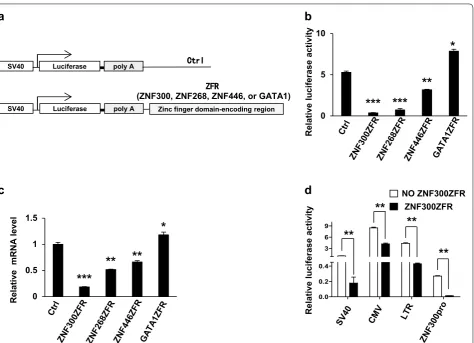
ZNF446ZFR downregulated the mRNA level of firefly luciferase gene proportional to luciferase protein activ-ity reduction while GATA1ZFR did not (Fig. 1c). These results suggest that the ZFRs of KRAB-ZNFs encoding zinc finger domain of these genes may act as a cis-ele-ment to mediate gene suppression.
To exclude that the inhibitory effect of ZFRs may be specific for SV40 promoter, ZNF300ZFR was used as a model for further experiments and the SV40 was replaced with CMV promoter, LTR (long terminal repeat from HIV-1), or ZNF300 gene promoter (ZNF300pro, nucleotides −1900 to +150 relative to the transcrip-tion start site). Without ZNF300ZFR (NO ZNF300ZFR), these promoters all nicely drove luciferase expression (Fig. 1d). Once ZNF300ZFR was placed on the down-stream, the luciferase activities were significantly reduced
(Fig. 1d). These results suggest that the inhibitory effect of ZFRs is universal for different promoters.
Collaboration of multiple zinc finger motifs is required for optimal inhibition function of ZNF300ZFR
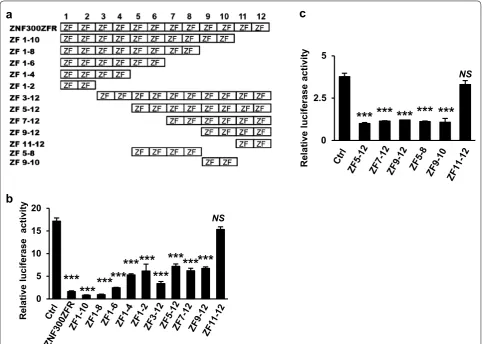
To further map the precise regions within ZNF300ZFR that were responsible for transcription repression, a serial truncation forms of ZNF300ZFR were constructed and subcloned into the luciferase reporter vector as described above. Each time, two DNA encoding zinc finger motif from the 3′ of ZFR was deleted (Fig. 2a). For instance, ZF1-10 represents the truncated ZFR spanning from the 1st to the 10th zinc finger motif-encoding regions of ZNF300ZFR and so on. As shown in Fig. 2b, c, the inhibi-tory activity of ZF1-10 and ZF1-8 was comparable to that of full length ZNF300ZFR whereas ZF1-6 started to
Re
lative
mR
NA
level
***
** **
*
0 0.5 1 1.5
a
c
d
*** ***
**
*
0 5 10
Re
lative
luci
ferase
activit
y
b
Luciferase poly A
SV40 &WUO
=)5
(ZNF300, ZNF268, ZNF446, or GATA1)
Luciferase poly A Zinc finger domain-encoding region SV40
Re
lative
luci
ferase
activity
0.0 0.2 0.4 3 6 9
**
**
**
**
ZNF300ZFR NO ZNF300ZFR
loose inhibitory activity and a significant proportion of inhibitory activity was lost for ZF1-4 and ZF1-2, suggest-ing a critical role of zinc fsuggest-inger motif-encodsuggest-ing regions from the 5th to 8th zinc finger motif (ZF5-8). Consist-ent with intact inhibitory function of ZF1-10, ZF11-12 completely lost the suppression ability. In contrast, trun-cations deleted from 5′ including ZF5-12, ZF7-12, and ZF9-12 retained similar inhibition ability comparable to that of ZF1-2 and ZF1-4, suggesting regions from the 9th to 10th zinc finger motif-encoding region (ZF9-10) may be important. Similarly, significant loss of inhibition abil-ity of ZF3-12 compared to that of ZNF300ZFR suggested an important role of zinc finger motif-encoding regions from the 1st to 2nd zinc finger motif (ZF1-2). However, further test showed that ZF1-2, ZF5-8, and ZF9-10 pos-sessed similar inhibition ability to that of ZF5-12, ZF7-12, and ZF9-12. Altogether, these observations suggest
that collaboration of multiple zinc finger motif-encoding regions is required for optimal inhibition function of ZNF300ZFR.
The ZNF300 protein directly binds to ZNF300ZFR
Based on our observations, we hypothesized that ZFR recruited inhibitory machinery to suppress gene tran-scription. Therefore, blocking the inhibitory machin-ery binding to the ZFR would ameliorate its inhibition. To achieve this, we took advantage of CRISPR/Cas9 technique. Recent studies showed that recruitment of the nuclease-deficient Cas9 (dCas9 with D10A and H840A mutations) to the interested gene loci directed by sequence-specific guide RNAs (gRNAs) potently regulated gene expression through sterically competing with potential transcription regulatory factors [26]. In addition, dCas9 may exert enhanced ability to inhibit or
*** *** *** *** ***
NS
0 2.5 5
a
b
c
Re
lative
lucife
rase
activit
y
***
******
***
******
***
*********
NS
0 5 10 15 20
Re
lative
lucife
rase
activit
y
e
HSC70 Flag Ctrl ZNF300 Blot
0 2 4 6
Ctrl ZNF300
Re
lative
mRNA
level
**
f
0 0.0005 0.001 0.0015
ZNF300
ZFR
Re
lative
enrichment
NS
**
FlagIgG
g
0 0.3 0.6 0.9 1.2
Relative luciferase
activity
***
#
h
GAPDH
promoter
0 0.005 0.01 0.015 0.02
ZNF300ZF GAPDH ZNF300 IgG
NS
**
Re
lative
enrichment
ZNF300
ZFR GAPDHpromoter
d
a
c
**
***
*
***
** ** *
***
0 5
10 SV40 promoter+dCas9-VP64
Relative
luciferase
activity
** ** *
**
*
**
*
**
0
2
4
SV40 promoter+dCas9Re
lative
lucife
rase
activity
Re
lative
lucife
rase
activit
y
**
***
**
***
**
**
**
***
0 0.5 1 1.5
2 ZNF300 promoter+dCas9-VP64
b
*
**
* ** *
**
*
**
0 0.5 1
1.5 ZNF300promoter+dCas9
Re
lative
lucife
rase
activit
y
i
**
0 2 4 6 8
Vehicle PMA Ctrl
ZNF300
NS
Re
lative
endogenous mRNA
leve
activate gene expression by fusing with KRAB or VP64 (suppression or activation domain, respectively) [26, 27]. To test this possibility, six pairs of gRNAs specific for different regions of ZNF300ZFR were designed. Firefly luciferase reporter vectors with ZFR on the downstream as described in Fig. 1d and dCas9 expressing vector in recombination with vectors expressing various gRNAs were co-transfected into 293T cells. As expected, the luciferase activity driven by SV40 or ZNF300 gene pro-moter was significantly increased by gRNAs (around two-folds increase) compared to control (Fig. 3a, b). Notably, the effect was more dramatic when dCas9-VP64 (dCas9 fused with the activation domain VP64) was overex-pressed (Fig. 3c, d). These results demonstrate that dCas9 recruitment to the ZNF300ZFR directed by gRNAs effec-tively antagonizes the inhibitory effect of ZNF300ZFR. These observations support our idea that inhibitory machinery may be recruited to the ZNF300ZFR.
A recent KAP1 ChIP-Seq study showed significant enrichment of KAP1 on the 3′ end of the KRAB-ZFP genes including ZNF300 [28]. Since KAP1 is a primary partner of KRAB-ZFPs, KRAB-ZFPs might form com-plex with KAP1 and bind to ZFR to mediate gene sup-pression. Interestingly, sequence analysis revealed two putative ZNF300-binding sites [consensus sequence C(t/a)GGGGG(g/c)G] between the second and the forth zinc finger motif-encoding region in ZNF300ZFR [20]. Thus, we speculated that ZNF300 might bind to its own ZFR and mediate the inhibitory effect of ZNF300ZFR. To test this, an exogenous Flag-tagged ZNF300 (Fig. 3e) was overexpressed through lentiviral transduction and ChIP-PCR with Flag antibody was performed to detect ZNF300 binding to this putative site. As shown in Fig. 3f, the DNA amount of the putative ZNF300-binding site co-immuno-precipitated by Flag antibody was much more (enriched by approximate ninefolds) than that by normal mouse IgG control antibody. As a negative control, the amount
of DNA from GAPDH promoter region was comparable in both groups. Moreover, an antibody recognizing the endogenous ZNF300 was also used to perform ChIP-PCR. Again, a significant enrichment in the putative ZNF300-binding site was observed in ZNF300 antibody group compared to normal rabbit IgG control (Fig. 3g). These data demonstrate that ZNF300 is able to bind to its endogenous ZFR locus. To further demonstrate the important role of ZNF300-binding in the inhibitory effect of ZNF300ZFR, the ZNF300-binding sites was mutated (ZNF300ZFR-M) by replacing the core sequence GGGG with ATAT. ZNF300ZFR-M showed reduced ability to suppress the luciferase activity compared to intact ZNF300ZFR (Fig. 3h). Our previous study showed that PMA treatment promoted megakaryocyte differen-tiation and upregulated ZNF300 expression in K562 cells [19]. Finally, we demonstrated that the upregulation of endogenous ZNF300 mRNA by PMA was reduced by the overexpression of the exogenous ZNF300 (Fig. 3i). Col-lectively, our data indicate that ZNF300 directly binds to ZNF300ZFR and may mediate the self-regulation of ZNF300 from its endogenous locus.
ZNF300ZFR mediates DNA methylation
KRAB-ZFPs are known to recruit KAP1 that subse-quently mediate heterochromatin formation by inducing long range of epigenetic modification changes including DNA methylation [28–30]. Our experiment confirmed the ability of ZNF300 to recruit KAP1 (Fig. 4a). There-fore, whether ZNF300ZFR mediated DNA methylation was further tested. By using online software MethPrimer program, a CpG island region containing 13 CpG sites between nucleotides −90 to +41 relative to the transcrip-tion start site was identified (Fig. 4b). Then the luciferase report vector directed by ZNF300 promoter (ZNF300pro) with or without ZNF300ZFR on the downstream as described in Fig. 1d was transfected into 293T cells. The
(See figure on previous page.)
Fig. 3 The ZNF300 protein directly binds to ZNF300ZFR. a, b 293T cells were co‑transfected with firefly luciferase reporter vector driven by SV40 promoter (a) or ZNF300 promoter (b) with ZNF300ZFR on the downstream of polyA element as described in Fig. 1d, inner control renilla luciferase reporter vector, dCas9 expressing vector, and in combination with different gRNAs specific for ZFR of ZNF300 as indicated. The promoter activity was measured, normalized, and presented as relative luciferase activity. c, d Same experiment procedure as described in a, b except that the dCas9 expressing vector was replaced with a vector expressing dCas9 fused with VP64. *, **, and *** indicate significance compared to control (p < 0.05, p < 0.01, and p < 0.001, respectively). Data (mean ± STDEV) are statistics of one representative results (triplicates) from three independent experi‑ ments with similar results. e K562 cells were transduced with control lentiviral vector (Ctrl) or a lentiviral vector expressing ZNF300. The exogenous ZNF300 protein in the resultant cells was detected by Western blot using antibody specific to Flag tag fused to exogenous ZNF300 (left panel). HSC70 serves as a loading control. The relative expression level of ZNF300 mRNA in the resultant cells was measured using quantitative RT‑PCR
(right panel). f K562 cells overexpressing Flag‑ZNF300 were cross‑linked and used for ChIP assay with Flag antibody or normal mouse IgG. The DNA
a
CD61
M
ax%
Ctrl Vehicle
Ctrl PMA ZNF300 VehicleZNF300 PMA Flag
Flag HA HA
Ly
sate
sIP:
Flag
Flag-ZNF300 - + HA-KAP1 + +
d
b
-90 -75 -72 -56 -50 -29 -13 -4 0+5 +11 +15+31 +41:Non-methylated CpG :Methylated CpG
M
ax%
CD61 CD61
Ma
x%
shZNF300#2 shZNF300#4
Vehicle 5-AzadC PMA PMA/5-AzadC
f
c
HSC70 ZNF300
Blot Vehicle 5-AzadC
0 1 2
5-AzadC
Re
lative
mRNA
leve
l
**
Vehicle
e
CD61 Vehicle
5-AzadC PMAPMA/5-AzadC
M
ax%
Fig. 4 ZNF300ZFR mediates DNA methylation. a A co‑immunoprecipitation assay was performed in HEK293T cells co‑transfected with Flag‑ZNF300 and HA‑KAP1 to examine the interaction between ZNF300 and KAP1. b Schematic illustrations show the position of CpG sites (circles). The arrow
indicates the transcription start position and numbers indicate the position of CpG sites relative to transcription start site (upper). Bisulfite sequenc‑ ing analysis the methylated CpGs in the ZNF300 promoter (ZNF300pro) with ZNF300 ZFR on the downstream as described in Fig. 1d. Black circles
a
H3 H3K9me3
H3K9Ac
Vehicle PMA Blot
b
H3 H3K9me3 PMA
Vehicle
H3K9Ac Blot
ZNF300 promoter +95
-1895 R1
R1˖-1509— -1262bp R2: -647— -478bp
R3: -1280—-1126bp R4: -480—-244bp
Zinc Finger Region ZF
R2 R4 R3
c
NS NS NS
*
*
*
R1 R2 R3 R4 ZF GAPDH
promoter
ZNF300 Ctrl
0 0.5 1 1.5 2
Re
lative
enrichment
0 0.5 1
1.5 Ctrl shZNF300#2 shZNF300#4
Vehicle PMA Vehicle PMA
H3K9me3 H3K9Ac
0 0.5 1
1.5 Ctrl ZNF300
Vehicle PMA Vehicle PMA H3K9me3 H3K9Ac
Fig. 5 The ZNF300 alters histone 3 lysine 9 acetylation. a, b Control (Ctrl), ZNF300 knockdown (shZNF300#2 and 4), or ZNF300 overexpression K562 cells were stimulated with vehicle or PMA and harvested for Western blot to measure H3K9 acetylation (H3K9Ac) and 3‑methyl‑H3K9 (H3K9me3)
(left panel). Histone3 (H3) serves as loading control. All data are representative blots from two independent experiments with similar results and
right panel was the average densitometry of the Western blot relative to the control. c Control (Ctrl) and ZNF300 overexpression K562 cells treated
with PMA were harvested for ChIP assay with anti‑H3K9Ac antibody. The DNA amount of ZNF300 gene promoter (indicated as R1, R2, R3, R4 in the
top panel), ZNF300 zinc finger domain‑encoding region (indicated as ZF in the top panel), and GAPDH gene promoter was quantified, normalized,
DNA methylation in the ZNF300 gene promoter was ana-lyzed by BSP. In total, 15 clones were picked for sequenc-ing in both groups. As control, ZNF300pro without ZNF300ZFR on the downstream did not show any meth-ylated CpG sites (data not shown). In contrast, 9 out of 15 colonies showed methylated CpG sites and 35 methyl-ated CpG sites were identified in total 195 CpGs (17.9% methylated CpG sites) (Fig. 4b). These observations sug-gest that ZNF300 binding to the ZNF300ZFR may induce DNA methylation and subsequently inhibit ZNF300 gene expression. To support this idea, a potent demethylating reagent 5-aza-2′-deoxycytidine (5-AzadC, optimal dos-age of 5 μM that did not cause obvious cell death in 24 h) increased ZNF300 expression at both mRNA level and protein level (Fig. 4c). It was verified that ZNF300 upregu-lation enhanced megakaryocyte differentiation induced by PMA (Fig. 4d). Furthermore, 5-AzadC treatment alone promoted megakaryocyte differentiation comparable to that of PMA and enhanced the effect of PMA (Fig. 4e), suggesting an important role of DNA methylation in this biological process. More importantly, 5-AzadC treat-ment restored megakaryocyte differentiation suppressed by ZNF300 knockdown as previously reported [19] (shZNF300#2 and shZNF300#4) (Fig. 4f). Taken together, our results suggest that ZNF300 tight regulation and functioning may involve DNA methylation.
The ZNF300 alters histone 3 lysine 9 acetylation
Heterochromatin formation caused by KRAB-ZNFs also involves HDAC [31]. Therefore, whether ZNF300 func-tioned to alter histone acetylation was tested by meas-uring the global histone 3 lysine 9 acetylation (H3K9Ac) and H3K9 tri-methylation (H3K9me3), markers for chro-matin in open or close status, respectively. At baseline level, ZNF300 downregulation or overexpression did not change H3K9Ac and H3K9me3 status (Fig. 5a, b). However, PMA-induced megakaryocyte differentiation caused decrease of H3K9Ac whereas ZNF300 knock-down reversed the phenotype (Fig. 5a). Consistently, ZNF300 overexpression showed opposite phenotype: H3K9Ac was further decreased by ZNF300 upon PMA induction (Fig. 5b). In contrast, H3K9me3 was reduced in ZNF300 knockdown cells but no change in ZNF300-overexpressing cells (Fig. 5a, b). Furthermore, the altera-tion of H3K9Ac in the ZNF300 promoter region and ZNF300ZFR was confirmed by ChIP-PCR (Fig. 5c). Our results suggest that ZNF300 may alter H3K9Ac.
Discussion
Dysregulation of ZNF300 contributes to multiple pathol-ogies including leukemia and cancer [19, 21, 24]. Under-standing how ZNF300 are tightly regulated and how ZNF300 functions are critical to reveal full picture of
ZNF300. In this study, we revealed several novel points regarding ZNF300 function and regulation, which might be common features of KRAB-ZFPs.
Our study revealed an important role of zinc finger domain-encoding regions in regulating the expression of KRAB-ZFP genes. We provided the first line of evi-dence showing that the zinc finger domain-encoding regions from different KRAB-ZFP genes acted as repres-sive cis-elements (Fig. 1b, c). One previous study showed that KAP1, the primary partner of KRAB-ZFPs, was enriched at the 3′ ends of KRAB-ZNF genes, suggest-ing that KRAB-ZNFs may be recruited to these sites and restrict their expression. In our study, we found that ZNF300 bound to ZNF300ZFR (Fig. 3f, g) and repressed ZNF300 expression by inducing epigenetic modification (Figs. 4, 5). These observations suggests that ZNF300 may repress its own expression. Further UCSC genome browser search showed that ZNF274 might bind to this region. Interestingly, further database analysis revealed that ZNF274 was enriched on its own zinc finger-coding region as well as other KRAB-ZNF zinc finger domain-encoding regions. ZNF263 ChIP-Seq dataset also showed enrichment on zinc finger domain-encoding regions of multiple KRAB-ZFP genes (UCSC genome browser). Therefore, self-inhibition or multilateral inhibition may exist in KRAB-ZFP genes. One can imagine that differ-ent KRAB-ZFPs may function in synergy or antagonism. Thus further study on the interaction among KRAB-ZFPs may be important to understand their functions.
Our study also demonstrated that ZNF300 mediated histone modifications in pathological conditions. It is well known that KRAB-ZFPs mediate long-range DNA methylation. However, whether KRAB-ZFPs also mediate histone modifications is not well established, although HDACs are shown to be components in KRAB-ZFP/ KAP1 complex. In our study, we showed ZNF300 medi-ated global change of H3K9Ac and H3K9me3 in K562 cells undergoing megakaryocyte differentiation. Consid-ering that ZNF300 dysregulation contributed to multiple pathological processes, ZNF300 dysregulation may be important to cause or maintain altered histone modifi-cations observed in these pathologies. Further study on how ZNF300 regulates histone modifications may help understand the mechanism leading to altered histone modifications in these pathologies.
In conclusion, our evidence supports that there may exist an unveiled mechanism of ZNF300 self-repression via binding to its own zinc finger domain-encoding region. Our study may put forward new insights into understanding of KRAB-ZFPs.
Authors’ contributions
analysis and interpretation; F‑JY and ZH drafted the paper. All authors read and approved the final manuscript.
Author details
1 College of Life Science, Wuhan University, Wuhan 430072, Hubei, People’s Republic of China. 2 Department of Pediatrics, Zhongnan Hospital of Wuhan University, Wuhan 430072, Hubei, People’s Republic of China. 3 Department of Neurology, Zhongnan Hospital of Wuhan University, Wuhan 430072, Hubei, People’s Republic of China.
Acknowledgements
Not applicable.
Competing interests
The authors declare that they have no competing interests.
Availability of data and materials
All data generated or analysed during this study are included in this published article.
Funding
This work was supported by the National Natural Science Foundation of China (31371481 and 81670140 to Z. Huang).
Publisher’s Note
Springer Nature remains neutral with regard to jurisdictional claims in pub‑ lished maps and institutional affiliations.
Received: 6 April 2017 Accepted: 20 June 2017
References
1. Bellefroid EJ, Poncelet DA, Lecocq PJ, Revelant O, Martial JA. The evolutionarily conserved Kruppel‑associated box domain defines a subfamily of eukaryotic multifingered proteins. Proc Natl Acad Sci USA. 1991;88:3608–12.
2. Huntley S, Baggott DM, Hamilton AT, Tran‑Gyamfi M, Yang S, et al. A com‑ prehensive catalog of human KRAB‑associated zinc finger genes: insights into the evolutionary history of a large family of transcriptional repressors. Genome Res. 2006;16:669–77.
3. Vissing H, Meyer WK, Aagaard L, Tommerup N, Thiesen HJ. Repression of transcriptional activity by heterologous KRAB domains present in zinc finger proteins. FEBS Lett. 1995;369:153–7.
4. Frietze S, O’Geen H, Blahnik KR, Jin VX, Farnham PJ. ZNF274 recruits the histone methyltransferase SETDB1 to the 3′ ends of ZNF genes. PLoS ONE. 2010;5:e15082.
5. Medugno L, Florio F, De Cegli R, Grosso M, Lupo A, et al. The Kruppel‑like zinc‑finger protein ZNF224 represses aldolase A gene transcription by interacting with the KAP‑1 co‑repressor protein. Gene. 2005;359:35–43. 6. Urrutia R. KRAB‑containing zinc‑finger repressor proteins. Genome Biol.
2003;4:231.
7. Wang W, Cai JY, Wu YL, Hu L, Chen ZY, et al. Novel activity of KRAB domain that functions to reinforce nuclear localization of KRAB‑con‑ taining zinc finger proteins by interacting with KAP1. Cell Mol Life Sci. 2013;70:3947–58.
8. Ayyanathan K, Lechner MS, Bell P, Maul GG, Schultz DC, et al. Regulated recruitment of HP1 to a euchromatic gene induces mitotically heritable, epigenetic gene silencing: a mammalian cell culture model of gene variegation. Genes Dev. 2003;17:1855–69.
9. Kim SS, Chen YM, O’Leary E, Witzgall R, Vidal M, et al. A novel member of the RING finger family, KRIP‑1, associates with the KRAB‑A transcrip‑ tional repressor domain of zinc finger proteins. Proc Natl Acad Sci USA. 1996;93:15299–304.
10. Moosmann P, Georgiev O, Le Douarin B, Bourquin JP, Schaffner W. Tran‑ scriptional repression by RING finger protein TIF1β that interacts with the KRAB repressor domain of KOX1. Nucleic Acids Res. 1996;24:4859–67. 11. Ecco G, Cassano M, Kauzlaric A, Duc J, Coluccio A, et al. Transposable ele‑
ments and their KRAB‑ZFP controllers regulate gene expression in adult tissues. Dev Cell. 2016;36:611–23.
12. Huang XQ, Yuan WZ, Huang W, Bai Y, Deng Y, et al. ZNF569, a novel KRAB‑ containing zinc finger protein, suppresses MAPK signaling pathway. Biochem Biophys Res Commun. 2006;346:621–8.
13. Castro‑Diaz N, Ecco G, Coluccio A, Kapopoulou A, Yazdanpanah B, et al. Evolutionally dynamic L1 regulation in embryonic stem cells. Genes Dev. 2014;28:1397–409.
14. de Sio FRS, Massacand J, Barde I, Offner S, Corsinotti A, et al. KAP1 regu‑ lates gene networks controlling mouse B‑lymphoid cell differentiation and function. Blood. 2012;119:4675–85.
15. Mackay DJ, Callaway JL, Marks SM, White HE, Acerini CL, et al. Hypo‑ methylation of multiple imprinted loci in individuals with transient neonatal diabetes is associated with mutations in ZFP57. Nat Genet. 2008;40:949–51.
16. Wolf D, Goff SP. Embryonic stem cells use ZFP809 to silence retroviral DNAs. Nature. 2009;458:1201–4.
17. Looman C, Mark C, Åbrink M, Hellman L. MZF6D, a novel KRAB zinc‑finger gene expressed exclusively in meiotic male germ cells. DNA Cell Biol. 2004;22:489–496.
18. Wang W, Guo M, Hu L, Cai J, Zeng Y, et al. The zinc finger protein ZNF268 is overexpressed in human cervical cancer and contributes to tumorigen‑ esis via enhancing NF‑κB signaling. J Biol Chem. 2012;287:42856–66. 19. Cai J, Gong R, Yan F, Yu C, Liu L, et al. ZNF300 knockdown inhibits
forced megakaryocytic differentiation by phorbol and erythrocytic differentiation by arabinofuranosyl cytidine in K562 cells. PLoS ONE. 2014;9:e114768.
20. Qiu HL, Xue L, Gao L, Shao HJ, Wang D, et al. Identification of the DNA binding element of the human ZNF300 protein. Cell Mol Biol Lett. 2008;13:391–403.
21. Wang T, Wang XG, Xu JH, Wu XP, Qiu HL, et al. Overexpression of the human ZNF300 gene enhances growth and metastasis of cancer cells through activating NF‑κB pathway. J Cell Mol Med. 2012;16:1134–45. 22. Huang Z, Dore LC, Li Z, Orkin SH, Feng G, et al. GATA‑2 reinforces
megakaryocyte development in the absence of GATA‑1. Mol Cell Biol. 2009;29:5168–80.
23. Huang Z, Richmond TD, Muntean AG, Barber DL, Weiss MJ, et al. STAT1 promotes megakaryopoiesis downstream of GATA‑1 in mice. J Clin Inves‑ tig. 2007;117:3890–9.
24. Xu JH, Wang T, Wang XG, Wu XP, Zhao ZZ, et al. PU.1 can regulate the ZNF300 promoter in APL‑derived promyelocytes HL‑60. Leuk Res. 2010;34:1636–46.
25. Chun JN, Song IS, Kang DH, Song HJ, Kim HI, et al. A splice variant of the C(2)H(2)‑type zinc finger protein, ZNF268s, regulates NF‑κB activation by TNF‑α. Mol Cells. 2008;26:175–80.
26. Gilbert LA, Larson MH, Morsut L, Liu Z, Brar GA, et al. CRISPR‑mediated modular RNA‑guided regulation of transcription in eukaryotes. Cell. 2013;154:442–51.
27. Cheng AW, Wang H, Yang H, Shi L, Katz Y, et al. Multiplexed activation of endogenous genes by CRISPR‑on, an RNA‑guided transcriptional activa‑ tor system. Cell Res. 2013;23:1163–71.
28. O’Geen H, Squazzo SL, Iyengar S, Blahnik K, Rinn JL, et al. Genome‑wide analysis of KAP1 binding suggests autoregulation of KRAB‑ZNFs. PLoS Genet. 2007;3:e89.
29. Rountree MR, Selker EU. DNA methylation and the formation of hetero‑ chromatin in Neurospora crassa. Heredity. 2010;105:38–44.
30. Wolf G, Yang P, Fuchtbauer AC, Fuchtbauer EM, Silva AM, et al. The KRAB zinc finger protein ZFP809 is required to initiate epigenetic silencing of endogenous retroviruses. Genes Dev. 2015;29:538–54.