O R I G I N A L A R T I C L E
Biodiversity gradient in the Baltic Sea: a comprehensive inventory
of macrozoobenthos data
Michael L. Zettler• Anna Karlsson•Tytti Kontula•Piotr Gruszka • Ari O. Laine•Kristjan Herku¨l• Kerstin S. Schiele•Alexey Maximov• Jannica Haldin
Received: 9 February 2013 / Revised: 7 August 2013 / Accepted: 30 August 2013 / Published online: 20 September 2013 ÓSpringer-Verlag Berlin Heidelberg and AWI 2013
Abstract In the Helsinki Commission Red List project 2009–2012, taxonomic and distributional data of benthic (macro) invertebrates were compiled by the present authors in a comprehensive checklist of the Baltic Sea fauna. Based on the most recent and comprehensive data, this paper presents the diversity patterns observed among benthic invertebrates in the Baltic Sea. As expected, the total number of species per sub-region generally declined along the salinity gradient from the Danish Straits to the northern Baltic Sea. This relationship is well known from the Baltic Sea and has resulted in a general assumption of an expo-nentially positive relationship between species richness and salinity for marine species, and a negative relationship for freshwater species. In 1934, Remane produced a diagram to describe the hypothetical distribution of benthic inver-tebrate diversity along a marine–freshwater salinity gradi-ent. Our results clearly indicated the validity of this theory for the macrozoobenthic diversity pattern within the Baltic
Sea. Categorisation of sub-regions according to species composition showed both separation and grouping of some sub-regions and a strong alignment of similarity patterns of zoobenthic species composition along the salinity gradient. Keywords Baltic SeaSpecies diversity
Macrozoobenthos InventoryChecklist
Introduction
The patterns of biodiversity in the Baltic Sea follow many ecological gradients, with salinity appearing to be the most prominent. The salinity changes from almost marine con-ditions in the Kattegat to almost limnic concon-ditions in the northern parts of the Bothnian Bay and the eastern parts of the Gulf of Finland. The Baltic Sea is also a very dynamic water body, strongly affected by both natural and anthro-pogenic processes. Some species may disappear locally, e.g. due to eutrophication, oxygen depletion, pollution, etc., Communicated by L. Gutow.
M. L. Zettler (&)K. S. Schiele
Leibniz Institute for Baltic Sea Research Warnemu¨nde, Seestr. 15, 18119 Rostock, Germany
e-mail: [email protected]
A. Karlsson
Swedish Species Information Centre, Swedish University of Agricultural Sciences, Ba¨cklo¨sava¨gen 10, 750 07 Uppsala, Sweden
T. KontulaJ. Haldin
Baltic Sea Environment Protection Commission (HELCOM), Katajanokanlaituri 6 B, 00160 Helsinki, Finland
P. Gruszka
National Marine Fisheries Research Institute, Research Station in S´winoujs´cie, Plac Słowian´ski 11, 72-600 S´winoujs´cie, Poland
A. O. Laine
Metsa¨hallitus, National Heritage Services, Sapokankatu 2, 48100 Kotka, Finland
K. Herku¨l
Estonian Marine Institute, University of Tartu, Ma¨ealuse 14, 12618 Tallinn, Estonia
A. Maximov
whereas new non-indigenous species arrive and may become established in the Baltic Sea (e.g. Leppa¨koski and Olenin2001; Leppa¨koski et al.2002; Bonsdorff2006). An inventory of data on benthic invertebrates was compiled within the HELCOM (Helsinki Commission) Red List project in 2009–2012by the authors of this paper, resulting in a comprehensive and updated checklist of macroscopic zoobenthic species of the Baltic Sea (http://www.helcom.fi/ stc/files/Projects/RedList/BSEP130.pdf). The work of continuing updates is also included (status: June 2013).
The aim of this study was to analyse the data of the checklist in order to: (1) discern biodiversity patterns of macrozoobenthos in the Baltic Sea and (2) clarify the relationships between salinity and species richness of dif-ferent salinity preferences (marine and freshwater) and origin (native and non-indigenous species). The similarity patterns of macrozoobenthic species composition between sub-regions and along the salinity gradient were also analysed.
Materials and methods
Data sources
The HELCOM Benthic Invertebrate Checklist is based on the data of Gerlach (2000), Zettler and Ro¨hner (2004), Zettler et al. (2008), Ojaveer et al. (2010) and Zettler (2011), including more than 1,400 species altogether. During the HELCOM Red List work, new data for more than 600 species were added, obtained from literature, national marine databases and unpublished sources by the present authors. The timeframe of data sets included ranges from the early nineteenth century to the current date (June 2013). This means that the data may not necessarily reflect the current state of the Baltic Sea macrofauna distribution patterns but rather the records of species (distribution potential) observed per sub-region.
Data processing
The collected data represent the presence/absence of data at species level on a spatial scale of sub-regions (see below). Not all species that have ever been observed in the Baltic Sea were listed. It only includes those which are believed to form sustainable populations in brackish water with minimum salinity of 0.5 PSU. Furthermore, only those records which are geographically located within the Baltic Sea itself have been included. Nearby freshwater lakes and ponds, rocky pools and rivers have been included. Species with a very low number of records were checked, and uncertain observations were consequently excluded.
Non-metric multidimensional scaling (NMDS) based on a Bray–Curtis dissimilarity matrix was used to examine differences in species composition at the sub-regional level. The distances between sub-regions on the ordination plot show the similarities of zoobenthic community com-positions between sub-regions: A smaller distance reflects higher similarity and vice versa. NMDS ordinations were employed in the package ‘‘vegan’’ (Oksanen et al. 2012) for the statistical software R version 2.15.1 (The R Foun-dation for Statistical Computing 2012). The average salinity value of sub-regions was fitted to the categorisation using the routineenvfitof the package ‘‘vegan’’. The fitting of salinity the gradient was based on a regression between scores of categorisation axes and salinity: the vector (arrow in the plot) points to the direction where the change in salinity values most strongly correlates with the scores of the first two ordination axes (i.e. change in community composition). In the function envfit, the strength of the relationship (R2) between categorisation of species com-position and salinity was derived from multiple regression: the salinity values of all sub-basins were regressed against the respective scores of the first two ordination axes (Ok-sanen et al. 2012). The statistical significance of the rela-tionship was assessed using a permutation test with 9,999 permutations.
A Spearman rank order correlation analysis was used to test relationships between the number of species and salinity and between the numbers and proportions of spe-cies with different salinity preferences.
Division into sub-regions
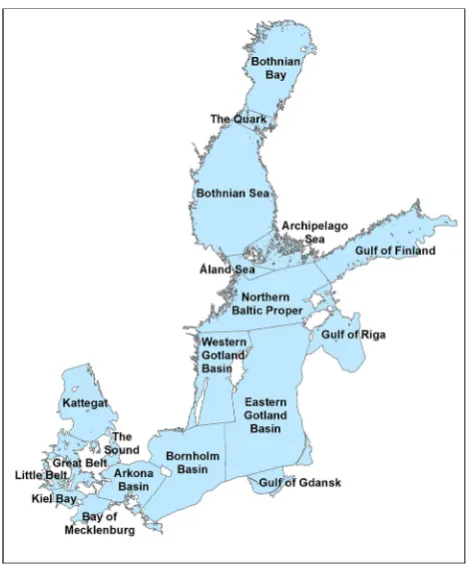
As the Baltic Sea is not a uniform water body throughout its extent, the area was divided into sub-regions according to geomorphological and hydrological characteristics (Fig.1). The benthic invertebrate checklist provides pre-sence/absence data for these sub-regions as well as for 13 smaller areas such as lagoons, estuaries and bays (Fig.2). The latter were added because the number of species found in shallow coastal waters can be very high compared to open, deeper waters, and the species found here may differ in salinity preference (freshwater or marine).
Results
taxonomic databases or other taxonomic reference, as well as a minimum of one reference confirming the occur-rence—historic and/or present—of the species in the sub-regions of the Baltic Sea.
A summary of the main data processed for inter-sub-region analysis can be found in Table 1; 1,423 marine species and 612 fresh and/or brackish water species were identified. Fifty-one species were classified as non-indige-nous species.
Taxonomic structure
Figure3shows the distribution of species among different higher taxonomic groups. Overall, Polychaeta contributes with the highest number of species (355). With one exception (Hypania invalida, which we identified as a freshwater species), all polychaetes in the checklist are of marine origin. Amphipods and gastropods rank second and third in diversity with 187 and 160 marine species, respectively. For these groups, freshwater species are also found (16 and 40 species, respectively). Diptera is the group represented by most freshwater species, amounting to 180 species. Several taxonomic groups only have one species occurring in the Baltic Sea, e.g. Aphanoneura, Arguloidea, Echiurida and Leptostraca.
Fig. 1 Baltic Sea sub-regions that were used as a basis for the
compilation of distribution data for the checklists
The NMDS ordination of the sub-regions according to species composition together with the fitting of a salinity gradient to the categorisation clearly showed: (1) the sep-aration and grouping of some sub-regions and (2) salinity-dependent pattern of similarities between sub-regions in the whole Baltic scale (Fig.4). Salinity was significantly correlated (p\0.001) with the categorisation axes. Spatial patterns of macrozoobenthic diversity
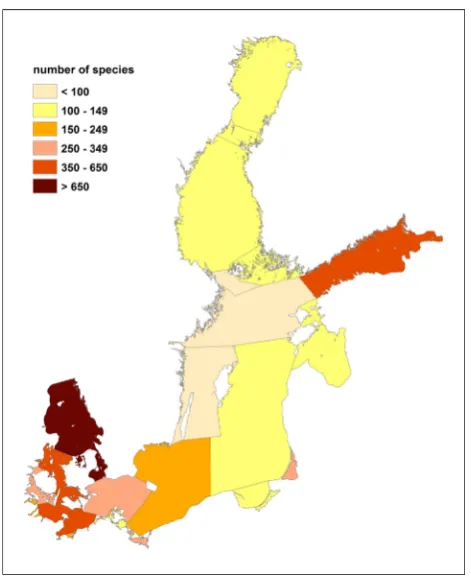
The number of species found in each sub-region is shown in Figs.5and6. Not surprisingly, the Kattegat hosted the highest number of macrozoobenthic species within the Baltic Sea, with 1,161 species, of which 1,154 are of
marine origin (Fig.5, 6,7). The Gulf of Finland, on the other hand, hosted the highest number of freshwater spe-cies (410) and only 72 marine spespe-cies. With the exception of the Gulf of Finland, species diversity was generally higher in the south-western area of the Baltic Sea than in the north-eastern area.
A continuous decline in the percentage of marine spe-cies in relation to overall spespe-cies numbers was observed from the west to the east (Fig.6c). In contrast, the occur-rence of freshwater species was highest in the Gulf of Finland, followed by some smaller coastal areas (e.g. Cu-ronian Lagoon, Szczecin Lagoon), Bothnian Bay and Bothnian Sea. This trend in species composition and diversity followed the salinity gradient. With decreasing
Table 1 The total number of species, number of freshwater and marine species, number of non-indigenous species, mean salinity and in each
sub-region and its area (km2) (in alphabetical order)
Sub-basin/sub-region Species number Freshwater species Marine species Neozoan species Mean salinity Area km2
A˚ land Sea 71 30 41 4 6 4,433
Archipelago Sea 130 73 57 10 6 11,076
Arkona Basin 304 25 279 13 9.85 15,555
Bay of Mecklenburg 440 19 421 16 18 4,423
Bornholm Basin 165 17 148 14 7.6 41,138
Bothnian Bay 135 108 27 7 3.1 33,224
Bothnian Sea 147 101 46 11 5.5 63,650
Curonian Lagoon 252 225 27 19 0.5 1,555
Darss-Zingst Lagoon 120 57 63 11 4.92 166
Eastern Gotland Basin 106 19 87 8 7.2 73,449
Eckernfde Bay 247 2 245 6 15 68
Flensburg Fjord 214 1 213 4 15 250
Great Belt 345 11 334 6 21 7,765
Greifswald Lagoon 121 33 88 12 5.8 501
Gulf of Finland 482 410 72 27 4.6 29,901
Gulf of Gdansk 127 54 73 14 7 5,076
Gulf of Riga 122 66 56 11 5.2 18,795
Kattegat 1,161 7 1,154 7 25 22,102
Kiel Bay 508 5 503 7 20 3,266
Kiel Fjord 227 6 221 6 15 40
Little Belt 411 12 399 6 21 2,701
Northern Baltic Proper 84 22 62 9 6.5 41,113
Rugia Lagoons 115 25 90 10 5.1 360
Schlei Estuary 166 54 112 8 9.8 132
Szczecin Lagoon 260 206 54 24 1 874
The Quark 105 65 40 7 4 4,509
The Sound 668 9 659 7 22 2,278
Trave Estuary 119 12 107 9 8.7 41
Vistula Lagoon 127 92 35 23 1 773
Warnow Estuary 144 51 93 16 8.9 12
Western Gotland Basin 69 12 57 5 6.7 27,876
Wismar Bay 211 16 195 12 11.33 198
salinity, the number of marine species declined, whereas the number of species from inland water bodies increased (Figs.7,8).
The sub-regions with the lowest total numbers of species were the Western Gotland Basin (69), A˚ land Sea (71), the northern Baltic Proper (84) and the Quark (105) (Figs.5, 7). Numbers of freshwater and marine species were almost equal in the Gulf of Riga (66/56), Darss-Zingst Lagoon (57/63) and A˚ land Sea (30/41) (Fig.7).
Non-indigenous species
The highest numbers of non-indigenous species were found in the Gulf of Finland (27), the Szczecin Lagoon (24) and the Vistula Lagoon (23) (Fig.6d). Less than 10 non-indigenous species were found in the Bothnian Bay, in the
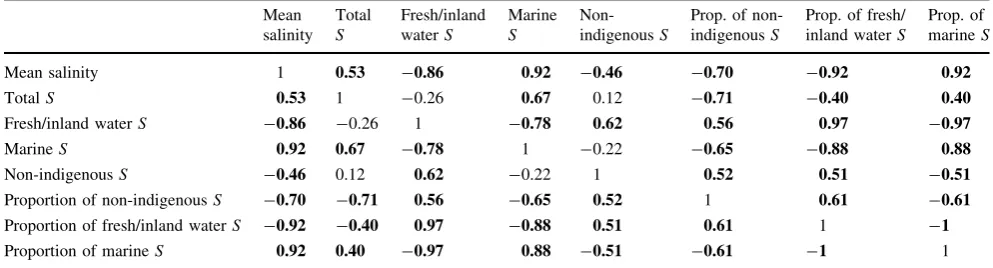
central basins and in the majority of the western sub-regions. About 33 % of non-indigenous species originate from marine waters, and about 67 % of non-indigenous species originate from inland waters. Among non-indige-nous species from inland waters, 48 % originate from the Ponto-Caspian region, whereas 19 % are of fully fresh-water origin. The proportion of non-indigenous species is negatively correlated with salinity and the total number of species and positively correlated with the number of fresh/ inland water species (Table 2).
Discussion
Species composition and diversity in the Baltic Sea are influenced by the steep salinity gradient from SW to NE
Fig. 3 Number of species per higher taxonomical group in the Baltic Sea for marine/freshwater species, respectively (columns), and the species
(e.g. Bonsdorff2006). This pattern can be clearly seen in our data. The categorisation of sub-regions according to species composition clearly revealed the separation and grouping of some sub-regions. The most distinct group was formed by the Vistula, Szczecin and Curonian Lagoons and
the Gulf of Finland (Fig.4). This separation in community composition is caused by the very low salinities in these sub-regions. At the other extreme of the salinity gradient, the species composition of the Sound and especially that of the Kattegat stood apart from the other sub-regions (Fig.4). Spatial trends in species composition resulting from the salinity gradient were reflected in the respective amount of marine and freshwater species within the dif-ferent sub-regions (Fig.6a–c). The more saline western parts were dominated by marine species, whereas fresh-water species dominated the eastern parts and coastal lagoons with brackish waters or more limnic conditions (Fig.7). The influence of the salinity gradient created a pattern where the lowest numbers of species are found in the central Baltic Sea (Fig.5). In this area, the prevailing oxygen depletion of deep and more saline water negatively affects benthic diversity (e.g. Laine et al. 1997).
In the Baltic Sea, as in brackish water bodies in general, the salinity gradient is the predominant factor controlling the distribution patterns of organisms. In 1934, Remane developed a diagram which described the hypothetical distribution of benthic invertebrate diversity along a mar-ine–freshwater salinity gradient. Our results (see Fig.8) clearly indicated the validity of this theory for the macro-zoobenthic diversity pattern within the Baltic Sea. Although the theory of Remane has been discussed and disputed (see Whitfield et al.2012for review), we assume that it is true, at least for the Baltic Sea macrozoobenthic diversity pattern. It has been shown (Attrill2002) that the major environmental factor influencing the distribution of organisms in tidal estuaries is the temporal variation in salinity (i.e. the extreme values), rather than tolerance of the mean salinity. In the Baltic Sea, however, the temporal variation is rather small due to the lack of tides. However, the variation in salinity is a concomitant effect in areas with salinity gradient (e.g. in local estuaries).
The general distribution pattern of benthic non-indige-nous species in the Baltic Sea largely coincided with that of fresh and brackish water species. This may be due to the fact that a high proportion of alien species originates from inland waters. However, only a few alien species occur in the Bothnian Bay. This is because most alien species in the Baltic Sea originate from the warm-water Ponto-Caspian region. Ponto-Caspian fauna is especially rich in the lagoons and estuaries of the southern Baltic Sea. In the northern Baltic, their distribution is likely to be limited by low temperatures. The proportion of non-indigenous spe-cies was negatively correlated with the total benthic diversity. This result is in agreement with studies showing that areas with low native species richness are more sus-ceptible to invasive species (e.g. Paavola et al. 2005). Additionally, major harbours are located in the sub-regions (and in close vicinity to these) with the highest number of
Fig. 4 NMDS ordination plot of the Baltic sub-regions based on the
zoobenthic species composition. The average salinity value of sub-regions is fitted to the ordination
Fig. 5 Total numbers of macrozoobenthic species (marine and
non-indigenous macrobenthic species, e.g. St. Petersburg (Gulf of Finland), Szczecin and S´winoujs´cie (Szczecin Lagoon), Kaliningrad and Gdan´sk (Vistula Lagoon), Klaipeda (Curonian Lagoon) and Rostock (Warnow Estu-ary). These areas are often important for both sea-going and inland shipping—the main vectors for spreading non-indigenous aquatic invertebrates. Several of other human activities, e.g. aquaculture, live food trade and leisure activities, often concentrated in estuaries, offer additional pathways of alien species dispersal (e.g. Leppa¨koski et al. 2002).
The number of species per sub-region declined from the south to the north (with the exception of the Gulf of Fin-land). This is a well-established pattern in the Baltic Sea and has led to a general assumption of an exponential relationship between the number of species and salinity (Fig.8). The present study, however, differs from previous ones by a more intensive accounting of the freshwater fauna, and the view that the bottom fauna of the eastern Baltic Sea is species-poor may thus to some extent be disputed. In the easternmost areas of the Baltic Sea, benthic diversity increased due to the increase in the number of
Fig. 6 Macrozoobenthic
freshwater species. Therefore, the Gulf of Finland hosted as many species as the western parts of the Baltic Proper, due primarily to the vast estuary of the River Neva.
Although an equal sampling effort for marine biodiversity studies may never be achieved over large areas, and the taxonomical expertise and resolution may differ between sub-regions, we argue that sub-regional comparisons can still be made. The huge data sets and the long time frame of investigation minimise the effects mentioned above. Thus, the slightly lower number of freshwater species in the Quark area (Fig.6) is most probably explained by the absence of estuaries in this sub-region and the relatively narrow salinity gradient as compared to both to the Bothnian Sea and the Bothnian Bay. Due to the large area of the Gulf of Finland and its high proportion of estuaries and fjordlike bays (e.g. Pojoviken Bay, Neva Estuary), the remarkably high number of freshwater species is explainable. In addition, the high number of some taxa (e.g. chironomid species) in some sub-regions may be caused by specially targeted studies involving experts on specific taxa.
In a previous study, an attempt was made to merge all the macrozoobenthos data around the Baltic Sea (Ojaveer et al. 2010). However, as we have learned during the present study, some areas, especially the highly saline area of the Kattegat and the areas with greater freshwater influence (e.g. Bothnian Bay and Gulf of Finland), were underrepresented by that previous inventory. The compi-lation of species checklists is a dynamic process and will never be fully completed. The HELCOM checklist of Baltic Sea macrozoobenthic species is the first ever to encompass the entire Baltic Sea and all macrozoobenthic species found therein, and it will function as an important knowledge base for management, administrative authori-ties as well as the scientific community.
Fig. 7 Number of species in the
Baltic Sea sub-regions ordered by the salinity gradient— marine/freshwater species, respectively. The mean salinity is indicated by acurve
y = 233,18x1,119
R²= 0,5763 p < 0.001 y = 29,219e0,1377x
R²= 0,8899 p < 0.001
0 200 400 600 800 1000
0 5 10 15 20 25
freshwater species
marine species
mean salinity
number of species
Fig. 8 Statistical test of the relationship between salinity and
Acknowledgments This work would not have been possible with-out the help of colleagues around the Baltic Sea and further afield. We are extremely grateful for assistance from different experts, and we acknowledge them in alphabetical order: Stefan Agrenius (Sweden), Jan Beermann (Germany), Nadezhda Berezina (Russia), Rafał Ber-nard (Poland), Torleiv Brattegard (Norway), Mikhail Daneliya (Fin-land), Darius Daunys (Lithuania), Elena Ezhova (Russia), Peter Go¨ransson (Sweden), Urszula Janas (Poland), Alf Josefsson (Den-mark), Sami Karjalainen (Finland), Hasse Kautsky (Sweden), Ka-tariina Ko¨no¨nen (Finland), Jonne Kotta (Estonia), Maiju Lanki (Finland), Alan Myers (UK), Henrik Nyga˚rd (Finland), Matthias Obst (Sweden), Martin Ogonowski (Sweden), Jari-Pekka Pa¨a¨kko¨nen (Finland), Jens Perus (Finland), Janne Raunio (Finland), Teemu Rintala (Finland), Juha Salokannel (Finland), Hans Silfverberg (Fin-land), Iya Tsiplenkina (Russia), Risto Va¨ino¨la¨ (Fin(Fin-land), Jan War-zocha (Poland) and Brygida Wydrowska-Wawrzyniak (Poland). Thanks are also expressed to Sally Clink (Copenhagen) for her help with improving the English version of the manuscript. The study was partially supported by the Institutional research funding IUT02-20 of the Estonian Research Council.
References
Attrill MA (2002) A testable linear model for diversity trends in estuaries. J Anim Ecol 71:262–269
Bonsdorff E (2006) Zoobenthic diversity-gradients in the Baltic Sea: continuous post-glacial succession in a stressed ecosystem. J Exp Mar Biol Ecol 33:383–391
Gerlach A (2000) Checkliste der Fauna der Kieler Bucht und eine Bibliographie zur Biologie und O¨ kologie der Kieler Bucht. In: Bundesanstalt fu¨r Gewa¨sserkunde (ed) Die Biodiversita¨t in der deutschen Nord- und Ostsee. Band 1. Bericht BfG-1247, Koblenz, 376 pp
HELCOM (2012) Checklist of Baltic Sea macro-species. In: Baltic Sea Environment Proceedings No. 130: 206 pp (http://www. helcom.fi/stc/files/Projects/RedList/BSEP130.pdf)
ISO (2005) Water quality—guidelines for quantitative sampling and sample processing of marine soft-bottom macrofauna. Eur Stand EN ISO 16665:2005
Laine AO, Sandler H, Andersin A-B, Stigzelius J (1997) Long-term changes of macrozoobenthos in the Eastern Gotland Basin and the Gulf of Finland (Baltic Sea) in relation to the hydrographical regime. J Sea Res 38:135–159
Leppa¨koski E, Olenin S (2001) The meltdown of biogeographical peculiarities of the Baltic Sea: the interaction of natural and man-made processes. Ambio 30:202–209
Leppa¨koski E, Gollasch S, Gruszka P, Ojaveer H, Olenin S, Panov V (2002) The Baltic—a sea of invaders. Can J Fish Aquat Sci 59:1175–1188
Ojaveer H, Jaanus A, MacKenzie B, Martin G, Olenin S, Rad-ziejewska T, Telesh I, Zettler ML, Zaiko A (2010) Status of biodiversity in the Baltic Sea. PLoS ONE 5(9):e12467 Oksanen J, Blanchet FG, Kindt R, Legendre P, Minchin PR, O’Hara
RB, Simpson GL, Solymos P, Henry M, Stevens H, Wagner H (2012) vegan: community ecology package. R package version 2.0-5. Availablehttp://CRAN.R-project.org/package=vegan Paavola M, Olenin S, Leppa¨koski E (2005) Are invasive species most
successful in habitats of low native species richness across European brackish water seas? Estuar Coast Shelf Sci 64:738–750 Remane A (1934) Die Brackwasserfauna. Zool Anz (Suppl) 7:34–74 The R Foundation for Statistical Computing (2012) R version 2.15.1.
Availablehttp://www.r-project.org
Whitfield AK, Elliott M, Basset A, Blaber SJM, West RJ (2012) Paradigms in estuarine ecology—a review of the Remane diagram with a suggested revised model for estuaries. Estuar Coast Shelf Sci 97:78–90
Zettler ML (2011) U¨ berarbeitung der BLMP-Makrozoobenthos-Taxaliste fu¨r die Nord- und Ostsee. Unpublished report in order of the Landesamt fu¨r Umwelt, Naturschutz und Geologie Mecklenburg-Vorpommern, 19 pages?annex
Zettler ML, Ro¨hner M (2004) Verbreitung und Entwicklung des Makrozoobenthos der Ostsee zwischen Fehmarnbelt und Use-dom—Daten von 1839 bis 2001. In: Bundesanstalt fu¨r Gewa¨s-serkunde (ed) Die Biodiversita¨t in Nord- und Ostsee, Band 3. Bericht BfG-1421, Koblenz: 175 pp
Zettler ML, Schiedek D, Glockzin M (2008) Chapter 17: Zoobenthos. In: Feistel R, Nausch G, Wasmund N (eds) State and evolution of the Baltic Sea, 1952–2005. A detailed 50-year survey of meteorology and climate, physics, chemistry, biology, and marine environment. Wiley, Hoboken, pp 517–541
Table 2 Spearman rank correlation matrix of macrozoobenthic diversity variables and salinity
Mean salinity Total S Fresh/inland waterS Marine S Non-indigenousS
Prop. of non-indigenousS
Prop. of fresh/ inland waterS
Prop. of marineS
Mean salinity 1 0.53 -0.86 0.92 -0.46 -0.70 -0.92 0.92
TotalS 0.53 1 -0.26 0.67 0.12 -0.71 -0.40 0.40
Fresh/inland waterS -0.86 -0.26 1 -0.78 0.62 0.56 0.97 -0.97
MarineS 0.92 0.67 -0.78 1 -0.22 -0.65 -0.88 0.88
Non-indigenousS -0.46 0.12 0.62 -0.22 1 0.52 0.51 -0.51
Proportion of non-indigenousS -0.70 -0.71 0.56 -0.65 0.52 1 0.61 -0.61 Proportion of fresh/inland waterS -0.92 -0.40 0.97 -0.88 0.51 0.61 1 -1
Proportion of marineS 0.92 0.40 -0.97 0.88 -0.51 -0.61 -1 1
Snumber of species