© 2017 IJSRST | Volume 3 | Issue 6 | Print ISSN: 2395-6011 | Online ISSN: 2395-602X Themed Section: Science and Technology
Development of Highly Crystalline Polyurethanes from Hydroxy
Terminated Polyesters
V. Swapna
1*, K. Sasidhar
2, Dipak Chattopadhyay
3, M. Lakshmi Kantam
1, Ramanuj
Narayan
4,B.thirupathi
5and S. Gangadhar Rao
51Inorganic & Physical Chemistry Division, CSIR-Indian Institute of Chemical Technology, Hyderabad, India 2Akzonobel, Amsterdam, Netherlands.
3
Honeywell India Technology Center, Gurgaon
4Polymers & Functional Materials Division, CSIR-Indian Institute of Chemical Technology, Hyderabad, India 5 Department of Botany, Osmania University, Hyderabad, India.
ABSTRACT
The present work describes two series of crystalline polyester based polyurethanes pent synthesized from 4, 4' diphenyl methane diisocyanate, chain extender 1,4 patanediol and low molecular weight polyesters, one with and another without the cross-linker, trimethylol propane (THP). The soft segment of the polyurethanes were composed of PEG based polyesters, which introduces waxy character to the polymers, but disphenyl methane disocyanate good crystalline to the polyurethanes. It was observed that incorporation of certain percentage of cross linker reduces the crystallinty of the system. The polyester ware prepared using both aliphatic acids such as maleic acid and phthalic anhydride. The synthesized polyurethanes were examined by thermo gravimetric analysis, which showed that the polyurethanes molergo thermal degradation at lower temperatures in oxygen atmosphere compared to that of the inert nitrogen atmosphere. The degradation pattern shows the fact that in oxygen atmosphere the degradation step is expanded one where as in the inert atmosphere the degradation step is rather stepper. The samples were also investigated by DSC, which reveals the melting temperature of the samples. The XRD curves also support the crystalline nature of the polyurethanes.
Keywords: Diisocyanate, DSC, Polyurethanes, TGA, THP
I.
INTRODUCTION
Hydroxylated Polyesters (HPs) or polyester polyols are one of the important oligomeric precursors used in the development of thermoset high solids coatings (HSCs). The range of structural variations of the HPs is due to the possibilities in the choice of raw materials, in the combination of the hydroxyl and carboxyl bearing compounds in differing ratios, in the degree of polycondensation and branching, as well as in the conditions and process during production. It has been exploited to a great extent and as a result, today, primarily polyesters with an average molecular weight from 400 to 6,000, hydroxyl number from 28 to 300 mg KOH/g and acid numbers less than 1mg KOH/g are being offered for curable compositions.1-8 HPs used as coating binders contain a certain proportion of trifunctional or even tetra functional reactants, which are added in order to introduce branching into the polymer
chain. Depending upon the formulation the hydroxyl groups are incorporated to be present as end groups or as pendant groups to the oligomer backbone.4 HPs for coatings are generally co-polyesters composed of several polycarboxylic acids and polyalcohols. In fact, the literature on HPs for coatings indicate that the binder polyesters with few exceptions are at least four-component polyester, i.e., a diol, a triol, an aromatic acid (or its anhydride), and an aliphatic dibasic acid.2
HPs for HSCs should be an oligomer with a low glass transition temperature (Tg), a low number average
molecular mass (Mn), the narrowest possible dispersity
of molar masses (Mw/Mn), and of low viscosity. The
the functionality. These ratios form strong synergy with high stability to transesterification. With the same mole ratio of dibasic acid/ total polyol, an increase in triol component will increase the average number of hydroxyl groups per molecule, decrease the hydroxy equivalent weight, broaden molecular weight distribution, and increase the crosslink density of a fully crosslinked film.3 The Tg can be varied within wide limits by
choosing appropriate raw materials. The ratio of aromatic to aliphatic dibasic acids is the principal factor controlling the glass transition temperature (Tg) of the
resin, but difference in polyol structures will also affect Tg.
5
The wide array of raw materials available for the synthesis of HPs provides flexibility in its design to get product with desired characteristics. With the advent of VOC compliance technologies, which requires tailor-made polymers to suit the application and performance criterion has renewed the interest in HPs .It is evident from the increase in number of recent patents and research papers. F.N.Jones6,9-10 has explained the ways and factors to design low molecular weight (Mn in the range of 520-690) oligoester diols of linear diol/terephthalic acids, and linear diol/dicarboxylic acids combination useful for 100% solid or solventless coatings. The maximum research work has been paid to the variation of raw materials in HP’s backbone. Acid intermediates such as 2-methyl-1,4-cyclohexanedimethanol11, phthalic anhydride12 1,4 cyclohexanedicarboxylic acid13,14 have been used in combination with other polyols and polyolacids. A series of polyesterdiols having low viscosities and with high content of non-volatile matter based on one or more aliphatic dicarboxylic acids or esters and one or more aliphatic diols has been reported.15 Walsh16 has explained the synthesis of low molecular weight linear polyester based on pentaerythritol, pelargonic acid, isophthalic acid and trimethylol propane, pelargonic acid, isphthalic acid combination. HPs for HSCs are
made from polyfunctional reactants, which can crosslink during polymerization causing gelation. Since the probability of gelation increases with conversion and high conversions are generally desirable, a relationship between formula composition, extent of reaction and probability of gelation is required in formulating HPs.3
II.
METHODS AND MATERIAL
EXPERIMENTAL
Diphenylmethane Diisocyanate (MDI), Polyethylene glycol-1000 (PEG-1000), Polyethylene glycol-4000 (PEG-4000) were purchased from Sigma Aldrich, Dibutyltin dilaurate (DBTDL), Trimethylol propane (TMP) were purchased from Apex Enterprises, Dimethyl formamide (DMF), Adipic acid (AA), Succinic acid (SA), Maleic acid (MA), Phthalic anhydride (PA), Paratoluene sulphonic acid (PTSA), Chloroform purchased from SD Fine Chem Ltd.
a) Synthesis of Hydroxylated Polyester
Polyesters were synthesized using the conventional melt polycondensation method. Four of the polyesters consist of polyethylene glycol-4000 and adipic acid, succinic acid, maleic acid, phthalic anhydride and the other one consisted of polyethyelene glycol-1000 and succinic acid with an OH/COOH mole ratio of 1.1/1 under nitrogen atmosphere. The reaction temperature was maintained in between 180°C-200°C, and continued for 14 hours in the presence of a continuous flow of Nitrogen. The acid and -OH values of the final polyesters were determined by methods of ASTM D4262 and D4274, respectively. The polyesters were designated by PE-1, PE-2, PE-3, PE-4 and PE-5. The synthesized polyesters were dried and freed from moisture by keeping them overnight in a vacuum oven at 60°C. Table 1 shows the composition of the synthesized hydroxylated polyesters.
Table 1. Compositions of synthesized hydroxy terminated polyesters
Polyester Acid used Quantity (gm)
Polyol used Quantity (gm)
PE-3 Maleic acid 1.451 PEG-4000 55.001 PE-4 Phthalic anhydride 1.852 PEG-4000 55.001
PE-5 Succinic acid 1.503 PEG-1000 51.848
b) Synthesis of Polyurethane:
The polyester diols synthesized from experimental procedure (a) were used to synthesize polyurethanes with MDI and 1,4-butanediol as a chain extender by pre-polymerization method. For the synthesis of polyurethanes, a four necked round bottomed flask equipped with mechanical stirrer, nitrogen inlet, calcium oxide guard tube to absorb moisture inside the kettle and thermometer was used. The temperature during the reaction was maintained within 60-80°C and the reaction was continued for 6 h. Completion of the reaction was monitored by observing the disappearance of the characteristic isocyanate peak at 2275 cm-1 from the infrared spectra.
The polyester and butane diol were made moisture free by keeping them in 90°C for 24 h in vacuum oven. MDI was used as received. N, N-dimethyl formamide used as
the solvent, which was treated with 3 A° molecular sieves to make moisture free before use. Polyester hydroxyl and diisocyanate ratio was maintained in 0.1:0.4 (OH/NCO) ratio. The excess NCO was chain terminated with butane diol by properly maintaining the OH:NCO ratio. For one set of polyurethanes no cross linker was used where as in the other set trimethylol propane was used as a cross linker. For one first set, appropriate amount of polyester was treated with the disocyanate and butane diol for about 6 h at 60°C temperature in N,N-dimethyl formamide solvent. The final polymer was then extracted from DMF using chloroform as the solvent. In other set of polymers, polyester polyol along with the diisocyanate and butane diol was treated with 10 wt% trimethylol propane cross linker. In both of the sets reagents were added followed by the addition of catalyst. For each set, the solvent was removed under vacuum and the polymers were dried for one week in open air before the instrumental analysis and characterization. In Table 2, sample abbreviations are given:
Table 2 Composition of the synthesized polyester polyurethane
Polyurethane Polyester Quantity (gm)
Diisocyanate Quantity (gm)
Chain extender
Quantity (gm)
Cross linker
Quantity (gm) PU-1 PE-1 15 MDI 0.328 BDO 0.266 Not
used
_
PU-2 PE~2 15.025 MDI 0.34 BDO 0.277 Not used
_
PU-3 PE-3 9.575 MDI 0.235 BDO 0.196 Not used
_
PU-4 PE-4 15.487 MDI 0.345 BDO 0.281 Not used
_
PU-5 PE-1 10.077 MDI 0.246 BDO 0.206 IMP 1.008 PU-6 PE-2 10.239 MDI 0.233 BDO 0.19 TMP 1.024 PU-7 PE-3 14.402 MDI 0.348 BDO 0.291 TMP 1.44 PU-8 PE~4 14.57 MDI 0.324 BDO 0.265 TMP 1.457 PU-9 PE-5 12.65 MDI 1.054 BDO 0.853 Not
used
_
III.
RESULTS AND DISCUSSION
FTIR analysis
Figure 1-2 shows the FT-IR overlay spectra of the synthesized polyurethanes. The absence of characteristic absorbance of NCO groups at 2270 cm-1 confirmed the complete reaction and PU formation. The characteristic vibrations, which confirmed the polyurethification are the N - H stretching vibration from 3200-3500 cm-1, and the C=O stretching vibration region in between 1650-1750 cm-1.
Figure 1. FT-IR Spectra of PU
Figure 2. FT-IR Spectra of crosslinked PU The peak regions of carbonyl groups in disordered ("amorphous") conformations and non H-bonded (free) carbonyl groups appears in between 1714-1718 cm-1 and 1731-1733 cm-1, respectively. Similarly, two distinct N-H stretching bands in the region 3320-3329 cm-1 and 3441-3446 cm-1 were observed and attributed to hydrogen bonded N-H and "free" N-H stretching vibrations, respectively. The peak due to non-hydrogen bonded N-H group is located in the range 3400-3450
polyurethanes also been analyzed. The N-H bending peak is shown near by 1600 cm-1. The another peaks as for example, the C-N stretching frequency, C — O — C stretching, C-O stretching of urethane group, C-H stretching of-CH2 are situated in the regions 1450-1470
cm-1, 1340-1350 cm-1, near about 1060 cm-1, and 2870-2890 cm-1, respectively.
Powder X-ray diffraction analysis
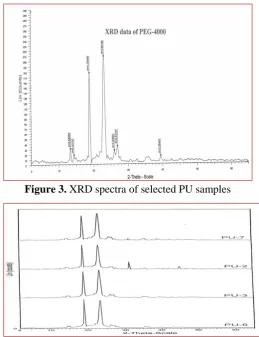
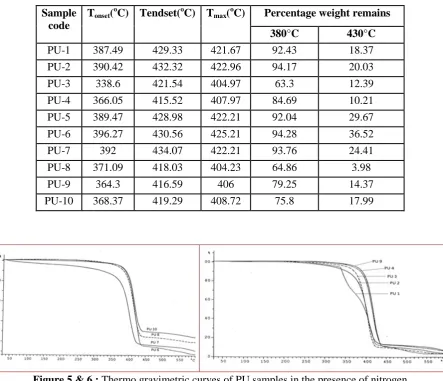
Figure 3-4 shows the X-ray diffractogram of PEG-4000 and different PU samples derived from PEG-4000. A powder X-ray diffraction experiment reveals the presence of two sharp peaks at 20 of 19 and 22° for PUs, which were synthesized from succinic acid, maleic acid and PEG-4000 based polyesters. Two were with the cross linker (PU-6 and PU-7) and remaining two (PU-2 and PU-3) were without the cross linker. Figure 3 (pure PEG-4000) shows the presence of crystalline peaks at 19 and 22°, which from the well-ordered long chain of hydrophilic PEG. It is therefore concluded that the crystallinity of the synthesized PUs was obtained from the ordered PEG segment.
TGA analysis
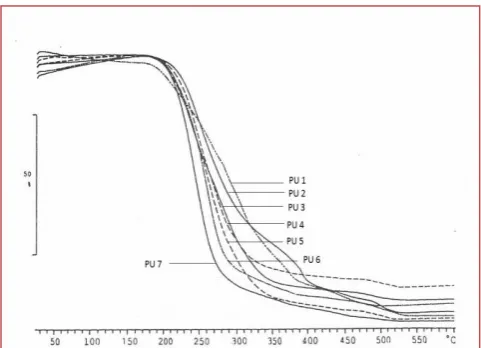
Each sample was scanned separately in the nitrogen and oxygen atmosphere. The heating rate employed was 10°C min-1. Figure 5-7 shows the TGA thermograms of different PUs analyzed in this study in N2 and O2
environment respectively some important terms related to thermogravimetric study is discussed.
From the TGA thermograms of the polyurethanes it is shown that in the Nitrogen atmosphere, the degradation starts at about 330oC and the major degradation step is continued upto 430oC, whereas in the oxygen atmosphere the major degradation step is initiated at
much lower temperature, at about 200oC. The other important observation is the degradation pattern in the two different atmospheres, which were easily identified from the nature of the DTG curves. The observation suggests a one step degradation profile in the presence of inert atmosphere and shows a rapid degradation pattern by a steep fall in the curve. In the presence of oxygen, most of the polyurethanes were degraded in one step, but the degradation step is not showing so much steep curve as like the inert atmosphere. Since the same sample was used for the thermal stability evaluation in N2 and O2, therefore the differences in the thermograms
were due to the environments applied to study the thermal decomposition.
Table 3 The characteristic thermal stability data of synthesized PUs in N2 atmosphere
Sample code
Tonset( o
C) Tendset(oC) Tmax( o
C) Percentage weight remains
380°C 430°C
PU-1 387.49 429.33 421.67 92.43 18.37 PU-2 390.42 432.32 422.96 94.17 20.03 PU-3 338.6 421.54 404.97 63.3 12.39 PU-4 366.05 415.52 407.97 84.69 10.21 PU-5 389.47 428.98 422.21 92.04 29.67 PU-6 396.27 430.56 425.21 94.28 36.52 PU-7 392 434.07 422.21 93.76 24.41 PU-8 371.09 418.03 404.23 64.86 3.98 PU-9 364.3 416.59 406 79.25 14.37 PU-10 368.37 419.29 408.72 75.8 17.99
Figure 7. Thermo gravimetric curves of PU samples in presence of oxygen
In the presence of inert atmosphere, different observations that are noticed, in the case of different polyurethanes are discussed below. It is generally noticed that in the case of the soft segment polyester in polyurethanes the degradation behavior is much complex compared to that of the polyether polyurethanes. In another set the cross linker, and the incorporated acids are also varied. In case of another two polyurethanes, PU-9 and PU-10 we used PEG-1000 in stead of PEG-4000. The total thermal degradation pattern is influenced by the nature of polyol as well as the diisocyanate used. Now the observations in presence of the inert atmosphere, in case of where the acid used is the straight chain aliphatic acids, the starting point of degradation that is the onset point is near about 3900C, this staring point is generally assumed to be the simple cleavage of the polyester part of the soft segment, as the ester bond is one of the weakest bond in these moities. Due to the same nature of PU-1 and PU-2 the two acids used in those two polyurethanes the starting of the degradation is approximately the same. At the Tmax
where the degradation percentage is the maximum, at that point generally the polyurethanes produce staring material or some side products, such as olefins, amines, and carbon dioxide. As in case of the synthesized
samples no further step of degradation is observed so it is clear that the produced monomers after the first step of degradation, do not undergo any further reaction. The results in the case of corresponding cross linker incorporated polyurethanes, in case PU-5 and PU-6 show increment in the onset value, which indicates greater thermal stability of the cross linked added polyurethanes. So what is assumed that, the cross linker is incorporated in the hard domain, which is the very important part in determining the thermal stability of polyurethanes. Again in the case of maleic acid-polyurethane that is PU-3 the Tonset is much lowered
Table 4. The characteristic thermal stability data of synthesized PUs in O2 atmosphere
Sample
code
T
onsetT
endsetT
maxPercentage weight
remains
(
oC)
(
oC)
(
oC)
250°C
330°C
PU-1
210.61
429.57
298.83
89.93
38.07
PU-2
216.86
372.22
311.83
77.73
28.23
PU-3
209.99
371.83
304.5
98.78
52.84
PU-4
213.41
324.43
293.31
72.67
28.28
PU-5
201.26
336.86
298.55
71.16
20.72
PU-6
212.44
281.12
266.33
50.75
15.83
PU-7
205.27
337.68
306.5
75.34
30.88
PU-8
204.85
286.42
266.5
72.83
26.13
PU-9
218.95
399.02
313.17
75.52
40.58
PU-10
190.5
382.14
297.33
80.57
40.58
The decomposition of the prepared polyurethanes involves one decomposition step in the presence of oxygen as shown from the TGA curve. In the presence of oxygen, the degradation initiation is accelerated and is much complex in nature compared to that of the inert atmosphere. Again the common observation is in case of unsaturated acid incorporated polyurethanes, the onset value is lowered compared to that of aliphatic, straight chain, saturated acid containing polyurethanes. This may be explained that the major degradation step is the cleavage of the ester bond in the soft segment and pi bond is much more susceptible towards that type of thermal cleavage. Another important factor is the onset value in PU-5, PU-6, PU-7, PU-8, PU-10 (cross linker added) is lowered compared to the corresponding simple polyurethanes, which can be explained by the fact that the major degradation step in case of these cross liker incorporated urethanes is the reaction of the cross linker with oxygen and so why the use of different acids here do not influence the thermal stability of that major step. In the presence of oxygen which acts as an accelerator
for the thermal degradation, and the decomposition here follows the free radical path, the oxygen accelerates the degradation of the polyurethanes. Most probably in the presence of the cross linker, it is the cross linker part which is the weakest site, and the thermal degradation is more accelerated in the corresponding cross linker added polyurethanes.
DSC Analysis
In our work all the samples were not tested by DSC. Few number of PU samples were investigated under DSC analysis. Among these we have prepared two different sets of data. Two sets of endothermic peaks were investigated. Samples under investigation show large and sharp endothermic peaks. The sharp nature of endothermic peak reveals the crystalline nature of tested
PU samples, which is supported by the XRD patterns also. The table 5 shows a set of data obtained from DSC analysis
Table 5. The characteristic DSC data of synthesized PUs in N2 atmosphere
Sample name
Melting
temperature Tm in °C
Melting enthalpy DHmin J. gm-1
Percentage of crystallinity (
)PE-1 56.7 111.9 59.05
PU-1 60.2 120.8 63.75
PU-5 58.2 105.9 55.88
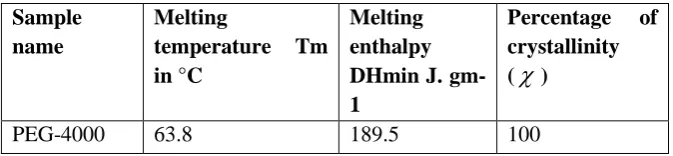
All samples exhibit a large and sharp endothermic peak at about 55-65°C. PEG shows its Tm value at 63.8°C,
where the corresponding polyester shows the Tm value at
56.7°C. The possible explanation is the decrease in the degree of crystallinity of the system after esterification, which results in a decrease in Tm value. In the case of
the samples PU-1 and PU-5 the soft segment melting temperature is observed around 60°C. In the temperature range of operation, no hard segment melting is observed. This could be due to the presence of small amount of hard segment and their phase mixing characteristics with the soft segment. On a comparison of the DSC thermograms for PE-1, PU-1 and PU-5, it is observed that the Tm of soft segment follows the order, PE-1 <
PU-5 < PU-1.
So the polyurethane itself gets highest melting temperature of the soft segment. The Tm increases in
PU-1 and PU-5 compared to PE-1. That is due to incorporation of hard segment in the polymer structure, contributed by MDI/chain extender. The incorporation of hard segment usually result in the increment of intermolecular attraction as well as extent of H-bonding in the polymer backbone, which results in, increasing the Tm value. Additionally, incorporation of hard segment
introduces crystallinity in the structure, which is
m value shown in the m is the heat energy required for the
melting of the soft segment. Since, a highly packed structure requires more thermal energy for the disruption and overcome the force associated with the well-ordered structure, therefore a high Tm and Hm value results in the
DSC analysis. The % crystallinity was calculated from the following equation:
(
)
Now comparision is made between PU - 1 and PU - 5, the observed fact is that the Tm value of the soft segment
was less for PU - 5 than PU - 1. That is due to the
groups, the symmetrical and ordered array of polyurethane network was disrupted and randomness introduced into the system. This type of branching due to the cross linker also inhibit the close packing and interfere with the formation of crystallites. So the crystallinity in the polyurethane structure of PU - 5 was hampered and the extent of H-bonding is also reduced. Therefore, a decrease in the extent of H-bonding results in a decrease in the Tm value of the soft segment. Also
due to the disruption of symmetry and orderedness in the structure, % crystallinity of PU -5 is less than that of PU
- m
values shown in Table 5.
Table 6 The characteristic DSC and SDTA data of synthesized PUs in N2 atmosphere
According to the observed Tm value, the PUs in the
following order: PU-3 <PU-1< PU-2
This phenomenon was also supported from the SDTA data obtained in the present study. The first observation was the lowest Tm value for PU - 3 in this series. This
phenomenon could be attributed to the presence of unsaturation in maleic acid part makes the soft segment of PU - 3 rigid, and therefore the formation of intra-molecular H-bonding hinders partially due to the restricted chain movement. A structural comparison between PU-2 and PU-1 shows the presence of long chain acid in PU - 1 compared to PU - 2. The presence of long chain in the backbone structure of PU-1 makes the H-bonding far apart from each other in comparison to PU-2, and thereby the strength of the H-bond was less for PU-1 in comparison to PU-2, which results in higher Tm value for PU-2 in comparison to PU-1. In support of
Sample name Tm from
DSC in °C
Tm from
SDTA in °C
Table 7 The characteristic SDTA data of synthesized PUs in N2 atmosphere
SDTA results shown in Table 7 and 8 for different PU samples also supported the conclusion obtained from the DSC analysis and shows that the addition of cross linker in polyurethane backbone was associated with a decrease in the melting temperature.
Figure 7.
DSC curves to evaluate melting temperature of selected samplesIV.
CONCLUSION
These studies are focused on the synthesis of crystalline polyester-polyurethanes and their properties. Finally we can summarize our investigation as follows: Crystalline polyester-polyurethanes can be synthesized from commonly available chemicals. The polyurethanes can be synthesized successfully through simple procedure. The reaction proceeds to almost 100% completion. The synthesized polyurethanes possess requisite structural and chemical features to serve as very good crystalline polymers. The resultant polymers show good thermal stability, and the thermal behaviour of samples is different in nitrogen and oxygen atmosphere. The thermal stability is increased in the presence of cross linker in inert atmosphere; whereas the opposite trend is observed in active atmosphere. DSC study finds the melting temperature of the soft segment, which decreases in cross linker added polyurethanes than that of simple polyurethanes. DSC study reveals good
crystallinity in the synthesized polymers. DSC study also shows that the crystallinity reduced with the incorporation of cross linker in the polymer backbone. XRD study also supports the crystallinity of the polymers, which is incorporated in the polymer structure from the used PEG. Hence, polymer with tunable crystallinity will enable the development of olutti functional coatings for use in practical applications.
V.
ACKNOWLEDGEMENT
The authors would like to extend their thankfulness to the Dr. K. S. Rama Rao, HOD, I&PC division and Director Dr. S. Chandrasekhar, CSIR-IICT for permitting the work to be carried out.
VI.
REFERENCES
[1]. Sickert, A., Stoye, D., Muller, M., Freitag, W., Ott, J., Neffgen B., and Kruse, A., Resins for Coatings, Ed., W. Freitag & D. Stoye Hanser, NY, 1996.
[2]. Encyclopedia of Polymer Science and Engineering, Vol.1, Wiley Inter Science, 1985, 670.
[3]. Wicks, Z. W., Jr., Jones, F. N., Pappas, S. P., Organic Coatings Science & Technology, John Wiley & Sons, Vol. 1(1992), 122.
[4]. Lanson, H. J., ACS Symposium series, Applied Polymer Science, 2nd Ed., Ed. R. W. Tess, American Chemical Society, Washington, D.C., 1985, 1185.
[5]. Stoye, D., Paints, Coatings and Solvents, VCH, New York, 1993, 54.
[6]. Jones, F. N., Journal Of Coating Technology 68 (1996), 28.
[7]. Clive H. H., Paint India, 2, 1997, 55.
[8]. Paul, S., Surface Coatings; Science and Technology, John Wiley & Sons, New York, 1985, 71.
[9]. Jones, F. N., Fu, S. K., Hua, Y. Z., Xiaoying, Y., US Patent, 5641854, 1997.
[10]. Jones, F. N., Fu, S. K., Hua, Y. J., Xiaoying, Y., Swarup, V., US Patent, 5969085, 1999.
[11]. Nakata, T., Toshi, S., Japanese Patent, 143762, 2000.
[12]. Hilshafer, D. K., O’Brien, M. E., Defining Future Technologies, Polyurethane Conference 2000 Proc., 289.
[13]. J.ung, J. Z., Korean Patent, 9606298, 1996.
[14]. Hai, J. N., Daum, L., Soucek, M. D. Journal of Coatings Technology, 74, 2002, 49.
[15]. Yezrielev, A. I., Rigopoulos, K. R., William, R. R., Karen, K. US Patent, 5976706, 1999.
[16]. Walsh, J. Modern Paint and Coatings, 73, 1983, 42. Sample
name
Tm Sample name Tm