© 2015 IJSRST | Volume 1 | Issue 2 | Print ISSN: 2395-6011 | Online ISSN: 2395-602X Themed Section: Science
Response Surface Methodology for Optimizing the Parameters
of a Roasting Machine Using Maize (
Zea mays L.
)
*
1Atere A. O.,
2Olukunle O. J.,
3Olalusi A. P.
1*Department of Agricultural Engineering, Federal College of Agriculture, Ibadan, Nigeria
2,3Department of Agricultural and Environmental Engineering, Federal University of Technology, Akure, Nigeria
ABSTRACT
A roasting machine performance was evaluated with the objective of investigating the optimal conditions of the factors (speed: 6.6, 12.8, 19, 24 and 30 rpm; temperature: 70, 100 and 150oC and moisture content: 20, 15.8 and 9.5%) that would best yield quality evaluation parameters (roasting capacity, RC; roasting efficiency, RE; conveyance efficiency, CE and quality efficiency, QE). The following instruments, infrared thermometer (digital type), thermocouple, tachometer, weighing balance, grain moisture meter and stop watch were used for temperature, speed, mass, moisture content and time respectively. Surface response methodology was used to study the relationship between the factors and the evaluation parameters. This was achieved by holding constant, conveyor speed, set temperature or moisture content of the maize. The results show that the set temperature, auger speed and moisture content of maize were all significantly influenced all the evaluation parameters. Increasing the auger speed and set temperature will yield a significant increase in the roasting efficiency and roasting capacity. From the study, it was observed that the optimal conditions required to achieve the optimum roasting efficiency were auger speed of 35 rpm and set temperature of 155oC. These conditions give the best roasting efficiency with coefficient of determination of R2 equals 79%.
Keywords:
Roaster; Optimization; Surface Response Methodology; Parameters; Maize
I.
INTRODUCTION
Maize (Zea mays L.) is a cereal crop, a member of the grass family. It is a domesticated grass that originated approximately 7000 years ago in what is now Mexico [1]. Maize is used primarily as a staple food for human consumption, animal feed and raw material for industrial use. The nutritional components of yellow dent maize are starch 61%, corn oil 3.8%, protein 8%, fiber 11.2% and moisture 16% [2]. Roasting is a cooking method that uses dry heat, whether an open flame, oven, or other heat source. Maize roasting has become popular postharvest operation to obtain highly commercial agricultural products and preserve the products for longer shelf-life [3]. The performances of roaster for different cereal crops were tested at various parameters and studied the characteristics of corn [4]; [5]; [6]; [7];. A number of the research work about properties, compositions and effect of roasting corn at different temperatures have been reported [8]; [9]; [10]; [11]; [12]. The moisture content and harvesting stage of the corn, moisture distribution due to drying have been described [13] and [14]. The principles of heat transfer are based on the energy sources and mode of transporting heat to the system [15]. Optimizing the performance of this roaster is necessary so that the roasting efficiency and quality
efficiency are set at maximum and mechanical damage set at minimum possible.
II.
METHODS AND MATERIAL
Study Location
The study location was in the Agricultural Engineering department of the Federal University of Technology Akure. The Maize grains ART/98/SW06-OB-W was obtained from the Institute of Agricultural Research and Training, Moor Plantation, Ibadan. The variety was fortified with protein.
Description of the Roasting machine
Measurement of parameters
The moisture content (MCdb) was determine using a microprocessor grain moisture meter, operating time with stopwatch, shaft speed of the roaster using photo/contact tachometer (DT-2236B), temperature which was regulated by temperature controller. The initial moisture content and final moisture content of maize were determined for maize at a pass for toasting machine.
Figure 1. Internal view of the toaster (A-Hopper, B-Auger, C-Shaft, D-Outlet, E-Frame, F-Pulley and G-Electric motor).
Experimentation
A known weight of maize sample was passed through the hopper into the roaster and exit after roasting. The initial moisture content of the grains was recorded before introducing it into the roasted and the temperature of the inside of the roasting chamber was recorded. The final weight and moisture of the product was measure. Part of the product that was left over in the roaster was retrieved and the weight was measured in order to check for the conveyance efficiency of the roaster. A split-split design (SSD) was used to present the data for this research. Each experiment was replicated five times for a chosen speed (6.6, 12.8, 19, 24 and 30 rpm), moisture content (20, 15.8 and 9.5%) and temperature (70, 100 and 150oC). The time taken for each experiment was recorded using a stop work. The roasting capacity (RC), conveyance efficiency (CE), roasting efficiency (RE) and quality efficiency (QE) were determined by the use of existing formulae.
Roasting Capacity CR, 1
Where mr is the final mass of collected product (kg) and t is the roasting time (min)
Conveyance Efficiency ηc, 2 where mw and mc equal to the mass of maize retained and collected at the outlet respectively.
Roasting efficiency , 3
Where mr is the mass of roasted product, muis the mass of unroasted maize
Quality Efficiency ηq,
4
Where mc is the mass of product at outlet, mbis the mass of broken maize and mi is the mass of maize fed into the roaster.
Optimization
Surface response methodology was used to study the relationship between the explanatory variables (speed, temperature and moisture content) and the response variables (RC, RE, CE and QE). This was achieved by holding constant conveyor speed, set temperature or moisture content of the maize Design expert version 8.0.7.1 was used.
III.
RESULTS AND DISCUSSION
Effect of speed, temperature and moisture content on roasting capacity, RC
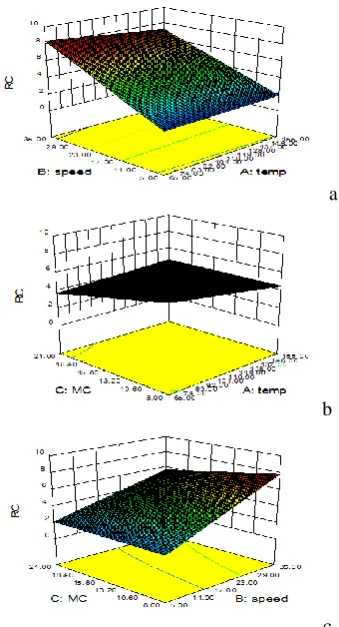
The regression model obtained for roasting capacity RC: RC = +3.73075 - 0.035424 * T + 0.39199 * v - 0.24582 * MC - 5.24990E-004 * T * v +2.82631E-003 * T * MC - 9.18911E-003 * v * MC with an R2 of 49.95%.
a
b
c
Figure 2: Response surface contours for roasting capacity, RC of roaster. For each contour plots, the third variable is fixed.
Effect of factors on the roasting efficiency, RE of roaster
The model obtained for RE:
RE = +52.30983 +0.48975 * temp 0.71211 * speed -3.72852 * MC 0.010562*temp*speed4.78808E003*temp*MC +7.70354E003 *speed * MC -3.59995E-004*temp2 +0.066662 * speed2 +0.11347 * MC2 with an R2 of 79.82%
There was a strong and significant influence of the quadratic factors of conveyor speed, moisture content of maize and temperature on the roasting efficiency. Statistical analysis conducted on the data showed that conveyor speed, moisture content of maize and temperature had significant (p ≤ 0.05) quadratic effects on the model. The model could explain 79.82% of the variations in roasting efficiency, meaning only 20.0% of the variation were due to other factors not included in the model. The response plots (Figure 3a–c) show that speed, moisture content and temperature, all had significant effects on the roasting efficiency of the roaster with significant interaction between all the factors. The response surface plots generated showed curvilinear plots with both conveyor speed and moisture content of maize (Figure 3a–c). This implies that the roasting efficiency of the roaster increased as speed and temperature increased.
a
b
c
Figure 3: Response surface contours for roasting efficiency, RE of roaster. For each contour plots, the third variable is fixed.
Effect of speed, temperature and moisture content on conveyance efficiency, CE
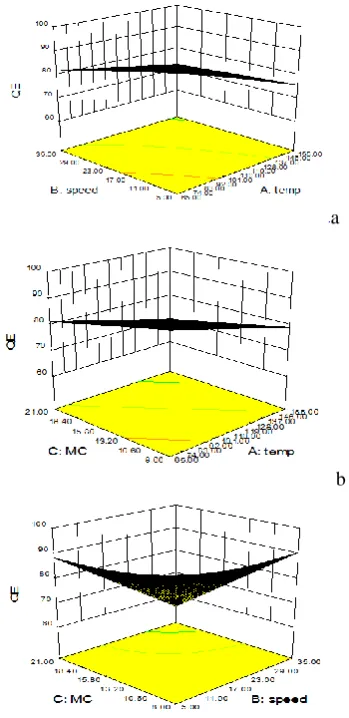
The regression model obtained for conveyance efficiency CE: CE = +116.15936 0.040800 * temp 0.53913 * speed -0.82425 * MC with an R2 of 47.26%
a
b
c
Figure 4 : Response surface contours for conveyance efficiency, CE of roaster. For each contour plots, the third variable is fixed.
Effect of speed, temperature and moisture content on quality efficiency, QE
The regression model obtained for quality efficiency QE: QE = +94.18063 -0.23675 * temp +1.25776 * speed +1.45696 * MC +2.96819E003 * temp * speed -7.07416E-004 * temp * MC -0.13407 * speed * MC with an R2 of 84.97%
The results of regression analysis show that all the factors did affect quality efficiency QE (p < 0.05), the analysis of variance reveals that regression was statistically significant at 84.97% confidence level, and the high coefficient of determination (R2 = 84.97) demonstrates that the model could be used to explain 84.97% of the total variation in the response. As Figure 5 shows, quality efficiency QE optimization required simultaneous decrease in speed and temperature. The best QE values were attained working at low speed and low temperature, conditions under which a slight reduction in the parameters will yield a corresponding increase in the quality efficiency.
a
b
c
Figure 5 : Response surface contours for quality efficiency, QE of roaster. For each contour plots, the third variable is fixed.
IV.CONCLUSION
Surface response can be used to evaluate the effect of temperature, speed and moisture content on the optimal evaluation parameters during roasting. The results show that the set temperature, auger speed and moisture content of maize were all significantly influenced all the evaluation parameters. Increasing the auger speed and set temperature will yield a significant increase in the roasting efficiency and roasting capacity. From the study, it was observed that the optimal conditions required to achieve the optimum roasting efficiency were auger speed of 35 rpm and set temperature of 155oC. These conditions give the best roasting efficiency with coefficient of determination of R2 equals 79%.
V.
REFERENCES
[1]. Brown W., and Darrah L., 1985. “Origin, adaptation, and types of corn," Natl. Corn Handbook. Cooperative Extension Service. Iowa State University. Iowa NCH-10. [2]. Davis K. S. 2001. “Corn Milling, Processing and
Minnesota Corn Growers Association. Minnesota Nutrition Conference, September 11, 2001.
[3]. Yang W., Winter P., Sokhansanj S., Wood H. and Crerer B. (2005). “Discrimination of hard-to-pop popcorn kernels by machine vision and neural networks," Biosystems Engineering, 91(1):, 1-8.
[4]. Bennett A. S., Bern C. .J., Richard T. L. and Anex R. P., 2007. “Corn grain drying using corn Stover combustion and CHP systems," Transaction of the ASABE, 50(6): 2161-2170.
[5]. Bhattacharya S. (1995). “Kinetics of hydration of raw and roasted corn semolina," Journal of Food Engineering, 25: 21-30.
[6]. Butkarev A. A. (2007). “Design of optimal (energy - efficient) roasting systems," Steel in Translation, 37: 756-763.
[7]. Jha S. N. (2005). “Mathematical simulation of roasting of grain." Journal of Food Engineering, 71: 304-310. [8]. Costa P. M. A., Jensen A. H., Harmon B. G. and Norton
H. W. (1977). “Effect of roasting and roasting temperatures on the nutritive value of high-moisture corn for swine," Journal of Animal Science, 44:, 234-241. [9]. Felsman R. J., Harvey R. W., Linnerud A. C. and Smith
F. H. (1976). “Effect of roasting temperature on corn grain characteristics," Journal of Animal Science, 42(2): 476-480.
[10]. Karababa E. (2004). “Physical properties of popcorn kernels," Journal of Food Engineering, 72:, 100-107. [11]. Sacchetti G., Mattia C. D., Pittia P. and Mastrocola D.
(2009). “Effect of roasting degree, equivalent thermal effect and coffee type on the radical scavenging activity of coffee and their phenolic fraction," Journal of Food Engineering, 90:, 74-80.
[12]. Tonroy B. R. and Perry T. W. (1974). “Effect of roasting corn at different temperatures on grain characteristics and in vitro starch digestibility," Journal of Diary Science, 58(4):.566-569.
[13]. Marton L. C., Tamas A. and Peter B. (2001). “Grain Moisture of Maize Hybrids in Different Maturity Groups at Various Harvesting Dates," Agriculture Research Institute of Academy and Science, Hungarian.
[14]. Salunkhe D. K., Chavan J. K and Kadam S. S. (1985). “Postharvest Biotechnology of Cereals," CRC Press, Inc. Boca Raton, Florida.