Electronic Cigarettes and Future
Marijuana Use: A Longitudinal Study
Hongying Dai, PhD, a, b, c Delwyn Catley, PhD, a, c Kimber P. Richter, PhD, d Kathy Goggin, PhD, a, c, e Edward F. Ellerbeck, MDdBACKGROUND: Cigarettes have been strongly associated with subsequent marijuana use among adolescents, but electronic cigarettes (e-cigarettes) are now rapidly replacing traditional cigarettes among youth. This study examines associations between youth e-cigarette use and subsequent marijuana use in a national sample.
METHODS: Youth (aged 12–17 years) never marijuana users at wave 1 (n = 10364; 2013–2014) from the Population Assessment of Tobacco and Health study were followed-up in 1 year (wave 2, 2014–2015). Multivariable logistic regressions were performed to evaluate associations between e-cigarette use at wave 1 and ever/heavy marijuana use in the past 12 months (P12M) and at wave 2.
RESULTS: Among never marijuana users, e-cigarette ever use (versus never use) at wave 1 was associated with increased likelihood of marijuana P12M use (adjusted odds ratio [aOR] = 1.9; 95% confidence interval [CI]: 1.4–2.5) at wave 2. There was a significant interaction between e-cigarette use and age (P < .05) with aOR = 2.7 (95% CI: 1.7–4.3) for adolescents aged 12 to 14 and aOR = 1.6 (95% CI: 1.2–2.3) for adolescents aged 15 to 17. The association with heavy marijuana use was significant among younger adolescents (aOR = 2.5; 95% CI: 1.2–5.3) but was not among older adolescents. Heavier e-cigarette use at wave 1 yielded higher odds of P12M and heavy marijuana use at wave 2 for younger adolescents.
CONCLUSIONS: E-cigarette use predicts subsequent marijuana use among youth, with a
stronger associations among young adolescents. Reducing youth access to e-cigarettes may decrease downstream marijuana use.
abstract
aThe Center for Children's Healthy Lifestyles and Nutrition, Children’s Mercy Kansas City, Kansas City, Missouri;
Departments of bBiomedical and Health Informatics and cPediatrics, and eSchool of Pharmacy, University
of Missouri-Kansas City, Kansas City, Missouri; and dDepartment of Preventive Medicine and Public Health,
University of Kansas Medical Center, Kansas City, Kansas
Dr Dai conceptualized the study, performed analyses, drafted the initial manuscript, and critically revised the manuscript; Drs Catley, Richter, and Goggin assisted in data analysis and result interpretation and critically reviewed and revised the manuscript; Dr Ellerbeck contributed to the manuscript design, assisted in data presentation and result interpretation, and critically reviewed and revised the manuscript; and all authors approved the final manuscript as submitted and agree to be accountable for all aspects of the work.
DOI: https:// doi. org/ 10. 1542/ peds. 2017- 3787 Accepted for publication Feb 26, 2018
Address correspondence to Hongying Dai, PhD, Health Services and Outcomes Research, Children’s Mercy Hospital, 2401 Gillham Rd, Kansas City, MO 64108. E-mail: [email protected] PEDIATRICS (ISSN Numbers: Print, 0031-4005; Online, 1098-4275).
Copyright © 2018 by the American Academy of Pediatrics
FINANCIAL DISCLOSURE: The authors have indicated they have no financial relationships relevant to this article to disclose.
FUNDING: No external funding.
WHAT’S KNOWN ON THIS SUBJECT: Cigarettes have been strongly associated with subsequent marijuana use among adolescents, but electronic cigarettes (e-cigarettes) are now rapidly replacing traditional cigarettes among youth. A growing body of literature shows that e-cigarettes could increase the subsequent risk of cigarette smoking among youth.
WHAT THIS STUDY ADDS: Youth e-cigarette use was associated with subsequent marijuana use, especially among young adolescents aged 12 to 14 years. Policies influencing the exposure of youth to e-cigarettes may have downstream effects on uptake of marijuana.
To cite: Dai H, Catley D, Richter KP, et al. Electronic Cigarettes and Future Marijuana Use: A Longitudinal Study. Pediatrics.
Although the prevalence of current cigarette smoking among youth declined from 28% in 1996 to 8% in 2016, 1, 2 electronic cigarette (e-cigarette) use is gaining popularity.3 Among teenagers, the use of e-cigarettes has outpaced the use of traditional cigarettes, especially among young adolescents.1, 4 It is also indicated in studies that marijuana remains the substance with the highest prevalence of use among youth; current use among high school seniors is nearly double that of current cigarette use.4 Moreover, teenagers’ attitudes are moving toward greater acceptance of marijuana. For instance, the percentage of high school seniors who perceived the occasional use of marijuana as harmful dropped from 27.4% in 2009 to 17.1% in 2016.4
In a growing body of longitudinal studies, it has been shown that youth who use e-cigarettes have higher odds of smoking cigarettes later, 5–9 suggesting that e-cigarettes might increase the risk of future cigarette use among adolescents. Researchers have also systematically evaluated cigarette smoking and marijuana use among adolescents. Authors of most longitudinal studies that examined cigarette smoking before marijuana use generally supported the association between baseline cigarette use and progression to use of other addictive substances (eg, marijuana).10–12 Although e-cigarettes are marketed as less harmful alternatives to smoking, 13 most youth are not using e-cigarettes to quit smoking. Instead, youth are attracted by the novelty of e-cigarettes and a wide variety of flavors specifically designed to appeal to the youth market.14 If youth e-cigarette use follows the same pattern as cigarette smoking, widespread use could expose youth to social environments that encourage substance use, thereby accelerating youths’ transitions to
the use of other substances with more adverse health effects.15, 16 Researchers in a few cross-sectional studies also examined the drug use patterns among adolescents, including poly use of e-cigarettes, marijuana, and other substances.17, 18 These studies revealed complex drug use patterns, and researchers identified higher risks of poly-drug use among e-cigarette users (versus nonusers).17, 18 Authors of cross-sectional studies have identified a high prevalence of marijuana vaping in both youth and adult populations.19–21 Researchers in a longitudinal study of Hispanic young adults further reported that e-cigarette use increased the likelihood of transitioning from nonusers to users of cigarettes or marijuana over a 1-year period.15 However, studies are needed to evaluate the longitudinal associations of e-cigarette use and future
marijuana use among adolescents in population-based samples.
Youth undergo multiple stages of development, and thus the role of e-cigarette use in an individual’s drug use patterns may differ by age.17 The age of e-cigarette initiation is similar to that of alcohol and marijuana, with a rapid increase after age 14 years and peaking around age 17 to 18 years.22 Because younger e-cigarette users were more likely to be nonusers of traditional drugs, 17 and adolescents who initiate substance use at an earlier age have higher risks for addiction and adverse health outcomes, 23, 24 we hypothesize that there might be an interaction between e-cigarette use and age in association with subsequent marijuana use. The risk difference in association between e-cigarette use and subsequent marijuana transition by age group has not been assessed in published studies.
To address these gaps, we analyzed the Population Assessment of Tobacco and Health (PATH) survey to examine the associations of
e-cigarette use (ever or number of e-cigarettes and/or cartridges used) at baseline (wave 1) and subsequent marijuana use (past 12 months [P12M] or heavy use) 1 year later (wave 2). We further stratified the analyses by age groups (12–14 and 15–17 years old) to enhance our understanding of this potential relationship.
METHODS
Data
Data on e-cigarette and marijuana use were obtained from wave 1 and wave 2 of the PATH study, a longitudinal cohort study of tobacco use behaviors, attitudes, and beliefs among a nationally representative sample of US civilian, noninstitutionalized individuals aged 12 years and older.25 A 4-stage, stratified probability sample design was used in the PATH study, and further details regarding the data collection, study design, and methods can be found elsewhere.25, 26 In this study, we used the public-use files of young participants aged 12 to 17 years at wave 1, continuing young participants (those still aged <18 years), and those who had become adults (age ≥18 years; “aged-up adults”) at wave 2.
subjects research by the Children’s Mercy Institutional Review Board.
Measures
E-cigarette Use at Wave 1 All participants were shown a brief description and pictures of e-cigarettes followed by a question, “Have you seen or heard of e-cigarettes before this study?”
Those who responded positively were asked, “Have you ever used an e-cigarette, even 1 or 2 times?”
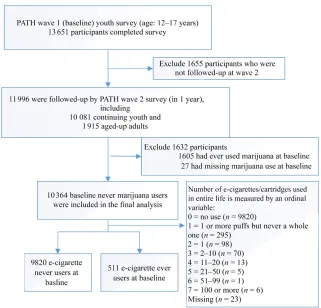
Those who responded “Yes” were categorized as e-cigarette ever users at wave 1. For the dose-response analysis, the number of e-cigarettes and/or cartridges used in an entire life was measured by an ordinal variable ranging from 0 (no use) to 7 (100 or more).27 See Fig 1. Marijuana Use at Wave 1 and Wave 2 Ever use of marijuana at wave 1 was defined by 2 items from the PATH study: “Have you ever used marijuana, hash, THC, grass, pot, or weed?” and “Have you ever smoked part of all of a cigar, cigarillo, or filter cigar with marijuana in it?”
Those who responded “No” to both of these questions were categorized as marijuana never users at wave 1. Those who responded “Yes” to either of these questions were categorized as marijuana ever users at wave 1. At wave 2, marijuana never users at wave 1 who reported using marijuana in the P12M were categorized as marijuana P12M users. On the basis of an additional item, “Which substances did you use weekly or more often?” we further categorized those who responded
“marijuana, hash, THC, grass, pot, or weed” as marijuana heavy users at wave 2.
Other Substance Use at Wave 1 Cigarette ever users were defined by the following item: “Have you ever tried cigarette smoking, even 1 or 2 puffs?” Those who responded
“Yes” were categorized as cigarette
ever users. Alcohol ever users were participants who responded “Yes”
to the following item: “Have you ever used alcohol at all, including sips of someone’s drink or your own drink?” Those who reported ever misuse of prescription drugs (ie, Ritalin, Adderall, painkillers, sedatives, or tranquilizers) were categorized as nonmedical ever users of prescription drugs. Those who reported ever using cocaine or crack, stimulants like methamphetamine or speed, heroin, inhalants, solvents, or hallucinogens were categorized as other illicit drug ever users.
Sensation Seeking
Sensation seeking was assessed by 3 items modified from the Brief Sensation Seeking Scale.28 Participants were asked to indicate the extent of agreement on the 5-point scale to the following: “I like new and exciting experiences, even if I have to break the rules”;
“I like to do frightening things”; and
“I prefer friends who are exciting and unpredictable.” Sensation seeking was calculated as the average response to these 3 items (Cronbach’s α = 0.76).28
Covariates
Several covariates were included to control for potential confounding effects: age (12–14 or 15–17 years old), sex (male or female), race and/or ethnicity (non-Hispanic [NH] white, NH African American, Hispanic, or NH other), grade performance (“mostly A’s” was classified as “A, ”“A’s and B’s or mostly B’s” was classified as “B, ” and
“B’s and C’s or mostly C’s or below”
was classified as “C or below”), parental education (less than high school, high school graduate, some college, or bachelor’s degree or greater), and region (Northeast, South, Midwest, West).
FIGURE 1
Statistical Methods
Weighted estimates of demographic characteristics and substance use at wave 1 were calculated for the overall sample and stratified by e-cigarette ever use status. Balanced repeated replication method with Fay’s adjustment = 0.3 was used to increase stability in variance estimation.29, 30 Confidence intervals (CIs) at the 95% level were calculated by using Wilson’s method. For continuing youth, wave 2 sampling weights in youth data were used; for aged-up adults, wave 2 sampling weights in adult data were used.27 Separate multivariable logistic regressions were used to examine the associations of e-cigarette use (ever, number of e-cigarettes/cartridges used) at wave 1 on subsequent marijuana use (P12M or heavy use) at wave 2 among marijuana never users at wave 1. Stratified analyses were conducted by age group (12–14 and 15–17 years old at wave 1). Adjusted odds ratios (aORs) were calculated in the multivariable analysis, in which all risk factors and covariates were included. Statistical analyses were performed by using SAS 9.4 (SAS Institute, Inc, Cary, NC), and P values <.05 were considered statistically significant.
RESULTS
Study Sample
A total of 11996 young participants aged 12 to 17 years completed both the wave 1 and wave 2 surveys. Ever users of marijuana (n = 1605; 13.4%) and subjects with missing marijuana ever use status (n = 27) at wave 1 were excluded. The final analysis included 10364 never marijuana users at wave 1 (Fig 1). As compared with ever marijuana users, never marijuana users tend to be younger and less likely to report using cigarettes, e-cigarettes, and other substances (Supplemental Table 5).
Sample Characteristics and Prevalence of Substance Use at Wave 1
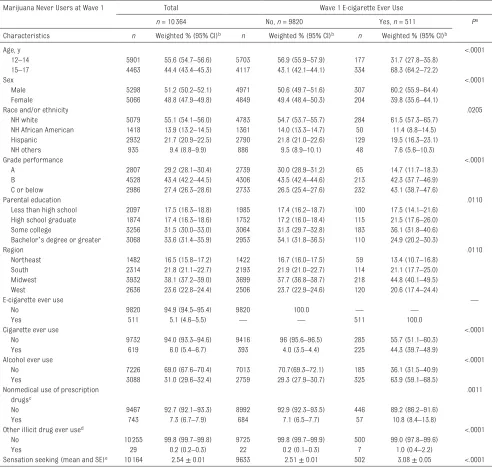
Overall, 44.4% of never marijuana users were aged 15 to 17 years, and 48.8% were female. NH white users accounted for 55.1% of respondents, followed by Hispanic users (21.7%), NH African American users (13.9%), and NH other users (9.4%) (Table 1). In terms of substance use, 5.1% of adolescents reported ever use of e-cigarettes, 6.0% reported ever smoking cigarettes, 31.0% reported ever drinking alcohol, 7.3% reported ever nonmedical use of prescription drugs, and 0.2% reported ever use of other illicit drugs.
Significant differences between e-cigarette never and ever users were observed. E-cigarette ever users were more likely than e-cigarette never users to be older, male, white, and have poorer grade performance. They were also more likely to report sensation seeking, smoking cigarettes, drinking, and ever nonmedical use of prescription drugs and using other illicit drugs.
Temporal Association With Marijuana P12M and Heavy Use at Wave 2
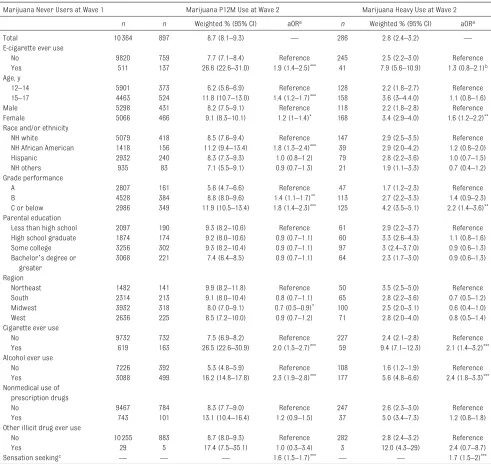
Overall, 8.7% of never marijuana users at wave 1 reported use of marijuana at wave 2. More than 1 in 4 (26.6%) adolescents who ever used e-cigarettes at wave 1 reported subsequent marijuana use at wave 2, as compared with 7.7% of adolescents who never used e-cigarettes at wave 1 (P < .05) (Table 2). After adjusting for demographic factors and other substance use, e-cigarette ever users at wave 1 were more likely to report subsequent P12M marijuana use at wave 2 (aOR = 1.9; CI: 1.4–2.5). Older age, being female, being African American, and having lower grade performance all had significantly elevated adjusted odds for wave 2 marijuana P12M use. In addition, wave 1 sensation seeking and cigarette and alcohol ever use
had significantly elevated odds for wave 2 marijuana use.
Overall, 2.8% of marijuana never users at wave 1 reported heavy use of marijuana at wave 2. Female participants (versus male participants) and adolescents with a grade performance of “C or below” (versus those with “A”) were more likely to report heavy use of marijuana at wave 2. Sensation seeking, cigarette ever use, and alcohol ever use at wave 1 were associated with higher odds of reporting heavy use of marijuana at wave 2.
Age-Stratified Analysis of the Temporal Association Between E-cigarette Use and Subsequent Marijuana Use
There were significant interactions between age group (12–14 years and 15–17 years) and marijuana P12M (P < .05) and heavy (P < .05) use (Table 3, Supplemental Fig 2). The association between baseline e-cigarette use and P12M marijuana use at wave 2 was significant among both younger adolescents aged 12 to 14 years (29.2% vs 5.5%; aOR = 2.7; CI: 1.7–4.3) and older adolescents aged 15 to 17 years (25.3% vs 10.6%; aOR = 1.6; CI: 1.2–2.3). Moreover, the association between baseline e-cigarette use and subsequent heavy marijuana use was significant among young adolescents (12.0% vs 1.9%; aOR = 2.5; CI: 1.2–5.3) but was not significant among older adolescents.
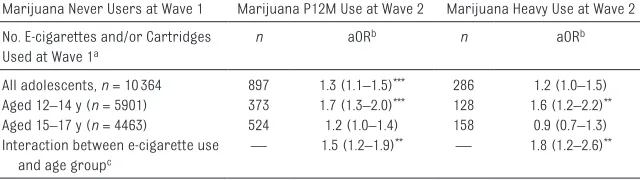
We tested a dose-response
DISCUSSION
It is suggested in the results from this longitudinal study that baseline e-cigarette use independently predicts subsequent marijuana use among youth after controlling for social-demographic factors, sensation
seeking, and other substance use. The overall prevalence of ever e-cigarette use among adolescents was 10.6% in the PATH 2013–2014 study (Supplemental Table 5), which is aligned with the prevalence reported by the National Youth
Tobacco Survey (8.1% in 2013).3 At wave 1, never marijuana users had a significantly lower prevalence of e-cigarette ever use as compared with marijuana users (5.1% vs 46.4%). To avoid confounding effects, baseline marijuana users were
TABLE 1 Sample Characteristics and Substance Use Prevalence, Overall and Stratified by E-cigarette Use Status Among Never Marijuana Users at Wave
1, PATH Study 2013–2015
Marijuana Never Users at Wave 1 Total Wave 1 E-cigarette Ever Use
n = 10364 No, n = 9820 Yes, n = 511 Pa
Characteristics n Weighted % (95% CI)b n Weighted % (95% CI)b n Weighted % (95% CI)b
Age, y <.0001
12–14 5901 55.6 (54.7–56.6) 5703 56.9 (55.9–57.9) 177 31.7 (27.8–35.8)
15–17 4463 44.4 (43.4–45.3) 4117 43.1 (42.1–44.1) 334 68.3 (64.2–72.2)
Sex <.0001
Male 5298 51.2 (50.2–52.1) 4971 50.6 (49.7–51.6) 307 60.2 (55.9–64.4)
Female 5066 48.8 (47.9–49.8) 4849 49.4 (48.4–50.3) 204 39.8 (35.6–44.1)
Race and/or ethnicity .0205
NH white 5079 55.1 (54.1–56.0) 4783 54.7 (53.7–55.7) 284 61.5 (57.3–65.7)
NH African American 1418 13.9 (13.2–14.5) 1361 14.0 (13.3–14.7) 50 11.4 (8.8–14.5)
Hispanic 2932 21.7 (20.9–22.5) 2790 21.8 (21.0–22.6) 129 19.5 (16.3–23.1)
NH others 935 9.4 (8.8–9.9) 886 9.5 (8.9–10.1) 48 7.6 (5.6–10.3)
Grade performance <.0001
A 2807 29.2 (28.1–30.4) 2739 30.0 (28.9–31.2) 65 14.7 (11.7–18.3)
B 4528 43.4 (42.2–44.5) 4306 43.5 (42.4–44.6) 213 42.3 (37.7–46.9)
C or below 2986 27.4 (26.3–28.6) 2733 26.5 (25.4–27.6) 232 43.1 (38.7–47.6)
Parental education .0110
Less than high school 2097 17.5 (16.3–18.8) 1985 17.4 (16.2–18.7) 100 17.5 (14.1–21.6) High school graduate 1874 17.4 (16.3–18.6) 1752 17.2 (16.0–18.4) 115 21.5 (17.6–26.0)
Some college 3256 31.5 (30.0–33.0) 3064 31.3 (29.7–32.8) 183 36.1 (31.8–40.6)
Bachelor’s degree or greater 3068 33.6 (31.4–35.9) 2953 34.1 (31.8–36.5) 110 24.9 (20.2–30.3)
Region .0110
Northeast 1482 16.5 (15.8–17.2) 1422 16.7 (16.0–17.5) 59 13.4 (10.7–16.8)
South 2314 21.8 (21.1–22.7) 2193 21.9 (21.0–22.7) 114 21.1 (17.7–25.0)
Midwest 3932 38.1 (37.2–39.0) 3699 37.7 (36.8–38.7) 218 44.8 (40.1–49.5)
West 2636 23.6 (22.8–24.4) 2506 23.7 (22.9–24.6) 120 20.6 (17.4–24.4)
E-cigarette ever use —
No 9820 94.9 (94.5–95.4) 9820 100.0 — —
Yes 511 5.1 (4.6–5.5) — — 511 100.0
Cigarette ever use <.0001
No 9732 94.0 (93.3–94.6) 9416 96 (95.6–96.5) 285 55.7 (51.1–60.3)
Yes 619 6.0 (5.4–6.7) 393 4.0 (3.5–4.4) 225 44.3 (39.7–48.9)
Alcohol ever use <.0001
No 7226 69.0 (67.6–70.4) 7013 70.7(69.3–72.1) 185 36.1 (31.5–40.9)
Yes 3088 31.0 (29.6–32.4) 2759 29.3 (27.9–30.7) 325 63.9 (59.1–68.5)
Nonmedical use of prescription drugsc
.0011
No 9467 92.7 (92.1–93.3) 8992 92.9 (92.3–93.5) 446 89.2 (86.2–91.6)
Yes 743 7.3 (6.7–7.9) 684 7.1 (6.5–7.7) 57 10.8 (8.4–13.8)
Other illicit drug ever used <.0001
No 10 255 99.8 (99.7–99.8) 9725 99.8 (99.7–99.9) 500 99.0 (97.8–99.6)
Yes 29 0.2 (0.2–0.3) 22 0.2 (0.1–0.3) 7 1.0 (0.4–2.2)
Sensation seeking (mean and SE)e 10 164 2.54 ± 0.01 9633 2.51 ± 0.01 502 3.08 ± 0.05 <.0001
—, not applicable.
a Rao-Scott χ2 test was performed to compare the distribution of sample characteristics and substance use by e-cigarette use status at wave 1.
b Researchers of the PATH study oversampled adult tobacco users, young adults aged 18–24 y, and African Americans, so weighted estimates were calculated to reflect the prevalence
in population.
c Prescription drugs include Ritalin, Adderall, painkillers, sedatives, or tranquilizers.
d Other illicit drugs include cocaine or crack, stimulants like methamphetamine or speed, heroin, inhalants, solvents, or hallucinogens.
excluded from analysis, which led to a low prevalence of e-cigarette use at baseline in this study. For associations between e-cigarette and subsequent marijuana use, the aORs were lower than the crude ratios. As shown in Supplemental Table 6,
the reduction was most affected by ever use of cigarettes, followed by drinking alcohol and sensation seeking, and slightly affected by age and grade performance. There are several possible reasons why e-cigarette use might be associated
with subsequent marijuana initiation. On the one hand, e-cigarettes may simply be a marker of risk-taking behavior; e-cigarette users are more likely to smoke cigarettes and drink alcohol, which are also associated with marijuana use.31, 32
TABLE 2 Temporal Association of E-cigarette Use and Covariates at Wave 1 With Marijuana Use at Wave 2 Among Baseline Marijuana Never Users, PATH
Study, 2013–2015
Marijuana Never Users at Wave 1 Marijuana P12M Use at Wave 2 Marijuana Heavy Use at Wave 2
n n Weighted % (95% CI) aORa n Weighted % (95% CI) aORa
Total 10364 897 8.7 (8.1–9.3) — 286 2.8 (2.4–3.2) —
E-cigarette ever use
No 9820 759 7.7 (7.1–8.4) Reference 245 2.5 (2.2–3.0) Reference
Yes 511 137 26.6 (22.6–31.0) 1.9 (1.4–2.5)*** 41 7.9 (5.6–10.9) 1.3 (0.8–2.1)b
Age, y
12–14 5901 373 6.2 (5.6–6.9) Reference 128 2.2 (1.8–2.7) Reference
15–17 4463 524 11.8 (10.7–13.0) 1.4 (1.2–1.7)*** 158 3.6 (3–4.4.0) 1.1 (0.8–1.6)
Male 5298 431 8.2 (7.5–9.1) Reference 118 2.2 (1.8–2.8) Reference
Female 5066 466 9.1 (8.3–10.1) 1.2 (1–1.4)* 168 3.4 (2.9–4.0) 1.6 (1.2–2.2)**
Race and/or ethnicity
NH white 5079 418 8.5 (7.6–9.4) Reference 147 2.9 (2.5–3.5) Reference
NH African American 1418 156 11.2 (9.4–13.4) 1.8 (1.3–2.4)*** 39 2.9 (2.0–4.2) 1.2 (0.8–2.0)
Hispanic 2932 240 8.3 (7.3–9.3) 1.0 (0.8–1.2) 79 2.8 (2.2–3.6) 1.0 (0.7–1.5)
NH others 935 83 7.1 (5.5–9.1) 0.9 (0.7–1.3) 21 1.9 (1.1–3.3) 0.7 (0.4–1.2)
Grade performance
A 2807 161 5.6 (4.7–6.6) Reference 47 1.7 (1.2–2.3) Reference
B 4528 384 8.8 (8.0–9.6) 1.4 (1.1–1.7)** 113 2.7 (2.2–3.3) 1.4 (0.9–2.3)
C or below 2986 349 11.9 (10.5–13.4) 1.8 (1.4–2.3)*** 125 4.2 (3.5–5.1) 2.2 (1.4–3.6)**
Parental education
Less than high school 2097 190 9.3 (8.2–10.6) Reference 61 2.9 (2.2–3.7) Reference
High school graduate 1874 174 9.2 (8.0–10.6) 0.9 (0.7–1.1) 60 3.3 (2.6–4.3) 1.1 (0.8–1.6)
Some college 3256 302 9.3 (8.2–10.4) 0.9 (0.7–1.1) 97 3 (2.4–3.7.0) 0.9 (0.6–1.3)
Bachelor’s degree or greater
3068 221 7.4 (6.4–8.5) 0.9 (0.7–1.1) 64 2.3 (1.7–3.0) 0.9 (0.6–1.3)
Region
Northeast 1482 141 9.9 (8.2–11.8) Reference 50 3.5 (2.5–5.0) Reference
South 2314 213 9.1 (8.0–10.4) 0.8 (0.7–1.1) 65 2.8 (2.2–3.6) 0.7 (0.5–1.2)
Midwest 3932 318 8.0 (7.0–9.1) 0.7 (0.5–0.9)* 100 2.5 (2.0–3.1) 0.6 (0.4–1.0)
West 2636 225 8.5 (7.2–10.0) 0.9 (0.7–1.2) 71 2.8 (2.0–4.0) 0.8 (0.5–1.4)
Cigarette ever use
No 9732 732 7.5 (6.9–8.2) Reference 227 2.4 (2.1–2.8) Reference
Yes 619 163 26.5 (22.6–30.9) 2.0 (1.5–2.7)*** 59 9.4 (7.1–12.3) 2.1 (1.4–3.2)***
Alcohol ever use
No 7226 392 5.3 (4.8–5.9) Reference 108 1.6 (1.2–1.9) Reference
Yes 3088 499 16.2 (14.8–17.8) 2.3 (1.9–2.8)*** 177 5.6 (4.8–6.6) 2.4 (1.8–3.3)***
Nonmedical use of prescription drugs
No 9467 784 8.3 (7.7–9.0) Reference 247 2.6 (2.3–3.0) Reference
Yes 743 101 13.1 (10.4–16.4) 1.2 (0.9–1.5) 37 5.0 (3.4–7.3) 1.2 (0.8–1.8)
Other illicit drug ever use
No 10255 883 8.7 (8.0–9.3) Reference 282 2.8 (2.4–3.2) Reference
Yes 29 5 17.4 (7.5–35.1) 1.0 (0.3–3.4) 3 12.0 (4.3–29) 2.4 (0.7–8.7)
Sensation seekingc — — — 1.6 (1.5–1.7)*** — — 1.7 (1.5–2)***
—, not applicable.
a aOR was calculated in the multivariable logistic regression, in which the explanatory variables included all listed variables (demographics, substance ever use, and sensation seeking)
at wave 1.
b There were significant interactions between age and e-cigarette use. See Table 3. c aOR corresponds to 1 U increase in the risk of sensation seeking (5-point scale). *P < .05;
Alternatively, because the brain is still developing during the teenage years, nicotine exposure might lead to changes in the central nervous system that predispose teenagers to dependence on other drugs of abuse.33 Experimenting with e-cigarettes might also increase a youth’s curiosity about marijuana, reduce perceived harm of marijuana use, and increase the social access to marijuana from peers and friends. As a result of marketing and social media promotion, 34, 35 vaping
cannabis is gaining popularity.19, 20 Youth who experiment with
e-cigarettes may use the same device or switch to newer generation devices for vaping marijuana, 20, 36 which could lead to use of substance with stronger addictive effects.37
With these findings, we highlight the importance of policy and education to reduce risks for youth. Currently, e-cigarette and marijuana are the 2 most commonly used substances by teenagers. The FDA has extended its
authority to regulate e-cigarettes, and the first round of these new regulations, including mandatory age and photo identification checks to prevent illegal sales of newly regulated tobacco products to minors, went into effect on August 8, 201638 (after data collected for this study). Data from this study may have implications for state authorities that presently vary greatly in their enforcement of e-cigarette sales and legal access to marijuana.39–41 It is important for health providers and educators to advise youth about the risks of e-cigarette use, including the propensity of progression to marijuana use after e-cigarette use. Policies to prevent youth use of e-cigarettes and reduce youth access to e-cigarettes, such as expanding smoke-free policies and Tobacco 21 policies, should be considered as well.
In research on the developmental trajectory of substance use and addiction, the critical role of nicotine initiation at an early age has been highlighted. For instance, smoking at a young age increases the likelihood of becoming an addicted daily smoker.2, 24, 42, 43 Our study revealed heterogeneity in the associations
TABLE 3 Age-Stratified Analysis of the Temporal Association Between E-cigarette Ever Use at Wave 1 and Marijuana Use at Wave 2 Among Baseline
Marijuana Never Users, PATH Study, 2013–2015 Marijuana Never
Users at Wave 1
E-cigarette Ever Use at Wave 1 Marijuana P12M Use at Wave 2 Marijuana Heavy Use at Wave 2
n Weighted % (95% CI) aORa n Weighted % (95% CI) aORa
Aged 12–14 (n = 5901)b
No (n = 5703) 321 5.5 (4.9–6.2) REF 107 1.9 (1.5–2.3) REF
Yes (n = 177) 52 29.2 (23.0–36.2) 2.7 (1.7– 43)***
21 12.0 (7.6–18.5) 2.5 (1.2-–5.3)* Aged 15–17 (n =
4463)b
No (n = 4117) 438 10.6 (9.5–11.9) REF 138 3.4 (2.8–4.2) REF
Yes (n = 334) 85 25.3 (21.0–30.3) 1.6 (1.2– 2.3)**
20 5.9 (3.8–9.1) 0.9 (0.5–1.5) Interaction between
age group and e-cigarette ever usec
— — — 2.1 (1.3–
3.3)** — —
3.1 (1.5–6.4)**
—, not applicable.
a For all models, aOR was adjusted by sensation seeking, ever use of cigarettes, drinking, nonmedical use of prescription drugs and other illicit drugs, and demographics (sex, race and/
or ethnicity, grade performance, parental education, and region) at wave 1.
b Separate multivariable logistic regression models were performed for youth aged 12–14 years and youth aged 15–17 years, respectively.
c A joint model was constructed to evaluate the main effects of age and e-cigarette use, along with an interaction between age and e-cigarette use. Interaction aOR indicates that e-cigarette
use (versus no use) at baseline was associated with higher risks of marijuana use at wave 2 among younger adolescents than among older adolescents.
*P < .05; **P < .01; ***P < .001.
TABLE 4 Age-Stratified Analysis of the Temporal Association Between the Number of E-cigarettes
and/or Cartridges Used at Wave 1 and Marijuana Use at Wave 2 Among Baseline Marijuana Never Users, PATH Study, 2013–2015
Marijuana Never Users at Wave 1 Marijuana P12M Use at Wave 2 Marijuana Heavy Use at Wave 2 No. E-cigarettes and/or Cartridges
Used at Wave 1a
n aORb n aORb
All adolescents, n = 10364 897 1.3 (1.1–1.5)*** 286 1.2 (1.0–1.5) Aged 12–14 y (n = 5901) 373 1.7 (1.3–2.0)*** 128 1.6 (1.2–2.2)** Aged 15–17 y (n = 4463) 524 1.2 (1.0–1.4) 158 0.9 (0.7–1.3) Interaction between e-cigarette use
and age groupc —
1.5 (1.2–1.9)** — 1.8 (1.2–2.6)**
—, not applicable.
a A dose-response analysis was conducted by treating the number of e-cigarette cartridges used as an ordinal variable,
and aOR corresponds to 1 U increase in the scale.
b For all models, aOR was adjusted by sensation seeking, ever use of cigarettes, drinking, nonmedical use of prescription
drugs and other illicit drugs, and demographics (sex, race and/or ethnicity, grade performance, parental education, and region) at wave 1.
c Significant interaction indicates that that number of e-cigarettes used at baseline was associated with higher risks of
marijuana use at wave 2 among younger adolescents than among older adolescents.
of e-cigarette use on subsequent marijuana use by age group. The temporal association between baseline e-cigarette use and initiation of marijuana use was larger among younger adolescents aged 12 to 14 years than among older adolescents aged 15 to 17 years. This finding is consistent with previous cross-sectional studies in which it was indicated that younger high school students were more likely to use e-cigarettes to vape cannabis, and that e-cigarettes may have made inroads among younger users who have low risks of using traditional substances.17, 20 As youth start to initiate e-cigarettes as early as 7 years old, 44 the interaction between age and subsequent marijuana use underscores the importance of starting prevention efforts on e-cigarette and other substance use at an earlier age because these youth have the most to gain. In addition, we found that youth who reported a larger number of e-cigarettes and/or cartridges used in a lifetime at baseline were more likely to be subsequent marijuana heavy users. Because the regular use of marijuana
during adolescence is of particular concern for adverse health effects, 45 we add to the existing literature by identifying the quantity of e-cigarette use as a risk factor for marijuana heavy use.
This study is subject to several limitations. First, both e-cigarette and marijuana use were self-reported. Thus, reporting and recall biases might have occurred, especially for younger respondents.46 Second, not all youth included in wave 1 of the PATH study responded to the wave 2 survey. However, attrition was not associated with a previous history of substance use (Supplemental Table 5). Finally, the investigators of the PATH study did not ask respondents about what substances youth vaped in their e-cigarettes, which could include flavoring only, nicotine, or marijuana derivatives.47 Therefore, we were not able to ascertain which specific vaped substances had effects on subsequent marijuana use. Future studies are needed to investigate the underlying
mechanism of substance transition and evaluate long-term impacts of
e-cigarette use. Our study revealed that e-cigarette use was associated with an increased risk of subsequent marijuana use among youth, with a stronger temporal association among younger adolescents. With these findings, we suggest that the widespread use of e-cigarettes among youth may have implications for the uptake of other drugs of abuse beyond nicotine and tobacco products.
ACKNOWLEDGMENT
We thank Dr Adam Leventhal from the University of Southern California for his helpful comments and suggestions on the manuscript.
ABBREVIATIONS
aOR: adjusted odds ratio CI: confidence interval
e-cigarette: electronic cigarette NH: non-Hispanic
PATH: Population Assessment of Tobacco and Health P12M: past 12 months
REFERENCES
1. Jamal A, Gentzke A, Hu SS, et al. Tobacco use among middle and high school students - United States, 2011-2016. MMWR Morb Mortal Wkly Rep. 2017;66(23):597–603
2. U.S. Department of Health and Human Services. Preventing Tobacco Use Among Youth and Young Adults: A Report of the Surgeon General. Atlanta, GA: US Department of Health and Human Services, Centers for Disease Control and Prevention, National Center for Chronic Disease Prevention and Health Promotion, Office on Smoking and Health; 2012
3. U.S. Department of Health and Human Services. E-Cigarette Use Among Youth and Young Adults: A Report of the Surgeon General. Atlanta, GA: US
Department of Health and Human Services, Centers for Disease Control and Prevention, National Center for Chronic Disease Prevention and Health Promotion, Office on Smoking and Health; 2016
4. Johnston LD, O’Malley PM, Miech RA, Bachman JG, Schulenberg JE.
Monitoring the Future National Survey Results on Drug Use, 1975-2016: Overview, Key Findings on Adolescent Drug Use. Ann Arbor, MI: Institute for Social Research, The University of Michigan; 2017
5. Leventhal AM, Strong DR, Kirkpatrick MG, et al. Association of electronic cigarette use with initiation of combustible tobacco product
smoking in early adolescence. JAMA. 2015;314(7):700–707
6. Wills TA, Knight R, Sargent JD, et al. Longitudinal study of e-cigarette use and onset of cigarette smoking among high school students in Hawaii. Tob Control. 2017;26(1):34–39
7. Barrington-Trimis JL, Urman R, Berhane K, et al. E-cigarettes and future cigarette use. Pediatrics. 2016;138(1):e20160379
8. Soneji S, Barrington-Trimis JL, Wills TA, et al. Association between initial use of e-cigarettes and subsequent cigarette smoking among adolescents and young adults: a systematic review and meta-analysis. JAMA Pediatr. 2017;171(8):788–797
9. Miech R, Patrick ME, O’Malley PM, Johnston LD. E-cigarette use as a predictor of cigarette smoking: results from a 1-year follow-up of a national sample of 12th grade students. Tob Control. 2017;26(e2):e106–e111
10. Ramo DE, Liu H, Prochaska JJ. Tobacco and marijuana use among adolescents and young adults: a systematic review of their co-use. Clin Psychol Rev. 2012;32(2):105–121
11. Kandel DB, Yamaguchi K, Chen K. Stages of progression in drug involvement from adolescence to adulthood: further evidence for the gateway theory. J Stud Alcohol. 1992;53(5):447–457
12. Lynskey MT, Heath AC, Bucholz KK, et al. Escalation of drug use in early-onset cannabis users vs co-twin controls.
JAMA. 2003;289(4):427–433
13. Farsalinos KE, Polosa R. Safety evaluation and risk assessment of electronic cigarettes as tobacco cigarette substitutes: a systematic review. Ther Adv Drug Saf. 2014;5(2):67–86
14. Wadley J. Most youth use e-cigarettes for novelty, flavors–not to quit smoking. Michigan News. December 16, 2015. Available at: www. ns. umich. edu/ new/ releases/ 23371- most- youth- use- e- cigarettes- for- novelty- flavors- not- to- quit- smoking. Accessed February 11, 2017
15. Unger JB, Soto DW, Leventhal A. E-cigarette use and subsequent cigarette and marijuana use among Hispanic young adults. Drug Alcohol Depend. 2016;163:261–264
16. Kandel DB. Examining the gateway hypothesis: stages and pathways of drug involvement. In: Kandel DB, ed. Stages and Pathways of Drug Involvement: Examining the Gateway Hypothesis. New York, NY: Cambridge University Press; 2002:3–15
17. Miech RA, O’Malley PM, Johnston LD, Patrick ME. E-cigarettes and the drug use patterns of adolescents. Nicotine Tob Res. 2016;18(5):654–659
18. Morean ME, Kong G, Camenga DR, Cavallo DA, Simon P, Krishnan-Sarin S. Latent class analysis of current e-cigarette and other substance use
in high school students. Drug Alcohol Depend. 2016;161:292–297
19. Lee DC, Crosier BS, Borodovsky JT, Sargent JD, Budney AJ. Online survey characterizing vaporizer use among cannabis users. Drug Alcohol Depend. 2016;159:227–233
20. Morean ME, Kong G, Camenga DR, Cavallo DA, Krishnan-Sarin S. High school students’ use of electronic cigarettes to vaporize cannabis.
Pediatrics. 2015;136(4):611–616 21. Mammen G, Rehm J, Rueda S.
Vaporizing cannabis through e-cigarettes: prevalence and socio-demographic correlates among Ontario high school students. Can J Public Health. 2016;107(3):e337–e338 22. Agrawal A, Grant JD, Waldron M, et al.
Risk for initiation of substance use as a function of age of onset of cigarette, alcohol and cannabis use: findings in a Midwestern female twin cohort. Prev Med. 2006;43(2):125–128
23. Mack AH. Adolescent substance use: America’s # 1 public health problem. In Talbott JA, Ballenger JC, Buckley PF, Frances RJ, Krupnick JL, Mack AH, eds.
Year Book of Psychiatry and Applied Mental Health. New York, NY: Elsevier Health Sciences; 2012:39–40
24. Taioli E, Wynder EL. Effect of the age at which smoking begins on frequency of smoking in adulthood. N Engl J Med. 1991;325(13):968–969
25. United States Department of Health and Human Services; National Institutes of Health; National Institute on Drug Abuse, and United States Department of Health and Human Services; US Food and Drug Administration; Center for Tobacco Products. Population Assessment of Tobacco and Health (PATH) Study [United States] Restricted-Use Files. Ann Arbor, MI: Inter-university Consortium for Political and Social Research; 2017
26. Hyland A, Travers MJ, Cummings KM, Bauer J, Alford T, Wieczorek WF. Tobacco outlet density and demographics in Erie County, New York. Am J Public Health. 2003;93(7):1075–1076
27. Inter-university Consortium for Political and Social Research.
Population assessment of tobacco and health (PATH) study [United States] restricted-use files: user guide. Available at: http:// doi. org/ 10. 3886/ ICPSR36231. userguide. Accessed February 20, 2018
28. Hoyle RH, Stephenson MT, Palmgreen P, Lorch EP, Donohew RL. Reliability and validity of a brief measure of sensation seeking. Pers Individ Dif. 2002;32(3):401–414
29. McCarthy PJ. Pseudoreplication: further evaluation and applications of the balanced half-sample technique.
Vital Health Stat 2. 1969;(31):1–24 30. Judkins DR. Fay’s method for
variance estimation. J Off Stat. 1990;6(3):223–239
31. Miech R, Johnston L, O’Malley PM. Prevalence and attitudes regarding marijuana use among adolescents over the past decade. Pediatrics. 2017;140(6):e20170982
32. Cohn A, Villanti A, Richardson A, et al. The association between alcohol, marijuana use, and new and emerging tobacco products in a young adult population. Addict Behav. 2015;48:79–88
33. Kandel ER, Kandel DB. Shattuck lecture. A molecular basis for nicotine as a gateway drug. N Engl J Med. 2014;371(10):932–943
34. Cavazos-Rehg PA, Krauss M, Fisher SL, Salyer P, Grucza RA, Bierut LJ. Twitter chatter about marijuana. J Adolesc Health. 2015;56(2):139–145
35. Cavazos-Rehg PA, Krauss MJ, Sowles SJ, Bierut LJ. Marijuana-related posts on Instagram. Prev Sci. 2016;17(6):710–720
36. Miech R, Patrick ME, O’Malley PM, Johnston LD. What are kids vaping? Results from a national survey of US adolescents. Tob Control. 2017;26(4):386–391
37. Vanyukov MM, Tarter RE, Kirillova GP, et al. Common liability to addiction and “gateway hypothesis”: theoretical, empirical and evolutionary perspective. Drug Alcohol Depend. 2012;123(suppl 1):S3–S17
family smoking prevention and tobacco control act; restrictions on the sale and distribution of tobacco products and required warning statements for tobacco products. Final rule. Fed Regist. 2016;81(90):28973–29106 39. Tobacco Control Legal Consortium.
U.S. e-cigarette regulations–50 state review. 2017. Available at: www. publichealthlawce nter. org/ resources/ us- e- cigarette- regulations- 50- state- review. Accessed June 2, 2017 40. National Conference of State
Legislatures. State medical marijuana laws. 2017. Available at: www. ncsl. org/ research/ health/ state- medical- marijuana- laws. aspx. Accessed December 28, 2017
41. Governing the States and Localities. State marijuana laws in 2017 map. 2017. Available at: www. governing. com/
gov- data/ state- marijuana- laws- map- medical- recreational. html. Accessed December 28, 2017
42. US Department of Health and Human Services. The Health Consequences of Smoking–50 Years of Progress: A Report of the Surgeon General. Atlanta, GA: US Department of Health and Human Services, Centers for Disease Control and Prevention, National Center for Chronic Disease Prevention and Health Promotion, Office on Smoking and Health; 2014
43. Campaign for Tobacco-Free Kids. The path to tobacco addiction starts at very young ages. 2017. Available at: https:// www. tobaccofreekids. org/ research/ factsheets/ pdf/ 0127. pdf. Accessed December 23, 2017 44. Chen X, Yu B, Wang Y. Initiation of
electronic cigarette use by age among
youth in the US Am J Prev Med. 2017;53(3):396–399
45. Volkow ND, Baler RD, Compton WM, Weiss SR. Adverse health effects of marijuana use. N Engl J Med. 2014;370(23):2219–2227 46. Brener ND, Billy JO, Grady WR.
Assessment of factors affecting the validity of self-reported health-risk behavior among adolescents: evidence from the scientific literature. J Adolesc Health. 2003;33(6):436–457 47. Johnston LD, Bachman JG,
DOI: 10.1542/peds.2017-3787 originally published online April 23, 2018;
2018;141;
Pediatrics
Ellerbeck
Hongying Dai, Delwyn Catley, Kimber P. Richter, Kathy Goggin and Edward F.
Electronic Cigarettes and Future Marijuana Use: A Longitudinal Study
Services
Updated Information &
http://pediatrics.aappublications.org/content/141/5/e20173787
including high resolution figures, can be found at:
References
http://pediatrics.aappublications.org/content/141/5/e20173787#BIBL
This article cites 33 articles, 6 of which you can access for free at:
Subspecialty Collections
http://www.aappublications.org/cgi/collection/smoking_sub Smoking
http://www.aappublications.org/cgi/collection/substance_abuse_sub Substance Use
following collection(s):
This article, along with others on similar topics, appears in the
Permissions & Licensing
http://www.aappublications.org/site/misc/Permissions.xhtml
in its entirety can be found online at:
Information about reproducing this article in parts (figures, tables) or
Reprints
http://www.aappublications.org/site/misc/reprints.xhtml
DOI: 10.1542/peds.2017-3787 originally published online April 23, 2018;
2018;141;
Pediatrics
Ellerbeck
Hongying Dai, Delwyn Catley, Kimber P. Richter, Kathy Goggin and Edward F.
Electronic Cigarettes and Future Marijuana Use: A Longitudinal Study
http://pediatrics.aappublications.org/content/141/5/e20173787
located on the World Wide Web at:
The online version of this article, along with updated information and services, is
http://pediatrics.aappublications.org/content/suppl/2018/04/19/peds.2017-3787.DCSupplemental
Data Supplement at:
by the American Academy of Pediatrics. All rights reserved. Print ISSN: 1073-0397.