147 | P a g e
A REVIEW ON EFFECT OF PROCESS PARAMETERS
OF RESISTANCE WELDING
Gajanan S. Gaikwad
1, Dr. K. H. Inamdar
21
PG Student, Department of Mechanical Engineering,
Walchand College of Engineering, Sangli, (India)
2
Associate Professor, Department of Mechanical Engineering,
Walchand College of Engineering, Sangli, (India)
ABSTRACT
Resistance welding is most commonly used joining method in automobile and aerospace industries. Resistance
welding methods are inexpensive and efficient which has made them highly popular in the making of sheet
joints. Several types of resistance welding are developed for producing continuous and pressure tight joints on
overlapped materials. The variants of resistance welding are spot welding, seam welding and projection
welding. This paper reviews on various effects of process parameters on response variables. Input parameters
such as welding current, weld time, electrode force and electrode geometry effects on the response variables
such as tensile strength, hardness, nugget size. ANOVA and Taguchi has been most efficient and powerful tool
for optimization of resistance welding response parameters which produce high quality parts rapidly and low
cost.
Keywords:
Electrode Pressure, Seam Welding, Spot Welding, Welding Current, Weld Quality,
I INTRODUCTION
Resistance welding is one of the oldest of the welding processes in use by industry today. Resistance welding is
a welding process in which work pieces are welded due to a combination of a pressure applied to them and a
localized heat generated by a high electric current flowing through the contact area of the weld. There are
various parameters such as welding current, electrode pressure etc. which directly and indirectly controls the
quality of the weld. In order to get better quality welds, proper combination of values required to be chosen
while welding. This paper reviews on various effects of process parameters on response variables. Particular
attention paid to the variation of response variables according to the process parameters. Major advantages of
resistance welding are high speed welding, Suitable for high rate production, easily automated, low fumes, low
148 | P a g e
1.1
Resistance welding process
Resistance spot welding is a process in which coalescences produced at two faying surfaces by heat generated at
the joint to form lap joint. Spot welding produces single spot like welds, which are called nuggets. The heat is
generated by resistance to flow of current though the workpiece. Electrodes are located on both sides of the
workpiece in which one is movable and other is fixed. The advantages of spot welding include cost efficiency,
good dimensional accuracy and reliable production. Without large deformation, it can be used for joining of
several metallic materials and sheets of different thicknesses together.
Fig. 1.1. Working of resistance spot welding
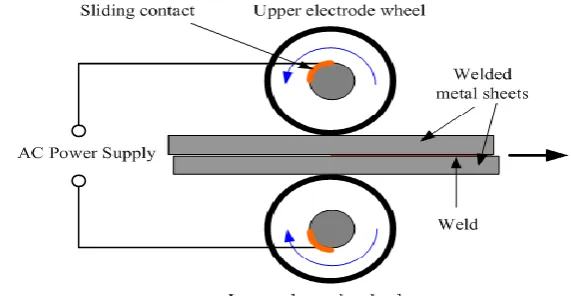
Seam welding process similar to spot welding process, but differs mainly because of the rolling welding wheel.
In Seam welding, two rotating circular electrode wheel are used to produce a series of spot welds. These
electrode wheels may rotate either continuously or intermittently. Seam welding produces continuous tight weld
which is not produced by other resistance welding methods. In most of the applications, wheels on both sides
produce the weld. Seam welding is mostly applied in manufacturing of containers, radiators and heat exchangers
etc. [2]
Fig.1.2. Working of resistance seam welding
II HEAT GENERATION
Heat generation in resistance welding is takes place by heating phenomenon. The heat generated depends upon
149 | P a g e
resistivity and surface condition of the parent material, the size, shape and material of the electrodes and thepressure applied by the electrodes.
Q= Rt …….. (Eq. 1)
where I is the current passing through the metal combination, R is the resistance of the base metals and the
contact interfaces, and t is the duration/time of the current flow.
The amount of resistance at the interface of the workpiece, depends on the heat transfer capabilities of the
material, the material’s electrical resistance, and the combined thickness of the materials at the weld joint [3].
III PROCESS PARAMETERS
Major factors that controlling resistance welding are welding current, welding time, electrode pressure,
electrode diameter and electrode geometry and dimension.
3.1 Welding current
Welding current is the most significant parameter that controls the heating at the joint of sheet to sheet interface
and hence the weld nugget development and formation takes place. AC and DC currents possess different
characteristics in total heating and heat input rate and their effect on weld quality and weld formation. Increase
in the current increases the diameter of the weld, root penetration. It also increases strength of the weld. Excess
current value gives rise to excessive indentation and burning of the weld nugget area.
3.2 Welding time
As given in the eq. 1, amount of heat generated is proportional to the weld time. Weld time includes squeeze
time, weld time, hold time and off time. Prolonged weld time increases the size of the weld. Due to the heat
transfer from the weld zone to the base metals and to the electrodes, as well as the heat loss from the free
surfaces to the surroundings, a minimum welding current as well as a minimum welding time will be needed to
make a weld. If sufficient welding current is not used, by increasing the welding time alone will not produce a
weld. When the welding current is high enough, the size of the weld nugget increases with increasing welding
time until it reaches a size similar to the electrode tip contact area. If welding time is more, expulsion of the
workpiece will occur or in the worst cases the electrode may stick to the workpiece [4].
3.3 Electrode force
Electrode force is the force exerted by the electrodes on to the workpiece during welding cycle. The pressure
exerted by the electrode tips on the workpiece has great effect on the amount of current that flows through the
welding joint. Electrode conveys the force and welding current to desired location. If the electrode force is high,
the contact area will be large resulting in low current density and low contact resistance that will reduce heat
generation and the size of weld nugget. Large indentation lowers the strength of the weld. If the welding force is
too low, expulsion may occur immediately after starting the welding current because of the contact resistance is
too high, resulting in rapid heat generation.
150 | P a g e
Welding speed parameter has great effect on weld quality. This parameter is effective in seam welding process.The speed at which workpiece should be welded depends on the parameters like thickness of workpiece, surface
conditions of workpiece. Lower welding speed causes more concentration of current at the interface, hence
causes surface burning of the workpiece. Higher welding speed causes reduction in the weld strength [5].
3.5 Electrode geometry and dimension
The geometry and dimensions of the electrodes and workpieces are also effect on weld quality since they
influence the current density distribution. The geometry of electrodes in spot welding controls the current
density and the resulting size of the weld nugget. Different thicknesses of metal sheets need different welding
currents and other process parameter settings. The design of the local projection geometry of the workpieces is
critical in projection welding, which should be considered together with the material properties especially when
joining dissimilar metals.
IV LITERATURE SURVEY
Literature survey has been done for analysing the process parameters and their effect on the response variables
of the resistance welding.
Ugur Esme [6] investigated on the optimization and the effect of welding parameters on the tensile shear
strength of spot welded SAE 1010 steel sheets. The level of importance of the welding parameters on the tensile
shear strength is determined by using ANOVA. It proved that welding current and electrode force were found as
most influencing parameters on tensile shear strength, whereas electrode diameter and welding time were less
effective factors. The results showed that welding current was about two times more important than the less
effective parameter electrode force for controlling the tensile shear strength.
Shamsul et al. [7] researched on spot welding of austenitic stainless steel type 304. The relationship of nugget
diameter and hardness distribution and welding current was investigated. They found out that increasing
welding current gives large nugget diameter and welding current does not much affect the hardness distribution.
Kamble V. A. [8] investigated effect of process parameters on resistance spot welding shear strength using
Taguchi method. They have taken welding current, welding time, electrode diameter and electrode force
parameters for their study. ANOVA method showed that current and electrode force were the most dominating
factors on welding process.
Kianersi et al. [9] carried out study on optimisation of resistance spot welding joints of AISI 316L austenitic
stainless steel sheets. They investigated the effect of optimised welding parameters on properties and
microstructure of AISI 316L.The analysis of effect of welding current by keeping constant welding time was
considered on the weld properties such as weld nugget size, tensile–shear load bearing capacity of welded
materials, failure modes, failure energy, ductility, and microstructure of weld nuggets. They concluded that
tensile strength increases up to certain limit of current value and then decreases. Micro hardness studies showed
that hardness of weld nugget was lower in comparison to HAZ and base metal.
M. Vural et al. [10] has done study on the fatigue strength of resistance spot welded galvanized steel sheets and
AISI 304 sheets. The results show that galvanized steel sheet combination has the highest fatigue limit. The
151 | P a g e
Kang Zhou and Lilong Cai [11] studied effect of electrode force on resistance spot welding process. Theyemployed the dynamic resistance profile to analyse the effect of the electrode force. Large force may decrease
the overall dynamic resistance and increase the nugget growth at high speed.
Pradeep M. et al. [12] presented investigation on parametric optimization in resistance spot welding of
dissimilar thickness materials. Process parameters selected were welding current and weld time. Optimization
was done with the help of Taguchi method. They followed finite element approach to quantify temperature at
the faying surfaces and visualization of nugget formation which is practically difficult during RSW process.
Thongchai Arunchai et al. [13] researched on optimization of RSW process using Artificial Neural Network on
Aluminum 6061-T6. They investigate parameter prediction by the use of an artificial neural network (ANN) as a
tool in finding the parameter optimization. Process parameter selected were welding current, electrode force,
and welding time and electrical resistance of the aluminum alloy, which depends on the thickness of the
material. Results obtained were in conformance with ANN process parameter prediction model.
Robert Matteson [14] carried out a review on resistance seam welding. Paper concludes that under given
electrode conditions, increasing weld force improves the welding range for speed and helps control cracking.
M. D. Tumuluru et al. [15] investigated procedure development and practice considerations for seam welding.
Peel test and tensile tests were carried out to evaluate mechanical strength of weld. This paper elaborates seam
welding of ferrous materials like low carbon steel, stainless steel and nonferrous materials like Al, Cu, Bronze
etc. The paper concludes that if the indentation is properly controlled, the welded joint will have a tensile
strength of 80 to 100% of the parent metal.
J. Saleem et al. [16] have been done 3 dimensional finite element simulation of seam welding process.
Appropriate parameters selection for welding sheets of different thicknesses depends on trial and error methods.
They proves that a three dimensional model with accurate material properties for the seam welding could prove
to be a good tool for understanding the difference between applying different frequency/mode input signals and
in checking their effect on the seam weld nugget growth.
Habdel-Aleem et al. [17] stated that at an identical welding current, nugget penetration increases with an
increasing exhausting pressure. The results obtained in tensile shear testing of joints suggested that fracture
always occurs near the fusion boundary on the 1050 material. The hardness increases at the fusion boundary of
1050 Aluminium metal.
Alireza Khosravi et al. [18] concluded that increasing current for low welding speeds results in the decreases
nugget size. It also increases joining zone thickness in each galvanized and electro galvanized sheet when higher
current used. With the increase of welding speed keeping current constant, nugget size decreased and thickness
of joining zone increased. Maximum hardness always was in the centre of the weld.
Inoue Tomohiro et al. [19] investigated an electric resistance welding (ERW) line pipe technique with a high
performance weld seam developed by JFE Steel. An analytical model of the ERW seam was constructed by
finite element analysis. Improved seam mechanical properties were achieved by the development of this
homogeneous heating technology.
152 | P a g e
V CONCLUSIONS
This paper has presented an overview on the effect of resistance welding process parameters on the response
variables like tensile strength, nugget width. It is highly efficient welding method that is particularly well suited
for automated production lines and mass production.
i. The resistance welding process is highly rely on the process parameters viz. welding current, welding
time, electrode force, welding speed in case of seam welding, electrode geometry and dimension.
ii. Welding current has significant effect on the response variable than other parameters. Electrode force,
welding time, welding speed are least influencing process parameters.
iii. Materials which are difficult to weld like aluminium also weld by resistance welding.
iv. Increase in welding current increases tensile strength of weld and also increases nugget size.
v. ANOVA and Taguchi have been very efficient tools for parametric optimization of effect of the
process parameters on response variables such as tensile strength, nugget width.
vi. Process modelling of resistance welding can be done with Finite element analysis tool and ANSYS
software.
REFERENCES
[1]Resistance Seam Welding by The ASM committee on Resistance Welding of Steel, ASM handbook, 6,
Welding, Brazing and Soldering, 425-436.
[2]N. T. Williams and W. Waddell, High speed resistance seam welding of uncoated and coated steels”,
British Steel Corporation, ECSC Agreement No. 7210.KA/809 1-5.
[3]A. G. Thakur, T. E. Rao, M. S. Mukhedkar, and V. M. Nandedkar, Application of Taguchi method for
resistance spot welding of galvanized steel, ARPN Journal of Engineering and Applied Sciences, 5, 2010,
22-26.
[4]D. S. Sahota, Ramandeep Singh, Rajesh Sharma, and Harpreet Singh, Study of effect of parameters on
resistance spot weld of SS316 material”, Mechanica Confab, 2, 2013, 67-78.
[5]M. Bayramoglu, U. Usme, N. Geren, H. Serin, and A. cakmak, Welding Journal research abstract, AWS,
paper no: 200542, 2005.
[6]Ugur Esme, “Application of Taguchi method for the optimization of resistance spot welding Process”, The
Arabian Journal for Science and Engineering, 34, 2009, 519-528.
[7]J. B. Shamsul, M. M. Hisyam, S. S. Rizam, D. Murizam, and M.W.M. Fitri, Study of spot welding of
austenitic stainless steel type 304, ICOSM, 2007, 229-230.
[8]Kamble Vijay Ananda, Analysis of effect of process parameters on resistance spot welding shear strength”,
153 | P a g e
[9]Danial Kianersi, Amir Mostafaei, and Ahmad Ali Amadeh, Resistance spot welding joints of AISI 316Laustenitic stainless steel sheets: Phase transformations, mechanical properties and microstructure
characterizations, Materials and Design, 61, 2014, 251–263.
[10]Vural M., Akkus A., and Eryurek B, Effect of weld nugget diameter on the fatigue strength of the
resistance welds joints of different steel sheets”, Journal of Materials Processing Technology, 176, 2002,
127-132.
[11]Kang Zhou and Lilong Cai, Study on effect of electrode force on resistance spot welding process”, Journal
of applied physics, 116, 2014, 1-7.
[12]Pradeep M., N. S. Mahesh, and Raja Hussain, Process Parameter Optimization in Resistance Spot Welding
of Dissimilar Thickness Materials, International Journal of Mechanical, Aerospace, Industrial and
Mechatronics Engineering, 8, 2014, 80-83.
[13]Thongchai Arunchai, Kawin Sonthipermpoon, Phisut Apichaykul, and Kreangsak Tamee, Resistance Spot
Welding Optimization Based on Artificial Neural Network, Hindawi Publishing Corporation International
Journal of Manufacturing Engineering, 2014, 1-6.
[14]Robert Matteson, Taylor-Winfield Technologies, Resistance Seam Welding, ASM Handbook, Welding
Fundamentals and Processes, 6 , 438-447
[15]Murali D. Tumuluru, Hong yang, Zhang, and R. (Bob) Matteson, Procedure Development and Practice
Considerations for Resistance Welding, ASM Handbook, Welding Fundamentals and Processes, 6A,
463-485.
[16]J. Saleem, A. Majid1, K. Bertilsson1, and T. Carlberg, 3-Dimensional Finite Element Simulation of Seam
Welding Process, Elektronika Ir Elektrotechnika,ISSN 1392-1215, 19, 2013, 73-78
[17]H. Abdel- Aleem, M. Kato, K. Nishio, T. Yamaguchi, and K. Furukawa, Joining of 1050/5052 by
resistance seam welding and materials evaluation of joints, Welding International 2005 19 (3), Selected
from Journal of Light Metal Welding and Construction, 19, 2005, 199–204.
[18]Alireza Khosravi, Ayyub Halvaee, and Mohammad Hossein Hasannia, Weldability of electro galvanized
versus galvanized interstitial free steel sheets by resistance seam welding”, Materials and Design, 44,
2013, 90–98.
[19]Inoue Tomohiro, Suzuki Masahito, Okabe Takatoshi, and Matsui Yutaka, Development of Advanced
Electric Resistance Welding (ERW) Line pipe “Mighty Seam TM” with High Quality Weld Seam Suitable