Factors Influencing Guyanese Health Worker Migration
to Canada
Helena Bleeker, Faculty of Medicine, University of Ottawa, Roger Guindon Hall, 451 Smyth Road, Room 2046, Ottawa, ON Dr. Raywat Deonandan, Faculty of Health Sciences, University of Ottawa, 538-540 KE, Ottawa, ON
Introduction
T
he migration of health care workers from low-income countries to high-income countries is a global phe-nomenon that may be leading to serious medical infrastructure deficits in the source countries.1,2 From both ethical and political standpoints, it behooves us to consider the effects of our health care recruitment patterns on the wherewithal of source countries. This position has been ac-knowledged in Canadian government position papers,3 but has not yet found its way into policy or practice.Migration of health care workers leaves behind a propor-tionally larger health care deficit in source countries that are already disadvantaged with respect to resources. This phe-nomenon, called ‘brain drain’, has affected many ex-colony nations for decades and hinders sustainable political and eco-nomic development. Furthermore, this phenomenon pro-longs their dependence on foreign aid while directly deplet-ing local skilled labour capital. To promote global citizenship and equitable global development, efforts should be made to stymie it and promote local health care development in un-derdeveloped countries experiencing brain drain.
Caribbean countries such as Guyana, due to their geo-graphical proximity, linguistic and cultural similarities, and trade relations, have a long history of transmigration and are a significant source of professional migrants to Canada.4-6 Overall, Guyana is experiencing negative population growth with a net emigration rate of over 7 migrants per 1000 people per year.5 While our Guyanese immigrants constitute a small percentage of foreign health care workers in Canada, they nevertheless represent a large percentage of Guyana’s edu-cated workforce capital. Over 70% of Guyanese citizens with tertiary education relocate to North America, making Guy-ana the South American nation most deleteriously affected by ‘brain drain’.7,8
While anecdotal evidence suggests that much of this skilled worker immigration is by workers in the health care field, there is little reliable data to specify this trend nor to the describe the motivations behind it. Insights into these con-cepts may help us define and quantify both the brain drain phenomenon and ultimately lead to policy directives to better address it. Finally, motivations for migration are often divided into ‘push’ and ‘pull’ factors, where push factors encourage emigration from one’s home country and pull factors attract immigration to the target country. Understanding which of the two is most important to Guyanese brain drain to Canada can further focus policy.
Corresponding Author: Helena Bleeker [email protected]
Abstract
Background: For years, Canada has benefited from the immigration of health care workers from Carib-bean nations, which may have resulted in a service deficit in the source country; this is known as brain drain. In addition to health care service deficits, economic development in source countries such as Guyana may be stagnated by the loss of citizens with tertiary education.
Objectives: We sought to identify experiences, at-titudes, and push and pull factors pertaining to Guyanese health care workers who migrated to and studied and/or worked in Canada.
Methods: A purposeful sample of 7 Guyanese health care worker expatriates now living in Canada was drawn from private networks. In-person and phone interviews were conducted with the respondents. We applied content analysis to identify themes re-lating to respondents’ motivations and experiences in migrating. Two researchers completed qualita-tive data analysis and discrepancies were resolved by consensus.
Results: Push and pull themes that were identi-fied included the existence of a champion who en-couraged migration and/or retention, family con-nections, perceived responsibilities to country left behind, remuneration, opportunities for self and children, and most commonly opportunities for further education and career satisfaction based on merit rather than political affiliation and race.
The present pilot study sought to qualitatively explore the experiences, attitudes, and push and pull factors contribut-ing to the migration of health care workers from Guyana to Canada during the 1960-1970s. This period of migration took place after a drastic change in government, where the Indo-Guyanese People’s Progressive Party (PPP) was replaced by the Afro-Guyanese People’s National Congress (PNC) party. We aimed to identify further research questions on this topic, as parallels may be drawn between our studied migration and current migration trends following the 2015 Guyanese na-tional elections (where again a racial change of government took place, with the Indo-Guyanese PPP party being replaced after 23 years). Ultimately, a deeper understanding of these issues might help to guide future investigations into the nega-tive impacts of brain drain, while still considering the free movement of individuals for opportunity and actualization and the current servicing of the needs of the Canadian health care system.
Methods
Informed Consent
Guyanese ex-patriots now living in Canada were selected via purposive sampling from the professional networks of the investigators, from recommendations from the High Commis-sion of Guyana in Ottawa, and from Google searches of the terms ‘Guyana’, ‘Canada’, and ‘health professional’. Twelve potential respondents were sent introductory emails inviting them to participate in this study, and those who responded met with researchers to go over the informed consent pro-cess. The seven respondents who acquiesced and completed informed consent forms were interviewed in-person or over the telephone by HB. Individual interviews were conducted to maximize convenience for the participants, as they live across Ontario, Quebec, and Newfoundland. All interviews were conducted in English and each took approximately 30 minutes. Triangulation was employed by acquiring partici-pants outside of our original purposing sample.
Data Collection and Analysis
The interviews were semi-structured in nature and consist-ed of three parts: collection of basic demographic informa-tion, answering of specific questions, and general open-end-ed discussion (see Appendix A for a complete list of interview questions). Responses were transcribed by HB and open-ended responses were analyzed phenomenologically by HB and RD for themes associated with push and pull factors in migration, as per the methods of content analysis described by Hsieh and Shannon.9 Using their approach, summative analysis of keywords and conceptual content was employed to divide responses thematically in order to reveal underly-ing context. Similar to Hsieh & Shannon, both of the pres-ent study’s authors (HB and RD) independpres-ently idpres-entified themes from the responses. Although no software was used for analysis, an a priori coding system for themes was deter-mined by HB and RD (a colour was assigned to push factors, pull factors, and categories (family, career, and relationship to Guyana). Discordance in analysis was resolved by discus-sion and consensus. Themes identified by each author were
compared, their presence among the respondents and contri-bution to the research question were considered, and a deci-sion was made on whether to include or discard them from the analysis. Triangulation was employed by having two sepa-rate analysts of the raw data. No field notes were employed as the interviews were recorded and transcribed by HB. Our analyses suggested moderate data saturation, as all the identi-fied themes were present in at least half of the participants’ answers.
Ethics
Approval for this study was granted by the Research Ethics Board of the University of Ottawa (file number H02-13-13).
Results
Demographics
Seven respondents agreed to be interviewed, of whom six were male. The specific interview questions yielded demo-graphic data for the study sample. Ages ranged from 25 to 69 years, with representation from both of Guyana’s major ethnicities, Indo-Caribbean and Afro-Caribbean. One respon-dent was Indo-Guyanese and born and raised in Trinidad and Tobago. Four were retired (one nurse, one physician, one PhD, and one public health inspector), one was a student, and two were employed (one PhD and one physician) at the time of the interview. All respondents represented the health care sector, including the unemployed individual who was a medical student. Five were married, one single, and one di-vorced.
Interview Responses
The open-ended interview questions yielded qualitative data relating to the research question, namely examples of push and pull factors for migration from Guyana to Canada, reflections on the decision to migrate, and insights into the broader impact of migration on their home country (see Ta-bles 1 and 2).
Pull Factors
Respondents reported leaving Guyana in their late teens or early twenties with the intention of pursuing postsecond-ary education. Reasons for leaving Guyana were uniformly reported as some derivation of seeking opportunities, most commonly better career and earning opportunities than were available domestically. Reasons for choosing Canada as a des-tination were also related to educational opportunities, with two respondents reporting that acceptance to a Canadian uni-versity was a key factor. Other respondents indicated that hav-ing family in Canada was important and some cited Canada’s close relationship with Great Britain, which was identified by two respondents as the true original intended destination.
played a big role in pulling them to Canada and/or keeping them in Canada after graduation. These champions included professors, research supervisors, and bosses in the workplace. One respondent describes his decision to stay: “Well, I mean I can say that my experience until the post-doctoral level was very positive. I had a very supportive PhD supervisor, I then started a post-doctoral fellowship in St. John’s…and that was a very positive experience. He was the one who suggested that I apply to become a citizen and supported my application.”
Push Factors
The most important push factor was the political instability and resulting consequences experienced by the respondents and their families. One respondent gave his opinion on the is-sue: “Why do people leave? Primarily economic. And to some degree political. Politics in Guyana is not nice. And there are lots of personal jarrings and people can be held back or pro-moted depending on where you are on the political side of things, and so people can feel themselves being constrained by the politics and think ‘I’m never going to get anywhere because of the politics so I will leave’ but the primary reason is economics… and yeah, a lot of people think ‘one day I’ll go back’.”
One interesting insight was that several respondents who came to Canada for education had originally intended to return to Guyana to work. However, the political instability that developed, local and available job prospects, and urging of fellow migrants including family created a long-term push factor. For example, as one respondent explains, “My family encouraged me to stay in Canada, and my mother too. When I was living in Canada, British Guyana started to go through pre-independence upsets and disturbances, and there was a lot of ethnic tension, and riots and so on.” Another respon-dent describes their view of the push factors beyond educa-tion and into career opportunities: “I think perhaps I would have been satisfied [with my career] because, with a PhD, in Guyana there aren’t very many and I probably could have had a very senior position in academia or government. So I think career-wise I might have been happy. That is one. But your ca-reer progress is dependent on the political situation, and the political situation as you know is divided along racial lines. It’s divided along Indian and black, and because I am East-Indian and at that time the government was primarily a black-orient-ed government or a black dominatblack-orient-ed government, I suspect there would or might have been some difficulties.”
Integration Factors
With respect to the experiences of Guyanese immigrants in the Canadian workforce in general, major enabling factors to their integration into Canadian culture included its common language and membership in the commonwealth. Likewise, a major attractant was the substantial expatriate population, especially in Eastern Canada in the greater-Toronto area (GTA). Several respondents referred to the racial lines that divide politics in Guyana and how this atmosphere permeat-ed both community and professional life, resulting in corrup-tion, discriminacorrup-tion, and inequity. This was in great contrast to the ‘merit-based’ professional recognition and reward they
received in Canada, and how this type of promotion would have been absent in Guyana.
Several respondents cited that perceptions of Guyanese-Canadians in the workplace were those of hard-working, easy-going, and self-effacing employees. In addition to these, one respondent summarized the cultural similarities saying, “If you define it in terms of language, Caribbeans have a plus be-cause we all speak English. The cultural background we come from has largely been influenced either by the British or by the Americans so we understand the culture, cultural issues, and commonwealth issues.” The most commonly reported ca-reer challenge for immigrating Guyanese health care profes-sionals was foreign education and licensing, which delayed or restricted job options. However, respondents also expressed support for the strict standards and believed that they help make the Canadian health care system as strong as it is. One respondent explains, “I am of the opinion that at the profes-sional level, you have to comply with Canadian standards. I don’t think we should dilute or compromise the Canadian standards of professional bodies. The people who come to Canada as immigrants have to meet Canadian standards. That’s my primary concern. It shouldn’t be based on race or creed, but standards. In terms of promotion I think there is discrimination, but the first criteria is that everyone has to fulfill Canadian standard requirements whether it’s plumb-ing, medicine, whatever it is. You must conform to Canadian standards.”
Ongoing Relationship with Source Country
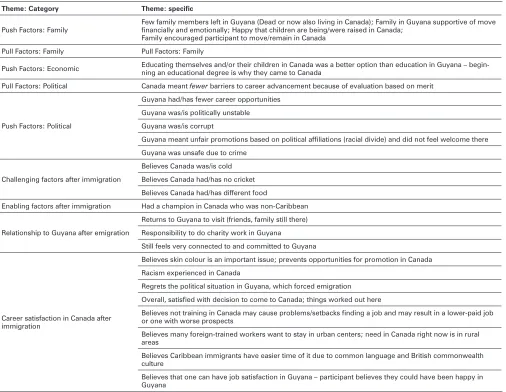
A summary of identified themes from the open-ended questions is presented in Table 1, with themes grouped under the following categories: the role of family in migration, eco-nomic push and pull factors, political push and pull factors, other push and pull factors, and career satisfaction.
Discussion
Common themes arising from our respondents included an appreciation of the power of education to effect personal change in the emigration process, and both career and quality of life factors being key in driving health professionals from Guyana to Canada. The pursuit of better educational opportu-nities is a push factor represented in the broader ‘brain drain’ phenomenon.10 This career-based or “brighter future” push factor reflects the discrepancy in economic development be-tween “brain drain” countries like Guyana and “brain gain” ones like Canada. The brighter future enabled by a recog-nized education system may even prove valuable in the gradu-ates’ home countries, meaning that educational pursuit can be a temporary push factor in order to achieve the career of
their choice upon return. This is supported in our results, as several respondents expressed having had the desire to return to and live out their ‘brighter future’ in Guyana after gradu-ation.
Specific to Guyana, the strongest push factor was the po-litical environment, which precluded merit-based career ad-vancement, fair opportunity, and freedom from corruption, discrimination, and harassment. Furthermore, the presence of a pervasive and ongoing political push factor may have con-tributed to modifying temporary emigration into the perma-nent expatriation seen in all our respondents. Racial issues are anecdotally known to punctuate domestic Guyanese politics,11 and thus it seems reasonable that a racial dynamic informs Guyanese migrants’ motivations for travel, both at the time of our respondents’ migration and today (the recent 2015 national elections, for example). Many respondents drew a connection between the ‘bad politics’ of Guyana and its poor economic prospects, and future research that builds on this project may be especially interesting in the coming years, as parallels may be drawn across the Guyanese political timeline.
Table 1. Identified themes relating to push/pull factors for leaving Guyana and emigrating to Canada.
Theme: Category Theme: specific
Push Factors: Family Few family members left in Guyana (Dead or now also living in Canada); Family in Guyana supportive of move financially and emotionally; Happy that children are being/were raised in Canada; Family encouraged participant to move/remain in Canada
Pull Factors: Family Pull Factors: Family
Push Factors: Economic Educating themselves and/or their children in Canada was a better option than education in Guyana – begin-ning an educational degree is why they came to Canada Pull Factors: Political Canada meant fewer barriers to career advancement because of evaluation based on merit
Push Factors: Political
Guyana had/has fewer career opportunities Guyana was/is politically unstable Guyana was/is corrupt
Guyana meant unfair promotions based on political affiliations (racial divide) and did not feel welcome there Guyana was unsafe due to crime
Challenging factors after immigration
Believes Canada was/is cold Believes Canada had/has no cricket Believes Canada had/has different food
Enabling factors after immigration Had a champion in Canada who was non-Caribbean
Relationship to Guyana after emigration
Returns to Guyana to visit (friends, family still there) Responsibility to do charity work in Guyana
Still feels very connected to and committed to Guyana
Career satisfaction in Canada after immigration
Believes skin colour is an important issue; prevents opportunities for promotion in Canada Racism experienced in Canada
Regrets the political situation in Guyana, which forced emigration Overall, satisfied with decision to come to Canada; things worked out here
Believes not training in Canada may cause problems/setbacks finding a job and may result in a lower-paid job or one with worse prospects
Believes many foreign-trained workers want to stay in urban centers; need in Canada right now is in rural areas
Believes Caribbean immigrants have easier time of it due to common language and British commonwealth culture
Another important observation was the identification by the majority of respondents of a champion in their lives, who had either suggested emigration or aided the respondent in getting their bearings in Canada through guidance and sup-port. It is important to note that the champion was not of Caribbean extraction in any of the cases. This is a novel find-ing not reported elsewhere in the literature, and may be a phenomenon specific to this cultural group. Future studies on this topic could explore this idea to assess if it is pervasive in today’s migrants.
Our findings are in line with what is reported in the lit-erature, where medical education has been a traditional fac-tor in empowering emigration from the Caribbean to more developed nations.12 Additionally, social and political conflict, crime, discrimination, economic stagnation, poor remunera-tion, job security, working conditions, and family migration have all been cited as push factors.2,12,13 Financial incentives, pursuit of status, job security, and intellectual satisfaction, and a desire for unspecific personal and generational develop-ment have been cited as pull factors toward a specific high-income country.2 The role of family connections in aiding migration is also well documented, leading to something one writer refers to as the ‘transnational household’,14 wherein mi-grants share familial connections across both source and des-tination countries. A similar study to ours, conducted on Afri-can nurses who had emigrated to the UK, identified push-pull factors including remuneration, professional development opportunities, pursuit of better health care, and similarities in language, culture, and educational certifications.15 These similarities suggest that there are indeed universal pull factors affecting health worker migration that are somewhat separate from local characteristics.
A pull factor that arises in the literature that was not de-tected in our sample is active recruitment by the destination country. During Canada’s post-War economic boom, foreign doctors were actively pursued for relocation.9 Such active re-cruitment may have been indirectly represented by the well-advertised and readily available job and post-graduate op-portunities reported by several respondents. In either case, Canada’s health care human resource needs have changed since their migration. Rather than an overall shortage of phy-sicians, for example, there is now a surplus in major centers and shortages mostly in rural and Northern communities. Ad-ditionally, the ethical impacts of draining tertiary educated workers from low-income countries like Guyana have created some pushback on unbridled health care worker influx. This philosophy is described in the so-called ‘Romanow report’ of 2001 – most notably recommendation 47, which calls for Ca-nadians to reduce our reliance on recruiting health care pro-fessionals from developing countries.3 Future studies focusing on more recent Guyanese immigrants could explore whether the Canadian work environment and health care worker im-migration policies have impacted current pull factors.
Two observations from our sample stand out as opportuni-ties for the exploration of solutions to the medical brain drain crisis in Guyana, and possibly other Caribbean nations associ-ated with emigration to Canada. First, respondents’ interest in maintaining a constructive, capacity-building relationship
with the source country can be encouraged and supported, and perhaps folded into formal development strategies. One respondent in particular articulated the effectiveness of health care worker education, especially by Guyanese or Trinidadian expatriates. Moreover, they suggested that it is a more desirable development strategy than aid money and foreign temporary care delivery. Second, the role of the so-called champions, who had catalyzed many respondents’ ini-tial move to Canada, can be re-tasked to a more constructive end. This could take the form of encouraging ongoing bilat-eral relationships with both source and destination countries, rather than solely encouraging migration. In other words, an opportunity may exist to leverage existing relationships and tendencies to further empower and ground capacity-building programs in the source countries.
Limitations
Our small sample size and lack of general demographic di-versity is a limitation of our study, as is our decision to accept re-spondents from any health-related sector. In retrospect, choos-ing to a focus on a narrowly defined medical career would have allowed us to generate more specific themes. Similarly, the dis-proportional representation of males may have impacted the push and pull factors identified, as there may be sex or gender differences in attitudes and behaviours relating to migration.
General qualitative content analysis allows for small samples and, herein, has provided us with sufficient output for mean-ingful reflection; however, the breadth of data and sample size limits our ability to draw conclusions about current migration trends. Data saturation was moderate, with all themes being represented in at least half of the sample; further sampling, however, may have provided additional data saturation. Addi-tionally, a software analysis of the data may have yielded ad-ditional triangulation and further confirmed data saturation. The insights obtained through this approach are not intended for the answering of research hypotheses, but rather for in-forming deeper understanding of an issue and generating fur-ther research questions.
A further limitation of our sample is the variability in age. The different times of emigration from Guyana may be associ-ated with different push factors; however, six out of the seven respondents emigrated between 1961 and 1969, which over-laps with a period of political volatility following the splitting of the multiracial People’s Progressive Party (PPP) into one Afro-Guyanese and one Indo-Afro-Guyanese party in 1955 and the elec-tion of the Indo-Guyanese PPP in 1957. Although this sample may have parallels with migrants in today’s political context, future studies should strive to sample Guyanese of all ages that are currently migrating.
Conclusions
Ca-ribbean. As Canadian health care needs continue to evolve, it is likely that health care workers will continue to be sourced from these countries. According to our results, economical and personal security is the strongest motivator for migration. Development and political challenges in source countries, es-pecially the recent national Guyanese elections in 2015, will likely continue to push health care workers to leave. This area of research is thus ethically relevant due to our responsibility as global citizens to promote equitable health care develop-ment in underdeveloped countries, and especially relevant today as political environments are in a state of change. The desire of migrants to maintain constructive contact with the source country, which was another strong theme in our study pool, might be leveraged to empower capacity-building en-terprises. Above all, these themes and their topical context urge further research on this phenomenon among Guyanese health care workers.
Copyrights
Copyright for this article is retained by the author(s), with first publication rights granted to the journal.
This is an open-access article distributed under the terms and conditions of the Creative Commons Attribution license (http://creativecommons.org/licenses/by/3.0/).
References
1. Mullan,F. The metrics of the physician brain drain. New England Journal of Medicine 2005:353(17):1810-1818.
2. Lofters A.K. The “brain drain” of health care workers: causes, solu-tions and the example of Jamaica. Canadian Journal of Public Health 2012:103(5):e376-e378.
3. Romanow R.J. Building on Values: The Future of Health Care in Canada, working paper [390 p. Report No.: CP32-85/2002E-IN]. Ottawa, Canada: Government of Canada, November 2002 [cited 2016 Mar 29]. Available from: http://publications.gc.ca/collections/Collection/CP32-85-2002E.pdf 4. Caribbean Expert Group: Regional and International Migration in the
Caribbean and its Impact on Sustainable Development [Internet]. Pre-sented at the 2015 Caribbean Expert Group Meeting on Migration, Hu-man Rights and Development in the Caribbean in Trinidad & Tobago [cited 2016 Mar 29]. Available from: http://www.cepal.org/publicaciones/ xml/3/23203/l.61.pdf
5. Nationmaster.com: Immigration stats: Canada vs Guyana [Internet]. 2013 Aug 19 [cited 2016 Mar 29]. Available from: http://www.nationmaster. com/compare/Canada/Guyana/Immigration.
6. Government of Canada: Canada–Guyana Relations: Bilateral Relations [In-ternet]. Ottawa, Canada: Government of Canada, 2013 [cited 2016 Mar 29]. Available from: http://www.canadainternational.gc.ca/guyana/bilat-eral_relations_bilaterales/canada_guyana-guyane.aspx?lang=eng 7. Carrington W.J. and Detragiache E. How extensive is the brain drain?
Fi-nance and Development. International Monetary Funds External Publica-tions 1999 Jun:36(2). Available from: http://www.imf.org/external/pubs/ ft/fandd/1999/06/carringt.htm
8. Mishra P. Emigration and brain drain: evidence from the Caribbean, work-ing paper [39 p. Report No.: WP/06/25]. District of Columbia, USA: Inter-national Monetary Fund, January 2006 [cited 2016 Mar 29]. Available from: https://www.imf.org/external/pubs/ft/wp/2006/wp0625.pdf
9. Hsieh H.-F. and Shannon S.E. Three approaches to qualitative content analysis. Qualitative Health Research 2005 Nov:15(9):1277.
10. Webb M.A. The brain drain and education opportunity in less developed countries. Eastern Economic Journal 1985:9(2):145-155.
11. Tennassee P.N. (n.d.). The Race Problem: 1965-1992. The Guyana Journal. Available from: http://www.guyanajournal.com/race1_pt.html
12. Korcok M. Medical brain drain from Caribbean subsidizes Canada. Cana-dian Medical Association Journal 1974 May:110(9):1089-1090.
13. Pang T., Lansang M.A. and Haines A. Brain drain and health professionals. British Medical Journal 2002:2(423):499-500.
14. Thomas-Hope E.M. Caribbean skilled international migration and the transnational household. Geoforum 1988:19(4):381-520.