This work is licensed under a Creative Commons Attribution-Noncommercial-No Derivative Works 3.0 United States License.
Vol. 32, No. 1 (2013) ISSN: 2164-7984 (online) DOI 10.5195/jlc.2013.59 http://jlc.law.pitt.edu
STATE OVERSIGHT OF NONPROFIT GOVERNANCE: CONFRONTING THE CHALLENGE OF MISSION ADHERENCE
WITHIN A MULTI-DIMENSIONAL STANDARD
Vol. 32, No. 1 (2013) ISSN: 2164-7984 (online) ISSN 0733-2491 (print)
STATE OVERSIGHT OF NONPROFIT GOVERNANCE: CONFRONTING THE CHALLENGE OF MISSION ADHERENCE
WITHIN A MULTI-DIMENSIONAL STANDARD
Mark S. Blodgett,* Linda J. Melconian,** and Jason H. Peterson***
“Donors generally do not expect to receive benefits from their donations, but they do anticipate their funds will be used to support the
mission [adherence] of the organization.”1
I.INTRODUCTION
Nonprofit governance is a national concern because these ubiquitous organizations comprise a significant part of the U.S. economy and
workforce.2 For example, in 2010, approximately 1.6 million nonprofits
* Associate Professor of Business Law & Ethics, Sawyer Business School, Suffolk University,
Boston, MA where he directed the Center for Global Business Ethics and Law.
** Assistant Professor, Business Law & Ethics and Institute for Public Administration, Sawyer
Business School, Suffolk University, Boston, MA; Senior Fellow, Moakley Center for Public Management.
*** Assistant Professor of Business Law & Ethics, Sawyer Business School, Suffolk University,
Boston, MA where he administers a Business Executive Ethics Advisory Board.
The authors acknowledge Jacob Stewart & Emily Patch for their assistance with research and preparation with this article.
1 Danné L. Johnson, Seeking Meaningful Nonprofit Reform in a Post Sarbanes-Oxley World, 54
ST. LOUIS U. L.J. 187, 193 (2009).
2 NONPROFITS BY THE NUMBERS, http://www.councilofnonprofits.org/telling-our-story/
were registered with the Internal Revenue Service (IRS) as public charitable organizations exempt from taxes; forty percent reported assets totaling
$4.49 trillion.3 Today, President and Fellows of Harvard College, the
nation’s largest public nonprofit charity, report assets of nearly $60 billion.4
Human services, healthcare and education are the three largest categories of nonprofit organizations, representing 34.0%, 12.1% and
18.2% respectively of the total nonprofit sector.5 Additionally, foundations,
community centers, churches and religious orders, veteran and fraternal organizations, and private golf clubs are among those nonprofits that
qualify for tax-exemption.6 Their total impact on the U.S. economy is
significant: approximately a 24% growth rate for nonprofits in the last 10 years; a growth rate that surpasses the growth rate of both business and government; an impact which contributes $804.8 billion or 5.5% of
National Gross Domestic Product.7 Their paid and volunteer workers
comprise more than 10% of the total workforce.8 Such economic impact
requires responsible nonprofit governance committed to the adherence of
the nonprofit mission.9
This article proposes that nonprofit governance includes three dimensions and that states confront the challenge of mission adherence
3See BLACKWOOD ET AL., supra note 2, at 2 (detailing break down of nonprofits in United
States); see also Johnson, supra note 1, at 194; Elizabeth T. Boris, Erwin de Leon, Katie L. Roeger & Milena Nikolova, National Study of Nonprofit-Government Contracting: State Profiles, URBAN INSTITUTE (Sept. 2009); see also 26 U.S.C. § 501(c)(3) (2012). For example, health care nonprofits include 60% of community hospitals, all community health centers, nearly 30% of nursing homes, approximately 17% of home health care agencies, and 40% of all private health insurance enrollees. See also AMY S. BLACKWOOD ET AL., URBAN INSTITUTE, NONPROFIT ALMANAC, 2012 (2012).
4 See Largest Organizations (NCCS, Core 2011 Public Charities File), National Center for
Charitable Statistics, URBAN INSTITUTE (2011), http://nccsdataweb.urban.org/PubApps/showTopOrgs .php?cat=ALL&amt=ass_eoy.
5See BLACKWOOD ET AL., supra note 2, at 4; see alsoStrengthening Transparency, Governance, Accountability of Charitable Organizations: A Final Report to Congress and the Nonprofit Sector, PANEL ON THE NONPROFIT SECTOR 11 (June 2005) (graphically demonstrating “Breakdown of Charitable Organizations by Mission”).
6See BLACKWOOD ET AL., supra note 2, at tbl.1.1, at 4–5 (noting expansiveness of tax-exempt
organizations listed in Internal Revenue Code); 26 U.S.C. § 501(c) (2012) (listing categories of tax-exempt organizations).
7Seesupra note 3 and accompanying text. 8See Johnson, supra note 1, at 195.
9 EVELYN BRODY, THE STATE OF NONPROFIT AMERICA 476 (Lester Salamon ed., Brookings
within this multi-dimensional standard.10 This suggested standard must
include the often overlooked and unregulated adherence to mission.11 It
must also include the highly visible public and scholarly considerations of fiduciary leadership and financial integrity.12 The importance of financial
integrity for nonprofits is indisputable since a nonprofit Board of Directors must govern by conserving and properly managing the organization’s assets.13 Furthermore, a nonprofit Board maintains a consistent fiduciary
responsibility to govern the organization in a manner that accomplishes its
mission and state oversight should complement this responsibility.14 Thus, a
multi-dimensional standard sets the tone for enhanced collaboration between State Attorneys General and nonprofit leadership.
The essence of any public charitable nonprofit organization is the
mission statement, which fully identifies and develops its values, purpose
and goals.15 Once the Articles of Incorporation are filed in the state where
the nonprofit is incorporated, it can seek a tax-exempt benefit from the
IRS.16 This benefit presumes an ethical obligation of public trust since the
public taxpayer bears the burden of nonprofit support.17 Consequently,
10 Gary Kirk & Shabnam Beth Nolan, Nonprofit Mission Statement Focus and Financial Performance, 20 NONPROFIT MANAGEMENT & LEADERSHIP 473, 477–78 (2010) (“Most authors agree that nonprofit organizational performance is multi-dimensional, but there is no accepted standard of effectiveness [for accomplishing mission]).”
11Seeinfra notes 78–80 and accompanying text.
12 See Kirk & Nolan, supra note 10, at 477–78 (discussing multidimensional approach to
nonprofit governance).
13See Panel on the Nonprofit Sector, Principles for Good Governance and Ethical Practice: Guide for Charities and Foundations, INDEPENDENT SECTOR (Oct. 2007), http://www.nacua.org/ documents/GoodGovernance.pdf (discussing legal compliance, governance, financial oversight and fundraising in nonprofit organizational context).
14Seeid.
15 R. Duane Ireland & Michael A. Hitt, Mission Statements: Importance, Challenge, and Recommendations for Development, 35 BUS. HORIZONS 34, 34 (1992) (discussing importance of mission statement as guiding principle for nonprofits); Kirk & Nolan, supra note 10, at 477–78; Ralph Hader, More than Words: Providing a Clear and Concise Mission Statement, 37 NURSING MGMT. 6, 6 (July 2006) (noting importance of dedication to mission statement).
16 I.R.C. § 501 (2006); see also National Council of Nonprofits—“How to Start a Nonprofit,”
http://www.councilofnonprofits.org/resources/how-start-nonprofit (listing five general steps regarding how to start a nonprofit organization).
society demands that nonprofits fulfill their unique purpose and historic
mission, an essential part of their governance.18
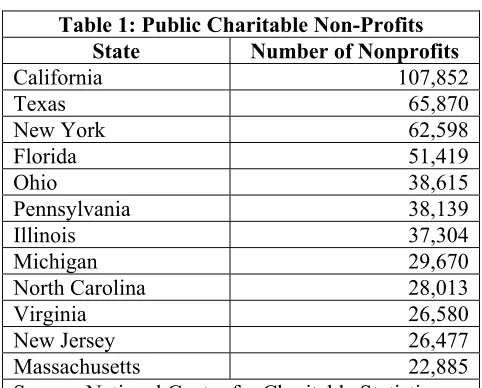
The authors investigated state application of a multi-dimensional standard of nonprofit governance in twelve states with the largest numbers of public charitable nonprofit corporations: California, Florida, Illinois, Massachusetts, Michigan, New Jersey, New York, North Carolina, Ohio,
Pennsylvania, Texas, and Virginia.19 A review of State Attorneys General
websites and nonprofit statutes in each of these states helps to ascertain
state oversight of nonprofit governance.20 State Attorneys General in six of
the twelve states—California, Massachusetts, Michigan, Ohio, Pennsylvania and Texas—have a separate Charities or Nonprofit Division with limited staffing to carry out their regulatory responsibilities of oversight, accountability and enforcement as well as monitoring nonprofit initiatives.21 Moreover, state guidance of nonprofits varies from state to
state.22 Most significantly, this regulatory review demonstrates no
Call to Overcome the Present Crisis of Trust in Business, BUSINESS ROUNDTABLE INSTITUTE FOR CORPORATE ETHICS 6 (2009), http://www.corporate-ethics.org/pdf/public_trust _in_business.pdf (discussing importance of trust in businesses generally). As this special report makes clear, “public trust in business” is not only a concern for nonprofit organizations, but rather stretches across all businesses. Seeid.
18Seesupra note 15 and accompanying text. 19See Table 1.
20See, e.g., State Dep’t of Justice, California Office of the Attorney General, http://oag.ca.gov/
(last visited Jan. 20, 2014); State Dep’t of Justice, Florida Office of the Attorney General, http:// myfloridalegal.com/ (last visited Jan. 20, 2014); State Dep’t of Justice, Illinois Office of the Attorney General, http://illinoisattorneygeneral.gov/ (last visited Jan. 20, 2014).
21See Office of the Attorney Gen., Services and Information: Charities, CAL. STATE DEP’T OF
JUSTICE, http://oag.ca.gov/charities (last visited Apr. 10, 2013); The Nonprofit Organizations/Public Charities Division, ATTORNEY GEN. OF MASS., http://www.mass.gov/ago/bureaus/business-and-labor/the-nonprofit-organizations-public-charities-division/ (last visited Apr. 10, 2013); State of Mich., Consumer Protection: Charities, ATTORNEY GEN. BILL SCHUETTE, http://www.michigan.gov/ag/ 0,4534,7-164-17337_18095---,00.html (last visited Apr. 10, 2013); Services for Charities, MIKE DEWINE: OHIO ATTORNEY GEN., http://www.ohioattorneygeneral.gov/Business/Services-for-Charities (last visited Apr. 10, 2013); Charitable Trusts and Organizations Section, PA. ATTORNEY GEN., http:// www.attorneygeneral.gov/consumers.aspx?id=227 (last visited Apr. 10, 2013); Charities and Nonprofits: Registration and Filings, ATTORNEY GEN. OF TEX. GREG ABBOTT, https://www.oag.state .tx.us/consumer/nonprofits.shtml (last visited Apr. 10, 2013) [hereinafter Charities and Nonprofits].
22Seesupra note 21 (citing to states’ charities divisions). For example, California, Ohio and
recognition or identification of mission adherence, today’s most pressing
nonprofit governance challenge.23
This article concludes by proposing a multi-dimensional standard of governance which confronts the challenge of mission adherence. State Attorneys General through their National Association of State Attorneys General (the National Association) should work with other nonprofit leadership to articulate, enable, and monitor this standard.24 Furthermore,
they must collaborate with members of the National Council of Nonprofits
to guide nonprofit governance.25 This collaboration should propose a “State
Nonprofit Best Practices” initiative to advance a multi-dimensional standard of governance that adequately addresses the challenge of mission
adherence.26 The best practices should include the development of mission
adherence criteria and a mechanism for communicating the nonprofits’
satisfaction of the criteria to the stakeholder community.27
http://oag.ca.gov/sites/all/files/agweb/pdfs/charities/publications/guide_for_charities.pdf?; Charitable Law Section, Handbook for Nonprofits: An Operational Resource for Members of Charitable Organizations, OHIO ATTORNEY GEN. MIKE DEWINE’S OFFICE, http://www.ohioattorneygeneral.gov/ OhioAttorneyGeneral/files/4e/4ebbc2fe-b053-427e-8730-de6cbd0244ff.pdf. Massachusetts, Florida, and Texas, on the other hand, merely provide general guidelines for nonprofit organizations regarding registration, filing, taxes, etc.
23See Table 2a.
24 See KEVIN P. KEARNS, THE STATE OF NONPROFIT AMERICA 589 (Lester Salamon ed.,
Brookings Institution Press, 2d ed. 2002) (noting importance of measureable standard).
25 See Find Your State Association, NATIONAL COUNCIL OF NONPROFITS, http://www
.councilofnonprofits.org/find-your-sa (last visited Apr. 11, 2013) (listing all states with an individual state Association of Nonprofits). It may also include such organizations as the National Association of Nonprofit Accountants and Consultants, a national affiliation of independently owned accounting firms who assist nonprofits to improve their governance. Welcome to NPAC, NATIONAL ASSOCIATION OF NONPROFIT ACCOUNTANTS AND CONSULTANTS, http://www.nonprofitcpas.com/public/default.asp (last visited Mar. 19, 2013).
26Seesupra notes 12 and 15 and accompanying text.
27Seeinfra note 111 and accompanying text (discussing importance of transparency); see also
II.BACKGROUND
A. Nonprofits: A Unique History
Nonprofit corporations possess distinctive qualities, benefits and obligations, and derive their formation, governance and organizational
existence from three historic roots.28 First, the tax-exempt benefit, based on
their legal formation and purpose, dates back to sixteen and seventeen century Acts of the British Parliament which granted a tax-exempt status to certain health and educational institutions whose mission benefited the
public good.29 To receive this tax benefit today, charitable nonprofit
organizations must commit in their legal formation to faithfully carry out a
specific, charitable public purpose.30 Additionally, they must commit their
profits to this public purpose rather than distribute net earnings to those
who control the organization.31
Secondly, our tradition of nonprofit governance is one that is largely autonomous from government control as provided by founding charters of
colonial America.32 An early example is the establishment of Harvard
28Seeinfra notes 29–38 and accompanying text (discussing history of nonprofit corporations). 29See Paul Arnsberger, Melissa Ludlum, Margaret Riley & Mark Stanton, A History of the Tax-Exempt Sector: An SOI Perspective, INTERNAL REVENUE SERVICE 105 (Winter 2008), see Peter Dobkin Hall, A Historical Overview of Philanthropy, Voluntary Associations, and Nonprofit Organizations in the United States 1600–2000, at 32, in THE NONPROFIT SECTOR: A RESEARCH HANDBOOK (W.W. Powell & R. Steinberg eds., Yale Univ. Press, 2d ed. 2006) (focusing on history of nonprofit organizations in United States). Hospitals have long been tax exempt as provided by the 1597 Charitable Corporations Act. Id. Shortly thereafter, the 1601 Statute of Charitable Uses expanded such charitable scope for “maintenance of sick and maimed soldiers, schools of learning, free schools and scholars in universities.” Id.See also Blodgett et al., supra note 2, at 444.
30See Arnsberger supra note 29, at 106 (noting requirement that “charitable organizations operate
for charitable purposes”); see also 26 U.S.C. § 501(c)(3) (2012) (including “[c]orporations . . . organized and operated exclusively for . . . charitable . . . purposes”). This requirement dates back to the Wilson-Gorman Tariff Act of 1894, one of the earliest acts to reference the tax-exempt status of nonprofit, charitable organizations.
31 Pamela C. Smith & Kelly A. Richmond, Call for Greater Accountability Within the U.S. Nonprofit Sector, 11 ACAD. ACC. & FIN. STUD. J. 75 (2007) (discussing prohibition against distributing profits to individuals in control of organization).
32See Peter D. Hall, A History of Nonprofit Boards in the United States, BOARDSOURCE 3 (2003),
College.33 In 1650, the Massachusetts colonial legislature initiated
governance practices for nonprofits by granting Harvard an independent charter of incorporation with a specific mission to promote the public
good.34 Thus, Harvard developed a distinct governance framework
promoting Board autonomy within the auspices of the colonial legislature’s regulatory oversight.35 From this colonial tradition states inherited the
primary responsibility to exercise regulatory authority over nonprofit
governance.36
Lastly, a nonprofit’s right to exist originates in the U.S. Constitution where the First Amendment’s Right to Assemble implicitly allows for this large and powerful area of organizational activity.37 Therefore, nonprofit
charitable organizations, committed to serving public needs, maintain a unique and favored status in the United States for four reasons: first, adherence to their charitable public mission and purpose justifies the public policy of a tax-exempt status; secondly, nonprofits are removed from the day to day sway of political influence better enabling them to meet the challenge of their charitable mission; thirdly, nonprofits are distinguished from business entities because their mission is to stakeholders, not profits for shareholders; and lastly, they must adhere to Leonard Bacon’s historic
Notions of Legally Based Reparations, 26 B.C. THIRD WORLD L.J. 207, 231 n.126 (2006) (“Colonists in Massachusetts established the Mayflower compact and only two colonies did not include self-governance provisions in their formation: New York and Georgia.”).
33See Hall, supra note 32, at 5–7 (acknowledging challenges in deciding how to govern); The
Charter of 1650, Harvard Corporation, http://library.harvard.edu/university-archives/using-the-collections/online-resources/charter-of-1650.
34See Hall, supra note 32, at 5; The Charter of 1650, Harvard Corporation, http://library.harvard
.edu/university-archives/using-the-collections/online-resources/charter-of-1650. In 1636 Harvard College was created as an autonomous self-managing corporation free of control from the Massachusetts Colonial Legislature. See also Blodgett et al., supra note 2, at 447 (discussing founding of Harvard for public good).
35 Hall, supra note 32, at 6; The Charter of 1650, Harvard Corporation, http://library.harvard.edu/
university-archives/using-the-collections/online-resources/charter-of-1650.
36 Hall, supra note 32.
37 U.S. CONST. amend. I, § 1. “Congress shall make no law respecting an establishment of
call for the highest standard of morality to assure continued public support
for advancement of the nonprofit mission.38
Such unique characteristics distinguish nonprofits from government and for-profit entities and help to explain why the public perceives them differently, generally regarding them as possessing a higher ethical standard of trust.39 However, this perception belies current nonprofit reality.40 For
example, their historic standard of fiduciary duty has been diluted and today is similar to that of for-profits; yet nonprofits do not receive the same
scrutiny as for-profits since state regulation is varied and limited.41
Additionally, it appears that a void exists in state regulation of nonprofit
mission adherence.42 Furthermore, Congress generally excluded nonprofits
from the Sarbanes Oxley Act leaving to the states the challenge of
coordinating a response to this regulatory gap.43
B. Nonprofit Regulatory Environment
The federal government regulates tax compliance of nonprofits through the IRS. The IRS utilizes the federal taxing power to grant to nonprofits a privileged tax-exempt status upon compliance with the tax
code and its corresponding suggested governance guidelines.44 The IRS
38 Leonard Bacon, Responsibility in the Management of Societies, 5 THE NEW ENGLANDER 28,
29, 32, 33 (1847). Bacon asserted that the fiduciary duties of nonprofit Boards require both disclosure to placate the public and a high moral standard of governance as the guardians of others’ property. Id.See also Blodgett et al., supra note 2, at 446 (discussing Bacon’s standard of morality).
39 Smith & Richmond, supra note 31, at 75 (discussing importance of ethical behavior due to
nonprofits’ need for public support to survive).
40Seeid.
41Seeid. (noting nonprofits potential desire to operate under corporate governance model to
remain competitive).
42See Table 2a.
43See Sarbanes-Oxley Act of 2002, Pub. L. No. 107-204, 116 Stat. 745 (generally omitting
nonprofits from consideration); see also Nicole Gilkeson, Note, For-Profit Scandal in the Nonprofit World: Should States Force Sarbanes-Oxley Provisions onto Nonprofit Corporations?, 95 GEO. L.J. 831, 844–45 (2007) (noting limited applicability Sarbanes-Oxley has on nonprofit organizations).
44 I.R.C. § 7801 (2006). See also 26 U.S.C. § 501(c) (2012) (outlining organizations receiving
tax-exempt status). Pursuant to this section, all
maintains a strong and necessary hand in monitoring the tax compliance of nonprofits. For example, in furtherance of its tax compliance, the IRS in 2006 revised its Form 990 requiring more transparency and disclosure from
all nonprofits registering for a tax-exempt status.45 Moreover, the IRS
website identifies its mission consistent with its enabling statute: “[t]he IRS role is to help the large majority of compliant taxpayers with the tax law, while ensuring that the minority who are unwilling to comply pay their fair share.”46 Thus, the IRS appears to have restricted its scope of nonprofit
authority as one that is limited to tax compliance, not governance.47
The IRS exercises jurisdiction over tax-exempt organizations through
the Exempt Organizations Division (EOD).48 However, the EOD’s capacity
inures to the benefit of any private shareholder or individual, no substantial part of the activities of which is carrying on propaganda, or otherwise attempting, to influence legislation (except as otherwise provided in subsection (h)), and which does not participate in, or intervene in (including the publishing or distributing of statements), any political campaign on behalf of (or in opposition to) any candidate for public office.
Seeid. The nine guidelines of good governance for nonprofits proposed by the IRS are
(1) Adoption of a Mission Statement, (2) Adoption of a Code of Ethics and Whistleblower policies, (3) Satisfaction of the Duty of Care/Director Diligence, (4) Satisfaction of the Duty of Loyalty/effective conflicts of interest oversight, (5) Constituent transparency, (6) Oversight of fund-raising activity, (7) Stewardship of financial affairs, (8) Payment of reasonable compensation; and (9) Adoption of a document retention policy.
IRS Releases Suggested Governance Guidelines for Tax-Exempt Organizations, MCDERMOTT WILL & EMERY (Feb. 5, 2007), http://www.mwe.com/publications/uniEntity.aspx?xpST=PublicationDetail&pub =6137; INTERNAL REVENUE SERV., GOOD GOVERNANCE PRACTICES FOR 501(C)(3) ORGANIZATIONS [hereinafter GOOD GOVERNANCE], available at http://www.mwe.com/info/news/IRS0207.pdf.
45See2010 Forms 990 and 990-EZ: Significant Changes, IRS (Feb. 15, 2013), http://www.irs
.gov/Charities-&-Nonprofits/2010-Forms-990-and-990-EZ-Significant-Changes-1 (noting specific changes in Form 990, Part VI, regarding governance, management, and disclosure). Several newsworthy controversies led to the changes. See, e.g., Adelphi University v. Board of Regents of the State of New York, 229 A.D. 2d 36 (1997) (finding high salary of President indicated that Board failed to achieve its educational mission and breached fiduciary duties); Karen Donnelly, United Way, Good Governance: Has the IRS Usurped the Best Judgment of Tax Exempt Organizations in the Name of Transparency and Accountability, 79 UMKC L. REV. 163, 173–74 (2010) (discussing nonprofit scandals including Aramony v. United Way involving excessive executive compensation, mismanagement, and misuse of organization’s donated funds); Keith Epstein, Case Study: American Red Cross, CONTRIBUTE (2009) (discussing Red Cross’s failure to disclose withholding of $200 million from 9/11 donations for administrative costs).
46 Internal Revenue Service Homepage, available at
/www.irs.gov/uac/The-Agency,-its-Mission-and-Statutory-Authority. The IRS was created pursuant to a legislative grant within section 7801 of the Internal Revenue Code. I.R.C. § 7801 (2006).
47Seeid.
48 Lloyd H. Mayer, The Much Maligned 527 and Institutional Choice, 87 B.U. L. REV. 625, 670
to monitor the complexities of charitable nonprofit mission adherence is often diminished through other agency objectives that deviate from its own
tax compliance authority.49 The EOD has only 400 agents with a budget of
$62 million and supervises close to 1.2 million nonprofits.50 In contrast, the
Securities Exchange Commission has a budget of $300 million with less
than 14,000 publicly traded companies to supervise.51 Consequently, the
director of the EOD has noted that its lack of resources require a self-regulating governance model that precludes the IRS from monitoring
nonprofit mission.52 Currently, analyzing nonprofit mission adherence is
largely a subjective challenge of qualitative and equitable determination.53
Such analysis is contrary to the IRS’s statutory authority of restrictive powers illustrating poignantly that nonprofit mission is to stakeholders a
quality far more difficult to measure than shareholder profits.54 The recent
IRS scandal in which officials targeted conservative 501(c)(4) groups provides an apt example of the consequences when the IRS deviates from
its stated mission and restrictive powers.55
The states inherited our colonial tradition of primary responsibility to regulate nonprofits which are legally formed through filing state Articles of
Incorporation.56 This state regulation is carried out through State Attorneys
General who oversee and supervise nonprofits and enforce the Board and Officer fiduciary duties to the organization.57 For example, if a nonprofit
49Id.
50 Peters Swords, Tax Exempt Charitable Organizations (ALI-ABA Course of Study Materials,
Dec. 1996).
51Id.
52 Shannon McGhee Hernandez, Conversions of Nonprofit Hospitals to For Profit Status: The Tennessee Experience, 28 U. MEM. L. REV. 1077 n.85, 1133 (1998); see also Jill R. Horwitz, Why We Need the Independent Sector: The Behavior, Law, and Ethics of Not-for-Profit Hospitals, 50 UCLA L. REV. 1345, 1385–86 (2003).
53 Evelyn Brody, A Taxing Time for the Bishop Estate: What is the I.R.S. Role in Charity Governance?, 21 U. HAW. L. REV. 537, 543 (1999); Evelyn Brody, Book Review: The Twilight of Organizational Form of Charity: Musings on Norman Silber, A Corporate Form of Freedom: The Emergence of the Modern Nonprofit Sector, 30 HOFSTRA L. REV. 1261, 1268 (2002).
54Id.
55 Nicholas Confessore, Uneven I.R.S. Scrutiny Seen in Political Spending by Big Tax-Exempt Groups, N.Y. TIMES, May 13, 2013; see alsosupra note 45 and accompanying text.
56Seesupra note 21 (listing state attorneys generals’ websites); see also Table 1.
57See CAL. CORP. CODE § 5000 et seq. (West 2013) (providing extensive statutory guidance for
leader breaches his fiduciary duty, the Attorney General may coordinate the
appointment of new fiduciaries.58 Additionally, State Attorneys General
regulate a variety of business forms and governance initiatives that dovetail with the IRS tax compliance function.59 The IRS could therefore play a
coordinating role with the state attorneys general to ensure that their
respective interests are properly aligned.60
The State Attorneys General are the public face of nonprofits and are responsible for consumer protection of donor contributions and oversight of
nonprofits’ assets.61 However, the traditional role of State Attorneys
General exceeds mere responsibility for nonprofit oversight; it is the most visible and influential state office protecting consumers and fighting
crime.62 Yet, individual state Attorneys General have competing agendas
and interests and they must prioritize their activities utilizing scarce
resources as reflected in inadequate staffing and budget allocations.63 Their
National Association may be a forum for leveraging resources to address
the challenge of mission adherence.64
58 Brody, supra note 53, at 544.
59 John Tyler, Symposium: Corporate Creativity: The Vermont L3C & Other Developments in Social Entrepreneurship: Negating the Legal Problem of Having “Two Masters”: A Framework for L3C Fiduciary Duties and Accountability, 35 VT. L. REV. 117, 150–51 (2010).
60 Brody, supra note 53, at 591 n.29.
61 See MASS. GEN. LAWS ch. 180 § 1 et seq. (2013) (listing sections governing nonprofit
organizations); Press Release, Mass. Att’y Gen. Office, Massachusetts Attorney General Martha Coakley Announces Enhanced Oversight of Nonprofit Executive and Board Compensation (Sept. 2, 2009), available at http://www.mass.gov/ago/news-and-updates/press-releases/2009/ag-coakley-announces-enhanced-oversight-of.html; Christine McConville, Pols Aim to Ban Money for Nonprofit Boards, BOSTON HERALD (May 23, 2011), http://bostonherald.com/news_opinion/local_politics/ 2011/05/pols_aim_ban_money_nonprofits%E2%80%99_Boards.
62See generally authors comments, LYNN M. ROSS, STATE ATTORNEYS GENERAL, POWERS AND
RESPONSIBILITIES (1990).
63 See Alicia M. Maples, State Attorney General Oversight of Nonprofit Healthcare Corporations: Have We Reached an Ideological Impasse?, 37 CUMB. L. REV. 235, 240 (2007) (noting differing opinions regarding attorney general’s duties to nonprofits). The author specifically highlights scholars’ arguments that attorneys general “lack the ‘[r]esources or expertise to engage in the detailed assessments of the business and health policy issues surrounding the appropriate deployment of charitable assets that such decisions implicate.’” Id.; see also Lumen M. Mulligan, What Good for the Goose is Not Good for the Gander: Sarbanes-Oxley Style Nonprofit Reforms, 105 MICH. L. REV. 1981, 1990, n.70 (2007) (“State attorneys general have historically given limited resources, and a low priority, to nonprofit enforcement”).
Limited state resources can impact nonprofit supervision and
oversight.65 For example, only six (50%) of State Attorneys General offices
in the 12-state sample have a Public Charities or Nonprofit Division to
enforce their nonprofit laws.66 Furthermore, resource support for Nonprofit
Charities Divisions vary from state to state.67 For example, New York with
62,598 public charitable nonprofits has 14 attorneys in its charities division;
Massachusetts with 22,885 public charitable nonprofits has 6.68 Those with
no attorneys in their charities division are Florida with 51,419 public charitable nonprofits, Michigan with 29,670 public charitable nonprofits,
and Virginia with 26,580 public charitable nonprofits.69 Consequently, the
number of attorneys assigned to the Charities Division or lack thereof may suggest inadequate staffing resources limiting the ability of the State Attorneys General to effectively fill in the nonprofit regulatory gap.
However, in the 12-state sample, a number of State Attorneys General are carrying on a more pro-active effort to prevent financial abuses by drafting legislative proposals to provide reforms of financial integrity for
nonprofits.70 For example, one state in the sample, California, has enacted
these financial reforms into law, the California Integrity Act.71 Other states
in the sample such as New York, Massachusetts, Ohio, and Pennsylvania,
have offered initiatives along the same line.72 From these proactive
65Seesupra note 63 and accompanying text (referencing lack of resources allocated to state
attorneys generals for oversight of nonprofits).
66Seesupra note 21 and accompanying text (noting states with specific charity/nonprofit division
within attorney general’s office).
67Seeinfra notes 68–69 and accompanying text. 68 Boris et al., supra note 3.
69Id.
70See Jamieson Baker, Nonprofits, Sarbanes-Oxley, and the States, GUIDESTAR (Aug. 2005),
http://www.guidestar.org/rxa/news/articles/2005/nonprofits-sarbanes-oxley-and-the-states.aspx?articleId =779 (noting states’ attempts to pass legislation due to major corporate scandals). See also Blodgett et al., supra note 2, at 458 (discussing proposed Massachusetts legislation to limit nonprofit Board compensation).
71See California Nonprofit Integrity Act of 2004, 2004 Cal. Stat. 919 (codified as amended in
scattered sections of CAL. BUS. & PROF. CODE and CAL. GOV’T CODE); see also Gilkeson, supra note 43, at834 (discussing California Act and its similarity to Sarbanes-Oxley regarding “independent audits and audit committees”).
72See Baker, supra note 70 (discussing briefly states’ proposed legislation following major
initiatives State Attorneys General appear to prioritize nonprofit financial integrity as the number one issue. Mission adherence is not included in these legislative initiatives; hence a multi-dimensional standard of governance remains elusive.
In the 12-state sample, all but one Attorneys General are elected, a political reality which imposes certain considerations in carrying out their
supervisory, oversight and enforcement duties.73 Elected State Attorneys
General are first and foremost responsible to electoral politics, facing periodic reelection campaigns which require prioritizing issues that appeal
to voters and the media.74 Consequently, our electoral process may
encourage a public perception of strong state government nonprofit leadership; however, in reality the focus of State Attorneys General remains almost exclusively on donor and nonprofit asset protection, financial fraud
and abuse.75 State Attorneys General must lead the way in a collaborative
effort with other nonprofit leadership to articulate a multi-dimensional
standard of governance.76
III.ANALYSIS
A. Mission Adherence
Overall, this article proposes a multi-dimensional standard for nonprofit governance that includes: 1) mission adherence; 2) fiduciary leadership; and 3) financial integrity. All three must work in tandem to be most effective and they must be tailored to the nonprofit sector, not mere
juxtapositions of for-profit concepts and practices.77 Likewise, each
dimension requires an ethical focus since nonprofits are deeply rooted in ethics; they benefit the public and are dependent on public trust.
73See National Association, supra note 64, at www.naag.org/current-attorneys-gen.php (listing
current Attorneys General as elected and appointed). New Jersey is the only state in the sample where the Attorney General is not elected. Id.
74 ROSS, supra note 62. It creates smart political perception and makes attention-grabbing
headlines when State Attorneys General pursue various forms of financial malfeasance and conflicts of interest. Id.
75Seesupra notes 61 and 63 and accompanying text. 76Id.
The first important dimension for nonprofit governance is mission
adherence which embodies the organization’s values, purpose and goals.78
Beyond mere statements of charitable purpose, mission statements have an important and unique role in nonprofits.79 These inspirational statements
comprise organizational values, purposes, and goals.80 More importantly,
they empower employees to act, clarify objectives and set an ethical tone.81
Peter Drucker suggests that organizations are not defined by name, statutes, or articles of incorporation; rather they are defined by business
mission.82 Likewise, nonprofits must be vigilant in adhering to their unique
charitable mission. Philosophical and operational commitment to the
accomplishment of mission begins at the top level.83 That commitment
determines the shared vision to which everyone in the organization
adheres.84 Nonprofits can build a culture that advances mission adherence
within a multi-dimensional standard of governance.85 “A clearly articulated
mission statement adopted by the Board of Directors serves to explain and popularize the charity’s purpose and guide its work,” and it also addresses “why the charity exists, what it hopes to accomplish, and what activities it
will undertake, where and for whom.”86 The charitable mission justifies the
public policy of granting nonprofits a tax-exempt status.87 Therefore, the
IRS has issued suggested guidelines for good governance practices.88
However, these guidelines are not an assertion of nonprofit governance leadership; rather, they were created to enhance tax compliance. Thus
78Seesupra note 38 and accompanying text; see also Ireland, supra note 15, generally see also
Manhattan Eye, Ear & Throat Hosp. v. Spitzer, 715 N.Y.S.2d 575, 587 (N.Y. Sup. Ct. 1999) (discussing attorney general’s role as parens patriae where nonprofit has no shareholders).
79See Kirk, supra note 10, at 477–78.
80 See Ireland & Hitt, supra note 15, at 34 (acknowledging importance of strong mission
statement).
81Seeid. at 35.
82See generally at pp. 89–90 Peter F. Drucker, What Business Can Learn from Nonprofits, 67(5)
HARV. BUS. REV. 88 (1989).
83See Ireland & Hitt, supra note 15, at 34. 84Seeid.
85SeeGovernance and Related Topics–501(c)(3) Organizations, I.R.S. (Feb. 4. 2008), http://
www.irs.gov/pub/irs-tege/governance_practices.pdf.
86See Kirk, supra note 10, at 474.
nonprofit governance including mission adherence remains the state’s
responsibility consistent with our colonial tradition.89
Yet, none of the State Attorneys General in the 12-state sample
appears to enforce mission adherence.90 The legal formation requirement of
a “statement of charitable purpose” as required by state Articles of Incorporation does not alone constitute state nonprofit best practices.91 A
narrow statement of charitable purpose is merely a starting point. This is not a mission statement, and often it lacks the holistic expression of values, purpose and goals necessary for nonprofit mission adherence. Consistent adherence to the nonprofit mission throughout its existence promotes state best practices for nonprofits. Furthermore, congressional action culminating in two recent Panel reports on nonprofit leadership initiatives correctly recognized a regulatory gap where limited Federal or IRS oversight ends and state regulation must begin. State leadership of nonprofits is consistent with their legal formation, the authority of the State Attorneys General, and our colonial heritage; states must place more emphasis on mission adherence within a multi-dimensional standard of governance.
B. Fiduciary Leadership
Board of Directors and principal officers of nonprofits must adhere to
a high standard of trust in the governance of the organizations they lead.92
This standard of trust or fiduciary duty includes: a duty of care and good faith, whereby conflicts of interest are to be avoided; diligence and attention, requiring attendance and active participation at Board meetings;
89Seesupra note 36 and accompanying text. 90See Table 2a.
91See Kirk, supra note 10, at 474; see also Jon Austin, Good Governance Practices & 501(c)(3) Organizations, McAlister & McAlister Law Firm (2012), available at http://www.mmmtlaw.com/ articles/IRSGoodGovernance.asp (noting importance of mission statements).
92See Beard v. Achenbach Mem’l Hosp. Ass’n, 170 F.2d 859, 862 (10th Cir. 1948) (upholding
and a level of skill that requires reasonable care.93 Often forgotten but
critical in the nonprofit context, fiduciary duty also requires a duty of obedience that assures commitment and adherence to mission and a duty of
loyalty which requires avoidance of personal gain and conflict of interest.94
Thus, the ethical underpinnings of fiduciary leadership are care, loyalty, and obedience.95 The preservation of these ethical values is the
responsibility of the nonprofit Board of Directors.96 A nonprofit Board
fulfills its fiduciary leadership through effective governance of the
organization’s mission and resources.97 This fiduciary responsibility is
based on trust requiring the fiduciary to act unselfishly by providing the organization with the benefit of his or her knowledge and skill, and by always keeping a nonprofit’s interests paramount.98 Thus the standard of
performance for Board nonprofit governance is necessarily high and
operates within the context of trust.99 Such fiduciary leadership must begin
93See Rob Atkinson, Obedience as the Foundation of Fiduciary Duty, 34 J. CORP. L. 43 (2008); see also Gary R. Pannone, Board Governance and the Nonprofit Organization, PANNONE LOPES DEVEREAUX & WEST LLC, http://www.pldw.com/Knowledge-and-Resource-Center/PLDW-Board-Governance.pdf (last visited Apr. 21, 2013) (defining nonprofit Board management structure and responsibilities); R.I. GEN. LAWS § 7-6-22 (2012) (outlining the duties of the Board of Directors); see also Manhattan Eye, Ear & Throat Hosp. v. Spitzer, 715 N.Y.S.2d 575 (Sup. Ct. 1999).
94See Manhattan Eye, Ear & Throat Hosp. v. Spitzer, 715 N.Y.S.2d 575, 587 (N.Y. Sup. Ct.
1999) (acknowledging nonprofit Directors duty to adhere to organization’s purposes and goals); see also Atkinson, supra note 93; Margaret E. McLean, Employee Stock Ownership Plans and Corporate Takeovers: Restraints on the Use of ESOPS by Corporate Officers and Directors to Avert Hostile Takeovers, 10 PEPP. L. REV. 731, 761 (1983). Disclosed conflicts of interest and other self-serving acts may be acceptable under both the nonprofit best judgment rule and the for profit business judgment rule if not contrary to the best interests of the corporation see also Hall, supra note 32, at 22.
95 See Pannone, supra note 93 (defining nonprofit Board management structure and
responsibilities); R.I. GEN. LAWS § 7-6-22 (2012) (stating Board of director responsibilities); see also Manhattan Eye, Ear & Throat Hosp. v. Spitzer, 715 N.Y.S.2d 575 (Sup. Ct. 1999). See generally Pamela C. Smith, Kerry McTier & Kelly R. Pope, Nonprofit Employees’ Machiavellian Propensities, 25 FIN. ACCOUNTABILITY & MGMT. 335 (2009) (asserting that preservation of nonprofit mission can be achieved through appropriate attention to disclosure, financial management and the public good) at 336– 38 and 347–50 generally.
96 Mark S. Schwartz, Thomas W. Dunfee & Mark J. Kline, Tone at the Top: An Ethics Code for Directors?, 58 J. BUS. ETHICS 79 (2005).
97See Harry J. Friedman & Tracy Green Landauer, How to be a Responsible Nonprofit Director: Do’s and Don’ts—Avoiding Punishment for Good Deeds, GREENBERG TRAURIG, LLP (2005), http:// www2.gtlaw.com/pub/alerts/2005/1102.pdf.
98 BLACK’S LAW DICTIONARY (9th ed. 2009) (defining “fiduciary”).
99 See supra notes 92–94 and accompanying text (discussing high level of trust owed by
at the top of the organization where fiduciary duty and other ethical values are communicated first at the highest level and then fully implemented
throughout the organization by training in the appropriate policies.100
The states within the sample are following a less rigorous fiduciary standard by following the 1987 revised Model Nonstock Corporation
Statute.101 It permits charitable nonprofits to follow the Best Judgment
Rule, a flexible and lenient fiduciary standard.102 It generally mirrors the
fiduciary standard required for business corporations under the Business
Judgment Rule.103 The Best Judgment Rule dilutes the previously more
rigorous standard for nonprofits, called the Prudent Man Rule, which
“strictly prohibited self-dealing and conflicts of interest.”104 It was based on
the historic ethical foundation of nonprofits as articulated by Leonard Bacon who set the ethical and moral tone for nonprofit associations to
receive continued public support.105 He noted that nonprofit governance
must reflect trust in a higher sense of ethics and morality to assure public support “as a security against mismanagement and gradual perversion of the trust.”106
Consequently, under the current Best Judgment Rule, such transactions as self-dealing and conflicts of interest are permitted as long as a “fully informed” Board acts in a way that is not manifestly “contrary to the
nonprofit’s best interests.”107 However, these lower standards of fiduciary
responsibility coupled with public revelations of nonprofit malfeasance
100See Smith et al., supra note 95, at 335; Schwartz et al., supra note 96.
101See REV.MODEL NONPROFIT CORP.ACT §§ 1.02, 8.12, 8.30–8.33 (1987) (amended 2008). The Revised Model Nonprofit Corporation Act is an ABA-sponsored model statute for uniform nonprofit governance that states may adopt. See id. §§ 1.01, 1.02; Jeremy Benjamin, Note,
Reinvigorating Nonprofit Directors’ Duty of Obedience, 30 CARDOZO L. REV. 1677, 1694 (2009) (noting similarity between the two rules).
102Id.
103 McLean, supra note 94, at 761. Disclosed conflicts of interest and other self-serving acts may be acceptable under both the nonprofit best judgment rule and the for profit business judgment rule if not contrary to the best interests of the corporation. See also Hall, supra note 32, at 22.
104 See Harvard College v. Amory, 26 Mass. 446 (1830); see also Hall, supra note 32, see
generally Harvard Coll. v. Amory, 26 Mass. 446 (1830) (applying Prudent Man Rule which exonerated diminished estate’s trustees of any mismanagement). This act abandoned the Prudent Man standard. Rev. Model Nonprofit Corp. Act § 8.30 cmt.
105Seesupra note 38 and accompanying text. 106 Bacon, supra note 38, at 28–32.
have raised serious concerns about Board commitment to the “exercise of wisdom and ethical conduct in fulfilling its fiduciary duties.”108 These
nonprofit concerns are poignant reminders of well-publicized corporate
for-profit malfeasance where similar disclosed acts met with BOD approval.109
While Congress enacted the Sarbanes Oxley Act as a way of promoting fiduciary duty of for-profits, such governance standards promoting financial accountability can also enhance fiduciary duty of
nonprofits.110 Consistent with the limited scope of federal regulation of
nonprofits described supra, Congress has urged the states to articulate a nonprofit governance initiative for better “accountability, disclosure, and transparency.”111 Perhaps it is most important that nonprofits cultivate “a
culture of financial understanding,” rather than expanding this financial
108Seesupra note 92 and accompanying text; see also Ray Bauschke, A Director’s Duty Is to Act Prudently, CREDIT UNION TIMES (May 3, 2010), http://www.cutimes.com/2010/03/03/a-DirectorsDirectorsDirectorsDirectorsDirectorsDirectorsDirectorsDirectors-duty-is-to-act-prudently. See REV. MODEL NONPROFIT CORP. ACT Official Comment to Section 8.12 (1987) (asserting that when setting Board compensation, compliance is necessary with sections 8.30–8.33 that include the fiduciary duties of loyalty and due care). In contrast with for-profits, the Congress has taken no affirmative action on revelations of nonprofit fiduciary breaches such as excessive executive compensation exemplified by United Way and Adelphi University, or of violation of mission adherence through Board profit-making schemes and conflicts of interests as exposed in Phoebe-Putney Memorial Hospital. Seesupra note 45 and accompanying text.
109SeeIn re Enron Corp. Securities Derivative & “ERISA” Litigation, 529 F. Supp. 2d 644 (S.D.
Tex. 2006); Sarbanes-Oxley Act of 2002, Pub. L. No. 107-204, 116 Stat. 745. Well-known and egregious scandals such as Enron and World-Com in the for-profit sector have resulted in enhanced Federal scrutiny and reform efforts culminating in Congress’ enactment of the Sarbanes-Oxley Act. Sarbanes-Oxley Act of 2002, Pub. L. No. 107-204, 116 Stat. 745. Its purpose is to strengthen the standard of fiduciary duty by improving corporate governance, financial controls and audits for business corporations. See Sarbanes-Oxley Act of 2002, Pub. L. No. 107-204, 116 Stat. 745 (“An Act to protect investors by improving the accuracy and reliability of corporate disclosures made pursuant to the securities laws, and for other purposes”). Although Congress generally excluded them from SOX, many advocate that nonprofits should fall under or comply with the principles of SOX; albeit this challenge may be limited to nonprofits in the largest asset class. See Mark S. Blodgett & Linda J. Melconian, Health-care Nonprofits: Enhancing Governance and Public Trust, 117:2 BUS. & SOCIETY REV. 210–12 (2012); Gilkeson, supra note 43, at 832 (referencing United Way scandals).
110Id.
regulation to include nonprofits.112 Congressional reluctance to extend the
Sarbanes-Oxley Act to nonprofits may have been intended to send a strong message of urgency to the states to legislate such governance and financial principles. The quest for nonprofit financial integrity does not require compliance with the Sarbanes-Oxley Act; rather, it requires an ethical focus on similar and complementary principles and values as they relate to governing the culture of nonprofit financial integrity.
C. Financial Integrity
States are taking numerous approaches to nonprofit financial integrity. Several Attorneys General in the 12-state sample focus on financial
transparency that requires financial disclosure and audit committees.113
Another approach is to increase external State Attorneys General oversight of accounting disclosure provisions including independent CPA audits, officer certification of financial statements, and Board executive
compensation approval.114 Eleven of the State Attorneys General offices
provide consumer donor protection. For example, California’s Attorney General requires registration and financial reporting for all charitable solicitation.115 However, Texas is the only state in the sample where this
office fails to protect donors as consumers.116 “Donors generally do not
expect to receive benefits from their donations, but they do anticipate their funds will be used to support the mission [adherence] of the
organization.”117
112 See Jane Crawford, Profiling the Nonprofit Leader of Tomorrow, IVEY BUS. J. 4,
http://www.iveybusinessjournal.com/topics/leadership/profiling-the-nonprofit-leader-of-tomorrow #.UUsvBlvSNH0 (2010).
113See Table 2b.
114See State Departments of Justice, supra note 20; see also Blodgett, supra note 2, at 465–66
(discussing State Attorneys General initiatives).
115 FLA. STAT. ANN. § 496.402 (West 2010); §§ 496.404(20), 496.406, 496.409, 496.410,
496.411. See State Departments of Justice, supra note 20.
116See Charities and Nonprofits, supra note 21. Texas requires registration and reporting of
professional solicitors only. TEX. BUS. & COM. CODE ANN. 22. Most states mirror the language of Florida’s Statute by clearly stating that the intent of the state legislature is to “protect the public by reviewing full public disclosure of the identity of persons who solicit contributions from the public.” FLA. STAT. ANN. § 496.402 (West 2010).
California is the model for financial integrity through the California
Integrity Act.118 This leading state response provides “oversight of
fundraising activity, stewardship of financial affairs, and payment of
reasonable compensation.”119 More specifically, it requires nonprofit
corporations with gross revenues of $2 million or more to file financial
reports with the State’s Attorney General.120 Additionally, it requires
Boards of nonprofits with annual revenues over $500,000:
1. “To engage an independent CPA to perform an audit according to GAAP accounting principles;”
2. “to submit audit inspection by the Attorney General and the public for three years;”
3. “to appoint an audit committee, with a detailed outline of responsibilities”121
Other states in the sample, New York, Massachusetts, Ohio and Pennsylvania, have proposed legislation mirroring the financial focus of California’s Integrity Act.122 Certainly, the California law and these other
state proposals embrace good state best practices that promote financial integrity. However, notwithstanding these lofty financial initiatives that also support fiduciary leadership, none will satisfy the proposed multi-dimensional standard of governance absent a holistic approach that
considers mission adherence.123
118 CAL. GOV. CODE ANN. § 12586 (West 2005). 119 CAL. GOV. CODE ANN. § 12586 (West 2005).
120 CAL. GOV. CODE ANN. § 12586 (West 2005). Furthermore, no uniformity exists from state to
state on the gross revenue threshold requirements for filing an audited financial statement. The range is $200,000 to $2 million. See State Departments of Justice, supra note 20.
121 CAL. GOV. CODE ANN. § 12586 (West 2005) (mirroring fiduciary principles of SOX). 122 Michael Klausner & Jonathan Small, Failing to Govern? The Disconnect Between Theory and Reality in Nonprofit Boards, and How to Fix It, STANFORD SOCIAL INNOVATION REV. (2005), www.lhc.ca.gov/studies/198/cirm/KlausnerNov08.pdf. These proposals would impose a duty on the Board to exercise financial oversight: (1) requiring CEO and CFO certification of accuracy and completeness of financial statements; (2) mandating public reporting of financial results to maintain appropriate financial controls; and (3) requiring Board disclosure to auditors and audit committee of deficiencies, weaknesses or fraud in these controls. Id.
D. Recommendations
Legislative reforms that address fiduciary leadership and financial integrity are important but they do not encompass a holistic approach to
nonprofit governance.124 “The need for mission and organizational
accountability is based on subtler arguments than financial accountability, but it is no less powerful.”125 Legislative initiatives concerning nonprofit
governance require a multi-dimensional standard with more focus on mission adherence and corresponding values, purpose, and goals. Such a mission statement clarifies an ethical focus in each dimension: uncompromising loyalty to mission, accountability in fiduciary leadership, and creation of a culture of financial integrity. State oversight of nonprofit governance confronts the challenge of mission adherence through collaborative efforts of the National Association and the nonprofit leadership including the National Council of Nonprofits to write a self-policing, multi-dimensional “Nonprofit State Best Practices.”
This article first recommends the establishment of a task force within the National Association to develop mission adherence criteria for inclusion in the nonprofit state best practices. The State Attorneys General within the sample, which represents over one half million nonprofits and their numerous stakeholders, could spearhead this effort. The criteria would permit the State Attorneys General to measure the ongoing achievement of mission by reviewing the achievement of values, purpose, and goals. For example, a nonprofit may establish the goal of serving a threshold number of clients within a targeted population. A nonprofit that feeds the homeless might include a target of increasing the population served by five percent annually; that target could represent a measurable criteria.
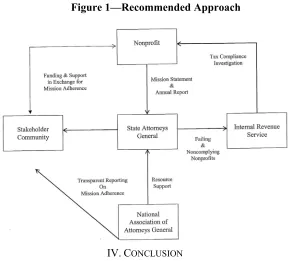
Second, this article recommends that State Attorneys General require nonprofits to submit a one-time comprehensive mission statement of values, purpose and goals and that they annually submit a descriptive narrative of mission adherence. In the above example where a nonprofit feeds the poor, the nonprofit’s narrative would describe how it has satisfied or failed to satisfy the five percent target. The appropriate State Attorneys General
124See Dana Brakman Reiser, Enron.org: Why Sarbanes-Oxley Will Not Ensure Comprehensive Nonprofit Accountability, 38 U.C. DAVIS L. REV. 205 (2004).
Office would then apply the aforementioned criteria to the annual reports, flagging those that fail in two respects; (1) failing to comply with the reporting altogether; or (2) failing to satisfy the State Attorneys General qualitative assessment mechanism by not explaining its success or lack thereof in meeting its target of mission adherence. Flagged nonprofits could then be forwarded to the IRS for tax compliance analysis to further the IRS’s regulatory mandate.
Third, reflecting statewide absence of mission as outlined in Table 2a, this article recommends that each State Attorney General office publish on its respective website a narrative on mission adherence. Within the section, nonprofits could upload their mission statements and annual narratives to match a list of nonprofits maintained by the State Attorneys General’s website. The National Association could also provide a descriptive section on its website regarding the importance of mission adherence and could also provide a link to the appropriate section on each State Attorneys General website. These connections are highlighted in Figure 1. This transparent approach would allow the stakeholder community, to which nonprofits owe the highest moral standard of governance, to fully
internalize and process mission adherence.126
Figure 1—Recommended Approach
IV.CONCLUSION
Exhibits:
Table 1: Public Charitable Non-Profits
State Number of Nonprofits
California 107,852
Texas 65,870
New York 62,598
Florida 51,419
Ohio 38,615
Pennsylvania 38,139
Illinois 37,304
Michigan 29,670
North Carolina 28,013
Virginia 26,580
New Jersey 26,477
Massachusetts 22,885
Table 2a: Multi-Dimensional Governance Standards of Performance within State Statutes
State Mission Core
Values
Fiduciary Leadership
Financial Integrity
California x
Florida x x
Illinois x x
Massachusetts x
Michigan x x
New Jersey x x
New York x
North Carolina x
Ohio x x
Pennsylvania x
Texas x
Virginia x x
Table 2b: Multi-Dimensional Governance Standards of Performance within State Statutes
State Fiduciary Leadership Financial Integrity
California § 12599.6(a) A charity must “establish and exercise control” over its fundraising activities conducted for its benefit, including approval of all written contracts and agreement.
§ 12586(e)(1) A $2 Million Charity must prepare annual financial statements using generally accepted accounting principles.
State Fiduciary Leadership Financial Integrity
Illinois § 109.10(d)(3)(e) The board of
directors may base a
determination that a distribution may be made under subsection (d) either on financial
statements prepared on the basis of accounting practices and principles that are reasonable in the circumstances or on a fair valuation or other method that is reasonable in the circumstances. Massachusetts § 6C A director, officer or
incorporator of a corporation shall perform his duties as such, including, in the case of a director, his duties as a member of a committee of the board upon which he may serve, in good faith and in a manner he reasonably believes to be in the best interests of the corporation, and with such care as an ordinarily prudent person in a like position.
§ 6C The auditor shall state that he has examined the statement of assets and liabilities included in such certificate, that his examination was made in accordance with generally accepted auditing standards, and that in his opinion said
statement of assets and liabilities presents fairly the financial position of the corporation as of the date thereof, in conformity with generally accepted accounting principles.
Michigan § 450.2105(3) Properties and
rights entered upon the books of a corporation in accordance with generally accepted accounting principles, or the current fair market value of such properties and rights.
New Jersey § 15A:6-14 Trustees and members of any committee designated by the board shall discharge their duties in good faith and with that degree of diligence, care and skill which ordinary, prudent persons would exercise under similar circumstances in like positions. New York § 521 Failure of the corporation to
comply in good faith with the notice or disclosure or reporting provisions of section 501 . . . shall