Article
When 5G meets deep learning: a systematic review
Guto Leoni Santos1, Patricia Takako Endo2, and Djamel Sadok1and Judith Kelner1
1 Universidade Federal de Pernambuco; [email protected], {jamel,jk}@gprt.ufpe.br 2 Universidade de Pernambuco; [email protected]
* Correspondence: [email protected]
Received: date; Accepted: date; Published: date
Abstract: This last decade, the amount of data exchanged in the Internet increased by over a staggering factor of 100, and is expected to exceed well over the 500 exabytes by 2020. This phenomenon is mainly due to the evolution of high speed broadband Internet and, more specifically, the popularization and wide spread use of smartphones and associated accessible data plans. Although 4G with its long-term evolution (LTE) technology is seen as a mature technology, there is continual improvement to its radio technology and architecture such as in the scope of the LTE Advanced standard, a major enhancement of LTE. But for the long run, the next generation of telecommunication (5G) is considered and is gaining considerable momentum from both industry and researchers. In addition, with the deployment of the Internet of Things (IoT) applications, smart cities, vehicular networks, e-health systems, and Industry 4.0, a new plethora of 5G services has emerged with very diverging and technologically challenging design requirements. These include: high mobile data volume per area, high number of devices connected per area, high data rates, longer battery life for low-power devices, and reduced end-to-end latency. Several technologies are being developed to meet these new requirements. Among these we list ultra-densification, millimeter Wave usage, antennas with massive multiple-input multiple-output (MIMO), antenna beamforming to increase spacial diversity, edge/fog computing, among others. Each of these technologies brings its own design issues and challenges. For instance, ultra-densification and MIMO will increase the complexity to estimate channel condition and traditional channel state information (CSI) estimation techniques are no longer suitable due to the complexity of the new scenarios. As a result, new approaches to evaluate network condition such as by continuously collecting and monitoring key performance indicators become necessary. Timely decisions are needed to ensure the correct operation of such network. In this context, deep learning (DL) models could be seen as one of the main tools that can be used to process monitoring data and automate decisions. As these models are able to extract relevant features from raw data (images, texts, and other types of unstructured data), the integration between 5G and DL looks promising and one that requires exploring. As main contributions, this paper presents a systematic review about how DL is being applied to solve some 5G issues. We examine data from the last decade and the works that addressed diverse 5G problems, such as physical medium state estimation, network traffic prediction, user device location prediction, self network management, among others. We also discuss the main research challenges when using DL models in 5G scenarios and identify several issues that deserve further consideration.
Keywords:5G; deep Learning; reinforcement learning; systematic review; cellular networks
1. Introduction
According to Cisco, the global Internet traffic will reach around 30 GB per capita by 2021, where more than 63% of this traffic is generated by wireless and mobile devices [1]. The new generation of mobile communication system (5G) will deal with a massive number of connected devices at base stations, a massive growth in the traffic volume, and a large range of applications with different
features and requirements. The heterogeneity of devices and applications makes infrastructure management even more complex. For example, IoT devices require low-power connectivity, trains moving at 300 KM/h need a high-speed mobile connection, users at their home need fiber-like broadband connectivity [2] whereas Industry 4.0 devices require ultra reliable low delay services. Several underlying technologies have been put forward in order to support the above. Examples of these include Multiple Input Multiple Output (MIMO), antenna beamforming [1], Virtualized Network Functions (VNFs) [3], and the use of tailored and well provisioned network slices [4].
Some data based solutions can be used to manage 5G infrastructures. For instance, analysis of dynamic mobile traffic can be used to predict the user location, which benefits handover mechanisms [5]. Other example is the evaluation of historical physical channel data to predict the channel state information, which is a complex problem to address analytically [6]. Another example is the network slices allocation according to the user requirements, considering network status and the resources available [2]. All these examples are based on data analysis. Some examples are based on historical data analysis, used to predict some behavior, and others are based on the current state of the environment, used to help during decision making process. These type of problems can be address through machine learning techniques.
However, the conventional machine learning approaches are limited to process natural data in their raw form [7]. For many decades, constructing a machine learning system or a pattern-recognition system required a considerable expert domain knowledge and careful engineering to design a feature extractor. After this step, the raw data could be converted into a suitable representation to be used as input to the learning system [8].
In order to avoid the effort for creating a feature extractor or suffering possible mistakes in the development process, techniques that automatically discover representations from the raw data were developed. Over recent years, deep learning (DL) has outperformed conventional machine learning techniques in several domains such as computer vision, natural language processing, and genomics [9].
According to [8], DL methods “are representation-learning methods with multiple levels of representation, obtained by composing simple but non-linear modules that each transforms the representation at one level (starting with the raw input) into a representation at a higher, slightly more abstract level.”. Therefore, several complex functions can be learned automatically through sufficient and successive transformations from raw data.
Similarly to many application domains, DL models can be used to address problems of infrastructure management in 5G networks, such as radio and compute resource allocation, channel state prediction, handover prediction, and so on. This paper presents a systematic review of the literature in order to identify how DL has been used to solve problems in 5G environments. The goals of this research is to identify some of the main 5G problems addressed by DL, highlight the specific types of suitable DL models adopted in this context and finally describe their findings. In addition, will delineate major open challenges when 5G networks meet deep learning solutions.
This paper is structured as follows: Section2an overview of the methodology adopted to guide this literature review. The results of the review including descriptive and thematic analysis are presented in Section3. The paper concludes with a summary of the key findings and contributions of the paper in Section4.
2. Systematic Review
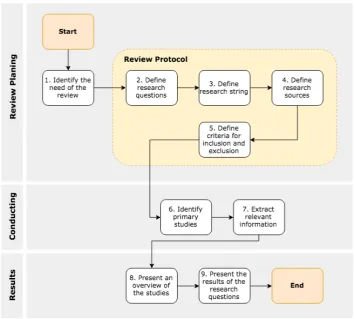
Figure 1.Systematic review methodology
2.1. Activity 1: Identify the need for the review
As discussed previously, both 5G and DL are technologies that have received considerable and increasing attention in recent years. DL has become a reality nowadays due to the availability of powerful off-the-shelf hardware and the emergence of new processing processing units such as GPUs. The research community has taken this opportunity to create several public repositories of big data to use in the training and testing of the proposed intelligent models. 5G on the other hand, has a high market appeal as it promises to offer new advanced services that up till now no other networking technology was able to offer. 5G importance is boosted by the popularity and ubiquity of mobile, wearable, and IoT devices.
In [11], a brief survey of works that applied DL for the problem of resource allocation in wireless networks is presented. The discussed works fell into the supervised DL and RL classes. Many problems and limitations related to resource allocation, such as throughput maximization, interference minimization, and energy efficiency were examined.
While the survey in [11] focused on the resource allocation problem, in this paper, we offer a more general systematic review spanning the used different DL models applied to 5G networks. We also cover other problems present in 5G networks, that demand the use of different DL models.
In the systematic review presented in this paper, we focus on 5G networks and their scenarios, applications, and problems. The DL models proposed in the analyzed works deal with specific cellular networks problems such as channel state information, handover management, spectrum allocation. The scenarios addressed in the works we select are also related with 5G networks and influence the DL-based solution proposed.
2.2. Activity 2: Define research questions
The main goal of this work is to answer the following research questions:
• RQ.1: What are the main problems DL is being used to solve?
• RQ.2: What are the main learning types used to solve 5G problems (supervised, unsupervised, and reinforcement)?
• RQ.3What are the main DL techniques used in 5G scenarios?
• RQ.4: How the data used to train the DL models is being gathered or generated?
• RQ.5: What are the main research outstanding challenges in 5G and DL field?
2.3. Activity 3: Define search string
The search string used to identify relevant literature was: (5G AND “deep learning”). It is important to limit the number of strings in order to keep the problem tractable and avoid cognitive overwhelming.
2.4. Activity 4: Define sources of research
We considered the following databases as the main sources for our research: IEEE Xplore1, Science Direct2, ACM Digital Library3, and Springer Library4.
2.5. Activity 5: Define criteria for inclusion and exclusion
With the purpose of limiting our scope to our main goal, we considered only papers published in conferences and journals between 2009 and 2019. A selected paper must discuss the use of DL in dealing with a 5G technological problem. Note that solutions based on traditional machine learning (shallow learning) approaches were discarded.
2.6. Activity 6: Identify primary studies
The search returned 3, 192, 161, and 116 papers (472 in total) from ACM Digital Library, Science Direct, Springer Library, and IEEE Xplore, respectively. We performed this search in early November 2019. After reading all the 472 abstracts and using the cited criteria for inclusion or exclusion, 60 papers were selected for the ultimate evaluation. However, after reading the 60 papers, two papers were discarded because they were considered as being out of scope of this research. Next, two others were eliminated. The first paper was discarded because it was incomplete whereas the second one was removed due presenting several inconsistencies in its results. Therefore, a total of56 paperswere selected for the for ultimate data extraction and evaluation (see TableA1in AppendixA).
2.7. Activity 7: Extract relevant information
After reading the 56 papers identified in Activity 6, the relevant information was extracted as it attempted to answer some of the research questions presented in the Activity 2.
1 http://ieeexplore.ieee.org/Xplore/home.jsp 2 http://www.sciencedirect.com/
2.8. Activity 8: Present an overview of the studies
An overview of all works will be presented in this activity (see Section3), in order to classify and clarify the conducted works according to our research questions presented in Activity 2.
2.9. Activity 9: Present the results of the research questions
Finally, an overview of the studies in DL as it is applied to 5G is produced. it will discuss our findings and address our research questions stated in Activity 2 (see Section3).
3. Results
In this section, we present the descriptive analytics and our answers for the research question formulated previously.
3.1. Descriptive analytic
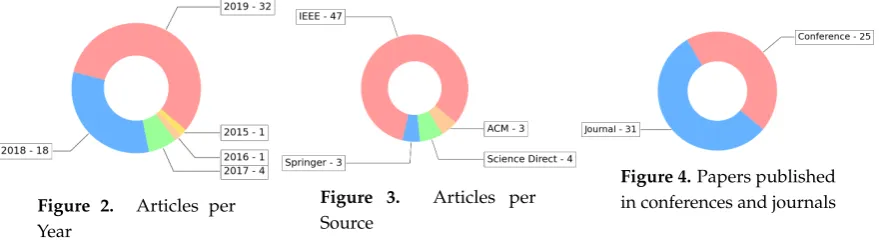
Figure2shows the related number of articles published per year, from 2009 to 2019. The works are very recent, mostly appearing after 2015, with more than 57.1% of which being published during 2019. This is a clear indication that the integration of DL and 5G is a growing research field.
Figure 2. Articles per Year
Figure 3. Articles per Source
Figure 4.Papers published in conferences and journals
Regarding to research sources, Figure3shows that IEEE societies published the majority of the retained articles (83.9%).
Figure4classifies the number of articles per publication type. Most of them were published in journals (55%), while 45% of works were published in the form of conference proceedings. This level of division is expected as conferences represent an important venue for the publication and discussion of ITC results.
3.2. What are the main problems DL is being used to solve?
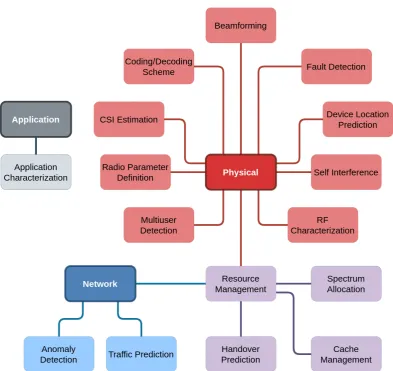
In order to answer the RQ.1, this subsection presents an overview of the papers found in the systematic review. We separated the papers according to the problem addressed as shown in Figure
5. The identified problems can be categorized in three main layers: physical medium, network, and application.
At physical level of the OSI reference model, we detected papers that addressed problems related to channel state information (CSI) estimation, coding/decoding scheme representation, fault detection, device prediction location, self interference, beamforming definition, radio frequency characterization, multi user detection, and radio parameter definition. At network level, the works addressed traffic prediction through DL models and anomaly detection. Research on resource allocation can be related to the physical or network level. Finally, at the application level, existing works proposed DL-based solutions for application characterization.
Figure 5.The problems related to 5G addressed in the works examined
3.2.1. Channel State Information Estimation
CSI estimation is a common problem in wireless communication systems. It refers to the channel properties of a communication link [6]. In a simplified way, these properties describe how the signal will propagate from the transmitter to the receiver. Based on the CSI, the transmission can be adapted according to the current channel conditions, in order to improve the whole communication. CSI is an important factor in determining radio resource allocation, the type of modulation and coding schemes to use, etc.
Traditional CSI estimation techniques usually require high computation capability [13]. In addition, these techniques may not be suitable for 5G scenarios due to the complexity of the new scenarios and the presence of different technologies (e.g., massive MIMO, OFDM, and millimeter-Wave), that impact the physical medium conditions [6]. Therefore, several authors have used DL models for CSI estimation. In our systematic review, we came across five papers related to CSI estimation with DL.
Three works proposed a DL-based solution focused on MIMO systems [14–16]. In MIMO systems both transmitter and receiver are equipped with an array of antennas. This is a very important technology for 5G, offering multiple orders of spectral and energy efficiency gains in comparison to LTE technologies [17]. Note that LTE uses MIMO but 5G takes this technology a notch further as it adopts massive antenna configurations in what is known as massive MIMO.
Doppler rate varies from one packet to another, making the CSI estimation difficult. Therefore, the DL model was used to learn and estimate the MIMO fading channels over different Doppler rates.
In [15], the authors proposed a combination of DL and superimposed code (SC) techniques for channel state CSI feedback. The main goal is to estimate downlink CSI and detect user data in the base stations.
In [16], Jiang et al. presented some evaluations for CSI estimation using DL models in three use cases. The first one focused on MIMO with multi users where the angular power spectrum (APS) information is estimated using DL models; and the two other scenarios were (a) static CSI estimation framework based on DL; and (b) a variant of the first scheme, but considering time variation, i.e., a DL model is proposed to estimate the CSI through time.
In [6], Luo et al. proposed an online CSI prediction taking into account relevant features that affect the CSI of a radio link, such as frequency band, user location, time, temperature, humidity, and weather.
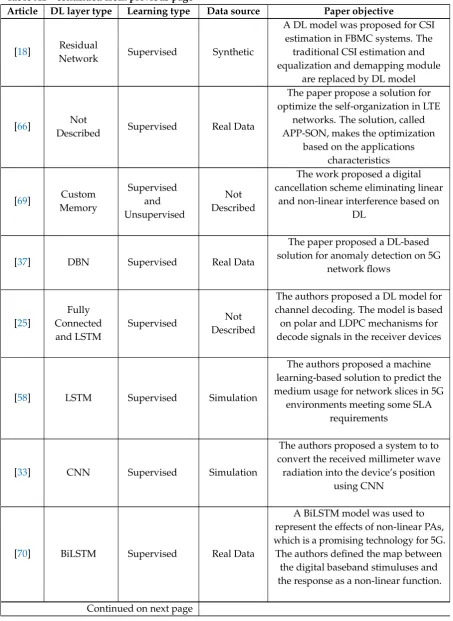
In [18], a residual network was proposed for CSI estimation in filter bank multicarrier (FBMC) systems. The traditional CSI estimation and equalization and demapping module are replaced by DL model.
3.2.2. Coding/Decoding Scheme Representation
The generation of the information at the source and the reconstruction of such information at the receiver makes up the coding and decoding processes, respectively. However, due to the unstable nature of the channels, some disturbances and noise in the signal can cause data corruption [19]. Considering the 5G networks, where new technologies, such as MIMO, non-orthogonal multiple access (NOMA), mmWave will be deployed, the coding/decoding schemes must be adapted to work properly. These schemes need to characterize several phenomena that can impact the data transmission, such as signal diffraction, fading, path loss, and scattering.
We identified a total of seven works that addressed the coding/decoding schemes using DL models.
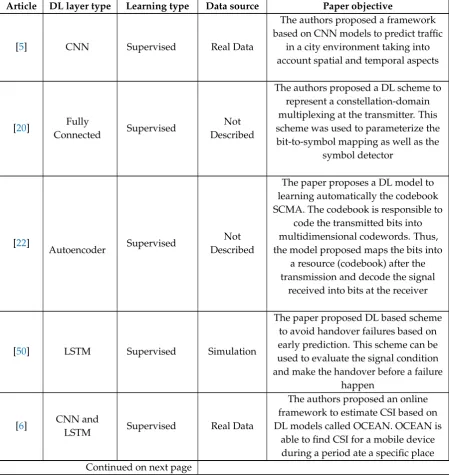
Three of these considered NOMA technology using DL models. In [20], the authors proposed a DL-based solution to parameterize the bit-to-symbol mapping and multi-user detection. Recall that as we are using non orthogonal modulation, multi-user detection becomes a cumbersome issue. In [21], the authors proposed a DL model to learn the coding/decoding process of MIMO-NOMA system in order to minimize the total mean square error of the users signals. In [22], the authors proposed a DL model to be used in sparse code multiple access (SCMA) system, which is a promising code-based NOMA technique, with the goal to minimize the bit error rate.
The authors in [23] considered multiuser single-input multiple-output (MU-SIMO) systems. A simple DL model was considered for joint multi user waveform design at the transmitter side, and non coherent signal detection at the receiver side. The main goal was to reduce the difference between the transmitted and received signals.
In [24], Kim et al. proposed a novel peak-to-average power ratio (PAPR) reduction scheme using DL of OFDM systems. The presence of large PAPR values is harmful to battery life as high peaks tend to draw high levels of energy from sometimes energy limited devices. The model proposed maps and demaps the symbols on each subcarrier adaptively and both bit error rate (BER) and the PAPR of the OFDM system could be jointly minimized.
In [25], a DL based unified polar-low-density parity-check (LDPC) is proposed. The DL model was created to receive the observed symbols and an additional information introduced by the authors called “indicator section”, and to output the signal decoded.
3.2.3. Fault Detection
Fault detection systems are very important to achieve ultra-reliable low latency communication (URLLC). For example, mission-critical industrial automation applications is a type of application that demands stringent timing and reliability guarantees for data collection, transmission, and processing [27]. Identifying faults is crucial to ensure low latency (since damaged equipment may increase the time transmission) and reliable communication (since point of failure may reduce the overall network performance). However, due to the device heterogeneity of 5G networks, identifying faults is a complex task that requires sophisticated techniques in order to automate such task.
In this systematic review, we found two papers that addressed fault detection in 5G scenarios using DL models.
In [28], a DL based schema was proposed to detect and locate antenna faults in mmWave systems. Firstly, the scheme detects the faults (using a simple neural network with a low cost), and then it locates where the fault occurred. Since the second step is a more complex task due to the high number of antennas present in a mmWave system, a more complex neural network was proposed.
In [29], Yu et al. covered fronthaul network faults. The model was designed to locate single-link faults in 5G optical fronthaul networks. The proposed model was able to identify faults and false alarms among alarm information considering single-link connections.
3.2.4. Device Location Prediction
Unlike traditional networks, in telecommunication networks, the nodes are characterized by a high mobility; and determining or estimating their mobility behavior is a complex task. Device location prediction has many applications, such as location-based services, mobile access control, mobile multimedia QoS provision, as well as the resource management for mobile computation and storage [30].
Considering urban scenarios, it is known that people movement presents a high degree of repetition, because they visit regular places in the city such as their own homes and place of work. These patterns can help building services for specific places in order to increase user experience [31]. In addition, more detailed information about human mobility across the city can be collected using smartphones [32]. This information (combined with other data sources) can be used as input for models to estimate the device and consequently user location with high accuracy.
In this systematic review, three articles presented models to deal with device location prediction. Two works focused on device location prediction in mmWave systems [33,34]. In these systems, predicting the device location is a complex task due to the radiation reflected on most visible objects, which creates a rich multi path (interference) environment. In [33], a DL model was used to predict user location based on the radiation sent by the obstacles encountered. These carry latent information regarding their relative positions; while in [34], fingerprint historical data was used to estimate the device location over beamformed fingerprints.
In [35], the authors proposed a DL model to predict the device location in ultra-dense networks. Predicting the device location in this scenario is important because the deployment of small cells inevitably leads to more frequent handovers, making the mobility process more challenging. The model was used to predict user mobility and anticipate the handover preparation. The DL was designed to estimate the future position of an user based on her/his historical data. If a handover is estimated as being eminent, DL was able to determine the best base station to receive the user.
3.2.5. Anomaly Detection
Anomaly detection systems are important to identify malicious network flows that may impact users and the network performance. However, developing these systems remains a considerable challenge due to the large data volume generated in 5G systems [37,38].
Four articles addressing the anomaly detection problem using DL in 5G were identified in this systematic review. In [37] and [39], the authors deal with cyber security defense systems in 5G networks, proposing the use of DL models that are capable of extracting features from network flows and the quick identification of cyber threats.
In [40] and [9], the authors proposed a DL-based solution to detect anomalies in the network traffic, considering two types of behavior as network anomalies: sleeping cells and soared traffic. Sleeping cells can happen due to failures in the antenna hardware or random access channel (RACH) failures due to RACH misconfiguration, while soared traffic can result in network congestion, where traffic increases but with relatively smaller throughput to satisfy the users demand. Recall, that RACH is the channel responsible for giving users radio resources so when RACH is not working properly we effectively have a sleepy cell with no transmission activity taking place.
3.2.6. Traffic Prediction
It is expected that Internet traffic will grow tenfold by 2027. This is acting as a crucial anchor to create the new generation of cellular network architecture [41]. Predicting traffic for the next day, hour, or even the next minute can be used to optimize the available system resources, for example by reducing the energy consumption, applying opportunistic scheduling, or preventing problems in the infrastructure [41].
In this systematic review, we found eight works that addressed traffic prediction using DL. The works presented in [42] and [43] proposed a DL-based solution to predict traffic for network slicing mechanisms. Note that 5G relies on the use of network slicing in order to accommodate different services and tenants while virtually isolating them. In [42], a proactive network slice mechanism was proposed and a DL was used to predict the traffic with high accuracy. In [43], a mechanism named DeepCog was proposed with a similar purpose. DeeCog can forecast the capacity needed to allocate future traffic demands in network slices while minimizing service request violations and resource overprovisioning.
Three works considered both temporal and spatial dependence of cell traffic.
In [5], the authors proposed a DL model to predict citywide traffic. The proposed model was able to capture the spatial dependency and two temporal dependencies: closeness and period.
In [44], the authors proposed different DL models for mobile Internet traffic prediction. The authors used the different models to consider spatial and temporal aspects of the traffic. The maximum, average, and minimum traffic were predicted for the proposed models.
In [45], the authors proposed a DL-based solution to allocate RRHs into BBU pools in a C-RAN architecture. The DL model was used to predict traffic demand of the RRHs considering the spatial and temporal aspects. The prediction was used to create RRH clusters and map them to BBU pools in order to maximize the average BBU capacity utility and minimize the overall deployment cost.
In [46], the authors considered traffic prediction in ultra-dense networks, which is a complicated scenario due to the presence of beamforming and massive MIMO technologies. A DL model was used to predict the traffic in order to detect if a congestion will take place and then take decisions to avoid/alleviate such congestion.
3.2.7. Handover Prediction
The handover process ensures continuous data transfer when users are on the move between call towers. For that, the mobile management entity (MME) must update the base stations where the users are connected. This procedure is known as location update. The handover delay is one of the main problems in wireless networks [48]. Conventionally, a handover is carried out based on a predefined threshold of the Reference Signal Receiver Power (RSRP), the Reference Signal Receiver Quality (RSRQ), among other signal strength parameters [49]. Predicting the handover based on the nearby stations’ parameters can be a fruitful strategy to avoid handover errors, temporary disconnections and improve user experience [48].
In this systematic review, we located two papers that addressed handover prediction. In [50], Khunteta et al. proposed a DL model to avoid handover failures. For that, the DL model was trained to detect if the handover will fail or be successful based on the historical signal condition data.
In [51], the handover prediction was tested to provide uninterrupted access to wireless services without compromising the expected QoS. The authors proposed both analytical and DL-based approaches to predict handover events in order to reduce the holistic cost.
3.2.8. Cache Optimization
In the last decade, multimedia data became dominant in mobile data traffic. This raised additional challenges in transporting the big volume of data from the content providers to the end users with high-rates and low latency. The main bottleneck point is the severe traffic congestion observed in the backhaul links, specially in 5G scenarios, where several small base stations will be scattered [52]. To mitigate this issue, the most popular content can be stored (cached) at the edge of the network (e.g., in the base stations) in order to free backhaul link usage [53]. However, finding the best strategy for the cache placement is a challenge. The best content to cache and the best location for storing this content are both decisions that can impact the cache scheme performance.
Two works addressed the cache placement problem in 5G environments using DL models. In [54], authors proposed a collaborative cache mechanism in multiple RRHs to multiple BBUs based on RL. This approach was used because rule-based and metaheuristics methods suffer some limitations and fail to consider all environmental factors. Therefore, by using RL, the best cache strategy can be selected in order to reduce the transmission latency from the remote cloud and the traffic load of backhaul.
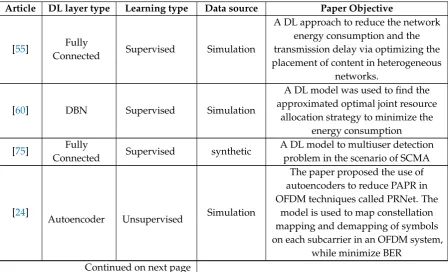
In [55], the authors considered ultra-dense heterogeneous networks where the content cache is performed at small base stations. The goal is to minimize energy consumption and reduce the transmission delay, optimizing the whole cache placement process. Instead of using traditional optimization algorithms, a DL model was trained to learn the best cache strategy. This model reduces the computational complexity achieving a real time optimization.
3.2.9. Resource Allocation/Management
As the numbers of users, services, and resources increase, the management and orchestration complexity of resources also increase. The efficient usage of resources can be translated into cost reduction and avoid over/under resource dimensioning. Fortunately, under such a very dynamic and complex network environment, recent achievements in machine learning that interact with surrounding environments can provide effective way to address these problems [56].
Four papers addressed resource allocation in network slices using solutions based on DL [4,56–58]. A network slice is a very important technology for 5G since it will allow a network operator to offer a diverse set of tailored and isolated services over a shared physical infrastructure.
Yan et al. proposed a framework that combined DL and RL to resource scheduling and allocation [56]. The main goal was to minimize resource consumption at the same time guaranteeing the required performance isolation degree by a network slice. In [4], the authors proposed a framework for resource allocation in network slices and a DL model was used to predict the network status based on historical data. In [58], a model was proposed to predict the medium usage for network slices in 5G environments while meeting SLA requirements.
Three papers proposed DL-based solutions to optimize the energy consumption in 5G networks [59–62]. The works proposed by [59] and [60] focused on NOMA systems. A framework was proposed in [59] to optimize energy consumption. A DL model is part of the framework and was used to map the input parameters (channel coefficients, the user demands, user power, and the transmission deadline) into an optimal scheduling scheme. In [60], a similar strategy was used, where a DL model was used to find the approximated optimal joint resource allocation strategy to minimize energy consumption. In [61], a DL model was used in the MME for user association taking into account the behavior of access points in the offloading scheme. In [62], the authors proposed a DL model to allocate carriers in multi-carrier power amplifier (MCPA) dynamically, taking into account the energy efficiency. The main idea was to minimize the total power consumption while finding the optimal carrier to MPCA allocation. To solve this problem, two approaches were used: convex relaxation and DL. The DL model was used to approximate the power consumption function formulated in the optimization problem, since it is a non-convex and non-continuous function.
In [63], the authors proposed a DL-based solution for downlink coordinated multi-point (CoMP) in 5G. The model receives physical layer measurements from the user equipment and “formulates a modified CoMP trigger function to enhance the downlink capacity” [63]. The output of the model is the decision to enable/disable the CoMP mechanism.
In [64], the authors proposed a DL model for smart communication systems with high density D2D mmWave environments using beamforming. The model selects the best relay node taking into account multiple reliability metrics in order to maximize the average system throughput. The authors in [11] also proposed a DL-based solution to maximize the network throughput considering resource allocation in multi-cell networks. A DL model was proposed to predict the resource allocation solution (taking as input the channel quality indicator and user location) without intensive computations.
3.2.10. Application Characterization
In cellular networks, self-organizing networks (SON) is a technology designed to plan, deploy, operate, and optimize mobile radio access networks in a simple, fast, and automated way. SON is a key technology for future cellular networks due to the potential of saving capital expenditure (CAPEX) and operational expenditure (OPEX). However, SON is not only about network performance but also QoS. A better planning of network resources can be translated into a better service quality and increasing revenues.
3.2.11. Other Problems
Some papers addressed problems which are not related to the ones previously listed. Thus, we will describe them separately.
The work presented in [67] applied a DL model to a massive MIMO system to solve the pilot contamination problem [68]. The authors highlighted that conventional approaches of pilot assignment are based on heuristics that are difficult to deploy in a real system due to high complexity. The model was used to learn the relationship between the users’ location and the near-optimal pilot assignment with low computational complexity, and consequently could be used in real MIMO scenarios.
The self-interference problem was addressed in [69]. A digital cancellation scheme based on DL was proposed for full-duplex systems. The proposed model was able to discover the relationship between the signal sent through the channel and the self-interference signal received. The authors evaluated how the joint effects of non-linear distortion and linear multi-path channel impact the performance of digital cancellation using the DL model.
The authors in [70] represented the characterization of radio frequency (RF) power amplifiers (PAs) using DL. While in previous works they have considered only linear aspects of PA, the authors included non-linear aspects of PA taking into account memory aspects of DL models in [70]. They defined the map between the digital base station stimulus and the response of PA as a non-linear function. However, the conventional methods to solve this function require from a designer to extract the interest parameters for each input (base station stimulus) manually. As a result, a DL model was proposed to represent this function, extracting the parameters automatically from measured base station stimulus and giving as output the PA response.
In [2], a RL was used to learn the optimal physical-layer control parameters of different scenarios. Authors proposed a self-driving radio, which learns the near-optimal control algorithm while taking int account the high-level design specifications provided by the network designer. A DL model was proposed to map the network specifications into physical-layer control instructions. This model was then used in the RL algorithm to take decisions according to feedback from the environment.
In [71], the spectrum auction problem was addressed using DL. The idea was to allocate spectrum among unlicensed users taking into account the interests of the channel for the auction, and the interference suffered during communication as well as economic capability. A DL model was proposed for spectrum auction, and it receives as input three factors: the interference, experience, and economic ability; and gives as output a number between zero and one that determines whether the channel will be allocated for a user or not.
In [72], path scheduling in a multi path scenario was addressed using RL. In these systems, the traffic is distributed across the different paths according to policies, packet traffic classes, and the performance of the available paths. Thus, RL was used to learn from the network the best approach for scheduling packets across the different paths.
The security aspect of cooperative NOMA systems was considered in [73]. In cooperative NOMA, the user with a better channel condition acts as a relay between the source and a user experiencing poor channel conditions (user receiver). The security may be compromised in the presence of an eavesdropper in the network. Therefore, a DL model was proposed to find the optimal power allocation factor of a receiver in a communication system has the presence of an eavesdropper node. The model input data are the channel realization while the output are the power allocation factor of the user with poor channel conditions.
In [74], authors considered the propagation prediction using DL models. Predicting the propagation characteristics accurately is needed for optimum cell design. Thus, the authors proposed a DL model to learn propagation loss from the map of a geographical area with high accuracy.
probability that a user is assigned into a resource block from a pool of resource blocks, taken the signal sent by the users as input.
In [1], an intelligent beamforming technique based on MIMO technology was proposed using RL. The proposal builds a self-learning system to determine the phase shift and the amplitude of each antenna. The RL algorithm can adapt the signal concentration based on the number of users located in a given area. If there are many users in a given small area, the solution may produce a more targeted signal for users located at that area. However, if users are spread out over a wide area, a signal with wide coverage will be sent to cover the entire area.
In [76], Tsai et al. proposed an RL-based solution in order to choose the best configuration of uplink and downlink channels in dynamic time-division duplexing (TDD) systems. The main goal was to optimize the mean opinion score (MOS), which is a quality of experience (QoE) metric. This metric has a direct relationship with the system throughput. The optimization problem was formulated as one that maximizes the MOS of the system by allocating uplink and downlik traffic for the time frames. Thus, a set of downlink and uplink configurations was defined by the authors and, for each frame, these configurations are chosen for each base station.
3.3. What are the main types of learning techniques used to solve 5G problems?
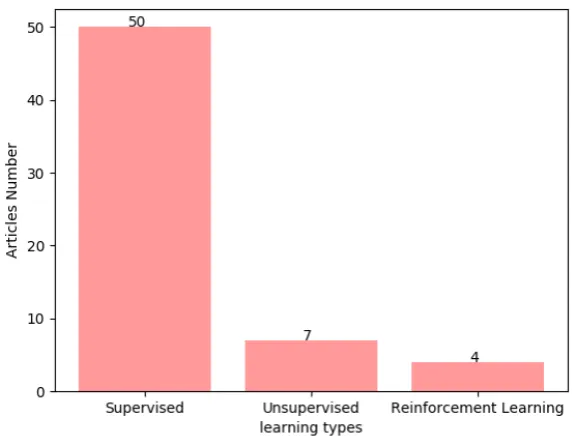
The works captured in this systematic review used three different learning techniques, as shown in Figure6. The majority of the these works used supervised learning (fifty articles), followed by reinforcement learning (seven articles), and unsupervised learning (four articles only).
Figure 6.Most common learning type used in the DL models for 5G
3.3.1. Supervised Learning
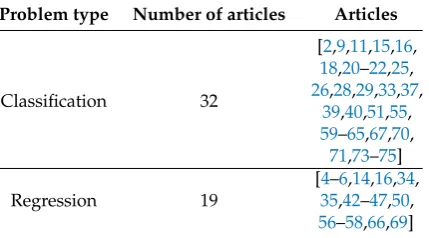
Although it is hard to find labeled data sets in 5G scenarios, most of the papers used the supervised learning approach. This approach is widely used for classification tasks (such as [77–80]) and regression problems (such as [81–84]), what are the most common problems addressed in the works found in this systematic review.
Table 1.Articles that used supervised learning in their DL models
Problem type Number of articles Articles
Classification 32
[2,9,11,15,16,
18,20–22,25,
26,28,29,33,37,
39,40,51,55,
59–65,67,70,
71,73–75]
Regression 19
[4–6,14,16,34,
35,42–47,50,
56–58,66,69]
3.3.2. Unsupervised Learning
We examined four articles that used unsupervised learning to train the models proposed. In [60], the authors proposed a hybrid approach with both supervised and unsupervised learning to train the model with the purpose to determine an approximate solution for optimal joint resource allocation strategy and energy consumption. The authors in [29], also used a hybrid learning approach, combining supervised and unsupervised learning to train the model in order to identify faults and false alarms among alarm information considering single link connections. In [24], the authors trained a DL model through unsupervised learning to map constellation mapping and demapping of symbols on each subcarrier in an OFDM system, while minimizing the bit error rate (BER). In [23], an unsupervised DL model was proposed to represent a MU-SIMO system. Its main purpose was to reduce the difference between the signal transmitted and the signal received.
3.3.3. Reinforcement Learning
RL has received big attention in the last years. This paradigm is based on trial and error, where software agents learn a behavior that optimizes the reward observing the consequences of their actions [85]. The works we reviewed addressed different problems while taking into account context information and solving optimization problems. For instance, authors in [1] used RL to determine phase shift and amplitude of each antenna element with the purpose to optimize the aggregated throughput of the antennas. In [61], authors used RL to improve the URLLC energy efficiency and delay tolerant services through resource allocation. In [72], the authors also considered a URLLC service but this time they worked on optimizing packet scheduling of a multipath protocol using RL. In [56] the authors adopted RL for network slicing in RAN in an attempt to optimize resource utilization. To handle the cache allocation problem in multiple RRHs and multiple BBU pools, the authors in [54] used RL to maximize the cache hit rate and maximize the cache capacity. In [76], RL was used to configure indoor small cell networks in order to optimize opinion score (MOS) and user QoE. Finally, in [2], RL was used to select radio parameters and optimize different metrics according with the scenario addressed.
3.4. What are the main DL techniques used in 5G scenarios?
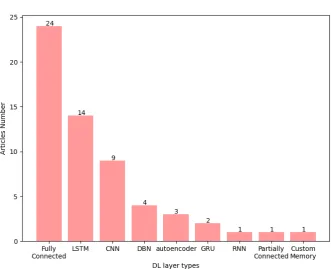
Figure7 shows the common DL techniques used to address 5G problems in the literature. Traditional neural networks with fully connected layers is the deep learning technique that most appears in the works (reaching 24 articles), followed by LSTM (with 14 articles), and CNN (adopted by only 9 articles).
3.4.1. Fully Connected Models
Figure 7.Most common DL techniques for 5G
physical information usually can be structured (e.g. CSI, channel quality indicator (CQI), radio condition information, etc). In addition, these works did not consider more complex data, such as historical information. It is understandable that the 5G physical layer receives such attention. It is the scene of a number of new technologies such as mmWave, MIMO and antenna beamforming. These are very challenging technologies that require real time fine tuning.
However, although fully connected layers were not designed to deal with sequential data, some works found in this systematic review proposed models based on time series. In [40] and [9], the authors considered real data of cellular networks such as Internet usage, SMS, and calls. Although the data set has spatio-temporal characteristics, the authors extracted features to compose a new input for the DL model. In [51], the authors proposed a fully connected model to deal with user coordinate location data. In this work both fully connected and LSTM models were proposed for comparison and the temporal aspect of data set was maintained. In [65], the authors adopted a data set composed of historical data records for urban and rural areas. Unfortunately, the paper did not provide more details about the data used, but a DL model composed of fully connected layers was used to process this data.
In [72], a fully connected model was used with an RL algorithm. In this work, the open source public Mininet simulator was used to create a network topology (the environment) in order to train the agent. Subsequently, the DL model was used to chose the best action according with the environment.
3.4.2. Recurrent Neural Networks
As highlighted in [8], RNN is able to deal with sequential data, such as time series, speech and language. It is due to its capacity for, given an element in a sequence, storing information of past elements. Therefore, one work used RNN ([16]) and several others used RNN variations (such as LSTM [86–89]) to deal with sequential data.
residual interference between the real and estimated self-interference signal. This model was based on RNN but with a custom memory unit.
In [16], authors used data from channel estimations using the ray tracing propagation software. The data was processed using traditional RNN layers to capture the time-varying nature of CSI. Similarly, several works adopted DL models with LSTM layers. This can be justified as LSTM is widely used in the literature to process sequential data.
The authors in [45] and [44] used the same data set to train their models (Telecom Italia, see the Subsection3.5). In [45], a multivariate LSTM model was proposed to learn the temporal and spatial correlation among the base station traffic and make an accurate forecast. In [44], an LSTM model was proposed to extract temporal features of mobile Internet traffic and predict Internet flows for cellular networks.
In [51], an LSTM model was suggested to deal with other an open data set in order to predict handover. The data set is composed of historical location of the users, and the model exploits the long-term dependencies and temporal correlation of data.
In [47], the authors proposed an LSTM model for handling historical data of traffic volume. The model was constructed to predict real time traffic of base stations in order to give relevant information to increase the accuracy of the offloading scheme proposed.
In [46], Zhou et al. also proposed an LSTM model to predict traffic in base stations in order to avoid flow congestion in 5G ultra dense networks. Uplink and downlink flows data were considered as input for the model. With the predicted data, it is possible to allocate more resources for uplink or downlink channels accordingly.
In [6], an LSTM model was proposed to make online CSI prediction. The model explored the temporal dependency of historical data of frequency band, location, time, temperature, humidity, and weather. The data set was measured through experiments within a testbed.
In [57], a variation of LSTM called X-LSTM was proposed in order to predict a metric called REVA, which measures the amount of PRBs available in a network slice. X-LSTM is based on X-11, which is an interative process that decomposes the data into seasonal patterns. X-LSTM uses different LSTM models to evaluate different time scales of data. “It filters out higher order temporal patterns and uses the residual to make additional predictions on data with a shorter time scale”[57]. The input data of the model is the historical data of PRB measured through a testbed, where the REVA metric was calculated.
In [70], the authors represented the memory aspect PA using a biLSTM model. The authors established a bridge between the theoretical formalism of PA behavior and the characteristic of biLSTM models to consider both forward an backward temporal aspect of the input data (baseband measurements using a testbed).
In [58], [50], [35], and [34], the authors used LSTM to deal with sequential data generated through simulation. In [58], the LSTM model was used to predict if a new network slice can be allocated given the sequential data of allocated resources and channel conditions. In [50], the LSTM model was used to evaluate historical signal condition in order to classify event in either handover fail or success in advance. In [35], the developed LSTM model was applied to learn the users mobility pattern in order to predict their movement trends in the future based on historical trajectories. In [34], the authors used LSTM to predict position of users based on historical beamformed fingerprint data (considering the presence o buildings in a scenario generated through simulations).
The work presented in [25] proposed an LSTM model to represent the coding/decoding schema considering a hybrid approach to support polar codes. Unfortunately, the authors did not describe the data used to train their model.
3.4.3. CNN
CNN models are created to deal with data that come from multiple arrays or multivariate arrays and extract relevant features from them. In other words, the convolution layer is applied to process data with different dimensionality: 1D for signals and sequences, 2D for images or audio spectrograms, and 3D for video or volumetric images [8]. As a result, this layer was typically used to deal with several types of data in the works found in this systematic review.
The works in [33], [28], [34], and [74] presented the input data for the CNN models as an image form in order to take advantage of the natural features of the convolutions applied by the CNN layers. Both temporal and geographical aspects were considered in the works presented in [44], [5], and [43]. These are relevant plans since the metrics have different behavior according to the time of the day and the base station location. As a result, these works used CNN to take into consideration temporal and space aspects at the same time and extract relevant joint patterns. The works presented in [6] used CNN models and considered several aspects that affect the CSI as input for the models such as frequency band, location, time, temperature, humidity, and weather. The authors considered 1D and 2D convolutions in order to extract frequency representative vector from CSI information.
A separate work used a special architecture of CNN called ResNet [18]. This architecture was proposed to solve the notorious problem of vanishing/exploding gradient. The main difference offered by the ResNet architecture is that a shortcut connection is added every two or three layers in order to skip the connections and reuse activation from a previous layer until the adjacent layer learns its weights. This architecture was used to process modulated frequency-domain sequence data for the purpose of channel estimation.
In addition to the LSTM and CNN models, the authors proposed a model named temporal convolutional network (TCN) in [34]. Unlike the other models, the TCN architecture considers the temporal dependency in a more accurate way. The interested reader may find out more detailed information TCN by consulting [90].
In [25], besides describing a fully connected layers and an LSTM models, the authors also proposed a CNN model for use with LSTM to represent the coding/decoding schema as convolution functions.
3.4.4. DBN
DBNs are attractive for problems with few labeled data and a large amount of unlabeled ones. This is mainly due to the fact that during the training process, unlabeled data are used for training the model and the labeled data are used for fine-tuning the entire network [91]. Therefore, this DL technique combines both supervised and unsupervised learning during the training process.
For instance, the works presented in [37] and [39] used a data set composed of several network flows of computers infected with botnets. The DBN model was used to detect traffic anomalies.
Similarly, in [60], the authors proposed a DBN model where the data set used consisted of the channel coefficients and the respective optimal downlink resource allocation solution.
In [29], another DBN model was trained using a hybrid approach (supervised and unsupervised) for fault location on optical fronthalls. The data set used was taken from a real management system of a network operator, and consists of link faults events.
3.4.5. Autoencoder
3.4.6. Combining models
Most of the examined works make use of only one DL technique, but we have seen that there are eight works that considered more than one technique and provided a combination with other(s).
For instance, the authors in [51] proposed the joint use of an LSTM and a fully connected model. The research in [56] combined LSTM with reinforcement learning, [74] proposed a solution combining a CNN model with a fully connected model, [61] and [72] combined a fully connected model with reinforcement learning. Finally a combination of LSTM with CNN was proposed in [6] and [44]. A hybrid model, GAN, combining both LSTM and CNN layers was adopted in [4].
Next we discuss how the data sets were used to train these DL models.
3.5. How the data used to trained the DL models was gathered/generated?
DL models (both supervised and unsupervised) require data sets for their training and testing. However, acquiring a good data set, in some cases, remains a considerable challenge.
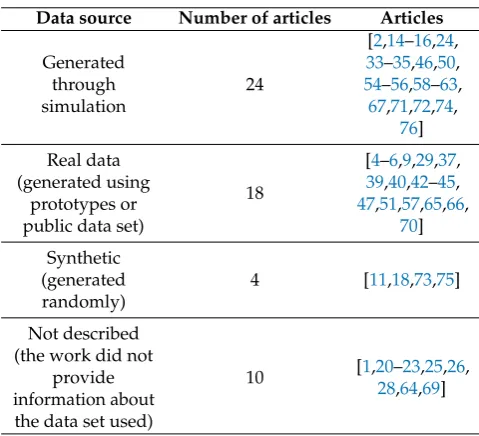
The works we reviewed either used different data sets or created their own data using different techniques, as shown in the Table2.
Table 2.Data source
Data source Number of articles Articles
Generated through simulation
24
[2,14–16,24,
33–35,46,50,
54–56,58–63,
67,71,72,74,
76]
Real data (generated using
prototypes or public data set)
18
[4–6,9,29,37,
39,40,42–45,
47,51,57,65,66,
70]
Synthetic (generated randomly)
4 [11,18,73,75]
Not described (the work did not
provide information about the data set used)
10 [1,20–23,25,26,
28,64,69]
Most of works (more precisely 24 of them) used simulation to generate their data set. This is often justified as the authors are unable to a suitable variety of available data sets focused on 5G, since this is a novel technology and is being slowly deployed since 2020. Nonetheless, as many as 18 works used actual data sets to train their models. Some works measured the data through experiments using their own platform, whereas other works used public data sets available across the Internet. Four papers generated synthetic data sets. They contained some parameters of the evaluated 5G environment that were randomly generated. Finally, 10 works did not describe the source of the data used to train the proposed models. This is a point of concern in our view, as it makes the reproducibility and verification of the results of these works very difficult if not impossible altogether.
Therefore, in this section we describe some of the few public data sets used in the works that we managed to verify during this systematic review. The idea is to provide a brief description of these data sets that may be used in new works based on DL and provide useful pointers to the reader on where to find these. Note that public 5G traces and data sets remain difficult to find and that most of the existing traces are relatively old and related to 4G technology.
3.5.1. Telecom Italia Big Challenge Data Set
The Telecom Italia data set [92] was used by majority of works [5,9,40,44,45]. It was provided as apart of a Big Data Challengeand is composed of various open multi-source aggregations of telecommunications, weather, news, social networks and electricity data. In 2014, the data was collected from two Italian areas: the city of Milan and the Province of Trentino.
With regard to the Call Detail Records (CDRs) present in the data set, Telecom Italia recorded the following activities: i) data about SMS, ii) data about incoming and outgoing calls, and iii) data about the Internet traffic. A CDR is generated every time a user starts or terminates an Internet session, if a connection takes more than 15 minutes, or more than five MB is transferred during a user session.
Further, the Telecom Italia data set also includes the Social Pulse data set5, and other data such as weather, electricity (only for the Tentrino region), and news. For more information about this data set, please see [92].
It comes at no surprise that the Telecom Italia data set was used in several papers found in this systematic review. In [44], the data set was used to train a model for predicting the minimum, maximum, and average traffic (multitask learning) of the next hour based on the traffic of the current hour. In [5], the models were proposed to predict traffic in a city environment taking into account spatial and temporal aspects. The data was sliced using a sliding window scheme generating several samples according with the closeness and the periodicity. In [40] and [9], the data set was used to train the model to detect anomalies and data for short messages (SMS), calls, and Internet usage were considered. The authors divided the data set into samples of 3-hours ranges (morning, from 6 to 9 am; afternoon, from 11am to 2 pm; and evening, from 5 to 8 pm). Another used of the data set targeting the prediction of traffic was made in [45]. Here the authors compiled the traffic volume from the covered areas of cells of the data set, and then normalized to the [0,1] range for the convenience of carrying the analysis.
3.5.2. CTU-13 Data Set
The CTU-13 Data set [93] was collected in 2011, in CTU University, in the Czech Republic, and comprises real botnet, normal, and background traffic.
The data set is composed of 30 captures (corresponding to different scenarios) for several botnets samples. In each scenario, a specific malware with different protocols is used. After the capture, the authors analyzed the flow data in order to create the labels. There are four types of flows in the data set: background, botnet, command and control channels, and normal. However, the data set is unbalanced. For example, for a given scenario, there are 114,077 flows, where 37 (0.03%) is botnet traffic, and 112,337 (98.47%) of normal traffic.
Two works found in this systematic review used this data set [37,39] to train DL models for anomaly detection. The authors made two different training/testing data partition. In the first partition, the CTU data set was divided between training (80%), and testing (20%), both containing samples of every botnet. In the second partition, the botnet flows were divided into training and testing, i.e., the botnet flows that are present in the training set were not present in testing set.
5 The Social Pulse dataset is composed of geo-located tweets that were posted by users from Trentino and Milan between
3.5.3. 4G LTE Dataset with Channel from University College Cork (UCC)
This next data set is provided by UCC [94] and is composed of client-side cellular key performance indicators (KPIs). The information was collected from two major Irish mobile operators for different mobility patterns (static, pedestrian, car, train, and tram). There are 135 traces in the data set, and each trace has an average duration of 50 minutes and a throughput that varies from 0 to 173 Mbit/s at a granularity of one sample per second. An Android network monitoring application was used to capture several channel related KPIs, downlink and uplink throughput, context-related metrics, and also cell-related information.
In an attempt to supplement the actual measured data set, another data set was generated through simulation and is also provided as a 4G LTE Dataset. The popular open source public Ns-3 simulator was used to create this data set. It includes one hundred users randomly scattered across a seven-cell cluster. The main purpose of thiscomplementarydata set is to provide information about the base stations (not present in the real data set). In addition, the code and context information are offered to allow other researchers to generate their own synthetic data sets.
Nonetheless, only one work found in this systematic review actually used this data set [4]. The model proposed was trained considering as input historical network data such as donwlink bitrate, uplink bitrate, and network delay. After the training, the model is then able to predict these network performance parameters for the next 1-minute time interval.
3.6. What are the most common scenarios used to evaluate the integration between 5G and DL?
Evaluating the works found in this systematic review, we noted that most of the works (40 of them) considered a generic scenario in their evaluations, and that only 16 articles considered specific ones.
The urban environment tops the studies as the most common scenario presented in the works [5,33,40,43–45,47,65,66,71,74]. This is justifiable as urban scenarios are very dynamic, very challenging and heterogeneous, with the presence of different obstacles (persons, vehicles, and buildings). They reflect extreme conditions that could not be easily handled by the previous cellular generations and where 5G requires special solutions such as the use of milli-meter waves, advanced beamforming, NOMA, etc., to deliver its promises. Notably, efficient usage of the frequency spectrum and the high energy consumption are two big challenges present in these scenarios [95].
Two recent works [2,16] considered vehicular networks as use case to evaluate their solutions. These demonstrate the increased research and interest in the domain of autonomous and connected vehicles, where 5G networks play a important role, providing a low latency with high availability [96]. Vehicular networks present unprecedented challenges that are not present in traditional wireless networks, such as fast-varying wireless propagation channels and ever-changing network topology [97]. Therefore, many researchers see the use of DL as a promising venue to solve some the stringent 5G problems.
In [2], the authors considered two vehicular network configurations while varying the device battery capacity and the available bandwidth; and also scenarios with a smartphone transmission of high definition (720p) real-time video conferencing signals.
Three different scenarios were evaluated in [4], namely, a video medical consultation (full duplex two direction live stream (UL/DL)), a virtual treatment (propagating a single direction video live stream (DL)) and a simple Data Submit (Single direction data exchange over the uplink (UL)).
two indoor scenarios were examined: The two outdoor scenarios were parking lots situated outside a building, while the two indoor scenarios were a workroom and an aisle inside a building.
3.7. What are the main research challenges in 5G and DL field?
Unfortunately, the most part of the articles examined in this systematic review did not present challenges or plans for future works (29 articles). It was then difficult to identify opportunities for new researches.
From the works that present next steps for the research, we can highlight the following relevant research issues. Some works plan to evaluate their solution based on real system aspects or real data sets. Authors often cite the lack of real data sets and traces as a major drawback of their current work and resort to the use of data sets generated through simulations. Though not an error in itself, the use of synthetic data may limit the scope of the findings.
Generally, many studies point out that the complexity of the 5G scenario remains a challenge. In fact, mathematical models are more difficult to develop here which makes the use of DL techniques more attractive. But although DL models are able to process a big variety of data and receive multi-variate input data, the solutions proposed are often simplified to achieve low computational complexity. In this line of thought, some studies plan to include and add more input parameters for their models. For example, some works plan to consider more realistic parameters about the physical medium in their systems, while others considered to add new parameters. The inclusion of these parameters can considerably increase the complexity of the scenarios to be addressed. In addition, the presence of more parameters have a direct impact on the system performance [11]. This is an issue when dealing with real time systems as in the case of 5G. Furthermore, it is always important to determine the level of abstraction needed to study a problem. It is not always the case that more parameters and detailing of a model are guaranteed to bring more accurate results and insights. The price may be higher than the benefits.
An alternative technique can be in the use of RL. This is known to adapt and react dynamically to the environment at hand. This paradigm does not require data for training the agent, but it needs to describe a reward function and to represent the environment so that the agent learns to take actions that optimize that reward. The problem can be that one cannot afford to let an agent take wrong decisions in an attempt to learn as these can be costly to the operation of the network. We find this kind of problem also present in other critical application domains such as medical applications were one cannot afford to the use of DL due to the the risk on human life it may generate.
A further challenge pointed out by [11] is to consider DL solutions in scenarios with massive connections. This is indeed seen as a considerable challenge due to the the presence of different mobility patterns and different wireless channel fading conditions for the thousands of users. More robust models are needed. This complex scenario can hardly be subject to the application of traditional models. Instead, DL models represent a powerful tool to handle the different mobility patterns (using new recurrent models obtained from historical data) and different wireless channels (for example by considering RL for environment-based learning).
The use of DL can sometimes be hampered by the processing power and timeliness especially in the presence of massive numbers of devices as in the case Industry 4.0. Understandably, many papers identified as challenges and future works the need to improve the performance of their solutions. After all, the performance of the overall system is slightly dependent on that of the adopted DL model. To achieve such improvement, some works intend to make a fine-tuning in the solution proposed, while others plan to trim or compress their networks, and there are those who consider new DL models altogether, with appropriated type of layers.
planned 5G services. The authors in [9,40] plan to evaluate their DL-based solutions in IoT scenarios: in [40] the authors plan to consider aspects about security (anomaly detection), while in [9] the authors plan consider energy consumption.
3.8. Discussions
As presented in this systematic review, all the selected papers are very recent as most of them were published in the year 2019 (57.1%). The oldest paper we examined is from the year 2015. This reflects the novelty and hotness of the technologies 5G and DL, and of course their integration.
5G is a technology in development and is set to solve several limitations present in the previous generations of cellular communication systems. It offers services, so far limited, such as massive connectivity, security, trust, large coverage, ultra-low latency ( in the range of 1ms over the air interface), throughput, and ultra-reliability, (99.999% of availability). On the other side of the spectrum, DL has received a lot of attention in the last few years as it has surpassed several state-of-the-art solutions in several fields, such as computer vision, text recognition, robotics, etc. The many reviewed recent publications attest the benefits that 5G technology would enjoy by making use of DL advances.
For the purpose of illustration only, as commented in [11], resource allocation in real cellular wireless network can be formulated and solved using tools from optimization theory. However, the solutions often used, have a high computational complexity. DL models may be a surrogate solution keeping the same performance but with reduced computational complexity.
We also noted that many works (a total of 25 to be precise) were published in conferences with few pages (around six pages). We believe that they represent works in progress, as they only show initial results. It reinforces the general view that the the integration between 5G and DL is still an evolving area of interest with many advances and contributions expected soon.
By observing the different scenarios considered in the examined articles, they generally do not focus on a real application (30 out of 57 articles found). However, a project called Mobile and wireless communications Enablers for the Twenty-twenty Information Society (METIS) published a document that explained several 5G scenarios and their specific requirements [99]. Nine use cases are presented: gaming, marathon, media on demand, unnamed aerial vehicles, remote tactile interaction, e-health, ultra-low cost 5G network, remote car sensing and control, and forest industry on remote control. Each of these scenarios have different characteristics and different requirements regarding 5G networks. For instance, remote tactile iterations scenarios can be considered a critical application (e.g., remote surgeries) and demand ultra-low latency (not be greater than 2 ms) and high reliability (99.999%). On the other hand, in the marathon use case, the participants commonly use attached tracing devices. This scenario must handle thousands of users simultaneously requiring high signaling efficiency and user capacity. As result, we believe that in order to achieve high impact results, DL solutions need to be targeted towards addressing use cases with specific requirements instead of trying to deal with the more general picture. Planning DL models for dynamic scenarios can be a complex task, since DL models need to capture the patterns present in the data set. Thus, if the data varies widely between scenarios, it can certainly impact the performance of the models. One approach that can be used to deal with this limitation is the use of RL. As presented in Section3.3, seven works considered this paradigm in their solutions. Indeed, this approach considers training software agents to react to the environment in order to maximize (or minimize) a metric of interest. This paradigm can be a good approach to train software agents to dynamically adapt according to changes in the environment, and thus meet the different requirements of the use cases presented above.
are necessary to avoid the drawbacks to deploying a non trained agent within a real operating 5G network. This is a cost, operators cannot afford.
4. Final Considerations
This work presented a systematic review on the use of DL models to solve 5G related problems. 5G stands to benefit from DL as reported in this review. Though these models remove some of the traditional modeling complexity, developers need to determine the right balance between performance and abstraction level. More detailed models are not necessarily more powerful and many times the added complexity cannot be justified.
The review has also shown that the used DL techniques range across a plethora of possibilities. A developer must carefully opt for the right strategy to a given problem. We also showed that many works developed hybrid approaches in an attempt to cover a whole problem. DL techniques are often also combined in the case of 5G with optimization algorithms such as GA among others to produce optimized solutions.
Establishing clear use cases is important to determine the scope of a problem and therefore the DL parameters applied to it. 5G is known to offer services that have different and sometimes conflicting requirements. Hence, a solution that works for a given scenario may not work for another one.
DL techniques are known to be data based. The more data, the most testing and development can be done and consequently, the better models we can produce. Unfortunately, due to reasons of business privacy very limited data sets are available. This is in contrast to other research communities that offer several data sets for research as in the case of image processing for example. We therefore believe that the industry and scientific community must make a similar effort to create more recent and representative 5G data sets. The use of simulated, old, and synthetic data has major limitations and may have questionable results.
A major point of concern in the 5G DL integration remains that of performance. As we are dealing with real time problems, the adopted solutions must not only deliver the expected solution but they must do it at the right time. Two things emerge from this point. A first one is related the scope of DL application. In this case, we need to be careful in using it for problems that require agile answers sometimes at the nanosecond level. A second approach would be to develop simpler or compressed models.
Overall, the use of DL in 5G has already produced many important contributions and one expects these to evolve even further in the near future despite the many limitations identified in this review.
Acknowledgments:In this section you can acknowledge any support given which is not covered by the author contribution or funding sections. This may include administrative and technical support, or donations in kind (e.g., materials used for experiments).
Conflicts of Interest:Declare conflicts of interest or state “The authors declare no conflict of interest.” Authors must identify and declare any personal circumstances or interest that may be perceived as inappropriately influencing the representation or interpretation of reported research results. Any role of the funders in the design of the study; in the collection, analyses or interpretation of data; in the writing of the manuscript, or in the decision to publish the results must be declared in this section. If there is no role, please state “The funders had no role in the design of the study; in the collection, analyses, or interpretation of data; in the writing of the manuscript, or in the decision to publish the results”.
References
1. Maksymyuk, T.; Gazda, J.; Yaremko, O.; Nevinskiy, D. Deep Learning Based Massive MIMO Beamforming for 5G Mobile Network. 2018 IEEE 4th International Symposium on Wireless Systems within the International Conferences on Intelligent Data Acquisition and Advanced Computing Systems (IDAACS-SWS). IEEE, 2018, pp. 241–244.