Resistance training for performance
and injury prevention in golf
Gregory J Lehman, MSc, CSCS, DC*
This introductory resistance training program is designed to minimize injury risk, improve golf swing speed and the overall fitness of recreational golfers. This article aims to introduce to the Chiropractor the basic concepts sport specific resistance training, periodization models of resistance training and proposes a year round conditioning resistance training program specific to golf. The exercises have been chosen based on the best biomechanical evidence to minimize injury risk and on the research supporting the use of movement specific training adaptations. Upper body strength exercises are performed standing to develop both trunk and hip stabilizing musculature and the primary movement of the golf swing.
(JCCA 2006; 50(1):27–42)
k e y wo r d s: golf, injury, exercise, strength training, stability.
Introduction
This paper outlines a simple 3 phase resistance training program designed for golfers with minimal strength training experience. The program can also be used as an introduction to strength training for elite golfers wishing to advance to a more rigorous and periodized strength and conditioning program. The program aims to prevent
musculoskeletal injuries, improve the strength and power of the golf swing and increase the general fitness of participants. For ease of description, the conditioning program will be split into two different components: 1. Injury Prevention and 2. Strength and Power Training. The two exercise components are not mutually exclusive. Exercises performed in the injury prevention component
Le programme introductif d’entraînement contre résistance est conçu pour diminuer les risques de blessure, améliorer la vitesse de l’élan de golf et la santé physique générale des golffeurs amateurs. Cet article a pour but d’introduire au chiropraticien, les concepts de base particuliers, reliés à l’entraînement sportif contre résistance, aux modèles de périodisation d’entraînement contre résistance et propose un entraînement de
conditionnement contre résistance, axé particulièrement sur le golf. Ces exercices ont été choisis selon les
meilleurs critères biomécaniques pour réduire les risques de blessure, ainsi que d’après la recherche qui soutient des adaptations d’entraînement, utiisant un mouvement particulier. Les exercices pour raffermir la partie du corps supérieure sont exécutés debout pour développer, à la fois le tronc et la hanche, pour stabiliser la
musculature et les mouvements principaux de l’élan de golf.
(JACC 2006; 50(1):27–42)
m o t s c l é s : golf, blessure, exercice, entraînement de la force, stabilité.
* Department of Graduate Studies, Canadian Memorial Chiropractic College, 6100 Leslie Street, Toronto, Ontario, Canada M2H 3J1. Address correspondence to: Gregory J Lehman, MSc, CSCS, DC, Assistant Professor, 273 King Street E, Kingston, Ontario, Canada. E-mail [email protected]
may improve the golf swing and exercises performed during the strength and power component may reduce the risk of injury.
An attempt has been made to select exercises based on the best available biomechanical and strength and condi-tioning research. However, research in many areas is lacking and suggestions for program construction are still necessary. Where research is lacking, exercises were in-cluded based on the published suggestions of leading re-searchers within the biomechanics and strength and conditioning field. It should also be noted that these are not the only possible exercises that may improve golf performance and decrease injury risk. Additionally, while the construction of the conditioning program is based on the available literature gaps in our current knowledge ul-timately makes much of the program still the opinion of the author based on my interpretation of the literature. Future longitudinal research comparing different training regimes for golf performance would be of benefit.
Injury Prevention
The injury prevention program focuses on developing muscle endurance and motor control to provide muscular stability for the lumbar and shoulder regions. It should be noted that research is lacking that prospectively evaluates the efficacy of these exercise programs in preventing in-juries. Rather, the rationale for the inclusion of these ex-ercises is supported by the available biomechanical evidence and cross sectional epidemiological evidence (i.e. greater hip abduction strength is correlated with few-er knee injuries). Exfew-ercise inclusion is supported by the exercise’s efficacy in achieving muscular activation (de-termined via electromyographic studies), minimization of excessive or asymmetrical spinal loading or theorized sub-optimal muscular recruitment (i.e. high levels of up-per trapezius recruitment during exercises designed to train serratus anterior) and the expert opinion of leading researchers. Details of the exercise inclusion rationale will be provided in the following sections.
Training to Improve Spinal Stability and Prevent Low Back Injuries
Trunk extensors, flexors, rotators and lateral bend ago-nists are active through all portions of the golf swing.1
Due to the muscular demands of the golf swing and the prevalence of injury in the lumbar spine, training the
trunk musculature may improve performance and de-crease injury risk. Adequate spinal stability is the amount of trunk muscle co-contraction necessary to reinforce the spine to prevent segmental buckling. This ability to stabi-lize the spine is considered necessary in the prevention of low back injuries.2,3 Spinal stability is not provided
by one specific muscle but rather via the coordinated ef-forts of the flexor, extensor and lateral bending trunk musculature4 (rectus abdominis, external oblique,
inter-nal oblique, tranverse abominis, erector spinae, quadratus lumborum and latissimus dorsi). Because only a minimal level of trunk muscle contraction appears necessary to stabilize the spine, the strength of these muscles appears less important than the endurance capabilities of the mus-cular stabilizing system. Spinal extensor endurance has been shown to be correlated with decreases in injury risk for the low back.5 Poor trunk muscular endurance as well
as aberrant flexor/extensor endurance ratios has also been correlated with a history of low back injury.6 Therefore,
the aim of this exercise program is to improve the endur-ance and strength of trunk muscles to facilitate their abil-ity to stabilize the spine in neutral and non-neutral positions and improve their ability to produce force dur-ing the golf swdur-ing.
Many exercises can stress the trunk muscular system and require muscle activation levels which result in in-creased strength and endurance. However, a justification and requirement for the inclusion of exercises in this spi-nal stability program is that the exercises are safe and do not increase the risk of injury with elevated spinal com-pressive and shear loads. Many commonly prescribed trunk muscle exercises for rehabilitation and performance may actually predispose one to injury due to the high compressive and shear loads imparted on the lumbar spine caused by excessive muscular co-contraction and extreme ranges of motion.7 The exercises (Figures 1–4,
description in Table 2; curl up, bird dog, side bridge and front support) chosen for this program currently have the most research supporting their ability to adequately acti-vate the trunk musculature without exceeding cautious injury thresholds for compressive and shear loading.8 The
neu-Table 1 Injury prevention exercises designed to train muscles responsible for trunk stability.
Exercise Description
Curl Up Golfer lies on back with one knee bent 90 degrees and the second leg straight. Hands should be placed under the low back to prevent spinal flexion. Golfer “curls” their shoulders 2 inch-es off the surface. The neck should should stay in a neutral position. Strain should be experi-enced in the abdominal region. The golfer should focus on curling the ribcage toward their pelvis.
Bird Dog Golfer starts on hands and knees. From this four point kneeling position the golfer should extend one leg parallel to the floor, hold for 3 seconds and return to the starting position. Repeat with other leg. Additionally, the opposite arm can also be raised. The golfer must maintain control of the spine and minimize twisting and excessive movement.
Side Support Golfer starts in side lying position and raises their torso off the floor. Their weight should be supported by their knee and their forearm. To increase difficultly support the weight from the forearm and the golfers lateral feet.
Front Support Rolling from the side support position the golfer maintains a neutral spine and supports their weight on their forearms and the balls of both feet.
Figure 1 Curl up.
Figure 2 Bird Dog.
Figure 3 Side Support.
tral spine posture should occur. For the isometric bridge exercises (front and side bridge) athletes should hold each position for 3–5 seconds then “roll” into the next bridge position while maintaining a neutral spine. When the athlete performs the bird dog or curl up exercise and has lifted their leg or chest, respectively, they should hold this position for 3–5 seconds. The athlete should choose a repetition level which results in fatigue and the inability to perform the exercises with correct form.
Defining these exercises as spine/core stability exercis-es doexercis-es not mean that the strength and power training ex-ercises are not core stability exex-ercises. The term core stability in terms of exercise prescription is overused to the point of becoming meaningless. When trunk muscles must be co-activated to stabilize the spine then that exer-cise is by definition a core stability exerexer-cise. For exam-ple, the loaded squat is an excellent example of a core stability exercise – anterior, lateral and posterior trunk muscles are active to ensure that the spine does not buck-le. All of the exercises in the strength and power training component will require bilateral agonist-antagonist co-activation to produce movement and stabilize the spine. It is the aim of the 4 previous exercises to condition the trunk muscles to facilitate this role and improve their en-durance to provide stability during everyday activities. An argument can also be made that these injury preven-tion exercises may not be necessary if a participant has no
back pain and has adequately functioning low back mus-cles. These exercises are included based on a least harm principle. While it is uncertain whether they might de-crease the injury risk for a participant they are not likely to increase their risk of injury.
Training to improve shoulder joint control and prevent shoulder injury
Adequate control of the scapula has been suggested to be necessary in the prevention and treatment of shoulder in-juries.9 Aberrant scapular movement is referred to as
scapular dyskinesis which is the result of incorrect mus-cular coupling between primary scapular stabilizers (ser-ratus anterior, upper, mid and lower trapezius, rhomboids and rotator cuff muscles).10 Dysfunction in the firing
pattern of the trapezius musculature has been noted in patients with rotator cuff impingement.11,12 Scapular
sta-bilizers are active during all throwing movements, golf included, and therefore conditioning of these muscles may be necessary to improve performance and decrease injury risk.13
Rubin and Kibler13 describe three roles of the scapula
in normal function. First, the scapula provides an ana-tomic and kinematic link between the trunk and the arm. Second, the scapula provides a stable socket for the artic-ulation of the humeral head. Third, scapular control at-tempts to create adequate space for the clearance of the
Table 2 Exercises to prevent shoulder injury through enhancing shoulder control.
Exercise Exercise Description
Lower Trap Arm Raise While lying face down the participant lifts their arm to a position 45 degrees lateral to and at the level of their head. The arm should be in line with the lower trapezius fibres. This exercise trains the trapezius, deltoid, external rotator cuff and rhomboids.
External Rotation –teres minor –infraspinatus
Using a dumbbell with their arm abducted and elbow flexed, the participant should eccentri-cally lower the dumbbell (internally rotate) and then raise the dumbbell to the starting posi-tion via external shoulder rotaposi-tion. This exercise trains the external rotator cuff. Athletes should focus on keeping their shoulder blades back and down.
rotator cuff during arm elevation via posterior tilting and upward rotation. Details of optimal scapular control can-not be explored in this paper; rather this paper will dem-onstrate some of the exercises which can train the muscles required to provide scapular stability. An excel-lent review of scapular function can be found in Rubin and Kibler.13
Based on the roles of the scapula delineated by Rubin and Kibler13 and Cools et al14 the aim of scapular
stabili-ty program is to perform exercises which satisfy the fol-lowing criteria:
1. Train the serratus anterior (SA), while minimizing up-per trapezius activity, to increase SA strength, there-fore decreasing scapular winging and increasing upward rotation and posterior tipping of the scapula, while minimizing the abnormal scapula rotation asso-ciated with increased upper trapezius activity.15,16
2. Train the subscapularis muscle because of its role in positioning the humeral head in the glenoid fossa,9
and its elevated activity during the golf swing.17,18
3. Train the scapulothoracic muscles (trapezius, levator scapula, serratus anterior, rhomboids) to control the scapula via retraction, protraction, elevation and de-pression to provide a stable socket for the humeral head and allow for an optimally positioned scapula for stability.19,20
4. Train external rotators to position the humeral head within the glenoid fossa and be optimally conditioned for the requirements of the golf swing.18
This scapular stability and strength program also pro-vides a conditioning stimulus for the muscles of the up-per limb and thorax. These exercises should be performed 2 times per week on separate days than the strength and power exercises. Two sets of 10–12 repeti-tions should occur for each exercise. Weights should in-crease with improvement in strength and endurance. It should be emphasized that these exercises are not the only exercises that can influence and improve shoulder control. These exercises were chosen because they are simple, can be easily implemented and train all the mus-cles responsible for shoulder joint control. Chiropractors may wish to modify or replace exercises provided they meet the previous requirements. The primary suggested exercises are the Lower Trapezius arm raise, standing
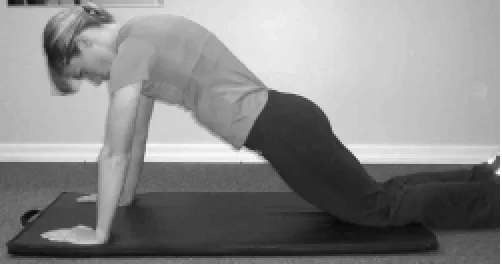
shoulder external rotation and push up plus (Figures 5–9, described in table 2). Other possible exercises are low rows, scapular punches, scaption and scapular protraction exercises.
Strength and Power Training
The aim of resistance exercise is to improve the strength of the golfer and their ability to generate power during the golf swing to increase club head speed. Before ex-plaining the resistance training program a brief introduc-tion to resistance training concepts is warranted. The following paragraphs establish a basis for exercise inclu-sion in the conditioning program.
Strength can be defined as the maximal force that a
muscle or muscle group can generate at a specific veloci-ty. Resistance training designed to increase strength typi-cally involves moving weight at a relatively slow pace (2 seconds for each eccentric and concentric portion of the movement) and at a repetition level of less than 12. Total sets per exercise typically range from 1 to 3-elite athletes may perform a significant amount more. Six or less repe-titions per set corresponds to approximately 80% of the athlete’s one repetition maximum and is the current rec-ommendation for building absolute strength from the Na-tional Strength and Conditioning Association.21 Higher
repetition levels (10–12 per set) correspond to the devel-opment of muscular hypertrophy. Some research suggests that strength gains are both velocity and movement spe-cific meaning that the largest training effects (increases in force development) occur during tasks which are most similar to the movement and velocity that an athlete per-formed while training.22,23 In practice, this suggests that
a manner similar to components of the swing. The exer-cises performed with resistance cable are executed with the athlete accentuating the production of force from the trunk and incorporating the weight shift from the back leg to the front leg. Essentially, exercises using cable re-sistance can be semi-specific to the movements of the golf swing. Additional exercises may not be similar to the swing kinematics but are still semi-specific because they train the muscles responsible for creating force and pow-er during the golf swing. The expow-ercises composing the program presented in this article are a combination of ca-ble resistance exercises which are semi-specific to the movement kinematics of the swing and traditional bench or ground based strength training exercises responsible for producing force and power.
Figure 5 Lower Trapezius Arm Raise.
Figure 6 External Rotation Start.
Figure 7 External Rotation Finish.
Figure 8 Push Up Plus Start.
One aim of the golf swing is to generate as much club head speed as possible. To generate these high speeds muscular power must be generated at a high velocity with little resistance to be overcome (only the body’s inertia and clubhead mass). Power is defined as the rate of work or the product of force and velocity of the movement. Be-cause both force and velocity are components of produc-ing power it is recommended that power production be improved via two methods; heavy resistance training and explosive exercises.24,25 The first requires improving the
ability of the athlete to generate high force via resistance training using high loads (>80% of 1RM) with the intent to maximally accelerate the load. An example is the use of the power clean or the clean and jerk by sprinters. The second method aims to increase the explosiveness of an athlete by developing their ability to generate force at high velocity. Athletes typically choose a weight corre-sponding to 30–60% of 1RM and attempt to accelerate the weight maximally. A common example is sprinters performing weighted squat jumps or sprints with a weighted sled attached to their waist. It was stated earlier that some research supports that strength gains are specif-ic to the velocity at whspecif-ich the athlete trains. Adhering strictly to the velocity specificity maxim would lead to the conclusion that golfers should only train at high speeds and therefore with minimum resistance. However, the intent to maximally accelerate a load is an important stimulus responsible for increases in force and speed.23
Therefore, training with high levels of force at low speeds can still increase an athlete’s ability to generate power at high velocities.25,26 This is exemplified in the training
programs for sprinters which incorporate high resistance training and low resistance-high velocity training to pro-duce improvements in sprinting performance.27 Due to
this research the golf resistance program incorporates both high force and high speed resistance training exer-cises. A recent study has demonstrated the effectiveness of a resistance training program combining a movement specific plyometric medicine ball toss (fast eccentric muscle actions immediately followed by fast concentric actions) program with a general strength training pro-gram in improving golf performance (club head speed, ball distance).28
In light of the research demonstrating the importance of specificity in strength development and the methods of developing muscular power the exercises chosen for the
resistance program satisfy at least one of the following criteria:
1. Exercises are multi-joint movements, recruit the pri-mary movers of the golf swing and require trunk and hip muscle activation to provide movement and stabil-ity.
2. Exercises performed are similar to the movement of the golf swing (i.e. weight shift, torso rotation, muscles recruited).
3. An intention to perform exercises at higher speeds can occur without altering the movements similar to the swing.
4. Exercises are relatively safe in regards to minimizing trunk loading by avoiding awkward postures.
Since safety was a concern in the selection of these ex-ercises a trade off between performance and cautious tis-sue loading is necessary. High level athletes (gymnasts, wrestlers, Olympic weightlifters) often train extreme ranges of motion, under high loads which exceed accept-able limits for most people. Theoretically, to satisfy the velocity and movement specificity demands of the golf swing, a training exercise would require the golfer to as-sume elevated levels of trunk rotation and full shoulder rotation and adduction while producing high levels of muscular force. This combination of high force and ex-treme range of motion is highly related to low back injury in work place and tissue biomechanics studies29 and may
Resistance Training Exercise Descriptions and Periodization
This resistance training program combines traditional strength and power exercises with non-traditional cable resistance exercises semi-specific to the movement kine-matics of the golf swing. Please note that the inclusion of these exercises do not exclude other exercises that may be similar to the golf swing and improve performance. Nor is their sufficient scientific proof to imply that a gen-eral strength program, without cable resistance exercises, will not improve golf performance. The largest assump-tion is that the addiassump-tion of non-tradiassump-tional cable resistance exercises are similar in kinematics to the golf swing re-sulting in greater strength and power gains being carried over to golf performance. The exercise selection is predi-cated on the belief that typical bench based exercises (bench press, two arm seated row, bicep curls) do not ad-equately train the hip stabilizing musculature (gluteus medius/minimus, gluteus maximus) or the “core” muscu-lature in a functional manner sufficiently to allow a carry over of force production to the golf swing. Additionally, traditional exercises may train the primary mover but they do not train the primary mover in a manner similar to the golf swing. Because traditional exercises do have benefits in improving general muscular strength and can be performed in a short time period they have not been entirely removed from the resistance training program.
Periodization
Periodization of a resistance training program changes program variables (volume, speed of movement, exercis-es performed, intensity) in an attempt to train different
muscular characteristics (hypertrophy, absolute strength, power). It is based on the idea that the body continually adapts to changes in stimulus and habituates to a constant stimulus. Periodization can occur over the long term (e.g. 1 year linear periodization model) or the short term (2 week undulating periodization model). A linear model may see an athlete initially train for hypertrophy for 2 months, then absolute muscle strength for two months, then muscular power for 2 months and finally begin a maintenance phase. An undulating model would have an athlete train for hypertrophy, absolute strength and power on different days during a 10–14 day period. Both meth-ods have been shown to be effective in improving strength gains compared with a non-periodized resistance program.30
The golf resistance program presented here combines both periodization methods. Three cycles of resistance training will occur. The introductory cycle (10 weeks du-ration) will focus on general strength and muscle hyper-trophy. The 2nd cycle (10 weeks) will emphasize power and absolute strength development with high force and high velocity exercises. The 3rd cycle follows an undulat-ing periodization scheme to maintain and increase power and strength.
Cycle One: Introductory Hypertrophy and Strength Phase
This phase is a 3 day/week introduction to strength train-ing and is geared toward gaintrain-ing the strength necessary to incorporate power exercises in the upcoming cycle. The exercises should be performed at a concentric: eccentric ratio of 2:2 seconds with controlled slow movements. All
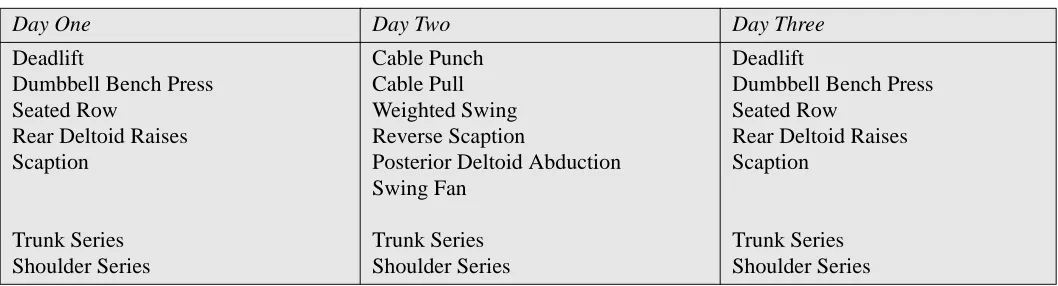
Table 3 Weekly schedule of workouts for Introductory Cycle.
Day One Day Two Day Three
Deadlift
Dumbbell Bench Press Seated Row
Rear Deltoid Raises Scaption
Trunk Series Shoulder Series
Cable Punch Cable Pull Weighted Swing Reverse Scaption
Posterior Deltoid Abduction Swing Fan
Trunk Series Shoulder Series
Deadlift
Dumbbell Bench Press Seated Row
Rear Deltoid Raises Scaption
one arm exercises should be performed bilaterally. The golfer-athlete should perform 2–3 sets of 10–12 repeti-tions of each exercise. A rest between sets of 1–2 minutes should occur. Golfers should attempt to mimic the weight shift that occurs during the golf swing and focus on prop-er golf form whprop-ere applicable. Table 3 details the exprop-ercis- exercis-es performed each day of the week. Table 4 dexercis-escribexercis-es the
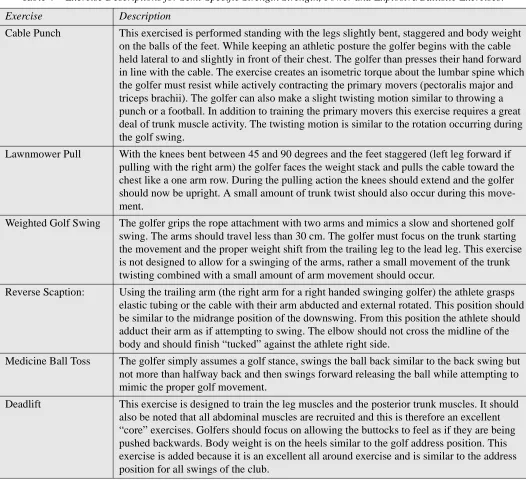
non-traditional semi-specific resistance exercises and Figures 10–18 illustrates some of the exercises.
Cycle Two: Strength and Power Development
In Cycle two the golfer-athlete aims to improve their power and strength production. In this stage the athlete will train three days per week. Each day will either be
de-Table 4 Exercise Descriptions for Semi-Specific Strength Strength, Power and Explosive/Ballistic Exercises.
Exercise Description
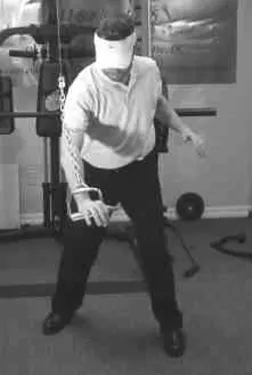
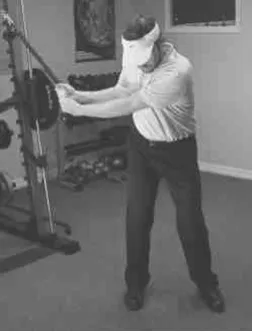
Cable Punch This exercised is performed standing with the legs slightly bent, staggered and body weight on the balls of the feet. While keeping an athletic posture the golfer begins with the cable held lateral to and slightly in front of their chest. The golfer than presses their hand forward in line with the cable. The exercise creates an isometric torque about the lumbar spine which the golfer must resist while actively contracting the primary movers (pectoralis major and triceps brachii). The golfer can also make a slight twisting motion similar to throwing a punch or a football. In addition to training the primary movers this exercise requires a great deal of trunk muscle activity. The twisting motion is similar to the rotation occurring during the golf swing.
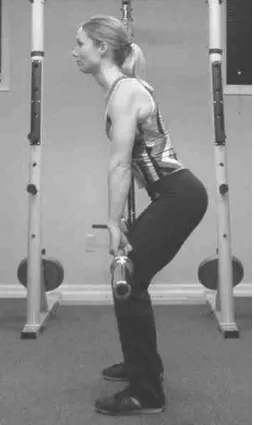
Lawnmower Pull With the knees bent between 45 and 90 degrees and the feet staggered (left leg forward if pulling with the right arm) the golfer faces the weight stack and pulls the cable toward the chest like a one arm row. During the pulling action the knees should extend and the golfer should now be upright. A small amount of trunk twist should also occur during this move-ment.
Weighted Golf Swing The golfer grips the rope attachment with two arms and mimics a slow and shortened golf swing. The arms should travel less than 30 cm. The golfer must focus on the trunk starting the movement and the proper weight shift from the trailing leg to the lead leg. This exercise is not designed to allow for a swinging of the arms, rather a small movement of the trunk twisting combined with a small amount of arm movement should occur.
Reverse Scaption: Using the trailing arm (the right arm for a right handed swinging golfer) the athlete grasps elastic tubing or the cable with their arm abducted and external rotated. This position should be similar to the midrange position of the downswing. From this position the athlete should adduct their arm as if attempting to swing. The elbow should not cross the midline of the body and should finish “tucked” against the athlete right side.
Medicine Ball Toss The golfer simply assumes a golf stance, swings the ball back similar to the back swing but not more than halfway back and then swings forward releasing the ball while attempting to mimic the proper golf movement.
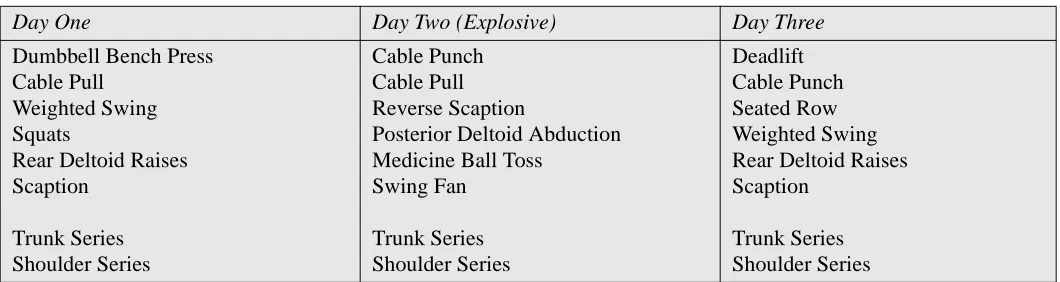
voted to strength and hypertrophy development (a “light” day 10–12 repetitions/set), power development using ex-plosive exercises and light loads (30–60% max) and pow-er development using “heavy” loads and an intention to maximally accelerate the weight (less than 6 repetitions/ set). Simply, there is a light day, an explosive day and a heavy day. Power, strength and hypertrophy is desirable for all muscles and all exercises, however; different exer-cises are performed on day 1 and day 3 meaning some exercises are subjected to different loading parameters. To rectify this imbalance the golfer athlete must rotate which exercises are performed on light days and which are performed on heavy days. This is done using a micro-cycle of two weeks duration. The first week requires that
day one be the “light day” and day three be the “heavy day”. This should be reversed for week two in the micro-cycle; day one using heavy loads and day three using lighter weights. Table 5 outlines the two week micro cy-cle for Cycy-cle Two.
For both the explosive training and the high force day the rest time between sets should increase to 3 minutes. The concentric portion of the exercises should occur as rapidly as possible however, the eccentric portion should not be violently fast. The typical backswing is not fast, therefore, for safety, the eccentric portion should be slightly slower than their backswing. Immediately fol-lowing the eccentric portion the athlete should rapidly contract concentrically, maintaining proper golf form for
Figure 10 Start of Cable Punch.
Figure 12 Lawnmower Pull start.
Figure 13 Lawnmower Pull finish.
Table 5 Two week micro cycle for Cycle Two.
Day One Day Two (Explosive) Day Three
Dumbbell Bench Press Cable Pull
Weighted Swing Squats
Rear Deltoid Raises Scaption
Trunk Series Shoulder Series
Cable Punch Cable Pull Reverse Scaption
Posterior Deltoid Abduction Medicine Ball Toss
Swing Fan
Trunk Series Shoulder Series
Deadlift Cable Punch Seated Row Weighted Swing Rear Deltoid Raises Scaption
Trunk Series Shoulder Series
the golf semi-specific exercises. During explosive train-ing the weight should be heavy enough that it is not ac-celerated so rapidly as to exceed the force of gravity to the extent that the cable becomes slack. If the Chiroprac-tor wishes to incorporate higher velocity movements then elastic tubing can be used. The deadlift should be exclud-ed from the power exercises. It should be performexclud-ed in the same manner as described in the exercise description section. If the chiropractor has sufficient training in strength training then the deadlift can be replaced with the Power Clean or Snatch if the athlete wishes to train this movement for power.
Cycle Three: Undulating Periodization Phase (Hypertrophy, Strength, Power, Speed)
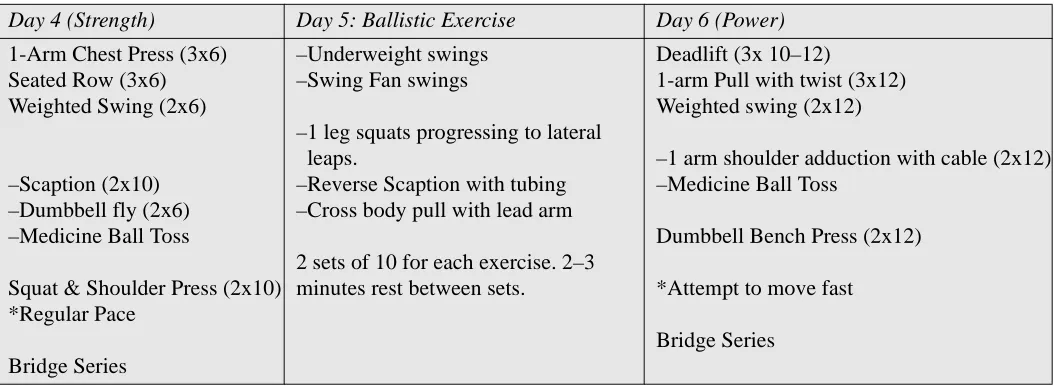
The program presented here is a 14 day cycle, consisting of 3 different routines for week 1 and 3 different routines for week 2. Strength, hypertrophy, power, ballistic speed and balance are being maintained and developed over the course of the 14 day cycle. This phase incorporates more high speed training where the golfer athlete uses elastic tubing rather than cable or free weights on the ballistic training days. Additionally, a SwingFan is incorporated into this day of training. The swing fan is a golf club with fins attached to the end which provides air resistance through out the swing. This allows the golfer to swing at high velocities against a resistance greater than what is provided by a club. Table 6 and 7 outlines week 1 and 2 of this phase.
Figure 16 Reverse Scaption. Figure 17 Medicine Ball Toss.
Table 6 Week one of undulating periodization.
Day 1 (Hypertrophy) Day 2: Ballistic Exercise Day 3 (Power)
1-Arm Chest Press (3x10) Seated Row (3x10) Weighted Swing (2x10)
Scaption (2x10)
Medicine ball toss (2x10)
Squat & Shoulder Press (2x10) Bridge Series
*regular pace
–Underweight swings –Swing Fan swings
–1 leg squats progressing to lateral leaps.
–Reverse Scaption with tubing –Cross body pull with lead arm
2 sets of 10 for each exercise. 2–3 minutes rest between sets.
Bridge Series
Deadlift (3x6)
1-arm Pull with twist (3x6) Reverse Scaption (2x6)
1 arm shoulder adduction with cable (2x6) Medicine ball toss (2x10)
Dumbbell Bench Press (2x6)
Bridge Series
Flexibility Training for Injury Prevention and Golf Performance
This is a complicated and much debated issue exacerbat-ed by a lack of research investigating the influence of stretching on injury prevention in golf and performance improvement of the golf swing. While little research ex-ists to suggest that increasing flexibility decreases the in-jury risk in some sporting events, no research has investigated whether stretching can decrease the injury
risk during golf. The greatest drawbacks to a stretching program are that stretching prior to performance may de-crease force production,31,32 stretching may have no
inju-ry preventative effects33,34,35 and specific stretches,
specifically, lumbar flexion, extension and rotation may load the spinal tissues to such an extent that injury may be more likely to occur.36,8 An argument in favour of
stretching suggests that a certain degree of range of mo-tion and flexibility is required to perform the golf swing, stretching has anecdotal support from many injury treat-ment and strength professionals, there is no epidemiolog-ical evidence suggesting that stretching increases the risk of injury and that stretching may be relatively safe com-pared with the biomechanical demands of the golf swing, considering that range of motion during stretches are more controlled than the ballistic range of motion which occurs during the actual performance of a golf swing.
The aim of a flexibility program is to increase active range of motion and ultimately increase performance. Unfortunately, the relationship between range of motion and golf performance is unknown. While stretching has been shown to increase range of motion via an increase in stretch tolerance,37 it is unknown whether increases in
ROM results in increased clubhead speed. Anecdotally, limited ranges of motion may be associated with a de-crease in clubhead speed due to the dede-creased size of the swing arc and time to produce clubhead speed. Since stat-ic stretching decreases the muscles ability to generate force immediately after a stretching protocol31,32 a
cau-tious recommendation for stretching would be to include golf specific stretching after a workout.
A preliminary recommendation for the incorporation of stretching exercises into a conditioning program may be based on a least harm assumption and clinical wis-dom. Stretches which do not actively mimic the neces-sary golf movement and may result in higher than acceptable tissue loads should be avoided, i.e. forward spinal bend and extension stretches. Stretches designed to increase range of motion that appear relatively innocuous (upper and lower limb stretches while maintaining a neu-tral spine angle) and those stretches that mimic the golf swing (trunk and hip rotation) should be advocated. Fur-ther support for advocating a trunk twisting stretch that may improve shoulder and hip turn during the back swing is seen in a case study where the rotational range of mo-tion of the trunk during the golf swing exceeds that of the
passive range of motion during a trunk twist suggesting the golf swing is a greater risk than the stretch itself in terms of passive tissue strain.38 If stretches are
rec-ommended by the Chiropractor then they should be performed after the strength training session or as an in-dividual session. Athletes are encouraged to warm up rather than stretch before golfing or working out.
Conclusion
This conditioning program aims to prevent injury and im-prove force and power generation during the golf swing to ultimately improve club head speed. The strength training program is designed under the assumption that the exercises are similar to the movements of the golf swing; therefore, greater strength and power gains will be transferred to the swing when compared with traditional strength exercises. It must be stressed that the exercises recommended are not the only possible exercises that may benefit a golfer. The Chiropractor is left to their indi-vidual discretion in choosing exercises but may still ben-efit from the inclusion criteria detailed in this program.
References
1 Watkins RG, Uppal GS, Perry J, Pink M, Dinsay JM. Dynamic electromyographic analysis of trunk musculature in professional golfers. Am J Sp Med 1996; 24(4):
535–538.
2 Panjabi MM. Clinical spinal instability and low back pain. J Electromyogr Kinesiol. 2003; Aug; 13(4):371–379.
3 McGill SM, Grenier S, Kavcic N, Cholewicki J. Coordination of muscle activity to assure stability of the lumbar spine. J Electromyogr Kinesiol 2003; Aug; 13(4):353–359.
4 Cholewicki J, VanVliet JJ. 4th Relative contribution of trunk muscles to the stability of the lumbar spine during isometric exertions Clin Biomech (Bristol, Avon).2002; Feb; 17(2):99–105.
5 Rissanen A, Heliovaara M, Alaranta H, Taimela S, Malkia E, Knekt P, Reunanen A, Aromaa A. Does good trunk extensor performance protect against back-related work disability? J Rehabil Med. 2002; Mar; 34(2):62–66. 6 McGill S, Grenier S, Bluhm M, Preuss R, Brown S, Russell
C. Previous history of LBP with work loss is related to lingering deficits in biomechanical, physiological, personal, psychosocial and motor control characteristics. Ergonomics 2003; Jun 10; 46(7):731–746.
7 Axler CT, McGill SM. Low back loads over a variety of abdominal exercises: searching for the safest abdominal challenge. Med Sci Sports Exerc.1997; Jun; 29(6):804– 811.
8 McGill SM. Distribution of tissue loads in the low back during a variety of daily and rehabilitation tasks. J Rehabil Res Dev. 1997; Oct; 34(4):448–458.
9 Kibler WB. The role of the scapula in athletic shoulder function. Am J Sports Med.1998; Mar–Apr; 26(2): 325–337.
10 Burkhart SS, Morgan CD, Kibler WB. The disabled throwing shoulder: spectrum of pathology Part III: The SICK scapula, scapular dyskinesis, the kinetic chain, and rehabilitation. Arthroscopy 2003; Jul–Aug; 19(6):641–661. Table 7 Week two of undulating periodization.
Day 4 (Strength) Day 5: Ballistic Exercise Day 6 (Power)
1-Arm Chest Press (3x6) Seated Row (3x6) Weighted Swing (2x6)
–Scaption (2x10) –Dumbbell fly (2x6) –Medicine Ball Toss
Squat & Shoulder Press (2x10) *Regular Pace
Bridge Series
–Underweight swings –Swing Fan swings
–1 leg squats progressing to lateral leaps.
–Reverse Scaption with tubing –Cross body pull with lead arm
2 sets of 10 for each exercise. 2–3 minutes rest between sets.
Deadlift (3x 10–12)
1-arm Pull with twist (3x12) Weighted swing (2x12)
–1 arm shoulder adduction with cable (2x12) –Medicine Ball Toss
Dumbbell Bench Press (2x12)
*Attempt to move fast
swimmers with subacromial impingement. Int J Sports Med. 1997; Nov; 18(8):618–624.
12 Cools AM, Witvrouw EE, Declercq GA, Danneels LA, Cambier DC. Scapular muscle recruitment patterns: trapezius muscle latency with and without impingement symptoms. Am J Sports Med. 2003; Jul–Aug; 31(4): 542–549.
13 Rubin BD, Kibler WB. Fundamental principles of shoulder rehabilitation: conservative to postoperative management. Arthroscopy. 2002; Nov–Dec; 18(9 Suppl 2):29–39. 14 Cools AM, Witvrouw EE, Declercq GA, Vanderstraeten
GG, Cambier DC. Evaluation of isokinetic force
production and associated muscle activity in the scapular rotators during a protraction-retraction movement in overhead athletes with impingement symptoms. Br J Sports Med. 2004; Feb; 38(1):64–68.
15 Ludewig PM, Cook TM. Alterations in shoulder kinematics and associated muscle activity in people with symptoms of shoulder impingement Phys Ther. 2000; Mar; 80(3):276–291.
16 Solem-Bertoft E, Thuomas KA, Westerberg CE. The influence of scapular retraction and protraction on the width of the subacromial space. An MRI study. Clin Orthop. 1999; Nov; (296):99–103.
17 Decker MJ, Tokish JM, Ellis HB, Torry MR, Hawkins RJ. Subscapularis muscle activity during selected rehabilitation exercises. Am J Sports Med.2003; Jan–Feb; 31(1):
126–134.
18 Pink M, Jobe FW, Perry J. Electromyographic analysis of the shoulder during the golf swing. Am J Sports Med 1990; Mar–Apr; 18(2):137–140.
19 Kebaetse M, McClure P, Pratt NA. Thoracic position effect on shoulder range of motion, strength, and
three-dimensional scapular kinematics. Arch Phys Med Rehabil 1999; Aug; 80(8):945–950.
20 Finley MA, Lee RY. Effect of sitting posture on 3-dimensional scapular kinematics measured by skin-mounted electromagnetic tracking sensors. Arch Phys Med Rehabil 2003; Apr; 84(4):563–568.
21 Kraemer WJ, Adams K, Cafarelli E, Dudley GA, Dooly C, Feigenbaum MS, Fleck SJ, Franklin B, Fry AC, Hoffman JR, Newton RU, Potteiger J, Stone MH, Ratamess NA, Triplett-McBride T; American College of Sports Medicine. American College of Sports Medicine position stand. Progression models in resistance training for healthy adults. Med Sci Sports Exerc. 2002 Feb; 34(2):364–380. Review.
22 Morrissey MC, Harman EA, Johnson MJ. Resistance training modes: specificity and effectiveness. Med Sci Sports Exerc 1995; May; 27(5):648–660.
23 Behm DG and Sale DG. Velocity specificity of resistance training. Sports Med. 1993; Jun; 15(6):374–388. Review. 24 Kraemer WJ, Ratamess NA. Fundamentals of resistance training: progression and exercise prescription Med Sci Sports Exerc. 2004; Apr; 36(4):674–688. Review.
2004; Aug; 18(3):675–684. Review
26 Cronin JB, McNair PJ, Marshall RN Is velocity-specific strength training important in improving functional performance? J Sports Med Phys Fitness. 2002 Sep; 42(3):267–273.
27 Blazevich AJ, Jenkins DG Effect of the movement speed of resistance training exercises on sprint and strength performance in concurrently training elite junior sprinters. J Sports Sci. 2002; Dec; 20(12):981–990.
28 Fletcher IM and Hartwell M. Effect of an 8-week combined weights and plyometrics training program on golf drive performance. J Strength Cond Res. 2004; Feb; 18(1): 59–62.
29 Marras WS, Lavender SA, Leurgans SE, Fathallah FA, Ferguson SA, Allread WG, Rajulu SL. Biomechanical risk factors for occupationally related low back disorders. Ergonomics. 1995; Feb; 38(2):377–410.
30 Marx JO, Ratamess NA, Nindl BC, Gotshalk LA, Volek JS, Dohi K, Bush JA, Gomez AL, Mazzetti SA, Fleck SJ, Hakkinen K, Newton RU, Kraemer WJ. Low-volume circuit versus high-volume periodized resistance training in women. Med Sci Sports Exerc. 2001; Apr; 33(4):635–643. 31 Young WB, Behm DG. Effects of running, static stretching
and practice jumps on explosive force production and jumping performance. J Sports Med Phys Fitness.2003; Mar; 43(1):21–27.
32 Church JB, Wiggins MS, Moode FM, Crist R. Effect of warm-up and flexibility treatments on vertical jump performance. J Strength Cond Res. 2001; Aug; 15(3): 332–336.
33 Herbert RD, Gabriel M. Effects of stretching before and after exercising on muscle soreness and risk of injury: systematic review. BMJ 2002; Aug 31; 325(7362):468. 34 Shrier I. Stretching before exercise does not reduce the risk
of local muscle injury: a critical review of the clinical and basic science literature. Clin J Sport Med 1999; Oct; 9(4):221–227.
35 Weldon SM, Hill RH. The efficacy of stretching for prevention of exercise-related injury: a systematic review of the literature. Man Ther 2003; Aug; 8(3):141–150. 36 McGill SM The biomechanics of low back injury:
implications on current practice in industry and the clinic. J Biomech 1997; May; 30(5):465–475. Review.
37 Halbertsma JP, van Bolhuis AI, Goeken LN. Sport stretching: effect on passive muscle stiffness of short hamstrings. Arch Phys Med Rehabil 1996; Jul; 77(7): 688–692.