http://www.sciencepublishinggroup.com/j/ss doi: 10.11648/j.ss.20190806.14
ISSN: 2326-9863 (Print); ISSN: 2326-988X (Online)
The Construction and Empirical Study of the Maker Space
Input-Output Model Under the Perspective of Resource
Sharing
Lv Bo, Yang Jing, Gu Qiaoling, Qi Meiru
Business School, Beijing Wuzi University, Beijing, China
Email address:
To cite this article:
Lv Bo, Yang Jing, Gu Qiaoling, Qi Meiru. The Construction and Empirical Study of the Maker Space Input-Output Model Under the Perspective of Resource Sharing. Social Sciences. Vol. 8, No. 6, 2019, pp. 322-332. doi: 10.11648/j.ss.20190806.14
Received: November 3, 2019; Accepted: November 21, 2019; Published: December 3, 2019
Abstract:
Maker space is a shared network platform that brings together many social entities to innovate and start businesses. It has new features such as openness, resource sharing, and social subject diversity. The traditional methods of input factors measured by the organization’s original human, financial, material, research and development are no longer suitable for the development of today's era and economic application. Input-output model needs to be redefined and re-explored. This paper defines the diversified social subject structure of maker space under the perspective of resource sharing. According to the measurability standard of input variables, crowd-sourcing, public support, crowds, crowd-funding, and public research are used as new input variables. A nonlinear input-output model embodying the characteristics of resource sharing is constructed, and through the method of empirical analysis, the output effect of the new input variables is empirically studied. In order to improve the output of the maker space, this paper formulates the input-output path diagram in the field of resource sharing based on the output effect coefficient, and proposes countermeasures and suggestions for how to effectively invest in the innovative space, start up business, policies and public research. The input-output graph of this paper can better reflect the characteristics of the space, and the method is also applicable to other fields of empirical analysis.Keywords:
Maker Space, Social Subject, Input Factor, Effect, Resource Sharing1. Introduction
The report of the 19th National Congress of the Communist Party of China proposes: Encourage more social entities to participate in innovation and entrepreneurship. Social subjects include political organizations (governments), economic organizations (enterprises), and social organizations. [1] Maker space is a shared network platform that brings together many social entities to innovate and start businesses. Since the “mass innovation, the public entrepreneurship” officially proposed and implemented as a national strategy, the maker space has shown a momentum of development. In terms of quantity, the maker space has surpassed the incubator to become an important carrier of innovation and entrepreneurship. According to the National Science and Technology Work Conference, there are 4,298 people in the current national Torch Program, and according to the Torch Statistical Yearbook, there are 863 national-level
incubators in the country. In terms of speed of development, maker space has developed in an over speed manner in recent years. Taking Beijing as an example, the total operating area, number of employees, and settled enterprises have increased by 310%, 320%, and 235% year-on-year. [2]
maker space is the product after the development stage of private garage space, interest club space, innovative laboratory space, etc. Open sharing is the common feature of this kind of space, that is, sharing office space for ideological exchange collision and achieve creative sharing through creative resources sharing. [3, 4]
In view of the fact that maker space has become an important carrier for the country to implement the innovation-driven strategy, foster new development momentum, and promote supply-side structural reforms, thus it is of great significance to study the input and output of the maker space. The innovation of this paper lies in: First, variable construction innovation. According to how to define the social subject under the shared conditions, the input variables are constructed in combination with the characteristics of the “public” characters in the maker space, while the previous input-output indicator system is divided by the perspective of organization’s own human, financial and material. The second is research method innovation. Under the background of “Internet+”, the complexity of the shared space resource sharing network is increased, and the relationship between the various elements presents a nonlinear relationship. For this reason, the research method of the paper will be based on the resource sharing network to study and construct a nonlinear programming model, and to change previous linear programming model methods such as Data Envelopment Analysis (DEA).
2. Literature Review
With the rapid development of domestic and foreign-like maker space, it is accompanied by a research boom in the academic space. The related research on the creation space in China and abroad is mainly divided into the following categories:
The first is the study of network relationship characteristics. Wang Liping (2017) believes that maker space is a space limitation that breaks through the resource organization, and promotes the optimal allocation of the creative elements mobility through the “four crowd” integration. The “four crowd” are maker space, crowd-sourcing, crowd-funding and crowd-supporting. [5] Zhang Shaoli et al. (2017) believe that colleges and universities maker space through organizing “crowd-constructing”, project “crowd-sourcing”, capital “crowd-funding”, and resources “shared”, through college automation, government promotion, and industry pull to achieve operations. [6] Zhang Yuli et al. (2017) analyze the operation mechanism of Haier maker space, and proposed that it consists of maker incubation, resource aggregation, user interaction and value exchange, which reflects the unique characteristics of maker space. [7]
The second is index research. The classification of index for science parks and incubators can be used for reference. Bigliardi (2006) proposes to evaluate the performance of science parks in four dimensions: economics, finance, human resources and networks. [8] Schwartz (2008) shows that the German incubator leases an average of 5,964
square meters, with an average infrastructure space of 900 square meters, with an average of 33 start-ups, and each start-up employs an average of seven people. [9] Michael (2011) conducts long-term performance data studies on 324 independent graduates who graduate from five incubators in Germany and find that these companies show rapid growth after graduation, but average performance after 7 years compared with graduation. The level is the same or even weaker. The contribution of graduated enterprises to regional employment is quite limited in the long run. [10] Barbero (2012) evaluates performance from five dimensions: research input, research output, employment cost, participation in research projects, and corporate growth. [11] Wann (2017) has set up eight key performance indicators (KPI), three of which relate to the establishment and operation aspects, and five of which are functional and service aspects. [12] The research on index of maker space includes: Chen Su et al. (2015) believe that maker space is a space for incubation technology innovation, business creativity and promotion of entrepreneurship. Its performance evaluation can learn from the evaluation method of incubator. The entrepreneurial ecosystem of maker space consists of four aspects: the spirit of innovation, the creation of the circle, the basic platform, the policy of creation, and the resource circle. These evaluations can be considered from these four aspects. [13] Wen Meirong et al. (2017) believe that the KPI indicators of maker space are divided into seven categories: entrepreneurship financing, gather of innovative entrepreneurs, entrepreneurship education training and activities, entrepreneurial growth services, entrepreneurial tutors, business coaching, and technical innovation services. [14] Li Yanping et al. (2017) believe that the influencing factors of inter-regional development and cooperation synergy, the influencing factors of integrating resources and constructing professional management teams, and the influencing factors of internal network and external social network structure, etc. Still not clear. [15] Jia Tianming et al. (2017) believe that the revenue channels of maker space include venue rent, member income, service income (including coffee and other food, supporting facilities, shared venue fees, professional services), investment income (including angel investment)., venture capital and equity investment), self-designed capital operation income (including self-designed special activity funds, self-designed investment funds, etc.). [16]
the structural equation method to measure, and conclude that economic status, regional innovation, government expenditure, and intellectual support have an impact on the technical effects of the incubator. Zhang Yuli (2017) studies the evolution and optimization of the maker space based on the theory of dissipative theory, analyzes the entrepreneurial ecosystem and the dissipative structure, and proposes two-stage evolution model of the entrepreneurial ecosystem and self-organization level, but needs to be further completed empirical analysis. Yin Qun et al. (2010), Dai Bibo et al. (2012), Yang Wenzhao et al. (2017), Zhang Jianqing et al. (2017) use the data envelopment analysis (DEA) when calculating the operation effect of the incubator. Sun Kai et al. (2013) improve the method and propose an improved DEA method, but it is still based on the DEA method.
In summary, this paper believes that for the research on the social subject, input and output of the maker space. First, the new research entry points of different scholars combine the characteristics of the maker space, and start from the word of “crowd”. This article will also highlight the word of “crowd”, based on shared resources from the perspective of crowds, crowd-sourcing, crowd-funding, and public support. Second, the selection of quantitative index can refer to the relevant research results of the technology incubator. Third, in terms of quantitative methods, the DEA method is the most commonly used quantitative research method in current related research. Since its basic principle is to express the input with x=(x1, x2,...
xm), the output uses y= (y1, y2,... yn), and then use the linear
programming model to find the optimal solution, but the drawback of this method is that the linear solution method is beneficial to the calculation, but in the context of “Internet +”, the relationship between input and output should be a non-linear relationship. Setting the hypothesis as a linear relationship is not realistic, and its logic has problems. This method can only find the relative output effect of multiple target objects, but cannot find the output effect of a single target object.
3. Model Construction and Assumptions
3.1. Model Construction
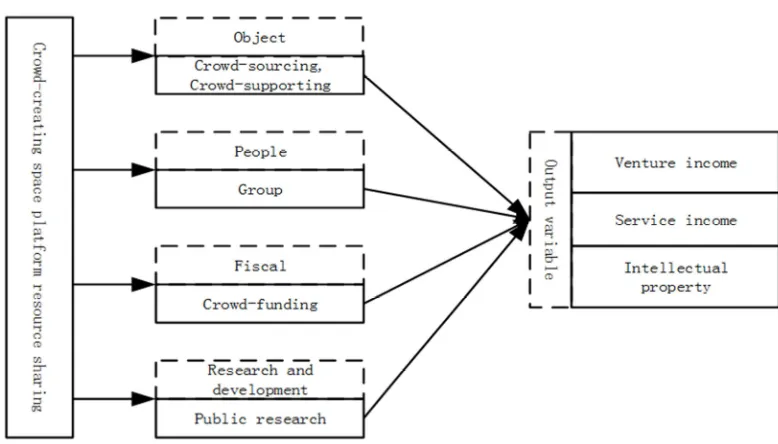
According to the social subject network relationship of the maker space based on resource sharing, the “Internet +” and sharing economy make the maker space have the characteristics of borderless and open sharing. Changes in social subject have changed the traditional mode of co-construction. People and wealth are no longer confined to the same one organization, they can be shared, and the path of research and development innovation has also undergone fundamental changes. The input variables need to be redefined. This paper believes that from the input-output
perspective, the attributes of input variables of maker space have not changed, and still can be classified according to things, people, finance, and research and development, and the new input variables can be matched with one-to-one.
From the perspective of things, resource openness and space collaboration enable start-ups to break through the limitations of traditional internal space, sharing the use of various open factories, workshops, laboratories, 3D printing facilities, and various external support forces. The fundamentals of innovation have changed radically, forming a situation of crowd-sourcing and crowd-supporting. Due to the openness of resources, this article replaces the above-mentioned “input amount C of the object” with “resources”, which is represented by the word “Sources”, and mainly includes variables such as crowd-sourcing and public support. [15]
From human perspective, social subjects have changed. Global innovators, creators, entrepreneurs, including designers, makers, users, and business owners can all be diversified social subjects in the context of the Internet and create services and products that can meet new needs. The factors related to “maker” in the maker space have surpassed the traditional category of internal employees. Because the innovation group forms “Maker Space” situation, this article replaces the above-mentioned “human input volume--code L” with “crowd group” and uses the word “crowd”. [19]
From the perspective of wealth, “Internet +” has changed the financial support conditions, and new financing methods such as crowd-funding, venture capital funds, financing guarantees, and financial leasing have been widely used, and the threshold for entrepreneurial financing has been greatly reduced. Due to the change of financing conditions, then informs “crowd-funding” situation. This article replaces the
above-mentioned “finance input--code M” with
“crowd-funding” in a broad sense, and uses the word “funds”. From the perspective of research and development innovation, researchers from external universities, research institutes and intermediaries are integrated into the research of entrepreneurs on the shared platform, participating in research and development or transfer of scientific research results, serving entrepreneurs and forming a “public research” situation, expressed by the word “RD”.
Figure 1. Input-output model based on resource sharing.
Output refers to the benefit of social entities using input resources, usually expressed by the ratio of input to output or cost-benefit ratio. The optimal output refers to the best state of input and output of the social entity. [20]
The output effect is expressed by OE, the input resource is represented by Input, and output benefit is represented by Output. According to the relationship of output effect, the input variable X is made by the object, the person and the wealth, and the output effect OE=eλ
, and then based on the Cobb-Douglas function formula: [21, 22]
Y e C L M RD e (1)
Where Y is the output variable; C is the input of the object, such as fixed assets; L is the labor input of the person, such as the number of employees; M is the input of the financial, such as cost; RD is the input of research and development, such as research and development cost of enterprise.
Substituting each new variable of the created space in the table into the formula (1), can gives:
Y e Sources Crowd Funds RD e (2)
For ease of calculation, take the ln value on both sides to get the new formula:
lnY λ α lnSources β lnCrowd γ lnFunds Φ lnRD ε (3)
Among them is the output variable of the maker space; i means the individual; Sources stands for crowd-sourcing, crowd-supporting, that is the material condition for the support and guarantee of the maker space under the open resources; Crowd stands for crowd, that is, the pluralistic social subject; Funds on behalf of crowd-funding, it refers to the channels for providing funds for crowd-funding and venture capital; RD still represents the public research; λ is the output effect coefficient; α, β, γ respectively are the output
effect coefficient of Sources, Crowd, Funds, RD; ε indicates random error. By comparing the output effect coefficient λi,
we can judge the output difference of the common space; and study the random error influence by εi.
3.2. Variable Selection
government subsidies, public research and development investment, total venture capital of start-ups, and space of
maker. The income and the number of intellectual property rights are measured as output indicators. As shown in Table 1.
Table 1. Variable table.
Variable Category Dimensionality Index Description Code
Input variables
Sources
Crowd-sourcing Numberofpartners Number of partners supporting X1
Crowd-supporting
Area of operation Actual available operating area X2
Number ofactivities Number of large-scale events such as training and
roadshows X3
Crowd Crowd group Number of employees Number of employees in start-ups X4
Number of servicing The number of people working in the maker space X5
Funds Crowd-funding
Venture financing Start-up financing X6
Service investment The input of the maker space X7
government subsidy Various government subsidies X8
R&D Public research Research input Research and development investment amount X9
Output variables
Start-up company Total income of start-up Total income of start-ups Y1
Maker space Total income of operation Total income of maker space Y2
Knowledge output Intellectual property Invention patents and software copyrights, etc. Y3
3.3. Relevance Hypothesis
According to Table 1, the general assumptions are as follows:
Let Yi={Y1, Y2, Y3};Xi={X1, X2, X3, X4, X5, X6, X7,
X8, X9}, Yi and Xi have correlation, that is, maker space
operation income Y2, the number of intellectual property
maker space Y3, and the number of input variable
crowd-sourcing partners X1, the area of business public
support X2, the number of activities public support X3, the
number of crowd groups’ employees X4, the number of people
crowd service X5, public entrepreneurship financing X6,
crowd-funding service input X7, crowd-funding government
subsidy X8, public research and development investment X9
have nonlinear correlation.
4. Empirical Analysis
4.1. Data Collection and Statistics
This paper selects Beijing, the largest and fastest growing area in China, as the sampling area. As of 2017, Beijing has a total of 424 maker space, [26] including 125 nationally-created space and 141 “Beijing Maker Space”. According to the variable index system design questionnaire, according to the accessibility of the address, 350
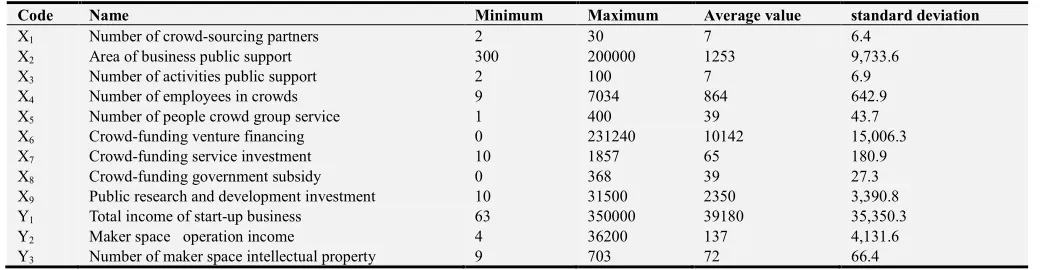
questionnaires were issued mainly through the issuance of questionnaires, and 313 valid questionnaires were collected. Excluding the actual output is 0 or there are obvious contradictions. The actual effective questionnaires are 301. According to the statistical results, of these 301 maker space, the number of average crowd-sourcing partners is 7, the average public support area is 1,260 square meters, the average number of public activities is 7 times, the average number of employees in the incubator reaches 864, the average number of service personnel of maker space is 39. The total amount of crowd-funding venture financing for each of the maker spaceis 101.42 million RMB, and the average service input of maker space is 650,000 RMB. The governments at all levels create an average of 390,000 RMB for each group. The average total revenue of start-up enterprises in each maker spacewas 391.8 million RMB, The average income of maker space operation is 1.37 million RMB, and the average number of intellectual property rights of maker space is 72.
From the distribution situation, each original variable conforms to the normal distribution law; Since the standard variable has a wide range of values, the standard deviation fluctuates greatly, so it should be normalized in the regression analysis of the output effect coefficient.
Table 2. Raw variable description statistics table.
Code Name Minimum Maximum Average value standard deviation
X1 Number of crowd-sourcing partners 2 30 7 6.4
X2 Area of business public support 300 200000 1253 9,733.6
X3 Number of activities public support 2 100 7 6.9
X4 Number of employees in crowds 9 7034 864 642.9
X5 Number of people crowd group service 1 400 39 43.7
X6 Crowd-funding venture financing 0 231240 10142 15,006.3
X7 Crowd-funding service investment 10 1857 65 180.9
X8 Crowd-funding government subsidy 0 368 39 27.3
X9 Public research and development investment 10 31500 2350 3,390.8
Y1 Total income of start-up business 63 350000 39180 35,350.3
Y2 Maker space operation income 4 36200 137 4,131.6
4.2. Regression and Inspection
Y1, Y2, and Y3 are used as dependent variables, and the
database is established with X1~X9 as independent variables.
The reliability test of the database shows that the clone Bach coefficient is 0.946, and the cloned Bach coefficient based on the standardized project is 0.946. Both coefficients are greater
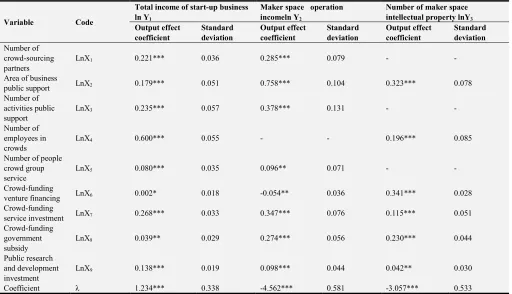
than 0.9, indicating high internal consistency, high data reliability, and regression analysis. Substituting Stata software for regression analysis, the heteroscedasticity test results of all three were Prob=0.0000, all passed the significance test, indicating that there is no heteroscedasticity. The regression results are compiled as shown in Table 3.
Table 3. Regression and test results table.
Variable Code
Total income of start-up business ln Y1
Maker space operation incomeln Y2
Number of maker space intellectual property lnY3
Output effect coefficient
Standard deviation
Output effect coefficient
Standard deviation
Output effect coefficient
Standard deviation
Number of crowd-sourcing partners
LnX1 0.221*** 0.036 0.285*** 0.079 - -
Area of business
public support LnX2 0.179*** 0.051 0.758*** 0.104 0.323*** 0.078
Number of activities public support
LnX3 0.235*** 0.057 0.378*** 0.131 - -
Number of employees in crowds
LnX4 0.600*** 0.055 - - 0.196*** 0.085
Number of people crowd group service
LnX5 0.080*** 0.035 0.096** 0.071 - -
Crowd-funding
venture financing LnX6 0.002* 0.018 -0.054** 0.036 0.341*** 0.028
Crowd-funding
service investment LnX7 0.268*** 0.033 0.347*** 0.076 0.115*** 0.051
Crowd-funding government subsidy
LnX8 0.039** 0.029 0.274*** 0.056 0.230*** 0.044
Public research and development investment
LnX9 0.138*** 0.019 0.098*** 0.044 0.042** 0.030
Coefficient λ 1.234*** 0.338 -4.562*** 0.581 -3.057*** 0.533
Note: ***, **, * indicate the statistical significance level of 1%, 5%, and 10%, respectively.
4.3. Empirical Analysis
4.3.1. Analysis of the Output Effect of Start-ups
The statistically significant results show that the output variable enterprise entrepreneurial total income Y1 has a
correlation with the input variables X1~X9, and the hypothesis is verified. Substituting the regression effect coefficient into the formula (3) gives:
lnY#= 1.234 + 0.221lnX#+ 0.179lnX-+ 0.235lnX/+ 0.6lnX1+ 0.08lnX3+ 0.002lnX4+ 0.268lnX5+ 0.039lnX6+ 0.138lnX7+ ε# (4) According to the output effect coefficient in formula (4), it
can be known that:
First, the most influential variable on the total entrepreneurial income Y1 is the number of employees in the
crowded enterprise X4. This shows that for start-ups in the
maker space, human capital is the most important input factor, which also verifies the formulation of “innovation creates the key to people” in the government work report.
Secondly, the number of public assistance activities X3,
crowd-funding service input X7, and the number of
crowd-sourcing partners X1 constitute the main supporting
force of the maker space ecosystem. The number of public assistance activities X3 refers to organizing all kinds of
training, roadshows and financing activities the by maker
space, which has a direct and important effect on the ability of start-ups to increase their ability and increase their income. Crowd-funding service input X7 refers to investing funds to
provide professional services for start-ups, including accounting sharing, intellectual property transformation, talent recruitment, legal affairs consulting, etc., which helps start-ups to reduce the burden on non-core businesses and concentrate on the core business. The number of crowd-sourcing partners X1 refers to important partners
Third, the public support operation area X2, public research
and development investment X9 is essential for the maker
space ecology. Based on the business area of the public support X2, including the open or independent work spaces
provided by the maker space, shared meeting rooms, etc., this is the activity place and carrier of the start-up business, although the operating area under the “Internet +” is no longer the biggest item of expenditure, and virtualized operation does not need to occupy the site in theory, but in reality it still needs to occupy a certain physical business area.
In addition to the traditional R&D investment, the research and development investment X9 refers to the sharing of
scientific research facilities and equipment provided by maker space under the “Internet +”, and the free research condition provided by the open laboratory through the network alliance. The research and development investment X9 contribute to the
total income is not high, mainly because the start-ups are mostly teams or enterprises newly established. They are currently in the R&D investment period, and their contribution to the total revenue of the start-ups has a certain lag period. This situation should be reflected in the future.
Finally, the number of crowd service X5, crowd-funding
government subsidy X8, crowd-funding venture financing
X6 also contributed to the total income of start-ups. The
number of crowd service X5 mainly refers to the service
personnel of maker space. They are mainly providing new entrepreneurial services for start-ups. In theory, it should include comprehensive online and offline services including membership services, information, investment and other resources. Given that the current online service is
in the incubation stage, the output effect coefficient of this variable is still low. Crowd-funding government subsidy X8
refers to the government’s various types of cash subsidies, tax reductions and other policy support, the current main subsidies to the maker space, the proportion of direct subsidies to start-ups is still low. Crowd-funding venture financing X6 refers to the financing provided by venture capitalists and maker space’s own funds. In view of the fact that many start-ups are currently in the investment period, the amount of financing is greater than the amount of income, so its effect on the income of start-ups cannot be fully realized. The output effect coefficient is also relatively low.
4.3.2. Analysis of the Output Effect of the Maker Space
The empirical results show that the variable that has not passed the significant verification is the number of employees in the crowded enterprise lnX4, indicating that the original
hypothesis is not established, that is, the number of employees in the startup is not related to the income of maker space. The main reason is that the operating rental income of maker space is charged according to the practical area of the station or independent office, rather than the number of employees of the startup. Under the condition of shared resource network, employees can have flexible office hours and work in mobility. The number of employees in each startup is very different. The remaining variables are related to maker space operation income lnY2, and the original relevant assumptions are
established. Substituting the regression effect coefficient into equation (3) is available.
lnY-= −4.562 + 0.285lnX#+ 0.758lnX-+ 0.378lnX/+ 0.096lnX3− 0.054lnX4+ 0.347lnX5+ 0.274lnX6+ 0.098lnX7+ ε- (5) From the comparison of the output effect coefficient, we
can see that:
First of all, the most influential variable of maker space operation income lnY2 is the public support area X2,
indicating that rent collection by operating area is the most important income component of maker space.
Second, the number of public assistance activities X3, the
number of crowd-sourcing partners X1, the crowd-funding
service input X7, and the crowd-funding government subsidy
X8 constitute a secondary variable that affects the maker
space’s operating income lnY2. The number of public support
activities X3 refers to the organization of road shows, training
and other activities, to collect a certain amount of fees of renting conference room and servicing, which constitute a source of income for the space. The crowd-sourcing partner number X1 can lead bridge and bring service costs to the space.
The crowd-funding service input X7 refers to the coffee,
catering, printing and other inputs provided by maker space, and also brings service benefits while investing. For the crowd-funding government subsidy X8, the survey sample
statistics found that only 50% of the maker space claimed to enjoy the cash subsidy support, and is limited by the subsidy quota, so there is a certain impact, but the output effect coefficient is not high.
Third, the public research and development investment X9,
the number of crowd service X5 has a certain impact on the
public space operating income lnY2. Public research and
development investment X9 is mainly used by start-ups. Only
a small proportion is converted into maker space revenue through service fees. This small proportion also indicates that maker space does provide a certain amount of service and support for start-ups. It is only the income value of this service converted into value-added services is still very low. The number of crowd service X5 mainly refers to the number of
service people in the maker space. In theory, the larger the number, the greater the income generated, but the contribution to the space revenue of the public is not great, indicating that the professional service level of the maker space needs to be improved. It is not feasible for maker space to increase the income of service personnel. It should improve the ability to generate income through professional services. Finally, the output effect coefficient of crowd-funding venture financing X6 is negative, which means that when this output effect
coefficient is converted into the power value of exp as the base, its value is much less than 1, that is, crowd-funding venture financing X6 The impact of space operation income
lnY2 is small. The reason is that about 50% of maker space is
period, and the value of crowd-funding venture financing X6
is relatively large, which is caused by the large difference in quantity comparison.
4.3.3. Analysis of the Output Effect of Maker Space Intellectual Property
The empirical results show that there is no correlation between the number of maker space intellectual property number lnY3 and the number of crowd-sourcing partner LnX1,
the number of public assistance activity LnX3, and the number
of crowd service LnX5. The three null hypotheses are not
valid. The rest of the variables are tested, and the regression effect coefficient is substituted into the following formula:
lnY/= −3.057 + 0.323lnX-+ 0.196lnX1+ 0.341lnX4+ 0.115lnX5+ 0.230lnX6+ 0.042lnX7+ ε/ (6) The number of intellectual property rights lnY3 is a
measure of intellectual property output. The empirical results of the number of crowd-sourcing partners X1 and its
non-correlation show that the number of crowd-sourcing partners of the startup in the maker space is mainly the financing channel and intelligent platform. Or the relationship between media, parent company, outsourcing service or production cooperation, and universities and scientific research institutions that reflect scientific research cooperation are still few. The number of public assistance activities X3 mainly refers to financing, training, product
promotion and other activities. Due to the large heterogeneity of scientific research in the enterprises that have settled in the maker space, there are still few scientific research activities organized by the collective space. No correlation is shown. The number of crowd service X5 also does not reflect the
correlation, indicating that the services provided by service personnel of maker space are mainly based on non-scientific research services.
By comparing the output effect coefficients of each variable, we can see that:
First of all, crowd-funding venture financing X6, public
support business area X2 has the greatest impact on the
number of intellectual property rights lnY3, indicating that
thelarger the crowd-funding venture financing X6, the more
favorable to increase R & D investment, and more output of intellectual property. At the same time, the larger the business area X2, the more start-up enterprises are settled, it is more
favorable to form a resource sharing network for scientific research, such as Beijing Youke Workshop, which introduces 208 enterprises, 32% of which belong to technological innovation enterprises, 21% are engaged in creative design, 20% are engaged in information technology intelligent hardware, 17% are financial investments, and the remaining 10% are cultural media and financial law consulting companies. These enterprise groups also form a resource sharing network, which is conducive to scientific research
sharing.
Secondly, the crowd-funding government subsidy X8, the
number of employees in the crowded enterprise X4, and the
crowd-funding service input X7 have the second influence on
the number of intellectual property rights lnY3.
Crowd-funding government subsidies X8 have played a
positive role in promoting intellectual property incentives. The number of employees in crowded enterprises X4 is the
main part of scientific research. The more researchers, the greater the number of intellectual property rights. The crowd-funding service input X7 also played a positive role in
promoting the number of intellectual property.
Finally, the research and development investment X9 has an
impact on the number of intellectual property rights lnY3, but
the impact is small. The reason for this result may be that, on the one hand, the output of intellectual property rights has a certain lag. At present, the R&D investment is in the input stage, and the input and output are not proportional; on the other hand, the research and development funding startup invest in the maker space is not high. At present, it is more inclined to invest in direct construction of the platform, product market, promotion and other aspects, which restricts the amount of output of intellectual property. A typical example is the competition of shared bicycles. The billion-dollar financing is mainly used for the construction, manufacturing and market share of intelligent platforms. The competitors mainly reflect the homogenization price competition and not improve the technical content of bicycles. [28]
5. Conclusions
5.1. Result
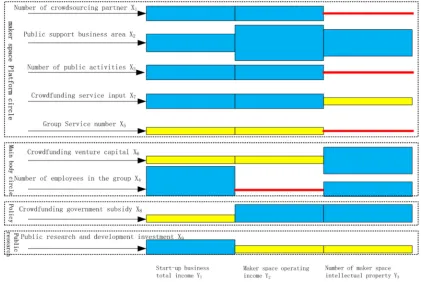
Figure 2. Input-output path diagram based on resource sharing.
5.2. Enlightenment
5.2.1. Enlightenment for the Input of the Collective Platform
According to the path diagram of the joint creation of resources sharing network of maker space, maker space platform should further build an open collaborative partner network, more effectively use open office space or free laboratory resources, and widely organize entrepreneurial salons, entrepreneurial lecture halls, and entrepreneurial training. Entrepreneurship training activities such as camps, road shows, and investments can effectively stimulate income growth. However, at present, the number of crowd-sourcing partners X1 and the number of public assistance activities X3
have no statistical correlation with the number of intellectual property rights Y3, indicating that the number of cooperation
between the crowd-sourcing partners and the scientific research institutions is insufficient, and the activities related to scientific research activities in the public welfare activities also need to be improved. The number of crowd service X5
contributes a low proportion to the revenue of maker space Y2.
Indicating that the current ability of the maker space service personnel to rely on professional services to increase value is weak, and the professional level of the resource sharing network of the maker space platform needs to be improved. In addition, the policies related to the resource sharing network of maker space play an important role in the prosperity and sustainability of the current resource sharing network. The maker space platform circle must not only become the workspace, social space and cyberspace of innovative entrepreneurs, but also become a space for sharing scientific
and technological resources, and also become a platform for innovative entrepreneurship to receive preferential policy funding.
5.2.2. Enlightenment on the Investment in the Start-up Circle
The crowd-funding venture financing X6 contributed more
to the public intellectual property rights Y3, indicating that the
financing target is clear, and the crowd-funding venture financing X6 has effectively promoted the improvement of
core competitiveness. The number of employees in the crowded enterprise X4 has made outstanding contributions to
the total revenue of the start-up enterprise Y1 and the number
of intellectual property rights Y3. It can be seen that “the key
to innovation and creation lies in human beings”, and the role of people as the subject of social entrepreneurship should be fully exerted. The crowd-funding venture financing X6 has a
low contribution to the total revenue of start-up enterprises Y1
and the operating revenue of maker space Y2, and it shows
that for start-ups, most of them are currently in the investment phase, and the total amount of financing is greater than the total income. The output effect has not been reflected.
5.2.3. Implications for Supporting Policy Investment
Crowd-funding government subsidy X8 has a certain
proportion of contribution to maker space operation income Y2 and the number of maker space intellectual property Y3,
but the contribution to the total revenue of the start-up enterprise Y1 is low, explain that the government’s funding
supply of investment, and the re-tax incentives will be greatly reduced by the mature period. [27] At present, resources sharing network of the maker space is in the initial stage, which is the best time to increase policy stimulus. In addition to funding maker space, the government should also formulate support policies for start-ups, such as venue-free rent, tax incentives, financial support, talent introduction, industry transplantation, and cultivation guidance.
In addition, resource sharing network of maker space makes the ecological environment have obvious difference between the startup and the startup team, and the support policies should be treated differently. Most start-ups have low turnover in the early stage of development. They are typical low-profit enterprises. It is recommended to reduce income tax. There is a difference between the financing support policies of the startup team and the start-ups. It is recommended to set up different loan guarantee funds, provide different conditions for the guarantee of business guarantee loans, provide loans with reference to the benchmark interest rate or implement different financial discounts to help the entrepreneurial team survive and startups grow. [28]
5.2.4. Enlightenment from the Research and Development Investment
The contribution of the research and development investment X9 to the public intellectual property number Y3
is not high, and this cautionary conclusion needs to be highly valued. Under the background of “Internet +”, the pattern of technological innovation has changed. The original closed-type innovation model with internal scientific research personnel as the research subject and its own laboratory as the carrier turned to the open innovation model with the industry-university-research network alliance as the main body and the shared laboratory as the carrier and the users to participate extensively. In thiscontext, the speed of research and development is accelerating, and the results of intellectual property rights are easily imitated or copied. As a result, many companies are reluctant to carry out original innovation and research and development, resulting in a low proportion of financing actually invested in research and development, and core intellectual property needs to be improved. In the end, it can only lead to excessive homogenization competition such as price wars and simple imitation. Effectively protecting maker space intellectual property rights in the context of the new economy is the key to the continued prosperity and growth of the space-sharing network.
In short, in the resource sharing network of maker space, the impact of crowd-sourcing, public support, crowd-funding, public research, and crowds on the total revenue of start-ups, the revenue from the maker space, and the number of intellectual property rights are not same. In the view of resource sharing, increasing the number of employees, the number of partners, R&D and service investment will help increase the total revenue of start-ups; Increasing the business area, government subsidies, and number of public assistance
activities will help increase the operating revenue of maker space e. Increasing entrepreneurial financing, business area, government subsidies, etc. are conducive to increasing the maker space intellectual property rights.
Acknowledgements
This article was funded by the Beijing Social Science Fund Key Project “Study on the Mechanism of Excitation, Transmission and Diffusion of Beijing Maker Space Innovation Power Source” (17GLA007).
References
[1] Xiang Chunling. On the role of various social subjects in social management innovation [J]. Journal of the Party School of the Central Committee of the Communist Party of China, 2011, 5: 89-93. (in Chinese)
[2] Beijing Maker Space Alliance, etc. 2016 Beijing Maker Space Blue Book [R]. 2016. (in Chinese)
[3] Chen Dejin. Comparative Analysis and Empirical Enlightenment of Foreign Maker Space Business Models [J]. Science Management Research, 2017, 3:110-113. (in Chinese) [4] Wang Youmei, Ye Aimin. From Hackerspace to Maker Space: functional model and service path based on innovation 2.0 [J]. Research on Audio-Visual Education, 2015, 11: 5-12. (in Chinese)
[5] Wang Liping, Liu Xiaolong. Research on the characteristics and operational mechanism of the integration of “four maker” in the maker space from the perspective of valuemaker space [J]. China Science and Technology Forum, 2017, 3: 110-116. (in Chinese)
[6] Zhang Shaoli, Zheng Xiaoqi. Research on the Construction and Realization Path of College Maker Space [J]. Modern Education Management, 2017, 7: 54-59. (in Chinese) [7] Zhang Yuli, Bai Feng. Research on Spatial Evolution and
Optimization of Maker Space Based on Dissipation Theory [J]. Science and Technology Management, 2017, 1: 22-28. (in Chinese)
[8] Bigliardi B, Dormio A I, Nosella A, et al. Assessing science parks’ performances: Directions from elected Italian case studies [J]. Technovation, 2006, 26 (4):489-505.
[9] Schwartz, M., and C. Hornych. Specialization as strategy for business incubators: An assessment of the Central German Multimedia Center [J]. Technovation, 2008, 28 (7): 436–449. [10] Michael Schwartz. Incubating and illusion? Long-term
incubator firm performance after graduation [J]. Growth and Change, 2011, 42 (4): 491–516.
[11] Barbero J, Casillas J C, Ramos A. Revisiting incubation performance: How incubator typology affects results [J]. Technological Forecasting and Social Change, 2012, 79 (5): 888-902.
[13] Chen Wei, Xiang Liyao, Yu Rongjian. The Maker Space Entrepreneurship Ecosystem: Characteristics, Structure, Mechanism and Strategy——Taking Hangzhou Dream Town as an Example [J]. Business Economics and Management, 2015, 11: 35-48. (in Chinese)
[14] Wen Meirong, Ma Ruoxi. Analysis of the Key Performance Indicator System for Constructing Public Policy Evaluation——Taking X City Trial Implementation of Maker Space Performance Evaluation System as an Example [J]. 2017, 3: 93-99. (in Chinese)
[15] Li Yanping, Chen Wu. Current Status and Prospects of China’s Maker Space Research [J]. China Science and Technology Forum, 2017, 5: 12-18. (in Chinese)
[16] JiaTianming, Lei Lianghai. Research on the Connotation, Type and Profit Model of Maker Space [J]. Contemporary Economic Management, 2017, 6: 13-18. (in Chinese)
[17] Grimaldi R, Grandi A. Business incubators and new venture creation--an assessment of incubating models [J]. Technovation, 2005, 3: 11-12. (in Chinese)
[18] Wang Liping, Liu Xiaolong. Research on the characteristics and operational mechanism of the integration of “four maker” in the maker space from the perspective of value maker space [J]. China Science and Technology Forum, 2017, 3: 109-116. (in Chinese)
[19] Sarkis J. Analysis of the operational efficiency of major airports in the United States [J]. Journal of operations management, 2000, 2: 335-351.
[20] Yang, Chih-Hai, Motohashi Kazuyuki, Chen Jong-Rong. Are new technology-based firms located on science parks really more innovative?--Evidence from Taiwan [J]. Research Policy, 2009, 38 (1): 77-85.
[21] Wu Jianwei, Zhao Chunyan, Nan Shijing. Can State-level Incubators Improve the R&D Efficiency of Technology Enterprises——Based on the Tendency Matching Method Verification [J]. Science and Technology Progress and Countermeasures, 2017, 10: 76-82. (in Chinese)
[22] Zhang Jiao, Yin Qun. Research on the Differences of Operational Efficiency of Business Incubators in China——Based on DEA and Cluster Analysis Methods [J]. Science of Science and Technology Management, 2010, 5: 171-177. (in Chinese)
[23] Yang Wenbiao, Hu Hanhui. Analysis of Operational Efficiency of National Technology Business Incubator Based on DEA [J]. Statistics and Decision Making, 2015, 22: 175-178. (in Chinese) [24] Zhang Daning, Fu Xiaowei, Yi Pingtao. Research on the Development Path of Shenyang Maker Space Industry Cluster——Based on Operational Efficiency Measurement [J]. Journal of Northeastern University (Social Science), 2017, 1: 34-40. (in Chinese)
[25] Liu Zhiyang. Optimizing the Ecological Environment of Innovation and Entrepreneurship--A Survey Report on the Development of Maker Space in China [N]. Guangming Daily, 2016, 12-7, 11 Edition. (in Chinese)
[26] Milton Friedman. Monetary variability: United States and Japan [J]. Journal of Money Credit & Banking, 1983, 15 (3): 339-343.
[27] Yang Lin, Qu Xiaodong. Summary of Research on Maker Space: Connotation Analysis, Theoretical Interpretation and Development Strategy [J]. Journal of Xi’an University of Finance and Economics, 2019, 32 (03): 121-128. (in Chinese) [28] Wu Yi, Jin Xia Ying, Zhang Wenyi. Maker Space: Research