UNIVERSIDAD CARLOS III DE MADRID
TESIS DOCTORAL
A system for the
Detection of Limited Visibility in BGP
Autor: Andra Lutu
Director: Dr. Marcelo Bagnulo Braun, PhD
DEPARTAMENTO DE INGENIER´IA TELEM ´ATICA
TESIS DOCTORAL
A System for the
Detection of Limited Visibility in BGP
Autor: Andra Lutu
Director: Dr. Marcelo Bagnulo Braun, PhD
Firma del tribunal calificador:
Firma:
Presidente:
Vocal:
Secretario:
Calificaci´on:
Acknowledgements
I would firstly like to acknowledge the support of my advisor, Marcelo Bagnulo, to whom I am forever grateful for sharing his knowledge, for his guidance, patience and
trust, from which I am truly fortunate to benefit. In addition, his assistance helped me
obtain an internship at IIJ Innovation Institute and another at the Center for Applied Internet Data Analysis (CAIDA), at the Supercomputer Center, UCSD, which fueled my
desire to continue my work on real-world problems.
I would like to acknowledge the support of Cristel Pelsser from IIJ, whose pragmatic approach to interdomain routing made me challenge and strengthen the research ideas
developed in this thesis. The two-months internship at IIJ and subsequent ongoing
col-laboration resulted in in an important part of this thesis.
I am grateful to Olaf Maennel for his in-depth knowledge of interdomain routing and
refreshing perspective on the research problems that we tackled throughout our lengthy
collaboration.
I would also like to acknowledge the support of my co-authors, Rade Stanojevic and
Jesus Cid-Sueiro. I am sincerely privileged and greatly appreciate their help and useful
comments.
The staff and students at IMDEA Networks Institute, the Telematics Department of
University Carlos III of Madrid and, in particular, the NETCOM research group provided
me with an excellent research environment. I am especially grateful to Alberto Garcia-Martinez, who devoted a significant amount of time to listen, guide and support me. I
would like to also thank Francisco Valera Pintor and Pierre Francois for frequent useful
discussions.
I thank Alberto Dainotti and Amogh Dhamdhere for guiding me during my internship
at CAIDA, for their time, energy and invaluable feedback.
Lastly, I thank my parents, to whom I owe everything. I thank the rest of my family
and all my loved ones for being always there for me in the best and, more importantly, in
the worst of times. I thank all who stand by me, all whose names I do not mention here, but keep forever in my thoughts.
Abstract
The performance of the global routing system is vital to thousands of entities
operat-ing the Autonomous Systems (ASes) which make up the Internet. The Border Gateway Protocol (BGP) is currently responsible for the exchange of reachability information and
the selection of paths according to their specified routing policies. BGP thus enables
traffic to flow from any point to another connected to the Internet. The manner traffic flows is often influenced by entities in the Internet according to their preferences. The
latter are implemented in the form of routing policies by tweaking BGP configurations.
Routing policies are usually complex and aim to achieve a myriad goals, including techni-cal, economic and political purposes. Additionally, individual network managers need to
permanently adapt to the interdomain routing changes and, by engineering the Internet traffic, optimize the use of their network.
Despite the flexibility offered, the implementation of routing policies is a complicated
process in itself, involving fine-tuning operations. Thus, it is an error-prone task and
operators might end up with faulty configurations that impact the efficacy of their strate-gies or, more importantly, their revenues. Withal, even when correctly defining legitimate
routing policies, unforeseen interactions between ASes have been observed to cause im-portant disruptions that affect the global routing system. The main reason behind this
resides in the fact that the actual inter-domain routing is the result of the interplay of
many routing policies from ASes across the Internet, possibly bringing about a different outcome than the one expected.
In this thesis, we perform an extensive analysis of the intricacies emerging from the
complex netting of routing policies at the interdomain level, in the context of the current operational status of the Internet. Abundant implications on the way traffic flows in
the Internet arise from the convolution of routing policies at a global scale, at times
resulting in ASes using suboptimal ill-favored paths or in the undetected propagation of configuration errors in the routing system. We argue here that monitoringprefix visibility
at the interdomain level can be used to detect cases of faulty configurations or backfired
routing policies, which disrupt the functionality of the routing system. We show that the lack of global prefix visibility can offer early warning signs for anomalous events which,
despite their impact, often remain hidden from state of the art tools. Additionally, we
show that such unintended Internet behavior not only degrades the efficacy of the routing
policies implemented by operators, causing their traffic to follow ill-favored paths, but
can also point out problems in the global connectivity of prefixes.
We further observe that majority of prefixes suffering from limited visibility at the
interdomain level is a set of more-specific prefixes, often used by network operators to
fulfill binding traffic engineering needs. One important task achieved through the use of routing policies for traffic engineering is the control and optimization of the routing
function in order to allow the ASes to engineer the incoming traffic. The advertisement
of more-specific prefixes, also known as prefix deaggregation, provides network operators with a fine-grained method to control the interdomain ingress traffic, given that the
longest-prefix match rule over-rides any other routing policy applied to the covering less-specific prefixes.
Nevertheless, however efficient, this traffic engineering tool comes with a cost, which
is usually externalized to the entire Internet community. Prefix deaggregation is a known reason for the artificial inflation of the BGP routing table, which can further affect the
scalability of the global routing system. Looking past the main motivation for deploying
deaggregation in the first place, we identify and analyze here the economic impact of this type of strategy. We propose a general Internet model to analyze the effect that
advertising more-specific prefixes has on the incoming transit traffic burstiness. We show
that deaggregation combined with selective advertisements (further defined as strategic deaggregation) has a traffic stabilization side-effect, which translates into a decrease of the
transit traffic bill. Next, we develop a methodology for Internet Service Providers (ISPs)
to monitor general occurrences of deaggregation within their customer base. Furthermore, the ISPs can detect selective advertisements of deaggregated prefixes, and thus identify
customers which may impact the business of their providers. We apply the proposed
Contents
Abstract iii
Contents vii
List of Figures x
1 Introduction 1
1.1 The BGP Visibility Scanner . . . 3
1.2 Winnowing Unintended Limited Visibility Prefixes . . . 5
1.3 Reachability of Limited Visibility Prefixes . . . 5
1.4 The Inadvertent Economic Impact of Strategic Deaggregation . . . 6
1.5 Strategic Deaggregation Detection . . . 8
1.6 Thesis Overview . . . 9
1.7 Statement of Research Contributions . . . 10
1.8 Publications Arising From This Thesis . . . 12
2 Background and Related Work 15 2.1 Monitoring BGP Routing Policies Efficiency . . . 16
2.2 The Machine Learning Approach for BGP . . . 17
2.3 Measuring Prefix Reachability . . . 18
2.4 Prefix Deaggregation . . . 20
3 The BGP Visibility Scanner 21 3.1 Methodology . . . 23
3.1.1 Refining the Raw Routing Data . . . 23
3.1.2 Sanitary Checks . . . 25
3.1.3 The Visibility Scanner Algorithm: the Labeling Mechanism . . . . 26
3.1.4 Identifying Dark Prefixes . . . 28
3.2 The LVPs in Rough Numbers . . . 28
3.2.1 Characteristics of the Prefix Visibility Categories . . . 30
3.3 Ground-Truth: UnderstandingLVPs through Operational Use Cases . . . 33
3.3.1 Intended LVPs . . . 34
3.3.2 Unintended LVPs . . . 34
3.4 Summary . . . 36
4 Winnowing Unintended Limited Visibility Prefixes 39 4.1 Data for Supervised Learning . . . 40
4.2 Study Design . . . 43
4.2.1 Data Structure . . . 43
4.2.2 Error Measures . . . 44
4.2.3 Decision Tree Induction . . . 46
4.2.4 Feature Selection . . . 46
4.2.5 Boosting for Improved Accuracy . . . 48
4.2.6 Performance on the Hold-Out Dataset . . . 51
4.3 Discussion on the Machine Learning Approach . . . 51
4.3.1 On the Visibility Features . . . 51
4.3.2 On the Data Structure . . . 52
4.3.3 On the Ground-truth Lifetime . . . 52
4.4 Summary . . . 53
5 Reachability of Limited Visibility Prefixes 55 5.1 Measurement Approach . . . 55
5.1.1 Traceroute Selection . . . 56
5.1.2 Validating the Measurement Approach . . . 57
5.2 Reachability Measurements and Results . . . 57
5.2.1 Reachability Measurements for the Different Visibility Classes . . . 57
5.2.2 RIPE Atlas Measurements and Results . . . 59
5.3 Summary . . . 60
6 The Inadvertent Economic Impact of Strategic Deaggregation 63 6.1 Toy Example . . . 65
6.2 Model Description . . . 67
6.2.1 Deaggregation Strategies and the Model for Interdomain Routing Changes . . . 68
6.2.2 Traffic model . . . 70
6.2.3 The Cost Model . . . 75
6.3 Quantifying the BGP Path Dynamics . . . 77
6.3.1 Data Set . . . 77
6.3.2 Estimation of the instability probability . . . 79
6.3.3 Analytical Model Savings Quantification . . . 80
CONTENTS vii
6.3.5 Savings Quantification using Real Routing Data . . . 81
6.4 Summary . . . 83
7 Strategic Deaggregation Detection 85 7.1 Detection of Deaggregation Events . . . 87
7.1.1 The Two-by-Two Routing Tables Comparison . . . 89
7.2 Sifting the Results . . . 89
7.2.1 Validation of Selective Advertisements . . . 90
7.3 Applying the Proposed Methodology . . . 91
7.3.1 The Dataset . . . 91
7.3.2 The Results . . . 92
7.4 Discussion . . . 94
7.5 Summary . . . 96
8 Conclusions and Future Work 97
List of Figures
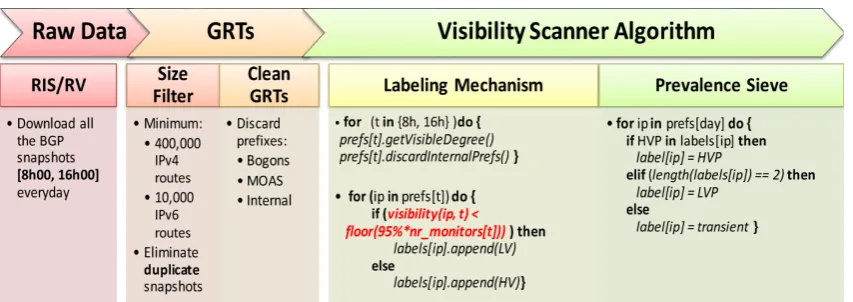
3.1 Methodology used for determining the LVPs and the HVPs. . . 23
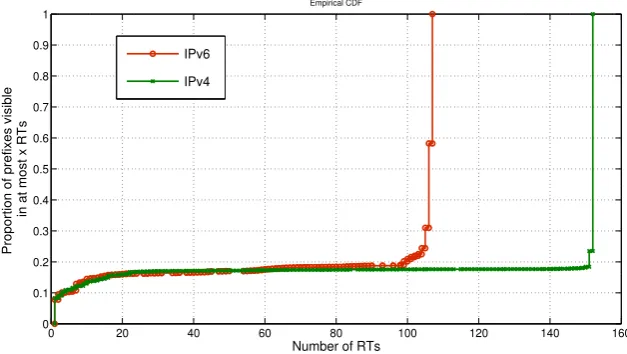
3.2 The Empirical CDF for prefix visibility within the sample of Global Routing
Tables (RTs), both for IPv4 and IPv6. . . 30
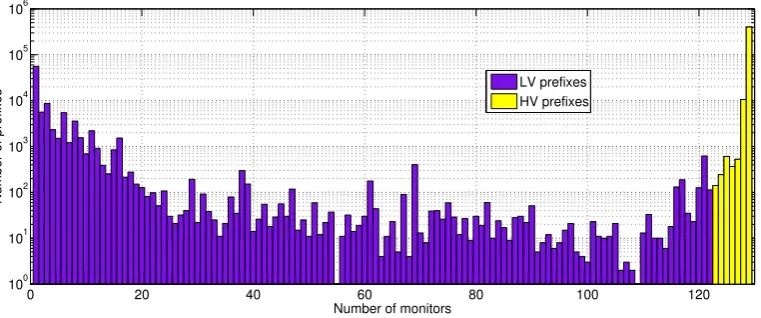
3.3 Distribution of IPv4 prefixes on visibility degree. . . 31 3.4 IPv4 Prefix length visibility: each bar shows the number of prefixes
with a certain mask length. The color code represents the visibility
dis-tribution of the prefixes within each prefix-length category, according with the visibility degrees marked in the color legend in the right part of the plot. 31
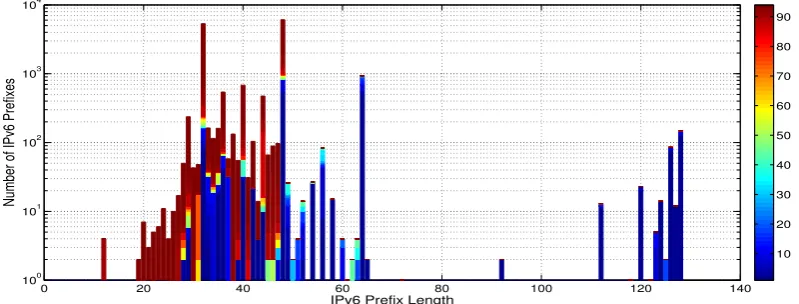
3.5 IPv6 Prefix length visibility: the bars are color-coded to show the visibility degree of the prefixes: from dark blue for LV, going to dark red
for HV. . . 32
3.6 Empirical PDF for the distribution of the BGP AS-Path length for IPv4
prefixes with the three different degrees of visibility: HVPs, LVPs and DPs. 33
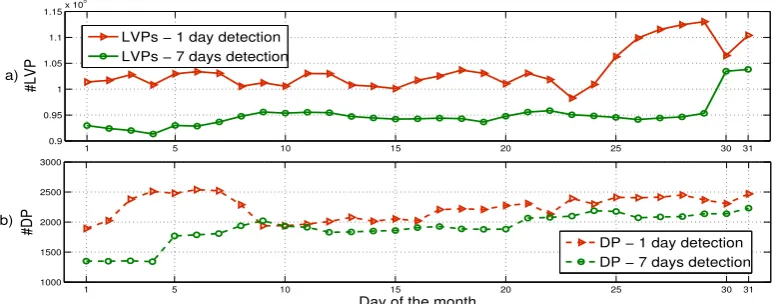
3.7 Comparing the visibility status determined for one-day and the visibility status calculated throughout a period of seven-days for IPv4 prefixes. . . 34
3.8 Empirical CDF of LVPs known to be unintended on the number of days they were active from June 2012 until the end of April 2013. . . 36
4.1 Winnowing Unintended LVPs: detailed methodology. . . 41
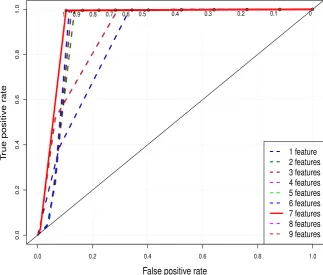
4.2 Threshold-average ROC curves for performance estimation of the decision
tree built with the 9 feature-sets. The red continuous curve for the model
using the 7 most important features has the highest AUC and, thus, is the optimal model. . . 49
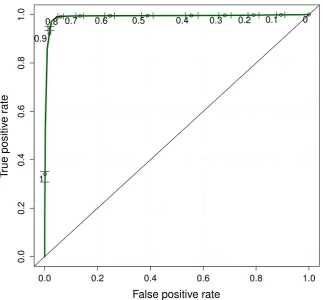
4.3 Threshold-average ROC curve of the boosted decision trees derived using each of the 989 possible data splits. . . 50
5.1 Scatterplot of reachability probability against the DP’s visibility, for v6DPs
and for v4DPs. . . 58
6.1 Toy example representation. . . 66
6.2 Strategic prefix deaggregation may have additional implications in terms
of costs incurred by the provider. . . 67
6.3 Graphical representation of the proposed Internet model. . . 68 6.4 Traffic dynamics for each transit link. . . 72
6.5 Distribution of the considered AS sample on the entire interdomain space. 78
6.6 Empirical cumulative distribution function of the number pf links per des-tination AS. . . 79
6.7 Model generated savings curve for an AS with at most 10 transit links,
considering a transit link instability probability of 3.5% and a skewness parameter α = 0.9. Comparison with simulation results and data-driven
savings approximation. . . 80 6.8 The empirical CDF of the savings proportions corresponding to the 6
months of analyzed routing data. . . 82
7.1 The methodology steps: at each step we require a different input dataset depicted at the top of each processing block. At the bottom of each block,
we can see the results we obtain at each step. . . 87
7.2 Algorithm used for detecting new customer deaggregation events. In the case where the algorithm detects that the more-specific prefix has been
re-aggregated, i.e., the more-specific no longer appears in the routing
ta-ble snapshot during one month at least, as depicted in case a), then the deaggregation event is discarded. We aim to detect cases of deaggregation
which last at least for one billing period, i.e., where the more-specific prefix
can be seen in the routing table snapshot for at least one month after the inferred time of deaggregation, as depicted in case b). . . 88
Chapter 1
Introduction
The performance of the global routing system is vital to thousands of entities
operat-ing the Autonomous Systems (ASes) which make up the Internet. The Border Gateway
Protocol (BGP) is currently responsible for the exchange of reachability information be-tween ASes and for the selection of the best paths to be used in order to enable the flow
of traffic between two nodes at the interdomain level. The manner in which traffic flows is
often influenced by network entities according to their needs, thus making BGP a policy-driven protocol. By tweaking configurations to influence the BGP decision process, the
network operators are able to implement their routing preferences, designed to
accom-modate myriad economic, technical and political goals. Furthermore, network operators can adapt to the developing Internet ecosystem and, by engineering the Internet traffic,
strive to optimize the use of their network.
Despite the flexibility offered, the added complexity of routing policies comes with
consequences, e.g., unforeseen side-effects impacting other entities active in the
rout-ing system, widespread undetected misconfiguration and even conflictrout-ing configurations leading to bogus routing policies to activate. In the context of tangled interconnections
between ASes and their routing policies, unexpected developments have been observed to
cause important disruptions that affect the global routing system [1, 2]. The main reason behind this resides in the fact that the actual interdomain routing is the result of the
interplay of many routing policies from ASes across the Internet, possibly bringing about
a different outcome than the one expected. Consequently, in order to ensure the efficiency of their routing policies, ASes periodically control how their preferences resonate in the
routing system or how others’ routing policies are affecting them.
Not to mention, the mere implementation of routing policies is a complicated process
in itself, involving fine-tuning operations. Thus, it is an error-prone task and operators
might end up with faulty configurations that impact the efficacy of their strategies or, more importantly, their revenues. Flawed routing policies cause for anomalies to emerge
in the Internet, including interdomain prefix leaks, e.g., the case of Dodo leaking its full
BGP routing table to provider Telstra in February 2012 [3], prefix hijacks, e.g., the
well-known case of Pakistan Telecom hijack of YouTube [4] or prefixes not being distributed
everywhere, e.g., the case where some multi-homed networks could not see the prefix of the DNS K root server [5]. Over the last years, a lot of effort has gone in the direction of
identifying, classifying and eliminating some of these anomalies [6].
In this thesis, we perform an extensive analysis of the intricacies emerging from the complex netting of routing policies at the interdomain level, in the context of the current
operational status of the Internet. Abundant implications on the way traffic flows in the Internet arise from the convolution of routing policies at a global scale, at times
resulting in ASes using suboptimal ill-favored paths or in the undetected propagation of
configuration errors in the routing system. We argue here that monitoringprefix visibility
at the interdomain level can be used to detect cases of faulty configurations or backfired
routing policies, which disrupt the functionality of the routing system. We show that
the lack of global prefix visibility can offer early warning signs for anomalous events which, despite their impact, often remain hidden from state of the art tools, e.g., [7, 8].
Additionally, we show that such unintended Internet behavior not only degrades the
efficacy of the routing policies implemented by operators, causing their traffic to follow ill-favored paths, but can also point out problems in the global connectivity of prefixes.
We further observe that majority of prefixes suffering from limited visibility at the
interdomain level is a set of more-specific prefixes. We learn that network operators in-tentionally limit the visibility of distinct fragments of their address space by selectively
announcing the more-specifics to different upstream providers. This strategy is adopted
by ASes to fulfill binding traffic engineering needs. Interdomain traffic engineering re-quirements usually depend on the connectivity of the AS with others and on the type
of business handled by the network [9]. One important task achieved through the use
of routing policies for traffic engineering is the control and optimization of the routing function in order to allow the ASes to engineer the incoming traffic. The advertisement
of more-specific prefixes, also known as prefix deaggregation, provides network
opera-tors with a fine-grained method to control the interdomain ingress traffic, given that the longest-prefix match rule over-rides any other routing policy applied to the covering less-specific prefixes.
Nevertheless, however efficient, this traffic engineering tool comes with a cost, which
is usually externalized to the entire Internet community. Prefix deaggregation is a known
reason for the artificial inflation of the BGP routing table [10], which can further af-fect the scalability of the global routing system. Recognizing the stable usage of prefix
deaggregation as an efficient traffic engineering method [11], we look past the initial
mo-tivations behind deploying this type of strategy, and instead focus on itsaftermath. More specifically, we investigate here its potential economic impact on the transit traffic bill,
deaggre-1.1. The BGP Visibility Scanner 3
gation in the first place. We show that by limiting the visibility of more-specific prefixes
with the usage of selective advertisements of deaggreagated prefixes, network operators
reduce the route diversity towards each prefix announced. Consequently, this also reduces the incoming traffic fluctuations on the corresponding transit link, thus possibly
decreas-ing the monthly traffic bill paid to the transit providers. This can further impact the
routing policies of its transit providers and, potentially, the providers’ revenues.
We provide next an overview of the contributions included in this thesis, which we
organize in five different chapters, as follows.
1.1
The BGP Visibility Scanner
In Chapter 3 of this thesis, we begin by presenting theBGP Visibility Scanner, the tool we have developed to enable network operators to validate the correct implementation of their routing policies by monitoring prefix visibility. The BGP Visibility Scanner
is publicly available at visibility.it.uc3m.es. The scanner corroborates BGP routing information from more than 150 independent observation points in the interdomain to create a multi-angled view on the efficiency of routing policies. We have publicly released
the visibility scanner in November 2012. Ever since, the tool has been well received
by the operational community. The BGP Visibility Scanner [12] has been presented in different network operators group meetings, including NANOG, LACNOG, UKNOF,
EsNOG, RIPE, and has also been announced on RIPE Labs [8]. It continues to evolve
and to attract a large amount of attention and feedback [13], thus validating its usefulness for the operational community.
The implementation of routing policies is a complicated process, involving subtle
tun-ing operations servtun-ing all the origin’s goals. For example, ill-defined outbound filters may lead to an AS unknowingly leaking internal routes to the Internet and impacting the
effec-tiveness of its own active routing policies [6]. Moreover, because of the increasing density
of AS-level interconnections [14], the manner a routing policy is implemented may not achieve the expected outcome. In order to avoid the distortions of their routing policies
due to accidental mis-configurations or adverse effects within the complex external web
of routing policies, ASes need to monitor the manner in which their preferences resonate in the global routing system. To this end, operators need to complement their
inter-nal perspective on routing with the information retrieved from multiple exterinter-nal sources,
e.g. publicly available looking-glasses. However useful, these tools have obvious limita-tions [15], e.g. allowing only for single per-route queries and not storing any historical
information.
There are numerous efforts towards detecting security related routing conditions, such as prefix hijacking (e.g., PHAS [16]). Also, various tools exist to provide useful information
attempts go far beyond this. They include RIPE Labs [8], which has a whole section devoted to tools that assists operators or Renesys [19] and BGPmon [20], which operate
this type of services to operators for a fee. Unlike tools which integrate a vast amount of operational problems [7], we do not focus on inferring and/or monitoring the AS-level
topology of the Internet, but on monitoring the healthy deployment of routing policies
through prefix visibility. In this sense, our work is very closely related to the work on BGP wedgies by Griffin et al [2, 21]. However, none of those theoretical work is able to detect
problematic routing conditions based on raw BGP observations. All of this work requires
access to configuration files, which are typically not shared. The latter are considered a company secret which BGP was designed to hide, making it hard to be inferred [15].
While we understand the limitations of BGP protocol monitoring, we noticed that still a great deal that can be inferred. In this sense, our work aims at reporting and aggregating
the information to make it usable for operators.
Despite that many other similar tools [7, 8] leverage the massive amount of available
routing data, the BGP visibility scanner is, to the best of our knowledge, the only tool offering specific information on global prefix visibility. The tool allows networks to check
how their own routes are being propagated in the Internet, verify the results of the
implemented routing policies and identify possible cases where these policies backfired. By merging all the available information from the ASes enabled as active monitors active
in the RIPE RIS [22] and RouteView [23] Projects, we create avisibility scannerfor all the IPv4 and IPv6 prefixes active in the interdomain. The tool is subject to the limitations of the available public looking-glasses, which we further address accordingly. It is important
to note that the properties of BGP do not allow us to get a complete picture on all policies,
but nevertheless those public observations points provide a multi-angle perspective on the interdomain routing.
Moreover, our tool has already proven its capability of triggering visibility alarms
and helping networks deal with the problems caused by their own routing policies. Since
the tool first became publicly available, it gathered, at the time of writing, over 5,000 queries performed for more than 1,500 different origin ASes. We have invited the users
actively performing queries on the BGP Visibility Scanner to participate in a survey regarding the status of the retrieved LVPs for the corresponding origin AS. Leveraging
the feedback received, we build a unique ground-truth dataset including 20,000LVPs. For each of these prefixes, the network operators reported which was the expected visibility status of the prefixes after defining their interdomain routing policies. We match the
origin’s intention with the observed visibility status of the prefixes identified with the
BGP Visibility Scanner, and separate the LVPs in two pre-determined classes: intended
1.2. Winnowing Unintended Limited Visibility Prefixes 5
1.2
Winnowing Unintended Limited Visibility Prefixes
In Chapter 4, we continue our analysis of prefix visibility and propose a machine
learn-ing model to automatically identify potential cases of bogus routlearn-ing policies or miscon-figuration. The problem we challenge here isdistinguishing the unintended prefixes suffering from limited Internet visibility, caused by configuration errors or un-foreseen routing policies interactions, from the intended prefixes with limited visibility at the interdomain level, which are natural expressions of intentional routing policies in the Internet. Though some legitimate routing policies of an AS intentionally constrain the visibility of its prefixes in the Internet, the limited visibility can, more than often, stem from human operator errors or unpredicted interplay with
the external entanglement of otherwise correctly defined routing policies. In light of the
perpetuity of the above-mentioned causes of anomalous interdomain events, there is an overall acute need for a simple warning system for faulty configurations and/or
problem-atic external routing conditions to assist operators in optimizing the performance of their routing policies. In this thesis, we further argue that monitoring the prefix visibility at the interdomain level can be used to detect a subset of anomalous events that still remain
hidden from state of the art tools [7, 8], despite their important impact on the routing system.
We design a machine learning Winnowing Algorithm able to predict with 95% accu-racy if the limited visibility of a prefix is intended or unintended. We exploit the unique ground-truth dataset of 20,000 prefixes, for which the expected visibility status has been confirmed by the networks operators themselves, while actively using the BGP
Visibility Scanner. We then rely on the robust machine learning concept ofboosted clas-sification trees [24] to train the system on this ground-truth operational set of prefixes with limited visibility and thus enable it to learn the patterns of misconfigurations and
backfired routing policies which are normally hard to detect. The classification model uses only visibility-related per-prefix features in order to predict with 95% accuracy if the
limited visibility of a prefix is intentional or not.
1.3
Reachability of Limited Visibility Prefixes
In Chapter 5, we continue our analysis of limited visibility prefixes and we further
analyze the potential correlation between the limited visibility and the reachability of the prefix at the interdomain level. Routing policy anomalies and misconfiguration not
only impact the operations and strategies of Internet entities by causing the traffic to
follow an ill-favored path. Policies may, at times, affect the propagation of routes, mak-ing some paths unavailable at a global level, and sometimes preventmak-ing a prefix to be
unreachable, since there might not always be a less-specific covering prefix to ensure that
the destinations attached are globally reachable.
We aim to establish if prefix visibility at the interdomain level can be further used
to alert network operators about reachability issues their prefixes might be suffering. In other words, we analyze if the routing anomalies that render a prefixes as limited visibility
can also deteriorate the reachability of the corresponding address space. To this end, we
perform reachability measurements towards prefixes with various degrees of visibility and that may or may not be covered by a less-specific prefix, with the goal of establishing the
existence of a correlation between visibility and reachability of prefixes in the Internet.
We find that for the set of limited visibility prefixes which are not covered by a less-specific prefix with high visibility, i.e., the dark prefixes, reachability is also an issue, especially
in IPv6. Contrariwise, the limited visibility prefixes covered by a high visibility prefixes
do not show any reachability problems, despite the fact that the traffic may be following the ill-favored path of the less-specific prefix.
1.4
The Inadvertent Economic Impact of Strategic
Deag-gregation
We previously observed that the majority of prefixes with limited visibility identified with the BGP Visibility Scanner includes prefixes that are covered by less-specific prefixes
which, in general, have high visibility at the interdomain level. Often, network operators intentionally limit the visibility of distinct fragments of their address block by selectively
announcing the more-specific prefixes to different upstream providers, while still injecting
the covering less-specific prefix to all the providers. This is usually driven by severe traffic engineering needs, e.g., load balancing the traffic by originating several
more-specific prefixes and announcing different prefixes via different AS paths. In Chapter6
we focus on this particular traffic engineering strategy and study its potential economic implications.
The injection of more-specific prefixes through BGP offers a fine-grained method to control the interdomain ingress traffic, since it allows networks to divide their assigned
address blocks in different-sized sinks of traffic. This type of phenomenon is commonly known as prefix deaggreagation. We further define the observed specific deaggregation phenomena as strategic deaggregation, i.e., the action of deaggregating the address block and selectively injecting each more-specific prefix to different transit providers or different disjoint subsets of transit providers. We use here the termstrategicto accentuate the fact that the decision is based on optimizing behavior, since it might increase the benefits for
the network deploying it. This relies on definitions provided in rational choice theory. Using this technique, geographically-spread networks can, for example, divert different
1.4. The Inadvertent Economic Impact of Strategic Deaggregation 7
the desired amount of traffic into their network through the PoP closest to the final
destination.
Several adjacent phenomena associated with deaggregation have been identified and
studied by the research community. The most important negative side-effect of the
widespread adoption of this technique is the artificial inflation of the BGP routing ta-ble, which can affect the scalability of the global routing system. This issue has become
an important concern of the entire Internet community over the past years [10, 25, 11]. Judging from this perspective, this type of behavior is considered to be harmful [10], as it
heavily impacts the global routing table scalability and it acts counter to the goals of the
Classless Inter Domain Routing (CIDR) architecture, which encourages aggressive address aggregation. However, it has been proved that, despite being frowned upon, deploying
this type of strategy is a constant occurrence in the Internet [11]. Thus, recognizing
as a reality the stable usage of strategic deaggregation as an efficient traffic engineering method in the Internet, we look past the motivations behind deploying deaggregation,
and instead we focus on its economic aftermath.
In spite of the negative overtone surrounding prefix deaggregation, a series of
col-lateral benefits emerge as by-products from the use of deaggregation, without, however,
constituting the central drive for ASes to deploy such strategies in the first place. For example, one alleged benefit is the increased security of the network announcing more
specifics in the interdomain. Some even claim that prefix deaggregation can be useful
as a technique for reducing prefix-hijacking attacks [26]. In this thesis, we investigate the potential economic impact of strategic deaggregation, independently on the reasons
driving the network operators to employ the technique in the first place [27, 28]. We
find that, as a result of the unique interaction between the routing path changes in the current Internet [29], the skewed distribution of traffic demand on sources and the widely
used 95th percentile billing model [30, 31] for calculating the monthly transit cost, the
deaggreagating ASes enjoy one particular by-product of strategically deaggregating their address space: the decrease of the monthly transit bill. We propose a general Internet model to analyze the impact of strategic deaggregation in terms of transit traffic cost. Based strictly on the information contained in public BGP routing tables, we show that
strategic deaggregation may decrease the transit bill of a given customer by 5% in
aver-age. Clearly, in the operational Internet some of these ASes that were taken into account for this approximation are much more affected by routing changes than others, and thus
may experience . However, this average gives us a somewhat concrete idea on the manner
in which the combination of routing changes, the skewed distribution of traffic on sources (analyzed in [32]) and the popular 95% percentile billing scheme [30, 31] inflate ones
1.5
Strategic Deaggregation Detection
We have previously verified from an analytical point of view that through combining
selective advertisements with the deaggregation technique, an AS can inadvertently enjoy a reduction of the traffic fluctuations on the transit links. In other words, indirectly
restricting the visibility of a certain destination prefix through selective advertisements of more-specific prefixes translates into monetary savings for the deaggregating network.
This economic impact is enabled by the current operational status of the Internet, and in
particular the widely used billing model based on the peak traffic usage [30, 31]. In this scenario, the customer network not only acts counter to the best recommended practices
regarding deaggregation, but might also indirectly impact the business of its providers.
In Chapter 7, we take the point of view of a transit provider with customers that might be deploying strategic deaggregation and ask a two-staged question:
(1) How extensive is the use of prefix deaggregation among the customer networks?
To answer this question, we further propose a methodology to identify cases of strategic deaggregation deployed by ASes in the customer base of an operational Internet Service
Provider (ISP). In this way, we enable any operator with the necessary methodology
aimed to detect the customers which are heavy deaggregators and further monitor their behavior in time.
(2) Can it be verified that deaggregation combined with selective advertisements de-creases the transit bill of some customers? Customers which exhibit this behavior may be able to game the 95th percentile billing rule and possibly have a negative impact on
the routing strategies of their ISPs. We propose a passive measurement approach for the detection of strategic deaggregation events and to asses their economic consequences. Our
approach requires obtaining and processing routing, topology, traffic and billing
informa-tion and molding it in order to reach the correct level of understanding on the impact different customers might have on their providers.
The novelty of this methodology is the manner in which it merges different types of
information characteristic to a transit provider, in order to have a complete picture on the operations of its customer networks. Any ISP interested in detecting the occurrence
of this phenomena within its customer base can build the necessary dataset and apply
the proposed detection methodology.
We demonstrate the use of this methodology on the real traffic and routing data from
a major Japanese ISP to identify real occurrences of the interest phenomena. Overall, we do not observe much deaggregation generated from the customer networks of this
operational ISP. And even more, despite the fact that the proposed analytical model does
successfully support the observed phenomena, we do not identify many cases of strategic deaggregation performed by the ISP’s customers. We do, however, distinguish and analyze
1.6. Thesis Overview 9
Regardless of the main goal to be achieved through deaggregation, we observe that, in
certain conditions, the deaggregating AS can indeed enjoy a decrease of its transit traffic
bill as a by-product of the strategic deaggregation deployed within certain conditions. In this representative case of strategic deaggregation detected within the customer base of a
major Japanese ISP, the deaggregating AS enjoyed a 20% decrease on its transit bill.
1.6
Thesis Overview
The remainder of this thesis is organized in six additional chapters. In Chapter 2 we
provide an background to acquaint the reader with the details required for the specific
issue being addressed in each of the following chapters. Next, in Chapter 3 we present the BGP Visibility Scanner, a novel tool we developed and released in order to help
oper-ators monitor the sanity of their routing policies by verifying their prefix visibility in the
Internet. Using the feedback received from active users of the tool, who have benefited from the information provided, we build a large ground-truth dataset consisting of 20,000
prefixes diagnosed with limited visibility. We further label these LVPs as intended or
unintended, depending on the match between the observed visibility status and the re-ported intention of the origin AS. Leveraging this unique dataset, we present in Chapter 4
a machine-learning algorithm which can accurately distinguish between the intended and
unintended LVPs identified by the BGP Visibility Scanner. Throughout the remainder of this thesis, we further characterize and analyze the implications of the limited visibility
prefixes in the Internet. In Chapter 5 we set out to determine if the limited visibility of
prefixes also impacts the manner in which traffic flows in the Internet. We find that for the dark prefixes global reachability is an issue, since these prefixes with limited visibility
do not have a covering less-specific HVP to ensure the global reachability. For the rest
of the LVPs which do have a less-specific covering prefix with high visibility to ensure global reachability, the traffic destined to the more-specific LVP ends up following initially
ill-favoured paths. In some cases, these latter LVPs are generated by ASes which adopt prefix deaggregation strategies to attain an optimized use of their network and engineer
the incoming traffic to follow the preferred incoming path. In other words, some ASes
intentionally limit the visibility of distinct fragments of their address block by selectively announcing the more-specifics to different upstream providers. In Chapter 6, we analyze
the economic impact of strategic deaggregation in term of monthly transit bill reduction.
We look for real-world occurrences of these strategies in Chapter 7. We propose a new methodology which we further exemplify on a dataset obtained from an operational ISP.
1.7
Statement of Research Contributions
The work outlined in this thesis is focused on developing techniques, tools and
mod-els to assist network operators, protocol designers and researchers in understanding the manner in which BGP routing policies take effect in the Internet and which may be their
possible impacts on the community. To this end, we analyze two different phenomena
characteristic to interdomain routing: prefix visibility at the interdomain level andprefix deaggregation, with a focus on the collateral benefits of strategic deaggregation.
We introduce the concept of prefix visibility, which we use as a simple warning to further detect cases of erroneous or bogus routing policies. In order to define prefix
visibility, we compare the BGP information contained in different Global Routing Tables (GRTs) from ASes which voluntarily make their data public. We loosely define the GRT as the routing table provided by an Internet Service Provider (ISP) to its customers requesting a full routing feed. Each ISP maintains its own version of the GRT, which
may vary from one network to another in terms of routes contained. We define Limited-Visibility Prefixes (LVPs)as stable long-lived Internet routes that are visible in the GRTs of at least two different ASes and in at most 95% of all the GRTs from the ASes analyzed. The choice of the 95% visibility threshold allows for a 5% error in the routing
tables sampling process, also accommodating possible glitches that may appear in the data. Complementarily, we define the High-Visibility Prefixes (HVPs)as the set of prefixes that are propagated in at least 95% of all the available GRTs. We also identify theDark Prefixes (DPs)[33], which represent the subset ofLVPs that are not covered by any HV less-specific prefix.
We observe that majority of LVPs are deaggregated more-specific prefixes, often used
by network operators to implement their routing policies and achieve stringent traffic engineering needs, e.g., load balancing. The traffic destined to these limited visibility
less-specifics is globally routed using sometimes ill-favored paths towards the less-specific
prefix with high visibility in the Internet, which basically acts like a traffic magnet. The impact of prefix deaggregation on the routing system has long been a reason of debate in the Internet community. Though usually frowned upon, this strategy is even more
commonly used nowadays, especially in light of the IPv4 address space depletion.
The contributions of this thesis are summarized as follows. First, we propose the
BGP Visibility Scanner [12, 34]s, publicly available at visibility.it.uc3m.es, a tool which allows network operators to check the visibility of their IPv4 and IPv6 prefixes and detect unintended policies. We have publicly released the visibility scanner in November
2012. Ever since, the tool has been well received by the operational community. The
BGP Visibility Scanner [12] has been presented in different network operators group meetings, including NANOG, LACNOG, UKNOF, EsNOG, and has also been announced
1.7. Statement of Research Contributions 11
feedback [13], thus validating its usefulness for the operational community.
Second, we build a unique ground-truth dataset of 20,000 LVPs [35, 34], for which the expected visibility status has been confirmed by the network operators them-selves, while actively using the BGP Visibility Scanner. After comparing the observed
with the expected visibility status, we label each of these LVPs asintended to have limited visibility, or as unintended. Collecting feedback from operators regarding their intended routing policies has not been an easy task. We have invited the operators using our tool
to fill in an on-line survey form after performing a query in the BGP visibility Scanner, to provide more information on the observed visibility status of their prefixes. Additionally,
we have actively been in contact with various operators who asked for our support while
debugging their routing policies. The dataset brings additional value in that it accurately documents distinct causes for the limited visibility of prefixes in the Internet and provides
a deep understanding of the routing conditions which allows them to emerge. It records
and explains multiple cases of misconfigurations, unforeseen interactions and intentional routing policies effects.
We propose the Winnowing Algorithm [35, 34], a machine learning classification algorithm able to automatically distinguishing the unintended LVPs, caused by miscon-figuration or unforeseen routing policies interactions, from the intended LVPs, which emerge as a natural expression of intentional routing policies in the Internet. Using the
BGP Visibility Scanner as a data mining tool, we corroborate the per-prefix visibility information with the ground-truth information from active users of the tool to generate a
simple alarm simple for misconfigurations or bogus routing policies which emerge as
un-intended limited-visibility prefixes. The resulting Winnowing Algorithm has a 95% level of accuracy. This further proves that visibility features are generally powerful to detect
anomalies which, despite their impact on the routing system, are hard to single out due
to the limited and distributed nature of the data.
Third, we analyze the correlation between global visibility and global reach-abilityof both IPv4 and IPv6 prefixes [36, 34]. The faulty configurations, complex inter-domain interactions or bogus routing policies not only impact the efficacy of the intended routing policies of ASes. Sometimes, the impacted prefixes are prevented to be learned
altogether, making the attached host globally unreachable. It is expected thatlimited vis-ibility does not necessarily imply limited reachability, since the less-specific high visibility covering prefix provides reachability. This is not true for the DPs, which lack a covering
less-specific prefix with high visibility to ensure that the attached hosts are still reachable. We show that the lack of global visibility of a prefix does sometime signal the potential
risk of limited global reachability, especially in the IPv6 Internet. While the IPv4 dark
address space can be largely explained as configuration slips, route leaks or errors, this is not valid for the IPv6 DPs. We find that the subset of IPv6 dark prefixes are highly
reachability of a non-negligible set of prefixes undermines the global connectivity of the
Internet.
Fourth, we observe that the majority of limited-visibility prefixes identified with the
BGP Visibility Scanner are actually more-specific prefixes covered by a less-specific prefix
with high visibility. Given that majority of prefixes suffering from limited visibility are the result of strategic deaggregation, we turn our attention to this controversial practice and analyze its aftermath in terms of the impact on the transit traffic dynamics and on the subsequent transit bill paid by a deaggregating AS to its transit providers [27, 28]. We propose an Internet model to analyze the cost for transit in the case when strategic deaggregation is being used, as opposed to the case when routing is not influenced by this phenomenon. We demonstrate that by using deaggreagation and
scoped advertisements, the originating AS reduces the path diversity towards the injected
prefixes. Thus, the amount of traffic destined to a particular sub-block of addresses is bound to the incoming link on which it was injected. This eliminates the possibility for
any traffic fluctuations due to routing changes towards that particular prefix. Since the
transit bill depends on the peak traffic usage and not on the total traffic usage, avoiding traffic fluctuations implies a lower monthly bill.
Fifth, we proposea passive measurement approach for the detection of strate-gic deaggregation events and to asses their economic consequences in the real world [37, 28]. The novelty of the approach is the manner in which it merges different types of information characteristic to an real-world operational ISP in order to have a complete picture on the operations of its customer networks. This requires obtaining and
processing routing, topology, traffic and billing information and molding it in order to
reach the correct level of understanding on the impact different customers might have on their providers. Any ISP interested in detecting the occurrence of this phenomena within
its customer base can build the dataset and apply the proposed methodology.
1.8
Publications Arising From This Thesis
Components of this thesis have previously been published:
• A. Lutu, M. Bagnulo, J. Cid-Sueiro, and O. Maennel,Separating wheat from chaff: Winnowing unintended prefixes using machine learning. In: Proceedings of 33rd IEEE International Conference on Computer Communications, ser. IEEE
INFO-COM 2014, April 2014.
1.8. Publications Arising From This Thesis 13
• A. Lutu, M. Bagnulo, and O. Maennel,The BGP Visibility Scanner. In: 16th IEEE International Global Internet Symposium (GI 2013), collocated with INFOCOM
2013, April 2013, Turin, Italy.
• A. Lutu, M. Bagnulo, and R. Stanojevic. An Economic Side-Effect for Prefix Deag-gregation. In: The Seventh Workshop on the Economics of Networks, Systems and Computation (NetEcon 2012), collocated with INFOCOM 2012, March 2012,
Orlando, Florida, USA.
• A. Lutu, C. Pelsser, M. Bagnulo and K. Cho,The Aftermath of Prefix Deaggregation. In: 25th International Teletraffic Conference (ITC25), 10-12 Sept. 2013, Shanghai,
China.
• A Lutu, M Bagnulo, C. Pelsser, O. Maennel and J. Cid-Sueiro,“The BGP Visibility Toolkit: Detecting Anomalous Internet Routing Behavior”. IEEE/ACM Transac-tions on Networking. Submitted, Major Revision due Nov. 2014. Impact Factor: 1.986.
• A Lutu, M. Bagnulo, C. Pelsser, K. Cho and R. Stanojevic, “An Analysis of the Economic Impact of Strategic Deaggregation”. Computer Networks. Major Revision Submitted, Aug. 2014. Impact Factor1: 1.282.
1
Chapter 2
Background and Related Work
The main task of the Internet is to provide connectivity to every node attached to it. In order to achieve this goal, organizations forming the Internet, identified by one or more
unique Autonomous System Numbers (ASNs), must ensure that they have paths to reach
all the rest of operational networks. These paths may traverse multiple ASes, making the Internet literally a network of networks. Modern interdomain routing with BGP is
based on policies, rather than finding shortest paths, since it quickly became apparent
that the latter would be insufficient to handle the myriad operational, economic, and political factors involved in routing [9]. BGP thus propagates routes across the Internet
while respecting the policies of individual ASes [38]. Network operators express their
rout-ing preferences by influencrout-ing the path decision process independently of others. These policies are achieved by tuning a variety of parameters available in BGP. Consequently,
network managers began to modify routing configurations to achieve countless goals held by the router’s owner that controlled which routes were chosen and which routes were
propagated to which neighbors.
Routing policies stem from a conglomerate of economic, political or performance
con-siderations dictate how traffic flows in the Internet [39, 9, 40]. The relationship between a pair of ASes often falls into one of the following two broad categories [9, 40, 41]:
1. Customer-Provider: The customer AS financially compensates the provider AS for
connectivity to the global Internet.
2. Peer-Peer: A mutually beneficial relationship between two ASes to provide con-nectivity to each others customers. No payment is required for traffic exchanged
between the two peer ASes.
ASes with wide geographic coverage and substantial backbone infrastructure are
con-sidered large or Tier1 (e.g., AT&T, Level3 etc.). A natural Internet hierarchy exists where smaller ASes are customers of larger ASes and thus the prior depend on the latter
to reach every other node connected to the Internet. In this context, multiple layers of
transit connectivity can be traversed until an end-user is reached. However, lately it has
been argued that the Internet is slowly migrating from a hierarchical structure to a flat
one, with an increasing density of peering links [42]. Furthermore, as the routing neces-sities of ASes grow more complex, also the relationship between networks fall out of the
two categories defined above. In the last years, customized policies became more often
than it was previously believed [43, 44].
2.1
Monitoring BGP Routing Policies Efficiency
The flexibility to set policies allowing any route to be preferred over any other has important ramifications, including unforeseen side-effects impacting other entities active
in the routing system, widespread undetected misconfiguration and even conflicting
con-figurations leading to bogus routing policies to activate. Given that ASes independently define their routing policies, it may happen that perplexing results of the interactions
between ASes have been observed to cause important disruptions that affect the global
routing system [1, 2]. The main reason behind this resides in the fact that the actual interdomain routing is the result of the interplay of many routing policies from ASes
across the Internet, possibly bringing about a different outcome than the one expected.
Consequently, in order to ensure the efficiency of their routing policies, ASes periodically control how their preferences resonate in the routing system or how others’ routing
poli-cies are affecting them. To this end, most of the work related to our efforts described
in Chapter 3 tackle the analysis of BGP raw data, which can be tricky and difficult. There are numerous efforts towards detecting security related routing conditions, such as
prefix hijacking (e.g., PHAS [16]). Also, various tools exist to provide useful information for operators [17, 18]. Multiple operational misconfigurations have been reported [6], but
attempts go far beyond this. They include RIPE Labs [8], which has a whole section devoted to tools that assists operators or Renesys [19] and BGPmon [20], which operate this type of services to operators for a fee.
Unlike tools which integrate a vast amount of operational problems [7], we do not focus on inferring and/or monitoring the AS-level topology of the Internet, but on monitoring
the healthy deployment of routing policies through prefix visibility. In this sense our work is very closely related to the work on BGP wedgies by Griffin et al [2, 21]. However,
none of those theoretical work is able to detect problematic routing conditions based
on raw BGP observations. All of this work requires access to configuration files, which are typically not shared. The latter are considered a company secret which BGP was
designed to hide, making it hard to be inferred [15]. While we understand the limitations
of BGP protocol monitoring, we noticed that still a great deal that can be inferred. In this sense, our work aims at reporting and aggregating the information to make it usable
2.2. The Machine Learning Approach for BGP 17
of available routing data, the BGP visibility scanner is, to the best of our knowledge, the
only tool offering specific information on global prefix visibility.
2.2
The Machine Learning Approach for BGP
In Chapter 4 we propose a machine learning algorithm to automatically detect
anoma-lous events which, despite their high impact on the routing policies, emerge as legitimate expressions of routing policies. We note that the proposed decision tree algorithm relies
exclusively on prefix visibility features. Machine learning in the context of interdomain
routing has been already proven to be a successful approach. Using traffic feature distri-butions, Lakhina et al. [45] show that the existence of some anomalies can be detected
from traffic flows. Furthermore, a Bayesian framework has been previously proposed for
detecting mistakes in the router configuration files using statistical anomalies [46]. Re-lying on network data, the usage of statistical algorithms has been advanced to detect
deviations from the long-term profile of BGP routing updates [47]. Similarly, an instance-learning framework has been previously recommended for identifying deviations from the
normal defined state of BGP routing dynamics [48]. Likewise, Li et. al advance a
rule-based framework for the detection of abnormal routing behavior caused by a major worm or a blackout [49].
In Chapter 4, we design a tree-based classification model. We begin by establishing
the base learning model, which we further boost for improved accuracy. Tree-based
learning methods rely on iteratively partitioning the data into smaller groups of similar elements [50]. The splitting of the data is done using the features that best separate the
outcomes. The key idea is to chose the splits which maximize the group homogeneity,
i.e., how similar are the elements within the same group, or until the small groups are sufficiently “pure”. Choosing the right number of splits is a challenge, since we can
easily overfit the model by considering splits that are very specific to the training data,
or, contrariwise, underfit it by considering shallow general splits. Finding the correct balance is conditioned by finding the optimal set of features used to partition the data.
We select the set of features which gives us the best classification model with the help
of Receiver Operating Characteristic (ROC) curves [50]. ROC curves come from signal detection theory that was developed during World War II for the analysis of radar images.
An ROC curve shows the trade-off between the true positive rate or sensitivity (proportion
of positive tuples that are correctly identified) and the false-positive rate (proportion of negative tuples that are incorrectly identified as positive) for a given model. That is, given
a two-class problem, it allows us to visualize the trade-off between the rate at which the
model can accurately recognize yes cases versus the rate at which it mistakenly identifies no cases as yes for different portions of the test set. Any increase in the true positive rate
(AUC) is a measure of the accuracy of the model.
Boosting [24] is one the most powerful learning mechanisms proposed in the last 20 years. The main idea behind this algorithm is to combine many weak classifiers to
produce one robust classification algorithm. Algorithm 1 presents the popular AdaBoost algorithm, first proposed in [24]. Unlike other boosting algorithms, AdaBoost adjusts
adaptively to the errors of the weak classifier considered. Algorithm 1 assumes the simple
case of two possible outcome classes, i.e., Y = 0,1 and a random sequence of training samples (x1, y1), ...,(xN, yN). Boosting is then used to find a hypothesishf with low error
rate after combining using a majority vote the output of all the weak hypotheses obtained
from each of the T boosting iterations.
Algorithm 1 AdaBoost
Input:
• sequence of N labeled samples (x1, y1), ...,(xN, yN) • distribution D over the N examples
• weak learning algorithmWeakLearn
• integer T specifying number of boosting iterations
Initializethe weight vector: w1
i =D(i) for i= 1, ..., N.
Do fort= 1,2, ..., T 1. Set
pt= w
t
PN i=1wti
2. Call WeakLearn, providing it with the distribution pt; get back a hypothesis ht:X→[0,1]
3. Calculate the error ofht:t=PNi=1pit|ht(xi)−yi|
4. Setβt=t/(1−t)
5. Set the new weights vector to be
wti+1=witβ1−|ht(xi)−yi|
t
Outputthe hypothesis
hf(x) = (
1, if PTt=1
log(β1 t)
ht(x)≥ 12PTt=1log(β1t)
0, otherwise
2.3
Measuring Prefix Reachability
In Chapter 5, we perform an extensive analysis of how BGP route propagation affects
2.3. Measuring Prefix Reachability 19
visibility address space both for IPv4 and IPv6.
Reachability is the main service provided by the Internet, thus attracting much inter-est from the research community, which generated numerous studies on the matter. Many
have tried to understand and characterize pathological behaviors at the interdomain level
which endanger this basic service, e.g., bogon advertisements [51], hijacking [52] or mis-configurations [53]. Several others have been concerned with establishing the correlation
between end-to-end Internet path performance degradation and routing dynamics [54,55].
There is also a large amount of studies concentrated on BGP and its intricacies which may impact prefix reachability, e.g., slow BGP convergence [56], routing instabilities [57],
or complex policies interactions [2]. Few other works have been concerned with proposing
tools to asses and identifying problems in the reachability of prefixes in the Internet [58]. In particular, the efforts of Mao et. al in [59] are somewhat on the same lines as the goal
we try to achieve with our methodology.
It has been previously confirmed that, when it comes to establishing the “real”
reach-ability in the Internet, performing data-plane measurements should take precedence over
the control-plane measurements [60]. Few tools are available for testing Internet reacha-bility today, out of which ping and traceroute are the most popular. Despite their wide usage, these tools suffer from limitations which have been long known within the research
community [61, 62]. Ping can be filtered by firewalls and NATs. In addition, ping probes between any two hosts, cannot confirm that reachability is bug-free [62]. If some routers
do not propagate routes for part of the address space, routing will try to find paths around
the problematic regions. Dynamics in the routing paths or load-balancing are only par-tially visible by traceroute [61]. Additionally, it has been found that ICMP traceroute is
the most efficient traceroute probing method [60, 63, 64], which is further consistent with
our own results.
In this chapter, we found especially difficult to test the reachability of the IPv6 address
space which, as opposed to the IPv4 address space, does not account with numerous connected hosts. More specifically, we turn our attention to the IPv6 dark prefixes and
attempt to measure their reachability at the interdomain level, using as a benchmark the
status of the IPv4 Internet. During the past years, IPv6 has received a lot of attention both from the operational and the research community. Various related works look into the
transition of the IPv4 network infrastructure to IPv6 [65] and how the Internet topology,
routing and performance across the two compares [66]. It had been proven that the routing dynamics in the IPv6 topology are largely similar to those know from IPv4, even
2.4
Prefix Deaggregation
In a more tangled Internet, both economically and technically, individual network
managers need to permanently adapt to the interdomain routing changes and, by engi-neering the Internet traffic, optimize the use of their network. For operational reasons, the
majority of the Internet entities has expressed the necessity to better control the
incom-ing and/or outgoincom-ing flows of Internet data traffic. Internet traffic engineerincom-ing [67, 68, 9] is the aspect of network engineering dealing with issues of performance optimization of the
IP networks [68]. Interdomain traffic engineering requirements are diverse and depend
on the connectivity of the AS with others and on the type of business handled by the network [9]. One important task achieved through the use of traffic engineering tools is
the control and optimization of the routing function in order to allow the ASes to shift
the traffic inside and outside their network in the most effective way.
Traffic engineering with BGP is performed through a series of methods which allows for
a better control on the traffic flow both inside and outside a network [], providing operators
with the means to optimize the use of their networks. Within the traffic engineering toolbox, the injection of artificially deaggregated prefixes through BGP offers a
fine-grained method to control the interdomain ingress traffic. When combined with routing
policies in the form of selective advertisements [69], prefix deaggregation enables operators to control how the traffic enters their network, which is one of the most challenging task to
be achieved in traffic engineering with BGP. Prefix deaggregation is recognized as a steady
long-lived phenomenon at the interdomain level, despite the negative overtone surrounding this approach [11,25]. The most important negative side-effect of the widespread adoption
of this technique is the artificial inflation of the BGP routing table, which can affect the
scalability of the global routing system. This issue has become an important concern of the entire Internet community over the past years [10]. From this perspective, this type of
behaviour is considered to be harmful, as it heavily impacts the global routing table and it acts counter to the goals of the Classless Inter Domain Routing (CIDR) architecture,
which encourages aggressive address aggregation.
Aside from the above-mentioned traffic-engineering benefits, there are also a number of collateral benefits resulting from the use of deaggregation in the Internet. For example,
one alleged benefit is the increased security of the network announcing more specifics in
the interdomain. Some claim that prefix deaggregation can be useful as a technique for reducing prefix-hijacking network attacks [26]. In Chapter 6, we study the impact strategic
deaggregation has on the transit traffic bill of the networks originating the more-specific
prefixes. We show that, given that fact that provider ASes have the incentives to respect the routing advertisements of their customers [38], the deaggregating AS may enjoy a
decreased monthly transit bill. In Chapter 7, we further propose and test a methodology
Chapter 3
The BGP Visibility Scanner
Problematic routing conditions and complex interactions between policies in the
In-ternet have been predicted manifold [2]. However, to detect them it is required that
ISPs make their configurations public, which appears to be unlikely in today’s Internet. In this chapter, we investigate to what extent it is possible to discover the match
be-tween the intended result of applying routing policies and the actual result reflected in the global routing system. Just by using public routing data, we present a methodology that scans raw BGP routing tables, filters and analyzes them, so that we can extract
potential problematic policy configurations or, contrariwise, verify that the intended ones
took the expected effect.
We propose theBGP Visibility Scannerwhich allows network operators to validate the correct implementation of their routing policies, by corroborating the BGP routing information from approximatively 130 independent observation points publicly available
at the moment of the study in the interdomain. The Visibility Scanner is public and can
be accessed at visibility.it.uc3m.es. The tool allows networks to check how their own routes are being propagated in the Internet, verify the results of the implemented routing
policies and identify possible cases where these policies backfired. By merging all the
information retrieved from the ASes enabled as active monitors in the RIPE RIS [22] and RouteView [23] Projects, we create avisibility scanner for all the IPv4 prefixes advertised in the Internet. The tool is subject to the limitations of the available public
looking-glasses, which we further address accordingly. It is important to note that the properties of BGP do not allow us to get a complete picture on all policies, but nevertheless those
public observations points provide a multi-angle perspective on the interdomain routing.
Moreover, our tool has already proven its capability of triggering visibility alarms and helping networks deal with the problems caused by their own routing policies.
We focus our analysis on a particular expression of routing policy interaction, namely the interdomain route propagation process and the manner it is reflected in the
interdo-main global routing tables. We define theLimited-Visibility Prefixes (LVPs)as being
stable long-lived Internet routes that are not present in all the global routing tables
ana-lyzed, but seen by at least two ASes. Contrariwise, we also define the High-Visibility Prefixes (HVPs)as the set of prefixes that are propagated within almost all the avail-able full routing feeds. We note thatthe limited visibility does not necessarily imply limited reachability. There could be a HV less-specific prefix that provides reachability. In this sense, we also identify a set of so-calledDark Prefixes (DPs), which represents a subset of theLVPs that are not covered by anyHV less-specific prefix. These prefixes represent address space that, in the absence of a default route, may not be globally reachable. We
throughly investigate this issues in Chapter 5.
There are several reasons behind the existence of LVPs, which can be classified as follows:
• Intentional/Deliberate. Some ASes create LVPs on purpose. There are several ways this can be done, including scoped advertisements (e.g. geographically scoped
prefixes to offer connectivity only to networks located in a certain region) or adver-tisements only through (some) peering and not transit relationships.
• Unintentional/Accidental. In many cases, LVPs are the result of errors in the configuration of filters of the origin or other ASes that have received the prefix
announcement. Additionally, some prefixes are announced by the origin ASes with the intention of being globally distributed, but some of the ASes receiving the prefix
decide to filter them. A notable example of this is filtering by prefix length.
We perform a differential analysis of routing tables to retrieveLVPs on a daily basis and we make the results of our study available on-line, thus creating the possibility for a close-to-real-time verification of the effectiveness of eventual modifications in the
im-plemented routing preferences. We integrate in our analysis previously “cleaned“ routing
information, after the elimination of routes that do not represents an expression of routing policies, but of other network-specific operations, e.g., internal routes visible in only one
monitor, converging routes, MOAS prefixes, bogon prefixes etc.
We merge this information and we use it to craft the BGP Visibility Scanner. The resulting tool further allows the validation of individual routing policies efficacy in the interdomai