
SERIES REPRESENTATION OF POWER FUNCTION
KOLOSOV PETRO
Abstract. In this paper described numerical expansion of natural-valued power functionxn, in pointx=x
0, wheren, x0- positive integers. Applying
numerical methods, that is calculus of finite differences, particular pattern, that is sequence A287326 in OEIS, which shows us necessary items to expand x3, x ∈
Nis reached and generalized, obtained results are applied to show expansion of power functionf(x) =xn, (x, n)∈
N. Additionally, in section 4 exponential functions Exp(x), x∈Nrepresentation is shown. In subsection (2.1) obtained results are applied to show finite difference of power.
Keywords. Power function, Binomial coefficient, Binomial Theorem, Finite difference, Perfect cube, Exponential function, Pascal’s triangle, Series repre-sentation, Binomial Sum, Multinomial theorem, Multinomial coefficient, Bi-nomial distribution, Hypercube
2010 Math. Subject Class. 30BXX
Personal website: kolosovpetro.github.io
ORCID: 0000-0002-6544-8880
e-mail: kolosov [email protected]
Contents
1. Introduction and main results 1
2. Answer to the Question (1.18) 5
2.1. Finite Differences 9
3. Properties of Triangle (1.17) and other expansions 10 3.1. Generalized Binomial Series by means of properties (3.5), (3.6) 13 4. Exponential Function Representation 14 5. Relation between Pascal’s Triangle and Volume of Hypercubes 14
6. Conclusion and future research 16
References 16
7. Application 1. Wolfram Mathematica codes of some expressions 17 8. Application 2. An extended version of triangle (1.17) 19
1. Introduction and main results
In this paper particular pattern, that is sequence A287326 in OEIS, [7], which shows us necessary items to expand x3, x ∈
N will be generalized and obtained results will be applied to show expansion of power functionf(x) =xn, (x, n)∈
N.In Section 3 received results are used to obtain finite differences of power functionf(x).
Date: February 18, 2018.
1
Also, in this paper coefficient U(n, k) is introduced and its properties are shown. Note that coefficientU(n, k) is k-th item of n-th row of triangle A287326. First, let review and basically describe Newtons Binomial Theorem, since our coefficient
U(n, k) is derived from finite difference of perfect cubes, which is taken regarding Binomial expansion. In elementary algebra, the Binomial theorem describes the algebraic expansion of powers of a binomial. The theorem describes expanding of the power of (x+y)n into a sum involving terms of the form axbyc where the exponentsb andcare nonnegative integers withb+c=n, and the coefficientaof each term is a specific positive integer depending onn andb. The coefficienta in the term ofaxbyc is known as the Binomial coefficient. The main properties of the Binomial Theorem are next
Properties 1.1. Binomial Theorem properties
(1) The powers of x go down until it reaches x0 = 1starting value is n (the n in(x+y)n)
(2) The powers of y go up from 0 (y0= 1) until it reaches n (also n in(x+y)n) (3) The n-th row of the Pascal’s Triangle (see[3],[14]) will be the coefficients
of the expanded binomial.
(4) For each line, the number of products (i.e. the sum of the coefficients) is equal to x+ 1
(5) For each line, the number of product groups is equal to 2n
According to the Binomial theorem, it is possible to expand any power ofx+y
into a sum of the form (see [3], [14])
(1.2) (x+y)n=
n X
k=0 n
k
xn−kyk
Let expand monomialxn such that (x, n)∈
Napplying finite differences, that are reached by means of Binomial theorem (1.2)
Lemma 1.3. Power function could be represented as discrete integral of its first order finite difference
xn = x−1 X
k=0
∆h(xn) (1.4)
= x−1 X
k=0
nkn−1h+
n
2
kn−2h2+· · ·+
n n−1
khn−1+hn
| {z }
∆h[xn]=(x+h)n−xn
= x−1 X
j=0 n X
k=1 n
k
jn−khk, h∈R
Or, by means of Fundamental Theorem of Calculus
(1.5) xn= x Z
0
ntn−1dt= x−1 X
k=0 Z k+1
k
ntn−1dt= x−1 X
k=0
Lemma 1.6. From lemma (1.3) follows that finite difference of powerxn, n∈N could be reached by Binomial expansion of the form
(1.7) ∆h(xn) = (x+h)n−xn = n X
k=1 n
k
xn−khk
Otherwise, let be a difference table of perfect cubes (see also [15], eq. 7)
(1.8)
x x3 ∆(x3) ∆2(x3) ∆3(x3)
0 0 1 6 6
1 1 7 12 6
2 8 19 18 6
3 27 37 24 6
4 64 61 30 6
5 125 91 36 6
6 216 127 42 6
7 343 169 48 6
8 512 217 54 9 729 271
10 1000
Table 1: Difference table ofx3, x∈
Nup to third order, [15], eq. 7 Note that increment h is set to be h = 1 and k > 2-order difference is taken regarding to [10], [8]. Review Figure (1.8), then we can see that1
∆(03) = 1 + 3!·0 (1.9)
∆(13) = 1 + 3!·0 + 3!·1
∆(23) = 1 + 3!·0 + 3!·1 + 3!·2
∆(33) = 1 + 3!·0 + 3!·1 + 3!·2 + 3!·3 ..
.
∆(x3) = 1 + 3!·0 + 3!·1 + 3!·2 + 3!·3 +· · ·+ 3!·x
Obviously, the perfect cubexcould written as
x3 = (1 + 3!·0) + (1 + 3!·0 + 3!·1) + (1 + 3!·0 + 3!·1 + 3!·2) +· · ·
+ (1 + 3!·0 + 3!·1 + 3!·2 +· · ·+ 3!·(x−1)) (1.10)
Generalizing above expression, we have
x3 = x+ (x−0)·3!·0 + (x−1)·3!·1 + (x−2)·3!·2 +· · ·
(1.11)
· · · +(x−(x−1))·3!·(x−1)
Provided thatxis natural. Particularizing expression (1.11), one could have
(1.12) x3=
x−1 X
m=0
3!·mx−3!·m2+ 1
1The sequence A008458, [4] in OEIS, [11] is observed, the first order finite difference of
Property 1.13. Let be a sets A(x) := {1, 2, . . . , x}, B(x) := {0, 1, . . . , x},
C(x) :={0, 1, . . . , x−1}let be expression (1.12) written as
T(x, C(x)) := X m∈C(x)
3!·mx−3!·m2+ 1
wherex∈Nis variable andU(x) is iteration set of (1.12), then we have equality (1.14) T(x, A(x)) =T(x, C(x))
Let be expression (1.11) denoted as
U(x, C(x)) :=x+ 3!· X
m∈C(x)
mx−m2
then
(1.15) U(x, A(x)) =U(x, B(x)) =U(x, C(x))
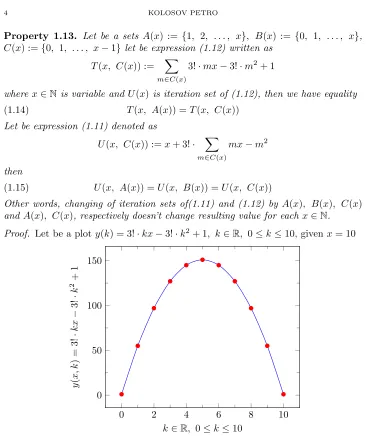
Other words, changing of iteration sets of(1.11) and (1.12) by A(x), B(x), C(x) andA(x), C(x), respectively doesn’t change resulting value for each x∈N. Proof. Let be a ploty(k) = 3!·kx−3!·k2+ 1, k∈
R, 0≤k≤10, given x= 10
0 2 4 6 8 10
0 50 100 150
k∈R, 0≤k≤10
y
(
x,
k
)
=
3!
·
k
x
−
3!
·
k
2 +
1
Figure 2. Plot ofy(k) = 3!·kx−3!·k2+ 1, k∈
R, 0≤k≤10, given x= 10 Obviously, being a parabolic function, it’s symmetrical over x2, hence equivalent
T(x, A(x)) = T(x, C(x)), x ∈ N follows. Reviewing (1.11) and denote u(t) =
txn−2−t2xn−3, we can conclude, thatu(0) =u(x), then equality ofU(x, A(x)) =
U(x, B(x)) =U(x, C(x)) immediately follows. This completes the proof.
Review above property (1.13). Let be an example of triangle built using
(1.16) y(n, k) = 3!·kn−3!·k2+ 1, 0≤k≤n, (n, k)∈N
(1.17)
Row 0: 1
Row 1: 1 1
Row 2: 1 7 1
Row 3: 1 13 13 1
Row 4: 1 19 25 19 1
Figure 3. Triangle generated by (1.16) from 0 ton= 4, sequence A287326 in OEIS [7].
We can see that for each row according to variable n = 0, 1, 2, 3, 4, ..., we have Binomial distribution of row items. One could compare Triangle (1.17) with Pascal’s triangle [3], [14]
Row 0: 1
Row 1: 1 1
Row 2: 1 2 1
Row 3: 1 3 3 1
Row 4: 1 4 6 4 1
Figure 4. Pascal’s triangle up to forth row, sequence A007318 in OEIS, [3], [14]. Note thatn-th row sum of Triangle (1.17) returns us perfect cuben3. Hereby, the
follow question is stated
Question 1.18. Has the Triangle (1.17) any connection with Pascal’s Triangle or others like Stirling or Euler, and is it exist similar patterns in order to receive expansion ofxj j >3?
2. Answer to the Question (1.18)
In section particular pattern (1.17), that is sequence A287326 in OEIS, [7], which shows us necessary items to expand x3, x ∈
N will be generalized and obtained results will be applied to show expansion of power functionf(x) =xn, (x, n)∈
N. To answer to the question (1.18), let review our Triangle (1.17) again. Next, let take away from each itemk, such that 0< k < nof Triangle (1.17) the value ofn2, then we have
(2.1)
1
1 1
1 3 1
1 4 4 1
1 3 9 3 1
Figure 5. Triangle generated by
(
3!·kn−3!·k2+ 1−n2, 0< k < n
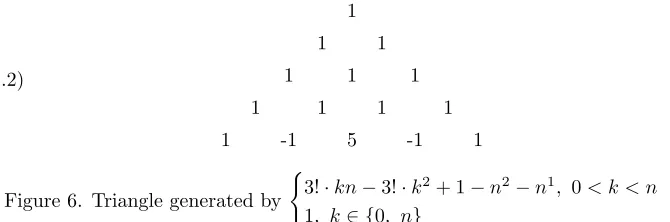
We can observe that summation ofn-th row of Triangle (2.1) overkfrom 0 ton−1 returns us the n2. It’s very easy to see that removingn1 from each itemk, such that 0< k < nof Triangle (2.1) and summing up receivedn-th rows overk from 0 ton−1 will resultn1, let show it
(2.2)
1
1 1
1 1 1
1 1 1 1
1 -1 5 -1 1
Figure 6. Triangle generated by
(
3!·kn−3!·k2+ 1−n2−n1, 0< k < n
1, k∈ {0, n}
Review the Triangle (2.2), we can say that above statement holds. Reviewing our Triangles (2.1), (2.2), let define generalized itemVM(n, k)
Definition 2.3.
(2.4) VM(n, k) := (
n0+n1+· · ·+nM, 0< k < n
1, k∈ {0, n}
Property 2.5. From definition (2.3) follows the equality between itemsVM(n, k) in rangek∈ {1, n−1}
∀k∈ {1, n−1}: VM(n, k) = VM(n, k+ 1≤n−1) (2.6)
= VM(n, k+ 2≤n−1)
. . .
= VM(n, k+j≤n−1), j∈N
Note thatk-th items of Triangles (2.1), (2.2), such that 0< k < nareV1(n, k), V2(n, k),
respectively. Reviewing our Triangles (2.1), (2.2), we could observe the identity
(2.7) nM =
n−1 X
k=0
VM−1(n, k), M ∈ {1,2,3}
Example 2.8. Review (2.7), let ben= 4, M = 3, then
43 = V2(4, 0) +V2(4, 1) +V2(4, 2) +V2(4, 3)
= 1 + 1 + 4 + 42
| {z } V2(4,1)
+ 1 + 4 + 42
| {z } V2(4,2)
+ 1 + 4 + 42
| {z } V2(4,3)
= 1 + 3(40+ 41+ 42) = 1 + 21 + 21 + 21
Hereby, let be Theorem
Theorem 2.9. Each power function f(x) = xn such that (x, n) ∈
N could be expanded next way
(2.10) xn=
x−1 X
k=0
Proof. Recall Triangle, consisting of itemsV0(x, k), that is analog of (2.2)
(2.11)
1
1 1
1 1 1
1 1 1 1
1 1 1 1 1
Figure 7. Triangle generated byV0(x, k), sequence A000012 in OEIS, [12].
Obviously, summation over rows of triangle (2.11) from 0 tox−1 gives us thex1.
Let show a second power by means ofV0(x, k), we have accordingly
(2.12) x2= 1 + (V0(x, 1) +x)
| {z }
V1(x, 1)
+ (V0(x, 2) +x)
| {z }
V1(x,2)
+· · ·+ (V0(x, x−1) +x)
| {z }
V1(x, x−1)
For example, consider the sum of third row of triangle (2.11), then we receive 31.
Hence, by power property
(2.13) xn=
x−1 X
k=0 xn−1
we have to add twice by 31to receive 32, i.e
32= 1 + (3 + 1) + (3 + 1)
Generalizing above result, for each (x, n)∈Nwe have identity x−1
X
k=0
Vn−1(x, k) =
(2.14)
= 1 + (x0+x1+· · ·+xn−1) +· · ·+ (x0+x1+· · ·+xn−1)
| {z }
x−1 times
= 1 + (x−1)(x0+x1+x2+· · ·+xn−1)
= x+ (x−1)x+ (x−1)x2+ (x−1)x3+· · ·+ (x−1)xn−1
= 1 + (x−1)Vn−1(x, k)
= 1 +xn−x0=xn
This completes the proof.
Also, (2.14) could be rewritten as
xn = 1 + (x−1) + (x−1)x+· · ·+ (x−1)xn−1
| {z }
ntimes
(2.15)
= 1 + n−1 X
k=0
(x−1)xk
= 1 + n−1 X
k=0
Define the power function f(x) = xn, such that (x, n) ∈ N and exponential functiong(x, k) =xk, x∈N, then expression (2.15) shows us the relation between exponential and power functions with natural base and exponent
(2.16) f(x) = 1 + n−1 X
k=0
g(x, k+ 1)−g(x, k)
Reader could also notice the connection between Maclaurin expansion 1−1x=x0+ x1+x2+x3+· · ·, −1< x <1 and (2.14), that is
(2.17) x n
x−1− 1
x−1
| {z }
− 1 1−x
=x0+x1+x2+· · ·+xn−1, ∀(x, n)∈N
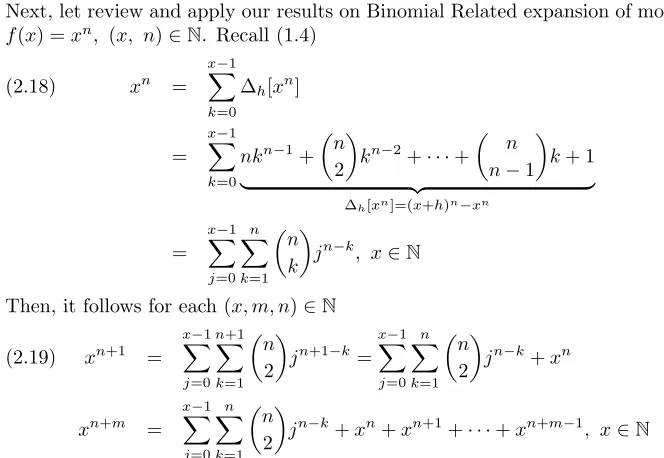
Next, let review and apply our results on Binomial Related expansion of monomial
f(x) =xn, (x, n)∈N. Recall (1.4)
xn = x−1 X
k=0
∆h[xn] (2.18)
= x−1 X
k=0
nkn−1+
n
2
kn−2+· · ·+
n
n−1
k+ 1
| {z }
∆h[xn]=(x+h)n−xn
= x−1 X
j=0 n X
k=1
n k
jn−k, x∈N
Then, it follows for each (x, m, n)∈N
xn+1 = x−1 X
j=0 n+1 X
k=1 n
2
jn+1−k= x−1 X
j=0 n X
k=1 n
2
jn−k+xn
(2.19)
xn+m = x−1 X
j=0 n X
k=1 n
2
jn−k+xn+xn+1+· · ·+xn+m−1, x∈N
To show one more property ofVM(n, k), let build Triangle givenV2(n, k)
(2.20)
1
1 1
1 3 1
1 4 4 1
1 5 5 5 1
Figure 8. Triangle generated byV2(n, k) overnfrom 0 to 9.
Reviewing above triangle, we could observe that summation of intermediate column gives us well known identity,
(2.21) x2=
|x|−1 X
k=0
ApplyingV2(n, k), we receive analog of above identity
(2.22) x2=
n−1 X
k=0
V2(2k, k), ∀(x, n)∈N
Note that upper expression (2.22) is partial case of (2.19), whenn+m= 2. Recall the Binomial (x+y)n, by means of (2.14) we have expansion
(2.23) (x+y)n= 1 + (x+y−1)Vn−1(x+y, k)
Hereby, let be lemma
Lemma 2.24. Relation between binomial expansion andVn−1(x, k)
(x+y)n = n X
k=0 n
k
xn−kyk = 1 + (x+y−1)Vn−1(x+y, k)
(2.25)
= 1 + (x+y−1)(x+y)0+ (x+y−1)(x+y)1+· · ·
+ +(x+y−1)(x+y)n−1
= 1 +x((x+y)0+ (x+y)1+ (x+y)2+· · ·+ (x+y)n−1)
+ y((x+y)0+ (x+y)1+ (x+y)2+· · ·+ (x+y)n−1)
− ((x+y)0+ (x+y)1+ (x+y)2+· · ·+ (x+y)n−1)
Multinomial case could be built as well as Binomial, hereby
(x1+x2+· · ·+xk) =
= 1 + (x1+x2+· · ·+xk−1)(x1+x2+· · ·+xk)0 (2.26)
+ (x1+x2+· · ·+xk−1)(x1+x2+· · ·+xk)1
+ (x1+x2+· · ·+xk−1)(x1+x2+· · ·+xk)2 ..
.
+ (x1+x2+· · ·+xk−1)(x1+x2+· · ·+xk)n−1
2.1. Finite Differences. In this subsection let apply received in previous section results to show finite differences of power functionf(x) =xn, such that (x, n)∈
N. From (2.14) we know identity
(2.27) f(x) = 1 + (x−1)(x0+x1+x2+· · ·+xn−1) = 1 + (x−1)Vn−1(x, k) =xn
Then, its finite difference ∆f(x) suppose to be
∆f(x) = f(x+ 1)−f(x) = (2.28)
= [1 +x((x+ 1)0+ (x+ 1)1+· · ·+ (x+ 1)n−1)
| {z }
xVn−1(x+1, k)
]
− [1 + (x−1)(x0+x1+x2+· · ·+xn−1)
| {z }
(x−1)Vn−1(x, k)=xn−1
]
= xVn−1(x+ 1, k)−(x−1)Vn−1(x, k)
= xVn−1(x+ 1, k)−xn−1
= xVn−1(x+ 1, k)−xVn−1(x, k) +Vn−1(x, k)
Example 2.29. Consider the example forf(x) =xn, x= 3, n= 3, then applying (2.27), we have
∆f(3) = f(4)−f(3) (2.30)
= [1 + 3((3 + 1)0+ (3 + 1)1+ (3 + 1)2)]
− [1 + (3−1)(30+ 31+ 32)]
= [3((3 + 1)0+ (3 + 1)1+ (3 + 1)2)]
− [(3−1)(30+ 31+ 32)]
= 63−26 = 37
Let generalize (2.27) and show high order finite difference of power f(x) =xn
by means ofVn−1(x, k), that is
(2.31) ∆m(xn) = m−1
X
k=0
(x−k)[Vn−1(x+m−k, t)−Vn−1(x+m−k+ 1, t)],
wheret6= 0. Derivative off(x) =xn could be written regarding to
(2.32) df(x)
dx = limh→0 xV
n−1(x+h, k)−(x−h)Vn−1(x, k) h
3. Properties of Triangle (1.17) and other expansions
Review the triangle (1.17), define the k-th, 0 ≤ k ≤ n, item of n-th row of triangle as
Definition 3.1.
(3.2) U(n, k) := 3!·nk−3!·k2+ 1, 0≤k≤n
Note that definition (3.1) also could be rewritten as
(3.3) U(n, k) = 3!·nk−3!·n0k2+n0, 0≤k≤n
Let us approach to show a few properties of triangle (1.17)
Properties 3.4. Properties of triangle (1.17).
(1) Summation of items U(n, k)of n-th row of triangle (1.17) over k from 0 ton−1 returns perfect cube n3 as binomial of the form
(3.5)
n−1 X
k=0
U(n, k) =A0,nn−B0,n=n3,
Since the property (1.14) holds, (3.5) could be rewritten as
(3.6)
n X
k=1
U(n, k) =A1,nn−B1,n=n3,
where A0,1,n and B0,1,n - integers depending on variable n ∈ N and on setsU(n), S(n), respectively.
(2) Recurrence relation betweenA0,n andA1,n
A0,n+1=A1,n, n≥1
(4) Summation of items U(n, k)of n-th row of triangle (1.17) over k from 0 tonreturns n3+n0
(3.7)
n X
k=0
U(n, k) =n3+ 1
(5) Induction by power. Summation of eachn-th row of triangle (1.17) multi-plied by nm−3 from0 tonreturns nm+nm−3
(6) First item of each row’s number corresponding to central polygonal num-bers sequencea(n)(sequence A000124 in OEIS,[13]returns finite difference ∆[n3] of consequent perfect cubes. For example, let be the k-th row of
tri-angle (1.17), such that k is central polygonal number, i.ek= n2+2n+2, n= 0, 1, 2, ..., N, then item
(3.8) U
n2+n+ 2 2 ,1
= ∆h(n3), h= 1
(7) Items of (1.17) have Binomial distribution over rows (8) The linear recurrence, for any k andn >0
(3.9) 2U(n, k) =U(n+ 1, k) +U(n−1, k)
(9) Linear recurrence, for each n > k
(3.10) 2U(n, k) =U(2n−k, k) +U(2n−k,0)
(10) From (3.8) follows that
(3.11) n3=
n−1 X
k=0
U(n, k) = n−1 X
k=0
U n2+n+ 2
2 ,1
(11) Triangle is symmetric, i.e
U(n, k) =U(n, n−k)
(12) Relation between Rascal Triangle A077028 and Triangle (1.17) A287326 A287326(n,k) = 6 * A077028(n,k) - 5
In (3.5) is noticed, that summation of eachn-th row of Triangle (1.17) from 0 to n−1 returns perfect cube n3, then, by properties (3.8), (3.9), (3.10), for each
(3.5) byxn−3
xn = x−1 X
k=0
U(x, k)xn−3=1 2
x−1 X
k=0
[U(x+ 1, k) +U(x−1, k)]xn−3
(3.12)
= x−1 X
k=0
1
2[U(2x−k, k) +U(2x−k,0)]x n−3
= x−1 X
k=0
1 2U
x2+x+ 2 2 ,1
xn−3
= x−1 X
k=0
1 2
U x2+x
2 ,1
+U
x2+x+ 4
2 ,1
xn−3
= x−1 X k=0 1 2 U
n+ 1
2
,1
+U
n+ 1
2 + 2 1 ,1 xn−3
To show other way of representation of power, let move the x from (1.12), x+ 3!P
mx−m2, under the sum operator and change iteration set from {0, x−
1} to{1, x−1}, then we get
(3.13) x3= x−1 X
m=1
3!·mx−3!·m2+ x
(x−1), x6= 1, x∈N
Review right part of (3.13), let be item x−x1 written as x−x1 = x+1x−−11 = 1 +x−11, given the power n > 3, multiplying each term of (3.13) by xn−3 we can observe that
(3.14) xn−1 = x−1 X
m=1
U(x, m)xn−3+xn−4+xn−5+· · ·+x+ 1
Applying properties (3.8), (3.9), (3.10), we can rewrite (3.14) as
xn−1 = x−1 X
k=1
1
2[U(2x−k, k) +U(2x−k,0)]x
n−3+xn−4+· · ·+x+ 1
= x−1 X
k=1
1
2[U(x+ 1, k) +U(x−1, k)]x
n−3+xn−4+· · ·+x+ 1
(3.15)
= x−1 X
m=0
1 2
h
U x2+x 2 ,1
+U x2+x+4 2 ,1
i
xn−3+xn−4+· · ·+x+ 1
= x−1 X
k=1
U x2+x+2
2 ,1
xn−3+xn−4+· · ·+ 1
Moving 1 from left part of (3.14) under sum operator, we add a term x−11 to initial functionU(x, m)xn−3+xn−4+xn−5+· · ·+x+ 1. By means of expansion
1 1−x =−
1
x−1 = 1 +x+x
2+x3+· · ·, the (3.14) could be rewritten accordingly
(3.16) xn= x−1 X
m=1
Generalizing (3.16) we have
xn = x−1 X
m=1
[U(x, m)−1]xn−3−xn−2−xn−1− · · ·
(3.17)
= x−1 X
m=1
U x2+x+ 2
2 ,1
−1
xn−3−xn−2−xn−1− · · ·
3.1. Generalized Binomial Series by means of properties (3.5), (3.6). Re-viewing properties (3.5), (3.6) we can say that for eachx=x0∈Nholds
(3.18) xn =A0,1,xxn−2−B0,1,xxn−3
Rewrite the right part of (3.18) regarding to itself as recursion
xn = A0,1,x(A0,1,xxn−4−B0,1,xxn−5)−B0,1,x(A0,1,xxn−5−B0,1,xxn−6)
= A20,1,xxn−4−2A0,1,xB0,1,xxn−5+B02,1,xxn−6
(3.19)
Reviewing above expression we can observe Binomial coefficients before eachA0,1,x· B0,1,x. Continuousj-times recursion of right part of (3.18) gives us
(3.20) xn=
j X
k=0
(−1)k
j k
Aj0−,1k,xB0k,1,xxn−2j−k
Suppose that we want to repeat action (3.19) infinite-many times, then
xn =
j
0
Aj
0,1,xB 0 0,1,xx
n−2j
− j
1
Aj−1
0,1,xB 1 0,1,xx
n−2j−1+ · · ·
(3.21)
− · · ·+ ∞
X
k (−1)k
j
k
Aj−k 0,1,xB
k 0,1,xx
n−2j−k+· · ·
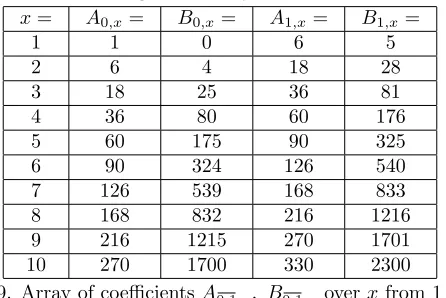
We know the solutions of above equation (3.18) for all A0,1,x, B0,1,x that present in follow table. The table arranged next way
x= A0,x= B0,x = A1,x= B1,x=
1 1 0 6 5
2 6 4 18 28
3 18 25 36 81
4 36 80 60 176
5 60 175 90 325
6 90 324 126 540
7 126 539 168 833
8 168 832 216 1216
9 216 1215 270 1701
10 270 1700 330 2300
Table 9. Array of coefficientsA0,1,x, B0,1,x overxfrom 1 to 10.
4. Exponential Function Representation
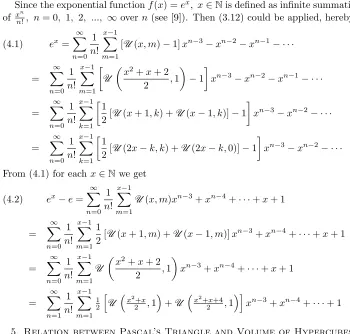
Since the exponential functionf(x) =ex, x∈Nis defined as infinite summation of xn
n!, n= 0, 1, 2, ..., ∞overn(see [9]). Then (3.12) could be applied, hereby
ex= ∞
X
n=0
1
n! x−1 X
m=1
[U(x, m)−1]xn−3−xn−2−xn−1− · · ·
(4.1) = ∞ X n=0 1 n! x−1 X
m=1
U x2+x+ 2
2 ,1
−1
xn−3−xn−2−xn−1− · · ·
= ∞ X n=0 1 n! x−1 X
k=1 1
2[U(x+ 1, k) +U(x−1, k)]−1
xn−3−xn−2− · · ·
= ∞ X n=0 1 n! x−1 X
k=1 1
2[U(2x−k, k) +U(2x−k,0)]−1
xn−3−xn−2− · · ·
From (4.1) for eachx∈Nwe get
ex−e= ∞
X
n=0
1
n! x−1 X
m=1
U(x, m)xn−3+xn−4+· · ·+x+ 1 (4.2) = ∞ X n=0 1 n! x−1 X
m=1
1
2[U(x+ 1, m) +U(x−1, m)]x
n−3+xn−4+· · ·+x+ 1
= ∞ X n=0 1 n! x−1 X
m=1
U x2+x+ 2
2 ,1
xn−3+xn−4+· · ·+x+ 1
= ∞ X n=1 1 n! x−1 X
m=1 1 2 h
U x2+x 2 ,1
+U x2+2x+4,1ixn−3+xn−4+· · ·+ 1
5. Relation between Pascal’s Triangle and Volume of Hypercubes
In this section let review and generalize well known fact about connection be-tween row sums of Pascal triangle and 2−dimension Hypercube, recall property
(5.1) n X k=0 n k
= 2n
Now, let multiply eachk-th term of ofn-th row of Pascal’s triangle [3] by 2k 1
1 2
1 4 4
1 6 12 8
1 8 24 32 16
Figure 10. Triangle built by nk
·2k, 0≤k≤n≤4. We can notice that
(5.2) n X k=0 n k
Hereby, let be theorem
Theorem 5.3. Volume of n-dimension hypercube with length m could be calculated as
(5.4) mn=
n X k=0 k X j=0 n k k j
(−1)k−jmj
where m and n - positive integers.
Proof. Recall induction overm, in (5.1) is shown a well-known example form= 2.
(5.5) 2n=
n X k=0 n k
(2−1)k
Review (5.5) and suppose that
(5.6) (2 + 1
| {z } m=3
)n= n X k=0 n k
·((2−1) + 1
| {z }
m−1
)k
And, obviously, this statement holds by means of Newton’s Binomial Theorem [1], [2] givenm= 3, more detailed, recall expansion for (x+ 1)n to show it.
(5.7) (x+ 1)n =
n X k=0 n k xk
Substitutingx= 2 to (5.7) we have reached (5.6).
Next, let show example for eachm∈N. Recall Binomial theorem to show this
(5.8) mn=
n X k=0 n k
·(m−1)k
Hereby, form+ 1 we receive Binomial theorem again
(5.9) (m+ 1)n=
n X k=0 n k
·mk
Review result from (5.8) and substituting Binomial expansionPk j=0
k j
(−1)n−kmj instead (m−1)k we receive desired result
mn =
n X k=0 n k
· (m−1)k
| {z } Pk
j=0( k
j)(−1)k−jmj
= n X k=0 n k k X j=0 k j
(−1)k−jmj
(5.10) = n X k=0 k X j=0 n k k j
(−1)k−jmj
This completes the proof.
The (5.5) is analog of MacMillan Double Binomial Sum (see equation 13 in [16]).
Lemma 5.11. Number of elements k−face elements Ek(Ynp) of Generalized Hy-percube Yp
n equals to
(5.12) Ek(Ypn) = k X j=0 n k k j
We also can observe that
xn−1 = n X k=1 n k
+xn−1= n X k=1 n k + n X k=1 n k
+xn−2 ! (5.13) = n X k=1 n k + n X k=1 n k + n X k=1 n k +· · · !
| {z }
n−times continued summation
In sense of Gauss Continued fraction operatorK, we can receive
xn−1 = n X k=1 " n k + n K j=1
(n−j X
k=1 n
k
+xn−j )#
6. Conclusion and future research
In this paper particular pattern, that is sequence A287326 in OEIS, [7], which shows us necessary items to expand x3, x ∈
N will be generalized and obtained results will be applied to show expansion of power functionf(x) =xn, (x, n)∈
N. The coefficientU(n, k) was introduced in definition (3.1), its properties are shown in (3.4). Power function’s xn, (x, n) ∈
N expansion firstly shown in (2.15) and other versions are shown below. In section 4 we show a various representations of exponential function ex, x ∈
N. We attach a Wolfram Mathematica codes of most important equations in Application 1. Extended version of Triangle (1.17) is attached in Application 2. Future research should be done inU(nm, kj), m, j∈
N to verify its properties. A research on finding difference and consequently derivative using (3.12) and extend it over real functions applying Taylor’s theorem also could be done. In subsection (2.1) finite differences by means ofVM(n, k) are shown. The difference of received method from Binomial theorem lays in fact that for Binomial expansion n-th row of Pascal’s triangle denotes the power of x, but in case of Triangle (1.17) n-th row denotes variable to power, corresponding to VM(n, k). Reviewing MacMillan Double Binomial Sum [16], we can observe that it reached by means of Stirling Numbers of Second Kind.
References
[1] M. Abramowitz and I. A. (Eds.) Stegun.Handbook of Mathematical Functions with Formulas, Graphs, and Mathematical Tables. New York: Dover, 9th edition, 1972. ISBN: 0486612724. [2] G. Arfken.Mathematical Methods for Physicists. Orlando, FL: Academic Press, 3rd edition,
1985. ISBN: 0123846544.
[3] J. H. Conway and R. K. Guy. ”Pascal’s Triangle.” In The Book of Numbers. New York: Springer-Verlag, 1996. ISBN: 978-0387979939.
[4] N. J. A. Sloane et al. Coordination sequence for hexagonal lattice. https://oeis.org/ A008458, 2002.
[5] Joshua Giambalvo. Entry a275709.https://oeis.org/A275709, 2016.
[6] Joe Keane. 6 times triangular numbers: a(n) = 3*n*(n+1).https://oeis.org/A028896, 1999. [7] et al. Kolosov Petro. ”triangle read by rows: T(n,k) = 6*k*(n-k)+1”. https://oeis.org/
A287326, 2017.
[8] C. H. Richardson.An Introduction to the Calculus of Finite Differences. Literary Licensing, LLC, 1954. ISBN: 978-1258324612.
[10] Bakhvalov N. S. Numerical Methods: Analysis, Algebra, Ordinary Differential Equations. MIR, 1st edition, 1977. ASIN: B000YC4GMM (In russian).
[11] N. J. A. Sloane. The on-line encyclopedia of integer sequences.https://oeis.org/, 1964. [12] N. J. A. Sloane. The all 1’s sequence.https://oeis.org/A000012, 1994.
[13] N. J. A. Sloane. Central polygonal numbers.https://oeis.org/A000124, 1994.
[14] N. J. A. Sloane and Mira Bernstein et al. Pascal’s triangle.http://oeis.org/A007318, 1994. [15] Eric W. Weisstein. Finite difference. http://mathworld.wolfram.com/FiniteDifference.
html.
[16] Eric W. Weisstein. Power.http://mathworld.wolfram.com/Power.html.
7. Application 1. Wolfram Mathematica codes of some expressions
In this section Wolfram Mathematica codes of most expressions are shown. Note that Mathematica.cdf-file of all mentioned expressions is available for download at this link. The.txt-file reader could find here. Define coefficientU(n, k), definition (3.1)
U[n , k ] := 3!∗n∗k−3!∗kˆ2 + 1
Check of property (3.8)
U[(nˆ2 + n + 2)/2, 1]
Check of expression (3.12),xn
1/2∗Sum[(U[2∗x−k, k] + U[2∗x−k, 0])∗xˆ(n −3), {k, 0, x−1}] 1/2∗Sum[(U[x + 1, k] + U[x−1, k])∗xˆ(n−3),{k, 0, x−1}] 1/2∗Sum[(U[(kˆ2 + k)/2, 1] + U[(kˆ2 + k + 4)/2, 1])∗xˆ(n−3),
{k, 0, x −1}]
Sum[U[x, k]∗xˆ(n−3), {k, 0, x−1}]
Sum[U[(kˆ2 + k + 2)/2, 1]∗xˆ(n−3),{k, 0, x−1}]
Generating formula of Triangle (1.17), Figure 3
Column[Table[U[n, k], {n, 0, 5},{k, 0, n}], Center]
Expression (3.14),xn−1
Expression (3.15),xn−1 using properties (3.8), (3.9), (3.10)
Sum[1/2∗(U[2∗x−k, k] + U[2∗x−k, 0])∗xˆ(n −3) + Sum[xˆ(n−t),{t, 4, n}], {k, 1, x −1}]
Sum[1/2∗(U[x + 1, k] + U[x−1, k])∗xˆ(n−3) + Sum[xˆ(n−t),{t, 4, n}], {k, 1, x −1}]
Sum[1/2∗(U[(kˆ2 + k)/2, 1] + U[(kˆ2 + k + 4)/2, 1])∗xˆ(n−3) + Sum[xˆ(n−t),{t, 4, n}], {k, 1, x −1}]
Sum[U[(kˆ2 + k + 2)/2, 1]∗xˆ(n−3) +Sum[xˆ(n−t),{t, 4, n}],
{k, 1, x −1}]
Expression (3.16),xn
Sum[U[x, m]∗xˆ(n−3) +Sum[xˆ(n−t),{t, 4, n}]−
Sum[xˆj,{j, 0, Infinity}], {m, 1, x −1}]
Expression (3.17), generalized version of (3.16),xn
Sum[(U[x, m]−1)∗xˆ(n−3)−
Sum[xˆ(n−3 + j),{j, 1, Infinity}], {m, 1, x −1}] Sum[(U[(mˆ2 + m + 2)/2, 1]−1)∗xˆ(n−3)−
Sum[xˆ(n−3 + j),{j, 1, Infinity}], {m, 1, x −1}]
Section 4, Expression (4.1),ex representation
Sum[1/n!∗Sum[(U[x, m]−1)∗xˆ(n −3)−Sum[xˆ(n−3 + j),
{j , 1, Infinity}], {m, 1, x −1}], {n, 0, Infinity}] Sum[1/n!∗Sum[(U[(mˆ2 + m + 2)/2, 1]−1)∗xˆ(n −3)−
Sum[xˆ(n−3 + j),{j, 1, Infinity}], {m, 1, x −1}],
{n, 0, Infinity}]
Sum[1/n!∗Sum[(1/2∗(U[x + 1, m] + U[x−1, m])−1)∗xˆ(n −3)−
Sum[xˆ(n−3 + j),{j, 1, Infinity}], {m, 1, x −1}],
{n, 0, Infinity}]
Sum[1/n!∗Sum[(1/2∗(U[2x−m, m] + U[2x−m, 0])−1)∗xˆ(n −3)−
{n, 0, Infinity}]
Section 4, Expression (4.2),ex−erepresentation
Sum[1/n!∗Sum[U[x, m]∗xˆ(n −3) +
Sum[xˆ(n−t),{t, 4, n}], {m, 1, x −1}], {n, 0, Infinity}] Sum[1/n!∗Sum[1/2∗(U[x + 1, m] + U[x−1, m])∗xˆ(n −3) + Sum[xˆ(n−t),{t, 4, n}], {m, 1, x −1}], {n, 0, Infinity}] Sum[1/n!∗Sum[U[(mˆ2 + m + 2)/2, 1]∗xˆ(n −3) +
Sum[xˆ(n−t),{t, 4, n}], {m, 1, x −1}], {n, 0, Infinity}] Sum[1/(n!)∗
Sum[1/2∗(U[(mˆ2+m+1)/2, 1] + U[(mˆ2+m+3)/2, 1])∗xˆ(n −3) + Sum[xˆ(n−t),{t, 4, n}], {m, 1, x −1}], {n, 0, Infinity}]
Expression (5.10), Binomial identity
Sum[Sum[Binomial[n,k]∗Binomial[k,j]∗(−1)ˆ(k−j)∗mˆj,
{j , 0, k}],{k, 0, n}]
8. Application 2. An extended version of triangle (1.17)
Row 0: 1
Row 1: 1 1
Row 2: 1 7 1
Row 3: 1 13 13 1
Row 4: 1 19 25 19 1
Row 5: 1 25 37 37 25 1
Row 6: 1 31 49 55 49 31 1
Row 7: 1 37 61 73 73 61 37 1
Row 8: 1 43 73 91 97 91 73 43 1
Row 9: 1 49 85 109 121 121 109 85 49 1 Row 10: 1 55 97 127 145 151 145 127 97 55 1
Figure 11. Extended version of Triangle (1.17) generated from givenn= 3 overx
![Table 1: Difference table of xNote that increment3, x ∈ N up to third order, [15], eq. 7 h is set to be h = 1 and k > 2-order difference is taken](https://thumb-us.123doks.com/thumbv2/123dok_us/1081835.1608919/3.612.126.487.70.667/table-dierence-table-xnote-increment-order-order-dierence.webp)
![Figure 4. Pascal’s triangle up to forth row, sequence A007318 in OEIS, [3], [14].](https://thumb-us.123doks.com/thumbv2/123dok_us/1081835.1608919/5.612.223.394.288.357/figure-pascal-triangle-forth-row-sequence-a-oeis.webp)
![Figure 7. Triangle generated by V0(x, k), sequence A000012 in OEIS, [12].](https://thumb-us.123doks.com/thumbv2/123dok_us/1081835.1608919/7.612.121.490.174.694/figure-triangle-generated-v-x-sequence-a-oeis.webp)
![Figure 11. Extended version of Triangle (1.17) generated from given n = 3 over xfrom 0 to 10, sequence A287326 in OEIS, [7], [11].](https://thumb-us.123doks.com/thumbv2/123dok_us/1081835.1608919/19.612.170.434.461.615/figure-extended-version-triangle-generated-given-xfrom-sequence.webp)