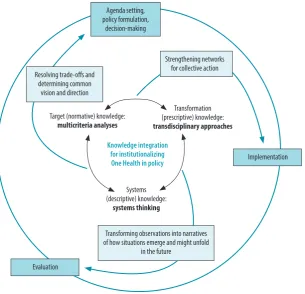
Knowledge integration in One Health policy formulation,
implementation and evaluation
Martin Hitziger,
aRoberto Esposito,
bMassimo Canali,
cMaurizio Aragrande,
cBarbara Häsler
d& Simon R Rüegg
aIntroduction
The concept of One Health initially arose from integrated research on zoonoses,1,2 but now covers all of the
interconnec-tions between human, animal and environmental health. The concept is a collaborative, interdisciplinary and intersectoral multi-institutional approach, linking many different forms of knowledge and expertise.3–5 One Health is represented by
a complex biological and social system that involves multiple actors and processes and their interactions over time, at local, national and global levels.5 To date, relatively little attention
has been given to the epistemological, institutional, political and social factors associated with the implementation of a One Health approach.2,6 This is illustrated by the almost complete
lack of literature on One Health governance.
There is an existing framework for global health gover-nance: a combination of the formal and informal institutions, rules and processes that influence global decisions on health policy.7,8 Ideally, such a framework should transcend national
boundaries, embrace multisectoral and interdisciplinary ap-proaches and engage with the whole wide range of relevant actors.9 In reality, however, the current framework is affected
by fragmentation of health interests, programmes and sectors, a general lack of societal participation and by professional focus on very limited areas of expertise, so-called professional silos.10,11
The dysfunctionality of the current framework, in terms of the core elements of the One Health concept, emphasizes the need for a dedicated framework for One Health governance.12
It has been suggested that some of the current framework’s shortcomings could be overcome by the development of co-ordinated supranational bodies, the promotion of specialized training and career opportunities and the creation of dedicated funding mechanisms.9,12–14 We suggest that the framework
may also be strengthened by improving the integration of its management4,7,15 and by integrating knowledge at all stages
of any related policy development.16–18 In 2012, knowledge
integration was listed as one of the United States National Cancer Institute’s key recommendations for improving 21st century epidemiology.19
Since 2014, about 230 experts and representatives of governments and nongovernmental organizations, from the fields of environmental, public and veterinary health and associated sciences, have come together in the Network for Evaluation of One Health.20 This network’s main aim is to
de-velop standards for assessing integration in One Health. Since 2016, this work has been enhanced by a core group of experts on complex systems, governance and knowledge integration. This paper summarizes the results of this group’s investigation of knowledge integration in governance, as a mechanism for multi-institutional learning to improve the governance and coordination of One Health implementation in the absence of hierarchical chains of command.
Coordination and governance
In policy cycles, multiple rounds of agenda setting, policy formulation, decision-making, implementation and evalu-ation lead to the creevalu-ation, implementevalu-ation and revision of policies.21 We believe that, in terms of the interdisciplinary,
intersectoral and multi-institutional One Health approach, knowledge integration at every stage of policy development, in every policy cycle, could strengthen the coordination and governance of One Health implementation. Although some integration of knowledge from different disciplines, institu-tions and sectors can, and does, take place intuitively, in many circumstances, we believe that it needs to become a regular, routine and institutionalized process at project, programme and policy levels.8,18,22 In the development of health policies,
knowledge assessment is often confined to the last, that is evaluation, stage of each policy cycle.23 We believe that, to op-Abstract The One Health concept covers the interrelationship between human, animal and environmental health and requires multistakeholder collaboration across many cultural, disciplinary, institutional and sectoral boundaries. Yet, the implementation of the One Health approach appears hampered by shortcomings in the global framework for health governance. Knowledge integration approaches, at all stages of policy development, could help to address these shortcomings. The identification of key objectives, the resolving of trade-offs and the creation of a common vision and a common direction can be supported by multicriteria analyses. Evidence-based decision-making and transformation of observations into narratives detailing how situations emerge and might unfold in the future can be achieved by systems thinking. Finally, transdisciplinary approaches can be used both to improve the effectiveness of existing systems and to develop novel networks for collective action. To strengthen One Health governance, we propose that knowledge integration becomes a key feature of all stages in the development of related policies. We suggest several ways in which such integration could be promoted.
a Epidemiology Section, Vetsuisse Faculty, University of Zurich, Winterthurerstrasse 270, 8057 Zürich, Switzerland. b External Relation Office, National Institute of Health, Rome, Italy.
c Department of Agricultural and Food Sciences, University of Bologna, Bologna, Italy.
d Department of Pathobiology and Population Sciences, Royal Veterinary College, London, United Kingdom.
Correspondence to Martin Hitziger (email: [email protected]).
timize the coordination and governance of the One Health approach, knowledge integration should be central at every stage of policy development.
In its broadest sense, knowledge integration has been defined as the build-ing of shared and meanbuild-ingful syntheses between distinct mental models, based on a recognition and explanation of the relevant differences between the mod-els.24,25 Rather than seeking consensus,
knowledge integration can be used to build a common framework that allows an understanding of the links between the knowledge of multiple individuals. Such integration has been likened to the weaving of multiple perspectives into a central vision or a search for coherence and correspondence.26,27 The fostering
of effective knowledge integration in a policy cycle is a multidimensional chal-lenge because it requires the integration of cognitive concepts, organizational and social interests and perspectives as well as communicative and cultural factors. The relevant literature distinguishes target knowledge from systems and transfor-mation knowledge. Target, or norma-tive, knowledge relates to objectives and interests, while systems, or descriptive, knowledge relates to perspectives on factual processes. Transformation, or prescriptive, knowledge relates to the transformation of the current version of a system towards a more desired version.28
The integration of these three forms of knowledge throughout a policy cycle can be facilitated by three different ap-proaches: multicriteria analyses for target knowledge, systems thinking for systems knowledge and transdisciplinary ap-proaches for transformation knowledge.
Multicriteria analyses
The key to integrating target knowledge is to understand the often-conflicting interests, preferences and values of the multiple actors, as a first step to mediation, negotiation and, ultimately, collective action.29 Multicriteria analyses
can assist such integration because they elicit and structure value systems in a way that accommodates a multiplicity of information sources and types.30 Such
analyses can incorporate any objective that has relevance to the point of view under consideration, rely on non-monetary units and apply valuation methods that are independent of pricing mechanisms. This makes these analyses particularly suited for priority setting in implementation of the One Health
ap-proach, which typically involves equity, intergenerational justice and non-mar-keted goods.31,32 When combined with
systems analysis for strategic, long-term assessments, multicriteria analyses offer a flexible yet systematic method of valu-ation that can bridge the gap between governance and action.33,34
Systems thinking
Systems knowledge refers to an under-standing of the complex interactions, between the many actors and processes in the fields of human, animal and envi-ronmental health that emerge and feed back over long time scales. To integrate such knowledge, the management disci-pline known as systems thinking can be used. Systems thinking can assist human thought by permitting the analytical in-ference of dynamic consequences, from complex nets of long causal chains that often have feedback loops and unin-tended effects. System thinking also al-lows information from multiple sources, e.g. quantitative data, expert knowledge and stakeholders’ experiential insight, to be combined systematically.35,36 These
different sources of information are complementary because of missing data, methodological differences and interest-based selective perception, even among members of the same scientific team.37,38
By using all of the available relevant information to understand the possible outcomes of policy interventions and by linking diverse bodies of relatively abstract information with the narratives that guide everyday experience, systems thinking can reduce uncertainty in com-plex governance problems.15,39,40
Transdisciplinarity
Transdisciplinary approaches, which are sometimes called boundary manage-ment, are designed to build a bridge, at the science–policy interface and between potentially diverse knowledge systems, by facilitating communica-tion, mediation and translation across cultural, disciplinary, institutional and/ or sectoral divides. Although multiple analytic methods may be employed,29,37
the distinctive characteristics of such approaches are mainly sociocultural and aim to foster collective action towards societal transformations.38,41,42 They
include the selection of actors that legiti-mately represent the interest groups of relevance to the research problem. Co-leadership helps to ensure the equitable representation of interests and
perspec-tives and to mitigate power differentials. The joint negotiation and definition of research objectives and hypotheses is a crucial step in linking target knowledge, building mutual understanding and en-abling successful collaborations. Linking narratives and experiential perceptions with conceptual or explanatory, systems knowledge is a central challenge. This challenge can be overcome by careful consideration and the development of a deep understanding in experiential encounters, by repeatedly exposing the different bodies of knowledge to each other and by working towards joint outputs. The sustained commitment of the varied stakeholders needs to be supported by strong leadership, trust building and conflict management.28,29,37
Transdisciplinary approaches may make three crucial contributions to societal transformations. First, they create so-cial contexts for successful knowledge integration, even where such contexts do not occur naturally. Second, as a result of their collaborative and interactive nature, they tend to produce knowledge that is generally perceived as credible, legitimate and salient. Finally, by foster-ing collaboration among societal and scientific partners, they can build trust and networks that are independent of any hierarchical chains of command.
Case studies
We believe that the effective implemen-tation of the One Health strategy, as an interdisciplinary and intersectoral approach that links different forms of knowledge and expertise across multiple institutions, depends on knowledge integration. Six case studies support this view: three general One Health initiatives and three integrated health initiatives that included multicriteria analyses, systems thinking or a trans-disciplinary approach (Table 1).
Integration of target knowledge
The integration of target knowledge has been fostered by including stakeholder perspectives in agenda setting and decision-making, through either explicit co-leadership and negotiation43,45,48 or
changes of perspective in collaborative work assignments.44,46,48 In Quebec,
Knowledge integration in One Health governance Martin Hitziger et al.
Table 1.
Comparison of int
egra
tion of thr
ee types of k
no
wledge in six initia
tiv
es
Initia
tiv
e, countr
y, study period
General details Int egra tion Sy st ems k no wledge Tar get k no wledge Transf orma tion k no wledge O
ne Health initia
tiv es W est N ile Virus sur veillanc e, I taly , from 2013 43 In ter -institutional w or king g roups
of local and r
eg
ional author
ities in
human, animal and en
vir onmen tal health, c ov er ing Emilia-R omag na, Lombar
dy and P
iedmon
t.
Implemen
ta
tion of in
teg
ra
ted
sur
veillanc
e of bir
ds
, horses
, humans
and mosquit
os
, including sampling
pr ot oc ols , t echnical pr oc edur es , da ta-shar ing ag reemen
ts and public
inf or ma tion campaig ns . Compr ehensiv e c onc eptual frame w or
k, multispecies sampling
pr ot oc ols , da ta shar
ing and link
ing
of inf
or
ma
tion in in
ter disciplinar y gr oups allo w ed f or in teg ra tion of syst ems k no wledge . Dissemina tion
to the gener
al public pr
omot
ed via
seminars and educa
tional ac
tivities
.
Shar
ed leadership f
ost
er
ed in
teg
ra
tion of tar
get
kno
wledge
. Objec
tiv
es and tar
gets , f or o ver all initia tiv
e and individual exper
t t eams , w er e w ell defined . L
ack of funding f
or specific tar
gets
demonstr
at
ed the inc
omplet e alig nmen t of objec tiv es bet w een c en
tral and local le
vels
.
Institutional set
-up lacked flexibilit
y f
or adapta
tion.
Str
ong institutional back
ing and
complex and c
ompet en t ac tor net w or k facilita ted leg itimac y, implemen ta
tion and r
esilienc
e.
Join
t field ac
tivities cr
ea
ted a t
eam
spir
it and f
ost er ed c ommunica tion. Annual plenar
y meetings impr
ov ed eff ec tiv eness . Ho w ev er , public in volv emen
t and ac
cessibilit y of transf or ma tion k no wledge w er e consider ed limit ed . Opisthor chiasis c on
trol in L
aw a pr ovinc e, Thailand , fr om 2005 44 Longstanding r esear ch tr ack a t local univ ersit y c omplemen ted with c ommunit y-based in teg ra ted sur veillanc e, par asit
e sampling in
fish, human scr
eening
, medical
trea
tmen
t and educa
tion campaig
ns
tar
get
ed a
t public and schools
. Linked to in ter na tional helmin th c on trol pr og ramme . Resear
ch on opisthor
chiasis
endemicit
y and human pr
ev
alenc
e.
Collabor
ation with c
ommunit y members f or da ta c ollec tion and dissemina tion f ost er ed in teg ra tion
of local syst
ems k
no
wledge
.
The need f
or a mor
e in teg ra ted sur veillanc e appr oach, t o understand transmission dynamics , w as rec og niz ed . An it er ativ e appr oach, t o facilita
te mutual lear
ning in
local c
ommunities
, r
esult
ed in an incr
easingly br
oad
sc
ope and c
ompr ehensiv e objec tiv es . H igh le vel
of local c
ommitmen
t and c
ollabor ation indica ted a str ong alig nmen
t of tar
get k no wledge bet w een initia tiv
e and all local ac
tors and stakeholders
. Tr ansf or ma tion k no wledge in teg ra ted via c ollabor
ation with, and capacit
y
building in, local hospitals
. E duca tion str at eg ies f or c ommunities and
schools aimed t
o f ost er tr ansf or ma tion kno
wledge among gener
al public
.
Pr
oduc
tion of manuals should allo
w
replica
tion of appr
oach. Str at eg ic plan for implemen ting One Health, Ken ya, fr om 2011 45 Establishmen
t of in
ter
minist
er
ial
committ
ees and task f
or
ces in char
ge of pr og ramme de velopmen t, e .g . a na
tional influenza task f
or ce , a zoonosis t echnical w or king g roup ,
One Health z
oonotic disease units a
t
cen
tral and per
ipher
al le
vels and a
One Health task f
or ce c ov er ing c en tral and east er n A frica. Establishmen t of
One Health offic
es within disease
units and a na
tional One Health
secr etar ia t. Join t situa
tion analyses of z
oonotic
diseases and the adoption of a One Health appr
oach in r
outine and/ or emer genc y ac tivities f ost er ed a shar
ed understanding of syst
ems kno wledge . D ev elopmen
t of a One Health str
at
egy/ac
tion plan
str
engthened c
ommon vision and dir
ec tion a t oper ational/institutional le vel . I nadequa te funding for c oor dina ted ac
tivities and lack of political will
indica
ted insufficien
t alig
nmen
t of objec
tiv es bet w een initia tiv
e and high-le
vel decision-makers
.
A lack of institutional ar
rangemen
ts
for c
oor
dina
tion and c
ollabor
ation
bet
w
een the line agencies and
oper ational depar tmen ts indica ted tha t net w or ks f or c ollec tiv e ac tion needed t
o be str
Initia
tiv
e, countr
y, study period
General details Int egra tion Sy st ems k no wledge Tar get k no wledge Transf orma tion k no wledge O ther initia tiv es a Re vie
w of c
omplex in tersec tor al ser vic es f
or child pr
ot ec tion, the Unit ed K ingdom, 2010–2011 46
Analysis of en
tir e child-pr ot ec tion syst em t o r evie
w and impr
ov e ser vic e pr ovision a t na tional le vel . Collabor ativ e in teg ra
tion of e
videnc
e
with stakeholders acr
oss en
tir
e chain
of in
ter
ests and r
esponsibilities: aff ec ted individuals , char ities , family pr oc eedings c our ts
, local institutions
,
na
tional depar
tmen
t of educa
tion and pr of essionals . Author
ities and stakeholders join
tly
defined 60 r
ele van t v ar iables , and pr ovided e videnc
e on their
rela
tions
, in
ter
ac
tions and f
eedback loops . T her e w as in teg ra tion of syst ems k no wledge thr ough personal in ter ac tions , facilita ted by join
t building and analysis of
syst
em dynamics models
. Gr
oup
understanding de
veloped in join
t
model analysis and v
alida tion. Tar get k no wledge w as in teg ra
ted via analysis of ac
tor
tar
gets
, as det
er
minan
ts of syst
em beha viour . In teg ra
tion of tr
ansf or ma tion kno wledge suppor ted b y join t
definition and analysis of sc
enar
ios
for tr
ansf
or
ming the ac
tivities
and struc
tur
es of the
child-pr ot ec tion sec tor . T rust , net w or ks and c ollabor ativ
e capacities f
or implemen ta tion w er e str engthened acr oss hier ar
chies and sec
tors
.
One Health sur
veillanc
e and c
on
trol
,
Canada, 2010–2012
47
Analysis of in
teg ra ted L yme disease sur veillanc
e and c
on trol str at eg ies to suppor t decision-mak ing and pr og ramme dir ec
tion of public health
author
ities in Quebec
. C
ollabor
ation
with fiv
e na
tional and r
eg
ional
author
ities in ag
ricultur
e, en
vir
onmen
t
and public health. A
ct
or perspec
tiv
es
on 11 str
at
eg
ic option
’s eff
ec
ts on 16
tar
get cr
iter
ia w
er
e analysed under
emer
ging and epidemic outbr
eak sc enar ios . Focus g roups , exper t in ter vie ws and lit er atur e r evie w facilita ted in teg ra
tion of syst
ems k
no
wledge
by join
t pr
oblem definition and
per
for
manc
e assessmen
t of str
at eg ic options . Tar get k no wledge w as in teg ra ted b y defining tar
gets in dialogue
, discussion and r
eflec
tion, b
y the
elicita
tion and syst
ema
tic analysis of stakeholder
institution
’s perspec
tiv
es on tar
get w eigh ts f or animal , en vir onmen
tal and public
, health, ec
onomic
,
oper
ational
, social and str
at eg ic impac ts and sur veillanc
e, and b
y join
t r
eflec
tion on, and v
alida
tion
of the r
esulting multicr iter ia assessmen ts . Suppor ted in teg ra ted tr ansf or ma tion kno wledge thr ough join t elabor ation of str at eg
ic options and tar
get
cr
iter
ia, indica
tors and scales
tha t w er e r ele van t t o per tinen t author ities . P ar ticipa
tion in r
esear
ch,
analysis and da
ta analysis built
collabor ativ e capacities , net w or ks f or implemen ta
tion and trust
. In ter cultur al c ollabor ation f or in teg ra
ted health, Gua
temala,
2012–2015
48
Analysis of impac
ts
, of a facilita
ted
transdisciplinar
y appr
oach, on trust
,
net
w
or
ks and mutual lear
ning among
biomedical doc
tors and tr
aditional
M
ay
a healers
. All in a c
oun tr y wher e struc tur al violenc
e hampers the
de
velopmen
t of in
teg ra tiv e health syst ems . C ollabor ativ e r ef er ral desig ned t o in teg ra te diff er en t health syst
ems in pa
tien ts ’ health-seek ing pa th w ays . In teg ra
tion of syst
ems k
no
wledge
facilita
ted among pr
ac
titioners
via join
t desig
n and v
alida
tion of
empir
ical r
esear
ch on bar
riers t o in teg ra tiv
e health ser
vic es . Gr oup understanding w as de veloped thr ough w or kshop t echniques and
the changes in perspec
tiv e tha t oc cur red dur ing join t fieldw or k. In teg ra
tion of tar
get k no wledge w as suppor ted thr ough incr
eased understanding of the perspec
tiv
es
of other par
ticipa
ting ac
tors and via negotia
tion
of the char
ac
ter
istics and objec
tiv
es of the
transdisciplinar y appr oach. In teg ra
tion of tr
ansf or ma tion kno wledge w as suppor ted b y str engthening c ollabor ativ e capacities ,
by an impr
ov
ed understanding of
vie
wpoin
ts of other ac
tors which in
man
y other pr
ojec
ts r
emain hidden
because of the seg
rega
tion of
institutions and sec
tors
, and b
y the join t de velopmen t, implemen ta tion, and assessmen
t of pilot models
for institutional and oper
ational
transf
or
ma
tion.
a I
nitia
tiv
es tha
t applied specific k
no
wledge in
teg
ra
tion appr
oaches in fields of r
ele
vanc
e t
o One Health.
Knowledge integration in One Health governance Martin Hitziger et al.
investigation, a participative approach that involved health professionals and other stakeholders from governmental and nongovernmental organizations was used to compare several surveil-lance strategies in terms of their likely animal, environmental and public health and socioeconomic impacts. The stake-holder group provided input during the definition of management strategies, the assessment of objectives and their relative importance and the scoring of the strategies in terms of their likely at-tainment of the objectives. Since stake-holders represented their institutional perspectives, the process presumably assured the balanced representation of each of the relevant institutional view-points. The analyses allowed preference rankings of several possible intervention strategies for the management of Lyme disease, facilitated a better understand-ing of the conflicts between the key objectives and the relevance of such conflicts to each stakeholder group, and apparently improved each stakeholder group’s appreciation of the preferences and priorities of the other stakeholder groups. In short, the analyses contrib-uted to resolving trade-offs and setting a common vision and direction. While multicriteria analyses have mostly been focused on the early stages of policy development, e.g. agenda setting and policy formulation, they have important evaluative elements and can build con-sensus, to strengthen collective action, during policy implementation (Table 1).
Integration of systems
knowledge
The integration of systems knowledge has been used in the joint definition of broad conceptual bases for the collection and assessment of evidence43,45,47,48 and in
facilitating group understanding of the evidence collected via collaborative data analysis and validation (Table 1).43,45,47
In the United Kingdom of Great Britain and Northern Ireland, a comprehensive intersectoral review of the activities, culture, effectiveness, policies and social relations within the child-protection sector demonstrated how One Health governance could be supported by struc-tured and rigorous systems thinking.46
This review engaged a reference group of relevant stakeholders, e.g. represen-tatives from charities, the civil service and other government departments, an adoptive mother and young people who had been through the child-protection
system themselves, and drew on evi-dence from databases, written sources and individual stakeholders’ perspec-tives. The collaborative development of causal loop diagrams, with 60 variables, facilitated both a better understanding of the systemic outcomes of interdependent decision-making processes and a com-parative assessment of potential policy interventions. The recommendations drawn from this review’s results were largely accepted by the commissioning government authority and triggered sub-stantial policy changes.46 Systems
think-ing can therefore transform complex mixtures of individual observations into coherent narratives that state how situa-tions emerge and how they may unfold in the future. While systems thinking has mostly focused on the evaluation stage of policy development, it usually includes target knowledge, as a determinant of be-haviour, and its participative nature can also build trust and foster mutual learn-ing between stakeholders and scientists.
Integration of transformation
knowledge
Most One Health and related initiatives rely on a multi-institutional network of actors. This network often contributes to the integration of transformation knowl-edge in two ways: via the institutional support provided by relevant decision-makers43,46,47 and via the collaboration of
individuals who have a broad range of implementation-related skills and exper-tise in many specialist fields.43,44,46,47 The
potential usefulness of transdisciplinary approaches for coordinating and manag-ing such interdisciplinary, intersectoral and intercultural collaboration, even in challenging societal contexts, was illus-trated by a collaboration in Guatemala.48
The main aim of this collaboration was to bridge the gaps between the knowledge systems of biomedical doctors and those of traditional Maya healers and, in so do-ing, promote collaboration and mutual learning between the two groups. After facilitating joint patient diagnosis and subsequent treatment reconstruction, the collaboration was deemed useful and relevant by both groups of subjects and appears to have reduced the long-standing prejudices held by each group towards the other. Scientific institutions that, in terms of these prejudices, were perceived as neutral acted as intermedi-aries and helped ensure the credibility of the results. The process provided multiple opportunities for the building of mutual
trust, via dialogue and experiential ex-change and also triggered reflection, by pointing out the shortcomings of the cur-rent health systems, and appears to have educated all of the participants. In short, it developed and/or strengthened the networks for collective action. While the Guatemalan study focused on the imple-mentation stage of policy development, the transdisciplinary approaches also had effects on agenda setting, by influenc-ing the actors’ target knowledge and on evaluation, by enabling process assess-ments that were more inclusive of the divergent knowledge systems (Table 1). Furthermore, the new networks and increased levels of trust helped achieve consensus and collective action at every stage of policy development.
Discussion
We believe that knowledge integration is both an integral element of successful One Health governance systems and a prerequisite for the effective implemen-tation of the One Health approach. The combined use of multicriteria analyses, systems thinking and transdisciplinary approaches (Fig. 1) could contribute to more systematic and successful collabo-rations within and across existing insti-tutions and form a procedural backbone for converting the aspirations of the One Health concept into institutional processes. In general, the aim of multi-criteria analyses, systems thinking and transdisciplinary approaches is to create, maintain and inform collective action by broad coalitions of societal partners. If successfully implemented over extended time spans, they could contribute to the building of trust, networks and institu-tions that are not primarily dependent on any existing hierarchical structures of government.
摘要
“唯一健康”政策制订、实施和评估中的知识整合 “唯一健康”概念涵盖了人类健康、动物健康和环境
健康之间的相互关系 , 需要多个利益相关方在诸多文 化、学科、机构和部门之间的合作。然而 ,“唯一健康” 的实施方法似乎受到全球卫生治理框架中的缺陷的阻
碍。知识整合方法在政策制订的各个阶段都可以帮助 解决这些缺点。关键目标的确定、权衡的解决以及建 立一个共同愿景和展开叙述可以通过多重判据分析来 实现。通过系统性思考 , 可实现基于证据的决策并将 networks for collective action towards
a common vision. Potentially, therefore, as a decisive element in policy develop-ment, knowledge integration could help resolve the main shortcomings of the current global framework for health
governance, by managing complexity and shaping interactions between actors and institutions towards joint learning.17,18
Knowledge integration could also be used to complement educational and institu-tional measures for improving the
imple-mentation of the One Health approach.14
We therefore propose that policy cycles relevant to One Health should aim at knowledge integration and make the best possible use of multicriteria analyses, systems thinking and transdisciplinary approaches. Whenever they are used as elements of the implementation of the One Health approach, the processes in-volved in knowledge integration should be reported explicitly in the associated scientific articles. Ideally, such reporting should be based on standardized criteria and systematic evaluation frameworks, like the one proposed by the Network for Evaluation of One Health.5,20 To
de-velop and improve best practices in One Health, the practitioners and scientists in active One Health networks should be educated on knowledge integration and encouraged to discuss their ideas with those of more established governance actors, ideally in programmes supported by permanent professional associations or organizations. Finally, attention should be directed towards developing and implementing efficient technical mecha-nisms to facilitate stakeholder involve-ment and brokering at all levels of health governance, from local to global level. ■
Acknowledgements
This article is based upon work from COST Action (TD 1404, Network for Evaluation of One Health, NEOH), sup-ported by COST (European Coopera-tion in Science and Technology).
Competing interests: None declared.
Fig. 1. Potential uses of knowledge integration within One Health policy cycles
Implementation
Evaluation
Strengthening networks for collective action
Transformation (prescriptive) knowledge:
transdisciplinary approaches
Target (normative) knowledge:
multicriteria analyses
Knowledge integration for institutionalizing One Health in policy
Systems (descriptive) knowledge:
systems thinking
Transforming observations into narratives of how situations emerge and might unfold
in the future Resolving trade-offs and
determining common vision and direction
Agenda setting, policy formulation,
decision-making
Notes: The outer and inner circles indicate the stages within each round of policy development21 and the approaches for integrating target, transformation and systems knowledge,28 respectively. The text on the arrows summarizes the main benefits of knowledge integration for each stage of policy development.
صخلم
همييقتو جهنلا ذيفنتو
”
ةحصلا لامج في ءادلأا ديحوت
“
جنه ةغايص دوهج نمض تامولعلما جمد
ةلدابتلما ةقلاعلا
”
ةحصلا لامج في ءادلأا ديحوت
“
موهفم يطغي
نواعت كلذ بلطتيو ،ةيئيبلا ةحصلاو تاناويلحاو شربلا ينب
تاسسؤلماو تاصصختلاو تافاقثلا دودلح رباعلا ةينعلما تاهلجا
لامج في ءادلأا ديحوت
“
جنه ذيفنت نأ ودبي كلذ عمو .تاعاطقلاو
.ةيحصلا ةرادلإل يلماعلا راطلإا في روصقلل هجوأ هلقرعت
”
ةحصلا
ةلجاعم في ةدعاسلما تامولعلما جمد ةيجهنلما بيلاسلأل نكميو
نكميو .تاسايسلا ريوطت لحارم عيجم في روصقلا هجوأ عيجم
دايجإو ،ةيساسلأا فادهلأا ديدتح لىإ ةيمارلا دوهلجا معد متي نأ
للاخ نم كترشم هجوتو ،ةكترشم ةيؤر قلخو ،تلااضفلما لولح
تارارقلا ذاتخا ةيلمع قيقتح نكميو .يرياعلما ددعتم ليلتح ءارجإ
Knowledge integration in One Health governance Martin Hitziger et al.
观察结果转化为对未来形势会如何出现及展开的详细 叙述。最后 , 跨学科方法既可以用来提高现有系统的 有效性 , 也可以用来开发全新的集体行动网络。为了
加强“唯一健康”的治理 , 我们建议将知识整合作为“唯 一健康”相关政策发展过程中的一个关键特征。我们 提出几种可以促进这种整合的方法。
Résumé
Regroupement des connaissances pour la formulation, la mise en œuvre et l’évaluation des politiques du concept «Un monde,
une santé»
Le concept «Un monde, une santé» a trait aux corrélations entre la santé humaine, la santé animale et l’environnement, et requiert la collaboration de différentes parties prenantes sur de nombreux plans culturels, disciplinaires, institutionnels et sectoriels. Or, la mise en œuvre de ce principe est rendue difficile par des défauts du cadre mondial de gouvernance en matière de santé. Les approches qui visent à regrouper les connaissances, à toutes les étapes de l’élaboration des politiques, pourraient permettre de résoudre ces défauts. Des analyses multicritères pourraient contribuer à définir des objectifs clés, à résoudre les compromis et à créer une vision et une direction communes. Une pensée
systémique pourrait déboucher sur une prise de décisions d’après des éléments probants et transformer les observations en descriptions détaillant la manière dont des situations surviennent et pourraient évoluer dans l’avenir. Enfin, des approches transdisciplinaires pourraient permettre d’améliorer l’efficacité des systèmes existants tout en développant de nouveaux réseaux d’action collective. Afin de renforcer la gouvernance du principe «Un monde, une santé», nous proposons que le regroupement des connaissances devienne un élément clé de toutes les étapes de l’élaboration des politiques relatives à ce principe et suggérons plusieurs manières de favoriser ce regroupement.
Резюме
Интеграция знаний в разработку, внедрение и оценку политики «Один мир — одно здоровье»
Концепция «Один мир — одно здоровье» охватываетвзаимосвязь между здоровьем человека, животных и состоянием окружающей среды и требует многостороннего сотрудничества во многих культурных, дисциплинарных, институциональных и секторальных областях. Тем не менее внедрению подхода «Один мир — одно здоровье», вероятно, препятствуют недостатки в глобальной структуре управления здравоохранением. Подходы с применением интеграции знаний на всех этапах разработки политики могут помочь устранить эти недостатки. Выявление ключевых целей, урегулирование компромиссов и выработка общего видения и общего направления деятельности могут быть подкреплены многокритериальными анализами. Принятие
решений на основе фактических данных и преобразование наблюдений в нарративы с подробным описанием того, как возникают и могут развиваться ситуации в будущем, могут быть достигнуты путем системного мышления. Наконец, трансдисциплинарные подходы могут использоваться как для повышения эффективности существующих систем, так и для разработки новых сетей для коллективных действий. Для лучшего управления политикой «Один мир — одно здоровье» авторы предлагают сделать интеграцию знаний ключевой особенностью всех этапов разработки этой политики. Предлагается несколько возможных способов содействия такой интеграции.
Resumen
Integración de conocimiento en la formulación, implementación y evaluación de la política de One Health
El concepto de One Health cubre la interrelación entre la salud humana,animal y ambiental, y exige la colaboración de varias partes interesadas atravesando diversos límites culturales, disciplinarios, institucionales y sectoriales. Sin embargo, la implementación del enfoque de One Health parece verse obstaculizado por deficiencias en el marco global de la gobernanza sanitaria. Los enfoques de integración de conocimientos, en todas las etapas del desarrollo de la política, podrían contribuir a abordar estas deficiencias. Los análisis basados en numerosos criterios permiten respaldar la identificación de objetivos claves, la resolución de dilemas y la creación de una visión común y una dirección común.
El pensamiento sistémico puede lograr la toma de decisiones basadas en pruebas y la transformación de las observaciones en textos donde se describa detalladamente cómo surgen las situaciones y cómo estas podrían desarrollarse en el futuro. Por último, pueden emplearse enfoques transdisciplinarios para mejorar la efectividad de los sistemas existentes y desarrollar redes innovadoras para la acción colectiva. A fin de fortalecer la gobernanza de One Health, proponemos que la integración de conocimientos se convierta en un aspecto clave de todas las etapas del desarrollo de las políticas relacionadas con One-Health. Sugerimos diferentes maneras de promover dicha integración.
References
1. Zinsstag J, Schelling E, Waltner-Toews D, Whittaker M, Tanner M, editors. One Health, the theory and practice of integrated health approaches. Wallingford: CAB International; 2015. doi: http://dx.doi. org/10.1079/9781780643410.0000
2. Woods A, Bresalier M. One health, many histories. Vet Rec. 2014 Jun 28;174(26):650–4. doi: http://dx.doi.org/10.1136/vr.g3678 PMID: 24970632 3. One Health [internet]. Atlanta: Centers for Disease Control and Prevention; 2018. Available from: https://www.cdc.gov/onehealth/index.html [cited 2018 Jan 16].
4. Cork SC, Geale DW. Hall DC One Health in policy development: an integrated approach to translating science into policy. In: Zinstag J, Schelling E, Waltner-Toews D, Whittaker M, Tanner M, editors. One Health: the theory and practice of integrated health approaches. Wallingford: CAB International; 2015. pp. 304–17. doi: http://dx.doi. org/10.1079/9781780643410.0304
6. Lebov J, Grieger K, Womack D, Zaccaro D, Whitehead N, Kowalcyk B, et al. A framework for One Health research. One Health. 2017 Mar 24;3:44–50. doi: http://dx.doi.org/10.1016/j.onehlt.2017.03.004 PMID: 28616503
7. Okello A, Vandersmissen A, Welburn SC. One Health into action: integrating global health governance with national priorities in a globalized world. In: Zinstag J, Schelling E, Waltner-Toews D, Whittaker M, Tanner M, editors. One Health, the theory and practice of integrated health approaches. Wallingford: CAB International; 2015. pp. 283–303. doi: http://dx.doi. org/10.1079/9781780643410.0283
8. Shiroyama H, Yarime M, Matsuo M, Schroeder H, Scholz R, Ulrich AE. Governance for sustainability : knowledge integration and multi-actor dimensions in risk management. Sustain Sci. 2012;7(S1) Suppl 1:45–55. doi: http://dx.doi.org/10.1007/s11625-011-0155-z
9. Dodgson R, Lee K, Drager N. Global health governance, a conceptual review. Geneva: World Health Organization; 2002. Available from: http://apps.who. int/iris/bitstream/10665/68934/1/a85727_eng.pdf [cited 2018 Jan 16]. 10. Lee K, Koivusalo M, Ollila E, Labonté R, Schuftan C, Woodward D. Global
governance for health. In: Labonté R, Schrecker T, Packer C, Runnels V, editors. Globalization and health: pathways, evidence and policy. London: Routledge; 2009. pp. 289–316.
11. Galaz V, Leach M, Scoones I, Stein C. The political economy of One Health research and policy. STEPS Working Paper 81. Brighton: STEPS Centre; 2015. Available from: http://steps-centre.org/wp-content/uploads/One-Health-wp3.pdf [cited 2018 Jan 16].
12. Lee K, Brumme ZL. Operationalizing the One Health approach: the global governance challenges. Health Policy Plan. 2013 Oct;28(7):778–85. doi: http://dx.doi.org/10.1093/heapol/czs127 PMID: 23221123
13. Frankson R, Hueston W, Christian K, Olson D, Lee M, Valeri L, et al. One Health core competency domains. Front Public Health. 2016 Sep 13;4:192. doi: http://dx.doi.org/10.3389/fpubh.2016.00192 PMID: 27679794 14. Queenan K, Garnier J, Rosenbaum Nielsen L, Buttigieg S, de Meneghi D,
Holmberg M, et al. Roadmap to a One Health agenda 2030. Perspect Agric Vet Sci Nutr Nat Resour. 2017;12(014): 1–17. doi: http://dx.doi.org/10.1079/ PAVSNNR201712014
15. de Savigny D, Adam T, editors. Systems thinking for health systems strengthening. Geneva: World Health Organization; 2009. Available from: http://apps.who.int/iris/bitstream/10665/44204/1/9789241563895_eng. pdf [cited 2018 Jan 16].
16. Dietz T, Ostrom E, Stern PC. The struggle to govern the commons. Science. 2003 Dec 12;302(5652):1907–12. doi: http://dx.doi.org/10.1126/ science.1091015 PMID: 14671286
17. Boyle M, Kay J, Pond B. Monitoring in support of policy: an adaptive ecosystem approach. In: Munn T, editor. Encyclopedia of global environmental change. Volume 4. New York: Wiley; 2001. pp. 116–37. 18. Chaffin BC, Gosnell H, Cosens BA. A decade of adaptive governance
scholarship: synthesis and future directions. Ecol Soc. 2014;19(3):56. doi: http://dx.doi.org/10.5751/ES-06824-190356
19. Khoury MJ, Lam TK, Ioannidis JP, Hartge P, Spitz MR, Buring JE, et al. Transforming epidemiology for 21st century medicine and public health. Cancer Epidemiol Biomarkers Prev. 2013 Apr;22(4):508–16. doi: http:// dx.doi.org/10.1158/1055-9965.EPI-13-0146 PMID: 23462917 20. Network for Evaluation of One Health (NEOH) [internet]. Brussels: COST
Association; 2018. Available from: http://neoh.onehealthglobal.net [cited 2018 Jan 16].
21. Jann W, Wegrich K. Theories of the policy cycle. In: Fischer F, Miller GJ, Sidney MS, editors. Handbook of public policy analysis: theory, politics and methods. Boca Raton: CRC Press; 2007. pp. 43–62.
22. Assmuth T, Lyytimäki J. Co-constructing inclusive knowledge within converging fields: environmental governance and health care. Environ Sci Policy. 2015;51:338–50. doi: http://dx.doi.org/10.1016/j.envsci.2014.12.022 23. El Allaki F, Bigras-Poulin M, Michel P, Ravel A. A population health
surveillance theory. Epidemiol Health. 2012;34:e2012007. doi: http://dx.doi. org/10.4178/epih/e2012007 PMID: 23251837
24. Jahn T, Bergmann M, Keil F. Transdisciplinarity: between mainstreaming and marginalization. Ecol Econ. 2012;79:1–10. doi: http://dx.doi.org/10.1016/j. ecolecon.2012.04.017
25. Körner M, Lippenberger C, Becker S, Reichler L, Müller C, Zimmermann L, et al. Knowledge integration, teamwork and performance in health care. J Health Organ Manag. 2016;30(2):227–43. doi: http://dx.doi.org/10.1108/ JHOM-12-2014-0217 PMID: 27052623
26. Wickson F, Carew AL, Russell AW. Transdisciplinary research: characteristics, quandaries and quality. Futures. 2006;38(9):1046–59. doi: http://dx.doi. org/10.1016/j.futures.2006.02.011
27. Klein JT. Evaluation of interdisciplinary and transdisciplinary research: a literature review. Am J Prev Med. 2008 Aug;35(2) Suppl:S116–23. doi: http:// dx.doi.org/10.1016/j.amepre.2008.05.010 PMID: 18619391
28. Pohl C, Hirsch Hadorn G. Principles for designing transdisciplinary research. Munich: Oekom Verlag; 2007.
29. Scholz RW, Tietje O. Embedded case study methods: integrating quantitative and qualitative knowledge. Thousand Oaks: Sage Publications; 2002. doi: http://dx.doi.org/10.4135/9781412984027
30. von Winterfeldt D, Edwards W. Decision analysis and behavioural research. Cambridge: Cambridge University Press; 1986.
31. Bots P, Hulshof JAM. Designing multi-criteria decision analysis processes for priority setting in health policy. J Multi-Criteria Decis Anal. 2000;9(1-3):56– 75. doi: http://dx.doi.org/10.1002/1099-1360(200001/05)9:1/3<56::AID-MCDA267>3.0.CO;2-E
32. Baltussen R, Niessen L. Priority setting of health interventions: the need for multi-criteria decision analysis. Cost Eff Resour Alloc. 2006 Aug 21;4(1):14. doi: http://dx.doi.org/10.1186/1478-7547-4-14 PMID: 16923181 33. Munaretto S, Siciliano G, Turvani ME. Integrating adaptive governance and
participatory multicriteria methods: a framework for climate adaptation governance. Ecol Soc. 2014;19(2):74. doi: http://dx.doi.org/10.5751/ES-06381-190274
34. Montibeller G, Franco LA. Raising the bar: strategic multi-criteria decision analysis. J Oper Res Soc. 2011 May;62(5):855–67. doi: http://dx.doi. org/10.1057/jors.2009.178
35. Rasmussen J, Nixon P, Warner F. Human error and the problem of causality in analysis of accidents. Philos Trans R Soc Lond B Biol Sci. 1990 Apr 12;327(1241):449–60, discussion 460–2. doi: http://dx.doi.org/10.1098/ rstb.1990.0088 PMID: 1970891
36. Dörner D. The logic of failure: recognizing and avoiding error in complex situations. New York: Metropolitan Books; 1996.
37. Bergmann M, Jahn T, Knobloch T, Krohn W, Pohl C, Schramm E. Methods for transdisciplinary research: a primer for practice. Frankfurt: Campus; 2010. German.
38. Scholz RW, Steiner G. The real type and ideal type of transdisciplinary processes: part I—theoretical foundations. Sustain Sci. 2015;10(4):527–44. doi: http://dx.doi.org/10.1007/s11625-015-0326-4
39. Rosenhead J, Mingers J. Rational analysis for a problematic world revisited. Chichester: Wiley; 2001.
40. Lane D. ‘Till the muddle in my mind have cleared awa’: can we help shape policy using systems modelling? Syst Res Behav Sci. 2016;33(5):633–50. doi: http://dx.doi.org/10.1002/sres.2422
41. Cash DW, Clark WC, Alcock F, Dickson NM, Eckley N, Guston DH, et al. Knowledge systems for sustainable development. Proc Natl Acad Sci USA. 2003 Jul 8;100(14):8086–91. doi: http://dx.doi.org/10.1073/ pnas.1231332100 PMID: 12777623
42. Lang DJ, Wiek A, Bergmann M, Stauffacher M, Martens P, Moll P, et al. Transdisciplinary research in sustainability science: practice, principles, and challenges. Sustain Sci. 2012;7 S1:25–43. doi: http://dx.doi.org/10.1007/ s11625-011-0149-x
43. Paternoster G, Tomassone L, Tamba M, Chiari M, Lavazza A, Piazzi M, et al. The degree of One Health implementation in the West Nile virus integrated surveillance in northern Italy, 2016. Front Public Health. 2017 09 5;5:236. doi: http://dx.doi.org/10.3389/fpubh.2017.00236 PMID: 28929098 44. Sripa B, Tangkawattana S, Laha T, Kaewkes S, Mallory FF, Smith JF, et al.
Toward integrated opisthorchiasis control in northeast Thailand: the Lawa project. Acta Trop. 2015 Jan;141 Pt B:361–7. doi: http://dx.doi.org/10.1016/j. actatropica.2014.07.017 PMID: 25102053
45. Mbabu M, Njeru I, File S, Osoro E, Kiambi S, Bitek A, et al. Establishing a One Health office in Kenya. Pan Afr Med J. 2014 09 29;19:106. PMID: 25722779 46. Lane DC, Munro E, Husemann E. Blending systems thinking approaches for
organisational analysis: reviewing child protection in England. Eur J Oper Res. 2016;251(2):613–23. doi: http://dx.doi.org/10.1016/j.ejor.2015.10.041 47. Aenishaenslin C, Hongoh V, Cissé HD, Hoen AG, Samoura K, Michel P, et
al. Multi-criteria decision analysis as an innovative approach to managing zoonoses: results from a study on Lyme disease in Canada. BMC Public Health. 2013 Sep 30;13(1):897. doi: http://dx.doi.org/10.1186/1471-2458-13-897 PMID: 24079303