Title
The use of multi-compartment compliance aids (MCAs) in pharmacies in England and North
Wales
• Subtitle
A clinical study performed in a small number of pharmacies in England and North Wales
• Author(s) names and affiliations Ana Pedro1,2, *
1. Fferyllfa Cymru Pharmacy (Roma Pharmacy Services), Bangor, North Wales, UK
2. University of Hull, Hull, UK
* Corresponding addresses: [email protected], [email protected]
Abstract
Multicompartment compliance aids (MCAs) are devices with each discrete section denoting a
single dosing occasion. The purpose of an MCA is to maximize patient adherence and
thereby optimize the treatment benefits. These devices are widely employed throughout
western Europe and UK and use appears to be rapidly increasing (2) although the RPS as
moved away from these devices as a means to improve adherence. We analysed MCAs from
various pharmacies over a wide geographic area in England and North Wales. We concluded
that most MCA users are elderly patients. Also, most of the patients suffer of combined
cardiovascular disease. However, a significant proportion of patients falls in the mental/
neurological disease category. Additionally, most of the externals added to MCAs are
inhalers and painkillers. Moreover, SDIs are more frequent in female patients and these SDI
are mainly related with mental health medication, cardiovascular disease medication and
neurological medication. In conclusion, a directive for dispensing of MCAs in pharmacies by
pharmacists through an enhanced service should be elaborated having in consideration PIMs,
SDIs, drug stability and use of externals and MCA design and brand.
Keywords
MCAs, clinical pharmacy
• Introduction
Multicompartment compliance aids (MCAs) are devices with each discrete section denoting a single dosing occasion (2). Preparation of an MCA therefore requires repackaging of solid dosage form medications, such as tablets and capsules, from the manufacturer's original packaging into an MCA what falls outside the terms of the marketing authorisation (i.e., is an unlicensed use). Furthermore, this repackaging transfer responsibility for the stability of the medicines from the manufacturer to the prescriber and pharmacist because repackaging medicines into MCAs introduces an extra step in dispensing where error can occur. It can lead to problems in identifying medicines and can cause confusion (1).
The purpose of an MCA is to maximize patient adherence and thereby optimize the treatment benefits (2). These devices are widely employed throughout western Europe and UK and use appears to be rapidly increasing (2) although the RPS as moved away from these devices as a means to improve adherence. (3) Moreover at the present there is few scientific data, from small local studies, regarding their usage among different patient groups, potential benefits and their potential drawbacks. A few old studies refer the occurrence of intestinal perforation or pelvic abscess after indigestion of blister-wrapped tablets (6-9 ). A more recent study, performed at a community pharmacy in Sabugal, Portugal found out that MCAs don’t make a difference to clinical outcomes in the elderly (4). However, another recent study conducted in 48 community pharmacies in Aberdeen, Scotland concluded that MCA use is associated with a significant incidence of potentially inappropriate medications (PIMs) particularly affecting those younger than 80 years and those living in deprived areas (2).
• Methodology
Data on the range of medicines used in MCAs was collected by AP while working in various
pharmacies over a wide geographic area in England and North Wales. Anonymised data on
DATA AVAILABILITY – an EXCEL file with original data are available online (see
Supplementary file)
o Situation before the initiative began
A significant increase in the risk for at least one PIM was associated with female sex, age <80
years and psychotropic medicines (2).
• Results
o Results achieved
We analysed 59 different MCAs from pharmacies in England and 23 different MCAs from a Pharmacy in North Wales and organized the data obtained in table 1.
The majority of MCA users in the pharmacies in England (80 %, n = 59) were female (52.5%) patients aged over 60 years, with a mean age of 70.8 years (SD±17.7). For the others, 3 patients were aged between 23-26 years of age and the average number of different medicines in each MCA was 7 (SD±2.5) with only two patients having 3 different drugs (below 5 drugs and therefore not considered polypharmacy (5). One patient was prescribed treatment for cardiovascular disease and the other schizophrenia/ depression. In North Wales, 52.2% of the MAC users are male (n=12) and 47.8% women (n=11), with an average age of 69.6 years for women (SD+/- 19.6) and of 65.5 years for men (SD+/-28.5 being the majority 60-70% older than 60 years. The average number of different drugs was 5.1+/-3.0 being that 9 patients were bellow 5 drugs therefore not considered in polypharmacy.
As shown in Table 1, the majority of patients (56%, n =33) in England were prescribed treatment for cardiovascular disease including other concomitant diseases such as diabetes or hypertension. Other treatments included in the MCA were medicines for mental health problems (14%), epilepsy (5.1%) and ADHD (3.4%). In North Wales, 56.5% of the MAC users (n=13) were prescribed treatment for cardiovascular disease alone (4) or cardiovascular disease associated with other pathology such as Alzheimer's (1), diabetes (1), depression and respiratory disease (1), Parkinson and depression (1), diabetes and hyperthyroidism (1), diabetes, hypothyroidism and respiratory (1), prostatic hyperplasia and respiratory disease (1). Other considerable group are patients with psychosis (8.7%).
Table 1: Patients disease groups: A. In England, B. In North Wales
A. Disease group Number of patients (out of 59)/ %
Cardiovascular 10 (17%)
Cardiovascular/ diabetes 12 (20%)
Cardiovascular/ respiratory/ diabetes 1 (1.7%) Cardiovascular/ auto-immune disease 2(3.4%) Cardiovascular/ Parkinson/ breast cancer 1(1.7%) Cardiovascular/Alzheimer/auto-immune disease 1(1.7%) Cardiovascular/ blood pressure/gout/Alzheimer
/auto-immune disease
1(1.7%)
Cardiovascular/ Alzheimer/ blood pressure 1(1.7%) Cardiovascular/ Alzheimer/ depression/diabetes 1(1.7%) Cardiovascular/ diabetes/respiratory/ epilepsy 1(1.7%)
Cardiovascular/Parkinson 1(1.7%)
Diabetes 1(1.7%)
Blood pressure 2(3.4%)
Diabetes/ blood pressure 1(1.7%)
Cardiovascular/Parkinson, bowel inflammatory disease
1(1.7%)
Cardiovascular/diabetes, bowel inflammatory disease
1(1.7%)
Cardiovascular/vertigo 1(1.7%)
Cardiovascular/pain, underactive thyroid 1(1.7%)
Depression 3 (5.1%)
Schizophrenia/ depression 1(1.7%)
Depression/ prostate hyperplasia 1(1.7%) Epilepsy/ psychosis/ depression 1(1.7%) Depression, hypothyroidism, pain 1(1.7%) Depression, asthma, intestinal cramps, vitD
deficiency
1(1.7%)
Epilepsy/ psychosis 2(3.4%)
Psychosis 1(1.7%)
Peripheral nerve pain/ epilepsy 1(1.7%)
Peripheral nerve pain 2(3.4%)
Hypothyroidism/ prostate cancer 1(1.7%)
ADHD 2(3.4%)
B. Disease group Number of patients (out of 23)/ %
Cardiovascular/Alzheimer's 1(4.3%)
Cardiovascular 4 (17.4%)
Epilepsy/bipolar/anaemia 1(4.3%)
Cardiovascular/diabetes 1(4.3%)
Depression/respiratory /Cardiovascular 1(4.3%) Parkinson/Cardiovascular/Depression 1(4.3%) Cardiovascular/diabetes/ hyperthyroidism 1(4.3%) Diabetes/Cardiovascular/hypothyroidism/respiratory 1(4.3%) Cardiovascular/prostatic hyperplasia/respiratory 1(4.3%)
Epilepsy/bipolar/anaemia 1(4.3%)
Depression/chronic neuropathic pain 1(4.3%) Depression/lack of vitamin B12/Alzheimer's 1(4.3%) Depression/anxiety/hypertension /gout 1(4.3%)
Mania/epilepsia/diabetes 1(4.3%)
Parkinson/thrombosis 1(4.3%)
Psychoses 2 (8.7%)
Schizophrenia 1(4.3%)
Sort of external medication added to the MCAs
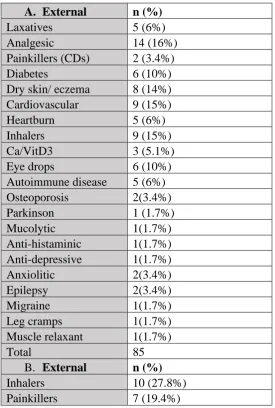
As seen in table 2, most of the externals in England were analgesic (16%) followed by inhalers (15%) and cardiovascular disease treatments (15%), treatments for dry skin or eczema (14%), with the remainder including treatments for diabetes, eye drops, heartburn, auto-immune disease and laxatives. Other externals are other painkillers including controlled drug and calcium/vitamin D3. In North Wales, most of the externals were inhalers (27.8%) followed by painkillers (19.4%) followed by treatment for dry skin and for diabetes (both 8.3%)
Table 2: Externals added to MCAs: A. In England, B. In North Wales
A. External n (%)
Laxatives 5 (6%)
Analgesic 14 (16%)
Painkillers (CDs) 2 (3.4%)
Diabetes 6 (10%)
Dry skin/ eczema 8 (14%) Cardiovascular 9 (15%)
Heartburn 5 (6%)
Inhalers 9 (15%)
Ca/VitD3 3 (5.1%)
Eye drops 6 (10%)
Autoimmune disease 5 (6%)
Osteoporosis 2(3.4%)
Parkinson 1 (1.7%)
Mucolytic 1(1.7%)
Anti-histaminic 1(1.7%) Anti-depressive 1(1.7%)
Anxiolitic 2(3.4%)
Epilepsy 2(3.4%)
Migraine 1(1.7%)
Leg cramps 1(1.7%)
Muscle relaxant 1(1.7%)
Total 85
B. External n (%)
Inhalers 10 (27.8%)
Treatment for dry skin 3(8.3%) Treatments for diabetes 3 (8.3%)
Heartburn 2 (5.5%)
Patches 2 (5.5%)
Warfarin 2 (5.5%)
Sildenafil 1(2.7%)
Hosiery 1(2.7%)
Alendronic acid 1(2.7%)
Viscotears 1(2.7%)
Spironolactone 1(2.7%)
Zopiclone 1(2.7%)
Serious drug interactions (SDIs)
Potential Drug-Drug Interactions (potential DDI) refers to the possibility a drug has to alter the effects of another when both are simultaneously administered (10) which can increase the risk for adverse drug reactions (ADRs), toxicity or loss of treatment efficacy (11-14).
By using the drug interaction chequer Drugs.com (15) and BNF (16), we found severe drug interactions in 13 cases out of 59 (22%) in England (table 3). A bivariate logistic regression analysis shows that in both male (CI=95%, p=0.429, F= 0.762) and female (CI=95%, p=0.046, F=0.161) patients SDIs are related with increased age, although this relationship is not significant in males. While in female patients these SDI are mainly with mental health medication (80% of the cases), in male patients, these SDIs are mainly associated with cardiovascular disease medication (75%). In North Wales, we found severe drug interactions in 5 cases out of 23 (21.7%). In Holyhead we didn’t find any relationship of age with SDI but women significantly have more SDIs than men (p=0.01013). While in female patients these SDI are mainly with neurologic disease medication (66% of the cases), in male patients, these SDIs are mainly associated with mental health medication (100%)
Table 3: Major drug-drug interactions found in England (A) and in North Wales (B)
A. Patient no. / number of drugs
Interaction Disease group
7 (14) Spirinolactone-losartan Cardiovascular
7 (14) fluoxetine-clopidogrel Cardiovascular
11 (8) topiramate-aripiprazole epilepsy /psychosis
21 (12) methotrexate- lansoprazole Alzheimer/ cardiovascular/ autoimmune disease
23 (6) amitriptyline-sertraline Depression
28 (11) aspirin-nicorandil cardiovascular/ diabetes
33 (14) salbutamol- carvedilol cardiovascular/ diabetes 33 (14) spironolactone-losartan cardiovascular/ diabetes 33 (14) Fluoxetine -clopidogrel cardiovascular/ diabetes 34 (8) topiramate -ARIPiprazole epilepsy, psychosis,
45 (7) omeprazole-citalopram peripheral nerve pain, epilepsy
45 (7) diazepam-oxycodone peripheral nerve pain,
epilepsy
46 (4) sertraline-zolmitriptan ADHD
48 (8) clopidogrel -rivaroxaban Cardiovascular
57 (9) allopurinol- ramipril cardiovascular, diabetes, bowel inflammatory dis
58 (7) sertraline- DULoxetine ADHD
B. Patient no. / number of drugs
Interaction Disease group
1 (5) amlodipine-simvastatin Cardiovascular, Alzheimer
3 (5) Valproate - lamotrigine Epilepsy, bipolar disorder, anaemia
6 (5) Amitriptyline -fentanyl,
sertraline, fentanyl-morphine amitriptyline-sertraline, fentanyl-morphine
Depression, chronic neuropathic pain
10 (6) Lanzoprazole - citalopram Depression, respiratory, cardiovascular
13 (6) Venlafaxine-mirtazapine Parkinson, depression, cardiovascular
• Discussion
This study has shown that the majority of MCA users were female (1/2) and male (1/2) patients aged over 60 years, with a mean age of 70 years. The majority of patients were prescribed treatment for cardiovascular disease including other concomitant diseases. Also, most of the externals were painkillers and inhalers. A bivariate logistic regression analysis shows that SDIs are more frequent in women than in men. These SDI are mainly related with mental health medication, cardiovascular disease medication and neurological
medication. Therefore, our results suggest that patients are at risk of serious side-effects from drug interactions
Our results are supported by recently published data (2) where it was found that a significant increase in the risk for at least one PIM was associated with female sex, age <80 years and psychotropic medicines.
Concerns exist regarding the safety of medication dispensing and the appropriateness of drug prescribing using MCAs (1). As suggested by Counter et al (2), the simplification of
known that dispensing medicines into compliance aids may alter the appearance of light-sensitive tablets or reduce bioavailability at elevated temperature and humidity (17)
The goal of medicines optimisation is to help patients to improve disease outcomes through take their medicines correctly, avoid taking unnecessary medicines which ultimately reduces medicine wastage of medicines and improve safety. A 2005 study concluded that home-based medication review by pharmacists was associated with a significantly higher rate of hospital admissions and did not significantly improve quality of life or reduce deaths what could be due either to iatrogenic effects of PIMs due to increased adherence to treatment or to a better patient awareness of warning symptoms of adverse effects or perhaps medicines optimisation research and protocols were not fully developed (18). However, a more recent study from 2015, found that the presence of a pharmacist at the emergency department for medication review reduced hospital admissions of older patients (19)
Our findings indicate the need for further wider studies regarding the most common drugs used in MCAs as well as the most common externals and the most common clinically
significant interactions. Further stability studies of these drugs in MCAs should be performed and the results should be available in a database. In agreement with these studies, a directive for dispensing of MCAs in pharmacies by pharmacists through an enhanced service should be elaborated having in consideration PIMs, SDIs, drug stability and use of externals and MCA design and brand
Study strengths/limitations
This study was limited to a small number of pharmacies in England and just one pharmacy in
North Wales although these pharmacies were located in a wide geographic region in England
and a representative region in North Wales
• Key points box
o Most MCA users are elderly patients
o Most of the patients suffer of combined cardiovascular disease. Also, a significant proportion
of patients falls in the mental/ neurological disease category.
o Most of the externals added to MCAs are inhalers and painkillers,
o SDIs are more frequent in women.
o SDIs are mainly related with mental health medication, cardiovascular disease medication
and neurological medication
o A directive for dispensing of MCAs in pharmacies by pharmacists through an enhanced
service should be elaborated having in consideration PIMs, SDIs, drug stability and use of
• Financial disclosure/Conflict of interest statement/Acknowledgements
No funding was involved in this work
The authors declare no conflict of interests
We are very thankful to West Hill Pharmacy in Bridlington, Unit Pharmacy in Scunthorpe, Boots, Newtons Pharmacy in Hull, Cohens Chemist, Rowlands Pharmacy, Total Health Pharmacy in Thetford and Woodside Pharmacy in Norwich for providing access to data regarding MCAs.
• Author contributions
AP collected the data and wrote the manuscript,
References
1. Lin-Nam Wang (2013) Multi-compartment compliance aids: do you need to review what
you do?. The Pharmaceutical Journal
2. Counter et al. Multicompartment compliance aids in the community: the prevalence of
potentially inappropriate medications. Br J Clin Pharmacol (2017) 83 1515–1520
3. Improving patient outcomes. The better use of multi-compartment compliance aids. July
2013. RPS.
https://www.rpharms.com/Portals/0/RPS%20document%20library/Open%20access/Support/t
oolkit/rps-mca-july-2013.pdf
4. Mosca et al. Assessing the impact of multi-compartment compliance aids on clinical
outcomes in the elderly: a pilot study. Int J Clin Pharm. 2014 Feb;36(1):98-104.
5. Masnoon et al. What is polypharmacy? A systematic review of definitions. BMC Geriatr.
2017; 17: 230.
6. Ishikura H, et al. Intestinal perforation due to ingestion of blister-wrapped tablet in
7. Fulford S, Tooley AH. Intestinal perforation after ingestion of a blister-wrapped tablet.
Lancet 1996;347: 128-129.
8. Norstein J, et al. Intestinal perforation after ingestion of a blister-wrapped tablet. Lancet
1995; 346:1308.
9. Gupta V, et al. Pelvic abscess after ingestion of blister-wrapped tablet. American Journal
of Gastroenterology 2002; 97: 2142-2143. 5
10. Alvim MM, Silva LA, Leite IC, Silvério MS. Adverse events caused by potential
drug-drug interactions in an intensive care unit of a teaching hospital. Rev Bras Ter Intensiva
2015; 27:353–359.
11. Moura C, Prado N, Acurcio F. Potential drug-drug interactions associated with prolonged stays in the intensive care unit: a retrospective cohort study. Clin Drug Investig 2011;
31:309–316.
12. Moura CS, Acurcio FA, Belo NO. Drug-drug interactions associated with length of stay and cost of hospitalization. J Pharm Pharm Sci 2009; 12:266–272.
13. Dechanont S, Maphanta S, Butthum B, Kongkaew C. Hospital admissions/visits associated with drug-drug interactions: a systematic review and meta-analysis. Pharmacoepidemiol Drug Saf 2014; 23:489–497.
14. Ganeva M, Gancheva T, Troeva J, Kiriyak N, Hristakieva E. Clinical relevance of drug-drug interactions in hospitalized dermatology patients. Adv Clin Exp Med 2013; 22:555– 563.]
15. https://www.drugs.com/drug_interactions.html
16. BNF (British National Formulary)
17. Donyai P. Quality of medicines stored together in multi-compartment compliance aids. Journal of Clinical Pharmacy and Therapeutics 2010; 35: 533-543.
18. Holland R, Lenaghan E, Harvey I, Smith R, Shepstone L, Lipp A, Christou M, Evans D, Hand C. Does home-based medication review keep older people out of hospital? The
HOMER randomised controlled trial. BMJ. 2005 Feb 5;330(7486):293.