Abstract
This paper presents a comprehensive model for supporting informed and critical discussions concerning the quality of Technology-Enhanced Learning in Blended Learning programmes. The model aims to support discussions around domains such as how institutions are prepared, the participants’ background and
expectations, the course design, and the learning process. The research that supported the design of this model was framed by a Grounded Theory method, combining different approaches to empirical data collection with a review of evaluation models on aspects of the quality of Online and Distance Learning. Throughout the paper, arguments are made that Higher Education institutions need to be more critical with regard to the use of Technology-Enhanced Learning, and to support it as a counterpart to face-to-face learning and teaching. The model provides a framework for teachers in Higher Education to reflect and discuss the quality of Technology-Enhanced Learning in their Blended Learning
programmes.
Introduction
Quality Assurance systems for assessing the quality of traditional face-to-face programmes and online/distance learning programmes have been seen, until now, as two different entities. Higher Education institutions still consider both
modalities with different levels of quality (Allen & Seaman, 2013) different standards of evaluation (Jara & Mellar, 2009; Masoumi & Lindström, 2012; Zhao, 2003), and apply different procedures for supporting the evaluation. However, the majority of Higher Education programmes today are offered in a Blended
Learning modality (Volungeviciene, Tereseviciene, & Tait, 2014), combining face-to-face with a sort of online learning and teaching. When evaluating the quality of these programmes, and as there is a discrepancy between the Quality Assurance systems for both models of delivery, there is a natural tendency to use quality procedures that focus on the face-to-face provision. There are
preconceptions suggesting that the learning process quality is more capable of being assessed in face-to-face moments, where the teacher’s presence is more visible. Thus, when assessing these Blended Learning programmes few questions are being directed towards the learning and the teaching delivered online.
Interestingly, perceptions of the level of responsibility of those delivering content face-to-face and those delivering online are also different although it may happen that the person is the same.
Literature review
The most common definition of Blended Learning suggests a mixture between the face-to-face and the online learning and teaching, where online can mean almost everything that is done by students and the teacher using a digital format
(Garrison & Kanuka, 2004; Sharpe, Benfield, Roberts, & Francis, 2006). Latchem (2014) refers to this plethora of meanings of the online learning and teaching by suggesting a continuous line of evolution: at one end one has the translation of didactic texts or presentations to a digital format with little opportunities for engagement, while at the other end one has a scenario where knowledge and learning are created by students.
A UCISA (Universities and Colleges Information Systems Association) report (Walker et al., 2014) suggests that the use of online learning and teaching in different Higher Education institutions in the UK is still largely confined to the access to external web based resources or digital repositories, e-submissions, and the use of software for detecting plagiarism. Student-centred strategies such as asynchronous collaborative working tools, peer-assessment and e-portfolios, are far from being the mainstream (less than 25% of teachers are using one of these strategies in their teaching). The same conclusion was found in a recent in-depth study, using learning analytics (van der Sluis & May, 2015). The study provides evidence that teachers involved in Blended Learning programmes were using Learning Management Systems not to design learning activities but to distribute resources and to manage assignments submissions. The number of wikis, blogs or discussion forums created was again sporadic. The research found evidence that teachers delivering Blended Learning courses are not reflecting on the different characteristics of the online delivery, rather they focus on transposing what they teach face-to-face to the institutional Learning Management Systems (van der Sluis & May, 2015).
Learning Management Systems providers and institutional directives also do not help to promote better online delivery. They focus on administrative/repository-based tasks, as employment of these is considered more cost effective than supporting pedagogical activities. Pedagogical activities are still seen as somewhat difficult to implement online and with a lower value to the students. Allen and Seaman (2013) found that a third of management bodies in US Higher Education institutions, which provide programmes with moments of online learning and teaching, believed that the learning outcomes of these moments have a lower complexity when compared with learning outcomes of traditional face-to-face teaching.
However, the increase use of the term Technology-Enhanced Learning (TEL) to name the online learning and teaching provision in Blended Learning has been suggesting a change in this paradigm. Unlike other terminologies such as online learning, e-Learning or Distance Learning, a semantic analysis of the words Technology-Enhanced Learning suggest a value judgement about the use of technology (Kirkwood & Price, 2014; Volungeviciene et al., 2014). The word
Quality in Higher Education, Online Learning and TEL
The role of quality as an area of discussion in the field of Higher Education has been addressed widely in the literature as a vehicle of assurance and
accountability, and more recently, as a vehicle for monitoring and enhancement (Harvey & Williams, 2010; Jara & Mellar, 2010). The topic is becoming even more pertinent with the emergence of different ‘League Tables’, increased competition between Higher Education institutions, and the restructuring of the Higher Education sector in some countries where students are paying tuition fees acquiring, therefore, the ‘right’ of demanding learning quality and consequently
acting like ‘consumers’.
With regards to Quality procedures there has been a lack of integration between what is happening in face-to-face teaching and the online learning and teaching. One example is given by the UK Quality procedures for Higher Education, where the Quality Assurance Agency (QAA) quality code sets expectations that all the UK Higher Education institutions need to meet in aspects such as: (i) setting and maintaining academic standards; (ii) assuring and enhancing academic quality; and (iii) providing information about Higher Education provision (QAA, 2014). Although attempts were made (QAQE in e-Learning Special Interest Group, 2010) to discuss the importance of having a more relevant role for TEL in the UK Quality procedures, the QAA quality code still gives little emphasis to the role of TEL, integrating it as something within other types of provision. A similar lack of importance is given to TEL by the Standards and Guidelines for Quality
Assurance in the European Higher Education Area.
In the interim, documents have been designed focusing solely on the quality of TEL, such as the Benchmarks for TEL (ACODE, 2014), the benchmark toolkit E-xcellence (from the European Association of Distance Teaching Universities), and the Institute for Higher Education Policy’s Benchmarks for Success in Internet-Based Distance Education (Merisotis & Phipps, 2000). None, however, has discussed the provision of TEL in Blended Learning programmes. This is an interesting finding, considering that although the majority of the provision in Higher Education is being announced as Blended Learning (Volungeviciene et al. 2014), in practice Quality procedures only monitor the quality of traditional face-to-face teaching, neglecting particular standards that are exclusively related to TEL (Jara & Mellar, 2009).
There is an argument that by involving technologies and distance learning, practices such as giving feedback, designing learning activities or students’
engagement should be measured using different standards (Masoumi &
Lindström, 2012; Zhao, 2003). Likewise, there are aspects only related to TEL, such as the quality and reliability of the Learning Management Systems or the availability of resources, that are not taken into consideration by traditional Quality procedures.
Quality procedures
documents), and perceptions collected from staff-student consultation committees, feedback forms or students’ evaluation questionnaires (Connolly, Jones, &
O’Shea, 2005). The purpose of involving students in these meetings and procedures is often ill-defined as there are lack of frameworks aiming to help guide discussions around where to look and what to evaluate. Students are often placed without knowing what to say, thus responding generically to the questions placed by those that chair the meetings or design the evaluation forms. When transposing these procedures to a Blended Learning programme, little attention is given to the level of online engagement, the level and quality of interactions, the quality of learning resources or of the learning environment. Moreover, the role of students in helping to build these different features is ignored, and so the focus of the evaluation is on the teacher rather than on what constitutes the overall
provision. Quality evaluation is centred on the teaching, which is not aligned with the level and importance that students should have on the learning process. And this should even be more important when this learning process is online where
students’ role should be more active and autonomous as they produce and share more learning content through blog posts, discussions threads, sharing resources or producing a wiki article.
This research aims to present an evaluation model that can frame discussions between teachers and students related to the Quality of TEL provision in Blended Learning programmes.
Research Design
This research follows a Grounded Theory method (Corbin & Strauss, 1990), which is a qualitative approach to research wherein theoretical analyses and assumptions are inducted by researchers during data collection, aiming to build or rebuild theories about concepts (Silverman, 2011). The research was carried out in two different countries in Europe during four years, involving participants from six different Higher Education institutions. The empirical data was collected and analysed respecting all ethical requirements, anonymity, and data confidentiality. Empirical data (interviews and focus groups) was guided based by validated scripts, which participants had access to before each session.
The research occurred over two cycles:
Cycle one
• Literature review focusing on definitions of TEL and instances relevant for the model. Documents categorisation and data collection were carried out using reference management software.
• Interviews were carried out with teachers involved in Blended Learning provision (six), a head of TEL (one) and managers (two) in a campus-based University in Portugal. Interviews were carried out aiming to discuss what TEL meant for the interviewed practices and how the institution was supporting such practices. The teachers were selected after being identified as being actively engaged with the online part of the Blended Learning. • Analyses of data collected from these two moments was made using a
This first cycle enabled the creation of the foundations of a theory for TEL that would inform a second review of the literature and subsequent interviews. It also gave an insight of how the teachers were perceiving the support provided by the institution with regards to the design and delivery of the Blended Learning programme.
Cycle two
The second cycle was divided into four sections:
• Literature review focusing on models for evaluating e-Learning/online learning/distance learning. Seventeen models were identified through a comprehensive search using Google Scholar and a triangulation of such terminologies with the key words: ‘Benchmarks’; ‘Model’; ‘Tool’;
‘Quality’; ‘Evaluation’. Document categorisation and data collection were carried through using a reference management software.
• Focus group made with students (N6) aiming to understand students’
perceptions of TEL quality and its role in the learning process in Blended Learning programmes. The focus group was conducted with students enrolled on Blended Learning programmes in the same campus-based University in Portugal and were identified by the teachers interviewed in the first cycle.
• Interviews with Heads of TEL (two in Portugal and two in the UK) and one specialist in the quality of TEL aiming to (i) discuss the concept of TEL and (ii) discuss the quality of TEL in Blended Learning programmes. The interviewed were selected based on the criteria of being Heads of TEL in campus-based institutions offering Blended Learning programmes. The specialist (from the UK) was chosen having in mind his level of expertise around the topic and due to his involvement in the QA-QE Special Interest Group.
• The NVivo file with data collected from the first cycle was updated with the data collected; concepts and categories were also revised.
How data was collected and analysed
From data collection moments (theoretical and empirical), 977 instances were identified. Instances are single occurrences identified throughout data collection that were perceived as relevant for supporting the design of the model. Instances were coded in a database linking them with a reference number and a source metadata field (
Figure 1 - research design and how the model was built from data collection and analysis to designing concepts, categories and descriptors.
After this process instances were grouped into concepts. On different occasions one particular instance in one source was similar to another in other source. Therefore, by grouping them, concepts would become meaningful entities for supporting the theory. For example, the concept ‘learning activities need to be authentic’ was built by merging instances retrieved from the literature related to the theory of TEL (Hannafin & Land, 1997; Herrington, Oliver, & Reeves, 2003), an evaluation model for virtual Universities (Masoumi & Lindström, 2012), and through discussions with students in a focus group. Using Grounded Theory this is the first moment of interpretation from the researcher, since by grouping instances into concepts the researcher is already establishing links between the
different instances and the researcher’s own conceptions(Charmaz, 2006). In a second stage, concepts were grouped into categories and descriptors, which are abstract deductions of grouping concepts into one aggregating entity. The concept given above was merged in the category ‘content’, descriptor ‘employability’ and the category ‘learning resources’, descriptor ‘scientific’ (Figure 1). Thus, one concept can be associated to one or more categories or descriptors.
Findings
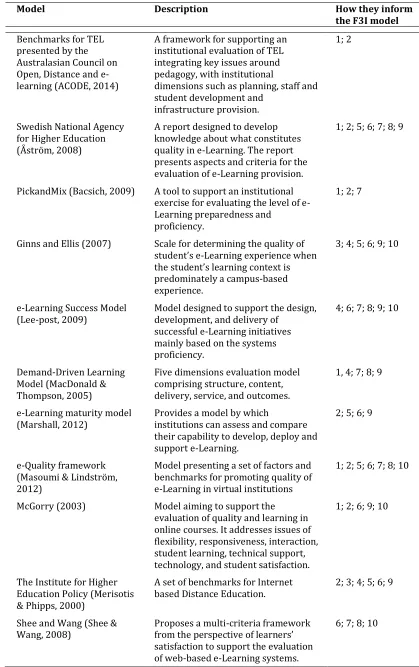
Findings from this study are presented throughout three sections. The first section presents a review of seventeen evaluation models and frameworks, and how these informed the design of the evaluation model. A second section presents empirical findings from the individual interviews and focus group and how these empirical findings were used to inform the model. In a final section the F3I model is presented as well as guidelines of how it may be used.
Reviewing models on quality of e-Learning, Online
Learning and Distance Learning
Different terminologies are used to express the frameworks found for evaluating the quality of e-Learning, Online Learning and Distance Learning. For the purpose of this research we designate all of the sources found as models with a view to simplify the reading of the document.
Table 1 - review of the models for evaluating e-Learning, Online Learning and Distance Learning and in which category they inform the F3I model
Model Description How they inform
the F3I model
Benchmarks for TEL presented by the Australasian Council on Open, Distance and e-learning (ACODE, 2014)
A framework for supporting an institutional evaluation of TEL integrating key issues around pedagogy, with institutional
dimensions such as planning, staff and student development and
infrastructure provision.
1; 2
Swedish National Agency for Higher Education (Åström, 2008)
A report designed to develop knowledge about what constitutes quality in e-Learning. The report presents aspects and criteria for the evaluation of e-Learning provision.
1; 2; 5; 6; 7; 8; 9
PickandMix (Bacsich, 2009) A tool to support an institutional exercise for evaluating the level of e-Learning preparedness and
proficiency.
1; 2; 7
Ginns and Ellis (2007) Scale for determining the quality of
student’s e-Learning experience when
the student’s learning context is
predominately a campus-based experience.
3; 4; 5; 6; 9; 10
e-Learning Success Model (Lee-post, 2009)
Model designed to support the design, development, and delivery of
successful e-Learning initiatives mainly based on the systems proficiency.
4; 6; 7; 8; 9; 10
Demand-Driven Learning Model (MacDonald & Thompson, 2005)
Five dimensions evaluation model comprising structure, content, delivery, service, and outcomes.
1, 4; 7; 8; 9
e-Learning maturity model (Marshall, 2012)
Provides a model by which
institutions can assess and compare their capability to develop, deploy and support e-Learning.
2; 5; 6; 9
e-Quality framework (Masoumi & Lindström, 2012)
Model presenting a set of factors and benchmarks for promoting quality of e-Learning in virtual institutions
1; 2; 5; 6; 7; 8; 10
McGorry (2003) Model aiming to support the evaluation of quality and learning in online courses. It addresses issues of flexibility, responsiveness, interaction, student learning, technical support, technology, and student satisfaction.
1; 2; 6; 9; 10
The Institute for Higher Education Policy (Merisotis & Phipps, 2000)
A set of benchmarks for Internet based Distance Education.
2; 3; 4; 5; 6; 9
Shee and Wang (Shee & Wang, 2008)
Proposes a multi-criteria framework
from the perspective of learners’
satisfaction to support the evaluation of web-based e-Learning systems.
Sloan-C (Shelton, 2010) A quality scorecard designed for evaluating the administration of online education programmes.
1; 2; 3; 4; 5; 6; 7; 8; 9; 10
Sims et al. (2002) Proactive evaluation framework aiming to support formative
assessment of different components of online delivery.
1; 7; 8; 9; 10
Stewart et al. (2010) An instrument that allows instructors to conduct a comprehensive
evaluation of the quality of Web-based courses.
7; 8; 9
Sun et al. (2008) A questionnaire aiming to investigate
the critical factors affecting learners’
satisfaction in e-Learning.
1; 4; 5; 6; 9; 10
Excellence – the European Association of Distance Teaching Universities model (2009)
A Benchmarking approach for assessing the quality of distance education provision.
1; 2; 3; 7; 8; 9
PDPP (2012) A four-phase evaluation model for e-Learning courses, including the stages of planning, development, process, and product evaluation.
1; 3; 7; 8; 9; 10
1 2 3 4 5 6 7 8 9 10
Level of support given by the institution Existence of regulations and guidelines
Course handbook with the relevant information Existing competencies and pre-requisites Initial expectations and motivations
Design of learning and assessment activities Learning resources and learning materials Learning environment
Delivery
Impact and results
1. Level of support given by the institution
Instances within this category were collected from eleven models. This category relates to the support that Higher Education institutions provide to participants and, more specifically, with the pedagogical (training, available helpdesk and support from tutors and mentors), technical (training, guidelines and manuals, available helpdesk) and librarian support. The support is also seen with regards to the IT infrastructure, more specifically, the quality and availability of the
information systems.
2. Existence of regulations and guidelines
In these category we found references regarding institutional regulations (on academic misconduct, copyright, staff recognition and promotion), procedures (quality assurance, security and anonymity procedures) or guidelines (learning design principles, a vision document and support documentation). Instances within this category were collected from seven models.
3. Course handbook with the relevant information
The importance of having course handbooks (or other similar resources) with the relevant information was collected from four models. Instances inferred the existence of clear information about the syllabus, students’ expected workload,
requirements, tuition costs or the institutional support available for learning difficulties or disabilities.
4. Existing competencies and pre-requisites
The need for evaluating competencies and pre-requisites for participating in TEL activities is also considered an important category in five models. Whilst
participating in TEL activities, students need to have particular competencies such as being autonomous or being motivated; but at the same time, they need to have access to computers and the web, and to have time available to engage with online activities. All of these needs to be evaluated beforehand so as to enable all
participants to have a similar starting point. 5. Initial expectations and motivations
Previous expectations and motivations for enrolling in online activities is also considered relevant in seven of the models analysed. Instances were collected
related with the value of understanding participants’ perceptions, motivations and
needs when engaging in online activities.
6. Design of learning and assessment activities
Ten instances were retrieved from this category although sometimes presented differently in the review made as course design, learning design or instructional design. It therefore reflects on the preparation and design of the learning. 7. Learning resources and learning materials
Instances were retrieved in this category from seven modules. In this category different authors refer the need for evaluating scientific accuracy, the interactivity element, adequacy, efficiency and aesthetics.
8. Learning environment
From the eight models in which this category is referenced, instances were retrieved related with the relevance of assuring the technical and organisational aspects, the usability and the immersive characteristic of the learning
environment. 9. Delivery
Still in the learning and teaching process another category relates with the
delivery and how the teacher engages with students (instances were retrieved from thirteen models). The models analysed suggest the delivery of content and
learning resources, the quality of assessment, the quality of the communication and the level of engagement with students as relevant areas related with the delivery.
10. Impact and results
Finally, a last category covered in nine models was the impact and results of online activities. It refers to the satisfaction of both students and teachers involved, the acquisition of knowledge and the impact of the use of the online activities.
Reflecting on the role of TEL in Blended Learning
programmes - Findings from the interviews and focus
groups
The empirical moments aimed at understanding teachers’ and students’
Integration
Integration is seen as the degree to which there are links between what happens in face-to-face and the online activities and how these two moments have parity. Martin (a Head of TEL in a UK university) referredthat“… TEL is an
enhancement of learning and not a revolutionary approach to learning, but nor is something invisible or embedded”. Martin’s words suggest that TEL needs to have a formal presence but that it also needs to have a level of integration that suggests being something that is not outside from the learning process.
Antonio (a teacher in Electronic and Telecommunications Engineering) referred the importance of planning the use of TEL beforehand, whilst designing the Blended Learning programme. He said that by doing so, one can design activities that have links with the face-to-face classes and so students will understand the rationale for using technology outside the classroom.
“If a teacher doesn't have an idea of why and what the main objectives are then he will be using tools without any meaning. If the objective is to share and collaborate then we must design strategies to foster this pedagogical goal. All of this needs to be carefully planned and linked with what
happens in the classroom.” (Antonio a teacher of Electronic and Telecommunications Engineering)
Rita (a postgraduate student in Education) sees the level of integration as
something different, more related to a need for replicating practices to the online provision. She said that: “We need to use technology like the air that we breathe.”
she added that “… one criterion to have a better use of technology is the time that one comment is left floating without response.” For Rita, there should be strategies in place to replicate the same experience that one has in a face-to-face
environment where a student asks a question and has an immediate feedback. There seems to be evidence suggesting that in Blended Learning programmes both online and face-to-face moments need to have a single plan, wherein activities are planned together and whereby both modes of delivery combine. There were also suggestions that TEL needs to be used in situations where it enhances students’ learning experience. However, the use of TEL does not mean the teachers’ detachment from the learning and teaching process. They need to act as similarly as possible to how they would perform face-to-face, and this implies planning and designing strategies to guide students and to promote more effective communication.
Flexibility
A second category to emerge from the data analyses suggests the need for
encouraging flexibility when using TEL in Blended Learning programmes. It was seen as an important feature by all the Heads of TEL and by two students during the focus group. Flexibility is considered to be one of the main advantages of TEL, as it is easier to apply and so enabling students to have more personal and customisable learning opportunities. Flexibility is often seen as flexible
timeframes, personalised resources, pace of learning and increasing ownership opportunities for students.
Innovation
John (a Head of TEL in a UK university) discussed that during online activities innovation should always be present. He says that more than promoting
He says that students are more open to the introduction of new learning strategies and resources when in a TEL environment. Likewise, he stresses that institutions must develop a culture of promoting innovation in learning and teaching, and that TEL moments, because of their intrinsic nature, may be the right opportunity to do so.
Impact
The category ‘Impact’ was widely referenced as being important to consider during the interviews and more frequently by students. One student said that:
“The use of technology has to be seen as a medium, but it also can be transformative. Because I am in an online environment rather than
sharing with three or four colleagues I am sharing with 30 or 40, and that suggests a completely different feedback experience from what I would have face-to-face. Also, the nature of feedback is different. We reflect more on what it means (Maria – a postgraduate student in Education).”
Maria’s words suggest that students understand having different experiences when
participating in an online moment. They have more time to answer a particular comment/question, substantiating this interaction with sources and references, and being able to reflect on their own comments. Additionally, their comments will be judged by more students, who will also be more informed when commenting whatever is being discussed. This notion of complementarity is supported by John (a Head of e-Learning in a UK university) who says that “I am looking to see aspects of learning that are not being met and where the use of technology can help develop certain aspects of that learning. This argument suggests that by using TEL there is a need for suggesting that this delivery has an impact rather than just being a supplement or an add-on to the face-to-face delivery. Hence, the impact of TEL can be seen twofold: firstly the impact it has on the learning and teaching experience, and secondly the impact it has on the transformation of the learning process design and delivery.
The F3I model
The F3I model was designed based on data collected from evaluation models, interviews and focus groups with stakeholders involved in Blended Learning provision. The model aims to provide a comprehensive framework for supporting informed and critical discussions about the quality of TEL in Blended Learning programmes. It is designed with the intent to provide a framework for supporting teachers and instructional designers when designing the online delivery of
Blended Learning programmes and to provide guidance to teachers and students when they evaluate the delivery of the programme, during evaluation meetings. It is therefore a model that aims to integrate a quality assurance and a quality enhancement dimensions.
The F3I model is divided in inner domains and outer domains. Each inner domain has three categories, which serve as main areas to reflect upon when within each inner domain. The outer domains serve as transversal reference points for building a narrative when discussing each category or descriptor. The F3I model
designation is based on the four outer domains first letters ‘Flexibility’,
‘Innovation’, ‘Impact’ and ‘Integration’ (Figure 2).
Figure 2 - overview of the F3I model
‘Flexibility’ is seen twofold: time flexibility and students’ preferences. Time
flexibility may relate with the timeframes and the pace of learning. Students may be encouraged to negotiate flexible timeframes that suite them the most. Students’
preferences suggest that students may be able to choose resources and tools that they are more familiar with.
‘Innovation’ in this model suggests that those involved are open to being
innovative, and to experiment with new tools and new pedagogies that encourage better learning experiences.
‘Impact’ relates to how the use of TEL has an implication on the learning process in terms of the acquisition of knowledge that would not be possible otherwise, but also on the students’ experience and satisfaction.
Finally, ‘Integration’ relates with how the face-to-face provision is aligned with the TEL provision and how the different stakeholders perceive this level of integration.
Scenario for using outer domains
Those evaluating a Blended Learning programme may want to reflect on the category ‘Support’ based upon its level of ‘Integration’ with other institutional wide support, or the degree to which it is ‘Flexible’ adapting to different hours of the day or to different needs from those involved. By giving the opportunity of triangulating each category or descriptor with the four outer domains we are ensuring that these four elements - seen as fundamental during the interviews and focus group phases - are discussed during the different stages of the TEL
provision (the inner domains and respective categories and descriptors).
The four inner domains
The F3I is organised in four inner domains: (i) ‘Institution’, (ii) ‘Participants’, (ii)
‘Design’ and (iv) ‘Learning Process’ (Figure 2), which represent different stages of a TEL provision. Each domain is divided into three categories, and within these categories there are 42 descriptors of analyses. Descriptors were created for supporting discussions around each category, as those involved in evaluation might experience difficulties in understanding the rationale for each category. Throughout this section each internal domain of the F3I is described, and to what extent it can be used for supporting evaluation of the TEL provision. The
categories and descriptors of analyses are also presented.
Institution
Bates and Sangra (2011) argue that institutions must rethink their learning and teaching so they can optimise the use of technology but, in line with this, they should also promote more prepared management bodies and better financial and supportive structures. When designing a Blended Learning programme teachers and instructional designers must evaluate the degree to which they have an effective institutional support to deliver the TEL moments. The ‘Institution’
pedagogical, library services and administrative); the (ii) ‘systems and
infrastructure quality’; and (iii) the existing ‘policies’ (existing procedures and
guidelines).
Figure 3 - detailed view of the institution domain, with categories and descriptors of analyses
Scenario for using domain
When using this domain teachers and instructional designers conduct a needs analyses on different aspects that need to be in place such as the Wi-Fi infrastructure, the effectiveness of the Learning Management Systems or the existence of a librarian to support students. Similarly, this evaluation can also be conducted after the delivery of the course and in a format of a dialogue between the teacher and the students. This domain serves as a mean for evaluating
institutions’ preparedness for delivering TEL moments during Blended Learning programmes.
Participants
In this domain the elements that each participant needs to possess or acquire for engaging in TEL activities are identified. The literature suggests this area to be relevant not only as a way of ensuring that all participants are prepared to fully take advantage of TEL but also as a way of managing expectations throughout the delivery.
This domain is divided into: (i) the need for evaluating different characteristics and competencies of each participant (scientific, pedagogical, communicational, technical, motivational, digital and the confidence of having the necessary competencies); (ii) the confluence of roles and expectations, which is paramount for understanding what each participant expects from the programme/activity and how it is aligned with its counterpart; and (iii) the existing constraints, particularly those related with practices that students are expecting to exist but that are not necessarily effective in TEL provision (Figure 4).
Figure 4 - detailed view of the participants’ domain, with categories and descriptors of analyses
Scenario for using domain
access to computers and the Internet, existence of e-mail and social media accounts or if software versions are updated.
Design
The domain ‘Design’ is divided into three categories (Figure 5). The first one is
‘Learning content’, which can be analysed according to if it is flexible, accurate, if it is learner-centred, and if it incorporates employability skills. A second category relates to the ‘course handbook’, which infers the need for giving the necessary information to students before the provision starts. A third category is the
‘Activities’, which is divided into technology integration and the levels of participation and active learning.
In this domain assumptions are made that the teaching team and students need to be consulted in order to understand if the design is suitable for the main outcomes and delivery mode of the programme. In the UK, the evaluation of the course design is usually made by combining a set of actions from academic registry and from a validation board with internal and external specialists. Students are usually not taken into consideration in these moments. Arguments can be made that by involving students in the evaluation of course design, institutions would prevent misalignments between what institutions, programme leaders and students perceive as relevant. This is particularly sensible in Blended Learning programmes wherein the conception of the role of TEL has different
interpretations. Thus, by involving students in the evaluation of the ‘Design’
domain, steps are taken to align perceptions and expectations of the role of technology in the learning process.
Similarly, we believe that there is a need for involving other stakeholders during the design process such as instructional designers, learning technologists and librarians.
Figure 5 - detailed view of the design domain, with categories and descriptors of analyses
Scenario for using domain
The model envisages a checklist document with guided questions to support the design of the online activities. Using the framework given teachers, instructional designers and those involved in the design phase can ask questions such as: ‘Does the learning content promote employability skills?’; ‘Are the rules of engagement
presented in the course handbook’; ‘Are the activities promoting students’ active
learning?’. This would support both the design and development, as it would set standards, but could also serve as a tool for supporting the evaluation during validation procedures.
Learning Process
The fourth domain is the ‘Learning Process’ and covers ‘Learning resources’, ‘Learning environments’ and the moment of ‘Instruction’ (Figure 6). ‘Learning resources’ are the different text, video, sound or interactive files and software programmes, all of which are used for learning within one activity or programme.
‘Learning environments’ are the virtual learning environments in which learning takes place. ‘Learning environments’ can be evaluated according to pedagogy, accessibility, usability, immersion and aesthetics descriptors of analyses.
The ‘Instruction’ refers to the moments where the teacher interacts with resources, learning environments and with the different participants. This category can be evaluated according to the interpersonal relationship built between students and teachers, the quality of delivery, communications and the quality of assessment practices.
Figure 6 - detailed view of the learning process domain, with categories and descriptors of analyses
Scenario for using domain
We foresee this last domain to be used in evaluation meetings between teachers and students, or in academic board meetings that group, in collegial discussions, teachers from different modules and programmes. Both these events are driven by Quality Assurance but they open the possibility for collegial discussions that may lead to improvement. We believe that by providing this model and especially this last domain about the learning process, students will be able to reflect upon the quality of the provision of TEL and provide solid evidence sustained on each of the descriptors of analyses. Thus, more solid and contextualised information will be given to promote the enhancement of the learning process and the overall programme.
Final Considerations and limitations
In this paper a model is presented aiming to serve the purpose of helping teachers in Higher Education to reflect upon the quality of the provision of TEL in their Blended Learning programmes. We believe there is a gap in the Quality Assurance systems for evaluating the role of TEL within Blended Learning as they are usually built either to evaluate face-to-face provision or solely online programmes. This gap needs to be filled with models that help to assure quality but also promote better awareness of what Quality is in relation to TEL and how it may lead to improvement. The F3I model is flexible enough to help fill in this gap as it can be used to promote more informed discussions about the quality of TEL. By not forcing the use of quality standards but instead providing areas to reflect
upon we are able to meet participants’ expectations rather than aligning their
judgements to prescriptive standards and/or benchmarks. We also encourage discussion of what is quality for that particular provision but within boundaries that are given by categories and descriptors of analyses for each category, which can in turn be triangulated with the outer domains. This attribute may at the same time be seen as an added value as it is open to interpretation and manipulation allowing therefore teachers, researchers and students to make their own
framework for discussion around themes which can be then tailored according to each particular context or institution. Furthermore, we endeavour to promote a model that is sustainable throughout the years rather than an outcome that may be downgraded at the same pace as the Higher Education sector develops new modes of delivery.
This paper grew from a discussion on the relevance of being critical when
referring to quality in the use of TEL in Blended Learning programmes in HE. We believe that Higher Education providers must enforce participatory discussions as regards the quality of the use of TEL in Blended Learning as these discussions may empower teachers and students to promote informed changes and enhance the quality of the programmes offered. We believe that by providing a framework for discussions around the relevant dimensions of the TEL provision we help practitioners and students to reflect on the relevant themes helping them to ask the right questions about the institution, their competencies and expectations, the design and the delivery of the Blended Learning programme. By providing
models similar to the F3I, Higher Education institutions and their stakeholders are provided with tools to support their level of preparedness, thus becoming more critical about how technologies are being used in Blended Learning programmes.
References
ACODE. (2014). Benchmarks for Technology Enhanced Learning. Retrieved from
http://www.acode.edu.au/pluginfile.php/646/mod_resource/content/2/ACODE_Benchmarks _Report_2014.pdf
Allen, I. E., & Seaman, J. (2013). Changing Course: Ten Years of Tracking Online Education in
the United States. BOOK, ERIC.
Åström, E. (2008). E-Learning quality: Aspects and criteria for evaluation of e-Learning in higher education. Retrieved from http://www.eadtu.nl/e-xcellencelabel/files/0811R.pdf
Bacsich, P. (2009). Benchmarking e-learning in UK Universities - the methodologies. In T. Mayes, D. Morrison, H. Mellar, P. Bullen, & M. Oliver (Eds.), Transforming higher
education through technology – enhanced learning (pp. 90–106). The Higher Education
Academy.
Bates, A. T., & Sangra, A. (2011). Managing technology in higher education: Strategies for transforming teaching and learning. San Francisco: Jossey-Bass.
Charmaz, K. (2006). Constructing grounded theory: A practical guide through qualitative
analysis. Thousand Oaks, CA: Sage Publications Limited.
Connolly, M., Jones, N., & O’Shea, J. (2005). Quality assurance and e‐learning: reflections from the front line. Quality in Higher Education, 11(1), 59–67.
http://doi.org/10.1080/13538320500077660
Corbin, J. M., & Strauss, A. (1990). Grounded Theory research: Procedures, canons, and evaluative criteria. Qualitative Sociology, 13(1), 3–21.
Garrison, D. R., & Kanuka, H. (2004). Blended learning: Uncovering its transformative potential in higher education. The Internet and Higher Education, 7(2), 95–105. Journal Article. http://doi.org/10.1016/j.iheduc.2004.02.001
64. JOUR.
QAQE in e-Learning Special Interest Group (2010). QAA Code of Practice Section 2: Collaborative provision and flexible and distributed learning (including e-learning) - A Commentary & Critique. Retrieved from
http://qaqe-sig.net/wp-content/uploads/2010/09/QAQE_Report_final1.pdf
Hannafin, M. J., & Land, S. M. (1997). The foundations and assumptions of technology-enhanced student-centered learning environments. Instructional Science, 167–202.
Harvey, L., & Williams, J. (2010). Fifteen Years of Quality in Higher Education. Quality in
Higher Education, 16(1), 3–36. JOUR. http://doi.org/10.1080/13538321003679457
Herrington, J., Oliver, R., & Reeves, T. C. (2003). Patterns of engagement in authentic online learning environments. Australasian Journal of Educational Technology, 19(1), 59–71. Jara, M., & Mellar, H. (2009). Factors affecting quality enhancement procedures for e-learning
courses. Quality Assurance in Education, 17(3), 220–232. http://doi.org/10.1108/09684880910970632
Jara, M., & Mellar, H. (2010). Quality enhancement for e-learning courses: The role of student feedback. Computers & Education, 54(3), 709–714.
http://doi.org/10.1016/j.compedu.2009.10.016
Kirkwood, A., & Price, L. (2014). Technology-enhanced learning and teaching in higher
education: what is “enhanced”and how do we know? A critical literature review. Learning, Media and Technology, 39(1), 6–36.
Latchem, C. (2014). Quality Assurance in Online Distance Education. In Olaf
Zawacki-RichterTerry Anderson (Ed.), Online Distance Education: Towards a Research Agenda (p. 311). JOUR, Athabasca University Press.
Lee-post, A. (2009). e-Learning Success Model : an Information Systems Perspective, 7(1), 61–70. MacDonald, C. J., & Thompson, T. L. (2005). Structure, content, delivery, service, and outcomes:
Quality e-learning in higher education. The International Review of Research in Open and Distance Learning, 6(2).
Marshall, S. (2012). Improving the quality of e-learning: lessons from the eMM. Journal of Computer Assisted Learning, 28(1), 65–78.
Masoumi, D., & Lindström, B. (2012). Quality in e-learning: a framework for promoting and assuring quality in virtual institutions. Journal of Computer Assisted Learning, 28(1), 27–41. McGorry, S. (2003). Measuring quality in online programs. The Internet and Higher Education,
6(2), 159–177.
Merisotis, J. P., & Phipps, R. A. (2000). Quality On the Line: Benchmarks for Success in
Internet-Based Distance Education. Washington, DC. Retrieved from
http://www.ihep.org/\assets\files\/publications/M-R/QualityOnTheLine.pdf
Quality Assurance Agency. (2014). The UK Quality Code for Higher Education: A brief guide. Gloucester. Retrieved from http://www.qaa.ac.uk/en/Publications/Documents/quality-code-brief-guide.pdf
http://www.medev.heacademy.ac.uk/assets/was York - delete this soon/documents/ourwork/archive/blended_elearning_full_review.pdf
Shee, D., & Wang, Y. (2008). Multi-criteria evaluation of the web-based e-learning system: A methodology based on learner satisfaction and its applications. Computers & Education,
50(3), 894–905. http://doi.org/10.1016/j.compedu.2006.09.005
Shelton, K. (2010). A Quality Scorecard for the Administration of Online Education Programs. Retrieved from
http://sloanconsortium.org/effective_practices/quality-scorecard-administration-online-education-programs
Silverman, D. (2011). Interpreting qualitative data (4th ed.). Thousand Oaks: Sage Publications Limited.
Sims, R., Dobbs, G., & Hand, T. (2002). Enhancing Quality in Online Learning : Scaffolding Planning and Design Through Proactive Evaluation. Distance Education, 23(2), 135–148. http://doi.org/10.1080/0158791
Stewart, I., Hong, E., & Strudler, N. (2010). the Quality of Web-Based Instruction Development and Validation of an Instrument for Student Evaluation of the Quality of Web-Based Instruction. American Journal of Distance Education, 18(3), 131–150.
http://doi.org/10.1207/s15389286ajde1803
Sun, P., Tsai, R., Finger, G., Chen, Y., & Yeh, D. (2008). What drives a successful e-Learning? An empirical investigation of the critical factors influencing learner satisfaction. Computers & Education, 50(4), 1183–1202. http://doi.org/10.1016/j.compedu.2006.11.007
van der Sluis, H., & May, S. (2015). Tag to track? Analytics to measure the impact of educational policies. Brookes E-Journal of Learning and Teaching, 7(2). JOUR.
Volungeviciene, A., Tereseviciene, M., & Tait, A. W. (2014). Framework of quality assurance of TEL integration into an educational organization. The International Review of Research in Open and Distributed Learning, 15(6). JOUR.
Walker, R., Voce, J., Nicholls, J., Swift, E., Ahmed, J., Horrigan, S., & Vincent, P. (2014). 2014
Survey of Technology Enhanced Learning for higher education in the UK. Oxford. Retrieved
from http://www.ucisa.ac.uk/~/media/groups/dsdg/TEL Survey 2014_29Sep2014
Williams, K., Kear, K., & Rosewell, J. (2009). Quality assessment for e-Learning a benchmarking
approach (2nd ed.). Heerlen, The Netherlands: European Association of Distance Teaching
Universities (EADTU).
Zhang, W., & Cheng, Y. (2012). Quality Assurance in E-Learning: PDPP Evaluation Model and its Application. International Review of Research in Open & Distance Learning, 13(2), 66– 82.