Elsevier Editorial System(tm) for Neuroscience & Biobehavioral Reviews Manuscript Draft
Manuscript Number: NEUBIOREV-D-08-00162R2 Title: Binding in voluntary action control
Article Type: Special issue: Binding
Keywords: ACTION PLANNING; EFFECT ANTICIPATION; IDEOMOTOR THEORY; MOTOR CONTROL Corresponding Author: Dr Dieter Nattkemper,
Corresponding Author's Institution: Humboldt University Berlin First Author: Dieter Nattkemper, Dr
Order of Authors: Dieter Nattkemper, Dr; Michael Ziessler, Prof; Peter A Frensch, Prof
*Manuscript
Click here to view linked References
Binding in voluntary action control
DIETER NATTKEMPER1, MICHAEL ZIESSLER2, PETER A. FRENSCH1
1
Humboldt University Berlin
2
Liverpool Hope University
Address for correspondence:
Dieter Nattkemper Michael Ziessler
Department of Psychology Department of Psychology Humboldt University Berlin Liverpool Hope University Rudower Chaussee 18 Hope Park
12489 Berlin Liverpool Germany L16 9JD
UK Email: Email:
[email protected] [email protected]
Peter A. Frensch
Department of Psychology Humboldt University Berlin Rudower Chaussee 18 12489 Berlin
Germany Email:
Abstract
The last decade has seen a proliferation of empirical studies that seek to understand how the cognitive system
links voluntary motor actions with their perceptual effects. A view that has found considerable support in this
research is the ideo-motor approach to action control which holds that actors select, initiate, and execute a
movement by activating anticipatory codes of the movement‟s sensory effects We, first review the empirical
evidence from different paradigms showing that effects of voluntary actions become anticipated during response
production. In a second step we survey empirical data investigating the nature of the mechanisms that link
voluntary motor actions with their intended and expected perceptual effects. We argue that the integration, or
binding, of perceptual and motor codes occurs in action planning where features of intended effects are
selectively bound to features of the actions that are selected to achieve these effects in the environment. As a
final step we will summarize empirical findings that may elucidate the particular roles of effect-code activation in
Introduction
In the 1980s Wolfgang Prinz published a book (Prinz, 1983) and several papers (Prinz, 1984,
1987, 1990; see also Prinz, 1997) that prepared the ground for an impressive body of
empirical studies seeking to understand how humans plan and control voluntary actions (for a
review, see Hommel, Müsseler, Aschersleben, & Prinz, 2001). Prinz´s core contention was
that perceived events and planned actions share a common representational domain (common
coding approach to perception and action). His second contention was that actions are planned
and controlled in terms of their effects – that is, that intentional actions are controlled by
anticipatory representations of intended and expected action effects.
The emphasis on action effects in action control echoes the ideomotor approaches of
philosophical psychology in the 19th century (Herbart, 1824; Lotze, 1852; Harless, 1861;
Münsterberg, 1888; James, 1890). Basically, these early ideomotor theorists have focused on
how consciousness can acquire and exert control over the human body (for overviews, see
Prinz, 1987; Stock & Stock, 2004) and assumed that actions are represented in memory in
terms of effect codes. Münsterberg (1888) and James (1890) considered the anticipation of an
action goal, i.e. the anticipation of the desired effect, to be a necessary precondition for
executing a particular action. Lotze (1852) stated that the anticipation of a movement goal
will make the body realize what the mind intends to do. These early ideomotor approaches to
action control, deeply rooted in the introspective tradition of theorizing, were almost
forgotten, even officially discredited (Thorndike, 1913) during the heydays of behaviorism
and information-processing theory (for overviews see Greenwald, 1970; Prinz, 1987). And
yet, ideomotor concepts have seen a renaissance in the last two decades, and empirical
evidence in their support is steadily increasing.
The first attempts to verify experimentally the ideomotor principle were reported by A.
investigated the impact of action effects on action control in a study on the Simon effect. This
effect arises when stimuli and responses vary on overlapping spatial dimensions (Kornblum,
Hasbroucq, & Osman, 1990). In the Hommel (1993) study participants responded to low- and
high-pitched tones by pressing a left- vs. right-hand key. The location of the tone was not
relevant but tones appeared randomly to the left or right of the subject. Conditions like that
are known to yield better performance (faster and less error-prone responses) if stimulus and
response correspond, hence if the tone signaling the left response appears on the left or if the
tone signaling the right response appears on the right side – this is the Simon effect (for an
overview, see Lu & Proctor, 1995). The aim of the Hommel (1993) study was to show that
changing the actor‟s action goal could modify the Simon effect. In two experimental groups,
each key was connected to a light on the opposite side, so that pressing the left key caused a
brief light flash on the right side and pressing the right key produced a flash on the left side.
Although the two groups performed exactly the same task with identical stimulus-response
and response-light mappings their instructions differed. One group of participants was
instructed to press the left/right key in response to the low/high tone (key instruction),
whereas the other group was instructed to flash the right/left light accordingly (light
instruction). The idea was that persons with a key instruction would specify their action goals
in terms of key location whereas they would specify their goals in terms of light location with
a light instruction. As these locations were always opposite to each other, the Simon effect
should be completely reversed: A left-side stimulus should facilitate left-hand key presses
under key instruction but right-hand key presses under light instruction – simply because with
light instruction the goal of a right-hand key press should be flashing a left-side light. In more
general terms, the occurrence of the Simon effect should depend on the overlap between
stimulus and intended action effect and not just on the overlap between stimulus and
response. And this is what happened: While participants in the key group produced a typical
completely reversed the pattern of results (i.e., better performance with stimulus-light
correspondence). Thus, the correspondence between stimulus and instructed goal determined
the effect.
These observations implicate that intentions and action goals or effects play an important role
in the planning and control of actions. Obviously, the action‟s goal determines how responses
are cognitively coded and represented. If it is “pressing a key” the response is coded in terms
of the location of the key and/or the finger operating the key. If, however, it is “flashing a
light” the very same response is coded in terms of the location of the light that the finger
movement switches on. In other words, responses are coded in terms of the effects they are
intended to produce (the action-effect principle).
Further evidence supporting the action-effect principle comes from a study by Kunde,
Hoffmann and Zellmann (2002). In Kunde et al.´s experiments participants performed a
speeded choice-reaction task with four stimuli (colors) and four responses (key-presses). Two
of the key-presses triggered the presentation of a low-pitched tone and the other two the
presentation of a high-pitched tone. Shortly before a stimulus was displayed the required
response was indicated by a cue. In 25% of the trials the cue was invalid, i.e., not the cued
key-press was actually required but one of the three remaining key-presses. These invalid
trials offered the opportunity to assess the effects of anticipated action effects on response
preparation. In half of the trials, the actual key-press produced the same acoustic effect as the
key-press being indicated by the cue, and in the other half of trials the key-press was coupled
with the alternative auditory effect. The important finding was that after some practice an
unexpected response was initiated faster when the required response shared its effect tone
with the prepared response.
Altogether, firstly these findings strongly indicate that planning an action must have involved
the anticipation of action effects (i.e., the activation of action-effect codes) at some point in
means restricted to body-related, proximal effects of a movement (feeling and seeing the
finger moving to and touching a light switch when intending to switch the room light on) but
also applies to more remote and external, distal effects of a movement (seeing the room
illuminated after operating the light switch). This opened the door for a wide range of
empirical investigations, simply because external, remote effects can be much better
experimentally manipulated than proximal, body-related effects.
Action effects are part of the mental representation of actions
There is now ample further evidence showing that action effects or action goals that, by
definition, can only be attained after an action has been executed are involved before action
execution starts. Two complementary research strategies have been chosen to establish the
claim that action effects actually play a role in the mental representation of the action itself.
The first strategy has been to show that responding is facilitated when the effect of a to-be-
executed response is presented during action planning, and the second has been to show that
action planning is facilitated if there is an overlap between features of the response and
features of the effect.
Following the first strategy, participants are usually confronted with novel, action-contingent
events (action effects) in an acquisition phase with the expectation that this leads to an
integration of effect and action codes. To diagnose the hypothesized action-effect binding, in
a later phase of the experiment effect-related stimuli are presented prior to action execution.
The critical question then is whether or not effect-related events presented while producing
the response to the action-demanding stimulus would have an impact on action planning.
Generally, the answer to this question is positive. For instance, in Hommel‟s (1996)
experiments, participants first learned that their responses (different key-presses) would
produce different effects (high and low pitched tones). Later they responded to visual stimuli
presented. Responses were faster if the presented effect was the effect of the required
response. The results were interpreted as evidence for an integration of the motor pattern
representing a certain movement and the cognitive pattern representing the effects of that
movement in the environment.
Action-effect learning seems to be a rather general phenomenon, as effective learning has
been demonstrated not only for auditory stimuli but also for visual letters that, unlike acoustic
events, can easily be ignored (e.g. simply by looking away, closing one‟s eyes, and so forth).
Ziessler and Nattkemper (2002) adapted the flanker paradigm introduced by Eriksen and
Eriksen (1974) to investigate the involvement of effect codes in the preparation of a motor
response. In the experiments participants first learned that their responses to stimulus letters
were followed by the presentation of a new letter on the screen. The new letter was presented
contingent to the response, i.e. as a response effect. To diagnose the hypothesized action-
effect binding, the stimulus letters were presented together with the effect-related letters in the
second phase of the experiments. The effect-related letters or new letters flanked the stimulus
letter on both sides. If the flanking letters were the effects of the correct response this was
considered as the effect-compatible condition. Effects of other responses as flanking letters
resulted in the effect-incompatible condition, new letters in the neutral condition.
Figure 1
What was observed was that compared to the effect-incompatible and neutral conditions
responding was faster under the effect-compatible condition (c.f. Fig. 1). To explain these
findings, Ziessler and Nattkemper (2002) assumed that response preparation involves the
anticipation of the response effects. In the effect-compatible condition the same effect codes
are activated by the anticipation process as well as by external stimulation. This might
facilitate response planning, which, in turn, results in shorter response times.
Similar observations have been reported for visual locations (Hommel 1993), words
Houwer, & Eelen, 2002). Hence, it seems that we have good reasons to believe that external,
remote action effects seem to become integrated with the responses that produce them.
However, the evidence for the impact of action effects on behavior presented so far emerged
primarily from experimental situations where action effects were presented prior to action
execution. Such conditions are less representative for actual goal-directed actions. In a real-
world scenario environmental effects always only follow action execution. The fact that the
advance presentation of effects facilitates responding might be an artifact in the sense that
response facilitation only occurs, and would thus be restricted to experimental settings where
external stimuli provide effect-related information. Hence, it remains open whether effect
codes are also activated in action planning if this external stimulation is not available. If we
want to show that the anticipation of action effects (i.e. the activation of effect codes) is a
constitutional part of action planning we need a paradigm in which effects are only presented
after the action has been executed, but their anticipation, provided that it occurs, should affect
the response times.
To meet this requirement two experimental strategies have been pursued: Ziessler et al.
(2006) developed a paradigm in which ´affordances´ (lawful relationships between object
characteristics and movement parameters in the sense of Gibson, 1966, 1979) evoked by
anticipated effects might interfere with action-related information conveyed by a stimulus
being presented prior to action execution. The experiment consisted of an acquisition phase
and a test phase. In the acquisition phase participants learned that left or right key-presses
would produce a picture of a beach ball or of a steering wheel on the screen. On presentation
of an “O“ participants were free to choose one of the two responses.
Figure 2
In the test phase participants were required to prepare a left response on presentation of a
yellow square and a right response on presentation of a yellow triangle. However, they were
signal). The hand postures either corresponded with affordances inherent in the learned
response effects or they did not (i.e., a catching-related hand posture would correspond with
the action-directed potential of a beach ball but would not be suited to efficiently operate a
car‟s steering wheel). Importantly, there was no relationship between the GO signal and the
required response. As expected, Ziessler and colleagues found that the correspondence
relation between the hand postures signaling action execution and inherent affordances of
learned response effects affected performance. Responding was delayed when the GO signal
indicated an action that was not related to the action-directing potential inherent in the learned
response effects. To explain these results we have to assume that participants anticipated the
effect of the required response (the steering wheel or the beach ball) in course of response
planning. Only then, the relationship between the GO signal and the effect could affect
response times.
Further evidence showing that action effects really play a role in action control is provided by
studies that demonstrate effects of the compatibility between responses and their effects (R-E
compatibility effects). For instance, persons were shown to respond faster if the spatial
locations of visual effect and response matched. That is, spatially specified actions are
initiated faster when they reliably produce spatially compatible effects as compared to
incompatible ones (spatial R-E compatibility effect; Hommel, 1993; Kunde, 2001). Similar R-
E compatibility effects have been reported for intensity and velocity (Kunde, 2003; Kunde,
Koch & Hoffmann, 2004). Spatial R–E compatibility effects are not confined to overlapping
physical features of actions and their effects but extend well to situations where anticipated
action effects refer to implicit, mentally generated spatial information (Nattkemper, Ziessler
& Frensch, 2007). This conclusion emerged from studies where numbers were introduced as
action effects. As Dehaene (1997) argues, the relative magnitude of numbers is spatially
coded on a mental “number line”. Small numbers are allocated on the left, higher numbers on
relatively small numbers are faster responded to by left responses, relatively larger numbers
by right responses. This phenomenon became known as Spatial Numerical Association of
Response Codes (or SNARC effect) (Dehaene, 1992, 1997; for a review see Fias & Fischer,
2005). Surprisingly, Nattkemper and colleagues observed that not only responding to numbers
but also producing numbers by key presses generated the SNARC-effect. Responses to visual
features (color or shape) of objects were faster when the mapping of response keys to the
numbers they produced was SNARC-compatible (i.e., when a left key-press produced 2 or 3
as effect and a right key-press 7 or 8) than when it was incompatible (i.e., when the left key
produced relatively large numbers and the right key relatively small numbers). In other words,
response planning is facilitated if there is an overlap between spatial features of the response
and (non-physical) spatial features of the effect. This adds convincing support to the notion
that (1) effects of voluntary actions become anticipated during response production and (2)
that anticipations of forthcoming effects have the power to interfere with the motor system.
In both types of experiments described in this section the action effects itself could not prime
the response. The effects were not physically present before the execution of the response.
Nevertheless the compatibility between features of the effect and features of the GO signal in
the first type of experiments and features of the responses in the second type of experiments
affected the response time. These findings conclusively indicate that preparing a response
must have involved the activation of response-effect codes at some point in the process of
response production. More generally, we have good reasons to believe that anticipatory
representations of intended and expected action effects are involved in action control.
How do motor patterns get connected to cognitive codes
representing the perceptual consequences of movements?
Though the issue of action-effect learning has been studied quite extensively in recent years
at least two key questions that are still under debate. The first concerns the nature of the
mechanisms that link voluntary motor actions with their intended and expected effects. As a
simple learning mechanism one could assume an associative mechanism connecting action
codes with codes representing a movement‟s (body-related and distal) consequences. In fact,
that is the idea of a two-stage model proposed by Elsner and Hommel (2001) as a modern
variant of Lotze‟s (1852) and Harless´s (1861 solution to the question of how motor patterns
can be brought under intentional control. Elsner and Hommel proposed that action-effect
learning has a very simple associative (Hebbian) basis and described action-effect binding as
the result of automatic processes by which associations between “motor pattern(s)” activated
in the “motor system” and representations of the movement‟s sensory effects in the “cognitive
system” are established (Elsner & Hommel, 2001, p. 230).
In the first stage of the Elsner & Hommel model, individuals are assumed to acquire
associations between movement representations and representations of those events that
frequently co-occur with the movements. At this stage, voluntary actions do not exist; only
random movements produce various perceivable body-related and external effects, which are
registered and associated with the motor patterns producing the movement, following the
Hebbian principle that what fires together wires together. The result is a sensory-motor
structure that integrates “codes of any perceptual consequence or effect of a given movement .
. . with the motor neurons producing this movement and thus become its cognitive
representation” (Hommel, 2009, p. 513). Once such a structure is acquired it can be used to
access motor patterns to achieve desired goals: activating the perceptual part of the structure
by imagining features of an intended action effect (goal) primes the motor means to bring
these effects about. From now on action effects can be produced intentionally by activating
the codes of desired effects, which then spread their activation to the associated motor codes
This view on action-effect acquisition is based on observations from learning studies (Elsner
& Hommel, 2001; see also Hommel, 1993, 1996) where participants first learned that their
responses (different key-presses) would produce different effects (R1 low pitched tone, R2
high pitched tone). In a subsequent test phase they were asked to respond to the former
effect tones, which were presented as imperative stimuli now. It turned out that an action was
performed faster in response to a tone that it had previously produced (low pitched tone
R1, high pitched tone R2) than to a tone that had been produced by the alternative action
(low R2, high R1) - hence, an acquisition-consistent mapping of tone and response
allowed for faster responding in the test phase than an acquisition-inconsistent mapping. In a
second set of Elsner and Hommel´s (2001) experiments response choice was free not only in
the learning phase but in the test phase, too. Elsner and Hommel found that presenting action
effects could bias the free choice of responses: participants more often selected the response
that had preceded a particular tone in the acquisition phase (i.e., the acquisition-consistent
response) than the alternative response (i.e., the acquisition-consistent response).
These and related observations from brain-imaging studies (Elsner et al., 2002; Melcher,
Weidema, Eenshuistra, Hommel, and Gruber, 2008 and studies on action-effect learning in
children (Eenshuistra, Weidema, & Hommel, 2004) have provided ample evidence suggesting
that it makes sense to assume that perceiving an action-effect sequence results in the
integration of action-related and effect-related codes. However, what is less clear is on what
sort of codes the hypothesized integration process operate.
Elsner & Hommel (2004) argued that action-effect binding consists of an association between
motor patterns activated in motor areas and cognitive codes representing the movement‟s
sensory effects. Taken literally, this would suggest that overt execution of responses is a
prerequisite for action-effect binding to occur. However, Ziessler & Nattkemper (2002)
demonstrated that the overt execution of responses in the acquisition phase is not required to
processes are sufficient to produce binding between responses and their sensory
consequences.
Recently, Kühn, Elsner, Prinz, & Brass (2009) extended these findings by showing action-
effect binding for what they called „intentional non-action‟. In their study participants had
three freely chosen response options: for the acquisition phase they were instructed to decide
on presentation of a visual Go-signal between pressing a left or right button (intentional
action) and no button (intentional non-action). When participants overtly responded left and
right button presses produced specific effect tones. When the no-button press option was
chosen a third tone was presented as „non-action‟ effect (its presentation was determined with
reference to the history of Rt‟s in button press trials).
On the basis of the assumption that intentional non-actions resemble intentional actions in that
they both involve a voluntary intention, Kühn et al. expected to find indications of action–
effect binding. And this is what was found. Presenting action effects biased the free choice of
responses: Participants more often selected the action or non-action that had preceded a
particular tone in the acquisition phase (i.e., the acquisition-consistent response) than the
alternative response (i.e., the acquisition-inconsistent response). In a second experiment
action-effect binding for voluntary non-actions was demonstrated by means of Rt‟s in an
induction paradigm: Participants had to perform a simple two-choice response task in the test
phase. When the action-demanding stimuli appeared, irrelevant compatible or incompatible
effect tones were presented and it was observed that compatible tones facilitated responding
whereas tones associated with the other response as well as the tone associated with the non-
action slowed down responding.
Altogether, the data showing that action-effect binding can be observed in the absence of
overt responses contradicts one way of reading the Elsner and Hommel approach to action-
effect acquisition, namely that action execution is a necessary prerequisite for action-effect
subsequent effects can be integrated suggesting that action execution may be sufficient to
create such bindings but it is not necessary.
In an attempt to understand why action-effect binding can be observed even in the absence of
overt responses, provided that action planning takes place, Ziessler and colleagues suggested
that the mechanisms underlying action-effect acquisition may be tied to processing structures
that serve action planning. In a nutshell, Ziessler, Nattkemper, and Frensch (2004) reasoned
that action codes are not connected to the encountered effects but rather to the anticipated
effects that constitute the motor intention. Preliminary evidence in support of this view
emerged from a study, which showed that action-effect learning is subject to interference
from a secondary task (Ziessler, Nattkemper & Frensch, 2004). In the primary task, the
responses of participants to stimulus letters produced new stimulus letters as action effects. In
addition to the stimuli of the forced choice reaction task, tones were presented at different
points in time, either before responding (during action planning) or after response execution
(but before the presentation of the action effect). Participants were either instructed to monitor
the tones or to ignore them. When participants had to monitor the tones, they were asked to
count the high-pitched tones and to indicate the calculated number after each block of trials.
The critical question then was whether or not the presentation of the tones at different points
in time would affect action-effect learning.
If action-effect acquisition were based on associative mechanisms that automatically link
responses with subsequent changes in the environment, the presentation of the distracting tone
between response execution and the actual effect should impair effect learning. In this case
the associative learning process would connect the response not only with the effect stimulus
but also with the random tones. Overall, this should reduce the contingency between the
response and the following events. By contrast, tones presented during response planning
should not influence action-effect learning. The only perceptual event contingently following
following associative views of action-effect learning clear indications of effect learning
should be obtained with tones being presented before action execution starts and reduced
learning with tones being presented after action execution.
Two observations emerged. Firstly, when counting tones was required action-effect learning
was substantially reduced. This was independent from whether the tones were presented
before or after action execution. Hence, it seems that the operations being in charge of the
tone-counting task interfered with action-effect learning. This may indicate that action-effect
learning requires cognitive resources and suffers from an overlapping task – a conclusion that
does not necessarily speak against associative models of action-effect acquisition when one
assumes that action-effect bindings need to be consolidated in order to affect subsequent
behaviour. As memory consolidation is known to be resource demanding (Jolicour &
Dell'Acqua, 1998), it may well be that it suffers from an overlapping task, such as tone
counting.
More conclusive with respect to the assumptions of associative models of action-effect
acquisition is the second observation showing indications of action-effect learning when
counting of tones was not required. Interestingly, the amount of learning depended on
whether the tones were presented before or after response execution. Large learning effects
were found when tones occurred after response execution and minor effects when tones
occurred before response execution. Hence, it seems that action-effect learning is vulnerable
to disturbances arising in the planning phase of an action.
Based on the findings that action planning processes may be sufficient to produce binding
between responses and their sensory consequences Ziessler and colleagues questioned the
assumption that action-related codes are bound to effect-related codes simply due to co-
occurrence of both activation patterns and suggested that the binding between actions and
With this view, action-effect binding emerges when the response is planned and the action-
effect is actively anticipated.
In an attempt to understand how action planning can contribute to action-effect acquisition
Ziessler et al. (2004) have proposed a model that integrates components of the forward and
inverse models of motor control (e.g. Frith, Blackmore, & Wolpert, 2000; Jordan, 1996;
Wolpert, Miall, & Kawato, 1998). The crucial point of the model is that learning of action
effects is not described as an association between movement patterns and effects in the
environment. Rather, it is assumed that action-effect binding emerges in action planning when
a prepared motor program is linked to the effects that the program execution should cause in
the environment.
Figure 3
The model (c.f. Fig. 3) suggests to make a distinction between the desired effects and the
anticipated effects. Depending on the environmental situation and the internal state, goals are
set for the behavior. Thus, the goals are the desired effects of the to-be-planned behavior.
Then the motor program is selected that is likely to achieve these goals. This process has been
described in terms of inverse models. Based on the selected program, the cognitive system
anticipates the effects that the program execution should cause in the environment in terms of
forward models. Then the anticipated effect is compared with the desired effect. This allows
for an internal test of the selected program. Differences between desired and anticipated
effects cause modifications of the motor program. However, if the anticipated effects are in
correspondence with the desired effects, then the selected motor program receives additional
activation that facilitates its execution. Thus, the interaction between the inverse and the
forward model provides a circuit that is important for internal testing of the planned behavior
and to initiate the execution. Critical for the system is the learning of action effects. We
motor program. The learning is controlled by the comparison between anticipated effects and
the actual effects. Differences result in an adjustment of effect anticipation.
As the model describes it, action-effect binding emerges in action planning when motor
programs are linked to the effects that the program execution should cause in the
environment. Hence, it is assumed that the binding between actions and their subsequent
sensory effects is mediated by anticipating environmental effects during action planning. In a
novel situation, the effect anticipations are abstract and are related to dimensions on which
changes in the environment are likely to occur. Later, the anticipations will be specified as a
function of prior experience. The model involves a step-by-step specification of effect
anticipation, starting with rough and ending with specific expectations of particular effects.
Thus, the main components for learning should be the action plan and the effects. As in the
forward model, learning occurs when there is a difference between the anticipated effect as
part of the action plan and the actual events in the environment and consists in an adaptation
of the prediction processes. Action execution is not necessary for learning. From this point of
view, action-effect learning is an integrated part of action planning, as it requires the
anticipation of effects in course of action planning and a modification of action planning as an
expression of learning. What follows is that action-effect learning should be intimately tied to
processes involved in action planning. And this is what was found – action-effect learning
was impaired when action planning was impaired.
Based on the assumptions underlying the anticipative learning model Ziessler and colleagues
raised the question for the selectivity of action-effect binding. More specifically, they argued
that the anticipation of action-effects during action planning should bias the cognitive system
to preferentially search for those events in the environment that are compatible with the
expected events. Thus, it would come as no surprise that action-effect binding operates
Preliminary evidence for this assumption stems from a study by Ziessler, Nattkemper, &
Frensch (2004). In an initial acquisition phase, participants were presented with one of eight
letters which were to be responded to with one of four button presses. These responses led to
the presentation of one out of 8 possible effects each consisting of a letter not used as a
stimulus and a digit. Neither S-R nor R-E associations were instructed beforehand, but
emphasis was put on the fact that there was a systematic relationship between responses and
effects, such that one group of participants was instructed to find out how to produce the
digits while another group was instructed to find out how to produce the letters. To diagnose
action-effect learning, both kinds of effects, i.e. letters as well as digits, were used as flankers
in both instruction groups in the test phase of the experiment. The idea was to provide the
opportunity to study the influence of intended and non-intended effects on the response to the
targets. If response-effect learning is modulated by the actors´ intentions the impact of
flankers from the instructed category of effects on action control should be different from the
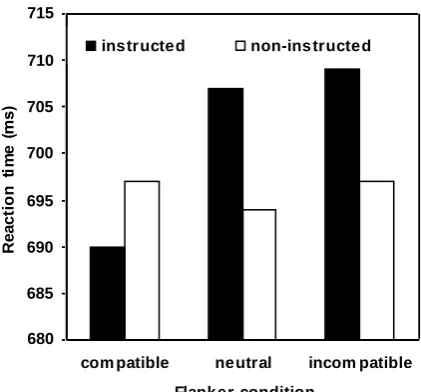
impact of flankers from the non-instructed category of effects. And this is what was observed
(c.f. Fig. 4): While flankers from the non-instructed category of effects did not affect
performance, effects of effect-compatibility emerged with flankers belonging to the instructed
set of effects (faster responding with effect-compatible flankers than with effect-incompatible
and neutral flankers).
Thus, it may be concluded that only those flankers affected behavior in the test phase that
belonged to the instructed category of action-effects while ignoring the information related to
the non-intended effects. Although these data do not exclude that the non-instructed action-
effects, too, played a role in the acquisition phase, they obviously indicate that the instructed
action-effects were weighted more highly than the non-instructed. This led Ziessler and
colleagues to conclude that the acquisition of action-effect structures is at least modulated by
Recently, Herwig, Prinz and Waszak (2007; see also Herwig & Waszak, 2008) went one step
further by showing that action-effect learning is not only modulated by but crucially depends
on an agent‟s intention. Following neuroscientific evidence which suggests that intention-
based actions (i.e., movements carried out in order to voluntarily produce desired
environmental effects - mediated by fronto-striatalcircuits, including the dorso-lateral
prefrontal cortex, anterior cingulate, and SMA) and stimulus-based actions (i.e., movements
carried out to accommodate environmental demands - controlled by circuits involving PMA
(lateral premotor cortex) and parietal areas) are controlled by different neural structures
(Passingham, Toni, & Rushworth, 2000; Toni, Rushworth, & Passingham, 2001) and differ in
behavioral indices, such as temporal attraction measures (Haggard, Aschersleben, Gehrke, &
Prinz, 2002; Haggard, Clark, & Kalogeras, 2002) and movement timing (Waszak, Wascher,
Keller, Koch, Aschersleben, Rosenbaum, & Prinz, 2005; Keller, Wascher, Prinz, Waszak,
Koch, & Rosenbaum, 2006), Herwig et al. speculated that action-effect learning only occurs
when agents act in an intention-based action mode. To test this speculation, Herwig and
colleagues replicated the Elsner and Hommel (2001) studies with different types of
acquisition phases - an intention-based acquisition phase and different types of stimulus-based
acquisition phase. Participants of the intention-based groups were required to freely select
between two possible actions (corresponding to the Elsner & Hommel study). By contrast, the
participants‟ actions were triggered by external stimulus events in the stimulus-based groups.
However, in all groups the actions were contingently followed by certain effect tones. That is,
in all groups participants performed identical movements (key presses with the index finger of
the left or the right hand) which were immediately followed by effect tones (e.g., high- or
low-pitched tones). The only difference between the groups was whether the actions were
selected in an intention-based or in a stimulus-based mode of movement. Most interestingly,
in the test-phase evidence for action-effect learning could only be found after intention-based
that the action had previously produced than if triggered by a tone that had been produced by
the alternative action. In contrast, after stimulus-based acquisition no indication of action-
effect learning was obtained, i.e. the mapping of the former effect tones as imperative stimuli
on the responses did not affect response times.
When we, now, consider what follows from the findings reported so far it seems that action-
effect binding may be more than linking action-related codes to effect-related codes simply
due to the co-occurrence of both activation patterns. This may be the case when agents start
learning a certain task with a tabula rasa concerning their action repertoire and concerning
the effects that would accompany and follow certain actions (i.e., children, infants, and
novices who acquire action effects in the first place). However, the agents that we usually
study in experiments on action-effect learning do not start with an action tabula rasa but are
equipped with a sophisticated action control machinery that reflects an individual‟s history of
interacting with the world. Thus, it is not surprising that action-effect learning (at least in
expert actors like the participants in our experiments) can be more than simply exploiting the
coincidence of movements and their sensory effects. The reported evidence suggests that
contiguity and contingency between actions and effects seem to be necessary for action-effect
learning to occur. However, an intention to produce a certain effect also seems to be sufficient
for action-effect learning to occur, provided that the effect can be contingently produced by a
certain action. For explanation it seems worthwhile to consider action-effect learning as a by-
product of efficient action planning where features of intended and expected effects get bound
to features of the actions that are selected to bring these effects about. This would fit very well
to the findings showing that action-effect learning did occur when agents acted in an
intention-based mode but not when they acted in a stimulus-based mode. According to
Herwig et al., agents pass on control to the stimuli in the stimulus-based mode and the system
merely acts upon presentation of a particular stimulus attribute in a pre-specified way (in the
ahead of the stimulus by instruction (Wenke, Gaschler, & Nattkemper, 2007; Wenke,
Gaschler, Nattkemper, and Frensch, 2009) and the participant‟s prior stimulus-response
learning history which create representations that integrate or bind codes of the action-
relevant stimulus attributes and the corresponding action codes (stimulus–response bindings ;
see Allport, 1987; Logan, 1988; Hommel, Pösse, & Waszak, 2000; Waszak, Hommel, &
Allport, 2003). If these bindings are stored in memory, they may serve to guide actions based
on external stimulus events without requiring to plan actions in terms of their sensory
consequences. By contrast, action-effect learning is boosted when actions are governed with
respect to their sensory consequences. In this case, action planning involves anticipating the
effects of a certain action. Anticipating the outcomes of executing a particular action may bias
or pre-tune the perceptual system to search for and to identify the anticipated effects in the
environment. Comparing encountered and expected sensory consequences then provides the
opportunity to generate an error signal that may be used to update internal models that capture
the relations between actions and their effects. .
What are codes of action-effects used for?
A second question that is under debate is the question for the functional role of effect-code
activation in action production and control. Proponents of the ideo-motor approach to action
control (Hommel et al., 2001, Kunde, 2003, Kunde et al., 2004) claim that performing an
action leaves behind an association between the action‟s motor code and the sensory effects
the action produces (action-effect bindings). By virtue of repeated experience this eventually
results in creating a sensory-motor structure that integrates motor codes with codes of the
perceptual events that represent action-effects. The associations between motor codes and
perceptual codes are assumed to be bidirectional. Perceiving or imagining events that
finally prime or induce the motor patterns that have been learned to produce these events. Do
effect-codes prime motor representations?
At first sight the above sketched compatibility effects obtained with exogenously as well as
endogenously activated effect codes seem to be consistent with the assumption that both
perceived and anticipated events gain the power to induce actions. Further evidence has been
provided by Elsner et al. (2002) and Melcher et al. (2008) who showed that the mere
perception of auditory stimuli that previously had been presented as effect tones of certain
actions results in the activation of neural structures that are selectively activated with
voluntary but not stimulus-driven actions. Moreover, Kunde (2004) observed response
priming by visual stimuli formerly presented as action effects although the prime stimuli were
masked during the test phase and thus could not be consciously identified.
Although these observations show that action codes are activated when perceiving effect-
related events, it is less clear whether the activation of effect codes really is the prerequisite
for accessing and selecting responses as considered in ideo-motor approaches. If this would
be the case, one should be able to show that effect codes have access to relatively early phases
of response production which can be equated with what traditional information-processing
models label as “response selection”. Thus, effect-code activation should precede response
selection, simply because codes of effects serve as mental cues for the selection of appropriate
motor patterns.
Until now there are only few studies that directly addressed the functional role and the locus
of effect-code activation. Using the well-established PRP-paradigm (Pashler, 1984, 1994;
Logan & Gordon, 2001) Paelecke and Kunde (2007) located the activation of effect codes
relative to the stage that information-processing models denote as response selection stage.
Their results suggest that endogenously activated effect codes affect the responses within or
after the response bottleneck whereas exogenously activated effect codes had their impact
cognitive system is intention-based mode) it seems likely that effect codes affect response
selection. However, if the effect codes are exogenously activated their impact on response
time does not depend on response selection.
These observations and their interpretation would be consistent with the claim that codes of
action-effects serve as mental cues for the selection of appropriate motor patterns. However,
results from another study point in another direction. Ziessler and Nattkemper (2009, under
revision) adapted their flanker paradigm to investigate the involvement of effect codes in the
preparation of motor responses. Participants first worked through a learning phase where they
responded to letters with key press actions that contingently produced new letters as effect
stimuli. In a second phase, the effect letters or neutral letters were presented before,
simultaneously with, or after the target letters as flanker stimuli. Depending on the acquired
response-effect associations, effect flankers could be compatible or incompatible to the
required response. The flanker-compatibility-effect served as indicator for an internal
activation of effect codes.
The results were not consistent with the idea that effect codes induce motor representations.
the effect compatibility of the flankers did not affect responding when flankers were presented
before target onset. This suggests that participants could not make use of the effect-related
information as long as the response had not been determined by the stimulus. If this
information was provided simultaneously with the target, effect-compatible flankers delayed
responding while no costs of incompatible flankers were observed. If effect-related
information was provided considerably after target onset, effect-compatible flankers
facilitated responding compared to incompatible or neutral flankers. Moreover, there was
only a benefit of effect-compatible flankers but no cost of incompatible flankers. RTs under
the effect-incompatible condition were almost identical to RTs under the neutral condition.
What was observed was that the effect compatibility of the flankers did not affect the
24 participants cannot make use of the information about the particular effect as long as the
response has not been determined by the stimulus. If this information was provided
simultaneously with the target, effect-compatible flankers delayed responding while no costs
of incompatible flankers were observed. If information about the effects was provided
considerably after target onset, it facilitated the responses to the targets compared to wrong or
neutral information. Moreover, there was only a benefit of effect-compatible flankers but no
cost of incompatible flankers. RTs under the effect-incompatible condition were almost
identical to RTs under the neutral condition.
These results indicate that advance information about the to-be-produced effects had little or
no effect on response times. It seems that effect-related information presented before the
target could not be used to activate or prime the response. This outcome is clearly not
compatible with “strong” versions of the ideo-motor theory that state that perceiving events
that resemble learned action-effects will prime or induce the motor patterns that have been
learned to produce these events. Furthermore, no difference between neutral and effect-
incompatible flankers was found. Only the effect-compatible flankers facilitated the
responses. In the framework of the ideomotor principle we should expect benefits for effect-
compatible and costs for effect-incompatible flankers since both flanker types should activate
the responses producing these effects. In case of effect-compatible flankers that would be the
correct response. In case of effect-incompatible flankers that would be an incorrect response.
Thus, the missing costs for effect-incompatible flankers are further evidence against the idea
that the activation of effect codes would prime the response.
In an effort to determine at what stages of response production action effects operate,
Nikolaev, Ziessler, Dimova and van Leeuwen (2008) used high-density event-related
potentials (ERP) in the flanker paradigm of Ziessler and Nattkemper. The analysis of the EEG
data aimed at two kinds of brain activity: (1) activity evoked by the presentation of the effect-
preparation of a motor response using lateralized readiness potentials (LRP) as a measure of
covert motor preparation. What was found was (1) that ERP‟s evoked by effect-incompatible
flankers differed from those evoked by other flankers in the early perceptual component P1
and in a later frontal component P2, which are supposed to reflect stimulus evalution and
conflict detection, respectively. Most interestingly in the present context, Nikolaev and
colleagues found (2) that effects of flanker-compatibility were not observed in the stimulus-
locked LRP, which was taken as evidence that effect-related flankers did not modulate motor
preparation stages. By contrast, flanker-compatibility effects were observed in the response-
locked LRPs, i.e. the interval between LRP onset and the overt response was affected by
effect-compatibility of the flanker. This interval is thought to sensitively reflect the duration
of motor processes following response selection. It was found that the time needed for
executing a motor response was longer with effect-incompatible than with the other flankers.
Thus, it seems that incompatible flankers delayed the execution of the response at a point in
time at which the motor program had already been prepared.
Altogether, it seems that analyzing the type and distribution of ERP‟s gives us important hints
about the function of effect anticipation in action planning. Effects of the effect-compatibility
of flanker stimuli were observed in the perceptual peak P1, and in the later peak P2 reflecting
conflict detection. These findings provide evidence that anticipated action-effects prepare
cognitive and perceptual processes for the immediate consequences of an action. Information
about these consequences is likely to reach the perceptual system in a top-down fashion in
that the perceptual system, as result of response preparation, is biased to search for the
anticipated action consequences in the environment. As indicated by the effects on the LRP-
component, anticipated action-effects also influenced motor processes. Interestingly,
however, it seems that effect-incompatible flankers did not affect pre-motor processes related
to response preparation but motor processes that come into play after having prepared a
In summary, the functional role that effect-codes play in action planning is far from being
understood. Facing the discrepancies between the reported results it seems that both further
theorizing and further experimenting is required to understand what effect-codes are used for
in action planning.
Conclusion
After Wolfgang Prinz in the 1980s revived and elaborated the idea that actions are controlled
by anticipatory activations of representations of intended and expected action-effects, we have
seen a proliferation of studies that show indeed that the cognitive system links voluntary
actions with their perceptual effects. Thus, the issue that seems to be settled is that action
effects are integrated and used in the control of voluntary actions. Some questions certainly
remain, such as how sophisticated the principles underlying action-effect integration are, how
intention and attention shape the integration and/or use of effect codes, and what the
conditions for integrating actions and their subsequent effects are.
References
Allport, D. A. (1987). Selection for action: Some behaviorial and neurophysiological considerations of attention
and action. In H. Heuer & A. F. Sanders (Eds.), Perspectives on perception and action (pp. 395–419). Hillsdale,
NJ: Lawrence Erlbaum Associates, Inc.
Beckers, T., De Houwer, J., & Eelen, P. (2002). Automatic integration of non-perceptual action effect features:
The case of the associative affective Simon effect. Psychological Research, 66, 166–173.
Dehaene, S. (1992). Varieties of numerical abilities. Cognition, 44, 1–42.
Dehaene, S. (1997). The number sense. Oxford University Press.
Eenshuistra, R.M., Weidema, M.A., Hommel, B., (2004). Development of the acquisition and control of action -
effect associations. Acta Psychologica 115, 185-209.
Elsner, B., & Hommel, B. (2001). Effect anticipation and action control. Journal of Experimental Psychology:
Human Perception & Performance, 27, 229-240.
Elsner, B., & Hommel, B. (2004). Contiguity and contingency in the acquisition of action effects. Psychological
Research, 68, 138-154.
Elsner, B., Hommel, B., Mentschel, B., Drzezga, A., Prinz, W., & Conrad, B. (2002). Linking actions and their
Eriksen, B.A., & Eriksen, C.W. (1974). Effects of noise letters on the identification of a target letter in a non-
search task. Perception & Psychophysics, 16 (1), 143149.
Fias, W., & Fischer, M. H. (2005). Spatial representation of numbers. In J.I. D. Campbell (Ed.), Handbook of
mathematical cognition (pp. 43–54). New York, NY: Psychology Press.
Frith, C.D., Blakemore, S.J., & Wolpert, D. M. (2000). Explaining the symptoms of schizophrenia:
Abnormalities in the awareness of action. Brain Research Reviews, 31, 357-363.
Gibson, J.J. (1966). The senses considered as perceptual systems. Houghton Mifflin, Boston.
Gibson, J.J. (1979). The Ecological Approach to Perception. Houghton Mifflin, Boston.
Greenwald, A. G. (1970). A choice reaction time test of ideomotor theory. Journal of Experimental Psychology,
86, 20-25.
Greenwald, A. G. (1970). A double stimulation test of ideomotor theory with implications for selective attention.
Journal of Experimental Psychology, 84, 392-398.
Greenwald, A. G. (1970). Sensory feedback mechanisms in performance control: with special reference to the
ideo-motor mechanism. Psychological Review, 77, 73-99.
Haggard, P., Clark, S., & Kalogeras, J. (2002). Voluntary action and conscious awareness. Nature Neuroscience,
5, 382–385.
Haggard, P., Aschersleben, G., Gehrke, J., & Prinz, W. (2002). Action, binding, and awareness. In W. Prinz & B.
Hommel (Eds.), Common Mechanisms in Perception and Action. Attention and Performance XIX. Oxford:
University Press.
Harleß, E. (1861). Der Apparat des Willens [The apparatus of will]. Zeitschrift für Philosophie und
philosophische Kritik, 38, 50 – 73.
Herbart, J.F. (1824). Psychologie als Wissenschaft neugegründet auf Erfahrung, Metaphysik und Mathematik.
Erster, synthetischer Teil [Psychology as a science newly based on experience, metaphysics, and mathematics]. Königsberg, Germany: August Wilhelm Unzer.
Herwig, A., & Waszak, F. (2008, in press). Intention and Attention in Ideomotor Learning. Quarterly Journal of
Experimental Psychology.
Herwig, A., Prinz, W., & Waszak, F. (2007). Two modes of sensorimotor integration inintention-based and
stimulus-based actions. The Quarterly Journal of Experimental Psychology, 60, 1540-1554.
Hoffmann, J., Sebald, A., & Stoecker, C. (2001). Irrelevant response effects improve serial learning in serial
reaction time tasks. Journal of Experimental Psychology: Learning,,Memory, & Cognition, 27, 470-482.
Hommel, B. (1993). Inverting the Simon effect by intention. Psychological Research, 55, 270 – 279.
Hommel, B. (1996). The cognitive representation of action: Automatic integration of perceived action effects.
Psychological Research, 59, 176 – 186.
Hommel, B. (2000). The prepared reflex: Automaticity and control in stimulus-response translation. In S.
Monsell & J. Driver (Eds.), Control of cognitive processes: Attention and performance XVIII (pp. 247-273).
Cambridge, MA: MIT Press.
Hommel, B. (2005). Perception in action: multiple roles of sensory information in action control. Cognitive Processing, 6: 3–
14.
Hommel, B. (2009). Action control according to TEC (theory of event coding). Psychological Research, 73,
Hommel, B., Alonso, D., & Fuentes, L. J. (2003). Acquisition and generalization of action effects. Visual
Cognition, 10, 965–986.
Hommel, B., Müsseler, J., Aschersleben, G., & Prinz, W. (2001). The Theory of Event Coding (TEC): A
framework for perception and action planning. Behavioral and Brain Sciences, 24, 849-937.
Hommel, B., Pösse, B., & Waszak, F. (2000). Contextualization in perception and action. Psychologica Belgica,
40, 227–245.
James, W. (1890). The Principles of Psychology. Dover Publications, New York.
Jolicœur, P. & Dell‟Acqua, R. (1998). The demonstration of short-term consolidation. Cognitive Psychology, 36, 138–202.
Jordan, M.I. (1996). Computational aspects of motor control and motor learning. In H. Heuer & S.W. Keele
(Eds.). Handbook of perception and action, Vol. 2: Motor skills. (pp. 71-120). San Diego, CA, US: Academic
Press.
Keller, P., Wascher, E., Prinz, W., Waszak, F., Koch, I., & Rosenbaum, D. (2006). Differences between
intention-based and stimulus-based actions. Journal of Psychophysiology, 20, 9–20.
Kornblum, S., Hasbroucq, T., & Osman, A. (1990). Dimensional overlap: Cognitive basis for stimulus response
compatibility: A model and taxonomy. Psychological Review, 97, 253-270.
Kühn, S., Elsner, B.,Prinz, W. & Brass, M. (2009). Busy doing nothing: Evidence for nonaction–effect binding.
Psychonomic Bulletin & Review, 16 (3), 542-549.
Kunde, W. (2001). Response-effect compatibility in manual choice reaction tasks. Journal of Experimental
Psychology: Human Perception and Performance, 27, 387–394.
Kunde, W. (2003). Temporal response-effect compatibility. Psychological Research, 67, 153–159.
Kunde, W. (2004). Response priming by supraliminal and subliminal action effects. Psychological Research, 68,
91–96.
Kunde, W., Hoffmann, J. & Zellmann, P. (2002). The impact of anticipated action effects on action planning.
Acta Psychologica, 109, 137–155.
Kunde, W., Koch, I. & Hoffmann, J. (2004). Anticipated action effects affect the selection, initiation, and
execution of actions. The Quarterly Journal of Experimental Psychology. Section A: Human Experimental
Psychology, 57, 87–106.
Logan, G. D. (1988). Toward an instance theory of automatization. Psychological Review, 95, 492–527.
Logan, G. D., & Gordon, R. D. (2001). Executive control of visual attention in dual-task situations.
Psychological Review, 108, 393–434.
Lotze, R.H. (1852). Medicinische Psychologie oder die Physiologie der Seele [Medical psychology or the
physiology of the soul]. Leipzig: Weidmann´sche Buchhandlung.
Lu, C.H., & Proctor, R.W. (1995). The influence of irrelevant location information on performance: a review of
the Simon and spatial Stroop effects. Psychonomic Bulletin & Review, 2, 174-207.
Melcher, T., Weidema, M., Eenshuistra, R.M., Hommel, B., & Gruber, O. (2008). The neural substrate of the
ideomotor principle: An event-related fMRI analysis, NeuroImage, 39, 3, 1274-1288.
Münsterberg, H. (1888). Die Willenshandlung. Ein Beitrag zur physiologischen Psychologie [The intended act.
A contribution to physiological psychology]. Freiburg: Mohr.
Nattkemper, D., Ziessler, M., & Frensch, P.A. (2007). Producing digits by key-presses generates the SNARC-
Nikolaev, A.R., Ziessler, M, Dimova, K, & van Leeuwen, C. (2008). Anticipated action consequences as a nexus
between action and perception: Evidence from event-related potentials, Biol. Psychol. , 78, 53–65. Paelecke M,
& Kunde W (2007) Action-effect codes in and before the central bottleneck: evidence from the PRP paradigm.
Journal of Experimental Psychology: Human Perception & Performance, 33, 3, 627–644.
Pashler, H. (1984). Processing stages in overlapping tasks: Evidence for a central bottleneck. Journal of
Experimental Psychology: Human Perception and Performance, 10, 358–377.
Pashler, H. (1994). Dual-task interference in simple tasks: Data and theory. Psychological Bulletin, 116, 220–
244.
Prinz, W. (1983). Wahrnehmung und Tätigkeitssteuerung. Springer.
Prinz, W. (1984). Modes of linkages between perception and action. In W. Prinz & A. F. Sanders (Eds.),
Cognition and motor processes (pp. xx-xx). Springer.
Prinz, W. (1987). Ideo-motor action. In H. Heuer & A. F. Sanders (Eds.), Perspectives on perception and action
(pp. 47-76). Erlbaum: Hillsdale.
Prinz, W. (1990). A common coding approach to perception and action. In O. Neumann & W. Prinz (Eds.),
Relationships between perception and action: Current approaches (pp. 167–201). Berlin: Springer.
Prinz, W. (1997). Perception and action planning. European Journal of Cognitive Psychology,9, 129-154.
Stock A, Stock C (2004) A short history of ideo-motor action. Psychological Research, 68, 176–188.
Thorndike, E. L. (1913). Ideo-motor action. Psychological Review, 20, 91–106.
Waszak, F., Hommel, B., & Allport, A. (2003). Task-switching and long-term priming: Role of episodic S–R
bindings in task-shift costs. Cognitive Psychology, 46, 361–413.
Waszak, F., Wascher, E., Keller, P., Koch, I., Aschersleben, G., Rosenbaum, D., & Prinz, W. (2005). Intention-
based and stimulus-based mechanisms in action selection. Experimental Brain Research, 162, 346-356.
Wenke, D., Gaschler, R., & Nattkemper, D. (2007). Instruction-induced feature-binding. In B. Hommel & B.
Milliken (Eds.), Feature integration in and across perception and action. Psychological Research, 71, 92-106.
Wenke, D., Gaschler, R., Nattkemper, D., & Frensch, P.A. (2009). Strategic influences on implementing
instructions for future actions. Psychological Research, DOI 10.1007/s00426-009-0239-x.
Wolpert, D.M., Miall, R.Ch., & Kawato, M. (1998). Internal models in the cerebellum. Trends in Cognitive
Science, 2, 338-347.
Ziessler, M., & Nattkemper, D. (2001). Learning of event sequences is based on response effect learning: Further
evidence from a serial reaction task. Journal of Experimental Psychology: Learning, Memory, & Cognition, 27,
595-613.
Ziessler, M., & Nattkemper, D. (2002). Effect anticipation in action planning: Anticipative learning of action
effects. In W. Prinz & B. Hommel (Eds.), Common mechanisms in perception and action: Attention and
Performance, Vol. XIX (pp. 645-672). Oxford: Oxford University Press.
Ziessler, M., & Nattkemper, D. (2009, under revision). The temporal dynamics of effect anticipation in course of
action planning.
Ziessler, M., Nattkemper, D. & Frensch, P.A. (2004). The role of anticipation and intention for the learning of
effects of self-performed actions. Psychological Research, 68, 163-175.
Ziessler, M., Nattkemper, D., Vogt, S., Ellsworth, S., & Sayers, J. (2006). Stimuli presented during action
planning affect the planning process depending on their compatibility with arbitrary action effects. Houston:
Acknowledgements
This research was supported by a grant of the Deutsche Forschungsgemeinschaft (Research
Group 448: „Bindung (binding): Funktionale Architektur, neuronale Korrelate und
Ontogenese”). We thank Jaan Aru, Maria Eichhorn, Mari Hiio, Anja Kühnel, Julija Mell, Jens
Nachtwei, and Stefanie Schmidt for running the experiments; Joachim Hoffmann and
Figure(s)
Figure captions
Fig. 1: Basic procedure and main result of the Ziessler & Nattkemper (2002) study. C, N, and I in the right -side
graph refer to the effect-compatible, neutral, and effect-incompatible flanker condition.
Fig 2: Illustration of the basic procedure of the Ziessler et al. (2006) study.
Fig. 3: Illustration of the anticipative action-effect learning model of Ziessler et al. (2004).
Fig. 4: Effects of effect-compatibility depending on whether the flanker was chosen from the instructed or the
non-instructed category of effect stimuli. The figure shows the mean RTs to targets depending on whether the
B) ct
R
eac
ti
o
n
m
e
715
710 ins tructe d non-ins tructe d
705
700
695
690
685
680
com patible ne utral incom patible
Flank e r condition