General intelligence is a good predictor of job performance and it has been widely used in personnel selection (Schmidt & Hunter, 1998; 2004). However, it is not a strong predictor of other key variables such as successful and effective leadership (Lappalainen, 2015; Rosete & Ciarrochi, 2005) and appropriate stress coping skills (Singh & Sharma, 2012). In fact, general intelligence only accounts for 25% of the variance in job performance (Goldstein, Zedeck, & Goldstein, 2002), leaving a high percentage of variance unexplained. This led researchers
to consider other potential variables that may account for the remaining variance, such as emotional intelligence (EI). Lam and Kirby (2002) conducted one of the fi rst systematic studies to compare the variance explained by both general intelligence and EI, fi nding that EI accounted for an additional percentage of variance not explained by general intelligence. This is further supported by a meta-analysis conducted by Joseph, Jin, Newman and O’Boyle (2015) who showed that EI was a strong predictor of job satisfaction, and performance and successful leadership. These results indicated not only the important role of EI as a predictor of job performance but also the independence between general intelligence and EI (MacCann, Joseph, Newman, & Roberts, 2014).
Despite the existence of different theoretical models (Fernández-Berrocal & Extremera, 2006), EI can be defi ned as
ISSN 0214 - 9915 CODEN PSOTEG Copyright © 2017 Psicothema www.psicothema.com
Impact of the Intensive Program of Emotional Intelligence (IPEI)
on work supervisors
Gustavo Adolfo Rodríguez García
1, Belén López-Pérez
2, Manuel Antonio Férreo Cruzado
3,
María Elena Fernández Carrascoso
3and Juan Fernández
11 Universidad Complutense de Madrid, 2 Liverpool Hope University and 3 Asociación N-Acción
Abstract
Resumen
Background: This study aimed to evaluate the effect of the Intensive Program of Emotional Intelligence (IPEI; Fernández, 2016; Férreo, 2016) on middle managers’ emotional intelligence, as this variable may have a signifi cant impact on personal satisfaction, task performance, and the work environment. Method: The intervention was applied to work team supervisors in a large call center, as it is an overlooked sector in this topic. Two-hundred and eighty-two supervisors from a Madrid-based, Spanish multinational (51.4% men and 48.6% women) participated in this study. Participants were assigned to the experimental group (n = 190) or the control group (n = 92) by availability, according to management decision. All supervisors fi lled in two questionnaires to evaluate the different components of intrapersonal emotional intelligence (i.e., attention, clarity, and repair; TMMS-24; Fernández-Berrocal, Extremera, & Ramos, 2004) and cognitive and affective empathy (i.e., perspective taking, emotion understanding, empathic joy, and personal distress; TECA; López-Pérez, Fernández, & Abad, 2008). Results: The fi ndings showed an increase in the studied variables for the experimental group. Conclusions: The results obtained support middle managers’ training in emotional competences through short, effi cient, economic programs. Potential limitations and implications of the results are discussed.
Keywords: Emotional intelligence, empathy, educational intervention program, management training, work psychology.
Impacto del Programa de Inteligencia Emocional Intensivo (PIEI) en supervisores de trabajo.Antecedentes: este estudio se centra en la evaluación del Programa de Inteligencia Emocional Intensivo (PIEI; Fernández, 2016; Férreo, 2016) aplicado a supervisores de trabajo. El programa pretende incrementar la inteligencia emocional, ya que esta variable incide en aspectos como la satisfacción personal, el desempeño de tareas y el clima laboral. Método: la intervención se aplicó a supervisores de un gran call center, un sector poco estudiado en este ámbito. Participaron 282 supervisores pertenecientes a una empresa española multinacional, radicada en Madrid (51,4% varones y 48,6% mujeres). Fueron asignados, por disponibilidad, al grupo experimental (n = 190) o al grupo control (n = 92). Todos los supervisores respondieron a dos cuestionarios: uno para evaluar los componentes de inteligencia emocional intrapersonal (v.g., claridad, comprensión y reparación; TMMS-24; Fernández-Berrocal, Extremera y Ramos, 2004) y otro para medir empatía cognitiva y afectiva (v.g., adopción de perspectivas, comprensión emocional, alegría empática y estrés empático; TECA, López-Pérez, Fernández y Abad, 2008).
Resultados: los resultados mostraron una mejora en las variables de estudio tras aplicar el programa en el grupo experimental. Conclusiones:
los resultados obtenidos apoyan la formación emocional de mandos intermedios con programas breves, efi caces y económicos. Además, se discuten las limitaciones e implicaciones de los resultados obtenidos. Palabras clave: inteligencia emocional, empatía, programa de intervención educativa, formación de los mandos, psicología del trabajo.
Psicothema 2017, Vol. 29, No. 4, 508-513
doi: 10.7334/psicothema2016.396
Received: December 28, 2016 • Accepted: May 17, 2017 Corresponding author: Gustavo Adolfo Rodríguez García Universidad Complutense de Madrid
different abilities to perceive, understand, and regulate one’s own and others’ emotions (Mayer & Salovey, 1997; Mayer, Salovey, & Caruso, 2001). Emotion perception consists of being able to accurately decode one’s own and others’ emotions through facial and body expressions, as well as emotions that may be present in different stimuli (i.e., paintings evoking different emotional states in the viewer) (Mayer et al., 2001). Emotion understanding consists of comprehending how basic emotions can evolve into complex emotions by blending, how emotions may be affected by different contextual factors, and what emotions may be more prototypical depending on the context (Mayer & Salovey, 1997). In addition, emotion regulation encompasses modifying one’s own and others’ emotions (Salovey & Mayer, 1990).
From this theoretical perspective, EI can be modifi ed with the appropriate training to enhance individuals’ emotional skills (Caruso, Salovey, Brackett, & Mayer, 2015). In fact, higher scores on emotion regulation have been linked to high quality social relationships and subjective well-being (John & Gross, 2004). Furthermore, emotion perception, understanding, and regulation have been described as important predictors of personal and social adjustment (Sánchez-García, Extremera, & Fernández-Berrocal, 2016).
Multiple studies have shown how EI and its different components may predict signifi cantly effi cient performance at work. For instance, different authors highlighted the need to improve emotional skills in organizations not only to increase job performance but also to improve affect and attitudes at work (Lopes, Grewal, Kadis, Gall, & Salovey, 2006), and to create a more pleasant work environment (Cooper & Sawaf, 1997). Further studies supported this by showing how EI not only had a positive impact at a personal and interpersonal level but also in the individuals’ job performance (Landy & Conte, 2016). Furthermore, higher levels of EI have been linked to better mental health, more engagement, less stress, less aggressive behavior and higher work satisfaction in employees (Harvey & Dasborough, 2006; Schutte & Loi, 2014), and better attitudes to work and better performance in middle managers (Sinha & Kumar, 2016). The benefi cial role of EI in the work environment has been explained due to the moderating role of EI in buffering the effect of job-related stressors (Guy & Lee, 2015).
Many authors have suggested that EI can be improved through appropriate training (Bar-On & Parker, 2000; Bisquerra, 2011). However, despite the important role of EI in job satisfaction and performance, most intervention programs in the organizational setting have been developed without a solid theoretical background and only few have been tested (Nelis, Quoidbach, Mikolajczak, & Hansenne, 2009). For instance, Slaski and Cartwright (2003) conducted an intervention program showing that an improvement in EI had a positive effect in employees’ well-being, performance, and stress levels. Eichmann (2009) developed and evaluated a training program for managers with a 10-week duration showing a signifi cant increase in the levels of EI. Groves, McEnrue, and Shen (2008) found out similar results with an 11-week EI training program. In Spain, most intervention programs have been developed in the educational setting (Blanco, 2007). To the best of our knowledge, so far there is not a single program available developed, applied, and evaluated in Spain in the organizational domain. Although the previously mentioned programs could be translated into Spanish, most of them involve training during an extended period, making the application diffi cult and more
importantly less effi cient (i.e., with employees and managers leaving their job to take part in the intervention), and therefore costlier (Cherniss & Goleman, 2003). Short intervention programs have proved successful in the educational domain (Ambrona, López-Pérez, & Márquez-González, 2012; Pool & Qualter, 2012), suggesting that the same principle may apply to intervention programs carried out in organizations. In fact, a 32-hour program applied in Romania to improve IT engineers’ socio-emotional skills has proved successful showing an improvement in the levels of EI in the experimental group (Vaida, 2015).
The present research aimed to test and evaluate the Intensive Program of Emotional Intelligence (IPEI). The IPEI aimed to enhance intrapersonal emotion perception, understanding, and regulation and interpersonal understanding (i.e., empathy and its different components) in a short time framework (i.e., 16 hours in three consecutive days). The program meets the standards of the Servicio Público de Empleo Estatal (2016) and the Consortium for Research on Emotional Intelligence in Organizations (2015). When developing the program, we also considered the following criteria suggested by Álvarez (2001): theoretical background, intervention targets, needs assessment, defi nition of intervention strategies, aim and objectives, trainers, content, time sequence for implementing the training, activities, and sources for evaluation. The program consisted of 32 eminently practical exercises, grouped into three modules. All the exercises were explicitly or implicitly aimed at promoting the skills proposed by Mayer and Salovey (1997): perception, understanding, and emotional self-regulation, both at an intrapersonal (module 1) and interpersonal level (modules 2 and 3). The fi rst module, entitled “Emotional Intelligence” was aimed at raising awareness of the importance of the emotions and their appropriate regulation in professional contexts. The second module, entitled “Empathy”, addressed the most interpersonal aspect of EI and it is intended to facilitate learning on how to handle situations with others, giving importance to the others’ points of view. The goal of the third module, entitled “Relational Skills”, was to reduce emotional barriers to communication and facilitate understanding of successful social interactions. To standardize program implementation and ensure replicability, each exercise was described in every detail with specifi c application guidelines (Fernández, 2016; Férreo, 2016).
The IPEI was administered to middle managers in a big call center to test whether there may be an increase in the intrapersonal emotion perception and regulation, and intra- and interpersonal emotional understanding of those middle-managers who participated in the intervention program (i.e., experimental group) compared to those who did not take part (i.e., control group).
Method
Participants
A total of 282 supervisors (51.4% men and 48.6% women) participated in this study, of whom 52.1% were aged over 35 years old, 50.7% had received a university education, 53.3% had been working in their post for over 4 years, and 56.5% had been working in the sector for over 8 years. This group was recruited in a multinational company with headquarters and various call center facilities located in Madrid (Spain).
for teams of eight to ten professional operators. Participants were divided into two groups: an experimental group, composed of supervisors who took part in the intervention program (the Intensive Program of Emotional Intelligence, IPEI), and a control group which did not participate in the program. Selection and formation of the control (92) and experimental (190) groups was decided by senior managers in the company. Both groups completed all the questionnaires in the pretest and 3-month follow-up phases of the study.
Instruments
Trait Meta-Mood Scale - 24(TMMS-24; Fernández-Berrocal et al., 2004). This 24-item questionnaire was used to evaluate the different components of intrapersonal EI [i.e., attention (α = 0.90), clarity (α = 0.90), and mood repair (α = 0.86)] in a 5-point Likert scale ranging from 1 = strongly disagree to 5 = strongly agree.
Cognitive and Affective Empathy Test(TECA; López-Pérez et al., 2008). This 33-item questionnaire was used to assess empathy (α = 0.86) and its different components [i.e., perspective taking (α = 0.70), emotion understanding (α = 0.74), personal distress (α = 0.78), and empathic joy (α = 0.75)] in a 5-point Likert scale ranging from 1 = strongly disagree to 5 = strongly agree.
Procedure
First, approval was obtained from senior managers in the company, who were informed of the protocol. Supervisors in the experimental group were divided into 10 intervention groups with about 20 participants each. Each intervention lasted 16 hours spread over three workshops, which were held on three consecutive days. Workshops 1 and 2 lasted 4 hours each, delivered on separate, consecutive days. Workshop 3 lasted 8 hours and was delivered on the third day. All workshops were led by two trainers (university specialists in EI). The IPEI intervention sessions were delivered over a total period of six months between late 2013 and early 2014. Data collection was conducted with a three-month interval between the pre-test and the follow-up phases. The trainers received a three-days training before implementing the program.
Sessions with the 10 experimental groups were held in a previously agreed room that offered all the necessary material conditions, on three consecutive days in a week and with an approximately 15-day interval between one intervention group and another. Before starting the fi rst workshop, questionnaires were administered as a pretest measure in the experimental and control groups. After the fi nal workshop participants were administered a questionnaire on the perceived quality of the program and its delivery. The control group consisted of about 10 participants for each intervention group. At all times, the confi dential and voluntary nature of participation was respected, and the study adhered to the criteria of the ethics committee of the company and the Complutense University of Madrid.
Data analysis
Data analysis was performed using SPSS v.19. Statistical hypothesis testing was performed by an Analysis of Covariance (ANCOVA).
Results
Before running the main and specifi c statistical analyses, we checked for possible age and gender differences between the groups. The results showed that the experimental (Mage = 37.19; 97 men and 93 women) and the control (Mage = 37.55; 48 men and 44 women) groups did not differ in age (t(282) = .29, p = .77) or gender (χ2(1, N = 282) = .03, p = .86).
A one-way ANCOVA was conducted to test a statistically signifi cant difference between the intervention and control groups on the follow-up scores of attention, clarity, and repair, after controlling for the pre-test scores in attention, clarity, and repair, respectively. For attention, the results showed a signifi cant effect of the covariate pre-test score in attention (F(1, 278) = 4.17, p = .01, ηp
2 = .02) and more importantly, and effect of the group condition
on the follow-up score in attention after controlling for the pre-test score in attention (F(1, 278) = 16.54, p < .001, ηp2 = .06). For clarity, the results showed a signifi cant effect of the covariate (F(1, 278) = 10.57, p = .001, ηp2 = .04), and an effect of the group condition on the follow-up score in clarity after controlling for the pre-test score (F(1, 278) = 14.61, p = .001, ηp2 = .05). Finally, for clarity, the results showed a signifi cant effect of the covariate (F(1, 278) = 27.57, p = .001, ηp2 = .09), and an effect of the group condition on the follow-up score in repair after controlling for the pre-test score (F(1, 278) = 15.43, p < .001, ηp
2 = .05).
A one-way ANCOVA was conducted to test a statistically signifi cant difference between the intervention and control groups on the follow-up scores of perspective taking, emotion understanding, empathic joy, and personal distress, after controlling for the pre-test scores in perspective taking, emotion understanding, empathic joy, and personal distress, respectively. For perspective taking, the results showed a signifi cant effect of the covariate pre-test score in perspective taking (F(1, 278) = 109.71, p = .001, ηp2 = .28) and more importantly, and effect of the group condition on the follow-up score in perspective taking after controlling for the pre-test score (F(1, 278) = 17.85, p < .001, ηp2 = .06). For emotion understanding, the results showed a signifi cant effect of the covariate (F(1, 278) = 320.99, p < .001, ηp
2 = .54), and
the group condition after controlling for the covariate (F(1, 278) = 6.12, p = .01, ηp2 = .02). For empathic joy, the results showed a signifi cant effect of the covariate (F(1, 278) = 172.81, p < .001, ηp
2
= .38), and the group condition after controlling for the covariate (F(1, 278) = 23.28, p = .001, ηp2 = .08). And for personal distress, the results showed a signifi cant effect of the covariate (F(1, 278) = 306.84, p < .001, ηp
2 = .52), and the group condition after
controlling for the covariate (F(1, 278) = 4.36, p = .04, ηp2 = .02). Finally, the data about participants’ satisfaction showed that participants were very satisfi ed with both the program (M = 4.32,
SD = 0.51) and the trainers (M = 4.45, SD = 0.53), in a 5-point Likert scale ranging from 1 = not satisfi ed at all to 5 = extremely satisfi ed.
Discussion
key, as previous research has shown the importance of having a positive perception of the training program as this may affect the program effi cacy (Baldwin & Ford, 1988; Lim & Morris, 2006).
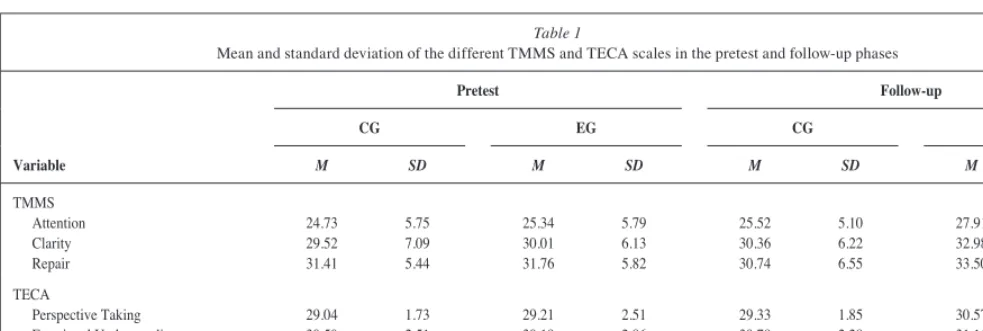
To evaluate the program’s effi cacy we compared whether there were differences in the follow-up scores between the experimental and the control groups, controlling for the pre-test scores. Results showed a signifi cant difference between the experimental and the control groups for all the variables, such that middle managers who participated in the program reported higher levels of intrapersonal emotion perception, understanding, and regulation, as well as higher perspective taking, interpersonal emotion understanding, empathic joy, and personal distress. The effect sizes were mostly satisfactory (medium and large), and only in a few cases were small.
It is important to bear in mind that extreme high levels of emotion perception (Extremera & Fernández-Berrocal, 2005) and personal distress (Batson, 2011) may not always be benefi cial as they have been linked with tension and neuroticism (Extremera & Fernández-Berrocal, 2005) and emotional rumination (López-Pérez & Ambrona, 2015), respectively. Thus, future research may need to investigate whether the increase in the levels emotion perception and personal distress entail positive personal and interpersonal consequences. Despite this, the results are similar to the ones obtained by Fernández (2015) who previously applied the program to undergraduate students, showing an enhancement in the students’ levels of intrapersonal emotion perception, understanding, and regulation. Thus, the obtained results support Bisquerra’s (2011) and Salovey’s and Mayer’s (see Caruso et al., 2015) approaches to the study of EI as they indicated that EI can be improved through training programs.
The obtained results have important implications for training emotional competences in the organizational domain as previous research has shown that higher levels of intrapersonal EI are positively related to better job performance, higher job satisfaction, better mental health, and more engagement (Schutte & Loy, 2014; Sinha & Kumar, 2016; Slaski & Cartwright, 2003), whereas higher levels of interpersonal EI are positively related to a more pleasant work environment and a highly effective leadership (Joseph et al., 2015). Therefore, we could expect that our program may have a positive impact not only at an individual level but also at a wider
level. This idea is supported in previous research which has shown how at an individual level, employees with higher EI are easier to work with and create a more positive environment (Salovey & Grewal, 2005). At an interpersonal level, previous research has found that higher EI scores are related to more cooperation, and more positive relationships (Schutte et al., 2001), as well as better team work (Druskat & Wolff, 2001).
We only evaluated the obtained effects three months after the application of the program. Therefore, we cannot assume whether the effects will hold for longer. Therefore, future research should be conducted from a longitudinal approach to assess whether the obtained effects are present in the long-term. Furthermore, the assignment to the different groups was not random and therefore, the obtained results may be due to other variables. Future research should be conducted by making a random allocation to the different groups.
The evaluation was conducted relying on self-report measures (e.g., TMMS-24) rather than on ability measures (Mayer-Salovey-Caruso Emotional Intelligence Test, Mayer et al., 2001). Given that self-reports may present different biases such as social desirability, future research should consider the inclusion of performance measures. Besides, future research may benefi t by considering other variables related to job performance such as job satisfaction to evaluate whether the effects of the program may have an effect in other relevant variables in the organizational domain. Finally, a main limitation of the study is that the control group was passive, whereas the experimental group engaged in different activities. Therefore, the obtained effects may be explained by the Hawthorne effect (e.g., Adair, 1984) or the experimental group knowing they are observed and evaluated in emotional intelligence. Thus, future research may need to consider engaging the control group in other activities unrelated to emotional intelligence to make sure that the effects can only be accounted by the training program.
The IPEI has shown a signifi cant improvement in middle-managers’ intrapersonal emotion perception and regulation and intra- and interpersonal emotion understanding in a short period. Although it is still early to know for how long the obtained effects may last it seems a promising step in the development and evaluation of short EI intervention programs in the organizational domain.
Table 1
Mean and standard deviation of the different TMMS and TECA scales in the pretest and follow-up phases
Pretest Follow-up
CG EG CG EG
Variable M SD M SD M SD M SD
TMMS Attention Clarity Repair
24.73 29.52 31.41
5.75 7.09 5.44
25.34 30.01 31.76
5.79 6.13 5.82
25.52 30.36 30.74
5.10 6.22 6.55
27.91 32.98 33.50
4.22 4.86 5.04
TECA
Perspective Taking Emotional Understanding Personal Distress Empathic Joy
29.04 30.50 22.08 28.43
1.73 2.51 3.00 2.58
29.21 30.19 21.88 28.76
2.51 2,86 3.59 3.09
29.33 30.78 22.46 28.39
1.85 2.28 3.42 2.98
30.57 31.11 22.92 29.99
2.40 2.47 3.17 2.86
Adair, J. G. (1984). The Hawthorne effect: A reconsideration of the methodological artifact. Journal of Applied Psychology, 69, 334-345. http://doi.org/10.1037/0021-9010.69.2.334
Álvarez, M. (Coord.) (2001). Diseño y evaluación de programas de educación emocional [Design and evaluation of emotional education programs]. Barcelona: Cisspraxis.
Ambrona, T., López-Pérez, B., & Márquez-González, M. (2012). Efi cacia de un programa de educación emocional breve para incrementar la competencia emocional de niños de educación primaria [Effi cacy of a brief emotional education program to increase emotional competence in children at primary school]. Revista Española de Orientación y Psicopedagogía, 23, 39-49. ttps://doi.org/10.5944/reop.vol.23. num.1.2012.11392
Baldwin, T. T., & Ford, J. K. (1988). Transfer of training: A review and directions for future research. Personnel Psychology, 41, 63-105. https://doi.org/10.1111/j.1744-6570.1988.tb00632.x
Bar-On, R., & Parker, J. (Eds.) (2000). The handbook of emotional intelligence. Theory, development, assessment, and application at home, school and in the workplace. San Francisco, CA: Jossey-Bass. Batson, C. D. (2011). The empathy-altruism hypothesis: Issues and
implications. In J. Decety (Ed.), Empathy: From Bench to Bedside
(pp. 40-54). London: The MIT Press. https://doi.org/10.7551/ mitpress/9780262016612.003.0003
Bisquerra, R. (2011). Educación emocional [Emotional education]. Bilbao: Desclée de Brower.
Blanco, A. (2007). Trabajadores competentes [Competent workers]. Madrid: Esic.
Caruso, D. R., Salovey, P., Brackett, M., & Mayer, J. D. (2015). The ability model of emotional intelligence. In S. Joseph (Ed.), Positive psychology in practice (pp. 545-558). Hoboken, NJ: Wiley. https://doi. org/10.1002/9781118996874.ch32
Cherniss, C., & Goleman, D. (Eds.). (2003). The emotionally intelligent workplace. San Francisco, CA: Jossey-Bass.
Consortium for Research on Emotional Intelligence in Organizations. (2015). Model program criteria. Retrieved from http://www. eiconsortium.org/model_programs/jobs.html
Cooper, R., & Sawaf, A. (1997). Executive EQ: Emotional intelligence in leadership and organizations. New York, NY: Penguin.
Druskat, V., & Wolff, S. (2001). Group emotional competence and its infl uence on group effectiveness. In C. Cherniss & D. Goleman (Eds.),
Emotional competence in organizations (pp. 132-155). San Francisco, CA: Jossey-Bass.
Eichmann, K. (2009). The effectiveness of training to improve the emotional intelligence of leaders (Doctoral dissertation, Tui University, Michigan, USA). Retrieved from ProQuest Dissertations and Theses database. (UMI No. 3350595)
Extremera, N., & Fernández-Berrocal P. (2005). Perceived emotional intelligence and life satisfaction: Predictive and incremental validity using the trait metamood scale. Personality and Individual Differences, 39, 937-948. https://doi.org/10.1016/j.paid.2005.03.012 Fernández, E. (2016). Efi cacia del programa educativo PIEI y su relación
con la inteligencia emocional autoinformada y la autopercepción de competencias emocionales adquiridas en estudiantes universitarios
[Effi cacy of the IPEI educational program and their relationship with self-reported emotional intelligence and self-perceived emotional competences in university students] (Doctoral dissertation, Universidad Complutense de Madrid, Spain). Retrieved from http:// eprints.ucm.es/37740/
Fernández-Berrocal, P., & Extremera, N. (2006). Emotional intelligence: A theoretical and empirical review of its first 15 years of history. Psicothema, 18, 7-12.
Fernández-Berrocal, P., Extremera, N., & Ramos, N. (2004). Validity and reliability of the Spanish modifi ed version of the Trait Meta-Mood Scale. Psychological Reports, 94, 751-755. https://doi.org/10.2466/ pr0.94.3.751-755
Férreo, M.A. (2016). Impacto del programa PIEI en los niveles de inteligencia emocional de supervisores de equipos de trabajo y en el desempeño laboral de su equipo en un centro de llamadas [Impact of the IPEI program on work team supervisors’ emotional intelligence
levels and on their team’s job performance in a call center] (Doctoral dissertation, Universidad Complutense de Madrid, Spain). Retrieved from http://eprints.ucm.es/37674/
Goldstein, H. W., Zedeck, S., & Goldstein, I. L (2002). G: Is this your fi nal answer? Human Performance, 15, 123-142. https://doi.org/10.1080/08 959285.2002.9668087
Groves, K. S., McEnrue, M. P., & Shen, W. (2008). Developing and measuring the emotional intelligence of leaders. Journal of Managers Development, 27, 225-250. https://doi.org/10.1108/02621710810849353
Guy, M. E., & Lee, H. J. (2015). How emotional intelligence mediates emotional labor in public service jobs. Review of Public Personnel Administration, 35, 261-277. https://doi.org/10.1177/0734371x13514095 Harvey, P., & Dasborough, M. T. (2006). Consequences of
employee attributions in the workplace: The role of emotional intelligence. Psicothema, 18, 145-151.
John, O. P., & Gross, J. J. (2004). Healthy and unhealthy emotion regulation: Personality processes, individual differences, and life span development. Journal of Personality, 72, 1301-1334. https://doi. org/10.1111/j.1467-6494.2004.00298.x
Joseph, D. L., Jin, J., Newman, D. A., & O’Boyle, E. H. (2015). Why does self-reported emotional intelligence predict job performance? A meta-analytic investigation of mixed EI. Journal of Applied Psychology, 100, 298-342. https://doi.org/10.1037/a0037681
Lam, L. T., & Kirby, S. L. (2002). Is emotional intelligence an advantage? An exploration of the impact of emotional and general intelligence on individual performance. The Journal of Social Psychology, 142, 133-143. https://doi.org/10.1080/00224540209603891
Landy, F., & Conte, J. (2016). Work in the 21st century: An introduction to industrial and organizational psychology. Hoboken, NJ: Wiley. Lappalainen, P. (2015). Predictors of effective leadership in industry - should
engineering education focus on traditional intelligence, personality, or emotional intelligence? European Journal of Engineering Education, 40,
222-233. https://doi.org/10.1080/03043797.2014.944102
Lim, D. H., & Morris, M. L. (2006). Infl uence of trainee characteristics, instructional satisfaction, and organizational climate on perceived learning and training transfer. Human Resource Development Quarterly, 17, 85-115. https://doi.org/10.1002/hrdq.1162
López-Pérez, B., & Ambrona, T. (2015). The role of cognitive emotion regulation on the vicarious emotional response. Motivation and Emotion, 39, 299-308. https://doi.org/10.1007/s11031-014-9452-z López-Pérez, B., Fernández, I., & Abad, F. (2008). Test TECA: Test de
empatía cognitiva y emocional [TECA Test: Cognitive and Emotional Empathy Test]. Madrid: Tea Ediciones.
Lopes, P., Grewal, D., Kadis, J., Gall, M., & Salovey, P. (2006). Evidence that emotional intelligence is related to job performance and affect and attitudes at work. Psicothema, 18, 132-138.
MacCann, C., Joseph, D. L., Newman, D. A., & Roberts, R. D. (2014). Emotional intelligence is a second-stratum factor of intelligence: Evidence from hierarchical and bifactor models. Emotion, 14, 358-374. https://doi.org/10.1037/a0034755
Mayer, J. D., & Salovey, P. (1997). What is emotional intelligence? In P. Salovey & D. Sluyter (Eds.), Emotional development and emotional intelligence: Educational implications (pp. 3-31). New York, NY: Basic Books.
Mayer, J. D., Salovey, P., & Caruso, D. R. (2001). Mayer–Salovey–Caruso Emotional Intelligence Test user’s manual. Toronto: Multi-Health Systems.
Nelis, D., Quoidbach, J., Mikolajczak, M., & Hansenne, M. (2009). Increasing emotional intelligence: (How) is it possible? Personality and Individual Differences, 47, 36-41. https://doi.org/10.1016/j. paid.2009.01.046
Pool, L. D., & Qualter, P. (2012). Improving emotional intelligence and emotional self-effi cacy through a teaching intervention for university students. Learning and Individual Differences, 22, 306-312. https:// doi.org/10.1016/j.lindif.2012.01.010
Rosete, D., & Ciarrochi, J. (2005). Emotional intelligence and its relationship to workplace performance outcomes of leadership effectiveness. Leadership & Organization Development Journal, 26, 388-399. https://doi.org/10.1108/01437730510607871
Salovey, P., & Grewal, D. (2005). The science of emotional intelligence. Current Directions in Psychological Science,14, 281-285.https://doi.org/10.1111/j.0963-7214.2005.00381.x
Salovey, P., & Mayer, J. D. (1990). Emotional intelligence. Imagination, Cognition and Personality, 9, 185-211. https://doi.org/10.2190/dugg-p24e-52wk-6cdg
Sánchez-García, M., Extremera, N., & Fernández-Berrocal, P. (2016). The factor structure and psychometric properties of the Spanish version of the Mayer-Salovey-Caruso Emotional Intelligence Test. Psychological Assessment, 28, 1404-1415. https://doi.org/10.1037/pas0000269 Servicio Público de Empleo Estatal (2016). Diseña el plan de formación de tu
empresa [Design your company‘s training plan]. Retrieved from https:// www.sepe.es/contenidos/empresas/formacion/plan_formacion_tu_ empresa.html
Schmidt, F. L., & Hunter, J. E. (1998). The validity and utility of selection methods in personnel psychology: Practical and theoretical implications of 85 years of research fi ndings. Psychological Bulletin, 124, 262-274. https://doi.org/10.1037//0033-2909.124.2.262
Schmidt, F. L., & Hunter, J. E. (2004). General mental ability in the world of work: Occupational attainment and job performance. Journal of Personality and Social Psychology, 86, 162-173. https://doi. org/10.1037/0022-3514.86.1.162
Schutte, N. S., & Loi, N. M. (2014). Connections between emotional intelligence and workplace fl ourishing. Personality and Individual Differences, 66, 134-139. https://doi.org/10.1016/j.paid.2014.03.031 Schutte, N. S., Malouff, J. M., Bobik, C., Coston, T. D., Greeson, C.,
Jedlicka, C., Rhosdes, E., & Wendorf, G. (2001). Emotional intelligence and interpersonal relations. The Journal of Social Psychology, 141, 523-536. https://doi.org/10.1080/00224540109600569
Singh, Y., & Sharma, R. (2012). Relationship between general intelligence, emotional intelligence, stress levels and stress reactivity. Annals of Neurosciences, 19, 107-111. https://doi.org/10.5214/ans.0972.7531.190304 Sinha, C., & Kumar, H. (2016). Relationship between emotional
intelligence, work attitude and outcomes: Examination of Indian middle-managerial level employees. Journal of Organizational Psychology, 16, 118-125.
Slaski, M., & Cartwright, S. (2003). Emotional intelligence training and its implications for stress, health and performance. Stress and Health, 19, 233-239. https://doi.org/10.1002/smi.979