On Enabling Dynamically
Adaptable Internet Applications
by
Saleem Noel Bhatti
A dissertation submitted in partial fulfilment o f the requirements for the degree of
Doctor of Philosophy
of the
University of London
Department of Computer Science University College London
University of London
ProQuest Number: U642268
All rights reserved
INFORMATION TO ALL USERS
The quality of this reproduction is dependent upon the quality of the copy submitted.
In the unlikely event that the author did not send a complete manuscript and there are missing pages, these will be noted. Also, if material had to be removed,
a note will indicate the deletion.
uest.
ProQuest U642268
Published by ProQuest LLC(2015). Copyright of the Dissertation is held by the Author.
All rights reserved.
This work is protected against unauthorized copying under Title 17, United States Code. Microform Edition © ProQuest LLC.
ProQuest LLC
789 East Eisenhower Parkway P.O. Box 1346
Abstract
Network applications operating over a packet-switched network, such as the Internet, receive varying quality of service (QoS). Fluctuations in QoS can be due to a combination of effects:
E l. variations in network behaviour due to network traffic from other sources B2. variations in network paths due to the behaviour of routing functions E3. the application resides on a mobile host
Fluctuations in QoS are observable over the lifetime of a single instance of an application, as well as between different instances of an application. Such fluctuations in QoS can lead to difficulties in operation for certain applications, particularly those with real-time media flows such as voice and video. We would like to offer these applications mechanisms that enable them to operate in environments where QoS can vary.
Research in progress within the Internet community considers schemes to provide resource reservation mechanisms. Resource reservation allows the application to make QoS requests to the network in terms of constraints defined by values of certain QoS parameters. However, it is unlikely that resource reservation will be ubiquitous in the short to medium term (next 2-5 years). Internet resource reservation using RSVP (Resource reSerVation Protocol) may not support sufficient receiver heterogeneity and is not robust to IP level outages. Additionally, there may be scenarios in which resource reservation may not be possible and/or practicable, e.g. mobile/wireless environments.
match the available network QoS. We make two contributions to address dynamic adaptability for Internet applications: the QoSSpace and the QoSEngine.
The QoSSpace models a multi-dimensional space, with each of its dimensions defined by a QoSParam. A QoSParam is a value derived from a real measured QoS parameter value, such as data rate or jitter. An application’s flow capabilities (flow-requirements) are used to specify regions of operation within QoSSpace, called QoSRegions. The network QoS is also expressed in terms of the same QoSParams and mapped into the QoSSpace. The QoSSpace forms part of the QoSEngine. The QoSEngine generates
QoSReports. QoS Reports contain QoS information summaries that are an indicator of the relative compatibility between an application’s flow-requirements and the network QoS.
The QoSSpace can be seen as the QoSEngine “front-end”. The “back-end” to the QoSEngine is a QoS information processing function that evaluates the network QoS in terms of QoSParams. The QoSEngine “back-end” maps the network QoS measurements into the QoSSpace. The QoSEngine then compares this mapping with the regions defined by QoSRegions to produce QoSReports. These consist of region compatibility values (RCVs) for each of the QoSRegions. A RCV for a QoSRegion is a measure of the compatibility between the network QoS and the QoS required to support that QoSRegion. The application uses the RCVs to help it make decisions about how to adapt its behaviour, i.e. change its flow-requirement.
Acknowledgements
Graham Knight has played the role of mentor and Devil’s Advocate. During the time over which I have completed my work, he has always been extremely patient and reigned in my wilder thoughts with solid, common sense, as well as encouraging me to pursue my ideas. He has also been kind enough to give me the resources and time to do this work when I probably should have been doing something else. Graham has always been ready to give up his own time in order to discuss my work with me. I owe him a debt of gratitude that will be hard to repay.
Jon Crowcroft’s oracular knowledge has kept me on the straight and narrow, while his holistic inputs have kept me on my toes! Whenever I have marched into his room for a “quick chat” he has always made time to talk to me, and I have yet to walk out o f such meetings without having learnt something.
I would like to thank Graham Knight, Steve Wilbur, Stephen Hailes and Jon Crowcroft for their extremely helpful feedback on this work. I would also like to thank the anonymous reviewers who have made useful comments on the parts of this work that have found their way into papers.
I am grateful to Mark Handley at MIT (USA), Franco Sirovich at Systems Wizards s.p.a. (Italy), Kate Lance at connect.com.au Pty. Ltd (Australia), and Dieter Gantenbein at IBM Labs Zurich (Switzerland) for allowing let me use hosts at their sites in order to take network measurements.
There are many people within the Department, past and present, who have been kind enough to share their thoughts with me, and have provided me with valuable experience by giving me the chance to work with them.
My thanks to Prof. David Hutchison (Lancaster) and Prof. Chris Mitchell (Royal Holloway) for examining this work.
My parents, Daisy and Peter, my sisters, Pauline and Neena, and my BroBroBro, Andrew, have always encouraged me ever onwards. I thank them for their love and support.
Notes
References to IETF work-in-progress: IETF Working Groups produce Internet-Draft (I-D) documents that have no official status and should not be quoted other than as “work- in-progress”. Abstracts of the current I-D documents are available in the file
l i d - a b s t r a c t s . t x t
at the FTP locations shown below:
Africa: f t p . i s . c o . z a / i n t e r n e t - d r a f t s
Europe: f t p . n o r d u . n e t / i n t e r n e t - d r a f t s f t p . n i s . g a r r . i t / i n t e r n e t - d r a f t s
Pacific Rim: m u n n a r i . o z . a u / i n t e r n e t - d r a f t s
US East Coast: f t p . i e t f . o r g / i n t e r n e t - d r a f t s
US West Coast: f t p . i s i . e d u / i n t e m e t - d r a f t s
Information about the IETF WGs can be found at http://www.ietf.org/
URLs: all URLs were checked to be correct at the time of writing but their longevity cannot be guaranteed.
Table of Contents
Page
Abstract...2
Acknowledgements... 4
N otes... 5
Table of C ontents...6
List of figures... 9
List of tables... 12
1. Introduction... 13
1.1 Network aware applications... 13
1.2 Overview ... 17
1.3 T hesis... 20
1.4 Goals and approach...20
1.5 Outline of dissertation... 21
2. The evolution of Internet applications...23
2.1 Towards integrated services netw orks...24
2.1.1 Integrated services in the Internet...25
2.2 Mobile applications...25
2.3 Network layer and transport layer protocols...26
2.3.1 Protocols for transporting QoS sensitive flo w s...28
2.3.2 Congestion control and flow control... 30
2.4 Getting information from the user of the application...31
2.5 Getting information from the netw ork... 32
2.5.1 Timeliness of network measurements... 33
2.5.2 Noise in network measurements... 33
2.6 Giving information to the netw ork...36
2.6.1 Application capability... 37
2.6.2 Network capability...38
2.6.3 Resource reservation... 38
2.6.5 Differentiated services... 40
2.7 Application adaptation and heterogeneity...41
2.8 Chapter summary... 44
3. Adaptability in Internet applications...46
3.1 Description of adaptation capability...47
3.2 Requirements for dynamic adaptability... 48
3.3 QoS architecture...49
3.3.1 QoS principles... 50
3.3.2 QoS specification... 52
3.3.3 QoS mechanisms... 54
3.4 Flow-requirement modelling... 57
3.4.1 QoS m apping... 57
3.4.2 QoS parameter value m onitoring... 58
3.5 Supporting adaptability in applications... 59
3.5.1 Operating system support...59
3.5.2 Distributed systems su p p o rt... 59
3.5.3 Media flow scaling and filtering... 60
3.5.4 Support for dynamic QoS assessment for flow s... 62
3.6 Chapter summary...63
4. Dynamic QoS assessments...66
4.1 The problem... 67
4.2 Control systems and adaptation...68
4.3 QoSSpace and QoSParams...70
4.4 QoSRegions... 71
4.5 NetQoSRegion...74
4.6 QoSReports and the region compatibility value (R C V )...75
4.6.1 Parameter compatibility value function (P C V F )... 76
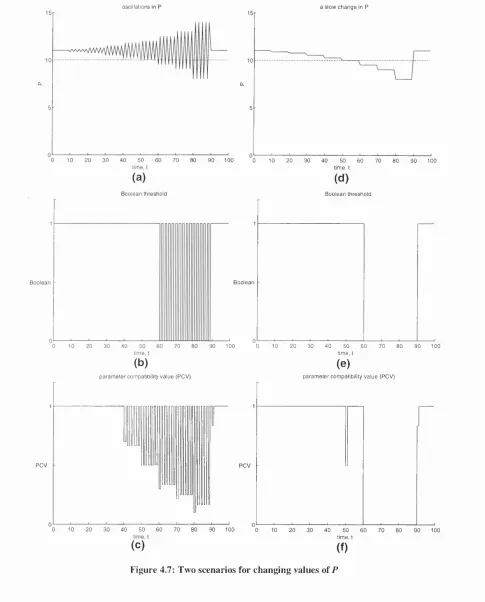
4.6.2 Examples showing the dynamics o f the PCVF... 77
4.6.3 Region compatibility value function (R C V F)...81
4.6.4 QoSiRegions - QoS intermediate regions... 82
4.7 The interface between the application and the QoSEngine, laq... 84
4.8 D iscussion...87
4.9 Chapter summary...89
5. Processing QoS parameter m easurem ents...91
5.2 Fuzzy adaptive prediction (PAP)... 93
5.3 Fuzzy adaptive smoothing (FA S)... 95
5.4 Performance of the FA P... 99
5.4.1 FAP response to pre-defined w aveform s... 100
5.4.2 FAP response to noise in the steady s ta te ... 103
5.4.3 FAP response to random signals with random n o ise ... 104
5.5 Producing NetQoSRegion values...106
5.6 D iscussion... 110
5.7 Chapter summary...113
6. Enabling dynamically adaptable applications...114
6.1 The problem...114
6.2 An example application - daat (dynamically adaptable audio to o l)...115
6.3 User preferences: adaptation policy... 116
6.4 An application adaptation function (AAF) for d a a t... 117
6.4.1 Effects of varying values for q_time and q_compatibility...122
6.5 A mobile scenario of the daat: power conservation dem onstration...127
6.6 Use of QoSiRegions... 130
6.7 D iscussion...134
6.8 Chapter summary...137
7. Summary and conclusions... 139
7.1 Integrated services via the Internet... 140
7.2 Adaptability: an essential part of the QoS framework...141
7.3 Contributions of this w o rk ... 142
7.4 Limitations and future w ork...143
G lossary...146
References... 150
Appendix A: RDJ probes... 166
List of figures
Page
Figure 1.1: An audio conference scenario... 14
Figure 1.2: A mobile application scenario... 15
Figure 1.3: Interaction between the application and the netw ork...18
Figure 2.1 : Interactions between the user, the application, and the network for adaptation... 32
Figure 2.2: A connectivity scenario between UCL and M IT ... 34
Figure 2.3: RDI probes estimate of capacity between d a r h u and t h e a k s t o n (see Figure 2.2 )... 35
Figure 2.4 RDJ probes estimate of capacity between p o t e e n and n o r t h . l e s . m i t . e d u (see Figure 2.2)... 36
Figure 4.1 : The QoSSpace and the Interface laq...68
Figure 4.2: A schematic diagram o f a general control system... 69
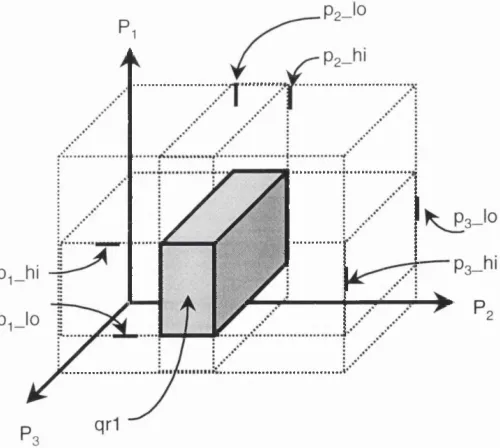
Figure 4.3: A QoSSpace defined in terms of three Q oSParam s... 70
Figure 4.4: An example of a general QoSRegion definition with three QoSParams 72 Figure 4.5: An example QoSRegion definition for an audio flow ... 73
Figure 4.6: Scenarios for the evaluation of WITHIN in the P C V F ...76
Figure 4.7: Two scenarios for changing values of P ... 80
Figure 4.8: Response to large, sudden changes in P... 81
Figure 4.9: QoS intermediate regions - QoSiRegions...83
Figure 4.10: Example use of a Q oSiR egion...84
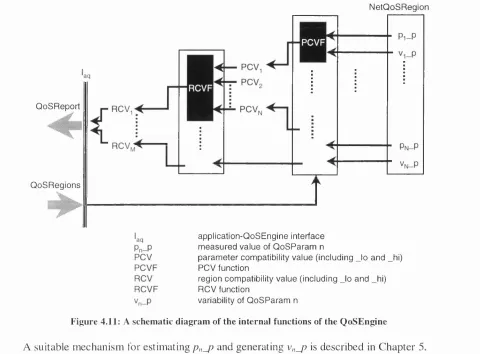
Figure 4.11: A schematic diagram o f the internal functions o f the Q oSEngine... 85
Figure 5.1: The back-end for the QoSEngine... 92
Figure 5.2: Using EWMA: the effects of changing ...94
Figure 5.3: The response of FAP to large spikes in values of P ...95
Figure 5.4: Definition of CIV (change-in-value)...96
Figure 5.6: (a) defintion of LARGE and SMALL; (b) mapping for change-in-value
(C lV )to > ...97
Figure 5.7: A schematic diagram o f the FAS-FAP estimator for producing QoSParam v alues... 98
Figure 5.8: Use of fuzzy adaptive smoothing (FAS) and fuzzy adaptive prediction (F A P )... 99
Figure 5.9: FAP and KMR response to noise in steady s ta te ... 100
Figure 5.10: FAP and KMR response to linear change...100
Figure 5.11: FAP and KMR response to sine w av e...101
Figure 5.12: FAP and KMR response to a square wave... 101
Figure 5.13: FAP and KMR response to triangle wave... 101
Figure 5.14: FAP and KMR response to sawtooth w a v e ...102
Figure 5.15: Comparison of FAP and KMR response: different waveforms (see Table 5.1 ) ... 102
Figure 5.16: Comparison of FAP and KMR response: different noise levels (see Table 5.2 ) ...104
Figure 5.17: (a) input SNR figures; (b) SNR improvement for KMR; (c) SNR improvement for F A P ... 106
Figure 5.18: A schematic diagram of the QoSEngine back-end... 107
Figure 5.19: FAS-FAP {K = 2) with RDJ probes: d a r h u - t h e a k s t o n (see Figure 2.2 ) ...108
Figure 5.20: FAS-FAP {K = 2) with RDJ probes: w a f f l e - t m n s e r v e r ... 108
Figure 5.21: FAS-FAP {K = 2) with RDJ probes: g r a p p a - k n a b e ...108
Figure 5.22: FAS-FAP {K = 2) with RDJ probes: d a r h u - p o t e e n ...109
Figure 5.23: FAS-FAP {K = 2) with RDJ probes: m o u n ta in d e w - m y p o n g a 109 Figure 5.24: FAS-FAP {K = 2) with RDJ probes: p o t e e n - n o r t h ...109
Figure 6.1: The application adaptation function (A A F)...115
Figure 6.2: Simple AAF algorithm for daat in pseudo-code...120
Figure 6.3: QoS information flows between the simple AAF and the daat application 120 Figure 6.4: daat with AAF using d a r h u - t h e a k s t o n data, q_compatibility = 0.8, qjtim e = 6 0 s ... 121
Figure 6.6; RDI for daat with AAF using d a r h u - t h e a k s t o n data with
q_compatibility = 0.8; (a) q_time = 90s; (b) q_time = 120s; (c) q_time = 180s ... 123 Figure 6.7: Flow rate for daat with AAF using d a r h u - t h e a k s t o n data with
q_compatibility = 0.8; (a) q jtim e = 90s; (b) q jim e = 120s; (c) q_time = 180s ... 123 Figure 6.8: RDI for daat with AAF using w a f f l e - t m n s e r v e r data with
q_compatibility = 0.8; (a) q J im e = 90s; (b) q J im e = 120s; (c) q J im e = 180s ... 124 Figure 6.9: Flow rate for daat with AAF using w a f f l e - t m n s e r v e r data with
q_compatibility = 0.8; (a) q jim e = 90s; (b) q jim e = 120s; (c) q jim e = 180s ... 124 Figure 6.10: RDI for daat with AAF using d a r h u - t h e a k s t o n data with q jim e =
60; (a) q jo m p a tib ility = 0.85; (b) q jo m p a tib ility = 0.9; (c) q jo m p a tib ility =
0.95s 125
Figure 6.11: Flow rate for daat with AAF using d a r h u - t h e a k s t o n data with q jim e = 60; (a) q jo m p a tib ility = 0.85; (b) q jo m p a tib ility = 0.9; (c) q jo m p a tib ility =
0.95s 125
Figure 6.12: RDI for daat with AAF using w a f f l e - t m n s e r v e r data with q jim e = 60; (a) q jo m p a tib ility = 0.85; (b) q jo m p a tib ility = 0.9; (c) q jo m p a tib ility =
0 .9 5 126
Figure 6.13: Flow rate for daat with AAF using w a f f l e - t m n s e r v e r data with q jim e = 60; (a) q jo m p a tib ility = 0.85; (b) q jo m p a tib ility = 0.9; (c)
q jo m p a tib ility = 0 .9 5 ...126 Figure 6.14: daat power consumption in the mobile h o st... 129 Figure 6.15: Simple modifications to the AAF for daat to use QoSiRegions (see also
List of tables
Page
Table 2.1: An example of some application-derived QoS param eters... 37 Table 3.1: Interpretation of the five QoS principles from [CAH96]...50 Table 3.2: Interpretation of QoS specification from [CAH96]...52 Table 5.1: Comparison of FAP and KMR response: different waveforms (see Figure
5.15 )...102 Table 5.2: Comparison of FAP and KMR response: different noise levels (see Figure
1. Introduction
As communications and computing are integrated, and distributed applications become the norm rather than the exception, there is now a wide range of network technologies and a whole host of applications expected to work across those different network technologies. The Internet protocol (IP) [IPv4, IPv6] is a packet switched network layer protocol that can be supported by just about any network technology. This is useful as it provides a common interface to network connectivity and hides the specifics of the actual underlying network technology. However, what IP cannot hide is that each of the different network technologies has different capabilities: different data rates, different delay characteristics, different error characteristics. We say that each network technology offers a different quality of service (QoS). Additionally, when IP is used for internetworking in wide area communication, there are many different networking technologies making up the underlying end-to-end network. In such situations, the QoS seen by an instance of an application at the communication end-points could vary dramatically during its lifetime, as well as between different instances of that application throughout the network.
1.1 Network aware applications
require guarantees on available data rate, delay bounds and jitter bounds). In today’s Internet, it is rare for the QoS seen by an application instance to remain consistent [Pax97a, Pax97b], especially in the wide area, but this can also be true in the local area environm ent. Additionally, with the advent o f mobile com puting (portable hardw are platform s), the physical connectivity that an application has to the network may be changing frequently. While this varying QoS may not be so important to applications such as file transfer that can make do with a best-effort service, interactive applications and real-tim e applications with QoS sensitive traffic flow s’ (such as audio and video) may suffer when there are QoS fluctuations. Consider the following two scenarios:
Scenario la: an audio conferencing tool using a packet sw itched netw ork may experience large fluctuations in the delay, throughput, error rates and loss for the transm itted audio data. This will depend on the network load and state o f the links both in the backbone netw ork and the transit networks. This is the situation today for the Internet, and is depicted in Figure 1.1.
Scenario 2a: a user with a mobile host uses services located on an office LAN. The user can connect the mobile host using BR -ISD N (Basic Rate ISDN) from hom e, use a digital mobile phone link whilst travelling to work on the train, and then connect the host to the office LA N (directly) once at work. In each case, the change in connectivity means a change in the QoS. This is depicted in Figure 1.2.
a
a
-Internet
TN transit network
host running audio conferencing application
□
Figure 1.1: An audio conference scenario
A H ow is a s e q u e n c e o f pack ets that are se m a n tic a lly related to ea ch oth er. P a ck ets b e lo n g in g to a H ow m a y be id e n tifie d b y in fo rm a tio n su ch as their so u r ce ad d ress, d estin a tio n a d d ress, port n u m b ers or an a p p lic a tio n s p e c if ic
□
ISDN
GSM
TN Internet
PSTN
host running conferencing application GSM global system for mobile communication ISDN integrated services digital network
11— U ^ ^ PSTN public switched telephone network
mobile host running conferencing application transit network
Figure 1.2: A m obile application scenario
So, an application may experience changes to its physical connectivity as well as its QoS. Any o f the following may contribute to the QoS fluctuation:
E 1. variations in network behaviour due to network traffic from other sources E2. variations in network paths due to the behaviour o f routing functions E3. the application resides on a mobile host
In general, the more routing hops and network elem ents there are on the route betw een source and destination, the greater the QoS fluctuation that is experienced. Across the Internet, this is due primarily to the effects o f E l [Pax97a] and E2 [Pax97b]. How ever, the behaviour o f the individual netw ork elem ents will also play a part, e.g. buffering strategies, queuing/servicing m echanism s, routing-table look-ups, etc.
To appreciate the need for dynamic adaptability, consider again our two scenarios:
Scenario lb: when the audio tool detects changes in the QoS that is being offered to its audio stream, it can adapt its behaviour to cope. For instance, current audio tools (such as
rat [HSK98] and vat [vat]) adapt the size o f their play-out buffers as they detect the delay variation o f the received packets. How ever, if these applications could obtain inform ation about other param eters, they may be able to adapt further. For exam ple, rat and vat allow the use o f several different audio encoding schemes, with differing packet sizes and data rates which, currently, m ust be configured manually. W ith appropriate inform ation about throughput, loss and error rates, a particular rat or vat instance could dynam ically adapt itself to pick the best audio coding scheme to use for the particular netw ork conditions experienced at that time.
Scenario 2b: the user is involved in a m ultim edia conference that has flow s for data, voice and video. W hen the user is at hom e (using BR-ISD N ) only the audio and data flows are enabled (possibly the video is enabled but with a sm all-sized picture and low refresh-rate). W hen the user is on the train (using a mobile phone link) only the audio flow is enabled. W hen the user gets to work (using a LA N) then all three flow s are enabled. In this way the user has rem ained part o f the conference, but the conferencing application has adapted its service in order to cope with the change in the u se r’s connectivity via the detected QoS.
Note that the exam ples in the scenarios consider only the network QoS issues, and not distributed architectural issues, such as resolution o f receiver heterogeneity. For exam ple, in a wide-area, m ultiparty audio conference, the many instances o f the audio tool will each experience different QoS, and so may all decide to adapt differently, e.g. by each choosing a different audio encoding scheme. Some additional application-level m echanism s would be required in order for all instances o f the audio tool to synchronise and/or locate proxy applications that are acting as audio transcoding or filtering gatew ays [KHC98, YGHS96].
1.2 Overview
We use different descriptions for our view of the application, the flow and the network.
An application may operate in different modes. Each o f these modes may have one or more flow-requirements^ for each of its flows, associated with that mode. The flow itself may operate at various set-points^ within the same flow-requirement. The QoS experienced by a flow is expressed as the network QoS as seen by that flow. For example, an Internet audio application may have several modes in which it can operate, such as “high”, “medium” or “low” quality modes. Each mode may uses one or more flow-requirements for the audio flow it generates, e.g. “high” quality may use PCM encoding, “medium” quality may use ADM6 or ADM4 encoding and “low” quality may use GSM or LPC encoding. Each flow-requirement is identified by a different name and has a different flow construction. While the flow is operating in a particular flow- requirement, it may also have a set-point within that flow-requirement. For example, an audio application may adjust the size of its audio play-out buffer to cope with jitter for the flow. This same adjustment may occur in any o f the flow-requirements. The distinction between the flow-requirement and the set-point may be see as the distinction between a course-grained, discrete description of the flow construction and a finer-grained, intra- flow-requirement description.
Each mode may support the use of one or more flow-requirements. The choice of application mode will depend on user input (e.g. user preferences), information from the network (e.g. information about which flow-requirements the network can support) and other application-specific information. The application modes are application-specific. Our eventual goal is to allow the application to make assessments about how it should choose between a number of flow-requirements. We are not concerned here with the application modes (other than there may be one or more flow-requirements associated with an application mode) or the set-point (other than that the set-points exist within a flow-requirement).
This work considers how to enable dynamically adaptable Internet applications by providing then with a QoS summary of the compatibility between flows and the network. A QoS processing function has been developed that measures the relative compatibility
^ A flow-requirement for a flow is a specific flow construction expressed in terms of QoS service requirements.
betw een the network QoS and the application’s flow requirem ents. The com patibility m easurem ents can be used by the applictaion to make changes to its flow construction in order to make use o f the available network QoS. The starting point for our approach is the model shown in Figure 1.3. We note three distinct areas o f interest, each logically separated by a well-defined interface:
1. the interaction between the user and the application (via interface 1,^,)
2. the interaction between the application and the QoSEngine (via interface I^q)
3. the interaction between the QoSEngine and the network flows (via interface 7,^,,)
Our work concerns only the part highlighted in the dashed box in Figure 1.3. W e m odel the application as the generator and/or receiver o f network flows (also called traffic flows or media flows). In this context, a flow is described as a sequence o f packets that form a single unidirectional stream carrying information between a given source and given (unicast or m ulticast) destination [IPv6]. The granularity o f a flow is application-specific e.g. it may be a single, hom ogeneous media stream such as audio, or the flow m ay be a logical channel carrying a variety o f m ultiplexed traffic. The application sends flow s over the network and may also receive flows. Figure 1.3 shows a single flow but there m ay be many flows being sent from or received by the application. We say that the application tlow s exist in QoSSpace.
region decision
information QoSReports control information
from user, e.g. | user preferences
traffic flow inform ation (e.g. m easured from traffic flow)
nternet
application QoSRegion information
traffic flow
0
QoSSpace applicationQoSEngine
^ application adaptation function AAF
Figure 1.3: Interaction between the application and the network
The QoSSpace models a multi-dimensional space, with each o f its dimensions defined by a QoSParam. A QoSParam is a value derived from a real measured QoS parameter value, such as data rate or jitter. An application’s flow capabilities (flow-requirements) are used to specify regions of operation within QoSSpace, called QoSRegions. The network QoS is also expressed in terms of the same QoSParams and mapped into the QoSSpace. The QoSSpace forms part of the QoSEngine. The QoSEngine generates
QoSReports. QoSReports contain QoS information summaries that are an indicator of the relative compatibility between an application’s flow-requirements and the network QoS.
The QoSSpace can be seen as the QoSEngine “front-end”. The “back-end” to the QoSEngine is a QoS information processing function that evaluates the network QoS in terms of QoSParams. The QoSEngine “back-end” maps the network QoS measurements into the QoSSpace. The QoSEngine then compares this mapping with the regions defined by QoSRegions to produce QoSReports. These consist of region compatibility values (RCVs) for each of the QoSRegions. A RCV for a QoSRegion is a measure o f the compatibility between the network QoS and the QoS required to support that QoSRegion. The application uses the RCVs to help it make decisions about how to adapt its behaviour, i.e. change its flow-requirement.
The QoSEngine and QoSSpace are defined to be independent o f any particular network technology. Additionally, we show that the QoSSpace and QoSEngine have the potential to be generally applicable to adaptable applications, and parameters other than network data (such as battery life, cost, host load, etc.) could also be used to derive QoSParams. We demonstrate the function and applicability of the QoSSpace and QoSEngine by the simulation of a dynamically adaptable audio tool.
1.3 Thesis
The QoSSpace and QoSEngine attempt to provide a general and flexible network QoS model. The application’s interface to the model should be relatively sim ple and hide the com plexities o f the network and its traffic flows, as well as the operation o f the Q oSEngine [CAH96], Also, the operation o f the Q oSEngine should not be restricted to any particular network technology or any particular application. The Q oSEngine should be able to function in any environm ent in which IP can function. W e offer the follow ing thesis:
It is possible to design d'general and practicable network QoS model that will enable Internet applications with QoS sensitive flows to make
adaptation assessments dynamically, by monitoring the QoS being #
1.4 Goals and approach
The goals o f this work were to define:
G l. the functions o f the QoSSpace and the QoSEngine
G 2. an interface to allow interaction between the application and the QoSEngine (/,„/)
Our main goal was G l, which has been investigated using sim ulation. The work has considered how information about the com patibility between the netw ork QoS and the application flow-requiremnents can be represented. The interaction betw een the tlow and the network has also been modelled. A specific engineering design for the inform ation m odelling and the interactions between the user, the applictaion and the netw ork have been investigated. Specific processing functions have been defined that can com bine m easurem ents from the network with the application-derived flow requirem ents to produce QoS summaries indicating the suitability o f the network to support particular Ilow-requirements.
specifically, the research has considered how G l may be realised on a packet-switched network offering a connectionless, best-effort service, i.e. the Internet. Although some adaptability mechanisms may already exist in specific applications (e.g. elastic buffering to counter jitter in audio play-out), or for specific network technologies, our aim was to provide a mechanism that is general and flexible enough to be used on any network technology that can support IP.
We have developed a model of the network QoS (QoSSpace/QoSEngine) and applications flows (QoSRegions). We have simulated the operation of the QoSEngine using pre-defined input waveforms, as well as network data captured from hosts on the Internet.
Note that it was not the purpose o f this research to define such functions as resource reservation or control of QoS within the network (e.g. RSVP [RSVP] and ST2+ [ST2+]). It was to provide a network QoS model that can assess the QoS being offered by the network to the application’s flows, and to allow the generation of QoS summaries that the application can use to make adaptation decisions.
1.5 Outline of dissertation
We examine the context for the work, providing the motivation and the current state of the art in Chapters 2 and 3:
• Chapter 2 examines the background for this research by considering the evolution in the use of the Internet and Internet applications. In particular, we consider the needs of QoS sensitive applications, such as those applications with real-time constraints and applications that make use of QoS sensitive data flows.
• Chapter 3 considers related work, including other approaches to solving the network resource-usage problem. We list and discuss a set of requirements for enabling dynamic adaptability. Other adaptation mechanisms currently being researched are discussed.
Chapter 2 and Chapter 3 highlight design constraints or engineering constraints that we have applied to our work by examining existing work in related areas. We then go on to describe our contribution in Chapters 4, 5 and 6:
• Chapter 4 presents the QoSSpace, our abstraction of the network in the QoSEngine,
we determine compatibility between the network QoS and the applications flow- requirements. Included here is a discussion of the application’s interface to the QoSEngine. The interface to the QoSEngine is an abstract definition. This is in order to keep the model free from the constraints and biases of any particular programming language binding. However, the simple abstract types make it possible to realise a software interface easily.
• Chapter 5 describes the QoSEngine back-end and the way it processes measured network QoS parameter values. The QoSEngine back-end uses a fuzzy logic processing system to counter the effects of noise in the measured QoS parameter values. A qualitative analysis of dynamics as well as a quantitative performance analysis is presented.
• Chapter 6 discusses how the QoSEngine can be applied. We use an example audio application and investigate its behaviour in a simple scenario using real network data as well as constructed data. We show how the QoSReports from the QoSEngine can be used to allow the application to make dynamic adaptation decisions based on measured network data and user preferences through a simple application adaptation function (AAF). We also highlight practical issues to be considered in designing an AAF.
2. The evolution of Internet applications
Today’s network users wish to use the Internet and Internet Protocols for a whole range of applications: from E-mail to World Wide Web (WWW) access to IP-telephony [Sch96], to name but a few of the ever increasing range of multimedia applications. All these applications may require different QoS guarantees to be provided by the underlying network. An E-mail application can make do with a best-effort network service. Interactive or real-time voice (and video) applications require (some or all of) delay, jitter, loss and throughput guarantees in order to function. Web access can make do with a best- effort service, but typically requires low delay, and may require high throughput depending on the content being accessed. As well as the application’s functional requirements are the preferences and requirements of the people using those applications. Such user preferences may modify the operation of the application - some users may want “high” quality audio, some are happy with “low” quality"^; some may be prepared to wait longer for their Web pages or E-mail to download than others^. In trying to satisfy the user, the application and the network must interact and co-operate to adapt operation of the application as required.
The Internet protocols were never designed to cope with such a sophisticated demand for services [Cla88]. Today’s Internet is built upon many different underlying network technologies, of different age, capability and complexity. Most o f these technologies are
The definition of “high” and “low” will typically be application specific.
unable to cope with such QoS demands. The explosive growth in the use of the Internet has resulted in much of the network being heavily loaded or overloaded. So there is a need to allow controlled use of resources.
In this chapter, we consider the way the use o f Internet applications is evolving and what this means for the Internet applications of the future. We start with an overview of the use of the network, network protocols and network apphcations, then move on to application- level protocols and mechanisms. In particular, in considering the interaction between the network and the application, we look at these two areas:
• retrieving information about resource availability/utilisation from the network; • giving resource requirement information to the network.
2.1 Towards integrated services networks
People today wish to use the Internet for many different applications. Some of these applications already exist on application specific networks, e.g. voice on POTS, data on X.25 [X.25], CATV networks for analogue broadcast television. As the ability to use a more diverse range of applications becomes available to an increasing number of people, there is a higher demand for these applications. To supply the demand and provide access to such a diverse range of applications, it would be impractical to maintain access to each of the application specific networks for each user. So, over the past two decades or so, there has been a move to provide a single integrated services network that can support the provision of any and all of these applications, e.g. N-ISDN (narrowband-ISDN), B-ISDN (broadband-ISDN). Although, in principle, such a network should be able to provide very good QoS guarantees, the notion of a single, ubiquitous network technology is not realistic (and in fact today’s Internet services are provided across networks that consist of many different technologies). The Internet protocols are widely available, generally easy to use, have well-defined software APIs, and can operate on many network technologies. Consequently the Internet is being seen as a means for allowing access to integrated services [DT97]. However, the Internet and Internet protocols were not designed to support the wide range of QoS profiles required by the huge plethora of current (and future) applications. This deficiency is currently being addressed by the IETF INTSERV (Integrated Services) WG^ [RFC1633].
2.1.1 Integrated services in the Internet
In [CSZ92], the authors speak of the Internet evolving to an integrated services packet network (ISPN). Although they mainly address the importance of end-to-end delay for flows, they clearly favour the ability of applications to have functionality that performs flow adaptation in response to fluctuations in network QoS. The IETF INTSERV WG has proposed an architecture for evolving the Internet to an ISPN [RFC1633]. To support the architecture, INTSERV have produced a set of specifications for specific QoS service- levels based on a general network service specification template [RFC2216] and some general QoS parameters [RFC2215]. The template allows the definition of how network elements should treat traffic flows. With the present IP service enumerated as best-effort,
currently, two service-level specifications are defined:
• controlled-load service [RFC2211]: the behaviour for a network element required to offer a service that approximates the QoS received from an unloaded, best-effort network
• guaranteed service [RFC2212]: the behaviour for a network element required to deliver guaranteed throughput and delay for a flow
Also specified is how to use a signalling protocol, RSVP [RSVP], to allow the use of these two services to be signalled through the network [RFC2210]. INTSERV also define SNMPv2 MIB extensions [RFC2213, RFC2214] to allow remote monitoring and management of network elements that support these network services. Part o f the INTSERV work is the definition of an architecture for a QoS Manager (QM) entity that co-ordinates flow activities and resource usage at the end system [INTSERVQM].
Note that this architecture requires that the network elements and applications have semantic knowledge about the service-levels for the application flows, as specified in the service templates.
2.2 Mobile applications
The Internet community has recognised the requirement for mobility support and has produced specifications to allow nomadic IP hosts to maintain network connectivity [RFC2002, RFC2005]. Mobile IP hosts have a home location from which they may wander to a foreign network, i.e. a network that does not have the same IP network address. The mobile host locates a foreign agent within the foreign network and informs its home agent about its location with respect to the foreign agent (by way of a care-of-address). The home and foreign agents then ensure that packets destined for the mobile host are re-routed to the mobile host by the use of a tunnelling mechanism between them [RFC2002]. The reverse path (from mobile host to sender) will typically not traverse the tunnel, and will be delivered through normal routing mechanisms, but work is in progress that will allow binding updates from the mobile host (e.g. in IPv6). These binding updates contain information about the new location of the mobile host to allow a more direct IP communication path. This deals with mobility at the macro-level, providing end- to-end routing of IP packets and movement across IP networks during communication, but does not consider micro-level mobility issues (e.g. link-layer hand-off between cells), relying on link-layer or physical layer mechanisms for such capability. This is in keeping with a general goal of IP to be usable over any network technology. There are also specifications for encapsulation of packets for tunnelling [RFC2003, RFC2004] as well as a SNMPv2 MIB [RFC2006] to allow remote management of devices using IP mobility.
Indeed the scheme presented above typically sets up asymmetric communication paths, and even when binding updates allow symmetric paths, the fluctuations in the end-to-end IP path topology can have adverse affects where higher level protocols rely on feedback from the receiver [BPK97]. Although IPv6 has much better mobility support than IPv4, QoS issues have yet to be fully addressed. Mobile applications that have connectivity via wireless links may also experience QoS fluctuations due to environmental conditions. Transport-level protocols may experience increased errors in received packets, and reliable transport protocols, such as TCP, behave adversely when there is a burst o f packet loss (more than one packet) during hand-off between cells [CI93]. Mobile computing is an area that has great need for adaptable applications in order to enable ubiquitous and continuous access [Kat94].
2.3 Network layer and transport layer protocols
The internet protocol is specifically limited in scope to provide the functions necessary to deliver a package o f bits (an internet datagram) from a source to a destination over an interconnected system o f networks.
There are no mechanisms to augment end-to-end data reliability, flo w control, sequencing, or other services commonly found in host-to-host protocols.
IPv4 provides a simple packet delivery service that gives no guarantees on QoS. Although IPv4 has some simple flags and a precedence indicator available for use in the type o f service (ToS) field [RFC 1349], support for the ToS is not well deployed. Also, when IPv4 was designed, it was required to work on many network technologies, so there are no QoS features in the design that were specific to any particular network technology. Furthermore, not all network technologies and network paths can support even the limited form of QoS requests made in the ToS field. Consequently, the ToS field has rarely been used for QoS control purposes, but there is now work in progress to revive the use of this field [DIFFSERVl]. IPv6 introduces (potentially) better awareness o f QoS into IP by providing an 8-bit traffic-class field and a 20-bit flow-Iabel in the packet header, allowing IP traffic to be marked for special handling by routers. The exact mechanisms and procedures to process QoS in IPv6 packets have yet to be agreed. INTSERV propose a flow-based scheme with applications signalling their requirements to the network (we discuss resource reservation later in Sections 2.6.3 and 2.6.4). DIFFSERV intend the packets to be marked within the network (e.g. by ingress routers), and that the IPv4 ToS field and the IPv6 traffic-class field should have the same syntax and semantics.
TCP (transmission control protocol) [TCP] was designed to provide reliable end-to-end (point-to-point) communication on top o f IP by setting up a logical connection that uses a scheme of acknowledgements and re-transmissions. TCP also provides congestion control, flow control and recovery mechanisms [RFC2001, JacSS, Jac90], but the behaviour of these mechanisms is not designed to be controllable by the human user or by the application. Additionally, retransmission for end-to-end reliability as used in TCP is typically unsuitable for QoS sensitive flows (especially real-time interactive flows such as those for conferencing), as the delay introduced with an end-to-end retransmission scheme can be too large^.
For transporting real-time or QoS sensitive flows, retrieving resource usage information from the network, and signalling the applications’ (and users’) QoS requirements to the network, additional protocols and mechanisms are required.
2.3.1 Protocols fo r transporting QoS sensitive flow s With QoS sensitive flows, we see two major concerns:
1. making sure that the packets in the flow are matched to the QoS available in the network
2. making sure that the handling of the packets end-to-end supports the semantics of the flow
For the first of these points, we can use some combination of:
• tell the network what is required for a particular flow so that the QoS is fixed for the duration of the flow, i.e. make a resource reservation for the flow. Typically, this may involve a negotiation between the application and the network, where several different reservations may be attempted and when one is successful, the application can use an appropriate flow-requirement
• adapt to the (possibly fluctuating) QoS offered by the network by changing the construction of the flow in some application specific way, e.g. lower the transmission rate, decrease packet size, etc
that the application should use additional application-level signalling procedures to control or manage the transport of any specific flow^.
The Internet community has adopted this approach. The main protocol used for QoS sensitive data flows is RTF (real-time transport protocol) [RTF]. RTF is a general protocol providing an end-to-end delivery system for QoS sensitive flows. RTF itself is not a protocol for negotiating and guaranteeing QoS; rather it provides a framework in which to build QoS sensitive applications. RTF has an associated simple signalling protocol, RTCF (real-time transport control protocol), that allows QoS information such as delay, jitter, loss, etc. to be sent between senders and receivers. The relevant features of RTF are:
• it is an extensible framework
• it uses IF and UDF allowing unicast and multicast communication
• it supports the notion of a communication session, which may consist o f many flows • it supports identification of a session and participants in a session
• it supports dynamic group membership (members can leave and join a session) • it allows synchronisation and timing of packets within a single flow
The features reflect general requirements for a communication protocol and RTF is used as the basis for transporting many different flow types including various audio and video formats [RFC2205, RFC2198, RFC2190, RFC2035, RFC2032, RFC2029, RFC1890]. Note that RTF is not designed to provide any mechanisms for inter-flow synchronisation or the description of session semantics (e.g. description of flows) - this is considered to be an application-specific issue. However, recent work shows that such session control is generally needed in many multimedia delivery scenarios (especially in conferencing systems) and other work addresses this [RTSF, SDF, Shu97, HWC95].
Retrieval o f information from the network about the QoS experienced by a flow is not supported directly by IF. We can split the problem into two: taking a measurement and distributing that measurement information. All QoS architectures support some method of
distributing measurement information [CAH96]. RTF supports time-stamping
mechanisms and also allows transport of other (application-specific) QoS parameter measurements. W e say more about the measurement process itself, later.
2.3.2 Congestion control and flo w control
The first attempts at QoS control for the Internet were designed to makes flows adaptive to combat congestion (congestion control) within the network due to high volumes o f data (compared to the network capacity), and to try and allow the end-to-end delivery rate of data to be controlled (flow control). It is useful to discuss the properties o f such mechanisms in the context of adaptable systems. Initially, such mechanisms were often built into network protocol and transport protocol operation, and were not designed to be controllable by the user. More recently, schemes have been proposed that are built into the application and allow some form of adaptability (e.g. [KHC98, VRC98]). There are some interesting and relevant issues:
• detecting network QoS variations in the network
• the behaviour o f protocol operation when there are QoS fluctuations • adaptation mechanisms
There are various schemes for congestion control and flow control in TCP (e.g. [Jac88, Jac90, WC91]), as well as for QoS sensitive packet flows (e.g. [Kes91, KMR93, BTW94, BV96]). Many of the schemes (especially TCP schemes) function in similar ways because they [YR95]’:
1. model a closed-loop feedback control system with the feedback coming from the network (e.g. the remote host) to adjust the set-point with respect to the traffic flow 2. rely on the fact that all users mn the same algorithm, are willing to co-operate and will
receive a fair-share of the network resources
3. work to be “kind” to the network as well as provide a “good” service to the user 4. use end-to-end delay as a measure of network congestion
5. do not use the raw delay values but typically apply some sort o f smoothing mechanism to form an estimate of the current delay (e.g. TCP is based on the use o f [KP87])
The first point shows that these mechanisms are trying to be adaptive in response to changing network conditions. The second point is less tme today than in the past
[LLSZ96], and, certainly within an integrated services network, some applications may require more resources than others may. “Fair” does not necessarily imply “equal” [DKS90], as some users may be willing to pay a premium for a “superior” service that allows access to more resources. Additionally, where there is no single mechanism or algorithm for adaptability, two different users with applications of equivalent functionality, the same user preferences and the same network QoS may get different adaptation behaviour. The (desired) property in the third point is found to be poorly achieved in some cases, and the use of acknowledgement packets as timing/clocking devices is found to be questionable [ZSC91]. The last of these points is o f particular interest as whatever smoothing function these mechanisms apply must be accurate enough to give a true reflection o f the current state of the network. We discuss this further in Section 2.5.
The adaptation action is to change the transmission rate. In TCP, the mechanism used is a conservative back-off policy (multiplicative decrease, additive increase), that has the granularity of a byte. This adaptation mechanism is not accessible for manipulation by the application. In an application with QoS sensitive data flows, however, such a policy and such small granularity o f data transfer may not be suitable. For example, audio applications typically send ADUs contain a “time-slice” of audio (e.g. 20ms, 40ms or 80ms ADU “size” are possible in vat [vat] and rat [HSK98]). These applications require a different model which reflects the ADU flow granularity and allows access to the adaptation process, i.e. based on adaptation of flow-requirement (as well as set-point).
We note that the mechanisms above all rely on information about the flow measured from the network in order to adapt the flow-requirement and set-point (and perhaps the application mode), and that the adaptation decision depends on having a good estimate of some QoS parameter for that flow. Also, very importantly, the adaptation behaviour is application-specific.
2.4 Getting information from the user o f the application
voice application than to ask the user to pick a particular audio encoding scheme given information about its QoS parameters such as data rate, error tolerance, etc. There are many mechanisms for soliciting and obtaining user preferences and we do not consider these in our work. However, what is of importance is that the user is not necessarily concerned with the details of operation of the application but simply wants the application to perform reasonably well given the user’s preferences and the application’s operating conditions.
As shown in Figure 2.1, a decision function must take information from the user and network resource information (e.g. QoS measurements for a flow) as well as information that is application specific (dynamic runtime information as well as static information about capabilities), and use this to make an adaptation decision. The adaptation behaviour might involve changing the flow-requirement and application mode. Typically, an application relies on a user to implement the decision function by selecting the correct user preferences. For example, if a user preference indicates transmission o f high quality video even when connected using a low-speed link, the application will try to service this request and it is up to the user to figure out why things do not work. To assess whether or not the user preferences are feasible, the application needs information from the network about the network resources available to it.
user preferences
runtime application specific information ^ decision
application capabilities --- ^ function
network resource information
adaptation decision
F igure 2.1 : In teraction s b etw een the user, the ap plication, an d the n etw ork for ad aptation
We would like to be able to move as much of the decision function into the application as possible. This does not necessarily mean that the decision function is totally automated, but may be semi-automated (or even totally under user control), with the application presenting a user-friendly QoS summary to the user for them to make an informed selection of the user preferences.
2.5 Getting information from the network
• via local mechanisms, e.g. from the communication stack on the host • via application-specific mechanisms, e.g. via proprietary signalling
• as control messages from the remote receivers, e.g. using RTP/RTCP [RTP]
• from network management tools, e.g. the RTFM MIB [RFC2063, RFC2064, R TFM l, RTFM2, RTFM3], using SNMP [SNMPv2]
• from a QoS/resource manager that receives information from the above mechanisms
We must appreciate that there is likely to be no single best, ubiquitous solution for getting information about the resources within the network. The best mechanism may depend on the network environment or the application’s function or both, but only the application (application designer) is in a position to make that assessment [SRC84]. So, any network model that requires information about QoS parameters should not put any constraints on where that information should come from [CAH96]. However, any measurement process we use, as well as having its own behaviour and errors, will also be affected by noise and delay.
2.5.1 Timeliness o f network measurements
If we have a system that allows us to receive measurements from the network, not only are these measurements noisy, but they are also always out of date due to network delays. So, when we need to use the values o f some parameter, we require an estimate o f its likely current value, rather than use the measured value directly. This immediately poses a problem - in order to predict the current value we need to:
1. remove noise from the measurement
2. have a model of the measured parameter that allows us to make a prediction
2.5.2 Noise in network measurements
It is not always possible to separate the noise from the normal system perturbation. The following treatment of measurements is from [KK92]. Consider a QoS parameter, P. In general, we have no knowledge about the distribution of the values of P, so we treat it as a random variable. We can consider values of P as a sequence [ pi , p2,---, Pk, Pk+j}, and we
represent this as:
Pa+1 ( 2 . 1 )
Pk the value o f the param eter P at time k Wk system perturbation
The sequence o f m easured values { } is represented as:
Pk =Pk
where:
(2.2)
Pk
P k
Ilk
the m easured value o f the param eter P at time k
the value o f the param eter P at time k
observation noise
We also, in general, have no knowledge about the values o f observation noise, Uk, and so it too appears as values from a random variable, U. As both P and U are random variables, we cannot predict their values accurately. W e can see the difficulties by considering the scenario depicted in Figure 2.2.
Figure 2.2 shows a real scenario o f some hosts connected by several different netw ork technologies using IPv4. W e use a simple, lightweight scheme o f probes, which we will call RDJ (rate, delay and jitter) probes (see Appendix A for details), to take m easurem ents o f “available capacity” (data rate) along the netw ork path between the hosts.
Consider first the path between the hosts theakston and darhu. W e have a netw ork route that contains 3 router hops. The LA Ns are both lObaseT and the ISD N connection between adnams and ascend uses a single B-Channel (i.e. m axim um o f 64Kb/s). Figure 2.3 shows a traceronte [traceroute] for the path between darhu and theakston, clearly showing that the hop between ascend to adnams (hop 2 to hop 3) is the delay bottleneck.
theakston.cs.ucl.ac.uk 128.16.20.2
adnams.cs.ucl.ac.uk 128.16.16.14 ^
ISDN
cisco.cs.ucl.ac.uk 128.16.6.150
ascend.cs.ucl.ac.uk 128.16.64.128
r S '— .
north.lcs.mit.edu 18.26.0.4
IPv4 host U E l IPv4 router
_
1 1Internet L - J
darhu.cs.ucl.ac.uk 128.16.8.177
poteen.cs.ucl.ac.uk 128.16.8.78
ISDN integrated services digital network
During the time that the m easurem ents were being taken, no other traffic other than the RDJ probes crossed the ISDN line. The graph in Figure 2.3 shows the available capacity on this path as m easured by the RDJ probes. W e note that:
• because there is no other traffic being sent, we know that the system perturbation is zero with respect to the B-Channel, so all the fluctuations are due to noise
• the amount o f noise on the graph appears to be large, with many spikes (outliers) in the data
• as we know the netw ork configuration, that the overall path has a very light load‘° and that there is no other traffic on the ISD N line, we could look at the graph and m ake a reasonable intuitive guess that the available capacity on the path is 57Kb/s' '
d a r h u . c s . u c l . a c . u k % t r a c e r o u t e - n t h e a k s t o n t r a c e r o u t e t o t h e a k s t o n . c s . u c l . a c . u k ( 1 2 8 . 1 6 . 2 0 . 2 )
30 h o p s max, 40 b y t e p a c k e t s 1 1 2 8 . 1 6 . 6 . 1 5 0 3 ms 3 ms 2 ms 2 1 2 8 . 1 6 . 6 4 . 2 8 3 ms 3 ms 5 ms 3 1 2 8 . 1 6 . 1 6 . 1 4 31 ms 33 ms 30 ms 4 1 2 8 . 1 6 . 2 0 . 2 32 ms 30 ms 31 ms d a r h u . c s . u c l . a c . u k %
darhu - theakston, 08:52:20 Sun 8 Feb 1998
if
0 200 400 600 800 1000 1200 1400 1600 1800 time [s]
Figure 2.3: RDJ probes estim ate of capacity between d a r h u and t h e a k s t o n (see Figure 2,2)
If we examine Figure 2.4, the path betw een poteen and north, we do not have the same level o f a priori inform ation about the network. The traceroute in Figure 2.4 reveals delay bottlenecks (e.g. hop 5 to hop 6) but tells us nothing about the nature o f the network or the presence (or otherwise) o f other netw ork traffic. Indeed, the graph seems to indicate the behaviour o f the m easured value o f R is m odal (seems to fluctuate - alm ost periodically - between values o f ~30K b/s and ~250K bs), and we can not determ ine why without additional information. It is difficult to m ake an assessm ent o f the available capacity on this path simply by looking at the graph, let alone on a m easurem ent by m easurem ent basis in real-time.
T h e m ciisu rem cn ts w e re tak en b e tw e e n 7 .0 0 a m imd 1 1 .0 0 a m (U K tim e ) on S u n d a y s, a p eriod w h e n th e c s.u c l.a c .u k n etw o rk traffic is very light.
poteen.cs.ucl.ac.uk %traceroute -n n o r th .les.m i t . traceroute to north.lcs.mit.edu (18.26.0.4)
3 0 hops max, 4 0 byte packets
1 128.16.6.150 2 ms 2 ms
edu
poteen - north.lcs.mit.edu, 07:29:22 Sun 8 Feb 1998
2 ms 2 ms 2 ms 3 ms 3 ms
2 1 2 8 . 4 0 . 1 4 . 2 4 5 2 ms 2 ms
3 1 2 8 . 4 0 . 2 0 . 2 5 4 2 ms 2 ms
4 1 9 4 . 8 3 . 1 0 0 . 6 2 3 ms 3 ms 5 1 9 3 . 6 3 . 9 4 . 8 5 3 ms 5 ms
6 2 0 7 . 4 5 . 2 0 6 . 2 4 1 87 ms 85 ms 85 ms
7 2 0 7 . 4 5 . 1 9 9 . 2 3 3 103 ms 103 ms 103 ms
8 1 4 4 . 2 2 8 . 1 6 4 . 6 1 106 ms 107 ms 106 ms
9 1 4 4 . 2 3 2 . 5 . 9 3 1 0 6 ms 105 ms 106 ms
10 1 4 4 . 2 3 2 . 5 . 6 106 ms 1 0 7 ms 106 ms
11 1 4 4 . 2 2 8 . 1 8 0 . 1 0 107 ms 108 ms 108 ms
12 4 . 0 . 2 . 2 2 113 ms 112 ms 11 2 ms
13 4 . 0 . 1 . 2 0 2 129 ms 129 ms 1 2 8 ms
14 1 9 2 . 2 3 3 . 3 3 . 3 1 3 1 ms 141 ms 129 ms
15 1 8 . 1 6 8 . 0 . 1 4 128 ms 1 2 7 ms 132 ms
16 1 8 . 1 0 . 0 . 1 131 ms 131 ms 1 3 4 ms
17 1 8 . 2 4 . 1 1 . 1 131 ms 1 5 6 ms 1 4 7 ms
18 1 8 . 2 6 . 0 . 4 133 ms * 137 ms
200 400 800 1000 time s
1400 1600 1800
poteen.cs.ucl.ac.uk %
Figure 2 . 4 R D J probes estim ate of capacity between p o t e e n and n o r t h . i c s . m i t . e d u (see Figure 2 . 2 )
2.6 Giving information to the network
If the application knows the user preferences, can map them on to its own functional capability aii(J knows the network capability, it can determine the flow -requirem ent it should use. It can then use the network in tw o ways with respect to the network:
• actively: it can ask the network to support its chosen flow -requirem ent by giving the network a description o f the QoS it requires for that flow -requirem ent. This may, in general, involve a negotiation during which this initial QoS request may fail and the application must make a QoS request for another o f its flow -requirem ents
• passively: it chooses an initial flow -requirem ent in which to operate and then changes its flow -requirem ent, as required, depending on the QoS it detects is being offered to it by the network
Let us consider the active case in this section. W e will assum e that a QoS m apping o f the user preferences is available. The application now needs:
• a m echanism for specifying its own functional capabilities (its flow -requirem ents) in terms o f the requirem ents o f its flows (QoS specification)
• a mechanism for mapping those flow requirem ents into something the netw ork can understand, i.e. a statement o f its resource requirem ents (QoS mapping)