Licensed under Creative Common Page 940
http://ijecm.co.uk/
ISSN 2348 0386
BIG DATA DRIVEN E-COMMERCE ARCHITECTURE
Ahmad Ghandour
Department of MIS, College of Business Administration
Al Ain University of Science and Technology, UAE
Abstract
Online businesses are increasingly investing in Big Data Analytics. Not only does it allow them
to gain deeper insights into customer behavior and industry trends, but it also lets them make
more accurate decisions to improve merchandising, marketing, customer retention, and every
other aspect of their business. However, various problems may emerge particularly when the
infrastructure of Big Data fails to perform optimally, hence leading to important intelligence and
information to become unavailable or delayed. The essence of this study is not only to
understand the benefits and challenges of applying Big Data Analytics but also to introduce a
reference architecture as an optimum solutions to online businesses. The reference architecture
represents the building blocks from which for every customer-specific situation an optimum
solution can be designed by combining various technologies.
Keywords: Big Data, e-Commerce, Hadoop, Analytics, Reference Architecture
INTRODUCTION
Big Data as such is an innovative topic which changes the way companies make decisions and
do business requiring new mindset with new infrastructure concepts. The term itself has been
an internet buzzword since 2012. Since then, big data has promised to be more utilized in
future, as organization both small and large employs big data analytics in creating a competitive
advantage. Big Data is defined as data that exceeds the processing capacity of conventional
database management system because of its volume, velocity, and variability. Within this data
lie valuable patterns and information that previously require amount of work and cost to extract
Licensed under Creative Common Page 941
Data Analytics is becoming feasible at affordable cost. Many ecommerce organizations depend
on Big Data Analytics in gleaning real time; and gaining valuable insights that drive profitability
and smarter business decisions. However, problems may emerge particularly when the
infrastructure of Big Data fails to perform optimally, hence leading to important intelligence to
become unavailable or delayed (Graham, 2012). It is true that the application of Big Data analytics comes with performance challenges, as well as bottlenecks, which plague the
presently distributed application, subsequently putting Big Data projects at risk. This paper is set
to examine technological challenges that are associated with the application of Big Data
analytics in ecommerce and suggest a building blocks as a reference architecture. The study is
intended to assist online business managers to effectively understand the issues behind using
Big Data analytics and how to deal with it.
This paper is structured as follows. In section 2, a review of literature on benefits and
challenges is presented. Section 3 present a reference architecture of applying Big Data
Followed by a discussion. Last, summary and conclusion conclude the paper.
LITERATURE REVIEW
A range of recently published research literature on Big Data is reviewed to explore their current
state, issues and challenges learned from their practice. Research by the firm in conjunction
with the Massachusetts Institute of Technology (MIT) in 2012 showed that companies that used
big data and analytics outperformed their peers by 5% in productivity and 6% in profitability.
Meanwhile, the Big Success with Big Data, 2014 report by Accenture based on a survey of
senior executives from companies across 19 countries and seven industries, revealed that 92%
of executives from those that were applying big data were satisfied with the results. They
expected big data to have the biggest impact on their organization over the following five years
in customer relationships (63%), product development (58%) and operations (56%). (Jobidon,
2014).
Big Data is not only a term that refers to data volume, but also it refers to data velocity,
and variety which rarely is structured, but rather unstructured. Its volume is in the range of many
Terabytes to Petabytes. The volume presents the most immediate challenge to conventional IT
structures, it call for scalable storage, and a distributed approach to querying. Data velocity
refers to the increasing rate at which data flows to the organization and the speed of the
feedback loop, taking data from input through to decision (Dumbill, 2012).
The term Big Data is also refers to the analytical processing capabilities. A Big Data
Licensed under Creative Common Page 942
IT logs, audio and video files, chatter from social networks, web server logs, traffic flow sensors,
satellite imagery, broadcast audio streams, banking transactions, the content of web pages,
scans of government documents, GPS trails, telemetry from automobiles, financial market data,
to name a few. While it is a daunting task to analyze data, the challenge for most eCommerce
businesses is to collect, store and organize data from multiple sources. Big data paves the way
for more organized data and enables businesses to better understand information from many
different resources and consequently make more informed decision, which in turn enhances a company’s performance. For example pricing based on historical sales data can be set effectively according to variables, such as seasonality and competitor prices. Tracking user’s
behavior can also alter pricing based on traffic and conversions to maximize sales and profit.
Big Data provides a detailed insight in relation to the behavior of customers. Consequently, this
could help an eCommerce business in tailoring their products and services to the client’s
preferences and needs. In addition, each customer profile relates to specific products or
services alongside helping in streamlining and targeting the promotional and marketing efforts.
This endeavor will help businesses cut their expenses across the board, as well as increasing
their revenue through high value customers. (Couldry & Turow, 2014).
Another area where Big Data are beneficial to the company is in regard to
communication. Companies with customer profiles are better positioned to understand what to
communicate, what strategy to employ in these communication, and the better time of
communicating.
Big Data is also beneficial to clients since they are able to receive information, and or
services that are specifically customized to them. In other words, customers with profiles can
receive information based on their circumstances and requirements. In most cases, customers
would need a customized segmentation systems that can be able to support a massive data
centric initiative that could be able to leverage and organize underutilized databases.
Furthermore, the communication between customers and the company is enhanced where
customers find it easy to express their concerns and needs at their convenience without having
to undergo lengthy or excruciating process (Hughes, 1994).
Rud (2001) explains that, Big Data analytics provides a more effective, and faster way of collecting, managing, dispensing and controlling structured and unstructured information across
ecommerce channels. The author notes that online content that is accurate creates trust and
assist in improving brand image. In the event when information about a product is not adequate,
difficult to find or inconsistent, there is a tendency for customers to find other alternatives.
Consequently, this could negatively affect company performance and sales alongside the brand
Licensed under Creative Common Page 943
By use of statistical analysis, distributed processing, operations research algorithms, and real
time capabilities, ecommerce entities may be able to establish mechanisms of practical pricing
that are tailored on each customer profile. Consequently, this can help sales personnel by
making better sale since they now have factual data that is also real-time. Through data
analytics, it becomes possible for firms to perform estimation of price elasticity. For instance, in
the event when prices are hiked for a specific product or service, or when the demand declines
or any other effects. Data analytics have greatly leveraged the challenges of segmentation and
price elasticity in the B2B environment owing to the sets and subsets, as well as the drill downs
in the product sets(Unilog, 2015).
According to Unilog, (2015) data analytics have facilitated real-time demand deliveries and forecasts, predicting the present capacity and optimizing supply chain levels. In addition, it
facilitates identification of the most important customers, strategies of expansion, and sources of
competitive supply, lead times and the capabilities of raw materials. The author also notes that
for customers, big data analytics have facilitated visibility with collaboration of real time supplier,
as well as traceability of the real status of their orders or queries.
Jagadish et al (2014) explains that data obtained from the RFID sensor, the GPS, bins and pallets, social media sources, scanning devices, mobile, and ERP systems could be
unstructured. Big data analytics can be used in breaking data from these sources into
meaningful chunks in providing significant information, checking bottlenecks in the supply chain
and making it more effective. Performing analysis on real time data from freight such as air, sea
or land may require longer time in processing owing to the larger scale. Data analytics could be
employed in synchronizing inventory data, supplier data, and POS in effectively providing
information regarding process improvement. Generally, the author identifies big data analytics
as providing a major impetus in the visibility of the supply chain, product traceability, and
geo-location mapping.
As McGuire (2013) observes, social networking has presented business entities with avenues of customer engagement and helps in providing market opportunities as well as
insights for lead generation. The development of social media in marketing platforms has been
increasingly used by organizations in building social signals that are very crucial in many SEO
digital marketing campaigns. Apparently, the emergence of various media platforms has offered
internet markers a broader range of marketing opportunities. The availability of large quantity of
data from online customer interactions could be helpful for online sales personnel in making
sales that are more effective. The author identifies a good example as being a shopping cart
abandonment. This provides information concerning the products intended for the purpose of
Licensed under Creative Common Page 944
correct information. In addition, sales representatives in identifying the patterns of customers
could use real-time updates. This will subsequently help them in selling products at the most
appropriate times with the most optimized pricing options. Additionally, it offers opportunities in
cross selling and up selling. Streamlined data provided options in market segmentation for peak
sales forecasting sales accurately, deploying sales resources. Pipelines and sales forecasts had
been based on historical trends. Nonetheless, Big Data analytics could be helpful in precise and
relevant information and therefore, the high hypothetical numbers no longer drives sales
personnel.
REFERENCE ARCHITCTURE
Based on the traditional method of the business intelligence process and taking into account
what Big Data is, its benefits and challenges, a high-level building blocks focuses on
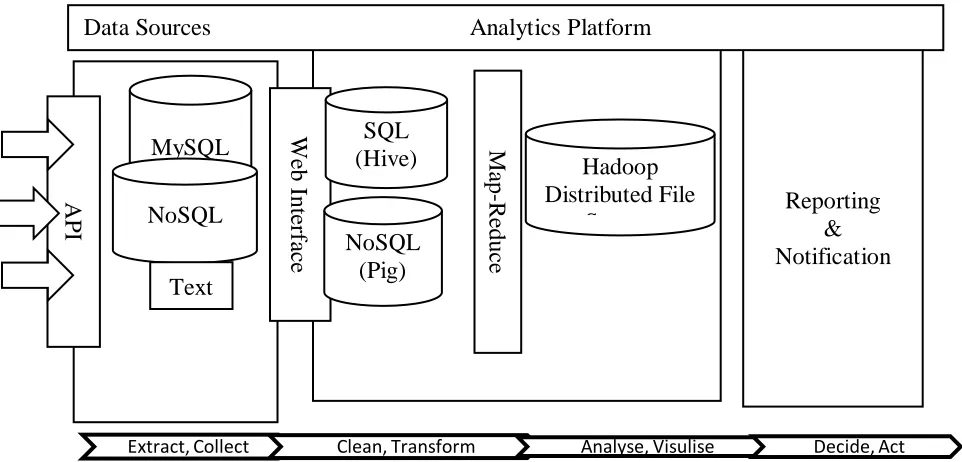
eCommerce businesses and how to alleviate them with Big Data services is portrayed in Fig.1.
Figure 1. Reference Architecture
1. Extract and collect: Traditionally, data is structured and typically stored in a static data
warehouse which will be queried periodically. For Big Data, there are versatile data sources
from which Data is extracted and it is unstructured. An eCommerce business has numerous
data sources to consider such as competitor offers, pricing data, sales data, stock level,
advertising data and customer sentiment. Usually data is processed through API and
become available from SQL, NoSQL and text files. Data from all the data sources is
Extract, Collect Clean, Transform Analyse, Visulise Decide, Act
Reporting
&
Notification
Data Sources Analytics Platform
Access
API
MySQL
W
eb
Inter
fa
ce
NoSQL
Text
Hadoop
Distributed File
System
SQL
(Hive)
NoSQL
(Pig)
M
ap
-R
educ
Licensed under Creative Common Page 945
imported into a distributed management system such as Hadoop. The integration of the
different databases with Hadoop varies but a simple web form is possible
2. Transformand Clean: The next step is transforming and loading data from difference sources into Hive table on Hadoop’s file system and/or data could be stored in scalable
NoSQL stores that integrate with Hadoop such as MongoDB. By means of tools such as
Map-Reduce the data is then cleansed and pre-processed.
3. Analyze and visualize: The analysis and visualization of the analytics results may be applied
directly to the distributed data management system. Alternatively, data transformed by
distributed parallel processing may be exported as distilled essence into another data
management system. This will usually be a SQL or NoSQL database. Analytics tasks will
then be applied to this database.
4. Decide and act: At this stage business gets reporting and notifications depending on the
challenges were addressed at the input. Such as product pricing, advertisement campaigns,
product adoption or discontinuation and stock level.
The reference architecture represents the building blocks from which for every
customer-specific situation an optimum solution can be designed by combining various technologies. The
more important it is not to face the end user with this high complexity. This is achieved by
corresponding connectors between the individual subsystems and by data adapters enabling a
smooth transition.
DISCUSSION
This evaluation finds that in a wide range of areas of application, there is a collection of data in
an unparallel scale. Decisions that were done previously on the basis of guesswork or curved
from models of reality could now be easily undertaken using data driven models. In essence,
Big Data analytics drives many aspects of the society including financial services, mobile
service, physical science, and online businesses. Until recently, most ecommerce businesses
have realized the opportunities in utilizing analytics and data to improve productivity, gaining a
competitive edge and improving decision-making process. In essence, analytics defines the
variation between winners and losers (Graham, 2012).
Despite its related advantages, Big Data analytics has presented new problems, which
are yet to be solved. For instance, they cannot be used as standalone processes; rather, they
have to be accompanied by human judgment. Other problems include issues related to multiple
Licensed under Creative Common Page 946
Studies including that of Lee et al (2013) established that 8 percent of all servers in a data
center encounter a hardware issue on an annual basis. The most common frequent of these
causes is the hardware failure. Additionally, Big Data analytics have to deal with unpredictable
communication latencies, as well as network partition owing to link failures. These requirements
necessitate a scalable application in treating failures as regular events, which have to be
handled carefully in ensuring that the application operation may not be interrupted.
New sources of data, ranging from various business transactions, the internet, high
solution sensors and social media have created a tidal wave of high quantity data. This data has
to be captured, integrated, processed, archived and analyzed. The application of big data
systems has become increasingly common not only for organizations that conduct businesses
online, but also in many aspects of the society. These systems have represented a long term
and major investment, which necessitate considerable financial commitments alongside
deployment of the massive software scale. Many aspects of data in such sectors as health,
intelligence analysis, military operations that represents big data applications which grows at an
exponential rate and need for scalable software solutions in sustaining future operations.
For ecommerce businesses, the Big Data challenges are intimidating. The complex and
swiftly evolving context of non-standardized technologies established on a radically divergent
data models. Using new technologies in designing and constructing a massive scale data
generates challenges related to software architecture. It therefore, becomes important for
companies to select a database technology, which best supports the mission needs of cost
effective, timely and efficient delivery, as well as future growth.
SUMMARY AND CONCLUSION
Big Data is vital if online businesses are to stay abreast of consumer’s demand and
preferences. From this review, it is apparent that Data Analytics could assist business
organizations in enhancing their performance and customer experience. It has facilitated
personalization with interactive and rich product displays as well as aspects of dynamic pricing.
This could assist with customer retention and acquisition alongside improving brand image and
loyalty. In addition to increased sales opportunities for companies, it also provides useful
insights regarding process improvement across the seller and buyer networks. Data analytics is
also helpful for organizations in capitalizing on their data since costs are saved through self
-service options. Finally, it highlights where improvements need to be done in terms of sales
performance improvement.
With the growth of data storage estimated to be 30 to 60 percent, businesses should
Licensed under Creative Common Page 947
require growing data sets with linear and predictable costs. In addressing the challenges of big
data, there should be a new generation of scalable data management system to replace the
outdated ones. These systems have to offer a strong, consistent guarantee on the basis of a
vertical scaling of storage hardware and scaling of computation. The new databases should also
have a high scalability and performance in employing simpler data mechanisms of data
consistency, low-cost hardware in enhancing availability, and performance.
However, while the architecture introduced is not solid as technology changes rapidly,
an operational architecture embedding new tools that can seamlessly grow with demands is
what online businesses need to acquire to improve their performance. In essence such
architecture enable the business to explore scenarios to run different analysis and make a
better decisions.
WAY FORWARD
This paper proposes an architecture for online businesses to analyze their Big Data. The
usefulness of this architecture should be tested in theory and practice. Further work should
derive such an architecture based on empirical results and how online business are analyzing
their Big Data.
REFERENCES
Couldry, N., & Turow, J. (2014). Advertising, big data and the clearance of the public realm: marketers' new approaches to the content subsidy. International Journal of Communication, 8, 1710-1726.
Dumbill, E. (2012). What is big data? An introduction to the big data landscape. Retrieved from http://radar.oreilly.com/2012/01/what-is-big-data.html on 17th April 2015
Graham, M. (2012). Big data and the end of theory? The Guardian.
Hughes, A. M. (1994). Strategic Database Mining. Chicago: Probus Publishing.
Jagadish, H., Gehrke, J., Labrinidis, A., Papakonstantinou, Y., Patel, J. M., Ramakrishnan, R., & Shahabi, C. (2014). Big data and its technical challenges. Communications of the ACM, 57(7), 86-94.
Jobidon, P. (2014). Using big data to enhance e-commerce. Retrieved from http://www.bpostinternational.com/en/content/using-big-data-enhance-e-commerce on the 17th April 2015
McGuire, T. (2013). Making data analytics work: Three key challenges. Retrieved from http://www.mckinsey.com/insights/business_technology/making_data_analytics_work on the 17th April 2015
Rud, O. P. (2001). Data mining cookbook: modeling data for marketing, risk, and customer relationship management. New York: John Wiley & Sons.