4581
IMPACT OF DIGITAL TECHNOLOGY
ADOPTION ON CARE SERVICE
ORCHESTRATION, AGILITY AND
RESPONSIVENESS
Samyadip Chakraborty, Vaidik Bhatt, Tulika ChakravortyAbstract— With the help of digitization, it is feasible to provide healthcare services to the extended part of the society. This study proposes how digitized technology adoption in hospitals (healthcare sector) influences care service responsiveness at large, The study measures mediating effects of care service orchestration, care service transparency and care service agility on care service responsiveness. The study uses empirical data collected from tertiary care hospitals in India having at least 50 beds and empirically validates the conceptual model using EFA, CFA and SEM-based techniques. The study outcome provides an authorized adaptation framework which throws light on the digitization of healthcare in the Indian context and might prove as managerial motivation in the hospital sector.
Index Terms— Healthcare digitization, Digitized Technology adoption, Care Service Orchestration, Care Service Transparency, Care Service Agility, Care Service Responsiveness
—————————— ——————————
1 INTRODUCTION
With an increase in standards of living, technology has played a significant role in human life. Technology is one of the daily requirements in human life for surviving and making daily work routine smooth. Every industry is using technology for providing services, creating products, management of internal affairs and working conditions, or managing the external environment. As one of the most promising industry, healthcare is also not left behind in technology usage. Healthcare industry is also using the technology in every field [1],[2]. Technology combined with healthcare sector plays a significant role in providing better healthcare services with sophisticated sensors, instruments and data exchange processes. Healthcare organisations, speciality hospitals and restorative organisations such as clinics can get a competitive advantage by practical usage of technology [3].In the current period, India is fighting with the reach to the healthcare services, because of low doctor‘s density ratio of 0.7 per 1000 population in comparison with the WHO‘s (World Health Organization) standard of 1 doctor per 1000 population [4]. On the other hand, some doctors do not practice their medical expertise due to one or the other reason like low incentive, low motivation, migration to the other country etc. [5]. This situation creates an additional gap in reach of the doctors apart from the low doctor density ratio. One side India is becoming an attractive country for medical tourism due to cost-effective healthcare services, and on the other hand, Indian population experiences high cost for healthcare withlower reach to the care services due to scarcity of medical experts and a lesser degree of coordination between healthcare facilities.
This study concentrates on with the help of technology adoption, how they reach to the doctors can be increased with the enhanced level of care service orchestration and care service agility and care service responsiveness to serve to the larger population of country with the limited workforce, as the study does not indicate increasing the current healthcare workforce. However, study helps in finding ways for expanding the reach of cost-effective healthcare with the help of digitised technology adoption in the healthcare sector. Although healthcare sector is using technology in every field like ophthalmology, radiology, management of lifestyle disorders and other acute as well as chronic situation, there is a significant need to streamline the workflow to increase the reach of healthcare services to the last mile and generates responsive healthcare services. The objective of the paper is to study the direct and indirect impacts of digital technology adoption in hospitals and therapeutic centres on care service orchestration, care service agility and care service responsiveness with analysis of intervening variables like care service orchestration and care service agility on care service responsiveness.
2
LITERATURE
REVIEW
2.1 Cybernetic Control Theory
The theory postulates how digital, interactive and interrogative technologies enhance the performance of any process with the help of improving the process flow integration. The performance is increased due to the involvement of a feedback loop into the process. With the help of data provided, managers can build various strategies for the organization [6]. The theory shows the importance of timely feedback and controlling the deviations in the processes flow [7]. With the help of this theory, digital technology provides a platform by which healthcare organization can trace the real-time data and ————————————————
Author Samyadip Chakraborty is currently working as Associate Professor at department of Operations & IT, ICFAI Business School (IBS), Hyderabad, The ICFAI Foundation for Higher Education (IFHE) (Deemed to be university u/s 3 of the UGC act 1956)
Co-Author Vaidik Bhatt is currently pursuing PhD from department of Operations & IT, ICFAI Business School (IBS), Hyderabad, The ICFAI Foundation for Higher Education (IFHE) (Deemed to be university u/s 3 of the UGC act 1956)
4582 information for increasing integration in their routine
processes. For example, hospital administrator and restorative staffs can have access to the continuous real-time data with precise information because of digital technology adoption in an emergency as well as a usual scenario.
2.2 Digital Technology Adoption
Organisations can achieve a competitive edge with the adoption, implementation and exploitation of digital technology as digital technologies follows the path dependency and helps in performance improvement for an organization [8]. On the other end, digital technology is embedded in the form‘s routine process and enhances the process flow, utilising increasing the relationship and organisational learning [9]. Digital technology is useful in healthcare sectors, specifically in hospitals, as there is a need for better coordination between the departments as well as inpatient treatments. Digital technology adoption is defined as a degree to which technology platforms are developed and integrated for capturing the vital records of patients and internal processes which can be used in future [1]. With the help of digital technology adoption in care service organisation, vital data of the patients can be digitally recorded and shared with across the departments or with other organisations which increase the transparency, pervasiveness and availability of information regarding patient health data to the physicians and other restorative staffs [10]. This integration and sharing of the patient health data across the organisation help in patient handling, avoiding errors occurred in manual data entry and removal of delicacy in data which is prevalent in manual data entry and record-keeping [2]. With digitised technology, integration for real-time data can be created for different units, stakeholders, suppliers and network partners [11]. The network's partners help each other during the critical situations by creating the complementarity in knowledge and resources by sharing of information with each other which fosters the essential performance of care organisation with the availability of pervasive details about each other [12].
2.3 Care Service Orchestration
Any organization needs to improve continuously in their internal and out focused processes for getting a competitive edge. Organisations having an integrated system with their suppliers and other stakeholders in up-flow as well as downflow outperforms doe to coordination and complementarity created [13]. Healthcare organization needs to achieve the highest degree of integration to serve the patients healthily.When a healthcare organisation shares essential data with their own suppliers‘ deficiency in the process flow of the hospital can be increased due to suppliers‘ involvement [14]. However, when a critical care organisation shares data with the other similar kinds of organisation it increases the absorptive capacity and knowledge of both the organisations due to data, information and knowledge sharing [15]. Care service orchestration can be defined as an extent to which the technology and process enabled platform creation increases the growth and synchronous transmission of information and service-flow in the system connecting interactive partners in transparent value-adding conducive environment using real-time digital technology adoption [13], [16]. Care service orchestration primarily highlights an
integrative approach, which connects the lower order underachieving processes into a meaningful larger synchronized well sequenced and planned network; thereby enabling the higher order overachieving outcomes, with the inclusions of network partners. In orchestrated services, network partners extend each other‘s competencies and capabilities to increase the value of the services [17].In the backdrop of service dominant logic conceptualization, the network actors (in the case of this study, the care service providers) extend their value propositions which through a combined synchronous outcome driven orientation of all actors, get extended outside each other‘s (network actor‘s) service peripheries; thereby leading to creation and extension of service delivery propositions and promises, which are often higher and more elaborate and deeper that each individual actors self-capability driven extension propositions.
2.4 Care Service Agility
Agility is out focused terminology. It explains how an organization can change its processes and performs well in the variety of situations created by external conditions of market, economy, policies and political scenario etc. Based on this, agility is an ability of an organization to excel and change quickly as per the variety if situations created by the external market, business, economic and political circumstances [18]. An organization should also smell and identify the customers‘ hidden needs based on the customers‘ reaction to the various situations and customers‘ experiences to get an edge over other firms [19]. Agile systems are vital in the healthcare sector, as critical care centers must be flexible enough in providing quick response to the patients‘ health conditions, anticipating the healthcare needs of patients and optimization of quality and cost for care services [20]. Agility is essential for reducing the queue in the emergency department and providing quick healthcare services to avoid dared consequences for the patient. It is also crucial for the physicians, as with the delay in treatment time, physician‘s challenge to cure the patient situation turned in to the stress, which can be fatal for the patient [21].
2.5 Care Service Responsiveness
In the services literature, responsiveness is defined as an expression of a service provider's commitment to the relationship with the customer in total services offering [22]. However, In the context of healthcare services responsiveness is defined as the speed with which hospital can adjust its service delivery abilities in response to an external stimulus [23].
3
HYPOTHESES
DEVELOPMENT
3.1 Linking Digital Technology Adoption to Care Service Orchestration
Digital technology can create coordination by providing the pervasive way for data transmission. Thus, the highest level of data integration can be created [24]. Like any other sector, the healthcare sector is also benefited from digital technology adoption. With the help of digitization of health records, it is possible to make the process interoperable [25].
4583 Valuable information can be pervasively sheared with
suppliers, stakeholders and other critical care facilities also to provide last mile access, complementarity in knowledge and skills, local support as well as strong relationship [26].
Hypothesis 1: The level of digital technology adoption enhances the standard of care service orchestration
3.2 Linking Care Service Orchestration with Care Service Agility and Care Service Responsiveness
Implementation of digitized technology enhances the network orchestration, and this orchestrated network has primarily influenced and transformed the treatment with a better quality of care, increased agility and responsive care delivery [10]. It is vital to have internal flexibility for obtaining the agility. Orchestrated services provide the flexibility on internal operations management for healthcare service providers, which leads towards the improvement in treatment quality with agile, responsive and personalized healthcare [3]. Responsiveness, agility and flexibility are the key areas where healthcare organizations compete and provide excellent healthcare services to their patients, which creates the critical differentiation in market [27].
With the orchestrated services, partners work together for a common benefit and leverage each other‘s competencies to provide better and affordable healthcare services with increased flexibility for their internal operations and increasing the responsiveness to the external stimuli [28].
Hypothesis 2: The level of care service orchestration enhances the standard of care service agility
Hypothesis 3: The level of care service orchestration enhances the level of care service responsiveness
3.3 Linking Care Service Agility to Care Service Responsiveness
Agility increases organisations ability to work under a variety of situations, some of which are favourable and some are not favourable/ unfavourable, which impacts the time to respond to the queries and issues of clients, customers and stakeholders. However, In a healthcare context, agility increases the ability of hospitals to accommodate more patients, to treat the various diseases, to take care of a patient who is suffering from rare disease, etc.… and hospital‘s readiness to look after patient and treat the patient with the rare disease is responsiveness of the hospital.
Hypothesis 3: The level of care service agility enhances the level of care service responsiveness
Figure 1: Proposed Model
4
RESEARCH
METHODOLOGY
4.1 Data Collection
Since the research study aims to observe and analyse the impact of digital technology adoption on the outcome of care service responsiveness, with analysing the mediation effects of care service orchestration and care service agility, a sample has been taken from the hospitals which have implemented digital technology in routine hospitals. The specific online database is used to get the details regarding hospital and specialists has been used. An email containing the cover letter and final questionnaire sent to the hospital administrator, with a written request to be filled by IT staff and administration staff trailed by four reminders each after 15 days. In revert, the investigation got 253 usable responses, which were supplied by administrative staff and IT staff of different hospitals.
4.2 Measures
The study includes four latent variables. The investigation went for pre-pilot, pilot and final testing. During pre-pilot, with the help of extensive literature review, proposed items were noted down. With the help of three industry experts and three academicians having research area in healthcare information technology, questions were assigned to each construct based on the face validity and definition of the latent term. Omitted items which cannot be attributed to any constructs has been put in the N/A column. This Q sort technique made a decision in pair of 2 experts worked as judges in a pair (set of 2) till Cohen‘s Kappa, Raw agreement score, and Interrater reliability values were found to be above 0.9. The value of >0.9 offered a rigour, fitness and meaning to the investigation. This primary investigation in pre-pilot testing was followed by Exploratory Factor Analysis (EFA), using IBM Statistics (SPSS) 21 programming. EFA confirmed and guaranteed that factors could be additionally used for the investigation. First two factors came out with the four items in each, and the other two elements have three questions in each, which can be used for final testing on 5 – point Likert scale with 1 = Strongly Disagree and 5 = Strongly Agree.
4.3 Non-Response bias
After sending the questionnaire, reminders also sent to the respondents to fill up the survey and revert. The examination has conducted the non-response bias through right on time and delayed reaction to the mailed questionnaire. The significant differences were not observed between these groups. With Mann – Whitney U test it has been confirmed that the two classes do not differ significantly from each other (P>0.05). This confirmed the absence of any noteworthy non-interaction, non-response bias.
5 RESULT
AND
ANALYSIS
The constructs used in the investigation was measured using different items. The rational flow of the study was,
A. Questionnaire development based on the extensive literature review.
B. Based on the understanding of constructs, items were assigned to each of the constructs.
4584 in the questionnaire.
D. Construct wise exploratory factor analysis (EFA) conducted to check the value of Cronbach‘s alpha to ensure reliability.
E. The measurement model was analysed using confirmatory factor analysis (CFA), followed by path analysis in Amos, to find the results.
Construct Item No.
Item Loadings
Composite reliability
AVE
Digital Technology Adoption
4 0.87 0.68 0.77 0.88
0.81 0.64
Care Service Orchestration
4 0.83 0.79 0.84 0.86
0.89 0.69
Care Service Agility
3 0.85 0.78 0.87
0.84 0.71
Care Service Responsiveness
3 0.97 0.88 0.77
0.78 0.77
Table 1: AVE, Composite Reliability and Cronbach Alpha
The constructs were measured from the administrative representative from the hospital side on the Likert scale of 1 to 5, where one strongly disagrees and five strongly agree. Based on the responses, the convergent and discriminant validity were calculated to measure the internal consistency and independence of the dimensions, respectively. Reliability of constructs was measured using Cronbach‘s alpha, and all the reliability values >0.70 were considered as acceptable.
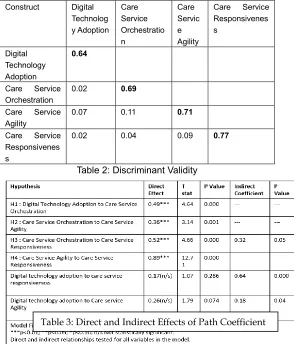
Hypothesis 1: Supported: H1 proposed a positive relationship between digital technology adoption and care service orchestration. This hypothesis was supported at p < 0.05, t statistics = 4.64
Hypothesis 2: Supported: H2 proposed a positive relationship between care service orchestration and care service agility. This hypothesis was supported at p < 0.05, t statistics = 3.14
Hypothesis 3: Supported: H3 proposed a positive relationship between care service orchestration and care service responsiveness. This hypothesis was supported at p < 0.05, t statistics = 4.66.
Hypothesis 4: Supported: H4 proposed a positive relationship between care service agility and care service responsiveness. This hypothesis was supported at p < 0.05, t statistics = 12.71.
Indirect effects: the study also observes the indirect effect of digital technology adoption on care service agility and care service responsiveness. For which direct impact cannot be established. That indicates care service orchestration is a potent mediator for enhancing the care service agility and care service responsiveness through digital technology adoption in the healthcare context. On the other hand, apart from the
direct effect on the care service responsiveness, care service orchestration also shows the indirect impact on the care service responsiveness, which is an indication of care service agility can also serve as a mediator to enhance care service responsiveness
Construct Digital Technolog y Adoption
Care Service Orchestratio n
Care Servic e Agility
Care Service Responsivenes s
Digital Technology Adoption
0.64
Care Service Orchestration
0.02 0.69
Care Service Agility
0.07 0.11 0.71
Care Service Responsivenes s
0.02 0.04 0.09 0.77
Table 2: Discriminant Validity
CFA conducted to verify the measurement model as a part of SEM. Overall fit for the measurement model is found to be acceptable for unconstrained model with Model Fit Indices: X2/df=2.20; GFI=0.90; AGFI=0.87; CFI=0.98; NNFI=0.97; RMSEA=0.07. The model shows an acceptable fit, which indicates good convergent and discriminant validity among measures, which is an indicator of satisfactory construct validity. In the structural model, path analysis has been performed, and the overall fit has been analysed. Based on the t value, the level of significance can be determined.
6 DISCUSSION
AND
CONCLUSION
6.1 Figures and Tables
4585 The investigation also confirms that, with the increase in the
agility to the external stimuli and market, responsiveness also increases, and digitized technology adoption indirectly enhances the coordination as well as responsiveness. Which indicates ‗IT value for healthcare‘. All the hypotheses regarding the outcome of care service responsiveness are found to be significant with the indirect effect of care service orchestration as well as digital technology adoption, which is an indicator of better healthcare service. Thus, digital technology adoption adds the value in the routine of healthcare service operations by sharing of patient data to other service providers as well as internal integration of data, which might be helpful in patient services. As every stakeholder has patient data, they will work together for benefit of patient with sharing of complementary resources, knowledge and providing on-ground logistic support to each other.
7 IMPLICATIONS
It is proven that adoption of technology enhances agility and responsiveness in patient care. Technology company should focus more on making robust technologies, which can be used by doctors and hospitals for sharing the patient data for serving patient as well as internal operation. Doctors should encourage the patient to use the personalized healthcare technologies like wearable devices, as it will enhance patient satisfaction because the patient will have an impression that, ‗doctor is always with me‘.Hospital management should play a more significant role, as orchestrated services enhance the physician‘s knowledge. Also, a physician can take help of the other physician working in different of the same organisation for the treatment of rare disease, as patient data is shared and orchestrated within and among health service providers. On the other side, network partners like pharmaceutical, lab reports, insurance agencies will also provide the complementarity resources and logistics support to provide better healthcare services to the patients.
8
LIMITATION
AND
FUTURE
WORK
The study analyses only viewpoints for physicians and hospital side. It does not include the perspective or comfort for the patient. On the other hand, the study does not cover the cost or monetary aspect from physician, hospital as well as patient side. In future, it is essential to include the financial characters with the real numbers as it is necessary to know the cost for hospitals and value for patients for technology adoption and compare the price of technology adoption with the traditional healthcare service delivery systems. The future scope is to study the digital technology adoption based on the technology maturity level, as with more mature technology work can be more comfortable or it can be difficult. It will be interesting to study the security aspects as well as patient adoption aspect in a country like India. However, despite the limitation, the study opens up new horizons to research healthcare service delivery with the inclusion of technology from the doctor, hospital as well as patient side and motivates researchers to analyse the impact of digital technology in a healthcare centre to fulfil the health service gap which exists in the country.
REFERENCES
[1] Bhatt, V., Sahikala, P. and Chakraborty S. (2019). The impact of Information Technology and Analytics on the Performance of a hospital: Scale Development in Indian Context. International Journal of Recent Technology and Engineering (IJRTE). 8(3), 2861 - 2869.
[2] Chakraborty, S., Bhatt, V., CHakravorty, T. (2019). Impact of IoT adoption on agility and flexibility of healthcare organization. International Journal of Innovative technology and exploring engineering (IJITEE). 8(11). 2673 – 2881.
[3] Heart, T., Ben-Assuli, O., & Shabtai, I. (2017). A review of PHR, EMR and EHR integration: A more personalized healthcare and public health policy. Health Policy and Technology, 6(1), 20-25. [4] WHO Official Website
[5] Gudwani, A., Mitra, P., Puri, A., & Vaidya, M. (2012). India healthcare: inspiring possibilities, challenging journey. New York, NY: McKinsey & Company.
[6] Vancouver, J.B. (1996), ―Living systems theory as a paradigm for organizational behavior: understanding humans, organizations, and social processes‖, Behavioral Science, Vol. 41 No. 3, pp. 165-204.
[7] Green SG, Welsh MA. Cybernetics and dependence: Reframing the control concept. Academy of Management Review. 1988 Apr 1;13(2):287-301.
[8] Bharadwaj, A. S. (2000). A resource-based perspective on information technology capability and firm performance: an empirical investigation. MIS quarterly, 169-196.
[9] Bhatt, G. D., & Grover, V. (2005). Types of information technology capabilities and their role in competitive advantage: An empirical study. Journal of management information systems, 22(2), 253-277.
[10]Fong, B., Chueng W. Y., Ho S. W., Leung K. M., Tse, W. C., Tsim W. T., Yick, C. S. & Yu, S. N. (2015). Promoting electronic health record (ehr) sharing system in Hong Kong – what can we learn from Taiwan
[11]Mucheleka, M., &Halonen, R. (2015, April). ERP in Healthcare. In ICEIS (1) (pp. 162-171).
[12]George, G., McGahan, A. M., & Prabhu, J. (2012). Innovation for inclusive growth: Towards a theoretical framework and a research agenda. Journal of management studies, 49(4), 661-683.
[13]Sezen, B. (2008). Relative effects of design, integration and information sharing on supply chain performance. Supply Chain Management: An International Journal, 13(3), 233-240.
[14]Subramani, M. (2004). How do suppliers benefit from information technology use in supply chain relationships?. MIS quarterly, 45-73.
[15]Sulistyo, H., & Wikaningrum, T. (2019, July). Fostering Absorptive Capacity and Self-efficacy on Knowledge Sharing Behavior and Innovation Capability: An Empirical Research. In Conference on Complex, Intelligent, and Software Intensive Systems (pp. 981-990). Springer, Cham.
[16]Prajogo, D., & Olhager, J. (2012). Supply chain integration and performance: The effects of long-term relationships, information technology and sharing, and logistics integration. International Journal of Production Economics, 135(1), 514-522.
[17]Vargo, S. L., & Lusch, R. F. (2004). The four service marketing myths: remnants of a goods-based, manufacturing model. Journal of service research, 6(4), 324-335.
4586 Pendergast D. Building personal and professional resources of
resilience and agility in the healthcare workplace. Stress and Health. 2012 Feb;28(1):11-22.
[19]Sharma S, Conduit J, Hill SR. Organisational capabilities for customer participation in health care service innovation. Australasian Marketing Journal (AMJ). 2014 Aug 1;22(3):179-88.
[20]Sindhwani, R., Singh, P. L., Prajapati, D. K., Iqbal, A., Phanden, R. K., & Malhotra, V. (2019). Agile System in Health Care: Literature Review. In Advances in Industrial and Production Engineering (pp. 643-652). Springer, Singapore.
[21]Shirey, M. R. (2006). Authentic leaders creating healthy work environments for nursing practice. American journal of critical care, 15(3), 256-267.
[22]Theoharakis, V., & Hooley, G. (2003). Organizational resources enabling service responsiveness: Evidence from Greece. Industrial Marketing Management, 32(8), 695-702. [23]Alavi, M., Khodaie Ardakani, M. R., Moradi-Lakeh, M., Sajjadi,
H., Shati, M., Noroozi, M., & Forouzan, A. S. (2018). Responsiveness of Physical Rehabilitation Centers in Capital of Iran: Disparities and Related Determinants in Public and Private Sectors. Frontiers in public health, 6, 317.
[24]Dapko, J. (2012). Perceived firm transparency: Scale and model development.
[25]Fiaz, M., Ikram, A., & Ilyas, A. (2018). Enterprise Resource Planning Systems: Digitization of Healthcare Service Quality. Administrative Sciences, 8(3), 38.
[26]George, G., McGahan, A. M., & Prabhu, J. (2012). Innovation for inclusive growth: Towards a theoretical framework and a research agenda. Journal of management studies, 49(4), 661-683.
[27]Chakraborty, S., & Mandal, S. (2019). Enablers of clinician involvement inclination, care delivery agility and clinical productivity: An empirical investigation. Benchmarking: An International Journal, 26(3), 753-772.
[28] Radjou, N., Prabhu, J., & Ahuja, S. (2012). Jugaad innovation: Think frugal, be flexible, generate breakthrough growth. John Wiley & Sons.
ANNEXURE
1:
ITEMS
FOR
CONSTRUCTS
DIGITAL
TECHNOLOGY
ADOPTION
My hospital stores patients‘ data into digital format My hospital frequently updates patient's data when
medicine or nature of treatment changes
My hospital keeps record of Inventories, medicines and surgical equipments
My hospital has access to an electronic system for patient data record
CARE
SERVICE
ORCHESTRATION
My hospital shares vital information between the departments
My hospital maintains high degree of partnership with important suppliers and stake holders
My hospital frequently contacts other care facilities My hospital tries to create more compatible platform
with other facilities and suppliers
CARE
SERVICE
AGILITY
My hospital can adjust operations to the extent necessary to execute out decision
My hospital increases its short-term capacity when needed
My hospital provides the wider range of adjustment to make our operations
CARE
SERVICE
RESPONSIVENESS
My hospital provides immediate care services to patient
My hospital‘s emergency department observes small queues in compare to others