INTRODUCTION
The development of various advanced drugs over the past decade has created a need for new methods of controlled delivery for these compounds, including peptides, proteins, plasmid DNA, antisense oligodeoxynucleotides, and immuno- toxins. Activity of such molecules depends on their ability to reach the targeted sites, however, they are easily degraded by proteases or DNA-degrading enzymes in vivo once they enter into the
Development of a Temperature - Sensitive Composite
Hydrogel for Drug Delivery Applications
MOHAMMAD SADEGHI¹* and MOJGAN YARAHMADI²
¹Department of Chemistry, Science Faculty, Islamic Azad University, Arak Branch, Arak (Iran). ²Department of English, Humaniti Faculty, Islamic Azad University, Arak Branch, Arak (Iran).
*Corresponding author: E-mail: [email protected] (Received: April 10, 2011; Accepted: May 13, 2011)
ABSTRACT
To develop materials with improved controllability and specificity, we have investigated synthesis of composite hydrogels with temperature-sensitive properties using thermal cross-linking, Specifically in the presence of kaolin powder. my novel composite materials are composed of particles made of kappa-carrageenan-poly(N-isopropylacrylamide) (PNIPAAm), temperature-sensitive hydrogels, and a thermal crosslinker, methylene bisacrylamide (MBA). A proposed mechanism for hydrogel composite formation was suggested and Infrared spectroscopy was carried out to confirm the chemical structure of the composite. Moreover, morphology of the samples was examined by scanning electron microscopy (SEM). The effect of MBA concentration and temperature of reaction on the water absorbency capacity has been investigated. The swelling variations of hydrogels were explained according to swelling theory based on the hydrogel chemical structure. The hydrogels exhibited tem-sensitivity and cation exchange properties. The temperature- and pH-reversibility properties of the hydrogels make the intelligent polymers as good candidates for considering as potential carriers for bioactive agents, e.g. drugs.
Key words: Superabsorbent Hydrogel, kappa-carrageenan, Acrylic monomers, composite.
body system1-3. An ideal drug delivery system for these molecules should be positioned near the diseased or injured site and release the drug in response to changes in the surrounding tissue. This controlled drug delivery system also provides an extra barrier to limit the accessibility of denaturing agents to the drugs. Photo cross-linking hydrogels are one of those materials that can be used to develop this “ideal” drug delivery system. This is because of their ability to rapidly convert a liquid monomer or macromer to a gel under physiological www.orientjchem.org
CODEN: OJCHEG 2011, Vol. 27, No. (3): Pg. 865-874
An International Open Free Access, Peer Reviewed Research Journal
conditions at a specific region in the body when exposed to a source of light, a condition called in situ Photo polymerization2-6.
Besides photo cross-linking hydrogels, externally “smart” sensitive drug delivery systems have been investigated as novel controlled delivery approaches to control the release of drugs in response to changes in the surrounding environment. To develop such dr ug deliver y systems, studies have been perfor med to manufacture stimuli-sensitive materials undergoing phase transitions in response to changes in ionic strength, pH, light, electric field, irradiation, or temperature. In particular, among the temperature-sensitive hydrogels reported to date, poly(N-isopropylacr ylamide) (PNIPAAm) and its copolymers have been widely used for cell separation as well as for pharmaceutical and tissue engineering applications because of their unique thermal properties[6, 8]. PNIPAAm undergoes a reversible temperature-sensitive phase transition in aqueous solutions at approximately 32°C (the lower critical solution temperature, LCST), which is between room temperature (25°C) and body temperature (37 °C).
In addition to its use as on-off switches for the attachment/ detachment of cells, this reversible deswelling event of PNIPAAm at below and above the LCST is also used as a means to control the release of various drugs. The collapse of PNIPAAm by raising temperatures above its LCST has been used to release various therapeutic agents including proteins from PNIPAAm-based materials. In addition, it should be noted that a significant problem associated with protein release technology is the loss of biological activity of the protein due to denaturation. By varying temperatures, temperature-sensitive polymers can be used to load proteins in a passive and nondenaturing manner7-9.
EXPERIMENTAL Materials
The polysaccharide, kappa-carrageenan (êC, from Condinson Co., Denmark), N, N’– methylene bisacryamide (MBA, from Merck) as a crosslinker, ammonium persulfate (APS, from Fluka) as a water soluble initiator, acrylic acid (AA from
Merck) as a monomer, were of analytical grade and used without further purification.
Graft copolymerization
Synthesis of the Superabsorbent hydrogel composite was carried out using KPS as an initiator and MBA as a crosslinker in an aqueous medium. A general procedure for chemically crosslinking graft copolymerization of poly acrylic acid and poly(N-isopropylacrylamide) onto kappa-carrageenan backbones was conducted as follows. kappa-carrageenan (0.75g) was dissolved in 50 mL distilled water and filtered to remove its insoluble salt. Then the solution was added to a three-neck reactor equipped with a mechanical stirrer (Heidolph RZR 2021, three blade propeller type, 300 rpm). The reactor was immersed in a thermostated water bath preset at a desired temperature (80oC). After complete dissolution of kappa-carrageenan, various amounts of kaolin powder (2.50-0.25 g) were added to the solution and allowed to stir for 10 min,Then the initiator solution (0.017, 0.043, 0.087, 0.17, 0.35, -0.52 g KPS in 5 mL H2O) were added to the mixture. After stirring for 15 min, certain amounts of 70% neutralized AA(1.0, 2.0, 3.0, 4.0, 5.0 g in 5 mL H2O) and NIPAM (1.5, 3.0, 4.0, 5.0, 6.0, 7.0, 8.0 g in 5 mL H2O) and MBA (0.13, 0.16, 0.21, 0.24, 0.27 g in 5 mL H2O) were simultaneously added to the reaction mixture. After 90 min, the produced hydrogel was poured to excess non solvent ethanol (200 mL) and remained for 6 h to dewater. Then ethanol was decanted and the product scissored to small pieces (diameter ~ 5 mm). Again, 250 mL fresh ethanol was added and the hydrogel was remained for 24 h. Finally, the filtered hydrogel is dried in oven at 60 oC for 5 h. After grinding, the powdered superabsorbent was stored away from moisture, heat and light.
RESULTS AND DISCUSSION Synthesis and spectral characterization
initiate grafting of AA and NIPAM onto kC backbones leading to a graft copolymer. Crosslinking reaction also occurred in the presence of the crosslinker, i.e. MBA.
For identification of the hydrogel, infrared spectroscopy was used. Fig. 1 shows the IR spectroscopy of kC-g-poly(AA-co-NIPAAm) hydrogel and hydrogel composite. The superabsorbent
NH
O O
HN
(MBA)
CONHCHMe2
(NIPAM)
COOH (AA) O
O OH
O
OH O
OH O O-3SO
SO.-4 S2O8
-HSO4
.
-kC (ROH)
RO
O
C
macroradicals
2-80
COOH HN
HN
O O
N H HN
(another poly acrylic chain)
O O
backbone kC
backbone NIPAM
AA
COOH
kC CONHCHMe2 CONHCHMe2
O N H HN
(another poly acrylic chain)
O
kC backbone
CONHCHMe2
O N H HN
(another poly acrylic chain)
O
kC backbone
CONHCHMe2
+aN-OOC
Si-OH +
R3iSOOC
[kC-g-poly(AA-co-NIPAM) hydrogel composite] Surface of Kaolin
hydrogel product comprises a kC backbone with side chains(Fig 1a,b) that carry sodium carboxylate and carboxamide functional groups that are evidenced by peaks at 1573 and 1668 cm-1 respectively. The intense characteristic band at 1573 cm-1 is due to C=O asymmetric stretching in carboxylate anion that is reconfirmed by another sharp peak at 1416 cm-1 which is related to the symmetric stretching mode of the carboxylate anion.
In the spectrum of the composite (Fig 1c), new absorption peak at 1722 cm-1 are appeared. the absor ption band at 1722 cm-1 can be
corresponding to the ester groups that can be formed during the graft polymerization reaction. The carboxylate groups of the grafted poly(acrylic acid) can be react with the -OH groups on the kaolin surface. The replacement of –OH groups in the surface of kaolin by carboxylate anions results in the ester formation. The reaction can be shown as follows(12):
To obtain additional evidence of grafting, a similar polymerization was conducted in the absence of the crosslinker. After extracting the homopolymer and unreacted monomers using a cellophane
Fig. 1: FTIR spectra of κκκκκC (a) and kC-g-poly(AA-co-NIPAAm) hydrogel (b). kC-g-poly(AA-co-NIPAAm)/kaolin hydrogel composite (c)
membrane dialysis bag (D9402, Sigma–Aldrich), an appreciable amount of grafted κC (88%) was observed. The graft copolymer spectrum was very similar to Fig. 1-b. Also according to preliminary measurements, the sol (soluble) content of the hydrogel networks was as little as 2.8 %. This fact practically proves that all monomers are almost involved in the polymer network. So, the monomers percent in the network will be very similar to that of the initial feed of reaction.
Scanning electron microscopy
One of the most important properties that
must be considered is hydrogel microstructure morphologies. The surface morphology of the samples was investigated by scanning electron microscopy. Fig. 2 shows an SEM micrograph of the polymeric hydrogels obtained from the fracture surface. The hydrogel has a porous structure. It is supposed that these pores are the regions of water permeation and interaction sites of external stimuli with the hydrophilic groups of the graft copolymers Effect of MBA concentration on swelling capacity The effect of crosslinker concentration on swelling capacity of kC-g-poly(AA-co-NIPAAm)
T
ransmittance
Fig. 2. SEM photograph of pure κκκκκC (a) and the hydrogel (b). Surfaces of hydrogel was taken at a magnification of 2000, and the scale bar is 10 µm
composite was investigated. As shown in Fig. 3, more values of absorbency are obtained by lower MBA concentration as reported by pioneering scientists13. In fact, higher crosslinker concentrations decrease the free space between the copolymer chains and consequently the resulted highly crosslinked rigid structure can not be expanded and hold a large quantity of water. The maximum
absorbency (248 g/g) is achieved at 0.006 mol/L of MBA.
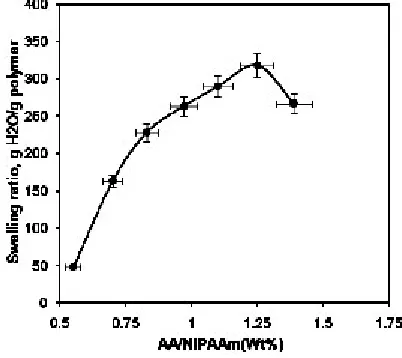
swelling capacity of the hydrogels prepared with various ratios of monomers is shown in Fig. 4. Since pH of the polymerization mixture was adjusted at 8.0 after the reaction, the superabsorbency of
kC-g-poly(AA-co-NIPAAm)hydrogel composite is due
to both functional groups of ionic carboxylate (from neutralized AcA) and dipole groups (amide).
The presence of the ionic groups in polymer chains results in increasing of swelling because the ions are more strongly solvated rather than dipole groups in the aqueous medium. Higher swelling capacities are obtained from employing higher initial ratios of AcA/NIPAAm. Therefore, the swelling enhancement versus higher AcA/NIPAAm ratio can be attributed to the formation of high carboxylate groups in the synthesized samples. However, Beyond 1.25 wt%, the water absorbency is considerably reduced. The swelling decrease after the maximum may be attributed to (a) preferential homopolymer ization over graft copolymerization, (b) increase in viscosity of the medium which hinders the movement of free radicals and monomer molecules, and (c) the enhanced chance of chain transfer to monomer molecules14.
Effect of APS Concentration on Swelling The effect of the initiator (APS) concentration on the water absorbency of the superabsorbent composite was also studied (Fig.5).
Fig. 3: Effect of crosslinker concentration on swelling capacity hydrogel composite
Fig. 4: Effect of monomer ratio (Wt%) on swelling capacity of hydrogel composite
The APS concentration was changed from 0.004 to 0.038 mol/L. Water absorbency of the composite was increased initially with increasing the initiator concentration up to 0.019 mol/L, but it was decreased later as shown in Fig 5. The increase of water absorbency with increasing initiator concentration may be ascribed to the increase of the active sites on the backbone of the κC arising from the attack of sulfate anion-radical. An additional reason, according to Flory(15), is imperfection of the polymer networks obtained from high-initiator polymerization systems. The increase the active sites on the polysaccharide led to increase of AANa grafting onto êC backbones. The decrease of water absorbency with initiator concentration beyond 0.019 mol/L may be due to: (a) increased number of produced radicals led to terminating step via bimolecular collision, (b) predominance of homopolymerization over grafting, (c) molecular weight loss of the synthetic part of the polymer network(20-21), and (d) free radical degradation of κC substrate. A proposed mechanism for the latter possibility has been reported in a previous work16-18. Hsu et al. have recently reported a similar observation in the case of degradation of chitosan with potassium persulfate19.
Fig. 5: Effect of initiator concentration on swelling capacity of hydrogel composite
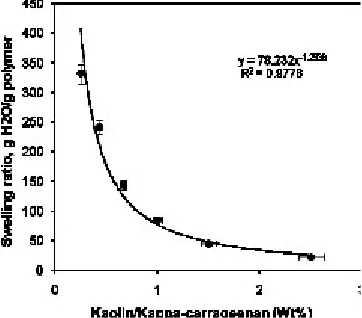
2.50, while other reaction variables were constant. The effect of kaolin amount on water absorbency is similar to MBA influence on absorbency. Fig.6 indicates that the water absorbency of the superabsorbent is decreased with increasing the kaolin amount incorporated in the composite structure. The clay in the polymerization reaction may be acts via two ways: (a) kaolin particles acts as a crosslinking agent (it means that carboxylate groups of sodium poly(acrylate) chains react with kaolin as obviously proved by FTIR spectra (Fig.1)), and (b) kaolin particles prevent the growing polymer chains through a chain transfer mechanism22.
Fig. 6: Effect of Kaolin/ κκκκκC ratio (Wt%) on swelling capacity of hydrogel composite
Fig. 7: On-off switching behavior as reversible pulsatile swelling (pH 8.0) and deswelling (pH
2.0) of the hydrogel composite
pH-responsiveness behavior of the hydrogel composite
Ionic superabsorbent hydrogels exhibit swelling changes at a wide range of pHs. Therefore, in this series of experiments, we investigated the reversible swelling-deswelling behavior of this hydrogel in solutions with pH 2.0 and 8.0 (Fig. 7). At pH 8.0, the hydrogel swells due to anion-anion repulsive electrostatic forces, while at pH 2.0, it shrinks within a few minutes due to protonation of the carboxylate anions.This swelling-deswelling behavior of the hydrogels makes them as suitable candidate for designing drug delivery systems23.
Thermo-sensitivity of the Hydrogel composite The dependence of swelling degree on temperature and time is shown in Fig. 8. It indicates that the swelling and deswelling of the hydrogels were reversible. The response to temperature change is very quick. An abrupt decrease of swelling ratio is observed from 25 oC to 45 oC 23.
Swelling kinetics
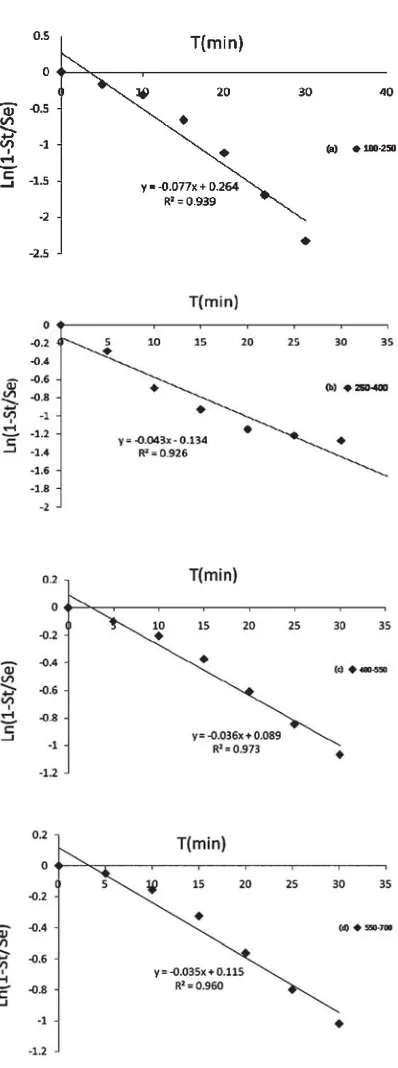
According to Fig. 9, the swelling values versus swelling time follow a power low trend. A ½Voigt-based model½ may be used for fitting the data24.
(1
t)
t e
S
=
S
−
e
− τ ...(1)St is the swelling at time t, Se is the equilibrium swelling (power parameter) and τ is the
rate parameter. The rate parameters for
superabsorbent are found to be 12.99, 23.25, 27.78 and 28.57 min for superabsorbent with particle sizes of 100-250, 250-400, 400-550 and 550-700 µm, respectively. It is well-known that the swelling kinetics for the superabsorbent polymers is significantly influenced by particle size of the absorbents(24). With a lower the particle size, a higher rate of water uptake is observed. An increase in the rate of absorption would be expected from the increase in surface area with decreasing par ticle size of composite. For calculate the rate parameter, by using the above formula and a little rearrangement, one can be plot Ln(1−StSe) versus time (t). The slope of the straight line fitted (slope = -1/τ) gives the rate
parameters. Since the τ value is a measure of swelling rate (i.e., the lower the ô value, the higher the rate of swelling), it can be used for comparative evaluating the rate of water absorbency of SAPs on the condition that the particle size of the comparing samples are the same or, at least, in the same range24.
CONCLUSION
Superabsorbent hydrogels composite,
kC-g-poly(AA-co-NIPAAm)/kaolin, were synthesized
through grafting of Acr ylic acid and N-isopropylacr ylamide monomers onto kappa-carrageenan using ammonium persulfate (APS) as an initiator and methylene bis acrylamide (MBA) as Fig. 9: Plot of Ln (1-St/Se) versus time,
according to Eq. 1 (first order kinetics) for the superabsorbent composites with particle sizes
a crosslinking agent in the presence of kaolin powder under an inert atmosphere. FTIR and SEM spectra provide the graft copolymerization and crosslinking do takes place. The study of FTIR spectra shows that in the composite spectrum a new absorption band at 1722 cm-1 was appeared that attributed to the ester formation from replacement of hydroxyl groups of kaolin with grafted carboxylate anions onto polysaccharide backbones.The superabsorbent hydrogels exhibited high sensitivity to pH (in 2.0 and 8.0) and media temperature. therfore, we investigated the pH- and tem[-sensitivity of the
1. Fanta, G. F., Polymer ic Materials
Encyclopedia, Salamone, J. C. (Ed.), vol.10,
p. 7901, CRC Press: Boca Raton, FL (1996). 2. Kirk, R.E., Othmer, D. F., Encyclopedia of
Chemical Technology, Kroschwitz, J.I.,
Howe-Grant, M., (Eds.), vol. 4, p. 942, John Wiley & Sons, New York (1992).
3. Hosseinzadeh, H., Pourjavadi, A., Zohouriaan-Mehr, M. J., Mahdavinia, G. R.,
J. Bioact. Compat. Polym., 20: 475 (2005).
4. Hosseinzadeh, H., Pourjavadi, A., Zohouriaan-Mehr, M. J., J. Biomater. Sci.
Polym. Ed, 15: 1499 (2004).
5. Pourjavadi, A., Harzandi, A. M., Hosseinzadeh, H., Eur. Polym. J., 40: 1363 (2004).
6. Hosseinzadeh, H., e-Polymers, no. 128 (2009).
7. Po R. Water-absorbent Polymers, A Patent Survey. J. Macromol. Sci-Rev. Macromol.
Chem. Phys. C34: 607 (1994).
8. Hoffman AS. Polymeric Mater ials
Encyclopedia, Vol. 5, Salamone JC (ed). CRC
Press: Boca Raton, FL, 3282 (1996). 9. J. Lin, J. Wu, Z. Yang, M. Pu, Synthesis and
Proper ties of Poly(acr ylic acid)/Mica Superabsorbent Nanocomposite, Macromol.
Rapid Commun., 22: 422-424 (2001).
10. J. Lin, J. Wu, Z. Yang, M. Pu, Synthesis and Proper ties of Poly(acr ylic acid)/ montmorillonite Superabsorbent composites,
Polymers & Polymer Composites, 9: 469-471
(2001).
hydrogel. Ionic repulsion between charge groups incorporated in the gel matrix by an external pH modulation could be assumed as the main driving force responsible for such abrupt swelling changes. This superabsorbent network intelligently responding to pH and temperature may be considered as an excellent candidate to design novel drug delivery systems. Finally, dynamic swelling kinetics of the hydrogel composite show that the rate of absorbency is increased with decreasing the particle size of superabsorbing samples.
REFERENCES
11. J. Wu, J. Lin, M. Zhou, C. Wei, Synthesis and Properties of Starch-g-Polyacrylamide/Clay Superabsorbent composite, Macromol. Rapid
Commun., 21: 1032-1034 (2000).
12. J. Wu, Y. Wei, J. Lin, S. Lin, Study on Starch-g-Acr ylamide/Mineral Powder Superabsorbent Composite, Polymer, 44: 6513-6520 (2003).
13. Kirk RE, Othmer DF. Encyclopedia of
Chemical Technology, Vol. 4, Kroschwitz JI,
Howe-Grant M. (eds). John Wiley & Sons: New York, 942 (1992).
14. Pourjavadi A, Harzandi AM, Hosseinzadeh H. Modified Carrageenan. 3. Synthesis of a Novel Polysacchar ide-based Superabsorbent Hydrogel via Graft Copolymerization of Acrylic Acid onto kappa-carrageenan in Air. Eur. Polym. J. 40: 1363 (2004).
15. Flory, P. J., Principles of Polymer Chemistry, Ithaca, Cornell University Press, New York, (1953).
16. Silverstein RM, Webster FX. Spectrometric
Identification of Organic Compounds, 6th Edn., Wiley, New York, 1998.
17. G. R. Mahdavinia, A. Pourjavadi, H. Hosseinzadeh, M.J. Zohuriaan-Mehr, Superabsorbent Hydrogels from Poly(acrylic acid-co-acrylamide) grafted Chitosan with Salt- and pH-Responsiveness Properties,
Eur. Polym. J., 40: 1399-1407 (2004).
Aqueous Solution Polymerization of Polyacrylate Superabsorbents.J Appl Polym
Sci 2000,75:808.
19. Hsu S.C, Don T.M, Chiu W.Y. Free Radical Degradation of Chitosan with Potassium Persulfate. Polym Degrad Stab 2002,75:73. 20. Lim DW, Whang HS, Yoon KJ. Synthesis and
Absorbency of a Superabsorbent from Sodium Starch Sulfate-g-Polyacrylonitrile. J.
Appl. Polym. Sci. 79: 1423 (2001).
21. Barbucci R, Maganani A, Consumi M. Swelling Behavior of Carboxymethylcellulose Hydrogels in Relation to Cross-linking, pH, and Charge Density. Macromolecules 33: 7475 (2000).
22. Omidian H, Hashemi SA, Sammes PG, Meldrum I. A Model for the Swelling of Superabsorbent Polymers. Polymer, 39: 6697 (1998).
23. Omidian H, Hashemi SA, Sammes PG, Meldr um I. Modified Acrylic-based Superabsorbent Polymers (Dependence on Particle Size and Salinity). Polymer, 40: 1753 (1999).