Elevators Scheduling In Elevator Group Control
System For The Emergency Evacuation Of High
Rise Buildings
Malan D. Sale, V. Chandra Prakash
Abstract: In a high-rise building, elevators are the best solution for transportation. In emergencies, using elevators and stairs has excellent help in population evacuation. However, in recent years, elevator use is prohibited during emergencies like fire detection, flood situation, and bomb detection. Without elevators, it is challenging to evacuate high buildings by staircase during emergencies. The crowd to evacuate may ha ve people of various age groups, i.e., the aged, physically disabled, children’s among whom not all are physically capable of using stairs in such a situation. Some studies propose the use of elevators in fire situations using zoning, which results in complex structure and wastage of time. The ele vators are operable from inside to travel between the ground floor and affected floor, which in turn results in a wastage of time. The proposed study focuses on the dynamic scheduling of elevators in Elevator group control system EGCS to evacuate building populations on a safer floor during emergencies like fire, flood, and bomb threat.
Index Terms: Bomb threat, EGCS, Emergency evacuation, Elevators, Fire, Flood.
—————————— ——————————
1.
INTRODUCTION
There is an emergency when a fire breaks out on any floor(s) in a high-rise building. In that situation, evacuation of the affected floor is of utmost importance for the safety of people. In existing high-rise buildings, the use of elevators is prohibited in case of fire; instead, the use of stairs is encouraged. This practice is safer and more manageable in buildings with small height, but since the buildings nowadays are much higher than before, evacuation using stairs is not practical anymore. Flood is another emergency where instead of evacuating people from the building to the outer environment, they need to be moved to the upper floors of the building to be safe from the increasing water levels. A bomb threat is an emergency, which has become quite common these days, owing to the various terrorist groups around the world. The building needs to be evacuated immediately once the threat is known. Also, there may be people with some or other disabilities among them, and rushing towards the stairs in an emergency may prove to be fatal for them. Elevators can prove to be very useful in emergencies as with proper care; they can evacuate more people safely and avoid casualties. The proposed system introduces dynamic elevator scheduling to handle emergencies like fire, flood, and bomb threats. The elevators can only be useful in fire emergencies if they are made to be fireproof, i.e., there needs to be the construction of elevators using various sensors like a smoke detector, fire detector. Such elevators can then detect fire and still not be affected in its working also since these elevators will be designed to be smoke proof so they will not harm the onboard passenger’s life as well. These considerations need to be taken care of for elevators installed in all high rise buildings only then can the elevators be used for evacuation of passengers in a fire emergency. The group of elevators can work as a unit and first evacuate people from the affected floor
to a floor that is four floors lower to it. After the evacuation of the affected floor, the preference can be given to the upper floors as the fire invariably rises upwards; an EGCS allocates elevators to the floor immediately above and below it. After the safe evacuation of the upper floors, the people can move to the ground floor from the respective floors they have been moved to till it is deemed safe for everyone inside. During the evacuation, the lifts need to operate at speed higher than their usual ones to speed up the process. Generally, in the case of floods, the first three floors are the floors in the utmost danger. Thus, the elevators will be effectively disabled to operate on these floors and will work on the floors above them only. The people on the lower floors can move to the 3rd-4th floor, and then the elevators will not go to those floors at all. Instead, it will concentrate on moving the people to the upper floors according to the capacity of each floor. This way the people will not get cramped on a particular floor and no floor will be overcrowded. The elevators will move faster in this condition as well, only slowing down near the destination floor to avoid jerking to the passengers on board. The elevators can be used in the flood emergency only if the required power station and elevators are either waterproof or before the water reaches to elevator cabins.
A bomb threat is an emergency, mainly occurs in places, which have a capacity of housing more people. Thus, the high-rise buildings are a popular point of attack. Usually, the officials (police) try to prevent such threats by taking immediate action. Once the bomb threat is detected, the floor that is the target needs to evacuate first. Thus, all elevators need to rescue people from these floors to a floor lower than it. After the evacuation of the whole floor, the elevators should not open on that floor; instead, it should move people on the upper floor to the ones lower and relatively close to the ground. Once all the people are m d to the relatively lower floors, they need to be moved to the ground floor from there so that they can leave the building at once. After that, the police and bomb squad people according to their need to diffuse the bomb, carry out a scan of the entire building for other threats, and use the elevators. This way, loss of life, as well as property, can be avoided if the operation is successful. The proposed system gives a solution to handle emergencies by the dynamic allocation of elevators.
————————————————
Malan Dipak Sale, pursuing Ph.D. Computer engineering, K.L.E.F. Vaddeswaram, Assistant Professor, Sinhgad College of Engineering,Pune,India. 09822024379 [email protected] Dr. V. Chandra Prakash, Professor Computer engineering, K.L.E.F.
2 RELATED WORK
Various studies propose the solution to handle fire conditions in the building, but no study proposes the solutions to handle flood and bomb threat situations in the building. Different studies focus on the use of sensors to collect the population data, but using sensors increases the cost. The advanced information is collected through devices like destination entry, and RFID sensors are used to optimize the time by introducing zoning [1][2]. The study does not focus on emergency scheduling. For emergency scheduling, the passengers who are coming towards the elevator are future traffic. The study focuses on three passage-elevator allocations. Floors to be served by an elevator are identified based on destination entries and RFID sensors data. The study does not discuss the scheduling during an actual fire situation. CPU time can reduce by further improvement. The study [3] focuses on use passenger destination information collected from RFID tags to allocate elevators. In an emergency, elevators serve the calling floor calls by ignoring all previous calls and then serving the remaining calls. The study [4] focuses on the Smoke spread system. The elevator stops only on the refuge floor, which is one floor lower the fire floor and ground floor. The study [5] focuses on the use of sensors to detect fire smoke and accordingly allocates lifts to evacuate people from building. The lift does not stop at the fire floor directly moves to the evacuation floor. Based on available data, passenger elevator allocation is done. The people need to enter in the allocated lift. The study [6] focuses on the agent-lift model simulated in EXODUS software with a hypothetical building of 50 floors and 32 elevators arranged in 4 banks and 7840 peoples. The model uses two approaches to evacuation. In the first approach, floor sequence changes dynamically. In the second approach, the floor sequence is static. Elevators visit sequentially to each floor and drop the people to the ground floor. In the suttle floor sequence, the elevator performs pick up and drop operations on each floor by considering elevator capacity. If the elevator has fewer agents, then it moves to the next sequential floor for evacuation. As passengers are selecting elevators, there will complicate the situation during an emergency. The study [7] focus on minimizing of evacuation time by considering the crowd at each floor. The crowd is detected by using sensors and depending on a count of people waiting for the elevator; the elevators sent to the floor. For this, elevators are divided into groups, and then one or more elevators from these groups are sent to the floor, depending on the crowd. If more, crowd then more elevators. The study uses the Genetic algorithm in MATLAB. Geo-fencing sensors are used to detect a passenger’s arrival and movement in the study [8]. Based on the sensor data, elevators are allocated to reduce the wait time. The proposed study [9] conducts an experimental study in a university building and human behavior during emergency conditions. When the number of evacuees wants to enter an elevator, it will be overloaded, and the time required to open/close the door is more. When evacuees wait in line, then the time required to enter an elevator is more than when they stand in an arch. People push each other to get into elevators during emergency conditions. The proposed study test smoke, count of people waiting for an elevator, door open/close time, loading/unloading time, and queuing behaviors. The study [10] focus on a review of human behavior during fire emergencies. The study [11] focuses on human behaviors for the selection of lifts during a routine and emergency condition. The study
focuses on the conducted online survey with 468 people among 23 countries. The survey states that the majority of people are ready to use elevators for evacuation at high floors, but by considering the floor number, the crowd waiting for elevators and waiting time. The study [12] conducts surveys in the university building, and two factors tested the number of people waiting for the elevator and smoke. Smoke does not affect the evacuee’s behavior, but the number of waiting people affects their behavior during the emergency. The study [13] focuses on the three-decision model for the evacuation of people during an emergency. By considering people's disabilities, the building must have some rescue features like a safe area for rest and rescue assistance, safe exit stairs, exterior equipment for evacuating people outside of building in case no safe area in the building, protected elevators. The decision model takes a decision about which occupants are in danger, are any safe floors available in the building, and which occupants need to move to safe floors. The study [14] focuses on the use of lifts in an emergency. When the fire is detected at a specific floor, the people are expected to use stairs only to gather at the refuge floor that is the fire-free, temporary space for rest. From this refuge floor, an external shuttle lift is used to evacuate people to street level. This shuttle lift is not having an opening at any of the floors, preventing fire and smoke spread. The study [15] focuses on the elevator system working using PLC. Once the emergency button glows, the elevator stops immediately, which halts the whole system. The study [16] focuses on the risk assessment factors of elevators in an emergency- includes incident-impacted zone; people flow using the elevator, rescue arrival time, rescue time. The study [17] focuses on the use of data warehousing concepts to maintain historical records of the elevator system. Therefore, the maintenance team can use this data for future purposes. The historical data may contain standard signals of emergency. The study has not given solution to emergency scheduling. The study [18] [19] [20] presents the analysis and dynamic scheduling of elevators in EGCS using traffic priority, time priority. The study [21] focuses on scheduling elevators using even and odd scheduling approach in standard situations. The proposed system proposes a solution to handle emergencies like a fire, flood, and a bomb threat in the building by dynamic scheduling of elevators
3 RESEARCH
METHOD
Fig. 1 Proposed system block diagram
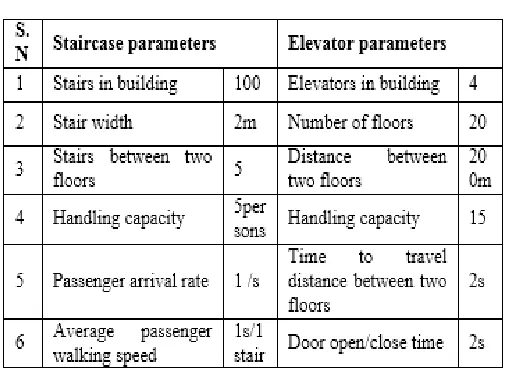
The proposed system considers the following assumptions. Each elevator is capable of handling a 1000kg load of 15 passengers, the staircase with 100 stairs: five stairs between two adjacent floors. Staircase width is about 1m with a walking capacity of five people in an emergency or routine situation. Assuming the average passenger interval is 1second in emergencies, and their walking speed is one stair/second. The passengers do not follow queue or sequence during an emergency. Everyone wants to move fast [6, 9, and 12]. Table I shows the building parameters considered in the proposed system.
Table I Building Parameters
The travel time required to evacuate passengers from one floor to other using elevator (Te) is given as
(1)
Where,
D is Total distance traveled in floors,
Tf is Time required to travel distance between two floors, S is No. of elevator stops,
Td is the Time required to open/close the door. Nf is No. of floors traveled,
Tw is the time required to walk between two floors, Ns is No. of stairs between two floors,
Tt is the time required to travel one stair.
The Time taken to walk by stairs Ts is given as
(2)
Where,
(3)
The algorithm for Emergency evacuation is described as below:
1. Emergency key activated, detect the emergency type,
and affected floor (Fi).
2. Retrieve information about available passengers at
each floor (Pi).
3. According to the data already stored with the system
regarding the number of people on that floor, the controller calculates the number of trips to be made for the respective floor based on parameters passenger count, lift capacity and lift count.
(4)
Where,
(5)
4. The elevators servicing all calls stop their services at
once.
5. If an emergency is a fire:
a. All the elevator cars are irrespective of their
motion direction move to the affected floor Fi.
b. Every elevator car accepts the passengers to its
full capacity and moves them to Fi-4
floor. Moreover, i represents floor
number
c. Announce at Fi, Fi+1, Fi+2, and Fi-2 floor: ―Evacuate the floor by using stairs. Handicapped, old people, pregnant women’s and children can wait for elevators.‖
d. Once all the people from the affected floor (Fi)
and Fi+1 evacuated to Fi-4 floor Fi+1-4 and ,
(6)
(7)
e. The elevators once again carry out the required
number of trips to evacuate these floors and move the passengers to a relatively safe floor. the safe floor is considered four floors below than fire-affected floor
f. If fire detected on Fi and i=1, then all elevators Ne
assigned to Fi to evacuate people to the safe
floor. Once all evacuated Ne cars to Fi+1, cars to
Fi+2 & Fi+3.
g. If fire detected on Fi and i=19, then all elevators Ne assigned to Fi to evacuate people to Fi-4 floor.
Once all evacuated, allot cars to Fi-1 and car
to Fi-2 and (Ec - ec) to Fi-3.
h. Carry out a similar evacuation operation for each
of the upper floors of the affected floors and the lower floors.
6. If an emergency is a flood:
a. All the elevators stop their services immediately
and rush to the First floor Fi. b. Move people to the Fi+4 floor.
c. After the evacuation, assign cars to the Fi+1
floor, cars to the Fi+2 floor, and move to the Fi+4 floor.
d. Disable access to these floors.
7. If an emergency is Bomb Threat:
a. All the elevator cars are irrespective of their
motion direction move to the affected the floor Fi
b. Move people to the Fi-4 floor
c. After evacuation assign cars to the Fi+1 floor,
cars to the Fi-1 floor and move to Fi-5 and Fi+5 floor
d. For top floors, evacuate to down floors.
8. Once all the people evacuated, the operation stops.
Where,
C - Total passenger capacity of the elevator, N – Total floors in the building,
Nt - Number of required trips,
Ce - Elevator capacity,
Np – Total Passenger count,
Pi - Passenger count at each floor,
Fi – Floor number ,
Ne –Elevator count,
Ei -Elevator number ,
Ec, ec -Elevator count to allocate.
4 RESULTS
AND
DISCUSSION
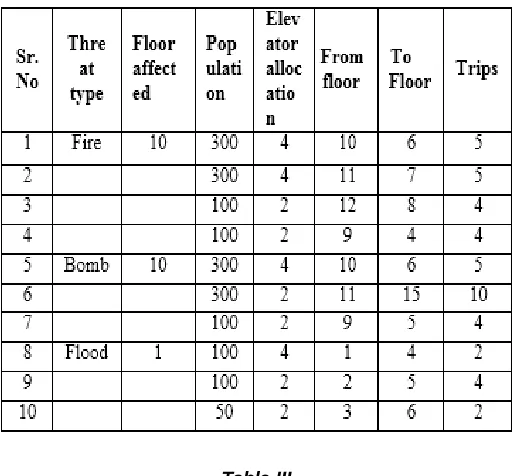
The proposed system allocates elevators based on the threat detected and performs trips based on the population on that floor. Table II shows the elevator allocation based on the threat detected on different floors and required trips.
Table II
Elevator Allocation and Required Trips.
Table III
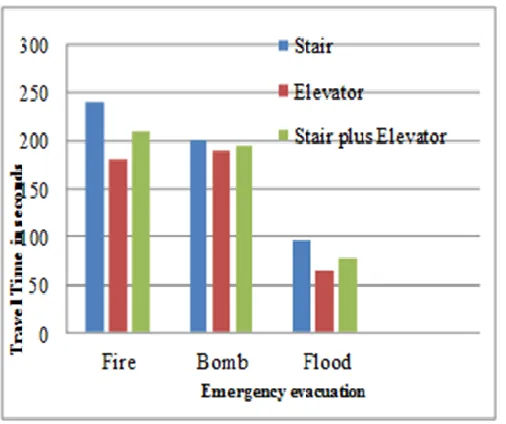
Travel Time by Using Stairs, Elevators and Both
Fig. 2. Emergency evacuation using various ways
Figure 2 shows the comparison of different techniques/ways used for evacuation of passengers in the building during an emergency. The use of stairs and elevators during emergencies such as fire, flood, and bomb threats are beneficial and life-saving techniques.
5
CONCLUSION
The traditional systems do not allow the use of elevators during emergencies like the fire, the flood, and the bomb threat. Population evacuation by staircase only increases the severity of emergencies. The present study proposes the use of elevators along with the staircase for population evacuation in emergency conditions. The proposed algorithm gives the best solutions in fire, flood, and bomb threat emergencies by the dynamic allocation of elevators. The system considers population data is available in the system, and emergencies can detect by sensors and emergency keys.
REFERENCES
[1] Bo Xiong, Peter B. Luh, Shi Chung Chang, "Group
Elevator Scheduling with Advanced Traffic Information for
Normal Operations and Coordinated Emergency
Evacuation,‖ Proceedings of the 2005 IEEE International Conference on Robotics and Automation, Barcelona, Spain, April 2005.
[2] Peter B. Luh, Bo Xiong, and Shi-Chung Chang,‖ Group
Elevator Scheduling with Advance Information for Normal and Emergency Modes,‖ IEEE transactions on automation science and engineering, vol. 5, no. 2 April 2008.
[3] T. Strang and C. Bauer, "Context-Aware Elevator
Scheduling," 21st International Conference on Advanced Information Networking and Applications Workshops (AINAW'07), Niagara Falls, Ont., 2007, pp. 276-281.
[4] Cai, N., and W. K. Chow, ―Numerical Studies on Fire
Hazards of Elevator Evacuation in Supertall
Buildings.‖ Indoor and Built Environment, vol. 28, no. 2, Feb. 2019, pp. 247–263.
[5] Kai Shi1,2, Yuichi Goto1, Zhiliang Zhu2, and Jingde
Cheng,‖ Anticipatory Emergency Elevator Evacuation
Systems,‖ ACIIDS 2013, Part I, LNAI 7802, pp. 117–126, 2013 Springer-Verlag Berlin Heidelberg 2013.
[6] Michael J. Kinsey, Edwin R. Galea, and Peter J.
Lawrence,‖ Investigating evacuation lift dispatch strategies using computer modeling,‖ FIRE AND MATERIALS Fire Mater. (2011) DOI: 10.1002/fam.1086.
[7] Ning Ding, Tao Chen, Peter B. Luh, Hui Zhang,‖
Optimization of Elevator Evacuation Considering Potential Over-Crowding,‖ Intelligent Control and Automation, eleventh World Congress proceeding Shenyang, China, June 29 - July 4, 2014.
[8] Harish Bharti, Rajesh K Saxena, Sandeep Sukhija, and
Vikram Yadav,‖ Cognitive Model for Smarter Dispatch System/Elevator,‖ IEEE International Conference on Cloud Computing in Emerging Markets (CCEM) 2017.
[9] Ding, Ning et al., ―Experimental Study of Elevator Loading
and Unloading Time During Evacuation in High-Rise Buildings,‖ Fire Technology 53 (2017): 29-42.
[10]Enrico Ronchi and Daniel Nilsson, ―Fire evacuation in
high-rise buildings: a review of human behavior and modeling research,‖ Ronchi and Nilsson Fire Science Reviews springer open journal 2013.
[11]M. J. Kinsey, E. R. Galea, and P. J. Lawrence, ―Human
Factors Associated with the Selection of Lifts/Elevators or Stairs in Emergency and Normal Usage Conditions,‖ Fire Technology, 48 (2012) 3–26.
[12]Ning Dinga, b, Hui Zhanga, Tao Chena, Peter B. Luh,‖
Evacuees’ behaviors of using elevators during evacuation based on experiments,‖ The Conference on Pedestrian and Evacuation Dynamics Transportation Research Procedia 2 ( 2014 ) 594 – 602.
[13]Norman E. Groner John,‖ A decision model for
recommending which building occupants should move where during fire emergencies,― Fire Safety Journal 80 (2016) 20–29.
[14]Kelvin H.L. Wong, m.c. Hui, d.g. Guo and m.c. Luo,‖ A
Refined Concept on Emergency Evacuation by Lifts,‖ fire safety science–proceedings of the eighth international symposium, pp. 599-610 2005.
[15]Gurmeet Singh, Anshul Agarwal, R.K. Jarial, Vineeta
Agarwal,‖ PLC Controlled Elevator System,‖ IEEE Students Conference on Engineering and Systems, SCES 978-1-4673-5630-5, 2013.
[16]Yingjie Liu, Xingjun Wu, XinHua Wang, Weixiong Wang,
Yuechao Song, Guojian Huang, and Xinhua Wang,‖ An Improved Risk Assessment Expert System for Elevator in Use,‖ Lecture Notes in Electrical Engineering 236, DOI:
10.1007/978-1-4614-7010-6_142, Springer Science
Business Media New York 2013.
[17] Yi-Yang Yang, Yain-Whar Si, and Wai-Leong Leong,‖
Data Warehousing Massive Real-time Elevator Signals
and Maintenance Records,‖ IEEE International
Conference on Industrial Technology 978-1-4244-1706-3/08 2008.
[18] Malan Sale, V.Chandra Prakash,‖ Traffic-Based Floor
Preference for the Scheduling of Elevators in Elevator Group Control System,‖ Indonesian Journal of Electrical Engineering and Computer Science, Vol. 16, No. 2, November 2019, pp. 835-842.
[19] Malan Sale, V. Chandra Prakash,‖ Dynamic Dispatching
Technology and Engineering (IJRTE) ISSN: 2277-3878, Volume-7 Issue-5, January 2019.
[20] Malan Sale, V.Chandra Prakash,‖ Dynamic Dispatching
of Elevators in Elevator Group Control System: Research and Survey,‖ IJITEE International Journal of Innovative Technology and Exploring Engineering ISSN: 2278-3075, Volume-8 Issue-4, February 2019.
[21] M. D. Sale, V.chandra Prakash, ―Elevator Group Control
System: scheduling of elevators using even and odd
elevators approach, ― JARDCS Journal of Advanced