3303
A Computational Diffie–Hellman based
Server Supported Signature
Augustin P. Sarr, Togdé NgarenonAbstract— The storage of private keys on mobile devices is a real issue; hardware based solutions are inconvenient and password encrypted storages may be vulnerable to offline dictionary attacks. At ESORICS 2017, Buldas et al. proposed an efficient (software only) password based server supported signature scheme, geared to mobile devices, termed Smart–ID. Unfortunately, despite its numerous interesting features, Smart–ID has two main limitations: (i) the (four prime RSA) signatures are large, and (ii) the design offers no password update mechanism. We propose an efficient password based server supported signature scheme, termed SCM, which achieves all the security attributes of Smart–ID, in addition to offering a password update mechanism and yielding smaller signatures on ECC groups. Under the computational Diffie–Hellman and the random oracle model, 𝑆𝐶𝑀 is unforgeable against chosen message attacks.
Index Terms— Computational Diffie–Hellman, Shared Chevallier–Mames (SCM) Signature, Server–Supported Signature Scheme, Clone Detection, Password Update, Smart–ID.
—————————— ◆ ——————————
1 I
NTRODUCTION IGITAL signatures are widely used in every day communications, either directly or as building blocks for more complex cryptographic schemes. Mobile devices are largely involved in these communications. On these devices, the issue of a secure storage of the private keys cannot be conveniently handled with a classical hardware module, which stores the private keys. Connecting a hardware (a smart–card reader, for instance) to these devices does not seem to be convenient. On another side, a software only solution which consists in encrypting the private keys with a user password may yield reference points for offline dictionary attacks. In the case of RSA signatures, Buldas et al. [4] propose an interesting solution, termed Smart–ID, built upon Damgård et al.’s four prime RSA [6]. Smart–ID is improved in [9]. Unfortunately, the Smart–ID design has two significant limitations. The signatures are large, for instance, for a target of 128–bits of security, it yields 6144–bits signatures; and, it offers no password update mechanism to device owners.In this paper, we explore the design of a password based server supported signature scheme, geared to software only implementations on mobile devices. The aim is to propose a scheme which offers all the security attributes achieved in Smart–ID, together with a password update mechanism, in addition to yielding smaller signatures.
Basing on Chevallier–Mames’ signature scheme, we propose an
efficient design, termed 𝑆𝐶𝑀, which is unforgeable against chosen message attacks, under the computational Diffie–
Hellman problem and the Random Oracle (RO) model. Similar to Smart–ID, it is secure against a malicious client (i. e. a client cannot generate a signature without the help of the server),
against a malicious server, against device read, and integrates a clone detection mechanism. And, contrary to Smart–ID, (i) it offers a password update mechanism, and (ii) it can be efficiently instantiated on the group of rational points of an elliptic curve, wherein it yields, for a target of 128 bits of security, for instance, signatures that are six times smaller than the Smart–ID ones.
This paper is organized as follows. In Section 2, we recall some preliminaries. In Section 3, we present the 𝑆𝐶𝑀 scheme. We provide a security and efficiency comparison between 𝑆𝐶𝑀, Smart–ID and a smart–card in section 4, and some concluding remarks in Section 5.
2
B
ACKGROUND2.1 Notations
𝒢 = 〈𝐺〉 is a cyclic group of prime order 𝑝 with identity element 1𝒢. We denote by 𝐸𝑥𝑝(𝒢, 𝑡) the computational cost of 𝑡 exponentiations with |𝑝|–bits exponents in 𝒢; 𝐸𝑥𝑝(𝒢) is a shorthand for 𝐸𝑥𝑝(𝒢, 1). For an integer 𝑛, [𝑛] denotes the set {0, ⋯ , 𝑛}. If 𝒮 is a set, 𝑎 ←R 𝒮 means that 𝑎 is chosen uniformly at random from 𝒮. For a probabilistic algorithm 𝒜 with parameters 𝑢1, ⋯ , 𝑢𝑛 and output 𝑉 ∈ 𝐕, we write 𝑉 ←R 𝒜(𝑢1, ⋯ , 𝑢𝑛). If 𝑥1, 𝑥2, ⋯ , 𝑥𝑘 are objects belonging to different structures, (𝑥1, 𝑥2, ⋯ , 𝑥𝑘) denotes a representation as a bit string of the tuple such that each element can be unequivocally parsed.
2.2 Computational Diffie–Hellman ( CDH ) Assumption If 𝑋, 𝑌 ∈ 𝒢, we denote the integer 𝑥 ∈ [𝑝 − 1] such that 𝐺𝑥= 𝑋 by log𝐺𝑋, and 𝑌log𝐺𝑋 by 𝐶𝐷𝐻(𝑋, 𝑌). The 𝐶𝐷𝐻 assumption is said to hold in 𝒢 if for all efficient algorithm 𝒜,
𝐴𝑑𝑣𝒜𝐶𝐷𝐻(𝒢) = Pr [
𝑋 ←R 𝒢; 𝑌 ←R 𝒢;
𝑍 ←R 𝒜(𝐺, 𝑋, 𝑌): 𝑍 = 𝐶𝐷𝐻(𝑋, 𝑌)]
is negligible in 𝑘.
D
• Augustin P. Sarr received his PhD in Cryptography at the University of Grenoble (France). He is an Assistant Professor at the Department of Applied Mathematics of the University Gaston Berger (Senegal). Email: [email protected]
• Togdé Ngarenon is currently pursuing PhD degree program in Cryptography af the University Gaston Berger. E-mail:
3304 2.3 Digital Signature
A Digital Signature is a triple of efficient algorithms 𝒮 = (𝐺𝑒𝑛, 𝑆𝑖𝑔𝑛, 𝑉𝑟𝑓𝑦) together with a message space 𝐌, such that:
• 𝐺𝑒𝑛 is probabilistic algorithm which takes a domain parameter 𝑑𝑝 as input and outputs a key pair (𝑠𝑘, 𝑝𝑘); 𝑠𝑘 is the signing key and 𝑝𝑘 is public.
• 𝑆𝑖𝑔𝑛 takes as inputs 𝑠𝑘 and a message 𝑚 ∈ 𝐌 and outputs a signature 𝜎.
• 𝑉𝑟𝑓𝑦 is deterministic; it takes as inputs 𝑝𝑘, a message 𝑚, and a signature 𝜎 and outputs 𝑑 ∈ {0,1}.
• And 𝒮 is such that for all ((𝑠𝑘, 𝑝𝑘), 𝑚) ∈ {𝐺𝑒𝑛(𝑑𝑝)} × 𝐌,
Pr[𝑉𝑟𝑓𝑦(𝑝𝑘, 𝑚, 𝑆𝑖𝑔𝑛(𝑠𝑘, 𝑚)) = 1] = 1.
Definition 1 A signature scheme 𝒮 is said to be (𝑡, 𝑞𝑠, 𝜀) unforgeable against chosen message attacks ( UF-CMA ) if for all adversaries 𝒜
playing Game , running in time 𝑡, and issuing 𝑞𝑠 signature queries, 𝐴𝑑𝑣𝒜,𝒮𝑢𝑓−𝑐𝑚𝑎(1𝑘) ⩽ 𝜀.
2.4 The Random Oracle Model
For a given security parameter 𝑘, we assume that the hash functions are Random Oracles [1]. i. e. if 𝐻: {0,1}∗⟷ {0,1}2𝑘 is a hash function, we assume that:
a) for all 𝑥 ∈ {0,1}∗, 𝐻(𝑥) ∈ {0,1}2𝑘, and
b) for all 𝑚 ∈ ℕ, for all 𝑥1, 𝑥1, ⋯ , 𝑥𝑚∈ {0,1}∗, for all 𝑦1, 𝑦2, ⋯ , 𝑦𝑚∈ {0,1}2𝑘, for all 𝑥0∈ {𝑥1, ⋯ , 𝑥𝑚}, and for all 𝑦0∈ {0,1}2𝑘,
Pr(𝐻(𝑥0) = 𝑦0|𝐻(𝑥1) = 𝑦1∧ ⋯ ∧ 𝐻(𝑥𝑚) = 𝑦𝑚) = 2−2𝑘.
3
T
HESCM
S
IGNATURES
CHEME3.1 Chevallier–Mâmes’ (CM) Signature
We recall in Figure 1 the CM signature scheme; it is tightly unforgeable against chosen message attacks under the 𝐶𝐷𝐻 assumption and the RO model [5, Theorem 2]. We do not mention group membership tests which are negligible in ℤ𝑞∗ and elliptic curve groups; 𝐻1: {0,1}∗→ 𝒢, and 𝐻2: {0,1}∗→ [𝑝 − 1] are hash functions.
Remark 1
a) The group element 𝑋 at step 1 of the 𝑆𝑖𝑔𝑛𝐶𝑀 algorithm is termed ephemeral key. If CM is modified such that instead of computing 𝑅 ← 𝐻1(𝑋) and ℎ ← 𝐻2(𝑚, 𝐺, 𝑋, 𝑅,𝑉, 𝑊, 𝑝𝑘) in the 𝑆𝑖𝑔𝑛𝐶𝑀 and 𝑉𝑟𝑓𝑦𝐶𝑀 algorithms, one computes 𝑅 ← 𝐻1(𝑋, 𝑎𝑢𝑥) and ℎ ← 𝐻2(𝑚, 𝐺,𝑋, 𝑅, 𝑉, 𝑊, 𝐴 ⋅ 𝑝𝑘), for some fixed bit string aux and some fixed 𝐴 ∈ 𝒢, then the Theorem 2 of [5] still holds for the
resulting CM variant. Given 𝑎𝑢𝑥 ∈ {0,1}∗ and 𝐴 ∈ 𝒢, we denote the signature generation and verification algorithms in the CM variant using aux and 𝐴 by 𝑆𝑖𝑔𝑛𝑉𝐶𝑀(𝑎𝑢𝑥,𝐴)(⋅,⋅) and 𝑉𝑟𝑓𝑦𝑉𝐶𝑀(𝑎𝑢𝑥,𝐴)(⋅,⋅,⋅), respectively.
3.2 Description of SCM
We assume a secure channel between the client 𝐶𝑙𝑡 and server 𝑆𝑟𝑣; such a channel may be obtained using a password based key exchange [2, chap.8], for instance.
3.2.1 Setup
The algorithm is the same as for CM ; it takes a security parameter 𝑘 as an input and defines a group 𝒢 = 〈𝐺〉 of prime order 𝑝, together with the digest functions 𝐻1: {0,1}∗→ 𝒢, and 𝐻2: {0,1}∗→ [𝑝 − 1]. It outputs 𝑑𝑝 = (𝒢, 𝐺, 𝑝, 𝐻1, 𝐻2).
3.2.2 Shared Key Pair Generation
The aim is to generate a public key 𝑝𝑘 together with a corresponding private key 𝑠𝑘 such that: (i) 𝑝𝑘 is uniformly distributed over 𝒢, (ii) 𝑠𝑘 is additively shared between the client 𝐶𝑙𝑡 and the server 𝑆𝑟𝑣, (iii) 𝐶𝑙𝑡’s private share 𝑎1 and 𝑆𝑟𝑣’s share
𝑎2 are independent, and (iv) 𝐶𝑙𝑡 or 𝑆𝑟𝑣 alone cannot generate a signature. The key generation is as in Protocol 1; the execution aborts if any verification fails.
A client’s private share is uniformly distributed over [𝑝 − 1]
and independent from the server’s share. Besides, when 𝑆𝑟𝑣
1) 𝑑𝑝 ← 𝑆𝑒𝑡𝑢𝑝(1𝑘); (𝑠𝑘, 𝑝𝑘) ←
R 𝐺𝑒𝑛(𝑑𝑝);
2) (𝑚0, 𝜎0) ←R 𝒜𝒪𝑆𝑖𝑔𝑛(⋅)(𝑝𝑘), where 𝒪𝑆𝑖𝑔𝑛(⋅) is a signing oracle
which takes as input a message 𝑚 and outputs
𝜎 ←R 𝑆𝑖𝑔𝑛(𝑠𝑘, 𝑚).
3) The attacker 𝒜 succeeds if : (a) 𝑉𝑟𝑓𝑦(𝑝𝑘, 𝑚0, 𝜎0) = 1 and (b) 𝑚0∉ 𝑀𝒜, where 𝑀𝒜 is the set of messages issued to the signing oracle. We denote by 𝐴𝑑𝑣𝒜,𝒮
𝑢𝑓−𝑐𝑚𝑎
(1𝑘) the probability that 𝒜 wins the game.
Game 1 UF-CMA Security Game
𝐺𝑒𝑛𝐶𝑀(𝑑𝑝): 𝑠𝑘 ←R [𝑝 − 1]; 𝑝𝑘 ← 𝐺𝑠𝑘; return (𝑠𝑘, 𝑝𝑘); 𝑆𝑖𝑔𝑛𝐶𝑀(𝑠𝑘, 𝑚):
1) 𝑥 ←R [𝑝 − 1]; 𝑋 ← 𝐺𝑥; 𝑅 ← 𝐻1(𝑋); 𝑉 ← 𝑅𝑥; 2) 𝑊 ← 𝑅𝑠𝑘; ℎ ← 𝐻
2(𝑚, 𝐺, 𝑋, 𝑅, 𝑉, 𝑊, 𝑝𝑘); 3) 𝜎 ← 𝑥 + ℎ ⋅ 𝑠𝑘 mod 𝑝; return (𝑊, 𝜎, ℎ); 𝑉𝑟𝑓𝑦𝐶𝑀(𝑝𝑘, 𝑚, (𝑊, 𝜎, ℎ)):
1) 𝑋 ← 𝐺𝜎𝑝𝑘−ℎ; 𝑅 ← 𝐻
1(𝑋); 𝑉 ← 𝑅𝜎𝑊−ℎ; 2) If ℎ = 𝐻2(𝑚, 𝐺, 𝑋, 𝑅, 𝑉, 𝑊, 𝑝𝑘) then return 1; 3) else return 0;
Figure 1 Chevallier–Mâmes’ Signature Scheme
a) The client 𝐶𝑙𝑡, with password 𝑃𝑤𝑑 ∈ 𝒫 does the following: 𝑟, 𝑢 ←R [𝑝 − 1]; 𝑎1← 𝐻2(𝑢, 𝑃𝑤𝑑); 𝐴1← 𝐺𝑎1; ℎ𝑎← 𝐻2(𝑟, 𝐴1); send ℎ𝑎 to the server;
b) At receipt of ℎ𝑎, 𝑆𝑟𝑣 does the following: 𝑎2 ←R [𝑝 − 1]; 𝐴2← 𝐺𝑎2; 𝑦 ←R [𝑝 − 1]; 𝑌 ← 𝐺𝑦; send (ℎ𝑎, 𝐴2, 𝑌) to 𝐶𝑙𝑡;
c) At receipt of (ℎ𝑎, 𝐴2, 𝑌), 𝐶𝑙𝑡 does the following: 1) Send (𝑟, 𝐴1) to 𝑆𝑟𝑣;
2) Compute 𝑝𝑘 ← 𝐴1𝐴2;
3) Store (𝑢, 𝑟, 𝑌, 𝑝𝑘), and delete the other values. d) At receipt of (𝑟, 𝐴1), 𝑆𝑟𝑣 does the following:
1) Verify that ℎ𝑎= 𝐻2(𝑟, 𝐴1); 2) 𝑝𝑘 ← 𝐴1𝐴2; 𝑇𝑆← 𝑇0;
3) Store (𝑎2, 𝑟, 𝑦, 𝑌, 𝑝𝑘, 𝑇𝑆) and delete the other values. e) The public key is 𝑝𝑘
3305 generates 𝐴2, it is only aware of ℎ𝑎, under the RO model, it
cannot then infer any information about 𝐴1. Following [9], in addition to the shared key, a nonce (𝑟, 𝑌) is jointly generated for next signature generation. The group element 𝑌 has a dual role, it is both 𝑆𝑟𝑣’s contribution to the ephemeral key and to the
nonce in next signature generation.
3.2.3 𝑺𝑪𝑴 Signature Generation
A signature generation is as in Protocol 2.
The Protocol 2 contains three stages. In the first stage, step A, 𝐶𝑙𝑡 generates 𝑋1, which is its contribution to the ephemeral key, together with its contribution to the next nonce 𝑟′. Then, it computes 𝑡 ← 𝐻2(𝑋1, 𝑌), wherein 𝑌 is 𝑆𝑟𝑣’s contribution to the ephemeral key, 𝑧 ← 𝑥1𝑡, 𝑍 ← 𝑋1𝑡, 𝑋 ← 𝑍𝑌 and 𝑅 = 𝐻1(𝑋). From this, it derives 𝑉1= 𝐶𝐷𝐻(𝑅, 𝑍), 𝑊1= 𝐶𝐷𝐻(𝑅, 𝐴1), and (𝑊′1, 𝜎1, ℎ1) ← 𝑆𝑖𝑔𝑛𝑉𝐶𝑀(``𝑆``,𝐴2)(𝑎1, (𝑟, 𝑟′, 𝐻2(𝑚′), 𝑅, 𝑉1, 𝑊1, 𝑋1)).
Notice that 𝐶𝑙𝑡 does not send 𝑌, it sends 𝐻2(𝑌). Doing so, the party communicating with 𝐶𝑙𝑡 on behalf of 𝑆𝑟𝑣 has to show that it knows 𝑌. Hence, not only 𝑆𝑟𝑣 may detect clones of 𝐶𝑙𝑡, but 𝐶𝑙𝑡 may also detect attempts to impersonate 𝑆𝑟𝑣 to it.
In step B, 𝑆𝑟𝑣 computes 𝑅 ← 𝐻1(𝑋) and 𝑉𝑟𝑓𝑦𝑉𝐶𝑀(``𝑆′′,𝐴2)(𝐴1, (𝑟, 𝑟′, 𝑚, 𝑅, 𝑉1, 𝑊1, 𝑋1), (𝑊′1, 𝜎1, ℎ1)). As 𝜎1 = 𝑥′1 + ℎ1𝑎1, and
𝐺𝜎1+ℎ1𝑎2𝑝𝑘−ℎ1= 𝐺𝜎1(𝐺−𝑎2𝑝𝑘)−ℎ1= 𝐺𝜎1𝐴1−ℎ1 ,
at the steps B.2–B.4, 𝑆𝑟𝑣 validates 𝐶𝑙𝑡’s signature with regard to
𝐴1. Then, 𝑆𝑟𝑣 generates and sends its contribution to the shared signature.
In the last stage, using 𝑆𝑟𝑣’s response, 𝐶𝑙𝑡 completes the signature generation. As 𝑠𝑘 = 𝑎1+ 𝑎2mod𝑝 and 𝑋 = 𝑍𝑌̂, it follows that 𝑥 = 𝑧 + 𝑦 ̂ mod 𝑝, 𝑉 = 𝑅𝑧𝑅𝑦̂= 𝑅𝑥, 𝑊 = 𝑊
1𝑊2= 𝑅𝑎1𝑅𝑎2= 𝑅𝑠𝑘, and 𝜎 = (𝑎 + ℎ𝑎
1) + (𝑦̂ + ℎ𝑎2) = 𝑥 + ℎ ⋅ 𝑠𝑘, where ℎ = 𝐻2(𝑚, 𝐺, 𝑋, 𝑅, 𝑉, 𝑊, 𝑝𝑘), and (𝑊, 𝜎, ℎ) is a 𝑆𝐶𝑀 signature on 𝑚′.
3.2.4 𝑺𝑪𝑴 Signature Verification
To validate a 𝑆𝐶𝑀 signature (𝑊, 𝜎, ℎ) on 𝑚′ (a CM signature on 𝐻2(𝑚′)) with regard to 𝑝𝑘, it suffices to execute 𝑉𝑟𝑓𝑦𝐶𝑀(𝑝𝑘, 𝐻2(𝑚′), (𝑊, 𝜎, ℎ)).
Remark 2 If the message 𝑚′ needs to be hidden to the server, 𝑚 can be computed as 𝑚 ← 𝐻2(𝑚′, 𝑡), for some random 𝑡 chosen from a sufficiently large set.
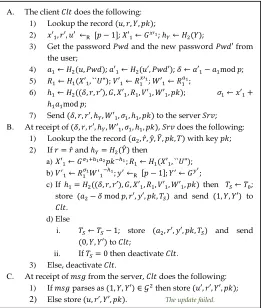
3.2.5 𝑺𝑪𝑴 Password Update
A password update can be performed as in Protocol 3. In Protocol 3, from his new password 𝑃𝑤𝑑′ and a fresh token 𝑢′, 𝐶𝑙𝑡 generates a new private share 𝑎′1 ← 𝐻1(𝑢′, 𝑃𝑤𝑑′). It computes 𝑆𝑖𝑔𝑛𝑉𝐶𝑀(``𝑈``,𝐴2)(𝑎1, (𝑎′1− 𝑎1mod𝑝, 𝑟, 𝑟′)), wherein 𝑟′ is its contribution to the next nonce. When 𝑆𝑟𝑣 receives and validates 𝐶𝑙𝑡’s signature, it updates its private share to 𝑎′2 ← 𝑎2− 𝛿 mod 𝑝, and sends to 𝐶𝑙𝑡 its contribution to the next nonce. After a successful update, it still holds that 𝑎′1+ 𝑎′2 = 𝑠𝑘 mod 𝑝.
A. The client 𝐶𝑙𝑡, with clear text 𝑚′ does the following:
1) Lookup the record (𝑢, 𝑟, 𝑌, 𝑝𝑘); ℎ𝑌← 𝐻2(𝑌);
2) 𝑥1, 𝑥′1, 𝑟′ ←R [𝑝 − 1]; 𝑋1← 𝐺𝑥1; 𝑡 ← 𝐻2(𝑋1, 𝑌);
3) 𝑧 ← 𝑡𝑥1mod𝑝; 𝑍 ← 𝑋1𝑡;𝑋 ← 𝑍𝑌; 𝑅 ← 𝐻1(𝑋);
4) 𝑉1← 𝑅𝑧; 𝑋′1← 𝐺𝑥′1; 𝑅1← 𝐻1(𝑋′1, ``𝑆"); 𝑉′1← 𝑅1 𝑥′1;
5) Get the password 𝑃𝑤𝑑 from the user;
6) 𝑎1← 𝐻2(𝑢, 𝑃𝑤𝑑); 𝑊1← 𝑅𝑎1; 𝑊′1← 𝑅1 𝑎1;
7) 𝑚 ← 𝐻2(𝑚′); 𝑚1← (𝑟, 𝑟′, 𝑚, 𝑅, 𝑉1, 𝑊1, 𝑋1);
8) ℎ1← 𝐻2(𝑚1, 𝐺, 𝑋′1, 𝑅1, 𝑉′1, 𝑊′1, 𝑝𝑘);
9) 𝜎1← 𝑥′1+ ℎ1𝑎1mod𝑝;
10) Send (𝑟, 𝑟′, ℎ𝑌, 𝑚, 𝑋1, 𝑉1, 𝑊1, 𝑊′1, 𝜎1, ℎ1, 𝑝𝑘) to 𝑆𝑟𝑣;
B. At receipt of (𝑟, 𝑟′, ℎ𝑌, 𝑚, 𝑋1≠ 1𝒢, 𝑉1, 𝑊1, 𝑊′1, 𝜎1, ℎ1, 𝑝𝑘), 𝑆𝑟𝑣 does the following:
1) Lookup the the record (𝑎2, 𝑟̂, 𝑦̂, 𝑌̂, 𝑝𝑘, 𝑇) with key 𝑝𝑘;
2) 𝑋′1← 𝐺𝜎1+ℎ1𝑎2𝑝𝑘−ℎ1; 𝑅1← 𝐻1(𝑋′1, ``𝑆");
3) 𝑉′1← 𝑅1 𝜎1𝑊′
1
−ℎ1;𝑡 ← 𝐻
2(𝑋1, 𝑌̂);𝑋 ← 𝑋1𝑡𝑌̂; 𝑅 ← 𝐻1(𝑋);
4) If ℎ1= 𝐻2((𝑟, 𝑟′, 𝑚, 𝑅, 𝑉1, 𝑊1, 𝑋1), 𝐺, 𝑋′1, 𝑅1, 𝑉′1, 𝑊′1, 𝑝𝑘) then
a)If 𝑟̂ = 𝑟 and ℎ𝑌= 𝐻2(𝑌̂) then
i. 𝑉2← 𝑅𝑦̂; 𝑊2← 𝑅𝑎2; 𝑉 ← 𝑉1𝑉2; 𝑊 ← 𝑊1𝑊2;
ii. ℎ ← 𝐻2(𝑚, 𝐺, 𝑋, 𝑅, 𝑉, 𝑊, 𝑝𝑘);𝜎2← 𝑦̂ + ℎ𝑎2mod 𝑝;
iii. 𝑦′ ←R [𝑝 − 1]; 𝑌′ ← 𝐺𝑦′; 𝑇𝑆← 𝑇0;
iv. Store (𝑎2, 𝑟′, 𝑦′, 𝑌′, 𝑝𝑘, 𝑇𝑆) and send (𝑚, 𝑌, 𝑌′, 𝑉2, 𝑊2, 𝜎2) to 𝐶𝑙𝑡.
b)Else, deactivate 𝐶𝑙𝑡. It is likely that a clone of 𝐶𝑙𝑡’s private share exists.
5) Else ℎ1≠ ℎ′1, the signature validation fails
a)If 𝑟̂ = 𝑟 and ℎ𝑌= 𝐻2(𝑌̂) then
i. 𝑦′ ←R [𝑝 − 1]; 𝑌′ ← 𝐺𝑦′; 𝑇𝑆← 𝑇𝑆− 1;
ii. Store (𝑎2, 𝑟′, 𝑦′, 𝑌′, 𝑝𝑘, 𝑇𝑆); and send (0, 𝑌, 𝑌′) to 𝐶𝑙𝑡;
iii. If 𝑇𝑆= 0 then deactivate 𝐶𝑙𝑡.
b)Else, deactivate 𝐶𝑙𝑡. 𝑆𝑟𝑣 detects a clone of 𝐶𝑙𝑡’s password
camouflaged private share.
C. At receipt of a message 𝑚𝑠𝑔 from 𝑆𝑟𝑣, 𝐶𝑙𝑡 does the following:
1) If 𝑚𝑠𝑔 parses as (𝑚, 𝑌̂ = 𝑌, 𝑌′, 𝑉2, 𝑊2, 𝜎2) ∈ [𝑝 − 1] × 𝒢4× [𝑝 − 1] then
a) 𝑉 ← 𝑉1𝑉2; 𝑊 ← 𝑊1𝑊2; ℎ ← 𝐻2(𝑚, 𝐺, 𝑋, 𝑅, 𝑉, 𝑊, 𝑝𝑘);
b) 𝜎3← 𝑧 + ℎ ⋅ 𝑎1mod𝑝; 𝜎 ← 𝜎2+ 𝜎3mod 𝑝.
c)Store (𝑢, 𝑟′, 𝑌′, 𝑝𝑘) and delete the other values.
d)Outputs (𝑊, 𝜎, ℎ) as a signature on 𝑚′. 𝐶𝑙𝑡 can verify the validity of 𝑆𝑟𝑣’s contribution by checking that
𝑉𝑟𝑓𝑦𝐶𝑀(𝑝𝑘, 𝐻2(𝑚′), (𝑊, 𝜎, ℎ)) = 1.
2) Else if 𝑚𝑠𝑔 parses as (0, 𝑌, 𝑌′) then store (𝑢, 𝑟′, 𝑌′, 𝑝𝑘) and delete the other values. Probably an erroneous password was typed.
D. Else, store (𝑢, 𝑟′, 𝑌, 𝑝𝑘) and delete the other values.
3306
4
S
ECURITY ANDE
FFICIENCYC
OMPARISONS4.1 Security Comparisons
As far as we are aware, the work that seems closer to ours in its aims and achievements is probably the Smart–ID design [4]. Smart–ID offers no password update protocol, and as shown in [9], its clone detection mechanism is flawed. So, we consider Smart–ID with the clone detection mechanism from [9]. Recall that the aim of SCM is a secure server supported signature scheme, which (i) is geared to password based software only implementations in server supported settings, (ii) integrates a secure clone detection mechanism, (iii) offers a shared key pair generation to avoid the existence of a reference point for offline dictionary attacks, and (iv) offers a password update protocol. For any 𝑚′ ∈ 𝐌 and (𝑠𝑘, 𝑝𝑘) ∈ {𝐺𝑒𝑛(𝑑𝑝)}, 𝑆𝑖𝑔𝑛𝑆𝐶𝑀(𝑠𝑘, 𝑚′) is defined as 𝑆𝑖𝑔𝑛𝐶𝑀(𝑠𝑘, 𝐻2(𝑚′)), 𝑆𝐶𝑀’s security in the 𝑈𝐹 − 𝐶𝑀𝐴 model is essentially that of CM. Theorem 1 follows straightforwardly from [5, Theorem 2].
Theorem 1 We assume the RO model. Let 𝑞𝐻
𝑖,𝑖=1,2 and 𝑞𝑠 be respectively the number of times 𝒜 issues the 𝐻𝑖,𝑖=1,2 and 𝑆𝑖𝑔𝑛 oracles in Game . If the 𝐶𝐷𝐻 problem is (𝜏(𝑘), 𝜀𝐶𝐷𝐻(𝑘))–hard in 𝒢, then 𝑆𝐶𝑀
is (𝜏, 𝑞𝑠, 𝜀) unforgeable against chosen message attacks, where
𝜀 ⩽ 𝜀𝐶𝐷𝐻+ 𝑞𝐻22 /2𝑝 + 2𝑞𝑠(𝑞𝑠+ 𝑞𝐻1)/𝑝.
Under the Random Oracle model and the 𝐶𝐷𝐻 assumption 𝑆𝐶𝑀 is (i) secure against a malicious client; (ii) it is secure against a malicious server, and (iii) is also secure against device read. We defer the detailed security proofs to the extended version of this paper.
We summarize in Table 1 the security comparison between 𝑆𝐶𝑀, Smart–ID, and a smart–card. We use the following short–
hands (a) IGKS stands for Independent Generation of the Key Shares, (b) CD for Clone Detection, (c) PU for Password Update, (d) MS for Malicious Server, (e) DR for Device Read, (f) DMR for Device Memory Read, (g) DMRKG for Device Memory Read during Key Generation, (h) DM for Device Malware, (i) S for Secure, (j) V for Vulnerable, and (k) LV for Limited Vulnerability.
Table 1 Security comparison between SCM, Smart-ID, and a smart-card
IGKS CD PU MS DR DMR DMRKG DM
Smart-Card no no yes S S S S V
Smart-ID yes yes no S S LV LV V
SCM yes yes yes S S LV LV V
All the three solutions, are vulnerable to a resident malware. Our design achieves all the security goals realized in Smart–ID, in addition to providing a secure password update protocol.
4.2 Efficiency Comparisons
We neglect group membership tests, as they have a negligible cost in ℤ𝑞∗ and elliptic curve groups. A 𝑆𝐶𝑀 key pair generation requires two exponentiations, one at 𝐶𝑙𝑡 and one at 𝑆𝑟𝑣. An execution of the signature generation protocol requires 𝐸𝑥𝑝(𝒢, 6) operations at 𝐶𝑙𝑡, and two multi–exponentiations and 𝐸𝑥𝑝(𝒢, 4) operations at 𝑆𝑟𝑣. Assuming that a multi–
exponentiation cost is about 𝐸𝑥𝑝(𝒢, 1.25) [8, Algorithm 14.88], the computational effort of the server is about 𝐸𝑥𝑝(𝒢, 6.5) operations. A signature verification requires two multi–
exponentiations, about 𝐸𝑥𝑝(𝒢, 2.5) operations. A 𝑆𝐶𝑀 signature consists in one group element and two |𝑝|–bits integers. A Smart–ID key pair generation requires the generation of two RSA moduli, 𝑛1 and 𝑛2 at the client and server, respectively. A signature generation requires 𝐸𝑥𝑝(ℤ𝑛1) operations at 𝐶𝑙𝑡 and 𝐸𝑥𝑝(ℤ𝑛1) + 𝐸𝑥𝑝(ℤ𝑛2) ≈ 𝐸𝑥𝑝(ℤ𝑛2, 2) operations at 𝑆𝑟𝑣. A signature verification requires one exponentiation in ℤ𝑛
1𝑛2, however the exponent can be chosen to be sparse (216+ 1, for instance), and the exponentiation negligible. A Smart–ID signature is a 2|𝑛1|–bits integer.
Given that both 𝑆𝐶𝑀 and Smart–ID’s security reductions are
tight, for a target security of 128–bits, for instance, the RSA moduli 𝑛1 and 𝑛2 need to have a bitlength ≈ 3072 [10]. In contrast, 𝑆𝐶𝑀 can be instantiated over an elliptic curve (sub)group 𝒢 = 𝐸(𝔽𝑞) such that |𝑞| ≈ 256 [10]. Considering a A. The client 𝐶𝑙𝑡 does the following:
1) Lookup the record (𝑢, 𝑟, 𝑌, 𝑝𝑘);
2) 𝑥′1, 𝑟′, 𝑢′ ←R [𝑝 − 1]; 𝑋′1← 𝐺𝑥′1; ℎ𝑌← 𝐻2(𝑌);
3) Get the password 𝑃𝑤𝑑 and the new password 𝑃𝑤𝑑′ from the user;
4) 𝑎1← 𝐻2(𝑢, 𝑃𝑤𝑑); 𝑎′1← 𝐻2(𝑢′, 𝑃𝑤𝑑′); 𝛿 ← 𝑎′1− 𝑎1mod 𝑝; 5) 𝑅1← 𝐻1(𝑋′1, ``𝑈");𝑉′1← 𝑅1
𝑥′1; 𝑊′ 1← 𝑅1
𝑎1;
6) ℎ1← 𝐻2((𝛿, 𝑟, 𝑟′), 𝐺, 𝑋′1, 𝑅1, 𝑉′1, 𝑊′1, 𝑝𝑘); 𝜎1← 𝑥′1+ ℎ1𝑎1mod 𝑝;
7) Send (𝛿, 𝑟, 𝑟′, ℎ𝑌, 𝑊′1, 𝜎1, ℎ1, 𝑝𝑘) to the server 𝑆𝑟𝑣; B. At receipt of (𝛿, 𝑟, 𝑟′, ℎ𝑌, 𝑊′1, 𝜎1, ℎ1, 𝑝𝑘), 𝑆𝑟𝑣 does the following:
1) Lookup the the record (𝑎2, 𝑟̂, 𝑦̂, 𝑌̂, 𝑝𝑘, 𝑇) with key 𝑝𝑘; 2) If 𝑟 = 𝑟̂ and ℎ𝑌= 𝐻2(𝑌̂) then
a) 𝑋′1← 𝐺𝜎1+ℎ1𝑎2𝑝𝑘−ℎ1; 𝑅1← 𝐻1(𝑋′1, ``𝑈"); b) 𝑉′
1← 𝑅1 𝜎1𝑊′
1 −ℎ1; 𝑦′←
R [𝑝 − 1]; 𝑌′← 𝐺𝑦 ′
;
c) If ℎ1= 𝐻2((𝛿, 𝑟, 𝑟′), 𝐺, 𝑋′1, 𝑅1, 𝑉′1, 𝑊′1, 𝑝𝑘) then 𝑇𝑆← 𝑇0; store (𝑎2− 𝛿 mod 𝑝, 𝑟′, 𝑦′, 𝑝𝑘, 𝑇𝑆) and send (1, 𝑌, 𝑌′) to 𝐶𝑙𝑡.
d) Else
i. 𝑇𝑆← 𝑇𝑆− 1; store (𝑎2, 𝑟′, 𝑦′, 𝑝𝑘, 𝑇𝑆) and send (0, 𝑌, 𝑌′) to 𝐶𝑙𝑡;
ii. If 𝑇𝑆= 0 then deactivate 𝐶𝑙𝑡. 3) Else, deactivate 𝐶𝑙𝑡.
C. At receipt of 𝑚𝑠𝑔 from the server, 𝐶𝑙𝑡 does the following: 1) If 𝑚𝑠𝑔 parses as (1, 𝑌, 𝑌′) ∈ 𝒢2 then store (𝑢′, 𝑟′, 𝑌′, 𝑝𝑘);
2) Else store (𝑢, 𝑟′, 𝑌′, 𝑝𝑘). The update failed.
3307 classical square–and–multiply based exponentiation,
𝐸𝑥𝑝(ℤ𝑛1) ≈ 4072 ⋅ 𝑀𝑢𝑙𝑡(ℤ𝑛1), where 𝑀𝑢𝑙𝑡(ℤ𝑛1) denotes the cost of a multiplication in ℤ𝑛1. Assuming that a group operation in 𝒢 requires 13 ⋅ 𝑀𝑢𝑙𝑡(𝔽𝑞) [7, p. 96], an exponentiation in 𝒢 requires 𝐸𝑥𝑝(𝒢) ≈ 256 × 1.5 × 13 ≈ 4992 ⋅ 𝑀𝑢𝑙𝑡(𝔽𝑞). Using Karatsuba–Ofman’s algorithm [3, chap 1], 𝑀𝑢𝑙𝑡(ℤ𝑛1) ≈ |𝑛1|1.585≈ 51 × |𝑞|1.585≈ 51 ⋅ 𝑀𝑢𝑙𝑡(𝔽𝑞), and then 𝐸𝑥𝑝(ℤ𝑛1) ≈ 40 ⋅ 𝐸𝑥𝑝(𝒢).
For a target of 128–bits of security, a 𝑆𝐶𝑀 signature generation over ECC is expected to be 6.6 times faster than Smart–ID at client side, and 12.3 times faster at server side, and these values are positively correlated to the number of bits of security. For sparse public exponents, signature verification is faster in Smart–ID than in 𝑆𝐶𝑀. A Smart–ID signature has 6144–bits length, while a 𝑆𝐶𝑀 signature, requires only 1024 bits (indeed 768 in a compact representation the ECC group elements). SCM signatures are 6 times smaller than the Smart–ID ones.
5
C
ONCLUDINGR
EMARKSWe proposed a password based server supported signature
scheme, built from the Chevallier Mames’ scheme, termed 𝑆𝐶𝑀, geared to mobile devices. Under the RO model and the 𝐶𝐷𝐻 assumption, 𝑆𝐶𝑀 is (i) unforgeable against chosen message attacks, (ii) secure against a malicious client, (iii) secure against a malicious server, and (iv) secure against device read, in addition to offering a secure clone detection mechanism, and a secure password update protocol.
A 𝑆𝐶𝑀 signature generation requires 6 exponentiations at the client and 4 exponentiations at the server. For a target of 128–
bits of security, we expect 𝑆𝐶𝑀 to be 6 times faster than Smart–
ID, at client side, and 12.3 times faster at server side. And, SCM signatures are about 6 times smaller than the Smart–ID ones. In a forthcoming stage, we will be interested in password based server supported signcryption schemes, geared to mobile devices.
R
EFERENCES[1] Bellare, M., Rogaway, P.: Random oracle are practical: A paradigm for designing efficient protocols. In: ACM–CCS 1993, pp. 62–73. ACM (1993)
[2] Boyd C., Mathuria A., Stebila D.: Password-Based Protocols. In: Protocols for Authentication and Key Establishment. Information Security and Cryptography. Springer, Berlin, Heidelberg (2020) [3] Brent, R. P., Zimmermann, P.: Modern computer
arithmetic (Vol. 18). Cambridge University Press (2010)
[4] Buldas A., Kalu A., Laud P., Oruaas M.: Server-Supported RSA Signatures for Mobile Devices. In: Foley S., Gollmann D., Snekkenes E. (eds) Computer Security — ESORICS 2017. ESORICS 2017. LNCS, vol 10492. Springer, Cham (2017)
[5] Chevallier–Mames B.: An Efficient CDH–Based Signature Scheme with a Tight Security Reduction. In: Shoup V. (eds) Advances in Cryptology — CRYPTO 2005. CRYPTO 2005. LNCS, vol 3621. Springer, Berlin,
Heidelberg (2005)
[6] Damgård, I., Mikkelsen, G. L., Skeltved, T.: On the security of distributed multi–prime RSA. In: Lee J., Kim J. (eds) Information Security and Cryptology —
ICISC 2014. ICISC 2014. LNCS, vol 8949. Springer, Cham (2015)
[7] Hankerson D., Menezes A. J., Vanstone S.: Guide to elliptic curve cryptography. Springer (2004)
[8] Menezes A., van Oorschot P., Vanstone S.: Handbook of Applied Cryptography. CRC Press (1996)
[9] Sarr, A. P.: Cryptanalysis and Improvement of Smart–
ID’s Clone Detection Mechanism. Cryptology ePrint
Archive: Report 2019/1412 (2019)
[10] Smart, N. P.: Algorithms, Key Size and Protocols Report (2018). ECRYPT–CSA, H2020-ICT-2014–