Optic flow based perception of two-dimensional
trajectories and the effects of a single landmark.
R.J.V. Bertin, I. Israël
Collège de France / L.P.P.A. 11, place Marcelin Berthelot 75005 ParisFrance ✆ fax:
Optic flow based perception of two-dimensional
trajectories and the effects of a single landmark.
R.J.V. Bertin, I. Israël
Abstract
It is well established that human observers can detect their heading direction on a very short time scale on the basis of optic flow. Can they also integrate these perceptions over time to reconstruct a 2D tra-jectory simulated by the optic flow stimulus? We investigated the visual perception and reconstruction of visually travelled two-dimensional trajectories from optic flow with and without a single landmark. Stimuli in which translation and yaw are unyoked can give rise to illusory percepts; using a structured visual environment instead of only dots can improve perception of these stimuli. Does the additional visual and/or extra-retinal information provided by asinglelandmark have a similar, beneficial effect? Here, seated, stationary subjects wore a head-mounted display showing optic flow stimuli that simu-lated various manoeuvres: linear or curvilinear 2D trajectories over a horizontal plane. The simusimu-lated orientation was either fixed in space, fixed relative to the path, or changed relative to both. Afterwards, subjects reproduced the perceived manoeuvre with a model vehicle, of which we recorded position and orientation. Yaw was perceived correctly. Perception of the travelled path was less accurate, but still good when the simulated orientation was fixed in space or relative to the trajectory. When the amount of yaw was not equal to the rotation of the path, or in the opposite direction, subjects still per-ceived orientation as fixed relative to the trajectory. This caused trajectory misperception because yaw was wrongly attributed to a rotation of the path. A single landmark could improve perception.
Key words: path reconstruction, ego-motion; optic flow; linear heading, circular heading; landmark; vision.
Introduction
direc-tion of heading using a pointer. Humans can perform these tasks accurately (Banks et al., 1996; Royden et al., 1992; Roy-den & Hildreth, 1996; Crowell & Banks, 1993; van Roy-den Berg, 1992, 1996; van Roy-den Berg & Brenner, 1994a,b; Warren et al., 1988., 1991b; Warren & Saunders, 1995; Grigo & Lappe, 1999; Lappe et al., 1999, 2000), and almost instantaneously (Hooge et al., 2000). This is true for linear trajectories, as well as for circular trajectories (Rieger, 1983; Turano & Wang, 1994; Stone & Perrone, 1997; Warren et al., 1991a,b).
Thus, the optic flow can tell where we are going. In navigation, this is not the only interesting or important fact. At some point, it may be necessary to also know how we have arrived there, via what route. Is it possible to glean this informa-tion from only the optic flow? We addressed the quesinforma-tion whether human subjects can reconstruct passively travelled trajectories from the optic flow in a recent study. In this study, we showed optic flow stimuli of 8s duration to 23 sub-jects, using a head mounted display (HMD). The stimuli simulated horizontal two-dimensional manoeuvres1 through a
virtual environment consisting of dots on a ground surface. The manoeuvres had 3 degrees of freedom: linear and semicircular trajectories, with the simulated (whole-body) orientation fixed in space, fixed relative (yoked) to the tra-jectory, or changing with respect to both space and trajectory. After each presentation, subjects were required to guide an input device in the form of a model vehicle through the manoeuvre they had perceived: position and orientation of the device were recorded. We showed that under certain conditions this task can indeed be performed, and that the perception of the simulated manoeuvres is similar to the perception of identical, physical manoeuvres travelled pas-sively in the dark ("vestibular perception"; Ivanenko et al. 1997a,b).
Problems arise when ambiguous flows are presented, both with heading perception and reconstruction. That is, when the presented flow field resembles the field that another movement would also generate. A well-known example of such a situation is when the stimulus consists of the retinal flow that would be generated by making a smooth horizontal eye or head movement during a linear translation. This flow closely resembles the retinal flow generated by a tangential, curvilinear movement2. Subjects typically report heading direction estimates that indicate that they perceive a
curvilin-ear movement (Banks et al., 1996; Crowell, 1997; Cutting et al., 1997; Royden et al., 1992, 1994; Royden et al., 1994; van den Berg, 1996; Warren & Hannon, 1990; Warren et al., 1991b; Wann et al., 2000). This is especially true when no extra-retinal or other disambiguating information is available. But if subjects make the appropriate eye movements, or move the head relative to the trunk in the appropriate manner, they are more likely to correctly perceive motion along a straight path (Royden et al., 1994; Crowell et al., 1998, Wann et al., 2000). Adding more structure to the simulated scene (posts, trees, etc.) also helps to disambiguate the optic flow based information (Cutting et al., 1997; Li & Warren, 2000). Our results showed that this illusion also occurs when the stimulus simulates a much larger eye or head rotation, made at higher speed, when the task is reconstruction of the travelled manoeuvre. This suggests that perceived rota-tion (yaw) is attributed to a rotarota-tion of the path (Bertin et al., 2000). Interestingly, the illusion also occurs when using vestibular and somato-kinaesthetic information (Ivanenko et al., 1997b).
In this paper we report on a sequel to the aforementioned study that addressed the effect of rotation (yaw) on the re-constructed manoeuvres (experiment 1). Finally, we also studied the effect of adding a single landmark (that could add additional extra-retinal and/or visual information) to the virtual environment (experiment 2). We compare the re-sults of these two experiments with some of the previously published rere-sults to provide a synthesis.
General Methods
Subjects.
16 subjects participated in experiments 1 and 2 and in the previously reported study (these experiments were run in two consecutive sessions with a pause in between): 8 men and 8 women. An additional control experiment (1c) was
! "#
$ $ #
run several months later, in which 16 subjects participated (6 female, 10 male, 8 of which had also participated in ex-periments 1 and 2). Subjects had varying experience in psychophysical exex-periments, but all were naive as to the pur-pose of the experiments. All had normal or corrected-to-normal vision, and were in their middle 20s to early 60s. Stimuli from experiment 1 and experiment 2 were presented intermixed randomly. Subjects gave informed consent for partici-pation; the experimental procedure was approved by the local and national ethics committees, and was conform the Declaration of Helsinki.
Experimental set-up: apparatus.
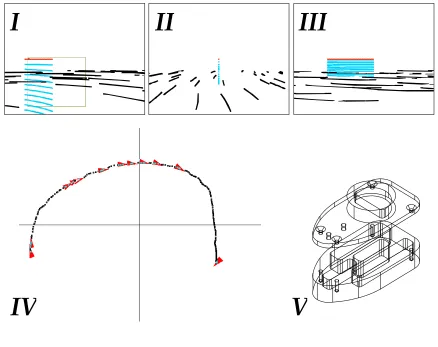
The experimental set-up has been described in detail in Bertin et al., 2000. We repeat here only the essentials. Optic flow stimuli consisted of dotscapes of white dots distributed (uniform, random; 4 pixel diameter; 4800 dots total) on a (50x50m) ground surface 1m below the virtual eye-level; the horizon was placed at 15m. The flow fields were gener-ated by simulating the movement of a virtual observer along the required manoeuvre, using Performer (Silicon Graph-ics). Each stimulus consisted of a 2s stationary period followed by 8s of simulated manoeuvre followed by another 2s stationary period. See figure 1a (insets I-III) for time-exposure impressions of stimuli (each with a landmark). Stimulus generation and display were under control of a Silicon Graphics Indigo2/Extreme workstation with a Virtual Research
VR4 head mounted display (HMD; FOV 48 horizontal, 36 vertical, 742x230 pixels, 60Hz refresh), and a Silicon Graph-ics O2 workstation with an NVision Datavisor LCD HMD (FOV 48 horizontal, 36 vertical, 640x480 pixels, 60Hz re-fresh). Presentation was binocular but monoscopic.
Subjects were required to reproduce their perception of the simulated manoeuvre after stimulus presentation. That is, they were to guide a model vehicle (a custom-made input device; inset V in figure 1a) through the manoeuvre they had just perceived, moving it over a graphics tablet. The device's instantaneous position (X,Y; resolution 22860x15240) and orientation ( o; resolution approx. 4 ) were read from the tablet using custom made software running on the Indigo, and saved to disk. During this reproduction (but not during stimulus presentations!), an overhead view of the tablet and the vehicle was presented in the HMD. A cursor showed the device's current position and orientation; previous po-sitions remained visible as dots to indicate the travelled trajectory. Horizontal and vertical lines intersecting in the cen-tre of the image were also shown as a frame of reference (inset IV in figure 1a). Buttons on the device allowed the sub-jects to erase unsatisfactory reproductions and accept (save) only those that best represented their percept.
Experimental procedure.
Subjects were seated, unrestrained but under instruction to remain as still as possible during stimulus presentations. The experimenter briefly introduced the experiment to the subjects. It was emphasised in particular that they were go-ing to see "movies" that were intended to give the impression of travellgo-ing in a vehicle capable of manoeuvres where its orientation is not yoked to the path, like a hovercraft. The input device was presented as a model of such a hover-craft-like vehicle; we will refer to it hereafter as the vehicle. A few possible manoeuvres not used in the experiment were demonstrated to familiarise the subjects with the fact that yaw was not necessarily yoked to the path, in other words, that the vehicle could make skidding and slipping movements in which its orientation could (continuously) change relative to its current direction of movement. Subjects were allowed to to train in the use of the vehicle and the tablet. This also allowed us to ensure they had fully understood the principle of reproducing manoeuvres (2D, 3 degrees of freedom; trajectory and orientation) with the vehicle. Instructions pertaining to the landmarks were given in the pause between the two sessions (see above).
Simulated manoeuvres.
A manoeuvre is described at any given instant by a position in space, and three orientations. Here, we ignore scale and use only orientation: a) the observer's orientation in space ( o; independent of the trajectory); b) the orientation of the trajectory ( p: the angle in space of the tangent to the trajectory, i.e. the direction of movement) and c) the observer's ori-entation relative to the trajectory, r = o - p. Thus, we can distinguish two types of rotation: o (yaw) and p (the rotation of the trajectory). Angles are expressed in degrees, with negative values indicating clockwise rotation.
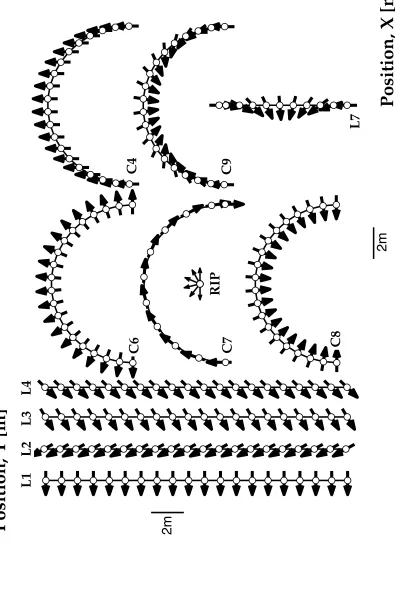
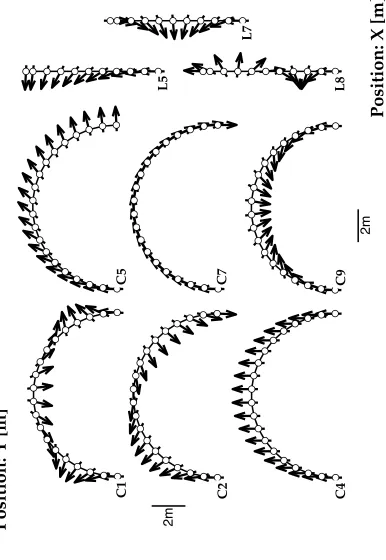
The simulated manoeuvres are listed in Table 1 divided in four distinct classes according to the observables described above. Figures 1b through 1d show the stimuli in top view (including stimuli discussed in Bertin et al., 2000 for com-pleteness). Triangular velocity profiles starting from zero velocity (angular and linear) and peaking at t=4s (half the stimulus duration) were used for comparison with earlier vestibular studies (Ivanenko et al., 1997a,b). The figures show the actual scale (in meters) of the simulated manoeuvres.
Figure 1 about here.
Table 1:
The presented stimulus conditions. The left column lists the condition name, the middle column a de-scription. The other columns lists Size: the size of the simulated manoeuvre (L=length, R=radius, in me-ters). 0,1,2: in which experiment it was presented (0: our previous study; for experiment 1, a indicates that this condition was presented in the later performed control experiment; for experiment 2, this also indicates the type of landmark; s=shifting and f=fixated). Fig: how the conditions are labelled in the fig-ures. C= curvilinear; L= linear.
Condition Description Size [m] P 1 2 Fig
Stimuli with the observer's orientation (yaw) fixed in space:
semicircle no-yaw R=1.5, 5 s C4
Stimuli with the observer's orientation fixed relative to the trajectory:
semicircle inward R=1.5, 5 - f C8
semicircle forward R=1.5, 5 - C7
Stimuli with the observer's orientation changing in space and relative to the trajectory:
semicircle 30-yaw R=1.5, 5 - - C10
semicircle 90-yaw R=1.5, 5 - - C5
semicircle 120-yaw R=1.5, 5 - - C11
semicircle full-turn R=1.5, 5 - - C9
linear 90-yaw L=7.8 - - L5
linear 140-yaw L=4.7, 7.8 - f L6
linear half-turn L=4.7, 7.8 - s L7
linear full-turn L=7.8 - - L8
rotation in place - - RIP
semicircle 64-counter R=5 - s,f C3
semicircle half-counter R=5 - - C2
semicircle full-counter R=5 - - C1
Semicircular trajectory with o=0º
Semicircular trajectory, observer looking inward ("centripetal": r=-90º)
Semicircular trajectory with tangential orientation ( r=0º)
Semicircular trajectory with a quarter rotation ( o=30º starting at r0=0º and r0=15º [C10']
Semicircular trajectory with a quarter rotation ( o=90º starting at r0=0º and r0=45º [C5'])
Semicircular trajectory with a quarter rotation ( o=120º starting at r0=0º and r0=60º [C11']
Semicircular counterclockwise trajectory with a full rotation ( o=360º starting at r0=0º)
Linear translation with rotation o=90º ( r0=0º)
Linear translation with rotation o»140º ( r0=20º)
Linear translation with rotation o=180º ( r0=0º)
Linear translation with rotation o=360º ( r0=0º) A o=-180º clockwise rotation.
Idem, with orientation changing in the direction opposite to the trajectory rotation:
At the beginning of each session, before the experiment proper, subjects were presented with 1) a simple forward translation and 2) a lateral translation ( o=90 : condition linear lateral). For these two stimuli, feedback was given to help the subjects arrive at the correct interpretation. This also served as a final check whether they completely under-stood the task, and to help them get used to the optic flow and its presentation in the HMD3.
Data analysis.
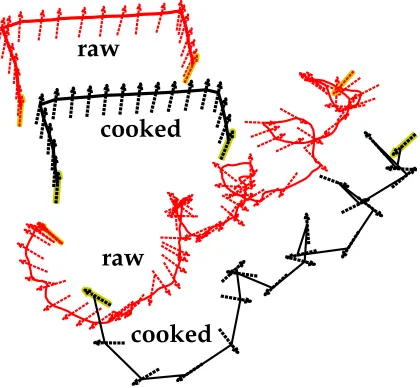
The responses were filtered, smoothed and then resampled to 20 equidistant points per trace as described in Bertin et al. (2000). Resampling to 20 points was more than adequate for the large majority of the responses. The stimulus traces in figures 1b-d were obtained by the same process from 60Hz position and orientation data generated by the stimulus programme. Figure 1e shows 2 examples of raw reproduction (1 more, 1 less typical), and the resampled versions: both retain the essential characteristics: angular turns, number of loops (and hence total path rotation) and the total yaw.
The resulting resampled reproductions were used to evaluate the subjects' performance. Performance was classified us-ing two criteria: overall correctness (if a reproduction retains certain key properties of the presented manoeuvre; globally correct) and the correctness of the trajectory (trajectory correct). The trajectory correct index gives a measure of how often subjects reproduced trajectories of the correct type (i.e. linear, "circular" or "in place"). A response is trajectory-correct when the path-rotation is within a stimulus-specific interval. The globally correct index also takes reported yaw ( o) into account and requires stimulus-specific combinations of yaw and trajectory. A response is globally-correct when it is trajectory-correct and in addition either the average path-relative orientation or the total yaw is within stimulus-spe-cific intervals, as well as possibly the initial path-relative orientation. For instance, for a lateral (or oblique) translation stimulus, a reproduced manoeuvre is globally correct when it is linear with the observer facing in the correct direction at a perpendicular (or oblique) orientation to the path. These qualitative criteria were determined automatically, after which a manual verification was performed to remove false positives and an occasional false negative.
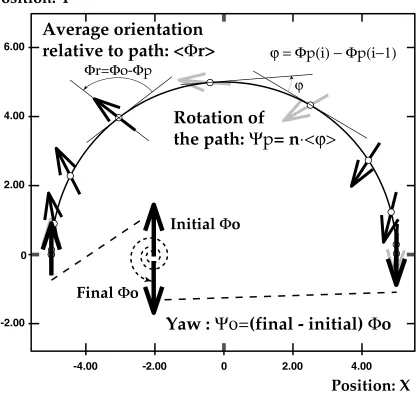
Our protocol only allowed us to analyse only scale-independent quantitative properties of the reproductions: repro-duced orientation ( ) and change in orientation (rotation; ). The three orientations and the two types of rotation that can be distinguished have been introduced above. Of these, we quantified our results with p, o and the average ori-entation relative to the path < r>; cf. figure 1f and Bertin et al. (2000). For rotations in place, only o is defined. All the other conditions (manoeuvres) could be described by p, o and < r>4.
For statistics (ANOVA) tests, we used relative errors in these measures. For the rotation of the path, the p error was normalised to (divided by) the presented o: this corrects for the attribution of yaw to path rotation that the subjects generally made.
We also analysed the responses with a figural distance measure, modified from Conditt et al. (1997). This measure quanti-fies the difference between stimulus and response, with zero indicating a perfect overlap. It is a measure that can be applied to all responses (whether or not a rotation in place), and that captures other aspects as well (e.g. three orthogo-nal linear segments can correspond to a 180° path rotation, while not being equal to a semicircle). Our measure (Df) consists of two independent components (Dfs and Dfa) that were calculated after all stimulus and reproduced ma-noeuvres had been normalised to unit length. A spatial figural distance (Dfs) was calculated as the average of the pair-wise, squared distances between all points on the two trajectories (point 1 to point 1, point 2 to point 2, etc.5). An angular
figural distance (Dfa) was calculated as the average squared difference (maintaining the sign) between the orientations
! ! "
#$ %
& ' ( % ) ( * (
+$ , " % , % % %
- . . / (
% % " "
0 1 . % "
o in radians at the corresponding points (Dfa was normalised by (1+Dfs)/ to put Dfs and Dfa on a comparable scale). The combined figural distance was then calculated as the length of the vector spanned by the spatial and angular components: Df ln Dfs2 Dfa2 (the logarithm was taken to obtain a distribution closer to the normal). Prior to this analysis, the maximum overlap was determined between all stimulus/response pairs. This was necessary because the position and overall orientation of the reproduced manoeuvre had not been constrained. It was done by shifting and rotating the response with respect to the corresponding stimulus, under control of a Simplex downhill method that minimised Df.
General Results
Introduction.
Our results indicate that it is possible to reconstruct passively travelled manoeuvres from optic flow. However, almost all subjects indicated that this was a difficult task. Most indicated that they had experienced impressions of ego-mo-tion (vecego-mo-tion). When the stimulus simulated a relatively large amount of yaw relative to the simulated translaego-mo-tion, sub-jects often reproduced a rotation in place.
Not all subjects systematically requested re-presentations. Very few subjects asked systematically for many (more than 3) re-presentations. In almost all cases, responses were consistent between re-presentations, with the final presenta-tion serving as a check, notably for the perceived direcpresenta-tion of rotapresenta-tion (that appeared to be easily forgotten). The re-sults we present hereafter are thus based on the final response only.
Influence of yaw (experiment 1, 1c).
Introduction and Methods
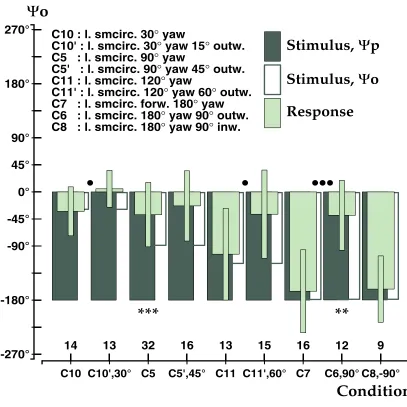
Our previous study had shown that in our reconstruction-from-optic-flow paradigm, subjects assume a fixed orienta-tion relative to the path they travel, and attribute perceived rotaorienta-tion to a rotaorienta-tion of that path (Bertin et al., 2000). This was shown for manoeuvres consisting of a linear and a semicircular trajectory with 180° more yaw than path rotation. In both cases, it led to strongly overshot curvature of the reproduced manoeuvres. Similarly, stimuli with the same amount of yaw (yoked to the path or not) but with different orientation with respect to the direction of travel gave rise to different perceptual errors. Condition semicircle forward was quite well perceived, condition semicircle outward was often perceived as a linear, lateral manoeuvre, and condition semicircle inward was not perceived in any consis-tent manner. All these conditions simulated a path rotation and yaw of -180°, but a (fixed) path-relative orientation < r> of 0°, 90° and -90° respectively.
In experiment 1 complemented by the later control experiment 1c, we studied this influence of the amount of yaw and the (initial) path-relative orientation on the perceived manoeuvre in more detail. Manoeuvres along semicircular and linear trajectories were presented (table 1, figure 1c), as described in the General Methods.
The quantitative measures (yaw, path rotation and figural distance) were averaged per condition across subjects, and compared to the presented values with Student's t-tests.
Results
Figures 2 & 3 about here.
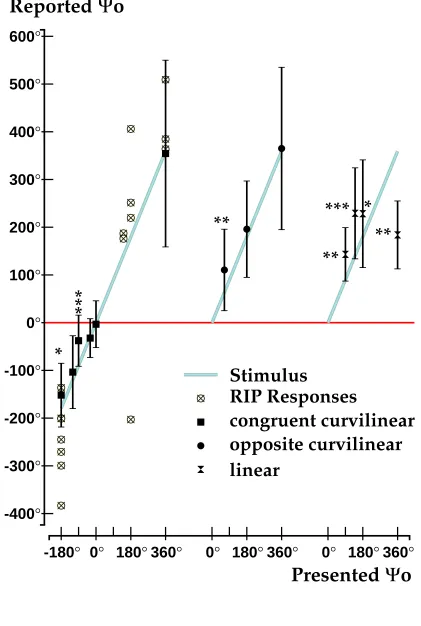
Subjects appear to be capable to approximate the angle over which they are rotated, even during complex manoeuvres (figure 2a). A small range effect occurs for the linear+yaw stimuli: overshoot for the smaller rotations, and undershoot for the large rotation ( o=360°). Difficulties in reproducing may partly account for this, as they may also (partly) for the large standard deviations in the more complex conditions. Does the good performance mean that on average sub-jects correctly perceive their simulated rotation, fully "specified" in the optic flow? Probably not, as shown by the cases in which rotations in place are (erroneously) reported ("RIP Responses" in the figure). It would appear that subjects in-correctly perceive the simulated rotation when they are not capable of detecting the simulated displacement in the stimulus. Yaw is never incorrectly perceived when the stimulus does not simulate any observer rotation (also cf. Bertin et al. 2000).
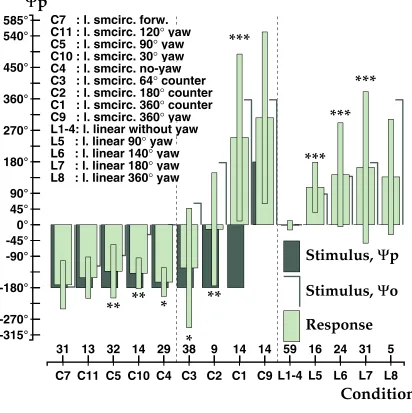
The perception of path rotation is shown in figure 3a (left part). Perception is close to veridical when orientation re-mains approximately fixed in the environment ( o 0°; slighty undershot for o 0°; p=0.044), and when it is tangen-tial to the trajectory. In experiment 1, a single condition with 0 < o < p was presented. Path rotation perception in this condition semicircle 90-yaw was not significantly different from condition semicircle forward. This suggested that perception is close to correct when 0° o p . The control experiment 1c (data included in the figures) showed that path rotation is, or tends to be, undershot (p< 0.002) when o p , although the subjects who participated in both experiments did not respond differently in the control. Recall that yaw perception is veridical in almost all con-ditions. This is not the case in conditions semicircle 90-yaw (p=5e-6), and possibly not in condition semicircle 30-yaw
for which many subjects verbally reported the perception of no yaw (but they reproduced on average 30° of yaw).
When the orientation changes relative to the trajectory, such that o> p (this includes the linear+yaw conditions, where p=0°; middle and right parts in figure 3a), subjects seem to assume that the detected rotation results from a ro-tation of the trajectory, or mostly so. They respond in a similar manner when the simulated yaw is in the direction op-posite to the direction in which the trajectory rotates. In this case, the number of reports of straight paths, or even paths curving in the wrong direction, increase with the presented o, highly significant in all cases (p<3e-5) except for linear full-turn (only 5 non-RIP responses). This effect is so strong that in condition semicircle half-counter (a clockwise semi-circle with a counterclockwise half-turn of the observer), the average perceived path is more or less a straight line (p=0.007). In condition semicircle full-counter, the average response is a three-quarter counterclockwise arc (p=3.9e-7)! The effect is already significant in condition semicircle 64-counter (p=0.046; t-test), but not when a landmark is present (see the next section).
During the time course of these ambiguous stimuli, the perceived manoeuvre becomes increasingly incompatible with the simulated manoeuvre. It should be evident from the reproduction if this conflict is perceived, e.g. in the form of corrections. We split all responses in two equal parts, and compared the errors in the two halves (using a condition x halve ANOVA design) to test if such corrections occurred. We only found significant differences for the ambiguous stimuli. However, these differences were not systematic. Typically, the sign of the error changed, without a significant decrease or increase in absolute error. There is thus no support (neither in our current nor in our previously published data) for the hypothesis that the subjects correctly interpret a perceived mismatch between their initial percept and the simulated manoeuvre at some later time. Thus, it seems that most subjects adhere to the manoeuvre they perceive in the first moments of the stimulus presentation, regardless of whether a mismatch is perceived later on. There are sub-jects who correctly perceive these stimuli, however.
Effects of initial/average path-relative orientation
right-ward curving paths), the perceived rotations undershoot the presented values, in most cases significantly so. In the cases where the orientation is (almost) 90° outward, this can lead to perceived manoeuvres that are (almost) linear tra-jectories with lateral orientation (yaw: p=0.006; path-rotation: p=4.7e-7; difference with semicircle forward: p<2.1e-4). When the orientation is inward (a single condition), rotations are perceived correctly — but only in the 9 (out of 16) re-sponses that are not rotations in place.
Influence of a single landmark (experiment 2).
Introduction and Methods
Experiment 1 confirmed a result from our previous study (Bertin et al., 2000), namely that illusions occur when the optic flow simulates manoeuvres in which the observer doesn't maintain a fixed orientation (or gaze) relative to the trav-elled path. This confirms that what others have called the 'rotation problem' also occurs when the task is to reconstruct a manoeuvre from optic flow, rather than indicate current heading. There were indications that a structured virtual en-vironment could help disambiguate the optic flow (Cutting et al., 1997), and recently, Li and Warren (2000) showed that heading perception along linear+yaw manoeuvres was more veridical when multiple landmarks are present.
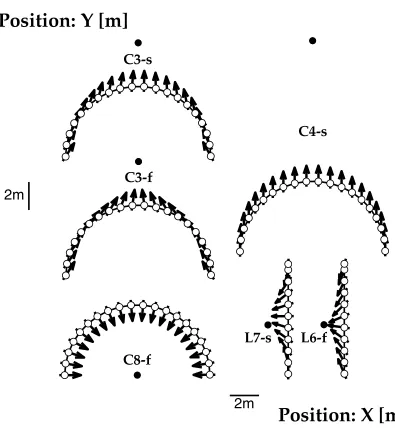
In experiment 2, we studied whether minimal additional structuring of the virtual environment — a single landmark — has an effect on reconstruction of a travelled manoeuvre from optic flow. A landmark, when present, was always fixed in the virtual environment, and visible during the whole stimulus presentation so that the additional information provided was available the whole time. This constraint made it impossible to present all stimuli both with and without a landmark. Figure 2d shows the manoeuvres that were presented, once without and once with a landmark (indicated by the large dot).
Landmarks were constructed of dots identical to the dots making up the rest of the stimulus, except for their colour (they could thus be identified individually). Every landmark had a single red dot on top that had to be kept fixated at all times. It was attached to the ground surface via a string of equally spaced blue dots (cf. figure 1a). Some landmarks moved through the observer's field of view because of the simulated manoeuvre and their (fixed!) location in the simu-lated environment. These landmarks are referred to as shifting landmarks (indicated with the suffix sLM). Thus, eye movements were induced, that provided extra-retinal information. Motion in depth relative to such a landmark gener-ated parallax of the landmark's dots with respect to each other (retinal information; see inset II in figure 1a: the blue dots are smeared). Other, fixated, landmarks (indicated with the suffix LM) remained stationary in (fixated to) the middle of the screen and could provide only parallax. Fixated landmarks were also used to test for the effect of the presence of a reference point alone in conditions without movement in depth relative to the landmark. Note that the point to be fix-ated is almost always at eye-level; when eye-movements are to be made, they are thus always horizontal (with respect to the virtual environment), and the flow contains only radial and horizontal fronto-parallel components6 (cf. Wann et al.,
2000). Exceptions are 4 semicircle inward conditions in which the red dot was placed directly on the ground surface; in 2 of these, the (simulated) gaze was tilted downward so that the landmark dot was imaged in the middle of the sub-jects' field of view (HMD image). A similar linear 140-yaw condition was also presented, with a fixated landmark of half height, requiring (simulated) gaze tilt. Only qualitative, aggregate results from these conditions are given (Table 2a,b).
The effect of landmark presence (and type) on the quantitative measures was tested for significance using analyses of variance (ANOVA).
Results
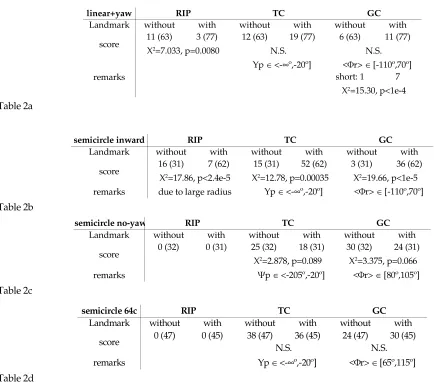
The presence of a landmark was perceived as helpful, but only in the cases where it was stationary in the field of view ("fixated"); otherwise it was considered distracting. The effect of the presence of such a landmark on the subjects' per-formance (response classification) is shown in Table 2a-d. The number of rotation-in-place responses observed are also
! " # $
listed, and the criteria used for determining globally correctness and trajectory correctness. (All responses were in-cluded in the following analyses.)
Table 2 and Figure 4 about here.
Positive effects
There are significant improvements in yaw and path perception for the linear+yaw conditions, when a landmark is pre-sent (figure 4). There is a clear, positive effect on the perception of the travelled path: the (yaw-relative) error in p de-creases when a landmark is present (figure 4a; F(1,14)=8.274; p=0.012), as does the spatial component of the figural dis-tance, Dfs (figure 4b; F(1,14)=9.043; p=0.00942).
Figures 4c and 4d compare the three different landmark conditions: no landmark, shifting through the field of view, and fixed at the centre of the HMD's field of view (fixated). The path rotation is significantly better reproduced with a shift-ing landmark (4c; F(2,30)=3.804; p=0.034). Perception of yaw is also (slightly) better when a shiftshift-ing landmark is pres-ent (4d; F(2,30)=2.91; p=0.07). The results suggest that the errors are smaller for a shifting landmark than for a fixated one; in fact, only the effect of a shifting landmark is significant.
This improvement can also be seen in the qualitative measures: table 2a. The number of RIP responses decreases sharply (p=0.022; Kruskal-Wallis), supporting the fact that the translation component of the simulated manoeuvre was better perceived. The number of globally correct responses increases, although this is significant only for the short ver-sion of the manoeuvre (p<0.0001).
There are also significant improvements in the perception of the semicircle inward conditions. This can most easily be seen in table 2b: the number of RIP responses decreases, and the number of trajectory correct and globally correct re-sponses increase when a landmark is present. This effect was also visible in the figural distance (Df=-1.468 without, Df=-2.287 with; F(1,14)=34.63; p<4e-5), but not clear in the other quantitative measures.
Finally, there are significant improvements in the perception of the semicircle 64-counter conditions. The figural dis-tance Df decreases (from -1.172 to -1.99; F(1,13)=42.17; p=2e-5; mostly due to the spatial component Dfs), and the rela-tive error in o decreases too (from 0.3018 to -0.0926; F(1,13)=4.862; p=0.046). Both the spatial and the angular (yaw) aspects of the manoeuvres are thus better perceived when a landmark is present. But curiously, Df improves for the shifting landmark type only, whereas the yaw perception improves only with fixated landmarks. The effect of land-mark type is highly significant: F(2,28)=13.19; p=9e-5. There are no significant effects on the qualitative performance indices (table 2c).
Negative effects.
General Discussion
We studied the perception of ego-movement from optic flow along passive 2D manoeuvres in the horizontal plane, and how subjects reconstructed such manoeuvres. Our question was whether subjects can reconstruct such passively trav-elled linear and curvilinear trajectories together with the orientation along them and, if so, how well. Or, in other words: can human subjects integrate subsequent instantaneous perceptions of heading (that can be perceived) into a percept of a complex, 2D manoeuvre? In the light of this question we studied the influence of simulated yaw, and also asked whether a single landmark can have a similar, positive effect in our reconstruction task as multiple landmarks can have on heading perception from ambiguous flow.
Perception of simulated 2-D manoeuvres and the influence of yaw
Our results show that subjects could perceive the qualitative nature of a simulated manoeuvre; correct directions, the correct form of trajectory and sometimes also the correct average orientation relative to the trajectory (< r>). How much of these qualitative aspects they perceived, and how well, depended on the complexity of the simulated manoeuvre. Human observers can thus indeed integrate their instantaneous perceptions of heading directions, at least to some ex-tent. This does of course not give any information about the distances travelled in these directions, since optic flow alone does not provide information on absolute linear ego-motion speed. An absolute judgement of the distance trav-elled can therefore not be made. But human observers are quite capable of making relative distance judgements from optic flow (Bremmer & Lappe, 1999; Bremmer et al. 1999). They can also estimate distances when the flow is generated by an accurate rendering of an environment they know well (Redlick, Jenkin et al., 2001). Finally, they can compare the radii of presented curvilinear manoeuvres (our preliminary results).
It is possible to quantitatively estimate rotation, i.e. turned angles, from the optic flow, at least in theory. More specifi-cally, it can be retrieved from the instantaneous flow field; no integration of information over time is necessary. Our re-sults suggest that subjects could indeed correctly detect the angle ( ) over which they were turned.
The reconstruction of the travelled trajectory was correct when the simulated trajectory was linear, and no yaw was simulated. In this case, the perceived path-relative orientation was also veridical (Bertin et al., 2000); this corresponds to the "classical" heading tasks. The angle ( p) over which the trajectory rotates can be determined from the optic flow just as well as any other angle, again in theory. This should at least be so when the optic flow corresponds to a ma-noeuvre maintaining a fixed orientation relative to the travelled path. Then all rotation is caused by a rotation of the path. Subjects were indeed capable of correctly judging the rotation of the path when orientation was yoked to the path, but only when it was tangential to the trajectory. Perception was much less veridical when the orientation was ei-ther inward (towards the centre of rotation, causing unreliable perception; perceived as rotations in place) or outward (away from the centre of rotation; perceived as rotations in place or as lateral translations when the radius was large).
When rotations are present and yaw is not necessarily yoked to the path (the "generic" case), correct perception re-quires that one can determine whether (and if so, how much) one-self rotates and whether the path (also) rotates. A manoeuvre in which the observer moves with zero yaw (orientation fixed in space) along a circular trajectory is a spe-cial case: there is only path rotation. The flow generated by such a manoeuvre in which "the path rotates underneath the non-rotating observer" is very different from when "the observer rotates on top of a straight path". For these ma-noeuvres, perceived path rotation was also close to (although significantly different from) veridical (it was not good at all when subjects were physically displaced along such manoeuvres: cf. Ivanenko et al., 1997b). Perception was probably good because the rotation of the displacement vector was easily detectable in these flow fields; it was not masked by any other rotation. In other words, no pure frontoparallel flow masked the transitions between radial flow and laminar flow. When yaw (in the same direction as the path rotation) increased, perception became less veridical (path rotation was undershot), until there was more than half as much yaw as path rotation.
(2001) who found that subjects tend to undershoot the curvature of the simulated path. These authors measured head-ing and path-curvature perception from stimuli with less than 1s duration, not reconstruction as we did. Furthermore, curvature is inversely proportional to radius: a semicircle with a 10m radius will have half the curvature of a semicir-cle with a 5m radius, and yet they both have 180° path rotation. We did not measure scale (radius), so our results are not directly comparable to those of van den Berg et al. However, a number of our subjects reproduced less-than-180° circular arcs with a "flat" appearance (as if part of a big radius circle), and some described them as elliptical rather than circular. This may indeed correspond to an underestimation of the path's curvature.
We also presented stimuli in which there was yaw but no path rotation (linear trajectories), or more yaw than path rota-tion, or yaw in the direction opposite to the rotation of the path. These stimuli are ambiguous, and give rise to illusory perception — that is they induce the perception of being on a trajectory other than the one actually simulated. A well known example is a "linear+yaw" stimulus that simulates a linear path travelled in combination with yaw (e.g. making a horizontal pursuit eye or head movement while walking straight forward). For such a stimulus, subjects often per-ceive curvilinear, tangential manoeuvres: they attribute the perper-ceived rotation to a rotation of the path. We also found this behaviour in response to our version of this stimulus. We also found it when the path rotated (a semicircle), but there was more yaw than path-rotation (a full turn; some subjects then reported spiral manoeuvres) and when there was less yaw (120° or 90°; see above). Surprisingly, the attribution also occurred for the stimuli in which yaw was in the direction opposite to the path rotation. Thus, a semicircle could be perceived as a straight line, or as a curvilinear ma-noeuvre in the opposite direction, depending on the amount of yaw. For condition semicircle 64-counter (64° counter clockwise yaw and a clockwise semicircular path, no landmark), subjects on average perceived approximately 130° of path rotation.
Many authors have argued why this kind of illusion occurs. The primary reasons put forward are that 1) the optic flow resembles the flow that would be generated by the illusory manoeuvre, and that 2) it simply does not provide enough information to choose between the alternative interpretations. Thus, the simplest (or most familiar) of the possibly matching manoeuvres is perceived. This is probably a sufficient explanation for short stimulus presentations, in which no big conflicts can occur between the illusory perceived manoeuvre (and its corresponding flowfield), and the manoeu-vre specified by the optic flow. All of our linear+yaw stimuli evolved from a forward to a lateral manoeumanoeu-vre, or be-yond (i.e. backward), due to the amount of yaw simulated. Thus, there was an increasing incompatibility with the ini-tially perceived, illusory manoeuvre, that should create conflict. Yet, subjects in many cases reproduced manoeuvres that suggest that they more or less extrapolated the initially perceived manoeuvre. Comparison of the 1st and 2nd halves
of their reproductions did not reveal any indication that they might have detected a conflict during the course of the stimulus, and adjusted their perception/response accordingly. Instead, the reproductions were in most cases based on the illusory initial percept. Maybe not all subjects monitored the optic flow continuously for gradual changes in head-ing direction. They could instead have relied on qualitative changes in the simulated manoeuvre (or in the presented optic flow) to update their perceived movement, extrapolating the previous (initial) percept as long as no such "events" occurred. A few subjects were experienced observers; they did detect the qualitatively different phases, and arrived at (more) veridical interpretations. It is relevant to note here that if one casually observes these stimuli (but also the "counter yaw" stimuli), one gets a strong impression of setting off on a trajectory that curves (in the wrong direction), even if one knows that the trajectory is straight, or in which direction it curves.
The effect of initial orientation
The perception of yaw and even of rotation breaks down when manoeuvres are simulated in which the observer's ori-entation is no longer tangential relative to the followed path, even if the manoeuvres were correctly perceived with tangential orientation. When the orientation is outward relative to the path (i.e. the observer "looks over the left shoul-der" for rightward curving paths), the perceived rotations undershoot the presented values, in most cases significantly so. Thus, curvilinear, outward manoeuvres can be perceived as (almost) linear trajectories with lateral orientation. When the orientation is inward, rotations are perceived correctly — but only in the relatively small number of re-sponses that are not rotations in place (which is highest in the small radius conditions).
cen-tre to an off-cencen-tre location (for gaze angles smaller than ± 90°). Adding observer rotation to a forward linear move-ment, so that it becomes a tangential, curvilinear manoeuvre adds a frontoparallel component to the radial flow, which removes the FOE altogether. Heading perception on this sort of manoeuvres remains possible (Rieger, 1983; Turano & Wang, 1994; Stone & Perrone, 1997; Warren et al., 1991a,b), and results from our comparison of different radii suggest that this is true to the extent that the future path is contained within the available field of view (FOV; even if the path is not visible or indicated; in our small radius conditions that were so often were perceived as RIPs, the future path fell outside the FOV). A pure outward, curvilinear manoeuvre (e.g. semicircle outward) can be obtained by adding observer and path rotation to a linear, lateral manoeuvre. This consists of adding pure frontoparallel flow to a flow that is purely laminar (and frontoparallel; there is no FOE in this case). The balance between these 2 frontoparallel types of flow (and the depth of the scene) will determine how well (and how much of) the rotational and translational compo-nents of the simulated manoeuvre will be perceived. Manoeuvres with less than 90° outward orientation are less ex-treme cases, and it can thus be expected that perception of rotation should be relatively better. This indeed seems to be the case. A pure inward curvilinear manoeuvre is obtained in a similar manner, except that here the flows are in differ-ent directions. In our stimuli, the laminar flow due to the translational compondiffer-ent would be rightward on the screen, whereas the (clockwise) rotational component gives rise to a leftward frontoparallel flow. These components combine to a shear (or vortex) like flow that again depends on the proportion rotation/translation in the simulate manoeuvre. In this light, it is not amazing that so many subjects had trouble interpreting this stimulus! Again, manoeuvres with less than 90° inward orientation should give relatively better performance, but unfortunately we did not test this.
The effect of a single landmark
Can path perception from our longer, more complex stimuli that give rise to illusory perception also benefit from addi-tional, visual or extra-retinal information, as it can in shorter stimuli? To study this, we placed a single landmark in a number of our stimuli. This landmark provided additional extra-retinal information when it moved through the field of view; it provided additional visual information (parallax) when there was movement in depth relative to the land-mark. Even when it did not provide these two types of information, it could still serve as a reference for the movement of the other points (conditions semicircle inward).
In general, the subjects reported that the presence of a landmark facilitated the task, but only when it remained station-ary in the field of view. This was confirmed by the figural distance measure: the reproductions indeed resembled the actually presented manoeuvres more when a landmark was present than when it was absent.
For the linear+yaw conditions, perception was more veridical when a landmark was present. This is in agreement with the study of Li and Warren (2000) who also found more veridical perception in shorter presentations of similar stimuli, but using many more landmarks. Our result can also be compared to the results of van den Berg (1996) who finds that heading perception is "much more accurate" when subjects were asked to judge their heading relative to the perceived motion in depth of the fixation point that was stationary on the screen and that corresponded to a fixed point in the virtual environment.
manner. Yet we have some evidence for these conditions that the improvement of path rotation perception was bigger for a shifting landmark than for a non-shifting landmark. This evidence is tentative and not very consistent. In the lin-ear+yaw conditions, the improvement in perception of both path-rotation and yaw seems to be best for the shifting landmarks. For the semicircle 64-counter conditions, path-rotation perception improves with the presence of a shifting landmark, whereas yaw perception improves with the presence of a fixated landmark. For a pure simulated RIP, this would be understandable: a fixated landmark suppresses the OKN that otherwise might interfere with retinal image motion (suppressing the OKN improves vection too). But since path-rotation and yaw occur together in all these stim-uli, this can not be the sole explication.
Two critical notes should be made about our response task. First, the good perception of yaw may in part be a result of an observational and/or response strategy. Our stimuli simulated manoeuvres with multiples of 90° and 180° of rota-tion. Subjects seemed to categorise in steps of at least 90°; estimating a large rotation that did not seem to be a full turn to be a half turn, or three quarters of a turn, and so forth. Similar observations were made in vestibular experiments by one of us (I. Israël). Sometimes subjects also indicated that they had little idea about the true amount of rotation, and their estimation was often considerably off when they erroneously perceived a rotation in place. But for stimuli simu-lating 64° yaw against 180° path-rotation in the other direction, the reported path rotation was around 130°. This was not significantly different from 180°-64°=116°, which suggests that the accuracy of rotation perception that we found was not solely due to a rough 90° categorisation. Second, the recorded reproductions that subjects made do not always exactly match how they verbally described them. For instance, in the semicircle 30-yaw condition, many subjects de-clared having seen a semicircle no-yaw manoeuvre, and yet the average reproduced yaw was approximately -32° — almost perfectly correct. It is impossible to tell whether the reproduction corresponded to the actual perception, and the verbal description was a categorisation; or whether the verbal description was closest to the actual percept, and the reproduction was just sloppy; or whether the truth was somewhere in the middle. But similar, inherent problems are likely to exist in any psychophysical method, quantitative or qualitative.
Conclusion
To summarise, we have shown that it is possible in certain circumstances to reconstruct virtually travelled manoeuvres from optic flow. Reconstructions were veridical when yaw was zero (observer orientation fixed in space; but the trajec-tory may be curved!); performance dropped but could still be good when yaw was non-zero but yoked to the path. When yaw was unyoked to the path and non-zero, it was perceived as stemming from a rotation of the path. The recon-structions tended to be governed by the initial percept. Perceptual veracity could be increased by structuring the simu-lated environment to add additional information, which can be as simple as adding a single landmark — that can also provide additional extra-retinal information.
References
Banks, M.S., Ehrlich, S.M., Backus, B.T., & Crowell, J.A. (1996). Estimating heading during real and simulated eye movements. Vision Res 36, 431-443.
Bertin, R.J.V., Israël, I., & Lappe, M. (2000). Perception of two-dimensional, simulated ego-motion trajectories from optic flow. Vision Res 40, 2951-2971.
Bremmer, F., Kubischik, M., Pekel, M., Lappe, M., & Hoffmann, K.P. (1999). Linear vestibular self-motion signals in monkey medial superior temporal area. Ann N Y Acad Sci 871, 272-281.
Conditt, M.A., Gandolfo, F. & Mussa-Ivaldi, F.A. (1997). The motor system does not learn the dynamics of the arm by rote memorisation of past experience. J. Neurophysiol 78, 554-560.
Crowell, J.A. (1997). Testing the Perrone and Stone (1994) model of heading estimation. Vision Res 37, 1653-1671. Crowell, J.A. & Banks, M.S. (1993). Perceiving heading with different retinal regions and types of optic flow. Percept
Psychophys 53, 325-337.
Cutting, J.E., Vishton, P.M., Flückiger, M., Baumberger, B., & Gerndt, J.D. (1997). Heading and path information from retinal flow in naturalistic environments. Percept Psychophys 59, 426-441.
Gibson, J.J. (1950). The perception of the visual world. Boston: Houghton Mifflin.
Grigo, A. & Lappe, M. (1999). Dynamical use of different sources of information in heading judgments from retinal flow. J Opt Soc Am A Opt Image Sci Vis 16, 2079-2091.
Hooge, I.T.C., Beintema, J.A., & van den Berg, A.V. (2000). Visual search of heading direction. Perception 29, 10. Ivanenko, Y.P., Grasso, R., Israël, I., & Berthoz, A. (1997a). Spatial orientation in humans: perception of angular
whole-body displacements in two-dimensional trajectories. Experimental Brain Research 117, 419-427.
Ivanenko, Y.P., Grasso, R., Israël, I., & Berthoz, A. (1997b). The contribution of otoliths and semicircular canals to the perception of two-dimensional passive whole-body motion in humans. J Physiol (Lond) 502 ( Pt 1), 223-233.
Kim,N.G. & Turvey,M.T. (1998). Visually perceiving heading on circular and elliptical paths. J Exp Psychol Hum Per-cept Perform 24, 1690-1704.
Lappe, M., Bremmer, F., & van den Berg, A.V. (1999). Perception of self-motion from visual flow [Review]. Trends in Gognitive Sciences 3, 329-336.
Lee, D.N. (1974). Visual information during locomotion. In: R.B. MacLeod & H.L. Pick (Eds), Perception. Essays in honor of J.J. Gibson. (Ch. 14, pp. 250-267), Cornell University Press.
Lee, D.N. (1980). The optic flow field: the foundation of vision. Philos Trans R Soc Lond B Biol Sci 290, 169-179.
Li, L. & Warren, W.H.Jr. (2000). Perception of heading during rotation: Sufficiency of dense motion parallax and refer-ence objects (in press). Vision Res
Redlick FP, Jenkin M, Harris LR (2001). Humans can use optic flow to estimate distance of travel. Vision Res. 41: 213-219.
Rieger, J.H. (1983). Information in optical flows induced by curved paths of observation. J Opt Soc Am 73, 339-344. Royden, C.S. (1994). Analysis of misperceived observer motion during simulated eye rotations. Vision Res 34,
3215-3222.
Royden, C.S., Banks, M.S., & Crowell, J.A. (1992). The perception of heading during eye movements [see comments]. Nature 360, 583-585.
Royden, C.S., Crowell, J.A., & Banks, M.S. (1994). Estimating heading during eye movements. Vision Res 34, 3197-3214. Royden, C.S. & Hildreth, E.C. (1996). Human heading judgments in the presence of moving objects. Percept Psychophys
58, 836-856.
Stone, L.S. & Perrone, J.A. (1997). Human heading estimation during visually simulated curvilinear motion. Vision Res 37, 573-590.
Turano, K.A. & Wang, X. (1994). Visual discrimination between a curved and straight path of self motion: effects of forward speed. Vision Res 34, 107-114.
van den Berg, A.V. (1992). Robustness of perception of heading from optic flow. Vision Res 32, 1285-1296. van den Berg, A.V. (1996). Judgements of heading. Vision Res 36, 2337-2350.
van den Berg, A.V. & Brenner, E. (1994a). Humans combine the optic flow with static depth cues for robust percep-tion of heading. Vision Res 34, 2153-2167.
van den Berg, A.V. & Brenner, E. (1994b). Why two eyes are better than one for judgements of heading. Nature 371, 700-702.
van den Berg, A.V., Beintema, J.A. & Frens, M.A. (2001). Heading and path percepts from visual flow and eye pur-suit signals. Vision Res 41, 3467-3486
Wann, J.P., Swapp, D., & Rushton, S.K. (2000). Heading perception and the allocation of attention. Vision Research 40, 2533-2543.
Warren, W.H.Jr. & Saunders, J.A. (1995). Perceiving heading in the presence of moving objects. Perception 24, 315-331. Warren, W.H.Jr, Blackwell, A.W., Kurtz, K.J., Hatsopoulos, N.G., & Kalish, M.L. (1991a). On the sufficiency of the
ve-locity field for perception of heading. Biol Cybern 65, 311-320.
Warren, W.H.Jr. & Hannon, D.J. (1990). Eye movements and optical flow. J Opt Soc Am [A] 7, 160-169.
Warren, W.H.Jr., Mestre, D.R., Blackwell, A.W., & Morris, M.W. (1991b). Perception of circular heading from optical flow. J Exp Psychol Hum Percept Perform 17, 28-43.
Acknowledgements
This research was carried out as part of the Human Frontiers Science Project RG71/96B. RJVB was supported by the Fondation pour la Recherche Médicale and TMR grant ERBFMDICT 97 2358. The authors wish to thank Michel Ehrette (C.N.R.S., L.P.P.A.) who created the "vehicle"; Dr. S. Wiener for critical reading of the manuscript, France Ma-loumian for help with some of the figures; the technical staff at CalComp (Scottsdale, CA) and Virtual Research for valuable support.
Tables:
Legend to Table 2
Performance classification; summary of landmark effects. Separate tables list, in the "score" line, the effect of landmark presence on the number of rotation in place responses (RIP), the number of trajectory correct responses (TC) and the number of globally correct responses (GC). Values in parentheses list the number of observations available. Where appropriate, the significance of the with/without landmark differences (Kruskal-Wallis tests) are shown too. The "remarks" line lists for the TC and GC col-umns the criteria that were used ( p: path rotation; < r> average path-relative orientation).
2a: results for the linear 140-yaw and the linear half-yaw conditions (including the half height landmark fixated by tilting). 2b: results for all linear+yaw conditions, for all landmark types (including the landmark dots on the ground fixated by tilting). 2c: results for the semicircle no-yaw conditions.
2d: results for the semicircle 64-counter conditions.
Table 2a
Table 2b
Table 2c
Table 2d
semicircle inward RIP TC GC
Landmark without with without with without with
score 16 (31) 7 (62) 15 (31) 52 (62) 3 (31) 36 (62)
remarks due to large radius
2=17.86, p<2.4e-5 2=12.78, p=0.00035 2=19.66, p<1e-5
Yp <- º,-20º] r> [-110º,70º]
semicircle no-yaw RIP TC GC
Landmark without with without with without with
score 0 (32) 0 (31) 25 (32) 18 (31) 30 (32) 24 (31)
remarks
2=2.878, p=0.089 2=3.375, p=0.066
p <-205º,-20º] r> [80º,105º]
semicircle 64c RIP TC GC
Landmark without with without with without with
score 0 (47) 0 (45) 38 (47) 36 (45) 24 (47) 30 (45)
N.S. N.S.
remarks Yp <- º,-20º] r> [65º,115º]
linear+yaw RIP TC GC
Landmark without with without with without with
score 11 (63) 3 (77) 12 (63) 19 (77) 6 (63) 11 (77) N.S. N.S.
remarks 7
2=7.033, p=0.0080
Yp <- º,-20º] r> [-110º,70º] short: 1
Legends to the figures:
Legend to figure 1:
1a: Information displays in the head mounted display: impressions of the optic flow stimuli and the feedback during reproduc-tion. In the experimental conditions, only single dots were seen to be moving, with a slightly higher density and otherwise identical geometry and field of view. See Table 1 for detailed descriptions of the stimuli. I): condition linear half-turn with a shifting landmark (after 1.87s); II) condition semicircle 64-counter with a fixated landmark (after 2.4s); III) condition semicircle no-yaw with a shifting landmark (after 4.68s). IV) an example of the reproduction feedback the subjects saw in the HMD: here, the input device was guided through a tangential, curvilinear manoeuvre (from left to right). V) an exploded view of the "vehi-cle", the input device manipulated by the subjects.
1b: Top view of the stimuli; stimuli used in our previous study (Bertin et al., 2000). Each curve represents a trajectory (X,Y), the ar-rows point in the direction of the observer's orientation ( o) at the indicated locations. These were obtained at 60Hz from the stimulus generator, and afterwards smoothed and resampled to 20 equidistant samples (like the responses; cf. figure 1e). The figure shows only the large conditions, from left to right, top to bottom:
(left): L1: linear lateral, L2: linear oblique 30 , L3: linear oblique 120 ; L4: linear oblique 135.
(middle): C6: semicircle outward ( r=90 ); C7: semicircle forward ( r=0 ); RIP: the rotation in place; C8: semicircle inward
( r=-90 ).
(right): C4: semicircle no-yaw; C9: semicircle full-turn; L7: linear half-turn.
1c: Top view of the stimuli; experiment 1. Presentation as described for figure1b. For simplicity, those stimuli from set A that will di-rectly be compared to stimuli from set B are also shown, whereas those that will be compared to stimuli from set C are shown in figure 1d. C1: semicircle full-counter; C2: semicircle half-counter; C4: semicircle no-yaw; C5: semicircle 90-yaw; C7: semicir-cle forward; C9 semicircle full-turn; L5: linear 90-yaw; L7: linear half-turn; L8: linear full-turn.
1d: Top view of the stimuli; experiment 2. Presentation as described for figure 1b; landmarks are shown as large filled dots. All stimuli were presented at least once with and once without the landmark at the indicated position. No distinction is made in this figure between the different types of landmark (sLM: shifting landmark; LM: fixated landmark). C3-s: semicircle 64-coun-ter, sLM; C3-f: semicircle 64-counter, LM; C4-s: semicircle no-yaw, LM; C8-f: semicircle inward, LM; L6-s: linear half-turn, LM; L6-f: linear 140-yaw, LM. Note the small differences between C3-s and C3-f, and L7-s and L6-f.
1e: Examples of raw reproductions (traces labelled 'raw') and the same responses resampled to 20 approximately equidistant points (traces labelled 'cooked'). Reproductions are dimensionless, hence no scale is shown. Both responses are not typical. The left-upper pair shows a response with 2 sharp angles that were faithfully preserved by our technique (also cf. the semicircles in figures 1b-d). The right-bottom pair shows a response that is much more different from a semicircle, yet the key features are preserved.
1f: Explanation of the indices used in the quantitative analyses. p, the average rotation of the path is calculated from the average difference between the tangents to the trajectory in 2 consecutive (resampled) points, multiplied by the number of segments per curve (19). The total yaw o is calculated by (non circular) summation over o, discounting the initial orientation; thus, 2 full observer turns give o=720 . The average orientation relative to the path, < r>, is calculated as the average difference be-tween o and p in the 20 resampled points. All these measures are expressed in degrees and averaged over subjects. In this example (semicircle half-counter), o=180 , p=-180 and < r>=179.7 109.8 . NB: points at which orientation is shown are arbitrarily chosen in this figure!
Legend to figure 2:
Reproduced yaw for conditions without landmark.
ex-pected values, determined by Student's t-tests using mean and average standard deviation; * p< 0.05, ** p< 0.005, *** p< 0.001 . The counter-yaw conditions are labelled opp(osite) in the figures.
2b: o responses as a function of initial path-relative orientation, per condition. Light grey bars show the average reported yaw, with the standard deviation of the mean. Behind them, dark grey bars show the presented p, and open bars the presented o. Numbers above the horizontal axis give the number of responses per condition. Asterisks indicate significant difference be-tween reported and presented yaw (bars above), large dots indicate significant effect of the initial path-relative orientation (bars left and right below) (t-tests). NB: C6, C7 and C8 are all semicircles with 180° yaw.
Legend to figure 3
Reproduced path rotation for conditions without landmark.
3a: Rotation of the path ( p) responses (light shaded bars) for all conditions with initial orientation o 0°, averaged over all sizes in which each condition was presented. Dark shaded bars show the expected (i.e. stimulus) pvalues; open "hooks" show the presented o. The conditions are ordered according to decreasing counter-clockwise rotation/increasing clockwise rotation. Left part: less yaw than path rotation; middle part: more yaw than path rotation; right part: yaw, no path rotation. Numbers above the horizontal axis show the number of analysed responses. The response value for condition semicircle 64-counter is the mean over all responses to the 3 presentations without landmark. Condition semicircle 120-yaw (C11) and semicircle 30-yaw
(C10) were presented in the control experiment 1c. The other results from this experiment are incorporated in the averages shown for the corresponding conditions: semicircle no-yaw, semicircle 90-yaw and semicircle forward. Errorbars show stan-dard deviation of the mean. Asterisks indicate significant differences from the expected values, determined by Student's t-tests; * p< 0.05, ** p< 0.005, *** p< 0.001 .
3b: Idem, showing the effect of the initial path-relative orientation. Presentation as in figures 3a and 2b.
Legend to figure 4:
Effects of landmark presence on the perception of yaw ( o), path rotation ( p) and the spatial figural distance for the linear+yaw conditions. The graphs show the results from ANOVAs (R 1.5.1: http://www.r-project.org) on the difference with the ex-pected values, using box-and-whisker plots. For o, relative error is shown. For p, we show the error relative to the pre-sented o (yaw-relative error), because of the observed tendency to attribute perceived yaw to path-rotation. Big dots indicate the median, thick lines connect the means also shown numerically, the boxes show the interquartile range, the whiskers 1.5 times that range and open dots indicate outliers.
4a: Plot of means for landmark presence on the perception of p. There is a significant increase in performance when a landmark is present.
4b: Plot of means for landmark presence on the perception of the spatial component Dfs of the figural distance. There is a significant increase in performance when a single (shifting or fixated) landmark is present.
4c: Influence of landmark presence and type on p perception. There is a significant effect of landmark presence/type; the benefit of a shifting landmark presence is significant.
I
II
III
IV
V
2m
2m
Position, Y [m]
Position, X [m]
RIP
L7
C9
C4
C8
C7
C6
L1
L3
L4
L2
2m
2m
Position: Y [m]
Position: X [m]
L8
L5
C1
C2
C5
L7
C9
C4
C7
Figure 1d
2m
Position: Y [m]
Position: X [m]
L6-f
L7-s
C4-s
C8-f
C3-f
C3-s
cooked
raw
cooked
raw
-2.00 0 2.00 4.00 6.00
-4.00 -2.00 0 2.00 4.00