Determining The Challenges To Infrastructure
Sharing Among Mobile Service Providers In
Delhi-NCR
Kuldeep Kumar, Dr. R.SRai, Dr. Anurag Dugar
Abstract: Infrastructure sharing among network operators is the latest rounds of policies to enforce accessible and cheaper broadband services. The major thrust behind the move is to bring down the capital and operational cost with less consumption of non-renewable energy. The benefits of infrastructure sharing have been widely echoed among various researches with minimum attention towards its possible side effects. The present study has been focused to differentiate between negative and positive implications of infrastructure sharing. The study conducted the survey among 200 employees from Airtel, Idea and Jio, on responses of whom the study established difficulties in service agreements and security of infrastructure as significant negative implications of the infrastructure sharing.
Keywords: Delhi, Infrastructure Sharing, Mobile Service Providers, Thrust
——————————◆——————————
1. BACKFROUND OF THE STUDY
1.1. Overview of Infrastructure Sharing Across Mobile Service Providers
Infrastructure sharing across telecommunication sector is both the need and the trend of the day. It basically allows mobile service providers the opportunity to share both electronic and non-electronic infrastructure. Where electronic infrastructure includes spectrum, antenna, radio nodes, transmission networks etc. (active sharing), non-electronic sharing includes building premises, sites and masts (Passive sharing) (GSM Association, 2012). The infrastructure sharing opportunities not only allows the firms to cut cost but also to lower the investments. Also through infrastructure sharing, developing economies tends to foster the concentration of investment toward accessible and affordable mobile services (Meddour, Rasheed, & Gourhant, 2011). In case of India, while the country was allowed for passive sharing long back, TRAI’s recommendation on active sharing in telecommunications also passed with the government permit in the year 2008 (Joji Thomas Philip, 2008). The major reasons behind policy makers intentions to converge decision in favor of massive infrastructure sharing was expected to reduce the total capital expenditure of firms, environmental benefits in term of less energy consumption, less site consumptions and favorable market status for incumbents. Also as per International telecommunication Unions, countries apart from India like Brazil, Malaysia, Jordan, Canada, Spain and United Kingdoms have also considered sharing mobile infrastructure a key to effective and efficient investment distribution (ITU, 2010). Coming to back to the case of India, biggest market share holders Bharti Airtel and Reliance Jio also joined hands in an agreement over sharing of optic fiber networks, submarine
________________________
• Kudeep Kumar is a Research Scholar, Amity Business School,
Amity University Noida, Uttar Pradesh, India.
• Dr. R.S. Rai is a Professor and Director, Research, Planning &
Statistical Services, Amity Business School, Amity University Noida, Uttar Pradesh, India.
• Dr. Anurag Dugar is an Associate Professor, Jaipuria Institute of
Management Jaipur, Rajasthan, India.
cable networks, towers and internet broadband services (ETTelecom, 2013). In past as well, Vodafone, Essar, Idea Cellular and Bharti Airtel have agreed over sharing of services Indus towers limited. Therefore, given a pool of benefits and profits opportunity for leading mobile service providers, infrastructure sharing in India is common strategy among well-known service providers (Jain & Avashia, 2011). However, given the vast scope of opportunities, there remain several issues pertaining to infrastructure sharing among business houses. While there are technical constraint on several sharing routes, issues pertaining to inadequate regulations partaking components of sharing some of equipment’s are also unanswerable (Meddour et al., 2011). Above all that, conflicts of interest, failure of market competitions and events of vandalism was also observed as feedbacks of widely appreciated infrastructure sharing. Thus, in order to scrutinize the exact impacts of infrastructure sharing, the ongoing research on the same requires performing a robust cost-benefit analysis to intensify the problem. Therefore, in the view of the discrepancies in benefits of infrastructure sharing and inadequate researches, the need of the present paper is realized.
2. AIM AND OBJECTIVES OF THE STUDY
The aim of this study is to understand the Impact of Active and Passive infrastructure sharing among network operators of Delhi-NCR region. Further, the objectives of this study are: i) To identify and differentiate among negative and positive implications of infrastructure sharing among leading network operators in Delhi, NCR (Airtel, Jio and Idea cellular)
ii) To analyze the prominent factors that is leading to possible benefits or challenges with infrastructure sharing.
3. LITERATURE REVIEW
3.1. Theoretical Overview
3.1.1. Resource Based View Theory.
`3133 assets which are non-substitutable and thus displays the
potential of competitive advantage over competitors. Resource based view is among the theories which empirically tested against the total benefits available to the firm. As per (Kostopoulos, 2002), resource based view offers the firms with a guide to mound efforts towards innovation. However, according to (Akio, 2005), Resource based view distracts firms efforts from necessary investment to assumed “rare” and “strategic assets”, which does play even a subsidiary role in competitive edge of the firm in the market. Further in another view, resource view does takes into account the mobile assets and resources which are the only source of competitive advantage. Resources which are shared among industries and are not something that resides with a single firm does not account for any competitive advantage ((Madhani, 2010). In the view of this theory, infrastructure sharing may be characterized as opportunities not serving anything to gain competitive share in market. Thus, the benefits of the theories realize above, like innovation, knowledge creation and edge over others are hard to be sustaining in telecommunications with Resource based view.
3.1.2 Cooperative Game Theory.
Cooperative game theory is leading theoretical assistance to infrastructure sharing. The theory reviews the decision making behavior of the firm in an enforced coalition or cooperative behavior in market (Namisiko, Sakwa, & Waweru, 2015). As mentioned previously, infrastructure sharing is permitted through various licenses held by government, and in presence of these laws, the firms take cooperative strategy to run operations. The only outlier lies here is the cooperation on shared assets usage. According to (Roson & Hubert, 2015), cooperative games theory in network markets tends to conclude the distribution of economic surplus among sharing agencies based on the bargaining power of the firm, position of the firm in market and reliability in cooperative agreement. Further, the applicability and suitability of corporate game theory in network sharing market can also be referred through the cost allocation strategies provided by this theory. As per (Sheng & Shi, 2016), cooperative gaming strategies is highly applauded in case of Chine’s three 4G services operators who managed to divide profits on sharing tower services through efficient cost allocations strategies. Thus, the applicability and suitability of the cooperative game theory is evident in case of network sharing as a part of active infrastructure sharing options.
3.2. Drivers of Infrastructure Sharing
Infrastructure sharing is the biggest stepping stone towards the sustainable development of the country. The major driver of infrastructure sharing in telecommunication sectors are capital cost reduction, cutback in operational expenditure, serving for rising demand in broadband services, time saving from licensing constraints, needs of incumbents to serve excess market demand, lower ICT costs and lastly environmental benefits through less energy consumption (Malungu & Moturi, 2017). Below given point precisely states the relevance of infrastructure sharing in each different area. 3.2.1 Cost Efficiency.
Cost efficiency as a major sustainable growth achieved with infrastructure sharing is the byproduct through shared cost
avenues both in capital or operational or ICT areas. Majority of broadband service providers are inclined to the use of shared services for its cost reduction benefits. According to (Derban, 2011), survey conducted on the employees of key departments of telecommunication firm indicated towards severe cost effectiveness their firm has faced after sharing agreements. Further, the survey also revealed the major contribution from passive infrastructure sharing that paid significantly towards cost effectiveness as well as improvement in customer services.
3.2.2 Excess Market Demand.
Increasing demand of broadband services can be multi-reasoned and itself a result of easy access. As per (Singhal, 2014), broadband services demand in India has upsurge due to increasing awareness, infrastructure, government initiatives and increasing need of quality life. The report also showcased the phase of sluggish broadband demand and was carried above by availability, affordability and relevance of broadband services. Thus, postulating the excess of demand as the reason of increasing infrastructure sharing to increase the reach of product and services, the same can also be put forward as factor contributing to increasing infrastructure sharing.
3.2.3 Operational Efficiency.
A push for infrastructure sharing also comes from the possible benefits in operating areas. As mentioned previously in the chapter, shared cost of maintenance of resources, reduction in licensing constraint, shared lease expenses and shared licensing fees and charges are also accounts for legal relief a company might avail through infrastructure sharing, especially in the case of site sharing, tower sharing or spectrum sharing.
3.2.4 Environmental Efficiency.
Environmental benefits prevails in the form of less energy consumption and hence less carbon emission. As per (Jain & Avashia, 2011), excess radiations from tower often accounted as having evidence of genetic mutations, brain tumors, cancer and Alzheimer’s disease. Also, roof top towers leading to congestion in residential areas and noise caused by standby generator are also ecological harms that directly come through telecommunication industries. Thus, infrastructure sharing significantly reduces the number of increase in this equipment’s and thereby widely protect environment from damage.
3.3. Barriers to Infrastructure Sharing
telecommunication companies as the hardship of attaining licensing increases the cost of time (Singhal, 2014). Therefore, various barriers, both at the end of companies and market environment occur in the way of infrastructure sharing among organizations.
4. RESEARCH METHODOLOGY
The present study aims at determining the positive and negative impacts of infrastructure sharing among telecommunication sectors. Thus, the present study has opted for positivism philosophy to design the research which will allow the researcher to determine the observable social reality whose outcomes is matched to be universal generalization of law (Saunders, Lewis, & Thornhill, 2009). The survey was conducted among employees of three popular networks of Delhi-NCR which are Idea cellular, Airtel and Jio using quantitative survey approach. The sample of 200 employees of respective network operators were attained to extracts their views about the impact of infrastructure sharing. Further, the data was analyzed with both descriptive and inferential tools of software SPSS v21.0. The descriptive analysis was based on frequencies, percentage, mean and standard deviation of the data. The inferential analysis was performed to carry out the regression of the impacts of infrastructure sharing.
5. FINDINGS and INTERPRETATIONS
The findings and interpretations are based on the results of the survey. As the objective of the study stated, the present research intends to review the impacts of infrastructure sharing on companies. The Hypothesis for the present study is given below:
H0: There is no negative significant impact of infrastructure
sharing on network operating firms. 5.1. Demographic Profile
Demographic profile includes the general details about the employees undertaken for the survey. The majority of the sample employees were of the age group 25 – 35. The rest belonged to either 18 – 24 or 36 – 45. On the diversity part, 56% of the samples are male and 44% are female. Further, 46% of the employees have an annual income in range 200,000 to 400,000. The rest either earn less than 200,000 or more than 400,000. Only six percent of the sample belongs to the income group of 500,000 to 700,000. Visible through the income, majority of the sample belongs to either customer support or associate level of workers. 35% of the employees belong to managerial positions with only six percent from top management. Demographic profiling of the sample indicates that the sample is well defined and is reliable to answer the questions without bias.
5.2. General Information
As the study previously mentioned, the infrastructure sharing is of two types including Active and passive sharing. The 69% of respondents revealed that their companies are indulged in both Active and Passive infrastructure sharing, with 28% admitting only active sharing. The survey further enquired about the type of active infrastructure sharing, on which 32% of the sample recorded the sharing of spectrum and 24% revealed the sharing of Antenna. Further 18% revealed the sharing of transceivers and other types of active sharing. On the passive share, majority of the sample was found to be sharing steel power and BTS shelter. Further, minimal percentages of the companies found sharing batteries, generators and Power supply.
Figure 1: Active Infrastructure Sharing
Figure 2: Passive Infrastructure Sharing
0.0 10.0 20.0 30.0
40.0
Active Infrastructure Sharing
Spectrum
Switches
Antenna
Transceivers
Other
37.0
23.5
9.5
8.5
8.0
7.5
6.0
0.0 10.0 20.0 30.0
40.0
Passive Infrastructure Sharing
Steel Power
BTS Shelter
Power Supply
Generators
Battery
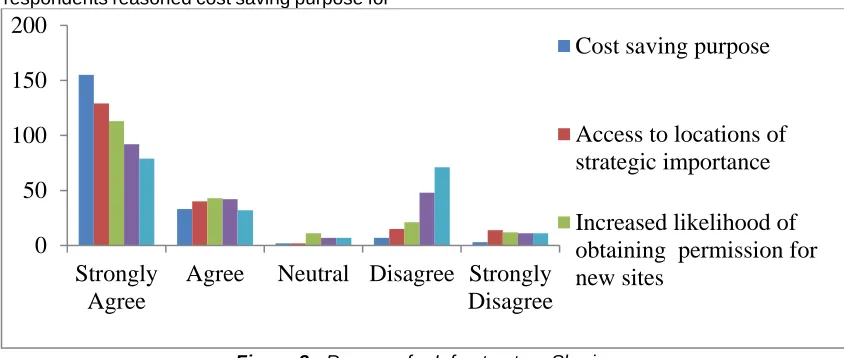
`3135 Further on being enquired about the reasons for
infrastructure sharing, the responses were widely similar. Figure visualized the responses as concentration towards the response of “strongly agrees” for every reason. Although, the maximum respondents reasoned cost saving purpose for
infrastructure sharing among Airtel, Idea and Jio. Further, the considerable number of respondents also found to be disagreeable from the reasons like increasing number of service providers or for environmental benefits.
Figure 3 : Reasons for Infrastructure Sharing
5.3. Positive and Negative Implications of Infrastructure Sharing
Administering the reliability of the sample through the knowledge and awareness of current infrastructure sharing, the sample further enquired about the possible positive and negative implications. As per the descriptive analysis of the same presented in Table 1, majority of the responses generated mean around 1 which meant sample were found strongly agreed on postulated statements. Further it can be seen that positive implications like operational expenses,
environmental contribution recorded mean between more than 2 which suggest responses were not strongly favored these benefits. On the negative impacts as well, cases of thefts, over investments and opportunity to new entrants were not admitted as strong negative implications of infrastructure sharing. From standard deviation as well, the responses received were similar around the level of 1.1 to 1.5.
Table 1 : Descriptive Analysis of Positive and Negative Implications of Infrastructure Sharing
0
50
100
150
200
Strongly
Agree
Agree
Neutral Disagree Strongly
Disagree
Cost saving purpose
Access to locations of
strategic importance
Increased likelihood of
obtaining permission for
new sites
Descriptive Statistics
Mean Std. Deviation
Benefits
Limits Duplication 1.64 1.260
Gear investment towards innovation 1.69 1.230
Reduces operational expenses 2.07 1.519
Optimization of total capital expenditure 1.78 1.338
Result in increased connectivity 1.68 1.061
Enable company to provide economical broadband services 1.41 .869
Contribute towards environment 2.38 1.350
Optimal use of spectral resources 1.62 1.078
Negative Impacts
Negative impact on competition 1.59 1.217
Give opportunities for new entrants 2.38 1.502
theft of fuel and equipment 2.10 1.484
Give rise to Scenarios of over investment 2.06 1.549
Restrictions on innovation due to agreements 1.66 1.159
Overuse of spectral resource due to large number of service providers 1.62 1.123
High risk of corrupting or illegal power use 1.82 1.172
5.4. Inferential Analysis
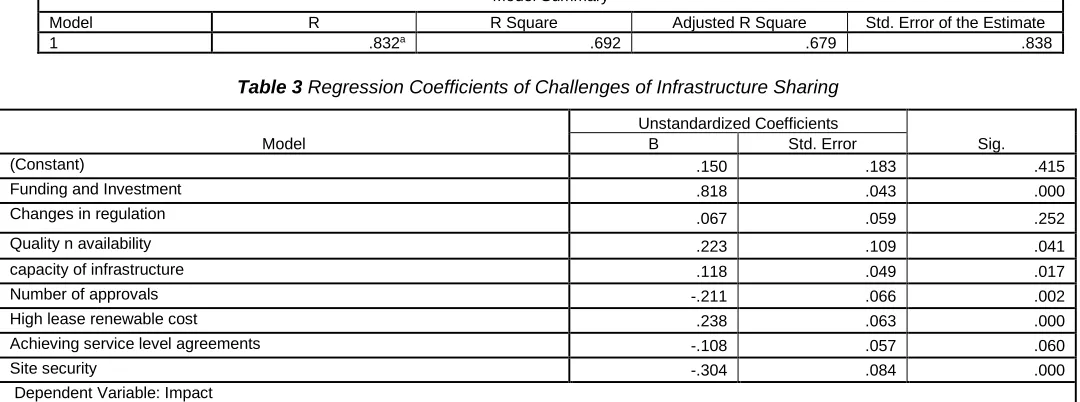
In the present case of infrastructure, the regression analysis is performed to review the impact of infrastructure sharing among Airtel, Jio and Idea cellular. Based on the literature performed, the company sharing infrastructures has to be go through the challenges as Funding’s and investments, changes in regulations, quality, availability and capacity of infrastructure, renewable costs, agreements, lease renewable cost and number of approvals for licensing. These challenges are gauged as ultimately hitting the company in
case of assets loss or increased expenses. Therefore, the regression analysis is performed to review these challenges as having positive or negative impact on companies. Firstly, model summary of the analysis is presented in Table 2. As the table shows, R square value signifying the model fitness id 0.692, which says that undertaken independent variable are responsible of 69% changes in dependent variable. Further, adjusted R square, accounting for relative impact of variables also show a value 0.679.
Table 2 Model Summary of Regression Impacts and Challenges of Infrastructure Sharing
Model Summary
Model R R Square Adjusted R Square Std. Error of the Estimate
1 .832a .692 .679 .838
Table 3 Regression Coefficients of Challenges of Infrastructure Sharing
As per the regression coefficients, challenges pertaining to funding of infrastructure sharing leads to positive impacts on the company with coefficient 0.818 signifying 80% change in total impacts. Further, quality and availability and capacity of the infrastructure too is recorded as benefiting the firm with coefficient 0.223 and 0.118, signifying 22% and 12% of change in total impact. Also, high lease renewable cost also recorded as having positive impacts on companies with
coefficient 0.238, too with significant level of less than 5%. Furthermore, for the rest of variables, number of approvals the companies are required to do, achievement of service agreements and security of infrastructure (site usually) bring overall negative impacts to the companies. Site security has recorded the highest coefficient of 0.304 with significance less than 5% (000).
Thus, as per the present analysis, infrastructure sharing brings funding ease, cost benefits and quality and availability of resources for the companies Airtel, Jio and Idea Cellular. Further, number of approvals, security of site and achieving agreements also brings difficulties and hence negatively impacts the companies. In the view of these results, Malungu & Moturi, (2015) has shown a similar outcome in his study of infrastructure sharing Kenya among Airtel, Essar and Telkom Kenya Orange, where companies found to have faced several challenges due to unwillingness of owners. The study through a survey found out that achieving service agreements due to owners unwillingness and complex procedures of approvals acted as impediments in infrastructure sharing. Another support to the present findings is given by study of Bhardwaj (Bhardwaj, 2013), where restriction on licensing in India after 2G scam of 2010 are quoted as a reason for impediments in infrastructure sharing and lost interest of companies to carry out agreements. Therefore, it has been quite clear from the analysis so far that infrastructure sharing does not necessarily associates with benefits to telecommunication companies. Hence we can reject the null hypothesis stating the negative impacts do not occur. The leading reasons observed from the present studies are the agreement among
owners and sluggish approval process of the infrastructure sharing in India.
6. CONCLUSION
It can be reported from the analysis that infrastructure sharing too involves many implications that either benefit or bring losses to the companies. The infrastructure sharing norms in telecommunications is a widely appreciated move to support environment and reduce Capital expenses. However, survey responses did not acknowledged preservation of environment as the reason behind infrastructure sharing. Further, regulatory norms and security concerns are found as major factor impacting negatively to company’s interest in infrastructure sharing. Therefore, all-inclusive findings of the study confirm the negative impacts of infrastructure sharing in telecommunications sector. Further, the present study on the basis of results can suggest the policy makers to ease the legal framework to allow more infrastructure sharing contracts. Also, as more telecommunication companies are more towards active infrastructure sharing, they can further extends the agreements towards passive sharing as well to further save the energy or space consumption.
Model
Unstandardized Coefficients
Sig.
B Std. Error
(Constant) .150 .183 .415
Funding and Investment .818 .043 .000
Changes in regulation .067 .059 .252
Quality n availability .223 .109 .041
capacity of infrastructure .118 .049 .017
Number of approvals -.211 .066 .002
High lease renewable cost .238 .063 .000
Achieving service level agreements -.108 .057 .060
Site security -.304 .084 .000
`3137
REFERENCES
[1] Akio, T. (2005). The Critical Assessment of the Resource-Based View of Strategic Management. Ritsumeikan International Affairs, 3(2005), 125–150. https://doi.org/10.1111/j.1751-9020.2011.00408.x [2] Bhardwaj, S. (2013). Infrastructure Sharing in Telecom
Industry: Growth of New Business Models & their Prospective Trends. International Journal of Research and Development - A Management Review (IJRDMR). [3] Charles B. Malungu, C. A. M. (2015). ICT Infrastructure
Sharing Framework for Developing Countries: Case of Mobile Operators in Kenya. International Journal of Applied Information System s (IJAIS), 9(No. 4), 17–24. [4] Derban, S. (2011). Telecom Infrastructure Sharing as a
Strategy for Cost Optimization and Revenue Generation. Blekinge Institute of Technology.
[5] ETTelecom. (2013). Bharti Airtel, Reliance Jio team up to share telecom infrastructure, Telecom News, ET Telecom.
[6] GSM Association. (2012). Mobile Infrastructure Sharing. GSMA White Paper, pp. 1–23.
[7] ITU. (2010). Sharing Infrastructure.
[8] Jain, R., & Avashia, V. (2011). Infrastructure Sharing ( Telecommunications ).
[9] Joji Thomas Philip. (2008). Telcos may share all infrastructure.
[10]Kostopoulos, K. (2002). The resource-based view of the firm and innovation: identification of critical linkages. European Academy of …, 47(33), 1–19.
[11]Madhani, P. M. (2010). Resource Based View (RBV) of Competitive Advantage: An Overview. Research Gate, 2(March 2010), 1–22.
[12]Malungu, C. B., & Moturi, C. A. (2017). ICT Infrastructure Sharing Framework for Developing Countries : Case of Mobile Operators in Kenya. International Journal of Applied Information Systems, 9(4), 17–24.
[13]Meddour, D. E., Rasheed, T., & Gourhant, Y. (2011). On the role of infrastructure sharing for mobile network operators in emerging markets. Computer Networks,
55(7), 1576–1591.
https://doi.org/10.1016/j.comnet.2011.01.023
[14]Namisiko, P., Sakwa, M., & Waweru, M. (2015). Effects of Network Infrastructure sharing Challenges on Open Information Communication Technology Infrastructure Sharing among Mobile Service Providers in Kenya. International Journal of Information Engineering and
Electronic Business, 7(3), 11–19.
https://doi.org/10.5815/ijieeb.2015.03.02
[15]Rogier. (2010). Infrastructure Sharing in Mobile Service Market: Investigating the final decisions of the network operators. Delft University of Technology Diploma. [16]Roson, R., & Hubert, F. (2015). Bargaining Power and
Value Sharing in Distribution Networks: A Cooperative Game Theory Approach. Networks and Spatial
Economics, 15(1), 71–87.
https://doi.org/10.1007/s11067-014-9270-6
[17]Saunders, M., Lewis, P., & Thornhill, A. (2009). Research Methods for Business Students (5th ed.). Essex, England: Pearson Education Limited.
[18]Sheng, H., & Shi, H. (2016). Research on Cost Allocation Model of Telecom Infrastructure Co-construction Based on Value Shapley Algorithm. International Journal of Future Generation
Communication and Networking, 9(7), 165–172. [19]Singhal, P. (2014). Broadband Highway : Driving India ’