Page 371
ANALYSIS OF QUALITATIVE METHODS USED IN COMPUTER AND EDUCATIONAL TECHNOLOGIES FIELD POSTGRADUATE THESIS
Nesrin Özdener Dönmez1, Aliye Saraç2, Zeynep Taçgın1 1Marmara University, Turkey
2Nişantaşı University, Turkey
Abstract
The purpose of this study is to analyze the thesis prepared in Computer and Educational Technologies field in terms of method and to determine what sort of data gathering tools were preferred and how open the method is indicated. Also, document analysis method was used in order to analyze the studies. In this context, 29 of 58 postgraduate thesis employing qualitative research have been analyzed by two researchers. Cohen’s Kappa (κ = 0.75; p= .00) coefficient was calculated for determining the coherence between the appraisals made by both researchers and coherence percentage was determined as 85%. The result of this study shows that the research methodology of qualitative thesis (16/29) has not been clearly defined. Besides, the qualitative methods are generally used to augment and verify preciseness and accuracy of quantitative information. Moreover, data gathering methods and tools of the examined qualitative thesis have been compared. Camera and audio recording are the most preferred tools. This situation could be related with the semi-structured interview ratio in these thesis. The results indicate that, the methodology of qualitative researches have to be determined correctly and precisely by researchers, Also, the data gathering methods and tools of these studies should be enhanced via their methodology.
Key words: qualitative research, methodology, data gathering tools, computer and instructional technologies
1. INTRODUCTION
Science defines the knowledge obtained through systematic ways by relying on experimentation, observation and intellect studying the universe, community and human (Büyüköztürk et al., 2014). Researchers proceed by using systematic ways in obtaining knowledge and analyze the incidents, phenomena. When the literature is analyzed it is seen that scientific studies are classified by taking different criteria as basis according to the philosophy they are based on, property of the used data, purpose of the research, experimentation-measurement conditions (Büyüköztürk et al., 2014; Fraenkel and Wallen, 2006; Karasar, 2002).
Researches are classified as quantitative, qualitative and combined researches where both are used, according to the philosophy they are based on. In quantitative researches studies are generally based on the belief that facts and emotions can be separated from each other and the world is "the only fact" which consists of the facts that can be explored while in qualitative researches it is considered that the world consist of multiple facts and different personal opinions can be present regarding the same condition and the facts are structured in social environments. (Büyüköztürk et al., 2014).
Page 372
quantitative research techniques are used and questionnaires were used as a data gathering tool preferentially in the researches made in educational technologies field between 2000-2009 in Turkey. Similarly, Doğru et al. (2012), in their studies which analyzed postgraduate and doctorate studies made in Science Education between 1990-2009, stated that researchers preferred use of experimental method generally, gather data through testing, use of single variable and parametric statistical analyses generally. Quantitative research is an approach which puts research and comprehension of the social phenomenon to forefront in the setting they are connected to, for addressing the determined problem(s) in a systematic and logical manner (Yıldırım, 2010). Creswell (1994) emphasizes that the fact is constituted by the researchers in quantitative researches and the researcher shall be in interaction with this setting while doing that. Therefore, there are significant points that the researchers shall pay attention in research process in order to put forward the fact or the studied phenomenon in a valid and reliable manner while carrying out a systematic and logical quantitative research. Yıldırım (1999) states that a systematic research means that the processes of establishment of a research method, data gathering, interpretation and coming to a conclusion complements and supports each other and indicates that a logical research means that the studies question(s) are to be answered by paying attention to validity aspect at each phase of the research in a realistic manner. However, the carried out researches indicate that both the thesis and the articles published in scientific journals cannot reach to a certain standard in terms of format, method and ethics.
Since, explanatory property of quantitative researches of educational subject is limited and is insufficient for offering significance to results and for providing practical knowledge to teachers, students and managers in the education process, it has required educational researchers to tend towards new quests. In thesis which are specific to CEIT, in which quantitative research methods of properties which can provide solution to the quest specified in this study are employed, thesis were analyzed in order to reveal the condition of the aspects which shall be taken into consideration systematically and logically. Thus, attempt was made to reveal the methods and data gathering tools preferred by researchers specialized in Information Technology field.
1.1 Purpose
The purpose of this study is to analyze the thesis prepared in Computer and Educational Technologies field in terms of method and to determine what sort of data gathering tools were preferred and how open the method is indicated. Answers are sought to the following questions within scope of the study: 1) Are research models specified in the thesis?
2) Are the research model specified in the thesis identical to the employed research model?
3) What sorts of data gathering tools are made use of in thesis which employ quantitative and combined research method?
4) Which technologies are used in data gathering process?
2. METHOD
In this study, document analysis method was used in order to analyze the studies. The purpose of this method is to analyze the texts which contain information regarding the studies phenomenon (Yıldırım ve Şimşek, 2006). Cohen’s Kappa (κ = 0.75; p= .00) coefficient was calculated for determining the coherence between the appraisals made by both researchers and coherence percentage was determined as 85%.
2.1 Data Gathering Tools
Page 373
Thesis Evaluation Form: This form was created for use in the phase of analysis of the thesis by the researchers.
a) Creation of categories: Information to be analyzed within scope of research questions is categorized. Thesis downloaded from YÖK's database are tabulated according to thesis number, type (Postgraduate, Doctorate), university, year, research method, research pattern, data gathering tools and method suggested to researchers for thesis.
b) Defining Unit of Analysis: "Method" and "Data Gathering Tool" chapters of thesis studies are analyzed within scope of the research.
c) Digitization: Thesis are grouped as quantitative (0), qualitative (1) and both (2) within this scope. Research pattern of the thesis which are considered as qualitative and both in the created table are added as specified in method section. Method and findings of these thesis were analyzed and the method which is considered to be used is defined. Additionally, data gathering tools of these thesis which are considered as qualitative and both are listed. Total usage number of the listed data gathering tools in the thesis is determined.
3. FINDINGS
According to research findings, it is specified that qualitative and combined method was used in 29 of 59 thesis open to access within the period that is in the research scope and it is seen that quantitative research methods were used in 30 thesis.
3.1 Are research models specified in the thesis?
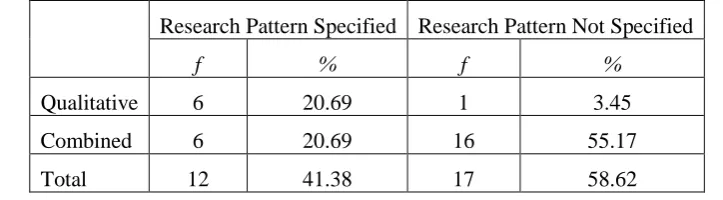
Distribution of thesis, where research pattern is specified in the method section among 29 thesis which are mentioned to utilize quantitative and combined method is as shown in Table 1.
Table 1. Distribution of thesis according to the status of specifying the research models Research Pattern Specified Research Pattern Not Specified
f % f %
Qualitative 6 20.69 1 3.45
Combined 6 20.69 16 55.17
Total 12 41.38 17 58.62
When Table 1 is analyzed it is seen that research pattern is not specified in 58.6% of the thesis. While it is expressed that qualitative research method is employed in 20.7% of the thesis, in which research pattern is specified, it is revealed that combined method was preferred in 20.7% of them.
3.2 Are the research model specified in the thesis identical to the employed research model?
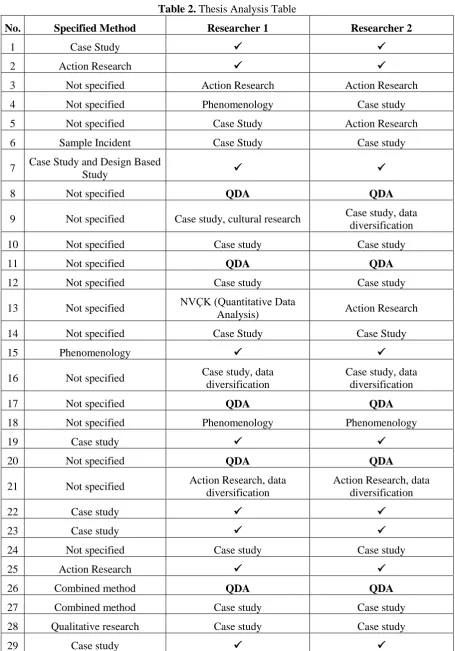
Coherence of research model specified in the thesis and the utilized research model was analyzed by both researchers. Methods specified in thesis and methods suggested by researchers for thesis are provided in Table 2. When Table 2 is analyzed it is seen that research model is not specified in 58.6% of the thesis. The most preferred research model is case study (f:5 17.24%) and it is seen that qualitative data is mostly used to support quantitative data.
Page 374
Table 2. Thesis Analysis Table
No. Specified Method Researcher 1 Researcher 2
1 Case Study
2 Action Research
3 Not specified Action Research Action Research
4 Not specified Phenomenology Case study
5 Not specified Case Study Action Research
6 Sample Incident Case Study Case study
7 Case Study and Design Based
Study
8 Not specified QDA QDA
9 Not specified Case study, cultural research Case study, data diversification
10 Not specified Case study Case study
11 Not specified QDA QDA
12 Not specified Case study Case study
13 Not specified NVÇK (Quantitative Data
Analysis) Action Research
14 Not specified Case Study Case Study
15 Phenomenology
16 Not specified Case study, data diversification
Case study, data diversification
17 Not specified QDA QDA
18 Not specified Phenomenology Phenomenology
19 Case study
20 Not specified QDA QDA
21 Not specified Action Research, data diversification
Action Research, data diversification
22 Case study
23 Case study
24 Not specified Case study Case study
25 Action Research
26 Combined method QDA QDA
27 Combined method Case study Case study
28 Qualitative research Case study Case study
29 Case study
- States that the researchers agree with the method specified in the thesis.
Page 375
3.3 What sort of data gathering tools is made use of in thesis which employ quantitative and combined research method?
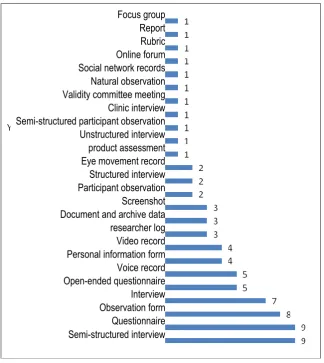
When the thesis are evaluated in terms of the utilized data gathering tools, it is seen that mostly semi-structured interview and questionnaire method was used (f:9 11.69%). While it is expressed that unstructured interview was employed in 1 thesis, it is expressed that interview was made in 8 thesis, yet, type of interview is not indicated. Methods such as focus group, rubric, report analysis, social network record, clinic interview, natural observation, product assessment etc. are the least employed methods in the studies. Figure 2 lists the data gathering methods.
Figure 1. Employed data gathering methods
3.4 Which technologies are used in data gathering process?
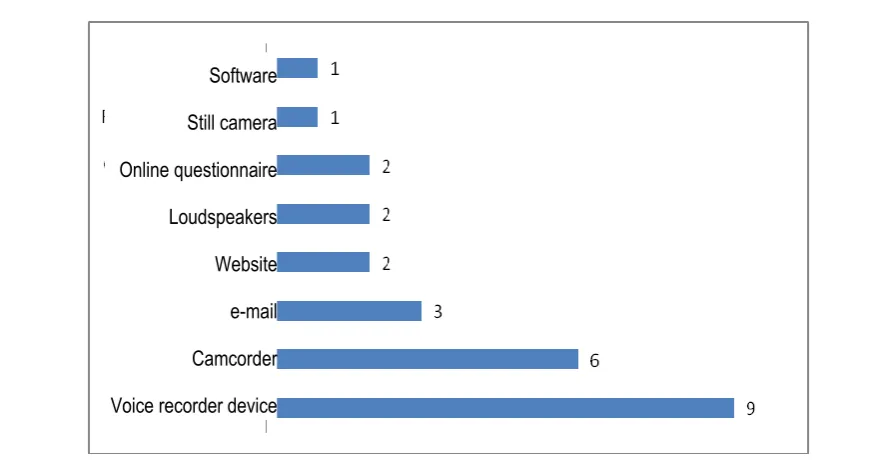
The most preferred tools in data gathering are revealed to be voice recorder device (f:9 34.62%) and camcorder (f:6 23.08%) (Table 2). High usage rate of voice recorder device can be related with the number of interviews. These tools are followed by website, loudspeaker, online questionnaire.
Focus group Report Rubric Online forum Social network records Natural observation Validity committee meeting Clinic interview Semi-structured participant observation Unstructured interview
Page 376
Figure 2. Technologies employed in data gathering
4. RESULT AND DISCUSSION
Amid the rapid rise of qualitative research to prominence in scientific communities, considerable debate has ensued regarding epistemological, philosophical, and methodological issues (Whittemore, Chase & Mandle, 2001). Qualitative research, thus, inevitably requires deeper knowledge within the domain of interest (Pham & Tacgin, 1991). That means the researchers gather detailed information about the specific area via qualitative methods.
In today’s world, current researches should provide profound information in order to create more innovative fields for researchers. This study, therefore, aims at investigating the master and doctoral studies in Computer and Education Technology (CEIT) department reported between 2010 and 2015 in Turkey. In this context, 29 of 58 postgraduate thesis employing qualitative research have been analyzed. The result of this study shows that the research methodology of qualitative thesis (16/29) has not been clearly defined. Research findings are supporting the results of the study made by Bacanak et al. in 2011, revealing that one-sixth of 173 articles did not specify method.
Besides, the qualitative methods are generally used to augment and verify preciseness and accuracy of quantitative information. For this reason, the authors focus on weakly defined researches and suggest correct methodology for them.
Therefore, majority of the investigated researches uses case study in CEIT field. However, according to Berg (2004), action research method is more suitable to the education field. Although, CEIT field consists of more practical situations so this diversification occurs naturally.
Moreover, data gathering methods and tools of the examined qualitative thesis have been compared. Camera and audio recording are the most preferred tools. This situation could be related with the semi-structured interview ratio in these thesis. In other words, interviews are recorded in order to make deeper content analysis so these methods and tools are compatible with each other. On the other side, there is no specific set of methods that a research project can use for an evaluation or a qualitative evaluation. Developing knowledge of how things work is where qualitative research comes into its own evaluation (Kelly, 2004). However, when the carried out studies are analyzed, it is observed that standard data gathering tools and techniques are utilized and these are limited with a certain number of analysis methods.
When analyzed under educational sciences, qualitative studies are becoming more important. Hence, education requires improvement of quality. On the other hand, CEIT field has a separate structure and significant since it follows up current technologies in educational sciences. Therefore, it is expected to
Software
Still camera
Online questionnaire
Loudspeakers
Website
Camcorder
Page 377
monitor reflection of current data gathering tools in CEIT field. The reason for analyzing the thesis in CEIT field within scope of this study is based on technological adaptation. However, it is seen that new technologies are not employed in research process, it is observed that current technologies such as Web of data, semantic data, virtual reality are not applied in research process or data gathering method and techniques. This draws an interesting frame that is below the expectations specific to CEIT.
The postgraduate thesis reported in the past 5 years have, therefore, been evaluated in accordance with the methodology mentioned above. The results indicate that, the methodology of qualitative researches have to be determined correctly and precisely by researchers, also, the data gathering methods and tools of these studies should be enhanced via their methodology.
Considering that the thesis discussed within scope of research are carried out in Institutes of Educational Sciences and two faculty members accompany the thesis supervisor in thesis juries, this reduces the possibility that this case is overlooked and it can be interpreted as the thesis juries do not take expression of the method explicitly into consideration. It is possible to avoid this problem by using checklists in the thesis submission process.
REFERENCES
Arık, R.S. ve Türkmen, M. (2009). Eğitim Bilimleri Alanında Yayınlanan Bilimsel Dergilerde Yer Alan Makalelerin İncelenmesi (Analysis of Articles in Scientific Journals Published in the Field of Educational Sciences). The First International Congress of Educational Research, Çanakkale http://oc.eab.org.tr/egtconf/pdfkitap/pdf/488.pdf
Bacanak,A.Değirmenci,S.,Karamustafaoğlu,S., Karamustafaoğlu,O.,(2011) E-Dergilerde Yayınlanan Fen Eğitimi Makaleleri: Yöntem Analizi (Science Education Articles Published in E-Journals: Method Analysis), Türk Fen Eğitimi Dergisi (Turkish Science Education Journal), 8(1), 119-132
Berg, B. L., Lune, H., & Lune, H. (2004). Qualitative research methods for the social sciences (Vol. 5). Boston, MA: Pearson.
Büyüköztürk, Ş., Çakmak, E. K., Akgün, Ö. E., Karadeniz, Ş., & Demirel, F. (2014). Bilimsel araştırma yöntemleri. (Scientific research methods.) 16th Edition. Ankara: Pegem Academy
Creswell, J. W. (1994). Research Design: Qualitative and Quantitative Approaches. London: SAGE Publications
Doğru,M., Gençosman, M., Ataalkın,A.N.,Şeker,F.(2012)Fen Bilimleri Eğitiminde Çalışılan Yüksek Lisans ve Doktora Tezlerinin Analizi (Analysis of Postgraduate and Doctorate Thesis Studies in Science Education), Journal of Turkish Science Education, 9(1),49-64.
Fraenkel, J. R. (8). Wallen. NE (2006). How to design and evaluate research in education. 4. Baskı, New York: Mcgraw Hill International Edition
Göktas, Y., Kucuk, S., Aydemir, M., Telli, E., Arpacık, Ö., Yıldırım, G., Reisoğlu, I.(2012), Educational Technology Research Trends in Turkey: A Content Analysis of the 2000-2009 Decade, Educational Sciences: Theory and Practice, v12 n1 p191-199
Karasar, N. (2002). Bilimsel Araştırma Yöntemi (Scientific Research Method). Ankara: Nobel Yayıncılık
Kelly, M. J. (2004). Qualitative evaluation research. Qualitative research practice, 521-535.
Özdemir, M. (2010). Nitel Veri Analizi: Sosyal Bilimlerde Yöntembilim Sorunsalı Üzerine Bir Çalışma (Quantitative Data Analysis: A Study on Methodology Problematic in Social Sciences). Eskişehir Osmangazi Üniversitesi Sosyal Bilimler Dergisi (Eskişehir Osnangazi University Journal of Social Sciences), 11(1)
Page 378
Sherman, R. R. & Webb, R. B. (1988). Qualitative research in education: An focus, in R. R. Sherman and R. B. Webb (Eds.), Qualitative research in education: Focus and methods, London: Falmer Press Whittemore, R., Chase, S. K., & Mandle, C. L. (2001). Validity in qualitative research. Qualitative health research, 11(4), 522-537.
Yıldırım, A. (1999). Nitel araştırma yöntemlerinin temel özellikleri ve eğitim araştırmalarındaki yeri ve önemi (Basic characteristics of qualitative research methods and their place and importance in educational researches). Eğitim ve Bilim (Education and Science), 23(112)
Yıldırım, A. ve Şimşek, H. (2006). Sosyal Bilimlerde Nitel Araştırma Yöntemleri (Qualitative Research Methods in Social Sciences). Ankara: Seçkin Yayınevi