Page 42
DIAGNOSTIC PRACTICES OF AUTISM SPECTRUM DISORDERS IN BRAZIL AND THEIR CONSEQUENCES FOR SPECIAL EDUCATION
Ana Claudia Vespa Mainer Dias
Centro Universitário Adventista de São Paulo (Unasp-EC), Estrada Municipal Pr Walter Boger, S/Ν, Engenheiro Coelho, SP, 13165-000, Brazil
Abstract
Students with special needs are directly affected by the results of diagnostic practices, since identifying the individuals is one of the first steps. Lack of understanding about that stage may lead to the problematic realities of underidentification or overidentification, exclusion of children who should receive that special intervention and inclusion of some who do not need them. Precision in diagnosis, that considers cultural factors, is a highly desired and continuous goal for special educators.
Through a survey instrument specifically designed for this study and responded by 236 Brazilian professionals, the purpose of this study is 1) to determine the knowledge and training of professionals that diagnose Autism Spectrum Disorder in Brazil (Audiologists, Neurologists, Pediatricians, Psychologists, Psychiatrists, and others), 2) to determine if those professionals are using diagnostic practices similar to the United States, 3) to investigate which procedures and instruments are used in the diagnosis of a child suspected of having an Autism Spectrum Disorder in Brazil; and 4) to determine what happens after diagnosis.
The results of this research suggest the need to invest in the training of professionals. Another related suggestion is to develop specific criteria and common diagnostic protocol for professionals in Brazil. Finally, providing access to inclusive education to people with autism would also provide them a more adequate opportunity for development.
Keywords:autism, diagnostic practices, special education
1. INTRODUCTION
ASD are identified by somewhat culturally-defined difficulties in social interaction, problems in verbal and nonverbal communication, and repetitive behaviors (Smith, 2004, p. 420). Those categories of symptoms are believed to be similarly present “in children across different cultures, but the meaning attributed to particular symptoms, help-seeking behavior, the degree that researchers and clinicians in different cultures follow the international diagnostic criteria, and available treatment options may vary greatly.” (Kang-Yi, Grinker, & Mandell, 2013). Grinker (2007) points out that “autism, like all disorders, does not exist outside of culture. It is culture that sees something as abnormal or wrong, names it, and does something about it, and all cultures respond to illness differently” (p. 12). Because different cultures have different expectations about child behavior, “what is considered healthy behavior in one society may be viewed as unhealthy in another,” the identification of disorders varies (Gardiner & Kosmitzki, 2008, p. 266).
Page 43
issue that has been linked to significant racial/ethnic disparities that exist in the diagnosis of ASD (Mandell et al., 2009, p. 493). Therefore, culture influences behavior expectations, and consequently, the diagnosis of autism.
While both, overidentification and underidentification, could be problematic, it seems that it is underidentification that causes more concern since it does not lead to proper care and intervention. At the core of this issue are diagnostic practices. “Programs for children in general (e.g., universal screening for autism) and programs that target traditionally underserved groups of children, their families, and their health care providers should be tested and implemented to optimize case finding of children with autism and to eliminate disparities” (Liptak et al., 2008). Paula, C. S., Ribeiro, S. H., Fombonne, E., and Mercadante, M. T. (2011) highlight the fact that the influence of cultural, ethnic, geographic and socioeconomic factors associated to Pervasive Developmental Disorders (PDD) is unclear. “Most surveys were conducted in North America, Northern Europe and Japan, and cross-national comparisons have been scarce (p. 1738).
Only recently, have researchers in Brazil begun mapping and studying the incidence of autism. There are no official statistics about the incidence of ASD in the general population in Brazil. The first study about epidemiology of Autism in Brazil was conducted in 2010 led by psychiatrist Marcos T. Mercadante in one town. His survey revealed a prevalence of one case of autism to 368 children between 7 and 12 years old (Paula et al., 2011). Another estimate dated of 2007 suggested as many as one ASD case per 190 inhabitants (Junior, 2010). Autism in Brazil seems to be following the growing trend of the West that has caused this disorder to be referred to as an epidemic and although a myriad of research studies on the disorder have been completed, ASD is far from being completely understood.
In practice, these dynamics are reflected in the differences of approach by private and public schools. In Brazil, traditionally, private schools have been better prepared to offer special education. There is no lack of critique to the inadequate public policies in the country. A recent study points out an example of a barrier to the improvement of the assistance to autist children: distribution of funds by the government to organizations without clear proposals of detailed action (Mello, Ho, Dias, & Andrade, 2013, p. 75). Costa (2013) also points to the neglect by Brazilian authorities in regard to public policies for people with autism, specialized schools, and healthcare professionals, so the population can have an early diagnostic and a treatment with efficiency and dignity (p. 72).
As Mendes (2006) points out “access to education for children with special needs has been very slowly conquered as the educational opportunities for the general population are expanded” (p. 387). Furthermore, he identifies other needs even for those who have access to special education, such as lack of qualified professionals or resources in general. Also, “there are evidences of lack of interest by the government, a tendency to privatize...and a slow evolution in the number of applications [for special education students] accepted in comparison to the existent demand” (Mendes, 2006, p. 397). According to official numbers of Brazil’s government, in 2012, private schools had a total of 178,589 special students (141,431 in exclusive classrooms or schools and 37,158 in regular classes) and public schools received a total of 641,844 special students (58,225 in exclusive classrooms or schools and 583,619 in regular classes) (Brasil tem 40,3 milhões de estudantes na rede pública, diz Censo Escolar, 2013).
Page 44
diagnostic report for admission. 52% of the institutions reported a lack of training for professionals to deal with autism, 13 institutions mentioned the need to improve access to specific vocational training for people with ASD, including professionals involved in the diagnostic process. The lack of understanding about autism and how to deal with it has led many professionals to make mistakes in their diagnosis and interventions. Among the recommendations by the researchers is the fact that, given the importance of diagnosis and the possibility of errors inherent to an incorrect diagnosis, it would be important to discover the cause of this trend and how to ensure that children with autism receive appropriate diagnosis (Mello et al., 2013).
In the Brazilian context, where autism is diagnosed outside the school system, Bragin (2011) supports the conclusions of the AMA’s survey and concludes that there is a lack of technical guidance, monitoring, and evaluation of educational programming. Jorge (2003) points out the need for more research to qualify the evaluative process in his Master’s thesis about instruments of evaluation of autistic children. Silva and Mulick (2009) discuss copying diagnostic models implemented in other countries and also highlight the large lacuna in terms of knowledge and professional empowerment in relation to diagnostic practices. “Many children, especially in Brazil, remain for many years without a diagnostic or with an inadequate diagnostic” (p. 118).
2. METHODS 2.1. Methods
This research was conducted in order to investigate the diagnosis of ASD in Brazil. The researcher utilized the descriptive method based on a quantitative non-experimental survey design. Descriptive research, widely accepted, seeks to discover a phenomenon and interpret it as accurately as possible in terms of its nature and characteristics (Certo & Bervian, 1996, p. 49). The purpose of employing this method is to describe instruments and procedures used the diagnosis of ASD in Brazil as well as the knowledge and training of professionals involved and what happens after that process. Considering the lack of research about this reality in Brazil, a descriptive research would contribute to the body of knowledge in that specific field.
2.2. Instrumentation
The survey instrument specifically designed for this study is The Autism Spectrum Disorders Assessment Survey comprised of thirteen questions (single and multiple choice items, and Likert-type items) designed to collect information in regards to demographic characteristics of the participant, description of the diagnostic team, procedures, instruments used for diagnosis, and knowledge about characteristics necessary to identify a child as having an ASD (see Appendix D).
This instrument was developed by Rudolph Bailey, Jeannie Montagano, Tevni Grajales, Brandon Tross, and Ron Coffen and has been applied to a similar study in the United States. The first nine questions were related to the professional practice of respondents. The rest of the questions were related diagnostic practice. A few adaptations were necessary. Question 1 was added to the survey in order to help describe the population with which professionals work the most. It surveys are, gender, and socioeconomic status. The researcher also added question 3 to identify which was the respondent’s professional practice. The diagnostic of ASD in Brazil is not done by a school psychologist as in the United States, but by a number of other professionals, such as Psychologists, Psychiatrists, Neurologists, and Pediatricians, as previously discussed. In question 9 the researcher used a list of instruments or measures known in Brazil. The options followed the official Protocol of the State of São Paulo for Diagnostic, Treatment, and Referral of Patients with ASD (Tamanaha et al., 2013, p. 22). Respondents had the option to mention other instruments they might use. Question 10 was added to the questionnaire. It asks about interventions recommended by those professionals and considers what happens after the diagnosis. Finally, question 13 was an addition to the survey that sought information on who referred the students to receive a diagnostic.
Page 45
and 580 by Facebook message. The survey received 236 responses from professionals from every state and the Federal District in Brazil. The anonymous nature of the survey helped to eliminate experimenter bias. Inviting professionals in every state in five different geographic regions to participate in the study allowed the result to be more generalizable to the greater population of professionals than if the participants were limited to specific predetermined regions and cities.
The researcher sent emails and Facebook messages with a link to the survey hosted online by Toluna QuickSurveys. The link directed the respondent to a cover letter and informed consent. After clicking on NEXT, the respondent is presented with the survey divided into four parts before the professional can submit his or her answers.
2.3 Data Analysis Procedures
The data collected in the quantitative approach, via online survey, were tabulated in spreadsheets and treated to enable comparisons and inferences. Figures and tables were used to present the results in a more comprehensive and meaningful way in most questions. Toluna QuickSurveys provide enough tools to select, cross, and display the information collected in the questionnaire.
3. RESULTS
Findings from the Autism Spectrum Disorders Assessment Survey with 236 respondents portrayed the current situation in Brazil. The profile of the respondents was traced in questions 2 to 5. The sample had representation from all 26 states and the federal district (Q2).
As far as professional practice (Q3), the three largest groups of respondents were Psychologists (42.80%), Audiologists (25%), and others (20,34%), which included Educational Psychologists (3.37%), Occupational Therapists (2.76%), and Neuropsychologists (0.92%) (see Figure 1). The number of years of experience of those professionals varied (Q4) as following: 164 respondents marked that their time of experience was between 1 and 10 years; 53 respondents between 11 and 20 years; and, 19 respondents more than 20 years (See Figure 2). Their experience also reflected on the number of children evaluated for possible ASD throughout their careers (Q5): 8 professionals reported between 500 and 3,500 evaluations, 34 professionals reported between 55 and 499 evaluations, 102 professionals reported between 10 and 54 evaluations, and 92 professionals reported between 0 and 9 evaluations.
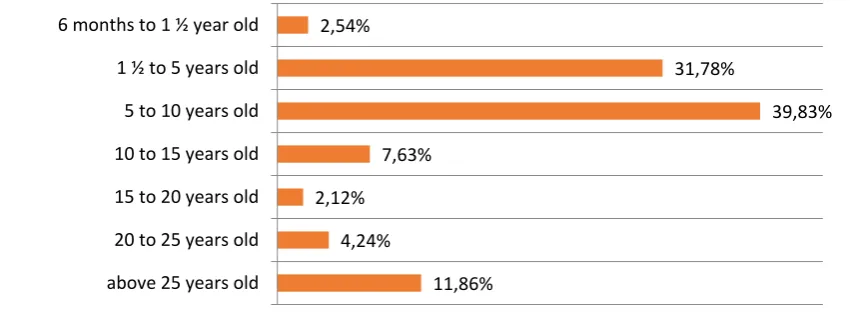
A description of the population with which professionals work the most was found in the answers to the first question (Q1). They revealed that over 70% of the children diagnosed are between ages 1.5 and 10, being the segment between 5 and 10 years old larger (1.5 to 5, 31.78%; 5 to 10, 39.83%). The next largest group is above 25 years-old (11.86%) (see Figure 1).
Figure 1. Answers to question 1a (Q1a) about the age of the population with which professionals work the most.
2,54%
31,78%
39,83%
7,63%
2,12%
4,24%
11,86% 6 months to 1 ½ year old
1 ½ to 5 years old
5 to 10 years old
10 to 15 years old
15 to 20 years old
20 to 25 years old
Page 46
The majority of these children are from the middle class (58.9%), followed by the lower class (31.78%), and the upper class (9.32%). Regarding gender, there was a higher male prevalence of approximately 3.5 to 1.
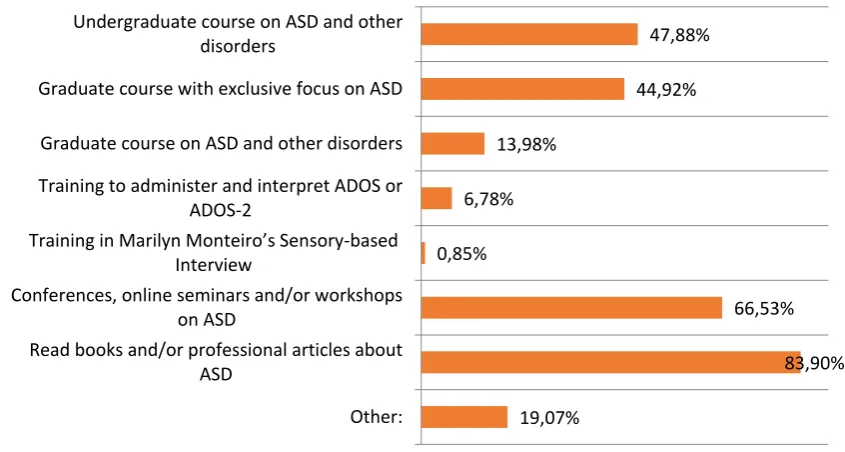
In order to determine the knowledge and training of professionals who diagnose ASD in Brazil, the answers to questions 11 (Q11) and 12 (Q12) are relevant. As far as training received by those professionals, having the option to choose more than one answer, 83.90% of respondents indicated read books and/or professional articles; 66.53% marked conferences, online seminars and/or workshops; 47.88% checked undergraduate course on ASD and other disorders; and 44.92% indicated graduate course with exclusive focus on ASD. The option other (19% of respondents) included Training to Administer ADI-R, CARS-BR, ABA, VB-MAPP, DOMAN, FLOORTIME, SON RISE, PECS, TEACCH; Specific course in the area of ASD; Practical Experience in a Specialized Clinic for Autism; Experience with Neurologists Experts in the Field of Autism; and Theoretical and Practical Course in the Association of Friends of Autistic (AMA) (see Figure 2).
Figure 2. Answers to question 11 (Q11): What training have you had in diagnosing ASD?
Question twelve (Q12) tested the professional’s understanding and knowledge by asking which characteristics are necessary to be able to identify a child as having ASD. Having the option of choosing more than one answer, 96.19% of respondents marked qualitative impairment in social interaction; 89.83% marked qualitative impairment in communication; 88.14% marked restricted, repetitive pattern of behavior or interests; 86.86% marked little to no eye contact; 74.58% marked lack of ability to initiate/maintain shared attention; 68.22% marked echolalia; 66.10% marked onset during early childhood; 56.36% marked hand flapping; and 50.85% marked does not show affection. Other answers included sensory processing disorder; lack of symbolic play; low playfulness; use the other as an object; absence of sensibility to pain; apparent auditory sensitivity; and apparent lack of modesty even after the genital stage (see Figure 3).
47,88%
44,92%
13,98%
6,78%
0,85%
66,53%
83,90%
19,07% Undergraduate course on ASD and other
disorders
Graduate course with exclusive focus on ASD
Graduate course on ASD and other disorders
Training to administer and interpret ADOS or ADOS-2
Training in Marilyn Monteiro’s Sensory-based Interview
Conferences, online seminars and/or workshops on ASD
Read books and/or professional articles about ASD
Page 47
Figure 3. Answers to question 12(Q12): Which of the following characteristics are necessary to be able to identify a child as having ASD?
3.1. Diagnostic Practices
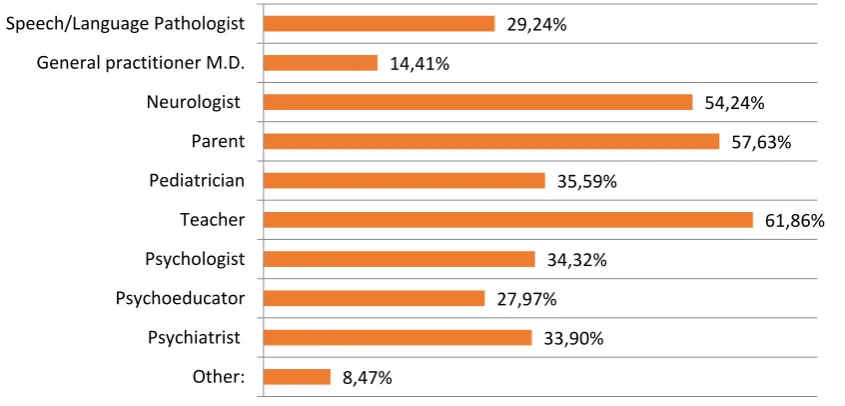
The description of ASD diagnostic practices in Brazil is related to the answers to questions 6, 7, 8, 13. Question 13 (Q13) was about who referred the student/child to those professionals. Most of the respondents (61.86%) indicated Teacher, 57.63% Parents, 54.24% Neurologist, 35.59% Pediatrician, 34.32% Psychologist, 33.90% Psychiatrist; 29.24% Speech/Language Pathologist, and 27.97% Psychoeducator, and Other (8.47%), which included Occupational Therapist, Social Workers, and Friends of Autistic Association (AMA) (see Figure 4).
Figure 4. Answers to question 13 (Q13): Who referred the students/child to you? 44,07%
50,85%
68,22%
56,36%
4,24%
74,58%
86,86%
66,10%
26,69%
88,14%
34,32%
96,19%
89,83%
11,02% Cognitive impairment
Does not show affection
Echolalia
Hand flapping
Hearing voices
Lack of ability to initiate/maintain shared attention
Little to no eye contact
Onset during early childhood
Rapid mood swings
Restricted, repetitive pattern of behavior or…
Self-injurious behavior
Qualitative impairment in social interaction
Qualitative impairment in communication
Other:
29,24%
14,41%
54,24%
57,63%
35,59%
61,86%
34,32%
27,97%
33,90%
8,47% Speech/Language Pathologist
General practitioner M.D.
Neurologist
Parent
Pediatrician
Teacher
Psychologist
Psychoeducator
Psychiatrist
Page 48
Question six (Q6) asked how long the professional spends per case when assessing for ASD. This were the answers: 17 respondents indicated that they spend less than one hour evaluating a case of ASD, 50 respondents between 1 and 2 hours, 48 respondents between 2 and 3 hours, 5 respondents between 3 and 4 hours, 27 respondents between 4 and 5 hours, 12 respondents between 5 and 6 hours, 14 respondents spend between 6 and 7 hours, 2 respondents between 7 and 8 hours, 1 respondent between 8 and 9 hours, 3 respondents between 9 and 10 hours, and 14 respondents between 10 and 11 hours evaluating an ASD case.
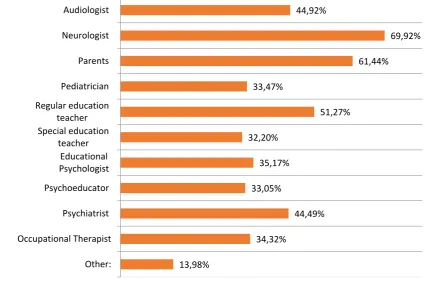
The next question (Q7) was about what professionals constitute their diagnostic team when assessing for ASD. Having the option to choose more than one answer, 69.92% reported Neurologists; 61.44% reported Parents; 51.27% reported Regular education teacher; 44.92% reported Audiologist, 44.49% reported a Psychiatrist, 35.17% reported Educational Psychologist; 33.05% reported Psychoeducator; 34.32% reported Occupational Therapist; 33.47% reported Pediatrician; 32.20% reported Special Education Teacher; and 13.98% reported other such as Psychologist and Relational Psychomotor (see Figure 5).
Figure 5. Answers to Question 7 (Q7): Which of the following constitute your diagnostic team when assessing for ASD?
Question 8 (Q8) was about procedures that professionals use in evaluating for ASD. These were the five answers with the highest percentages that respondents indicated they almost always use: general interview with parent (91.53%), achievement assessment (80.08%), developmental history interview with parent specifically looking at ASD (77.97%), receptive and expressive language assessment (77.54%), and cognitive assessment (69.07%). Other answers were marked by more than half of the respondents: adaptive behavior assessment (64.83%), pragmatic language assessment (64.83%), direct/dynamic interaction with various team members (64.83%), sensory processing assessment (60.59%), and record review (58.90%). Among the twelve options, the procedures never used by professionals with the highest percentages were classroom observations (12.29%), adaptive behavior assessment (11.44%), and interview with the teacher (9.75%) (see Figure 6).
44,92%
69,92%
61,44%
33,47%
51,27%
32,20%
35,17%
33,05%
44,49%
34,32%
13,98% Audiologist
Neurologist
Parents
Pediatrician
Regular education teacher Special education
teacher Educational Psychologist
Psychoeducator
Psychiatrist
Occupational Therapist
Page 49
Figure 6. Answers to question 8 (Q8): How often do you (or your team members) utilize the following procedures or measures in your evaluation for ASD?
3.2. Diagnostic Instruments
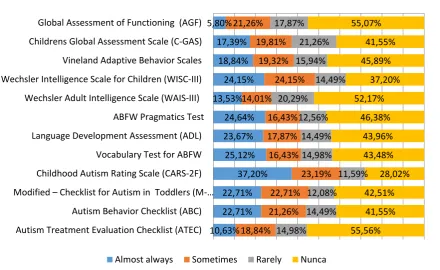
Another research interest concerns the instruments the professionals use in Brazil. Question 9 (Q9) was about that. In this case large percentages indicated that many of the instruments were never used by those professionals. More than half of respondents (55.56%) of respondents never used the Autism Treatment Evaluation Checklist (ATEC). A large percentage of respondents also never used Global Assessment of Functioning (AGF) (55.07%), Wechsler Adult Intelligence Scale (WAIS-III) (52.17%), ABFW Pragmatics Test (46.38%), Vineland Adaptive Behavior Scales (45.89%), Language Development Assessment (ADL) (43.96%), Vocabulary Test for ABFW (43.5%), Modified Checklist for Autism in Toddlers (M-CHAT) (42.51%), Childrens Global Assessment Scale (C-GAS) (41.55%), and Autism Behavior Checklist (ABC) (41.55%). The four instruments that scored highest in the almost always option was Childhood Autism Rating Scale (CARS-2F) (37.20%), Vocabulary Test for ABFW (25.12%), ABFW Pragmatics Test (24.64%), and Wechsler Intelligence Scale for Children (WISC-III) (24.15%). Other responses (29) included Psychoeducational Profile Revised (PER-R), Verbal Behavior Milestones Assessment and Placement Program (VB-MAPP), Denver Developmental Screening Test (DDST), Sensory Profile Test (Winnie Dunn), School Performance Test (TDE), Facial Recognition Test (Baron-Cohen), Diagnostic and Statistical Manual of Mental Disorders (DSM-IV) (see Figure 7).
Adaptive behavior assessment Classroom observation(s) Developmental history interview with…
Interview with teacher Receptive and expressive language…
Sensory processing assessment
Adapti ve behavi or assess ment Achiev ement assess ment Classr oom observ ation(s ) Cognit ive assess ment (Avg. 3.54) Develo pment al history intervi ew with parent , specifi cally looki… Gener al intervi ew with parent Intervi ew with teache r Pragm atic langua ge assess ment Recept ive and expres sive langua ge assess ment Recor d review Sensor y proces sing assess ment Direct /dyna mic intera ction with variou s team memb ers
Almost always64,83%60,59%58,90%77,54%64,83%42,80%91,53%77,97%69,07%48,31%80,08%64,83% Sometimes 19,49%20,34%24,15%13,56%19,07%32,63%4,66%11,02%22,46%23,73%11,02%17,80% Rarely 8,90%11,02%10,59%3,39% 8,05%14,83%0,00% 2,54% 2,12%15,68%2,54% 5,93%
Page 50
Figure 7. Answers to question 9 (Q9): How often do you (or your team members) utilize the following instruments or measures in your evaluation for ASD?
3.3. Post-diagnosis
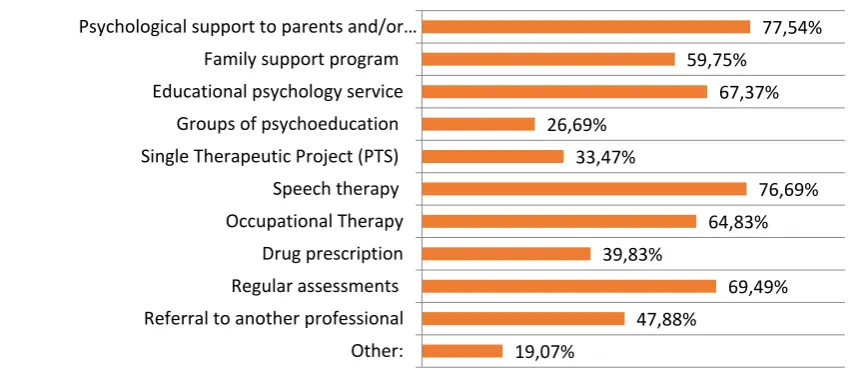
The last research question is related to question 10 (Q10), Which interventions are recommended after diagnosis. The top recommendations were Psychological support to parents and/or caregivers (77.54%), Speech therapy (76.69%), Regular assessments (69.5%), Educational psychology service (67.37%), Occupational Therapy (64.83%); Family support program (59.75%), Referral to another professional (47.88%), and Drug prescription (39.83%). Respondents also suggested others (19%) such as Applied Behavior Analysis (ABA),
Multidisciplinary team; Psychiatric care; Physical Educator; Physiotherapist; School; Specialized Treatment Education (AEE); Picture Exchange Communication System (PECS); Treatment and Education of Autistic and Related Communication-Handicapped Children (TEACHH); Relational Psychomotricity; Nutritionist; Child psychotherapy; Pediatric Neurology; Music Therapy; Special Education (see Figure 8).
5,80%
17,39%
18,84%
24,15%
13,53%
24,64%
23,67%
25,12%
37,20%
22,71%
22,71%
10,63% 21,26%
19,81%
19,32%
24,15%
14,01%
16,43%
17,87%
16,43%
23,19%
22,71%
21,26%
18,84% 17,87%
21,26%
15,94%
14,49%
20,29%
12,56%
14,49%
14,98%
11,59%
12,08%
14,49%
14,98%
55,07%
41,55%
45,89%
37,20%
52,17%
46,38%
43,96%
43,48%
28,02%
42,51%
41,55%
55,56% Global Assessment of Functioning (AGF)
Childrens Global Assessment Scale (C-GAS)
Vineland Adaptive Behavior Scales
Wechsler Intelligence Scale for Children (WISC-III)
Wechsler Adult Intelligence Scale (WAIS-III)
ABFW Pragmatics Test
Language Development Assessment (ADL)
Vocabulary Test for ABFW
Childhood Autism Rating Scale (CARS-2F)
Modified – Checklist for Autism in Toddlers (M-…
Autism Behavior Checklist (ABC)
Autism Treatment Evaluation Checklist (ATEC)
Page 51
Figure 8. Answers to question 10 (Q10): Which interventions are recommended after diagnosis?
4. DISCUSSION
4.1. Profile of Professionals
Important observations can be drawn from the responses related to the profile of professionals who diagnose ASD in Brazil (Q1, Q2, Q3, Q4, Q5). The total number of respondents was 236, being 11.86% men and 89.66% women. Although this research used a nonprobability sampling, this result is in line with the observation about the Brazilian reality. For example, the majority of Psychologists, one of the main professionals involved with diagnostic of Autism, is women (de Castro & Yamamoto, 1998, p. 155). As demonstrated in question 3 (Q3) most of the professionals who took part in the survey were Psychologists (42.80%), followed by Audiologists (25%), Psychiatrists (10.17%), and others (20.34%). This seems to reflect at least partially the reality of the diagnostic of ASD in Brazil. Unlike in the United States where Pediatricians and School Psychologists have the primary role, in Brazil Psychologists have taken that role.
More information about the profile of those professionals was gathered in question Q1a, such as the fact that most diagnostics are done with children between 5 and 10 years old (39.83%). This number is higher than the children between ages 1.5 and 5 and indicates a less-than-ideal scenario in which diagnostic is being done late, which is consistent with previous studies (Visani & Rabello, 2012, p. 293). Probably most children receive their diagnostic after they start going to school. In the United States most cases are identified between the ages 1 and 3. The next part of question 1 (Q1b) showed that most professionals (77.54%) work more with male than (22.46%). This suggests a higher incidence of ASD among boys, which is consistent with other researches (Da Costa & Nunesmaia, 1998, p. 26) and is typical in other countries, such as the United States where “the ratio is one girl per 4 to 5 boys” (Paiva, 2010). Professionals were also surveyed about the socioeconomic status of their clients (Q1c). More than half of the professionals working with a majority of children from the middle class (58.90%). Poor children are the second largest group (31.78%). This seems to reflect the current social distribution in Brazil. According to the 2010 Census, 54% of the population is part of the middle class (Censo 2010, 2010). Geographic distribution (Q2) also seemed to reflect the actual scenario. São Paulo, Paraná, Rio de Janeiro, and Minas Gerais, most represented states in the survey, have some of the largest populations. According to Brazilian Institute of Geography and Statistics (IBGE), São Paulo is the most populous state in the country, with 43.6 million inhabitants, followed by Minas Gerais with 20.5 million residents, and Rio de Janeiro with 16.3 million people (Censo 2010, 2010).
Responses to questions four (Q4) and five (Q5) indicated that most professionals who diagnose children with ASD have little experience. Of the total participants (236), 164 (69.49%) respondents
77,54% 59,75%
67,37% 26,69%
33,47%
76,69% 64,83%
39,83%
69,49% 47,88%
19,07% Psychological support to parents and/or…
Family support program Educational psychology service
Groups of psychoeducation Single Therapeutic Project (PTS) Speech therapy
Occupational Therapy Drug prescription Regular assessments
Page 52
have 10 or fewer years of experience. Furthermore, only 42 (17.8%) had diagnosed at least 55 children throughout their career (38.98% have diagnosed fewer than 10 children), which supports the understanding of diagnostic being conducted by inexperienced professionals. This reality seems to be part of a cycle that includes low levels of awareness about ASD among the population, outdated curricula in the universities, and difficult access to professionals. It also reflects the recent interest in researching ASD in Brazil.
In answering specifically the four main research questions, results of this research provide a description of the diagnostic practices of ASD in Brazil.
4.2. Knowledge and Training of Professionals
Answers about the training and knowledge of professionals who conduct diagnosis of ASD in Brazil (Q11 and Q12) seem to point to outdated university curricula. Training of those professionals in Brazil seem to come exclusively from books/articles and conferences/workshops. Less than half of the respondents indicated that they had an undergraduate or a graduate course that included ASD. The percentage of respondents that took a graduate-level class exclusively focused on ASD was approximately 14%. Very few academic programs in Brazil contemplate the reality of ASD.
Regarding the knowledge of those professionals, the survey showed a consensus around four major characteristics necessary to be able to identify a child as having ASD. More than 87% of respondents indicated impairment in social interaction, impairment in communication, restricted and repetitive pattern of behavior or interests, and little or no eye contact. Most professionals recognize the most common aspects of children with ASD.
4.3. Diagnostic Practices and Instruments
As far as diagnostic practices and tools (Q6, Q7, Q8, Q9, and Q13) the survey identified the following scenario:
Three groups of people refer children to professionals who conduct diagnostic for ASD more than half of the time (Q13): Teacher, 57.63% Parents, 54.24% Neurologist, 35.59%. Other professionals also refer abour 1/3 of the time: 35.59% Pediatrician, 34.32% Psychologist, 33.90% Psychiatrist; 29.24% Speech/Language Pathologist, and 27.97% Psychoeducator.
About 2/3 of the time, professionals spend between 1-7 hours assessing for ASD (about 42% between 1-3 hours) (Q6). At least half of the time (Q7), this process includes Neurologists, Parents, and regular education teachers, but it will most likely include also Audiologists (45%), Psychiatrist (44.5%), Educational Psychologist (35.17%), and Psychoeducator (33.05%).
More than 3/4 of the time the diagnostic of ASD in Brazil will include these procedures (Q8): General interview with parents (91.5%), developmental history interview with parent (77.97%), achievement assessment (80.08%), receptive and expressive language assessment (77.54%). More than half of time, however, it will also include adaptive behavior assessment (64.83%), pragmatic language assessment (64.83%), direct/dynamic interaction with various team members (64.83%), sensory processing assessment (60.59%), and record review (58.90%).
More than half of the time professionals will use one or more of these nine instruments (Q9): Childhood Autism Rating Scale (CARS-2F) (71.98%), Wechsler Intelligence Scale for Children (WISC-III) (63.80%), Autism Behavior Checklist (ABC) (58.45%), Children Global Assessment Scale (C-GAS) (58.45%), Modified-Checklist for Autism in Toddlers (M-CHAT) (57.49%), Vocabulary Test for ABFW (56.52%), Language Development Assessment (ADL) (56.04%), Vineland Adaptive Behavior Scales (54.11%), and ABFW Pragmatics Test (53.62%).
Page 53
Toddlers (M-CHAT) (42.51%), Childrens Global Assessment Scale (C-GAS) (41.55%), and Autism Behavior Checklist (ABC) (41.55%).
In summary, a multidisciplinary team usually does diagnosis of ASD in Brazil, in a relatively short period of time, and through a combination of various procedures and instruments. Further observations include the fact that Interview with teacher (42%) and Record Review (58.90%), as part of the diagnostic process, were expected to be almost a consensus and very low percentages for instruments ATEC and WAIS-III probably indicate that professionals are not familiar with these tools.
Among the instruments used in the United States the CARS was used more than any other rating scale in the evaluation process. Autism Diagnostic Observation Scale was used by only half of the school psychologists (Allen, Robin & Decker, 2008). Children’s Autism Rating Scale is also the most used instrument in Brazil, while ADOS is not part of the recommended protocol for the state of Sao Paulo and it was not cited even by one respondent in the other option. M-CHAT, ABC, and ATEC appear in the protocol in English. A recent survey by AMA found confusion about instruments (including DSM-IV, CID 10, M-CHAT, and CHAT) and criteria for diagnostic in their units. Almost half of the institutions indicated that they have their own method of diagnostic and 11.32% stated that they do not have any method. Among the instruments most mentioned were PEP-R (20.75%) and CARS (14.15%). Respondents also mentioned ABLLS, WISC, ABFW, AVDs, PRO-SELF, ABLA, CIF, and Vineland Scale (Mello et al., 2013, p. 52).
4.4. Post-diagnosis
The last research question related to interventions recommended after diagnosis (Q10). More than half of the time interventions will include Psychological support to parents and/or caregivers (77.54%), Speech therapy (76.69%), Regular assessments (69.5%), Educational psychology service (67.37%), Occupational Therapy (64.83%), and Family support program (59.75%). It is observable that high percentages of interventions seem to focus on the child’s family instead of to him or her. Another observation is the relatively high percentage of drug prescription (39.83%), which suggests a classical orientation to ASD intervention. The somewhat contradictory observation in this case is the fact that referral to another professional is done in less than half of the cases. According to Visani & Rabello (2012), in Brazil, early treatment of autistic children takes so late not only because of failure to achieve early detection, but also because of the delay on the part of professionals and/or health institutions to give a formal diagnosis and carry out a referral to health professionals to deal with this serious psychopathology (Visani & Rabello, 2012, p. 293).
5. CONCLUSIONS
The results of this research suggest the need to invest in the training of professionals. Helpful measures include adding specific courses on ASD at both undergraduate and graduate levels and organization of conferences for professional involved in diagnostic (pediatricians, psychiatrists), therapeutic (psychologists, speech therapists), and educational (teachers, educational psychologists) processes. Incentives for more publications on ASD should be part of these initiatives.
Another related suggestion is to develop specific criteria and common diagnostic protocol for professionals in Brazil. Ignorance about autism and how to deal with it have led many professionals involved in diagnostic and therapy to make mistakes. They do not know how to identify people with autism and what the best techniques are in those cases (Mello et al., 2013, p. 57).
Page 54
The implementation of these suggestions would still have little impact and take much longer if the government is not involved and does not support them by mobilizing the society, investing financial resources, and passing relevant legislation.
5.1. Limitations and Need for Further Study
It is evident, after this research, the need for demographic studies that provide reliable numbers about the incidence of ASD in Brazil. The low number of professionals who diagnose ASD in certain areas of the country not necessarily indicate fewer cases in those regions.
Based on the delimitations of this research, there is need for further study comparing diagnostic practices of ASD with the same process for other developmental disorders. The results would point to the general situation of special education in Brazil and to possible ways to improve awareness, training, and practices related to ASD.
It would also be important to develop studies to show the relation between diagnostics and interventions. It should consider practices and outcomes from both positive and negative views. Studies on children who are not diagnosed would also provide important information.
Finally, a delimitation of this research was the professionals in Brazil. Further study should be conducted comparing their practices with those of professionals in other countries especially in the United States. Since professionals in Brazil seem to rely on the same instruments for diagnosis of ASD, that study could reveal the degree of contextualization in their practices.
Silva and Mulick (2009) believe that it is necessary that models for the diagnostic practice, that have shown to be efficient and adequate in other countries, be included in the discussions among educators (p. 118). However, a step further seems to be necessary. Although the instruments of diagnosis translated and adapted to the Brazilian context seem appropriate to identify childhood autism, they are still based on the American society. Their use of an instrument “globally accepted” allows for more exchange of information between centers of research (Pereira, Riesgo, & Wagner, 2008, p. 488) but does not take into consideration the relevance of local cultural values.
This research may seem like a “drop in the ocean” in terms of research needs in Brazil. However, if professionals want to make a significant contribution to the treatment of ASD, the first step seems to be a collection of drops in the “research bucket” that will survey the reality and point to new and improved ways as awareness brings development.
REFERENCES
1. Allen, R. A., Robins, D. L., & Decker, S. L. (2008). Autism Spectrum Disorders: Neurobiology and current assessment practices. Psychology in the Schools, 45(10), 905-917.
2. Brasil tem 40,3 milhões de estudantes na rede pública, diz Censo Escolar. (2013). Retrieved from http://g1.globo.com/educacao/noticia/2013/09/brasil-tem-403-milhoes-de-estudantes-na-rede-publica-diz-censo-escolar.html.
3. Certo, A. L. & Bervian, P. A. (1996). Metodologia científica. São Paulo, BR: Makron Books. 4. Da Costa, M. I. F. & Nunesmaia, H. D. S. (1998). Diagnóstico genético e clínico do Autismo
infantil. Arq Neuropsiquiatr, 56(1), 24-31.
5. Gardiner, H. W. & Kosmitzki, C. (2008). Lives across cultures: Cross-cultural human development (4th ed.). Boston, MA: Pearson Allyn and Bacon.
6. Grinker, R. R. (2007). Unstrange minds: Remapping the world of Autism. New York, NY: Basic Books.
Page 55
8. Liptak, G. S., Benzoni, L. B., Mruzek, D. W., Nolan, K. W., Thingvoll, M. A., ... & Fryer, G. E. (2008). Disparities in diagnosis and access to health services for children with Autism: Data from the National Survey of Children's Health. [Research Support, Non-U.S. Gov't]. J Dev Behav Pediatr, 29(3), 152-160.
9. Mandell, D. S., Wiggins, L. D., Yeargin-Allsopp, M., Carpenter, L. A., Daniels, J., . . . Kirby, R. S. (2009). Racial/ethnic disparities in the identification of children with Autism Spectrum Disorders. American Journal of Public Health, 99(3), 493-498.
10. Mello, A. M. (2005). Autismo: Guia prático. São Paulo, SP: AMA - Associação de Amigos do Autista, Brasília.
11. Mello, A. M., Ho, H., Dias, I., & Andrade, M. (2013). Retratos do Autismo no Brasil (1ª ed.). São Paulo, SP: AMA - Associação de Amigos do Autista.
12. Paiva, J. (2010). Impressive number: One per 110 children has Autism. Revista Autimo, 73. 13. Paula, C. S., Ribeiro, S. H., Fombonne, E., & Mercadante, M. T. (2011). Brief Report: Prevalence
of Pervasive Developmental Disorder in Brazil: A Pilot Study. Journal of Autism and Developmental Disorders, 41(12), 1738-1742.
14. Pereira, A., Riesgo, R. S., & Wagner, M. B. (2008). Autismo infantil: Tradução e validação da Childhood Autism Rating Scale para uso no Brasil. Jornal de Pediatria, 1678-4782. Retrieved from http://dx.doi.org/10.1590/S0021-75572008000700004.
15. Silva, M. & Mulick, J. A. (2009). Diagnosing autistic disorder: Fundamental aspects and practical considerations. Psicologia: ciência e profissão, 29(1), 116-131.
16. Smith, D. (2004). Introduction to special education: Teaching in an age of opportunity (5th ed.). Boston, MA: Pearson.
17. Smith, D. & Tyler, N. (2010). Introduction to special education: Making a difference (7th ed.). Upper Saddle River, NJ: Merrill.
18. Tamanaha, A. C., Martins, A. C. P., Maia, A. K., Paula, C. S., Bordini, D., . . . Ribeiro, T. C. (2013). Protocolo do Estado de São Paulo de Diagnóstico Tratamento e Encaminhamento de Pacientes com Transtorno do Espectro Autista (TEA). São Paulo, SP: SEDPcD Retrieved from http://www.pessoacomdeficiencia.sp.gov.br.