R E S E A R C H
Open Access
BRCA mutation screening and patterns
among high-risk Lebanese subjects
Chantal Farra
1, Christelle Dagher
2, Rebecca Badra
1, Miza Salim Hammoud
2, Raafat Alameddine
2, Johnny Awwad
3,
Muhieddine Seoud
3, Jaber Abbas
4, Fouad Boulos
1, Nagi El Saghir
2and Deborah Mukherji
2*Abstract
Background:Previous studies have suggested that the prevalence ofBRCA1and2mutations in the Lebanese
population is low despite the observation that the median age of breast cancer diagnosis is significantly lower than European and North American populations. We aimed at reviewing the rates and patterns ofBRCA1/2mutations found in individuals referred to the medical genetics unit at the American University of Beirut. We also evaluated the performance of clinical prediction tools.
Methods:We retrospectively reviewed the cases of all individuals undergoingBRCAmutation testing from April 2011 to May 2016. To put our findings in to context, we conducted a literature review of the most recently published data from the region.
Results:Two-hundred eighty one individuals were referred for testing. The prevalence of mutatedBRCA1or2genes were 6 and 1.4% respectively. Three mutations accounted for 54% of the pathogenic mutations found. TheBRCA1c. 131G > T mutation was found among 5/17 (29%) unrelated subjects withBRCA1mutation and is unique to the Lebanese and Palestinian populations. For patients tested between 2014 and 2016, all patients positive for mutations fit the NCCN guidelines forBRCAmutation screening. The Manchester Score failed to predict pathogenic mutations.
Conclusion:TheBRCA1c.131G > T mutation can be considered a founder mutation in the Lebanese population detected among 5/17 (29%) of individuals diagnosed with a mutation inBRCA1and among 7/269 families in this cohort. On review of recently published data regarding the landscape ofBRCAmutations in the Middle East and North Africa, each region appears to have a unique spectrum of mutations.
Keywords:BRCA1, BRCA2, Manchester score, Familial, Lebanon
Background
Germline mutations in BRCA1 and BRCA2 genes have important implications for treatment of patients diag-nosed with breast or ovarian cancers as well as unaffected carriers of these mutations. Various guidelines have been established to guide physicians as to which patients should be referred for germline genetic testing. The National Comprehensive Cancer Network (NCCN) guidelines which are developed in the United Sates are freely avail-able to practitioners worldwide and include broad guide-lines for mutation testing based on clinical criteria without a calculation of expected mutation frequency.
A number of on-line calculators for risk of mutation assessment, based on clinical data are also available and largely used by clinical genetics specialists. The Manchester Score is a simple scoring system using basic clinical data that has been validated in several European populations to estimate an individual’s mutation risk and determine eligibility for genetic screening.
Patients with breast cancer in the Middle East, par-ticularly in Lebanon, tend to present at a younger age with a median of 50 years compared with the median age at diagnosis of 63 years in Europe and North America [1]. In Lebanon, the prevalence ofBRCA muta-tion were reported to be 5.7% among a cohort of pa-tients with breast cancer meeting high-risk criteria [2]. In another study, it was found that 12.5% of referred
* Correspondence:[email protected]
2Division of Hematology-Oncology, Department of Internal Medicine,
American University of Beirut Medical Center, Beirut, Lebanon Full list of author information is available at the end of the article
subjects had deleterious BRCA mutation in a cohort of high risk individuals referred for genetic testing [3].
In order to further explore the landscape of BRCA mutations in the Lebanese population, we have reviewed all cases referred forBRCAmutation testing at the Ameri-can University of Beirut Medical Center (AUBMC), the largest tertiary referral center in the country. We also aimed at addressing the practice of referral for genetic testing and establishing whether clinician-friendly risk prediction models or guidelines could be helpful in identi-fying individuals meeting high-risk criteria in our popula-tion lacking access to genetic counselors [4], specifically the Manchester Score and NCCN guidelines.
Methods
After Institutional Review Board (IRB) approval, we retro-spectively reviewed the cases of all individuals referred for
BRCA mutation testing at the Medical Genetics Unit of AUBMC from April 2011 to May 2016. Data regarding family history and the frequency and characteristics of Table 1Manchester Score
Cancer Gender Age at diagnosis Score
Breast Cancer Female < 30 11
Breast Cancer Female 30–39 8
Breast Cancer Female 40–49 6
Breast Cancer Female 50–59 4
Breast Cancer Female > 59 2
Breast Cancer Male < 60 13
Breast Cancer Male > 59 10
Ovarian Cancer Female < 60 13
Ovarian Cancer Female > 59 10
Pancreatic Cancer Both 1
Prostate Cancer Male < 60 2
Prostate Cancer Male > 59 1
Table 2Characteristics of patients
Variable Number/Percentage
Number of patients 281
Number of Families 269
Age (mean, years) 47.86 (15–86)
Positive first-degree family history for Breast and/or Ovarian cancer
165
Positive personal history for Breast and/or Ovarian
208
Breast cancer only 194
Ovarian cancer only 12
Both ovarian and breast cancer 2
Mean age of BC diagnosis (years) 47.71
Families carriers of Deleterious Mutation 10
Table 3BRCA1gene mutation and VUS identified in our cohort
Nucleotide Change
AA Change Nomenclature
Protein
Number of families with history of mutation
Deleterious
c.131G > T p.Cys44Phe C44F 7
c.3436_3439delTGTT p.Cys1146Leufs 3555del4 5
c.2158G > T p.Glu720Ter E720X 3
c.3679C > T p.Gln1227Ter Q1227X 1
c.679G > T p.Glu227Ter E227X 2
c.3381 T > G p.Tyr1127Ter Y1127X 3
c.4096 + 1G > A IVS11 + 1G > A 1
c.1039_1040delCT p.Leu347Valfs 1158_1159delCT 1
VUS
c.536A > G p.Tyr179Cys Y179C
c.1456 T > C p.Phe486Leu F486 L 4
c.1648A > C p.Asn550His N550H
c.804C > G p.Asn268Lys N268K 2
c.3526G > A p.Val1176Ile V1176I 1
c.107C > A p.Ser36Tyr S36Y 1
c.4132G > A p.Val1378Ile V1378I 2
c.3956G > T p.Gly1319Val G1319 V 1
c.2617 T > C p.Ser873Pro S873P 1
c.488G > C p.Arg163Thr R163T 1
c.346G > A p.Glu116Lys E116K 1
c.1717_1717delT p.Ser573HisFsX 1863delT 1
Table 4BRCA2gene mutation and VUS identified in our cohort
Nucleotide Change
AA Change Nomenclature
Protein
Number of families with history of mutation
Deleterious
c.9257-1G > A IVS24-1G > A 3
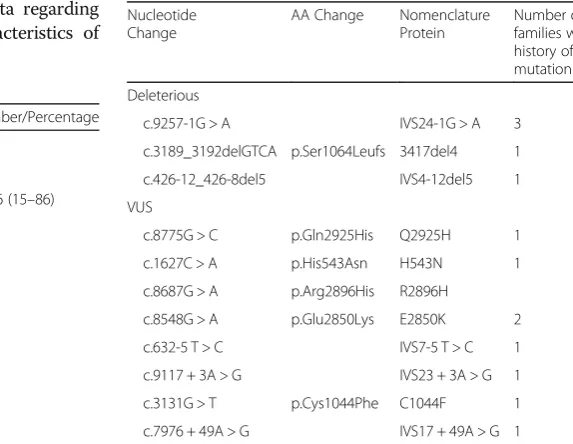
c.3189_3192delGTCA p.Ser1064Leufs 3417del4 1
c.426-12_426-8del5 IVS4-12del5 1
VUS
c.8775G > C p.Gln2925His Q2925H 1
c.1627C > A p.His543Asn H543N 1
c.8687G > A p.Arg2896His R2896H
c.8548G > A p.Glu2850Lys E2850K 2
c.632-5 T > C IVS7-5 T > C 1
c.9117 + 3A > G IVS23 + 3A > G 1
c.3131G > T p.Cys1044Phe C1044F 1
BRCA variants were collected from medical charts in order to calculate the Manchester score for this co-hort (Table 1) [5]. Receiver Operating Characteristics (ROC) analysis was used to determine the predictive performance of the scoring system to identify those at risk of harboring a pathogenic mutation. Criteria for genetic risk evaluation according to NCCN guidelines were taken from NCCN guidelines version 1.2017 (www.nccn.org).
To put our findings in the context of the landscape of
BRCA mutations in the wider Middle East, we con-ducted a literature review of the most recently published data from the region.
BRCA1andBRCA2analysis
Blood samples were collected in ethylenediaminetetra-acetic acid (EDTA) tubes, DNA extraction was per-formed using QiaAmp DNA Mini kit (Qiagen). Amplification of the target genes (BRCA1 and BRCA2) was performed by polymerase chain reaction (PCR) with specific primers designed through Primer 3 [6]. Ampli-fied sequences were visualized on agarose gel 2% to check the efficiency of the PCR. The amplicons were then purified, sequenced and loaded on the Genetic Analyzer (Applied Biosystem ABI 3500). Obtained sequences were analyzed using Seqscape® v2.7 software and compared to the corresponding reference sequences (BRCA1: ncbi RefSeq NM_007294; BRCA2: ncbi RefSeq NM_000059.3). The significance of each variant found was determined referring to Clinvar database [7].
Results
Patients and disease characteristics
We reviewed the results of 281 individuals from 269 families of whom 12 subjects were known to carry a spe-cific mutation diagnosed in an outside laboratory. 97.5% were females and 2.5% were males. The mean age of the cohort was 47.9 years (range 15–86), 208 (74.02%) patients were diagnosed to have breast (194) or ovarian (12) cancer with 2 patients presenting with both simul-taneously. The mean age of patients with a diagnosis of breast cancer was 47.7 years (Table 2). Of the families
Fig. 1Performance of Manchester score in predicting likelihood of BRCAmutation: The area under the ROC curve of 0.494 (95% CI 0.349–0.639)
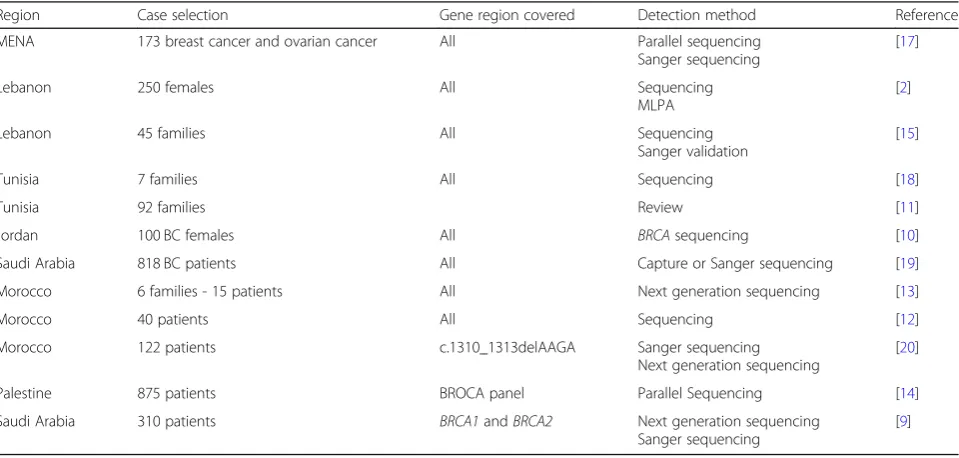
Table 5Studies examiningBRCA1&2mutations in Middle East and North Africa region from 2015 to 2018
Region Case selection Gene region covered Detection method Reference
MENA 173 breast cancer and ovarian cancer All Parallel sequencing
Sanger sequencing
[17]
Lebanon 250 females All Sequencing
MLPA
[2]
Lebanon 45 families All Sequencing
Sanger validation
[15]
Tunisia 7 families All Sequencing [18]
Tunisia 92 families Review [11]
Jordan 100 BC females All BRCAsequencing [10]
Saudi Arabia 818 BC patients All Capture or Sanger sequencing [19]
Morocco 6 families - 15 patients All Next generation sequencing [13]
Morocco 40 patients All Sequencing [12]
Morocco 122 patients c.1310_1313delAAGA Sanger sequencing
Next generation sequencing
[20]
Palestine 875 patients BROCA panel Parallel Sequencing [14]
Saudi Arabia 310 patients BRCA1andBRCA2 Next generation sequencing
Sanger sequencing
referred because of a known mutation six out of twenty five (24%) of subjects were found to be positive for the specific mutation (Tables3and4).
Mutations
In this cohort of 281 patients referred for BRCAtesting at AUBMC, we found 17 patients with BRCA1 muta-tions and 4 patients with BRCA2 mutations, as seen in Table 3 and Table 4. Three common mutations (two
BRCA1 and one BRCA2) accounted for 54% of the pathogenic mutations found in this cohort.
The most common BRCA1 mutation, c.131G > T was found in 5 patients and is carried by 7 Lebanese families (2 patients with family history positive of the c.131G > T mutation were found to be negative for the mutation).
BRCA1 3555del4 mutation was also common, found in 4 patients and carried by 5 families. BRCA1 E720X (c.2158G > T), ranked third in frequency and was present in 2 patient and found in 3 families (Table 3). In the
BRCA2 gene, the mutation IVS24-1G > A, was found in 2 patients and carried by 3 families (Table4.) A number of Variant of Undetermined Significance (VUS) were identified inBRCA1and2(Tables3and4).
NCCN guidelines and Manchester scores
For the cohort of patients tested between 2014 and 2016 detailed family history was available. All patients positive for BRCA1 or 2 mutations fit the NCCN guidelines for
BRCAmutation screening. The Manchester Score for all tested individuals was calculated, it did not discriminate between positive and negative BRCA mutation test re-sults in this cohort with the area under the ROC curve of 0.494 (95% CI 0.349–0.639). Mean Manchester Score in patients negative for aBRCAmutation was 12.15 and that of patients positive for BRCA 1/2 mutations was 11.63 (Fig.1).
Literature review ofBRCAmutations in the MENA region
In order to put our data in to context, we reviewed the spectrum of mutations reported in the Middle East and North Africa (MENA) region, updating a previous re-view published in 2015 [8].
Studies conducted in the MENA region in the past 3 years have reported a number of new mutations espe-cially in Moroccan, Tunisian, Jordanian and Lebanese families. The most common mutations found in the MENA region are included in the Tables5and6below.
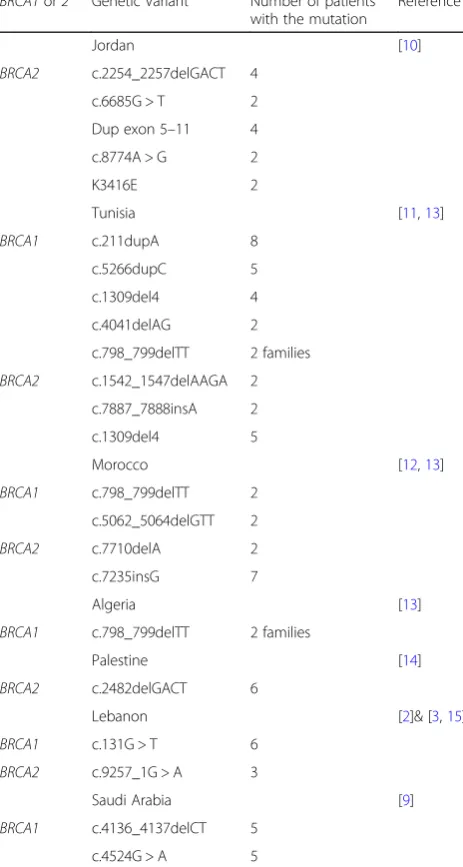
In Saudi Arabia, the BRCA1 c.4136_4137delCT and c.4524G > A were identified as the two most common mutations each found in 5 patients out of 310 enrolled in the study, accounting for 30.4% of the total BRCA mutations found in the cohort tested [9]. In Jordan, the
BRCA2 c.2254_2257delGACT and Dup exon 5–11 were the 2 most common mutations each found in 4 patients
out of 100 females enrolled in the study, accounting for 40% of patients presenting with the BRCA muta-tion [10, 11]. In Tunisia, the c.211dupA was the most common mutation found in 8 patients out of 92 from unrelated families, 29.6% of all the BRCA mutations found in this study [11]. In Morocco, several muta-tions were found, the most common being the c.7235insG in 2 different patients out of 40 study par-ticipants, 18.2% of the BRCA mutation carriers [12] . The BRCA1 c.798_799delTT was a common mutation in North Africa [13], however this has not been iden-tified in studies conducted in the Middle East, namely Lebanon, Jordan or Palestine. This mutation is the only one found in several countries in the MENA re-gion, all the other new mutations were exclusive to
Table 6Common genetic variant in the MENA region
BRCA1or2 Genetic Variant Number of patients
with the mutation
Reference
Jordan [10]
BRCA2 c.2254_2257delGACT 4
c.6685G > T 2
Dup exon 5–11 4
c.8774A > G 2
K3416E 2
Tunisia [11,13]
BRCA1 c.211dupA 8
c.5266dupC 5
c.1309del4 4
c.4041delAG 2
c.798_799delTT 2 families
BRCA2 c.1542_1547delAAGA 2
c.7887_7888insA 2
c.1309del4 5
Morocco [12,13]
BRCA1 c.798_799delTT 2
c.5062_5064delGTT 2
BRCA2 c.7710delA 2
c.7235insG 7
Algeria [13]
BRCA1 c.798_799delTT 2 families
Palestine [14]
BRCA2 c.2482delGACT 6
Lebanon [2]& [3,15]
BRCA1 c.131G > T 6
BRCA2 c.9257_1G > A 3
Saudi Arabia [9]
BRCA1 c.4136_4137delCT 5
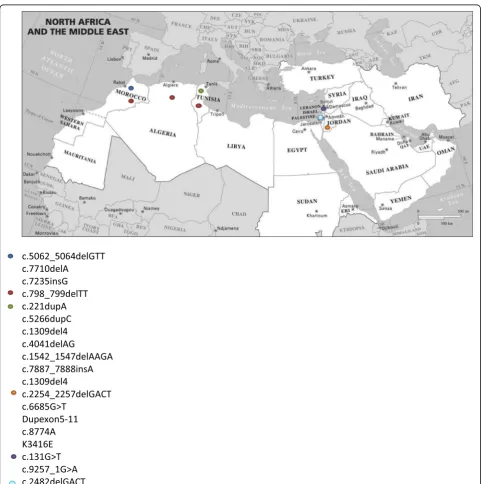
one country with the exception of the c.131G > T found in Lebanon and in one Palestinian patient [14] (Fig. 2).
Discussion
In a population of high-risk individuals referred for gen-etic testing at our institution, the prevalence ofBRCA1/
2 mutation was 7.8%. A c.131G > T mutation was de-tected among 5/17 (28%) of individuals found to have a mutation inBRCA1and among 7/28 (25%) families. The c.131G > T mutation has only recently been classified as
pathogenic [7] and can be considered as a founder mutation in the Lebanese population. It is present in a relatively large number of families in our study and has previously identified in other studies conducted in Lebanon [2, 3, 15], and in a study conducted in Palesti-nians [14]. All individuals referred for genetic testing fit the broad NCCN guidelines however in a resource-limited health-care system where genetic testing is not usually covered by third-party payers, as is the situation in Lebanon and many other countries, identifying the indi-viduals at highest risk for priority testing is desirable. The
BRCA1 c.131G > T and c.3436_3439delTGTT along with theBRCA2mutations account for 54% of the totalBRCA mutations found in our cohort. In a resource limited en-vironment, if the frequency of these mutations is validated in larger studies we could consider a cost-effective tar-geted screening test for these 3 common mutations as had been proposed in an Italian population harboring a founder mutation [16].
The Lebanese population has limited access to clinical genetics specialists and information regarding genetic testing is usually delivered by other health-care profes-sionals such as oncologists [4]. The Manchester Score is a simple and accessible scoring system that has been used in Europe to identify individuals at high risk of har-boring a BRCA mutation but has not been validated in the Middle Eastern population were the median age of diagnosis of breast cancer is significantly lower. In this cohort the Manchester score failed to discriminate be-tween positive and negative tests. One of the limitations of this study is the size of the cohort and low absolute number of individuals tested and mutations identified. Another limitation is the retrospective nature of the data collection, although patients were prospectively assessed by a clinical geneticist at the time of testing. The rela-tively low rate of mutations in the BRCA1 and 2 genes in this high-risk population with breast cancer diagnosed in the relatively young, suggests that mutations in other genes may be prevalent.
To give a broader perspective on our results, we reviewed the reported mutations in the MENA region (Tables5and6, Fig.2). The founder mutation identified in our cohort seems to be unique to the Lebanese/Pales-tinian populations. An interesting finding is the mutual exclusivity of reported founder mutations in each of the countries in the region, with the exception of theBRCA1 c.798_799delTT identified in several North African populations.
Conclusion
In a cohort of high-risk Lebanese individuals referred for genetic testing, pathogenic BRCA1/2 mutations were detected in 7.8%. While all subjects fit current NCCN guidelines for testing, the Manchester score failed to discriminate between those with positive and negative test results in this study. TheBRCA1mutation c.131G > T was detected among 5/17 (29%) of individ-uals found to have a pathogenic BRCA1 mutation in the cohort and can be considered a founder mutation in the Lebanese population. On review of recently pub-lished data regarding the landscape of BRCAmutations in the MENA, each region appears to have a unique spectrum of mutations. Further investigation of other genes involved in young-onset and familial breast can-cer in Lebanon are ongoing.
Abbreviations
AUBMC:American University of Beirut Medical Center;
EDTA: Ethylenediaminetetraacetic acid; IRB: Institutional review board; MENA: Middle East and North Africa; NCCN: National comprehensive cancer network; PCR: Polymerase chain reaction; ROC: Receiver operating characteristics; VUS: Variant of undetermined significance
Acknowledgements
Not applicable.
Funding
No funding was required for this study.
Availability of data and materials
The datasets used and/or analysed during the current study are available from the corresponding author on reasonable request.
Authors’contributions
All authors read and approved the final manuscript.
Ethics approval and consent to participate
The Institutional Review Board (IRB) of the American University of Beirut Medical Center has approved this research. Due to the retrospective nature of data collection, a waiver of written consent was granted.
Consent for publication
Not applicable.
Competing interests
The authors declare that they have no competing interests.
Publisher’s Note
Springer Nature remains neutral with regard to jurisdictional claims in published maps and institutional affiliations.
Author details
1Medical Genetics Unit and Department of Pathology and Laboratory
Medicine, American University of Beirut Medical Center, Beirut, Lebanon. 2Division of Hematology-Oncology, Department of Internal Medicine,
American University of Beirut Medical Center, Beirut, Lebanon.3Department of Obstetrics and Gynecology, American University of Beirut Medical Center, Beirut, Lebanon.4Department of Surgery, American University of Beirut Medical Center, Beirut, Lebanon.
Received: 18 October 2018 Accepted: 15 January 2019
References
1. El Saghir NS, Khalil MK, Eid T, El Kinge AR, Charafeddine M, Geara F, Seoud M, Shamseddine AI. Trends in epidemiology and management of breast cancer in developing Arab countries: a literature and registry analysis. Int J Surg. 2007;5(4):225–33.https://doi.org/10.1016/j.ijsu.2006.06.015. 2. El Saghir NS, Zgheib NK, Assi HA, Khoury KE, Bidet Y, Jaber SM, Charara RN,
Farhat RA, Kreidieh FY, Decousus S, Romero P, Nemer GM, Salem Z, Shamseddine A, Tfayli A, Abbas J, Jamali F, Seoud M, Armstrong DK, Bignon YJ, Uhrhammer N. BRCA1 and BRCA2 mutations in ethnic Lebanese Arab women with high hereditary risk breast cancer. Oncologist. 2015;20(4):357– 64.https://doi.org/10.1634/theoncologist.2014-0364.
3. Jalkh N, Nassar-Slaba J, Chouery E, Salem N, Uhrchammer N, Golmard L, Stoppa-Lyonnet D, Bignon YJ, Megarbane A. Prevalance of BRCA1 and BRCA2 mutations in familial breast cancer patients in Lebanon. Hered Cancer Clin Pract. 2012;10(1):7.https://doi.org/10.1186/1897-4287-10-7. 4. Saroufim R, Daouk S, Abou Dalle I, Kreidieh F, Bidet Y, El Saghir N. 1411P
genetic counseling, screening and risk reducing practices in patients with BRCA mutations. Ann Oncol. 2017;28(suppl_5).https://doi.org/10.1093/ annonc/mdx383.007.
6. Untergasser A, Cutcutache I, koressaar T, Ye J, Faircloth BC, Remm M, Rozen SG (2012) Primer3 - new capabilities and interfaces.
7. ClinVar.https://www.ncbi.nlm.nih.gov/clinvar/. Accessed spetember 2018. 8. Laraqui A, Uhrhammer N, Rhaffouli HE, Sekhsokh Y, Lahlou-Amine I, Bajjou T,
Hilali F, El Baghdadi J, Al Bouzidi A, Bakri Y, Amzazi S, Bignon YJ. BRCA genetic screening in middle eastern and north African: mutational spectrum and founder BRCA1 mutation (c.798_799delTT) in north African. Dis Markers. 2015, 2015:194293.https://doi.org/10.1155/2015/194293.
9. Abulkhair O, Al Balwi M, Makram O, Alsubaie L, Faris M, Shehata H, Hashim A, Arun B, Saadeddin A, Ibrahim E. Prevalence of BRCA1 and BRCA2 mutations among high-risk Saudi patients with breast Cancer. J Glob Oncol. 2018;(4):1–9.https://doi.org/10.1200/JGO.18.00066.
10. Abdel-Razeq H, Al-Omari A, Zahran F, Arun B. Germline BRCA1/BRCA2 mutations among high risk breast cancer patients in Jordan. BMC Cancer. 2018;18(1):152.https://doi.org/10.1186/s12885-018-4079-1.
11. Riahi A, Ghourabi ME, Fourati A, Chaabouni-Bouhamed H. Family history predictors of BRCA1/BRCA2 mutation status among Tunisian breast/ovarian cancer families. Breast Cancer. 2017;24(2):238–44.https://doi.org/10.1007/ s12282-016-0693-4.
12. Jouhadi H, Tazzite A, Azeddoug H, Naim A, Nadifi S, Benider A. Clinical and pathological features of BRCA1/2 tumors in a sample of high-risk Moroccan breast cancer patients. BMC Res Notes. 2016;9:248.https://doi.org/10.1186/ s13104-016-2057-8.
13. Jouali F, Laarabi FZ, Marchoudi N, Ratbi I, Elalaoui SC, Rhaissi H, Fekkak J, Sefiani A. First application of next-generation sequencing in Moroccan breast/ovarian cancer families and report of a novel frameshift mutation of the BRCA1 gene. Oncol Lett. 2016;12(2):1192–6.https://doi.org/10.3892/ol. 2016.4739.
14. Lolas Hamameh S, Renbaum P, Kamal L, Dweik D, Salahat M, Jaraysa T, Abu Rayyan A, Casadei S, Mandell JB, Gulsuner S, Lee MK, Walsh T, King MC, Levy-Lahad E, Kanaan M. Genomic analysis of inherited breast cancer among Palestinian women: genetic heterogeneity and a founder mutation in TP53. Int J Cancer. 2017;141(4):750–6.https://doi.org/10.1002/ijc.30771. 15. Jalkh N, Chouery E, Haidar Z, Khater C, Atallah D, Ali H, Marafie MJ, Al-Mulla
MR, Al-Mulla F, Megarbane A. Next-generation sequencing in familial breast cancer patients from Lebanon. BMC Med Genet. 2017;10(1):8.https://doi. org/10.1186/s12920-017-0244-7.
16. De Bonis M, Minucci A, Scaglione GL, De Paolis E, Zannoni G, Scambia G, Capoluongo E (2018) Capillary electrophoresis as alternative method to detect tumor genetic mutations: the model built on the founder BRCA1 c. 4964_4982del19 variant. Fam Cancer. doi: https://doi.org/10.1007/s10689-018-0094-2.
17. Alhuqail AJ, Alzahrani A, Almubarak H, Al-Qadheeb S, Alghofaili L, Almoghrabi N, Alhussaini H, Park BH, Colak D, Karakas B. High prevalence of deleterious BRCA1 and BRCA2 germline mutations in Arab breast and ovarian cancer patients. Breast Cancer Res Treat. 2018;168(3):695–702. https://doi.org/10.1007/s10549-017-4635-4.
18. Hamdi Y, Boujemaa M, Ben Rekaya M, Ben Hamda C, Mighri N, El Benna H, Mejri N, Labidi S, Daoud N, Naouali C, Messaoud O, Chargui M, Ghedira K, Boubaker MS, Mrad R, Boussen H, Abdelhak S, Consortium PEC. Family specific genetic predisposition to breast cancer: results from Tunisian whole exome sequenced breast cancer cases. J Transl Med. 2018;16(1):158.https:// doi.org/10.1186/s12967-018-1504-9.
19. Bu R, Siraj AK, Al-Obaisi KA, Beg S, Al Hazmi M, Ajarim D, Tulbah A, Al-Dayel F, Al-Kuraya KS. Identification of novel BRCA founder mutations in middle eastern breast cancer patients using capture and sanger sequencing analysis. Int J Cancer. 2016;139(5):1091–7.https://doi.org/10.1002/ijc.30143. 20. Laarabi FZ, Ratbi I, Elalaoui SC, Mezzouar L, Doubaj Y, Bouguenouch L,