www.clim-past.net/13/135/2017/ doi:10.5194/cp-13-135-2017
© Author(s) 2017. CC Attribution 3.0 License.
Changes to the tropical circulation in the mid-Pliocene
and their implications for future climate
Shawn Corvec1and Christopher G. Fletcher2
1Department of Applied Mathematics, University of Waterloo, 200 University Ave W, Waterloo, Ontario, N2L 3G1, Canada 2Department of Geography and Environmental Management, University of Waterloo, 200 University Ave W, Waterloo,
Ontario, N2L 3G1, Canada
Correspondence to:Shawn Corvec ([email protected]) Received: 2 August 2016 – Discussion started: 18 August 2016
Revised: 17 January 2017 – Accepted: 29 January 2017 – Published: 16 February 2017
Abstract.The two components of the tropical overturning circulation, the meridional Hadley circulation (HC) and the zonal Walker circulation (WC), are key to the re-distribution of moisture, heat and mass in the atmosphere. The mid-Pliocene Warm Period (mPWP; ∼3.3–3 Ma) is considered a very rough analogue of near-term future climate change, yet changes to the tropical overturning circulations in the mPWP are poorly understood. Here, climate model simulations from the Pliocene Model Intercomparison Project (PlioMIP) are analyzed to show that the tropical overturning circulations in the mPWP were weaker than preindustrial circulations, just as they are projected to be in future climate change. The weakening HC response is consistent with future projections, and its strength is strongly related to the meridional gradient of sea surface warming between the tropical and subtropical oceans. The weakening of the WC is less robust in PlioMIP than in future projections, largely due to inter-model vari-ations in simulated warming of the tropical Indian Ocean (TIO). When the TIO warms faster (slower) than the tropi-cal mean, lotropi-cal upper tropospheric divergence increases (de-creases) and the WC weakens less (more). These results pro-vide strong epro-vidence that changes to the tropical overturn-ing circulation in the mPWP and future climate are primarily controlled by zonal (WC) and meridional (HC) gradients in tropical–subtropical sea surface temperatures.
1 Introduction
The tropical overturning circulation driven by tropical con-vection is an important driver of the hydrological cycle of the tropics and subtropics. Additionally, variability in tropi-cal convection can cause changes to midlatitude weather pat-terns on a wide range of timescales (e.g., Weickmann et al., 1985; Roundy et al., 2010; Lau and Phillips, 1986; Trenberth et al., 1998). The tropical overturning circulation can be bro-ken down into zonal (Walker circulation; henceforth WC) and meridional (Hadley circulation; henceforth HC) compo-nents. Both the WC and HC are susceptible to external forc-ing, and numerous studies have shown – both theoretically and through modeling – that the WC and HC (at least in the Northern Hemisphere) will weaken in response to climate change (e.g., Vallis et al., 2015; Bony et al., 2013; He and So-den, 2015; Vecchi and SoSo-den, 2007; Gastineau et al., 2009). This is associated with an overall weakening of the global hydrological cycle and weaker convective updrafts over the tropical oceans (e.g., Vecchi and Soden, 2007; Held and So-den, 2006).
(Raymo et al., 1996) and the continental configuration was highly similar (relative to other paleoclimate intervals fur-ther in the past) to present (Dowsett, 2007a). Since a wealth of paleoclimate data is available for the mPWP, and its cli-mate conditions are expected to be similar to the clicli-mate of the near future (Dowsett, 2007a), this interval is considered useful for validation of future climate simulations. Previous modeling studies examining changes to the tropical circula-tion in the mPWP found a weakening of the WC and HC similar to studies examining future climate (Kamae et al., 2011; Sun et al., 2013), but these are single-model studies only, where the results could be skewed by individual model biases.
One of the key features of the mPWP derived from pa-leoclimate records was significantly warmer high-latitude re-gions compared to present, with relatively similar tropical sea surface temperatures (SSTs) to modern (Dowsett et al., 1992, 1994, 1996; Raymo et al., 1996). There are also strong indi-cations that the upwelling regions off the coast of western South America were much warmer than present, causing a weakening of the west–east SST gradient in the tropical Pa-cific and indicating a flattening of the thermocline (Dekens et al., 2007; Dowsett and Robinson, 2009). These changes in zonal and meridional SST gradients could have had im-portant effects on the tropical overturning circulation of the mPWP, and studying these effects could provide insight into the usefulness of the mPWP as an analogue for future climate change since they differ significantly from present day.
Multiple effects due to increased greenhouse gases (GHGs) can slow down the tropical overturning circulation (Vallis et al., 2015). Initially, GHG forcing alone warms the free troposphere, which tends to increase atmospheric static stability over the tropical oceans and reduce convective pre-cipitation. This effect, sometimes referred to as the “direct” GHG forcing, occurs almost immediately after GHG is in-creased, as the mid-upper troposphere warms in response to decreased radiative cooling to space (Bony et al., 2013). An indirect effect of GHG forcing is warming of the surface, with the land warming almost instantaneously, and ocean warming lagging by several decades, causing increased land– sea temperature contrasts (Bayr and Dommenget, 2012). This tends to lower surface pressures over land, relative to the oceans, which leads to an increased land–sea pressure gradient, moisture convergence and precipitation over land, and a strengthening of the monsoonal circulations (e.g., Hu et al., 2000). The delay in surface warming over the oceans increases static stability there as the free troposphere warms, while stability is either unchanged or decreases over land where surface temperatures can warm at a similar rate to the free troposphere (Bayr and Dommenget, 2012).
Eventually the SSTs also warm, increasing boundary layer specific humidity, which – assuming fairly constant relative humidity under climate change (Vecchi and Soden, 2007) – increases nonlinearly with increasing temperature by the Clausius–Clapeyron relation. In order for precipitation to
balance evaporation on a global scale, and since most precip-itation occurs through convection in the tropics, the tropical convective mass flux must decrease (Held and Soden, 2006). In other words, tropical convective updrafts do not have to be as strong as before to maintain the balance between evap-oration and precipitation due to the increased water vapor content due to climate change.
A factor that can alter local (although not global mean) tropical convection from increasing GHGs is the spatial pat-tern of the SST warming. Regions where SSTs warm faster (slower) than the tropical mean are likely to experience smaller (larger) increases in static stability than the tropi-cal mean. This is because the warming of the tropitropi-cal tropo-sphere is fairly uniform since temperature gradients are diffi-cult to maintain there (Ma and Xie, 2012). This change to the regional pattern of tropical convection, caused by the pattern of SST warming and increased land–sea contrast, could lead to a redistribution of tropical and subtropical precipitation (e.g., Bayr and Dommenget, 2012; Chadwick et al., 2012).
The weakening of the tropical zonal overturning circula-tion (WC) is among the most robust responses of the tropical circulation to future climate change (He and Soden, 2015; Vecchi and Soden, 2007). The primary driver of the pro-jected slowdown of the WC is thought to be from warm-ing SSTs and associated reduction in convective mass flux (Held and Soden, 2006; He and Soden, 2015; Ma et al., 2011; Lu et al., 2007; Vecchi and Soden, 2007). Additionally, it is well known that the WC strength can be modulated by the zonal gradient in tropical SST (Bjerknes, 1966); for exam-ple, on interannual timescales the warm phase of ENSO (El Niño–Southern Oscillation) reduces the zonal SST gradient and weakens the WC. Thus, any change to zonal SST gradi-ents resulting from increased GHGs is likely to be important for modulating the WC response to climate change. During the mPWP, the zonal SST gradient in the tropical Pacific is thought to have been much weaker than present – primarily due to warmer SSTs in the upwelling regions off the west coast of South America – causing the WC to be weaker than present (Kamae et al., 2011). Observations and reanalysis data show contradictory trends in recent WC strength over the satellite era, with some indicating weakening (e.g., Vec-chi et al., 2006; Power and Kociuba, 2010) and others indi-cating strengthening (e.g., L’Heureux et al., 2013; McGregor et al., 2014). Nonetheless, future projections from the Cou-pled Model Intercomparison Project Phase 5 (CMIP5) (Tay-lor et al., 2011) indicate a robust weakening of the WC and overall tropical overturning circulation over the 21st Century, which is associated with reductions in the zonal gradient of tropical SSTs (Shin and Sardeshmukh, 2010; Ma and Xie, 2012; He and Soden, 2015).
re-sponse (Lu et al., 2007; Kang and Lu, 2012). Additionally, as the troposphere warms, the HC is expected to expand ver-tically as the tropopause height increases in the tropics, an effect which may already be apparent in observations (Santer et al., 2003). The CMIP5 models show fairly good agreement for a weakening of the northern hemispheric HC, with sub-stantial disagreement over the response of the southern hemi-spheric cell (He and Soden, 2015; Ma and Xie, 2012; Vecchi and Soden, 2007). However, satellite observations and re-analysis data suggest that the HC has, in fact, strengthened rather than weakened since 1979 (Mitas and Clement, 2005; Liu et al., 2012). This apparent contradiction may be the re-sult of poor model parameterization of clouds or convection (e.g., Mitas and Clement, 2006; Sohn et al., 2016) or due to natural variability. For example, internal fluctuations in the tropical and extratropical oceans have effects on the tropical circulation in the short term that could be masking a longer-term trend (Kosaka and Xie, 2013).
Part of the variability in HC strength could be explained by changes in meridional SST gradients, which have been shown to weaken (strengthen) the HC if these gradients weaken (strengthen) (e.g., Seo et al., 2014; Levine and Schneider, 2010; Williamson et al., 2013; Gastineau et al., 2009; Kamae et al., 2011). The meridional SST gradient from the tropics to the poles is greatly reduced in the mPWP (e.g., Haywood et al., 2013; Dowsett et al., 1996; Dowsett and Robinson, 2009), which to leading order weakens the HC as shown in Kamae et al. (2011). This reduced-meridional-SST-gradient world can provide a test bed for the climate models to better gauge the sensitivity of the HC to these boundary conditions.
Our study aims to examine the tropical circulation of the mPWP using multiple general circulation models (GCMs). Our paper attempts to show the similarities and differences of the tropical circulation of the mid-Pliocene to the tropical circulation under anthropogenic climate change. As such, the mPWP provides a unique opportunity to gain a better under-standing of large-scale climate dynamics in a warmer world. The structure of this article will be as follows: Sect. 2 will ex-plain the model dataset and diagnostics that will be used for our analysis in the data and methods section. Then Sect. 3 will examine the modeled tropical circulation of the mPWP with comparisons to CMIP5, broken down into one section for the WC and one for the HC. Section 4 will present further discussion and our primary conclusions.
2 Data and methods
2.1 Climate model simulations
To examine the tropical circulation of the mPWP, we used the Pliocene Model Intercomparison Project (PlioMIP), which aims to simulate the climate of the mPWP (Haywood et al., 2010, 2011). Two different groups of models were run; atmosphere-only general circulation models (AGCMs)
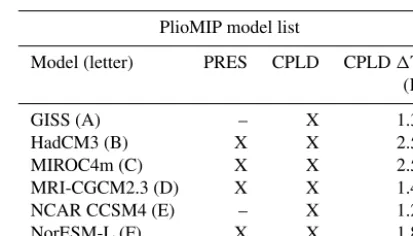
Table 1.The list of models available from PlioMIP for the pre-scribed SST (PRES) and coupled ocean–atmosphere (CPLD) exper-iments. The “X” (dash) indicates that the model data are available (unavailable). Two models in CPLD (GISS and NCAR CCSM4) do not have equivalents in PRES (we elected not to use data from NCAR CAM3.1 because it was not available for pressure levels). In the left column, the letter in parentheses after the model name shows its index in Fig. 6. The right column shows the tropical (30◦S– 30◦N) mean near-surface air temperature response (1Ts, units K) for each model in CPLD.
PlioMIP model list
Model (letter) PRES CPLD CPLD1Ts (K)
GISS (A) – X 1.36
HadCM3 (B) X X 2.56
MIROC4m (C) X X 2.58
MRI-CGCM2.3 (D) X X 1.48
NCAR CCSM4 (E) – X 1.24
NorESM-L (F) X X 1.89
and coupled ocean–atmosphere general circulation models (AOGCMs). The AGCM models use a prescribed monthly SST climatology that does not change through the integra-tion, while the AOGCM SSTs are allowed to evolve freely. Hereafter, we refer to the AGCM model group as PRES (for prescribed SSTs) and the AOGCM group as CPLD (for cou-pled ocean–atmosphere models). The mid-Pliocene bound-ary conditions are based on the Pliocene Research, Inter-pretation and Synoptic Mapping Phase 3 (PRISM3) paleo-climate reconstructions (Dowsett et al., 2010). A list of the PlioMIP models examined in this study is included in Ta-ble 1, and further details on the experiments and model con-figuration can be found in Haywood et al. (2013).
that proxy data may not be representative of conditions from the time period consistent with the boundary conditions (e.g., Salzmann et al., 2013). Indeed, over the ∼300 ky mPWP, it has been shown that solar insolation exhibited very large fluctuations (Laskar et al., 2004). The next phase of the PlioMIP project, PlioMIP2, will mitigate this issue by fo-cusing on a narrower time period at 3.2 Ma, with consistent orbital and SST forcing.
2.2 Climate diagnostics
To compute diagnostics to measure tropical circulation change, some post-processing was necessary on the data from PlioMIP. The data were interpolated to a 2.5×2.5◦grid for all models to create a common resolution for comput-ing multi-model mean statistics. We define the response as the difference, for any given quantity, between the mPWP simulation and the PI control simulation for each model. The response is evaluated using monthly mean climatolo-gies computed over all available years of simulation (typi-cally 150 years in most models). Meridional wind data were available on 10 common vertical levels between 1000 and 100 hPa for all models listed in Table 1. Lastly, if a model did not contribute output to the CPLD experiment, it was not included in our analysis.
We compute multi-model means for PRES and CPLD us-ing the models listed in Table 1. Each model’s response is first scaled by its tropical mean (30◦S–30◦N) surface tem-perature response in CPLD (Table 1), consistent with the procedure followed for future climate simulations by He and Soden (2015). In figures showing multi-model means, stip-pling indicates regions of agreement across the model en-semble and is added where all but one member in the model group agree on the sign of the response. The small number of models in each PRES and CPLD prevents a more robust statistical analysis of the model agreement. JJA refers to a month June–July–August mean, while DJF refers to a 3-month December–January–February mean.
To diagnose changes to the HC, zonally averaged merid-ional mass stream function (9) was calculated (Oort and Yienger, 1996), then latitude-height cross sections of this quantity were created. This field highlights the vertical and meridional circulation associated with the HC, with pos-itive (negative) values indicating clockwise (counterclock-wise) overturning. To diagnose changes to the WC, we use upper-tropospheric (200 hPa) velocity potential (χ), which is anticorrelated with regions of divergence (convergence) that are strong indicators of upwelling (downwelling) associated with the WC. We also use sea level pressure (SLP) to diag-nose changes to the WC and overall tropical overturning cir-culation (SLP data were not available from the MIROC4m model).
3 Simulated changes to the tropical circulation during the mid-Pliocene
3.1 Response of the tropical climate
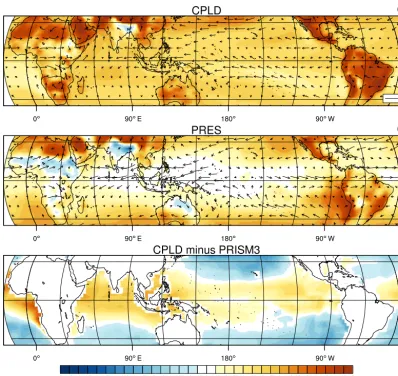
We begin with a brief overview of the simulated changes to the multi-model mean, annual mean tropical climate in the mPWP, relative to the PI. In CPLD the tropical oceans warm by ∼0.5–1.5 K (Fig. 1a), and tropical land regions generally warm even more than the oceans (upwards of 5 K in some arid regions). The 850 hPa wind response indicates a strengthening of the easterly trade winds across much of the tropics and subtropics, with indications of strengthened southwesterly monsoonal flow over the northwestern Indian Ocean.
Over a large region of the tropical ocean, the imposed SST perturbation in PRES (Fig. 1b) shows weak warming com-pared to PI. The only region that sees significant warming in the tropics in PRES is the eastern Pacific, especially near the coast of South America, with some regions warmer by up to 5 K, which drastically weakens the west–east SST gra-dient in the tropical Pacific. The PRES simulations do warm in the subtropics, and they show even greater warming (by a factor of 1.2 in the Northern Hemisphere (NH) and 1.1 in the Southern Hemisphere (SH)) than CPLD in the extratrop-ics, especially at high latitudes (not shown). Additionally, the tropics (30◦S–30◦N) warm more in CPLD (1.75 K) than in PRES (0.95). This acts to reduce the meridional equator–pole surface temperature gradient more in PRES than in CPLD.
Tropical precipitation generally increases in CPLD, par-ticularly over the oceans at the outer edges of the climatolog-ically “wet” zones (Fig. 2a). This pattern indicates an expan-sion of the wet regions on both sides of the equator, but with a significantly stronger response in the NH. Land precipi-tation increases substantially in a band covering the Sahel, the Middle East and southern Asia. By contrast, precipita-tion decreases over the South Atlantic, the eastern South Pa-cific Convergence Zone (SPCZ) and over continental south-ern Africa and Amazonia.
Figure 1.CPLD(a)and PRES(b)multi-model mean, annual mean surface temperature response (shading, units K) and 850 hPa wind response (reference vector denotes 3 m s−1K−1). Prior to computing the multi-model mean, the response in each model is scaled by its tropical mean surface temperature response in CPLD (see Sect. 2.2 and Table 1).(c)CPLD multi-model annual mean sea surface temperature (SST) minus PRISM3 reconstructed SST.
between CPLD and PRES (Fig. 2) occur where there are the largest differences in SST warming (Fig. 1).
3.2 Response of the Walker circulation
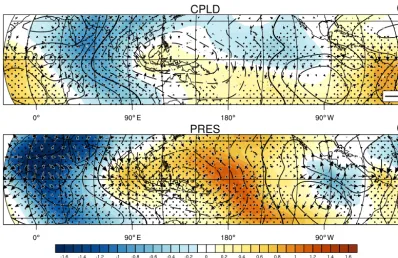
The ascending branch of the annual mean WC is lo-cated over the Maritime Continent, where the region of strongest climatological upper-tropospheric divergence (neg-ative 200 hPaχ) indicates large-scale ascent and convective outflow (Fig. 3a). The compensating descending branch of the climatological WC is located over the eastern Pacific in a region of strong convergence. The response of the WC to mPWP climate change in CPLD indicates a slight (∼3–4 %) weakening of theχfield over the Maritime Continent (based on the multi-model mean of the percentage change of the ab-solute value of the minima in the 200 hPa χ field for each model in that region), a strengthening over the eastern
Pa-cific and a westward shift of the ascending branch over the western Indian Ocean (Fig. 3a). However, the weakening of the ascending branch is not robust, as indicated by a lack of model consensus on the sign of the response, with two models (NCAR CCSM4 and NorESM-L) showing a slight strengthening.
Figure 2. As Fig. 1, except showing the precipitation response as a percentage of the preindustrial control climatology (shading). The precipitation rate from the preindustrial control climatology is shown by thick black contours, interval 2 mm d−1and starting at 4 mm d−1. Stippling indicates regions where at least all but one of the models in the model group agree on the sign of the response.
for CPLD – with unanimous agreement on the sign, which suggests a role for tropical SST changes. However, there is a large spread among the four models in PRES for the WC weakening of∼1–29 % using the same WC strength-change metric used for CPLD.
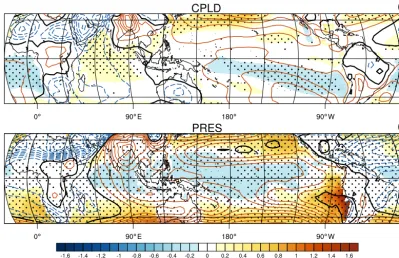
Another way to examine the WC response is through the surface response, by using SLP to measure changes in the mass distribution of the atmosphere. In Fig. 4a, b we show, for both groups of models, that the SLP response displays a similar pattern of WC response to that obtained using χ. In CPLD, the tropics show relatively minor changes in SLP, with an increase over the Maritime Continent and west-ern Pacific and a decrease over the Indian Ocean associ-ated with increased ascent and upper-level divergence there (see Figs. 4a, 3a). This pattern represents a minor weaken-ing of the climatological zonal gradient in tropical SLP (not shown), consistent with weakening of the WC in CPLD. By contrast, the PRES experiment shows an increase in SLP across the Maritime Continent and into the western–central tropical Pacific, with a smaller increase in the eastern Pacific. This pattern represents a more pronounced weakening of the zonal gradient in tropical SLP, consistent with a more sub-stantial weakening of the WC in PRES than in CPLD.
The patterns of χ and SLP response in the tropics are driven, to leading order, by changes to tropical convec-tion, which drives the mass circulation and hence the WC (e.g., Gill, 1980; Sasamori, 1982). Since the tropical
tropo-sphere warms uniformly in response to climate change, lo-cal changes in static stability must be controlled by changes in local surface temperature (Ma and Xie, 2012; Xie et al., 2010). To investigate the role of local surface warming we define the quantity dSST∗as the difference between the local SST response and the tropical (20◦S–20◦N) mean SST re-sponse in each model for both PRES and CPLD (Fig. 4a, b, shading). There is a very strong association between the spa-tial pattern of dSST∗and that of the SLP response (anomaly correlation of−0.65 for the multi-model mean and a range of −0.56 to−0.66 for the 10th–90th percentile of CPLD mod-els), and also with 200 hPaχ(anomaly correlation of−0.57 for the multi-model mean, with a range of−0.43 to−0.6 for the 10th–90th percentile of CPLD models). The SLP (χ) re-sponse tends to show high pressure (upper-tropospheric con-vergence) over regions where dSST∗is negative; that is, there is large-scale descent where the local warming is less than the tropical mean warming. This may explain why the WC weakens less in CPLD than in PRES because the pattern of surface warming in CPLD produces a maximum located in regions of climatological divergence and ascent, particularly in the eastern Indian Ocean and around the Maritime Conti-nent.
Figure 3.As Fig. 1, except showing the 200 hPa annual mean velocity potential (χ) response (shading) and 200 hPa divergent wind annual mean response vectors (reference vector denotes 1 m s−1K−1). Contours show 200 hPaχfrom the preindustrial control climatology, interval 2×10⁶m2s−1with dashed contours negative and the zero line thickened. Stippling as in Fig. 2.
section using 200 hPaχ) was performed. A positive correla-tion of 0.61 was found among the models (i.e., higher dSST∗ tends to have less WC weakening). This shows that the rate of SST warming in and around the Maritime Continent (east-ern Indian Ocean and west(east-ern Pacific) is important for mod-ulating the change in WC strength due to climate change (i.e., faster warming may lead to less weakening or in fact strengthening).
3.3 Response of the Hadley circulation
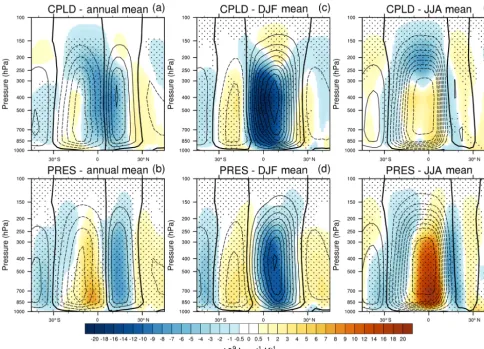
In CPLD the annual mean climatology of mass stream func-tion (9) consists of two overturning cells on either side of the equator, with the southern cell being slightly stronger (Fig. 5a). These cells describe the HC: ascent occurs in the equatorial regions, with descent generally occurring in the subtropics. The response in CPLD is largely negative and is centered just north of the equator but encompasses the as-cending region of both cells. This implies a weakening of the ascending branch in the NH and a strengthening in the SH. This general pattern of HC strength change is consistent with the expected changes due to future climate change as simu-lated by the CMIP5 coupled models (e.g., Vallis et al., 2015; Bony et al., 2013; He and Soden, 2015; Vecchi and Soden, 2007; Gastineau et al., 2009). There is also strengthening ap-parent in the descending branch of the HC in the NH, but model agreement is low.
The HC response in CPLD displays a distinct seasonal cy-cle because the appearance of two distinct cells is an artifact of taking the annual mean. In fact, in DJF and JJA there ex-ists one dominant cell straddling the equator, ascending in the summer hemisphere and descending in the winter hemi-sphere (Fig. 5c, e). Henceforth, we refer to the seasonal cells with respect to the hemisphere containing the descending limb. The weakening of the DJF (i.e., NH) cell is very ev-ident in CPLD, with a tendency for greater weakening in the ascending limb (Fig. 5c). One feature that was not apparent in the annual mean is the increase in cell height, as evidenced by the positive9response around 150 hPa. This is associated with a well-documented increase in tropopause height con-sistent with warming tropical SSTs, which through moist adi-abatic adjustment, leads to a higher tropopause (e.g., Schnei-der et al., 2010; Santer et al., 2003; He and Soden, 2015). There is a clear poleward shift of the descending branch of the DJF cell in the mid-lower troposphere, which would im-ply a poleward shift of the midlatitude eddy-driven jet.
Figure 4.As Fig. 1, except showing the dSST∗response (shading) and SLP response (contours, interval 0.2 hPa K−1with blue as negative, red as positive, and black denoting the zero line). Stippling as in Fig. 2.
Soden, 2007), but to our knowledge this is the first time a similar result has been shown for the mPWP. The increase in tropopause height is stronger in JJA than DJF, and there is a small – but robust – expansion poleward of the descend-ing branch around 30◦N that mirrors the result in the NH for DJF (Fig. 5c, e). Given the apparent non-robustness of the HC weakening response, the robustness of the poleward shift suggests that the strength change and meridional expansion are controlled by different processes. Interestingly, the spatial pattern of the weakening of the JJA cell, and its nonrobust-ness, are very similar to the response seen among the CMIP5 models for future climate change (e.g., Seo et al., 2014). This has been linked to the slower rate of tropical warming in the SH compared to the NH (e.g., He and Soden, 2015; Ma and Xie, 2012; Vecchi and Soden, 2007; Kang and Lu, 2012; Seo et al., 2014).
Overall, the response of the annual mean HC is quite dif-ferent in PRES than in CPLD. In PRES both cells weaken, with the largest weakening in the ascending branch of the southern cell just south of the equator (Fig. 5b). The weak-ening of the northern HC occurs in the center of the cell, indicating an overall weakening of cell strength, as opposed to a weakening of the ascending branch in CPLD. The south-ern HC, however, weakens mainly in the ascending region, which is opposite to the strengthening seen there in CPLD. There is a slight poleward expansion of the descending re-gion of the northern HC in PRES, which is more robust in terms of model agreement than in CPLD.
Similar amounts of HC weakening are found in DJF and JJA in PRES (Fig. 5d, f). However, there are differences in the response around the edges of the cell in each season. There is strong model agreement that in DJF the ascend-ing portion of the cell moves slightly poleward (Fig. 5d), while in JJA both the ascending and descending portions of the cell expand poleward (Fig. 5f). This robust weakening and expansion of the southern HC in the ascending region is consistent with an expansion of the tropical wet zones de-scribed in Sect. 3.1 (Fig. 2b) and with the single AGCM study of Kamae et al. (2011). While this expansion of the HC is also somewhat evident in CPLD, it is much weaker and only robust for the northern cell (i.e., DJF) in the lower troposphere. An increase in tropopause height is not evident in any season for PRES, which is likely related to the lack of tropical warming in the imposed SSTs in PRES (Fig. 1b). Although PlioMIP temperature data were not archived from model layers in the mid-upper troposphere, we speculate that the warming in that region in PRES would be substantially weaker than in CPLD because of the reduced latent heating driven by muted tropical surface warming (Seo et al., 2014; Santer et al., 2003).
Merid-Figure 5.CPLD(a, c, e)and PRES(b, d, f)meridional mass stream function response (shading) and preindustrial control climatology (contours, interval 2×10¹⁰kg s−1, with dashed lines as negative and the zero line thickened):(a, b)annual mean,(c, d)DJF mean,(e, f)JJA mean. Stippling as in Fig. 2.
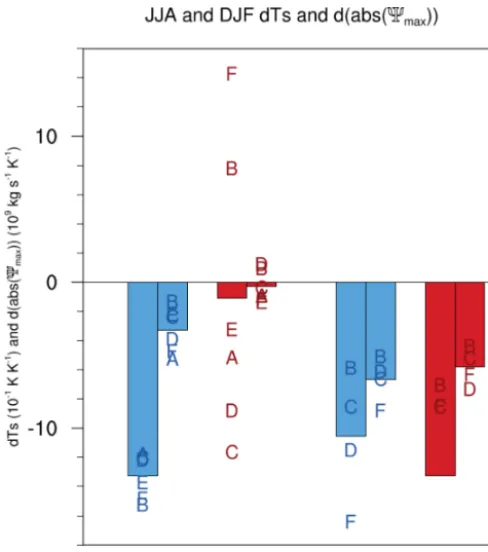
ional gradients in SST and lower-tropospheric temperature between the tropics and subtropics have been shown to affect HC strength in both mPWP and future climates (e.g., Seo et al., 2014; Levine and Schneider, 2010; Williamson et al., 2013; Gastineau et al., 2009; Kamae et al., 2011). We further investigate this mechanism using the quantity dTs, which we define as the change in the meridional surface temperature gradient between the equatorial region (5◦S–5◦N) and the northern (15–25◦N) or southern (15–25◦S) subtropics. We compute dTs separately for the two winter hemispheres in each model, then compare the values of dTs with a common measure of HC strength in each model: the absolute change in the maximum (minimum) value of 9 (1|9|max) for the Northern (Southern) Hemisphere (e.g., Kang et al., 2013).
Figure 6 shows that, to leading order, the seasonal asymmetry in the multi-model mean HC response in CPLD is explained by differences in dTs. The relatively small change in HC strength during JJA (1|9|max of −0.01×10⁻¹¹kg s−1K−1 in the multi-model mean) is ac-companied by a small 1Ts in that season (0.03 K K−1),
compared to the larger values seen in DJF (1|9|max of −0.13×10⁻¹¹kg s−1K−1, 0.33 K K−1). In other words, the stronger weakening of the NH cell than the SH cell in CPLD could be explained by the subtropics warming faster than the tropics – and the associated weakening of the tropical– subtropical surface temperature gradient – in DJF, but not in JJA (Fig. 6). This is reminiscent of the result from Seo et al. (2014), who found a significant positive linear relation-ship between1|9|maxand dTs among a suite of 30 CMIP5 models. However, in our sample of six CPLD models from PlioMIP, we find only a modest relationship (r= −0.46) be-tween dTs and1|9|max, and this only emerges when DJF and JJA data are pooled (not shown). The correlation values for DJF and JJA separately are not significant and show the opposite relationship (r=0.39 andr=0.14, respectively).
Figure 6.CPLD and PRES multi-model mean DJF (blue) and JJA (red)1|9|max(left bar of pair) and1Ts (right bar of pair), with individual models indicated by letters (see Table 1 and text for de-tails).
for DJF and JJA (not shown). Therefore, we propose that the seasonal asymmetry in HC response in CPLD is, at least partially, explained by a corresponding asymmetry in the tropical SST warming between the hemispheres. A further demonstration of this idea comes from PRES, where dTs and 1|9|maxare very similar in both seasons and hemispheres (Figs. 4b, 6). We note that the hemispheric asymmetry in surface warming found in CPLD, and the associated changes in the HC, are similar to those projected for future climate change from CMIP5 (e.g., He and Soden, 2015).
4 Discussion and conclusions
The tropical circulation response in two groups of mod-els in PlioMIP show an overall slowdown of the zonal and meridional components of the tropical overturning circula-tion. However, we found that there are significant differ-ences in the Walker circulation (WC) and Hadley circulation (HC) response between the two model groups. The ascending branch of the WC weakens, but does so much less in CPLD than in PRES (and less than reported in CMIP5 models by He and Soden, 2015). Across the two experiments we find that the sign and magnitude of the WC response is strongly related to pattern of SST warming, particularly around the Maritime Continent and eastern Indian Ocean. We also find
that the change in the winter hemispheric meridional SST gradient between equatorial regions and the subtropics ef-fects the HC response. We find that the southern subtropics warm more slowly than the northern subtropics in CPLD and there is thus an asymmetry in the HC response between JJA and DJF.
The dependence of the WC response on the pattern of SST warming is contrary to studies of future climate, where the weakening of the WC is found to be a robust response to global warming, and is not as strongly related to the spa-tial pattern of SST warming (e.g., Ma and Xie, 2012). How-ever, there exists a two-way coupling between the WC and SSTs through the Bjerknes feedback (Bjerknes, 1966), mak-ing it possible that the models in CPLD exhibit greater In-dian Ocean warming precisely because the WC weakens less. In PRES, where SSTs are held fixed, we see a significant weakening of the WC compared to PI, which indicates that the atmospheric changes from global warming weaken the WC. This provides further evidence that the pattern of SST warming in CPLD is working against the overall tendency for WC weakening driven by an increasing atmospheric sta-bility. Only a new set of experiments designed to separate the SST and WC changes, beyond the scope of this study, can fully resolve this problem of cause and effect.
What we have found in PlioMIP for the HC is gener-ally consistent with projections of future climate. Thus, the PlioMIP models indicate that the Pliocene tropical circula-tion could be similar to near-future (i.e., this century) HC changes caused by anthropogenic climate change. The HC response of both groups of models is similar to projections of future climate, with CPLD having the most similar re-sponse to CMIP5. In fact, the spatial pattern of the CPLD JJA HC response looks incredibly similar to that of the RCP 8.5 CMIP5 response in Fig. 1b in Seo et al. (2014). As we have shown, this similarity is likely explained by the similar meridional asymmetry in tropical SST response in CPLD and CMIP5, with regions in the southern tropical Pacific warm-ing slower than those along and north of the equator. It would seem that the meridional pattern of tropical SST response is a robust response to increased GHGs since it is seen in both the PlioMIP coupled simulations and in CMIP5.
for the tropical circulation, and so this requires further urgent investigation if the mPWP is to be considered as a reliable analogue for future climate.
5 Data availability
The data archive for PlioMIP phase 1 can be found at https://geology.er.usgs.gov/egpsc/prism/prism_1.23/ prism_pliomip.html (last access: December 2013). The PlioMIP group homepage can be found at http://geology.er.usgs.gov/egpsc/prism/7_pliomip2.html.
Competing interests. The authors declare that they have no con-flict of interest.
Acknowledgements. We thank the modeling groups in Table 1 who contributed data to the PlioMIP project. Shawn Corvec and Christopher G. Fletcher acknowledge funding from NSERC Discovery Grant no. 402661.
Edited by: A. Winguth
Reviewed by: two anonymous referees
References
Bayr, T. and Dommenget, D.: The Tropospheric Land-Sea Warming Contrast as the Driver of Tropical Sea Level Pressure Changes, J. Climate, 26, 1387–1402, doi:10.1175/JCLI-D-11-00731.1, 2012. Bjerknes, J.: A possible response of the atmospheric Hadley circu-lation to equatorial anomalies of ocean temperature, Tellus, 18, 820–829, doi:10.1111/j.2153-3490.1966.tb00303.x, 1966. Bony, S., Bellon, G., Klocke, D., Sherwood, S., Fermepin, S., and
Denvil, S.: Robust direct effect of carbon dioxide on tropical circulation and regional precipitation, Nat. Geosci., 6, 447–451, doi:10.1038/ngeo1799, 2013.
Chadwick, R., Boutle, I., and Martin, G.: Spatial Patterns of Precip-itation Change in CMIP5: Why the Rich Do Not Get Richer in the Tropics, J. Climate, 26, 3803–3822, doi:10.1175/JCLI-D-12-00543.1, 2012.
Dekens, P. S., Ravelo, A. C., and McCarthy, M. D.: Warm up-welling regions in the Pliocene warm period, Paleoceanography, 22, PA3211, doi:10.1029/2006PA001394, 2007.
Dowsett, H. and Poore, R.: Pliocene sea surface temperatures of the north atlantic ocean at 3.0 Ma, Quaternary Sci. Rev., 10, 189– 204, 1991.
Dowsett, H., Thompson, R., Barron, J., Cronin, T., Fleming, F., Ishman, S., Poore, R., Willard, D., and Holtz, T.: Joint inves-tigations of the Middle Pliocene climate I: PRISM paleoenvi-ronmental reconstructions, Glob. Planet. Change, 9, 169–195, doi:10.1016/0921-8181(94)90015-9, 1994.
Dowsett, H., Barron, J., and Poore, R.: Middle Pliocene sea surface temperatures: a global reconstruction, Mar. Micropaleontol., 27, 13–25, doi:10.1016/0377-8398(95)00050-X, 1996.
Dowsett, H., Robinson, M., Haywood, A., Salzmann, U., Hill, D., Sohl, L., Chandler, M., Williams, M., Foley, K., and Stoll, D.: The PRISM3D paleoenvironmental reconstruction, Stratigraphy, 7, 123–139, 2010.
Dowsett, H. J.: The PRISM palaeoclimate reconstruction and Pliocene sea-surface temperature, in: Deep-time perspectives on climate change: Marrying the signal from computer models and biological proxies, Micropaleontological Society (Special Publi-cation), Geological Society of London, London, UK, 459–480, 2007a.
Dowsett, H. J. and Robinson, M. M.: Mid-Pliocene equato-rial Pacific sea surface temperature reconstruction: a multi-proxy perspective, Philos. T. R. Soc. A, 367, 109–125, doi:10.1098/rsta.2008.0206, 2009.
Dowsett, H. J., Cronin, T. M., Poore, R. Z., Thompson, R. S., Whatley, R. C., and Wood, A. M.: Micropaleontological Ev-idence for Increased Meridional Heat Transport in the North Atlantic Ocean During the Pliocene, Science, 258, 1133–1135, doi:10.1126/science.258.5085.1133, 1992.
Gastineau, G., Li, L., and Le Treut, H.: The Hadley and Walker Cir-culation Changes in Global Warming Conditions Described by Idealized Atmospheric Simulations, J. Climate, 22, 3993–4013, doi:10.1175/2009JCLI2794.1, 2009.
Gill, A. E.: Some simple solutions for heat-induced tropi-cal circulation, Q. J. Roy. Meteor. Soc., 106, 447–462, doi:10.1002/qj.49710644905, 1980.
Haywood, A. M., Dowsett, H. J., Otto-Bliesner, B., Chandler, M. A., Dolan, A. M., Hill, D. J., Lunt, D. J., Robinson, M. M., Rosen-bloom, N., Salzmann, U., and Sohl, L. E.: Pliocene Model Inter-comparison Project (PlioMIP): experimental design and bound-ary conditions (Experiment 1), Geosci. Model Dev., 3, 227–242, doi:10.5194/gmd-3-227-2010, 2010.
Haywood, A. M., Dowsett, H. J., Robinson, M. M., Stoll, D. K., Dolan, A. M., Lunt, D. J., Otto-Bliesner, B., and Chandler, M. A.: Pliocene Model Intercomparison Project (PlioMIP): experi-mental design and boundary conditions (Experiment 2), Geosci. Model Dev., 4, 571–577, doi:10.5194/gmd-4-571-2011, 2011. Haywood, A. M., Hill, D. J., Dolan, A. M., Otto-Bliesner, B. L.,
Bragg, F., Chan, W.-L., Chandler, M. A., Contoux, C., Dowsett, H. J., Jost, A., Kamae, Y., Lohmann, G., Lunt, D. J., Abe-Ouchi, A., Pickering, S. J., Ramstein, G., Rosenbloom, N. A., Salz-mann, U., Sohl, L., Stepanek, C., Ueda, H., Yan, Q., and Zhang, Z.: Large-scale features of Pliocene climate: results from the Pliocene Model Intercomparison Project, Clim. Past, 9, 191–209, doi:10.5194/cp-9-191-2013, 2013.
He, J. and Soden, B. J.: Anthropogenic Weakening of the Tropi-cal Circulation: The Relative Roles of Direct CO2Forcing and Sea Surface Temperature Change, J. Climate, 28, 8728–8742, doi:10.1175/JCLI-D-15-0205.1, 2015.
Held, I. M. and Soden, B. J.: Robust Responses of the Hydro-logical Cycle to Global Warming, J. Climate, 19, 5686–5699, doi:10.1175/JCLI3990.1, 2006.
Hu, Z.-Z., Latif, M., Roeckner, E., and Bengtsson, L.: Intensified Asian Summer Monsoon and its variability in a coupled model forced by increasing greenhouse gas concentrations, Geophys. Res. Lett., 27, 2681–2684, doi:10.1029/2000GL011550, 2000. Kamae, Y., Ueda, H., and Kitoh, A.: Hadley and Walker
Atmo-spheric General Circulation Model, J. Meteorol. Soc. Jpn., 89, 475–493, doi:10.2151/jmsj.2011-505, 2011.
Kang, S. M. and Lu, J.: Expansion of the Hadley Cell under Global Warming: Winter versus Summer, J. Climate, 25, 8387–8393, doi:10.1175/JCLI-D-12-00323.1, 2012.
Kang, S. M., Deser, C., and Polvani, L. M.: Uncertainty in Climate Change Projections of the Hadley Circulation: The Role of Inter-nal Variability, J. Climate, 26, 7541–7554, doi:10.1175/JCLI-D-12-00788.1, 2013.
Kosaka, Y. and Xie, S.-P.: Recent global-warming hiatus tied to equatorial Pacific surface cooling, Nature, 501, 403–407, doi:10.1038/nature12534, 2013.
L’Heureux, M. L., Lee, S., and Lyon, B.: Recent mul-tidecadal strengthening of the Walker circulation across the tropical Pacific, Nature Climate Change, 3, 571–576, doi:10.1038/nclimate1840, 2013.
Laskar, J., Robutel, P., Joutel, F., Gastineau, M., Correia, A. C. M., and Levrard, B.: A long-term numerical solution for the insola-tion quantities of the Earth, Astron. Astrophys., 428, 261–285, doi:10.1051/0004-6361:20041335, 2004.
Lau, K.-M. and Phillips, T. J.: Coherent Fluctuations of Fx-tratropical Geopotential Height and Tropical Convection in Intraseasonal Time Scales, J. Atmos. Sci., 43, 1164–1181, doi:10.1175/1520-0469(1986)043<1164:CFOFGH>2.0.CO;2, 1986.
Levine, X. J. and Schneider, T.: Response of the Hadley Circulation to Climate Change in an Aquaplanet GCM Coupled to a Simple Representation of Ocean Heat Transport, J. Atmos. Sci., 68, 769– 783, doi:10.1175/2010JAS3553.1, 2010.
Liu, J., Song, M., Hu, Y., and Ren, X.: Changes in the strength and width of the Hadley Circulation since 1871, Clim. Past, 8, 1169– 1175, doi:10.5194/cp-8-1169-2012, 2012.
Lu, J., Vecchi, G. A., and Reichler, T.: Expansion of the Hadley cell under global warming, Geophys. Res. Lett., 34, L06805, doi:10.1029/2006GL028443, 2007.
Ma, J. and Xie, S.-P.: Regional Patterns of Sea Surface Temperature Change: A Source of Uncertainty in Future Projections of Precip-itation and Atmospheric Circulation, J. Climate, 26, 2482–2501, doi:10.1175/JCLI-D-12-00283.1, 2012.
Ma, J., Xie, S.-P., and Kosaka, Y.: Mechanisms for Tropical Tropo-spheric Circulation Change in Response to Global Warming, J. Climate, 25, 2979–2994, doi:10.1175/JCLI-D-11-00048.1, 2011. McGregor, S., Timmermann, A., Stuecker, M. F., England, M. H., Merrifield, M., Jin, F.-F., and Chikamoto, Y.: Recent Walker circulation strengthening and Pacific cooling ampli-fied by Atlantic warming, Nature Climate Change, 4, 888–892, doi:10.1038/nclimate2330, 2014.
Mitas, C. M. and Clement, A.: Has the Hadley cell been strength-ening in recent decades?, Geophys. Res. Lett., 32, L03809, doi:10.1029/2004GL021765, 2005.
Mitas, C. M. and Clement, A.: Recent behavior of the Hadley cell and tropical thermodynamics in climate models and reanalyses, Geophys. Res. Lett., 33, L01810, doi:10.1029/2005GL024406, 2006.
Oort, A. H. and Yienger, J. J.: Observed Interannual Vari-ability in the Hadley Circulation and Its Connection to ENSO, J. Clim., 9, 2751–2767, doi:10.1175/1520-0442(1996)009<2751:OIVITH>2.0.CO;2, 1996.
Power, S. B. and Kociuba, G.: The impact of global warming on the Southern Oscillation Index, Clim. Dynam., 37, 1745–1754, doi:10.1007/s00382-010-0951-7, 2010.
Raymo, M. E., Grant, B., Horowitz, M., and Rau, G. H.: Mid-Pliocene warmth: stronger greenhouse and stronger con-veyor, Mar. Micropaleontol., 27, 313–326, doi:10.1016/0377-8398(95)00048-8, 1996.
Robinson, M. M., Dowsett, H. J., and Chandler, M. A.: Pliocene Role in Assessing Future Climate Impacts, EOS, 89, 501–502, doi:10.1029/2008EO490001, 2008.
Roundy, P. E., MacRitchie, K., Asuma, J., and Melino, T.: Modula-tion of the Global Atmospheric CirculaModula-tion by Combined Activ-ity in the Madden-Julian Oscillation and the El Niño-Southern Oscillation during Boreal Winter, J. Climate, 23, 4045–4059, doi:10.1175/2010JCLI3446.1, 2010.
Salzmann, U., Dolan, A. M., Haywood, A. M., Chan, W.-L., Voss, J., Hill, D. J., Abe-Ouchi, A., Otto-Bliesner, B., Bragg, F. J., Chandler, M. A., Contoux, C., Dowsett, H. J., Jost, A., Kamae, Y., Lohmann, G., Lunt, D. J., Pickering, S. J., Pound, M. J., Ramstein, G., Rosenbloom, N. A., Sohl, L., Stepanek, C., Ueda, H., and Zhang, Z.: Challenges in quantifying Pliocene terres-trial warming revealed by data-model discord, Nature Climate Change, 3, 969–974, doi:10.1038/nclimate2008, 2013.
Santer, B. D., Wehner, M. F., Wigley, T. M. L., Sausen, R., Meehl, G. A., Taylor, K. E., Ammann, C., Arblaster, J., Washington, W. M., Boyle, J. S., and Brüggemann, W.: Contributions of An-thropogenic and Natural Forcing to Recent Tropopause Height Changes, Science, 301, 479–483, doi:10.1126/science.1084123, 2003.
Sasamori, T.: Stability of the Walker Circulation, J. Atmos. Sci., 39, 518–527, doi:10.1175/1520-0469(1982)039<0518:SOTWC>2.0.CO;2, 1982.
Schneider, T., O’Gorman, P. A., and Levine, X. J.: Water Vapor and the Dynamics of Climate Changes, Rev. Geophys., 48, RG3001, doi:10.1029/2009RG000302, 2010.
Seo, K.-H., Frierson, D. M. W., and Son, J.-H.: A mechanism for future changes in Hadley circulation strength in CMIP5 cli-mate change simulations, Geophys. Res. Lett., 41, GL060868, doi:10.1002/2014GL060868, 2014.
Shin, S.-I. and Sardeshmukh, P. D.: Critical influence of the pattern of Tropical Ocean warming on remote climate trends, Clim. Dy-nam., 36, 1577–1591, doi:10.1007/s00382-009-0732-3, 2010. Sohn, B.-J., Lee, S., Chung, E.-S., and Song, H.-J.: The Role of the
Dry Static Stability for the Recent Change in the Pacific Walker Circulation, J. Climate, 29, 2765–2779, doi:10.1175/JCLI-D-15-0374.1, 2016.
Sun, Y., Ramstein, G., Contoux, C., and Zhou, T.: A comparative study of large-scale atmospheric circulation in the context of a future scenario (RCP4.5) and past warmth (mid-Pliocene), Clim. Past, 9, 1613–1627, doi:10.5194/cp-9-1613-2013, 2013. Taylor, K. E., Stouffer, R. J., and Meehl, G. A.: An Overview of
CMIP5 and the Experiment Design, B. Am. Meteorol. Soc., 93, 485–498, doi:10.1175/BAMS-D-11-00094.1, 2011.
Vallis, G. K., Zurita-Gotor, P., Cairns, C., and Kidston, J.: Response of the large-scale structure of the atmosphere to global warming, Q. J. Roy. Meteor. Soc., 141, 1479–1501, doi:10.1002/qj.2456, 2015.
Vecchi, G. A. and Soden, B. J.: Global Warming and the Weak-ening of the Tropical Circulation, J. Climate, 20, 4316–4340, doi:10.1175/JCLI4258.1, 2007.
Vecchi, G. A., Soden, B. J., Wittenberg, A. T., Held, I. M., Leet-maa, A., and Harrison, M. J.: Weakening of tropical Pacific at-mospheric circulation due to anthropogenic forcing, Nature, 441, 73–76, doi:10.1038/nature04744, 2006.
Weickmann, K. M., Lussky, G. R., and Kutzbach, J. E.: In-traseasonal (30–60 Day) Fluctuations of Outgoing Longwave Radiation and 250 mb Streamfunction during Northern Win-ter, Mon. Weather Rev., 113, 941–961, doi:10.1175/1520-0493(1985)113<0941:IDFOOL>2.0.CO;2, 1985.
Williamson, D. L., Blackburn, M., Nakajima, K., Ohfuchi, W., Takahashi, Y. O., Hayashi, Y.-Y., Nakamura, H., Ishiwatari, M., McGREGOR, J. L., Borth, H., Wirth, V., Frank, H., Bechtold, P., Wedi, N. P., Tomita, H., Satoh, M., Zhao, M., Held, I. M., Suarez, M. J., Lee, M.-I., Watanabe, M., Kimoto, M., Liu, Y., Wang, Z., Molod, A., Rajendran, K., Kitoh, A., and Stratton, R.: The Aqua-Planet Experiment (APE): Response to Changed Meridional SST Profile, J. Meteorol. Soc. Jpn. A, 91, 57–89, doi:10.2151/jmsj.2013-A03, 2013.