www.solid-earth.net/5/461/2014/ doi:10.5194/se-5-461-2014
© Author(s) 2014. CC Attribution 3.0 License.
Practical analytical solutions for benchmarking of 2-D and 3-D
geodynamic Stokes problems with variable viscosity
I. Yu. Popov2, I. S. Lobanov2, S. I. Popov2, A. I. Popov2, and T. V. Gerya1
1Institute of Geophysics, Department of Earth Sciences, Swiss Federal Institute of Technology Zurich (ETH), 5 Sonnegstrasse, 8092 Zurich, Switzerland
2St. Petersburg National Research University of Information Technologies, Mechanics and Optics, 49 Kronverkskiy, St. Petersburg, 197101, Russia
Correspondence to: I. Yu. Popov ([email protected])
Received: 20 November 2013 – Published in Solid Earth Discuss.: 9 December 2013 Revised: 15 April 2014 – Accepted: 22 April 2014 – Published: 10 June 2014
Abstract. Geodynamic modeling is often related with chal-lenging computations involving solution of the Stokes and continuity equations under the condition of highly variable viscosity. Based on a new analytical approach we have de-veloped particular analytical solutions for 2-D and 3-D in-compressible Stokes flows with both linearly and exponen-tially variable viscosity. We demonstrate how these particu-lar solutions can be converted into 2-D and 3-D test problems suitable for benchmarking numerical codes aimed at mod-eling various mantle convection and lithospheric dynamics problems. The Main advantage of this new generalized ap-proach is that a large variety of benchmark solutions can be generated, including relatively complex cases with open model boundaries, non-vertical gravity and variable gradi-ents of the viscosity and density fields, which are not parallel to the Cartesian axes. Examples of respective 2-D and 3-D MatLab codes are provided with this paper.
1 Introduction
Numerical modeling of geodynamic processes is recognized as a challenging computational problem which requires use of advanced computational techniques and development of powerful numerical tools (e.g., Ismail-Zadeh and Tackley, 2010, and references therein). One of the major challenges concerns solving of the inertia-free Stokes equation cou-pled to the incompressible continuity equation in a combi-nation with strong viscosity variations in the computational domain. Consequently, benchmarking of numerical codes
against analytical and numerical solutions constrained for various mechanical and thermomechanical Stokes flow prob-lems is a common practice in computational geodynamics (e.g., Blankenbach et al., 1989; Moresi et al., 1996; van Keken et al., 2008; Gerya and Yuen, 2003, 2007; Deubel-beiss and Kaus, 2008; Duretz et al., 2011; Gerya et al., 2013; Popov, 2014; Lobanov et al., 2014; Popov and Sobolev, 2008; Tackley and King, 2003; Torrance and Turcotte, 1971; Zhong and Gurnis, 1994). Available analytical and numerical solu-tions are mostly two-dimensional and include
– 2-D mantle convection with constant and variable vis-cosity (Hager and O’Connell, 1981; Revenaugh and Parsons, 1987; Blankenbach et al., 1989);
– 2-D thermochemical convection (van Keken et al., 1997);
– 2-D buoyancy-driven flows for strongly varying viscos-ity (Zhong, 1996; Moresi et al., 1996; Gerya and Yuen, 2003);
– 2-D mechanical and thermomechanical channel and Couette flows for constant and variable viscosity (Tur-cotte and Schubert, 2002; Gerya and Yuen, 2003; Gerya, 2010);
– 2-D flow around deformable elliptic inclusions (Schmid and Podladchikov, 2003);
– 2-D thermomechanical corner flows in subduction zones (van Keken et al., 2008);
– 2-D spontaneous subduction with a free surface (Schmeling et al., 2008);
– 2-D buoyancy-driven flows with a free surface (Crameri et al., 2012);
– 2-D numerical sandbox experiments (Buiter et al., 2006);
– 3-D mantle convection in Cartesian geometry (Busse et al., 1993; Albers, 2000);
– 3-D mantle convection in spherical geometry (Zhong et al., 2008);
– 3-D infinitesimal and finite amplitude folding instability (Kaus and Schmalholz, 2006);
– 2-D and 3-D shear band formation and plasticity imple-mentation (Lemiale et al., 2008; Kaus, 2010; Thieulot et al., 2008);
– numerical sandbox experiments (Buiter et al., 2006), (Gerya and Yuen, 2007), (Thieulot, 2011) and (Gerya, 2010);
– 3-D convection at infinite Prandtl numbers in Cartesian geometry (Busse et al., 1993);
– falling block (Gerya and Yuen, 2003; Gerya, 2010; Thieulot, 2011).
These solutions are constrained for a number of well defined model setups, which are of potential significance for vari-ous situations which numerical codes may face during real geodynamic simulations. Availability and broad range of 2-D and 3-2-D benchmark solutions are, therefore, critical for the development and testing of the next generation of numerical geodynamic modeling software which aims to combine rhe-ological complexity of constitutive laws with adaptive grid resolution to on both global and regional scales (e.g., Moresi et al., 2003; Dabrowski et al., 2008; Tackley, 2008; Stadler et al., 2010; Gerya et al., 2013).
In the present paper we aim to significantly expand avail-ability of benchmark solutions for both 2-D and 3-D variable-viscosity Stokes flows. In contrast with previous studies, we prefer not to start from any prescribed model setups but rather derive general analytical solutions, which are poten-tially suitable for generating a broad range of test problems. We derive generalized solutions for incompressible Stokes problems with linearly and exponentially variable viscosity. In the following we demonstrate how these generalized solu-tions can be converted into 2-D and 3-D test problems suit-able for benchmarking numerical codes. Finally, based on the obtained benchmark problems, we show examples of nu-merical convergence tests for staggered-grid discretizations schemes (e.g., Gerya and Yuen, 2003, 2007).
2 Two-dimensional solution
2.1 Formulation of 2-D equations with variable viscosity
Consider the plane flow, 2-D Stokes equations for the case of varying viscosity have the form
2η∂
2v x
∂x2 +2
∂η ∂x
∂vx ∂x +η
∂2vx ∂y2 +η
∂2vy ∂y∂x + ∂η ∂y ∂vx ∂y (1) +∂η ∂y ∂vy ∂x − ∂P
∂x = −ρGx,
η∂
2v y
∂x2 +η
∂2vx ∂y∂x+ ∂η ∂x ∂vx ∂y + ∂η ∂x ∂vy ∂x +2
∂η ∂y
∂vy
∂y (2)
+2η∂
2v y
∂y2 −
∂P
∂y = −ρGy, ∂vx
∂x + ∂vy
∂y =0. (3)
Here(vx, vy)is the flow velocity,η=η(x, y)is the viscos-ity,P is the pressure,ρis the density,(Gx, Gy)is the gravi-tational force. Note that Eq. (3) is the continuity equation.
Let us change the variablesvx, vy, P in such a way that ∂vx ∂x = 1 η ∂ux ∂x , ∂vx ∂y = 1 η ∂ux
∂y , (4)
∂vy ∂x = 1 η ∂uy ∂x , ∂vy ∂y = 1 η ∂uy
∂y , (5)
1
η ∂P
∂x = ∂P˜ ∂x,
1
η ∂P
∂y = ∂P˜
∂y. (6)
The correctness conditions for such replacement are as fol-lows: ∂ ∂y 1 η ∂ux ∂x = ∂ ∂x 1 η ∂ux ∂y , ∂ ∂y 1 η ∂uy ∂x = ∂ ∂x 1 η ∂uy ∂y , ∂ ∂y η
∂P˜ ∂x
!
= ∂
∂x η ∂P˜
∂y !
.
These conditions lead to the following correlations:
∂η ∂y ∂ux ∂x = ∂η ∂x ∂ux ∂y , ∂η ∂y ∂uy ∂x = ∂η ∂x ∂uy ∂y , ∂η ∂y ∂P˜
∂x = ∂η ∂x
∂P˜ ∂y.
If we consider these conditions as a partial differential equa-tions then we obtain the same characteristic equation for all these conditions:
∂η ∂xdx+
Evidently, η(x, y)=C is an integral of the equation. It is well known that an integral of the characteristic equation gives one good new variable. Namely,η=η(x, y)is a good new variable (the second coordinate should be orthogonal to the first one). Note that the assumption that the viscosity varies is now crucial because we use the viscosity as a new coordinate (instead of the standard Cartesian spatial coordi-nate). Hence, the solutions of our equations, which predeter-mine the correctness of the replacement suggested above, are
ux=8(η), uy=9(η), P˜= ˜P (η).
After the replacement, the Stokes Eqs. (1, 2) and the conti-nuity condition (3) transform to the following form:
2∂ 2u
x
∂x2 +
∂2ux ∂y2 +
∂2uy ∂y∂x−η
∂P˜
∂x = −ρGx, (7)
∂2uy ∂x2 +
∂2ux ∂y∂x +2
∂2uy ∂y2 −η
∂P˜
∂y = −ρGy, (8)
∂ux ∂x +
∂uy
∂y =0. (9)
Inserting the expressions for ux, uy into Eqs. (7–9), one obtains the following equations:
280∂
2η
∂2x +28
00 ∂η
∂x 2
+80∂
2η
∂2y+8
00 ∂η
∂y 2
+
90 ∂
2η
∂y∂x+9 00∂η
∂y ∂η ∂x−η
˜ P0∂η
∂x = −ρGx, (10)
290∂
2η
∂2y+29
00 ∂η
∂y 2
+90∂
2η
∂2x +9
00 ∂η
∂x 2
+
80 ∂
2η
∂y∂x+8 00∂η
∂y ∂η ∂x−η
˜ P0∂η
∂y = −ρGy, (11)
80∂η ∂x+9
0∂η
∂y =0. (12)
2.2 Linearly varying viscosity
To obtain the solutions of Eqs. (10–12) we make some as-sumptions. In particular, in this section we assume, first, that the viscosityηis a linear function of the Cartesian coordi-nates,
η=ax+by+c, (13)
where a, b, c are non-zero constants. Second, the restric-tion concerning the gravitarestric-tional terms takes place:ρ(aGy− bGx)andρ(bGy+aGx)are assumed to be functions of one variable – viscosity. It means that ρGy andρGx are func-tions ofηonly. Introduce functionsf, f1:
f (η)=ρ(aGy−bGx)
(a2+b2)2 , f1(η)=
ρ(bGy+aGx)
a2+b2 . (14)
Under these assumptions one gets the following system of equations:
800(2a2+b2)+900ab−aηP˜0= −ρGx, 900(a2+2b2)+800ab−aηP˜= −ρGy, 80a+90b=0.
One can simply solve this linear algebraic system with re-spect to800, 900,P˜0:
800=bf (η), 900= −af (η), P˜0=f1(η)
η . (15)
That gives us
ux=8=b η Z
1 dη1
η1
Z
1
dη2f (η2)+bc1η+c2,
uy=9= −a η Z
1 dη1
η1
Z
1
dη2f (η2)−ac1η+c3,
˜ P =
η Z
1 dη1
f1(η1)
η1 +c4.
Correspondingly, one obtainsvx, vy, P:
vx=b η Z
1 dη1
η1 η1
Z
1
dη2f (η2)+bc1logη+c2
=b η Z
1
dη2f (η2) η Z
η2 dη1
η1
+bc1logη+c2.
Finally,
vx=b η Z
1
dη2f (η2)log
η η2
+bc1logη+c2. (16)
Analogous transformation takes place forvy:
vy= −a η Z
1 dη1
η1 η1
Z
1
dη2f (η2)−ac1logη+c3,
Namely,
vy= −a η Z
1
dη2f (η2)log
η η2
−ac1logη+c3. (17)
The expression for the pressure is as follows:
P = η Z
1
In particular, in the case of constant gravitational terms, i.e., forf (η)=A=const,f1(η)=A1=const one has
vx=bAη+bc˜1logη+ ˜c2,
vy= −aAη−ac˜1logη+ ˜c3,
P =A1η+ ˜c4.
Consider a more complicated case when the density is a linear function of the viscosity:ρ=β1η+β2. Then,
f (η)=a1η+a2, f1(η)=b1η+b2, where constantsa1, a2, b1, b2are as follows:
a1=β1
(aGy−bGx)
(a2+b2)2 , a2=β2
(aGy−bGx) (a2+b2)2 ,
b1=β1
(bGy+aGx)
a2+b2 , b2=β2
(bGy+aGx) a2+b2 .
Note that in this case the continuity Eq. (3) should be rewrit-ten in a more general form:
∂(ρvx)
∂x +
∂(ρvy)
∂y =0. (19)
Equations (16)–(18) gives us
vx= −b(a1/2+a2−c1)logη+ 1 4ba1η
2+ba 2η −1
4a1b−a2b+c2,
vy=a(a1/2+a2−c1)logη− 1 4aa1η
2−aa 2η +1
4a1a+a2a+c3,
P =1 2b1η
2+b 2η−
1
2b1−b2+c4.
The continuity Eq. (19) gives us the relation betweenc2, c3:
ac2+bc3=0.
2.3 Exponentially varying viscosity
Let us construct the second benchmark solution. Now we assume that the viscosity is the exponential function of the Cartesian coordinates:
η=cexp(ax+by). (20)
General consideration up to Eqs. (10–12) is the same as ear-lier. By inserting Eq. (20) into Eqs. (10–12) and taking into account that
∂η ∂x =aη,
∂η ∂y =bη,
one obtains the following system of equations:
(2a2+b2)(800η2+80η)+ab(900η2+90η) −aP˜0η2= −ρGx,
ab(800η2+80η)+(a2+2b2)(900η2+90η) −bP˜0η2= −ρGy,
a80+b90=0.
Using the last relation, we exclude9from the first two equa-tions:
(a2+b2)(800η2+80η)−aP˜0η2= −ρGx, −a
3+ab2
b (8
00
η2+80η)−bP˜0η2= −ρGy, 90= −a
b8 0
. (21)
One can see that we obtain a linear algebraic system with respect to(800η2+80η)andP˜0. The solution is as follows:
˜
P0=f1(η)
η2 , (22)
800η2+80η=bf (η). (23)
Remark. It is interesting that these formulas contain the same functionsf (η),f1(η)as in the previous section.
Equation (23) is a well-known Euler ordinary differential equation. One can get its solution for arbitrary functionf:
ux=8(η)=b η Z
1 log
η η1
f (η
1)
η1
dη1+bc1logη+c2. (24) Taking into account the relation in Eq. (21), one obtainsuy:
uy=9(η)= −a η Z
1 log
η η1
f (η
1)
η1
)dη1−ac1logη+c3. (25) Taking into account Eqs. (4, 5) one obtainsvx,vy:
vx=b η Z
1
dη1
η21 η1
Z
1
dη2
f (η2)
η2 −bc1
1
η+bc1+c2
=b η Z
1
dη2
f (η2)
η2 η Z
η2
dη1
η21 −bc1
1
η+bc1+c2.
Hence, we get the expression forvxand analogously, forvy:
vx=b η Z
1
dη2
f (η2)
η2
η−η2
ηη2 −bc1
1
η+bc1+c2, (26)
vy= −a η Z
1
dη2
f (η2)
η2
η−η2
ηη2 +ac1
1
As for the pressure, we obtain it from Eq. (22) by taking into account Eq. (6):
˜ P = η Z 1 dη1
f1(η1)
η21 +c4.
Hence, P = η Z 1 dη1
f1(η1)
η1
+c4. (28)
One can compare Eqs. (26–28) with Eqs. (16–18).
For a simple particular case (constant gravitational term) whenf (η)=A=const,f1(η)=A1=const one has
vx= −
b(A+c1)
η −
bAlogη η + ˜c2, vy=
a(A+c1)
η +
aAlogη η + ˜c3, P =A1logη+c4−b1,
wherec˜2=bc1+c2,c˜3= −ac1+c3.
For more a complicated case when the density is a linear function of the viscosityρ=β1η+β2, i.e.,
f (η)=a1η+a2, f1(η)=b1η+b2,
where constantsa1, a2, b1, b2are the same as in the previous section. The continuity equation should be written in a more general form Eq. (19). It is simple to evaluate integrals in Eqs. (26–28). In such a way one obtains
vx=ba1logη+
b(a1−a2−c1)
η −ba2
logη η + ˜c2, vy= −aa1logη−
a(a1−a2−c1)
η +aa2
logη η + ˜c3, P =b1η+b2logη+ ˜c4,
where c˜2=c2+bc1+ba2−ba1,c˜3=c3+aa1−aa2−
ac1,c˜4=c4−b1. The continuity Eq. (19) gives us the same relation as earlier:
ac2+bc3=0.
3 Three-dimensional case
3.1 Formulation of 3-D equations with variable viscosity
The situation in the 3-D case is similar to that for 2-D. In particular, we can realize the same procedure as in the 2-D
case with some additional restrictions. The initial system of equations is as follows:
2η∂
2v x
∂x2 +2
∂η ∂x
∂vx ∂x +η
∂2vx ∂y2 +η
∂2vy ∂y∂x + ∂η ∂y ∂vx ∂y + ∂η ∂y ∂vy ∂x +η∂ 2v x ∂z2 +η
∂2vz ∂z∂x + ∂η ∂z ∂vx ∂z + ∂η ∂z ∂vz ∂x − ∂P
∂x = −ρGx,
η∂
2v y
∂x2 +η
∂2vx ∂y∂x+ ∂η ∂x ∂vx ∂y + ∂η ∂x ∂vy ∂x +2
∂η ∂y
∂vy ∂y +2η
∂2vy ∂y2 +η∂
2v y ∂z2 +η
∂2vz ∂z∂y+ ∂η ∂z ∂vy ∂z + ∂η ∂z ∂vz ∂y − ∂P
∂y = −ρGy,
η∂
2v z
∂x2 +η
∂2vx ∂z∂x + ∂η ∂x ∂vz ∂x + ∂η ∂x ∂vx ∂z +η
∂2vy ∂z∂y+ ∂η ∂y ∂vz ∂y +∂η ∂y ∂vy ∂z +η
∂2vz ∂y2 +2η
∂2vz ∂z2 +2
∂η ∂z
∂vz ∂z −
∂P
∂z = −ρGz,
(29) ∂vx ∂x + ∂vy ∂y + ∂vz
∂z =0. (30)
The replacement of the variables vx, vy, vz, P by ux, uy, uz,P˜ is analogous to that in the two-dimensional case: ∂vx ∂x = 1 η ∂ux ∂x , ∂vx ∂y = 1 η ∂ux
∂y , (31)
∂vx ∂z = 1 η ∂ux ∂z , ∂vy ∂x = 1 η ∂uy ∂x , ∂vy ∂y = 1 η ∂uy ∂y , ∂vy ∂z = 1 η ∂uy ∂z , ∂vz ∂x = 1 η ∂uz ∂x, ∂vz ∂y = 1 η ∂uz ∂y, ∂vz ∂z = 1 η ∂uz ∂z, 1 η ∂P ∂x = ∂P˜ ∂x,
1
η ∂P
∂y = ∂P˜
∂y,
1
η ∂P
∂z = ∂P˜
∂z.
The correctness conditions for such replacement are as fol-lows: ∂η ∂y ∂ux ∂x = ∂η ∂x ∂ux ∂y , ∂η ∂z ∂ux ∂x = ∂η ∂x ∂ux ∂z , ∂η ∂z ∂ux ∂y = ∂η ∂y ∂ux ∂z , ∂η ∂y ∂uy ∂x = ∂η ∂x ∂uy ∂y , ∂η ∂z ∂uy ∂x = ∂η ∂x ∂uy ∂z , ∂η ∂z ∂uy ∂y = ∂η ∂y ∂uy ∂z , ∂η ∂y ∂uz ∂x = ∂η ∂x ∂uz ∂y , ∂η ∂z ∂uz ∂x = ∂η ∂x ∂uz ∂z, ∂η ∂z ∂uz ∂y = ∂η ∂y ∂uz ∂z, ∂η ∂y
∂P˜ ∂x =
∂η ∂x
∂P˜ ∂y, ∂η
∂y ∂P˜
∂x = ∂η ∂x
∂P˜ ∂y,
∂η ∂z
∂P˜ ∂x =
∂η ∂x
The characteristic equations for each triplet of equations, i.e., forux, uy, uz,P˜are the same (analogously to 2-D case). The solutions for these conditional equations are
ux=8(η), uy=9(η), uz=0(η), P˜= ˜P (η). (32) These relations give us correctness of the above introduced replacement for arbitrarily varying viscosity. However, it al-lows one to obtain the solution of the Stokes continuity equa-tions only under some assumpequa-tions concerning the viscosity. 3.2 Linearly varying viscosity – 3-D case
Below we will assume (analogously to 2-D case, Eq. 13) that
η=ax+by+cz+e, (33)
wherea, b, c, eare non-zero constants. Moreover, in the 3-D case we need the following restriction for the gravitational terms (compare with Eq. 14):ρGx, ρGy, ρGz are functions of one variable – viscosity (for example, these terms may be constant).
Making the substitution (Eq. 31) in the system (Eq. 29), one transforms it to the form,
2∂ 2u
x ∂x2 +
∂2ux ∂y2 +
∂2uy ∂y∂x+
∂2ux ∂z2 +∂
2u z ∂z∂x−η
∂P˜
∂x = −ρGx ∂2uy
∂x2 +
∂2ux ∂y∂x +2
∂2uy ∂y2 +
∂2uy ∂z2 +∂
2u z ∂z∂y−η
∂P˜
∂y = −ρGy, ∂2uz
∂x2 +
∂2ux ∂z∂x +
∂2uy ∂z∂y+
∂2uz
∂y2 (34)
+2∂ 2u
z
∂z2 −η
∂P˜
∂z = −ρGz,
∂ux ∂x +
∂uy ∂y +
∂uz
∂z =0. (35)
Substitution of Eq. (32) into Eq. (??), Eq. (35) leads to the following system for8, 9, 0,P˜:
800(2a2+b2+c2)+900ab+000ac−ηaP˜0= −ρGx, (36) 900(a2+2b2+c2)+800ab+000bc−ηbP˜0= −ρGy, (37) 000(a2+b2+2c2)+800ac+900bc−ηcP˜0= −ρGz, (38)
80a+90b+00c=0. (39)
Hence,
800(a2+b2+c2)−ηaP˜0= −ρGx, 900(a2+b2+c2)−ηbP˜0= −ρGy,
−1 c8
00
(ac2+ab2+a3)−1 c9
00
(bc2+a2b+b3) −ηcP˜0= −ρGz, 00= −
a c8
0−b
c9 0
.
The first three equations gives one a linear algebraic sys-tem with respect to800, 900,P˜0 which can be solved with-out difficulties. Then, one gets000 from the last equation of the system. To be correct, the obtained expressions should be functions of one variable – viscosity. It is ensured by our as-sumption concerning the gravitational terms. The result is as follows:
800=ρ(Gyab+Gzac−Gx(b 2+c2))
(a2+b2+c2)2 =fx(η), (40)
900=ρ(Gxab+Gzbc−Gy(a 2+c2))
(a2+b2+c2)2 =fy(η), (41) 000=ρ(Gxac+Gybc−Gz(a
2+b2))
(a2+b2+c2)2 =fz(η), (42) ˜
P0=ρ(Gxa+Gyb+Gxc) η(a2+b2+c2) =
fP(η)
η . (43)
Here we defined four functions:fx(η), fy(η), fz(η), fP(η). The obtained expressions are analogous to that in Eq. (15). Correspondingly, the integration is analogous, and one ob-tains
vx= η Z
1
dη2fx(η2)log
η η2
+c1xlogη+c2x, (44)
vy= η Z
1
dη2fy(η2)log
η η2
+c1ylogη+c2y, (45)
vz= η Z
1
dη2fz(η2)log
η η2
+c1zlogη+c2z, (46)
P = η Z
1
dη1fP(η1)+cp. (47)
In particular, in the case of constant gravitational terms, i.e., for fx(η)=Ax=const, fy(η)=Ay=const, fz(η)= Az=const,fP(η)=AP =const one obtains a result anal-ogous to the 2-D case:
The continuity condition gives one the following correla-tion between the coefficients:
ac˜1x+bc˜1y+cc˜1z=0. (48) The condition,
aAx+bAy+cAz=0,
is identically valid (see the expressions forfx, fy, fz). Consider a more complicated case when the density is a linear function of the viscosity:ρ=β1η+β2. Then,
fx(η)=a1η+a2, fy(η)=b1η+b2,
fz(η)=d1η+d2, fP(η)=p1η+p2,
where constantsa1, a2, b1, b2, d1, d2, p1, p2are as follows:
a1=β1
(Gyab+Gzac−Gx(b2+c2)) (a2+b2+c2)2 ,
a2=β2
(Gyab+Gzac−Gx(b2+c2)) (a2+b2+c2)2 ,
b1=β1
(Gxab+Gzbc−Gy(a2+c2)) (a2+b2+c2)2 ,
b2=β2
(Gxab+Gzbc−Gy(a2+c2)) (a2+b2+c2)2 ,
d1=β1
(Gxac+Gybc−Gz(a2+b2)) (a2+b2+c2)2 ,
d2=β2
(Gxac+Gybc−Gz(a2+b2)) (a2+b2+c2)2 ,
p1=β1
(Gxa+Gyb+Gxc) (a2+b2+c2) , p2=β2
(Gxa+Gyb+Gxc) (a2+b2+c2) .
The continuity Eq. (30) in this situation has more general form:
∂(ρvx)
∂x +
∂(ρvy)
∂y +
∂(ρvz)
∂z =0. (49)
In this case the formulas for the velocity and the pressure preserve their form from Eqs. (44–47) and give us
vx= −(a1/2+a2−c1x)logη+ 1 4a1η
2+a 2η−
1 4a1 −a2+c2x, vy= −(b1/2+b2−c1y)logη+
1 4b1η
2+b 2η−
1 4b1 −b2+c2y, vz= −(d1/2+d2−c1z)logη+
1 4d1η
2+d 2η−
1 4d1 −d2+c2z, P =1
2p1η 2+p
2η− 1
2p1−p2+cp. The continuity Eq. (49) leads to the relation
ac2x+bc2y+cc2z=0.
3.3 Exponentially varying viscosity – 3-D case
Consider the second benchmark solution (for exponential de-pendence of the viscosity on the Cartesian coordinates):
η=Cexp(ax+by+cz). (50)
The assumption concerning the gravitational terms is the same as earlier. General 3-D consideration is the same. By inserting Eq. (32) into the equations forux, uy, uz,P˜and tak-ing into account that
∂η ∂x =aη,
∂η ∂y =bη,
∂η ∂z=cη,
one obtains the following system of equations:
(2a2+b2+c2)(800η2+80η)+ab(900η2+90η) +ac(000η2+00η)−aP˜0η2= −ρGx,
ab(800η2+80η)+(a2+2b2+c2)(900η2+90η) +bc(000η2+00η)−bP˜0η2= −ρGy,
ac(800η2+80η)+bc(900η2+90η)+(a2+b2+2c2) (000η2+00η)−cP˜0η2= −ρGz,
a80+b90+c00=0.
We can note that the first three equations give us the same linear algebraic system as in the case of linear viscosity (Eqs. 36–38), if one takes (800η2+80η), (900η2+90η),
(000η2+00η),ηP˜0 as variables instead of800, 900, 000,P˜ in the linear viscosity case. Hence, the solution of the system is as follows:
800η2+80η=fx(η), 900η2+90η=fy(η), 000η2+00η=fz(η),
˜
P0η=fP(η) η .
The definition of the functions fx, fy, fz, fp was given above, see Eqs. (40–43). One can solve these equations by the procedure used in the corresponding 2-D case (exponen-tial viscosity). By this method, we come to the result
vx= η Z
1
dη2
fx(η2)
η2
η−η2
ηη2 +c1x
1
η+c2x, (51)
vy= η Z
1
dη2
fy(η2)
η2
η−η2
ηη2 +c1y
1
η+c2y. (52)
vz= η Z
1
dη2
fz(η2)
η2
η−η2
ηη2 +c1z
1
η+c2z. (53)
P = η Z
1
dη1
fP(η1)
η1
Here c1x, c1y, c1z,c2x, c2y, c2z, cp are constants. The conti-nuity equation gives one a relation between the coefficients:
ac1x+bc1y+cc1z=0.
One can compare Eqs. (51–54) with the results for the corre-sponding 2-D case (Eqs. 26–28).
For a particularly simple case (constant gravitational term) when fx(η)=Ax=const, fy(η)=Ay=const, fz(η)= Az=const,fP(η)=AP =const one has:
vx= −
(Ax+c1x)
η −Ax
logη η + ˜c2x, vy= −
(Ay+c1y)
η −Ay
logη η + ˜c2y, vz= −
(Az+c1z)
η −Az
logη η + ˜c2z, P =APlogη+cp.
Consider a more complicated case when the density is a linear function of the viscosity:ρ=β1η+β2. Then,
fx(η)=a1η+a2, fy(η)=b1η+b2,
fz(η)=d1η+d2, fP(η)=p1η+p2,
where constantsa1, a2, b1, b2, d1, d2, p1, p2have been deter-mined in the previous section. Here we use the continuity equation in the form of Eq. (49). In this case Eqs. (51–54) give us
vx=a1logη+
(a1−a2−c1x)
η −a2
logη η + ˜c2x, vy=b1logη+
(b1−b2−c1y)
η −b2
logη η + ˜c2y, vz=d1logη+
(d1−d2−c1y)
η −d2
logη η + ˜c2y, P =p1η+p2logη+ ˜cP,
wherec˜2x=c2x+c1x+a2−a1,c˜2y=c2y+c1y+b2−b1, ˜
c2z=c2z+c1z+d2−d1, c˜P =cp−p1. The continuity Eq. (49) leads to the relation
ac˜2x+bc˜2y+cc˜2z=0.
4 Example problems and numerical convergence tests The scheme of algorithm testing is as follows. Initially, we have obtained particular solutions of the Stokes and conti-nuity equations for two types of viscosity variations. Let us choose a domain, e.g., a rectangle in the 2-D case. We calcu-late the values for velocity and pressure given by our analyti-cal solution and take these values as the boundary conditions.
Figure 1. Distribution of viscosityηand densityρ; 2-D case, lin-early varying viscosity, high-viscosity contrast (η2=η3=100).
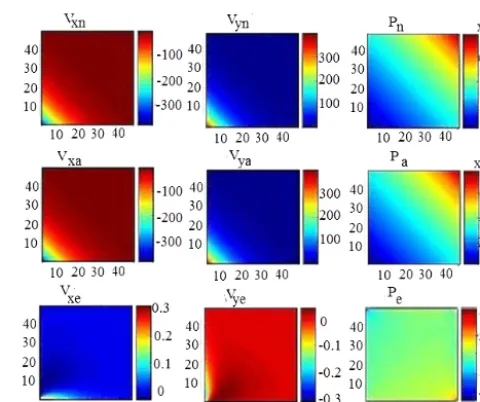
Figure 2. Distribution ofvx,vyandP; 2-D case, linearly varying viscosity, high-viscosity contrast (η2=η3=100),vxe=vxn−vxa, vye=vyn−vya,Pre=Prn−Pra.
Figure 3. Logarithm of the relative error (logE) via logarithm of the grid step (logH); 2-D case, linearly varying viscosity, high-viscosity contrast (η2=η3=100); blue lines – pressure, green lines – vx, black lines – vy; solid lines –L1-error, dashed lines –L∞-error, solid dotted line –L2-error.
Figure 4. Distribution of viscosityηand densityρ; 2-D case, ex-ponentially varying viscosity, high-viscosity contrast (η2=η3= 100).
4.1 2-D example
4.1.1 Linearly varying viscosity
Consider a simple example of such flow in a rectangle : 0≤x≤xsize,0≤y≤ysize.We assume thatη=ax+by+c. We will mark the exact solution obtained in Sect. 2 as
vx,a, vy,a, Pa. It is the solution of the boundary problem in the rectanglewith the following conditions at the bound-ary∂= {x=0, x=xsize, y=0, y=ysize} :
vy|∂=vy,a, vx|∂=vx,a.
Let us compute the velocity and the pressure by the finite-difference scheme. The corresponding solution is marked as
vx,n, vy,n, Pn. The deviation of these values from the exact
Figure 5. Distribution ofvx, vy and P; 2-D case, exponentially varying viscosity, high-viscosity contrast (η2=η3=100)vxe= vxn−vxa,vye=vyn−vya,Pre=Prn−Pra.
solution (vx,n−vx,a, vy,n−vy,a, Pn−Pa) is related to the error of the numerical scheme. We calculate the relative er-ror norms of three types:L∞, L1, L2for different viscosity contrasts, i.e., different values of the coefficients a, b. We test the program Stokes 2-D variable-viscosity 1 from Gerya (2010). Calculations show that the convergence is better for the case of low-viscosity contrast (cf., Supplement). The re-sults for high-viscosity contrast are presented in Figs. 1–3: Fig. 1 shows prescribed viscosity and density distribution, Fig. 2 presents the pressure and the velocity components dis-tributions and Fig. 3 contains the plot of the relative errors via the grid resolutions in logarithmic scale. The viscosity contrast, i.e., the values of the coefficients in the expression for the viscosity, is determined by the given values of the viscosity at three corners of the model rectangle. . .The value of the viscosity at the initial rectangle corner is 1, whereas
η2 andη3 are the prescribed values of the viscosity at the upper-left and lower-right corner, respectively. In all figures “n” means “numerical solution”, “a” means “analytical so-lution” (benchmark).
For the case of linearly varying viscosity we made calcu-lations for the following system parameters:
xsize=ysize=1, Gx=0, Gy=10, η1=1, β1=1, β2=3×10³,
c=η1, a=(η3−η1)/xsize, b=(η2−η1)/ysize,
ρ=β1(ax+by+c)+β2.
Figure 6. Logarithm of the relative error (logE) via logarithm of the grid step (logH); 2-D case, exponentially varying viscos-ity, high-viscosity contrast (η2=η3=100); blue lines – pressure, green lines –vx, black lines –vy; solid lines –L1-error, dashed lines –L∞-error, solid dotted lines –L2-error.
Figure 7. Distribution of viscosityηand exponentially varying vis-cosity, high-viscosity contrast (η2=η3=η4=100).
To describe in more details the dependence of the error on the viscosity contrast, we fill tables with errors for different values ofη2, η3(see Appendix, Tables A1–A3).
4.1.2 Exponentially varying viscosity
The case of exponentially varying viscosity is treated analo-gously. In order to make a comparison with the case of lin-early varying viscosity, we take the same system parameters (geometrical size, gravitational terms and the dependence of the density on the viscosity) with the same viscosity contrast
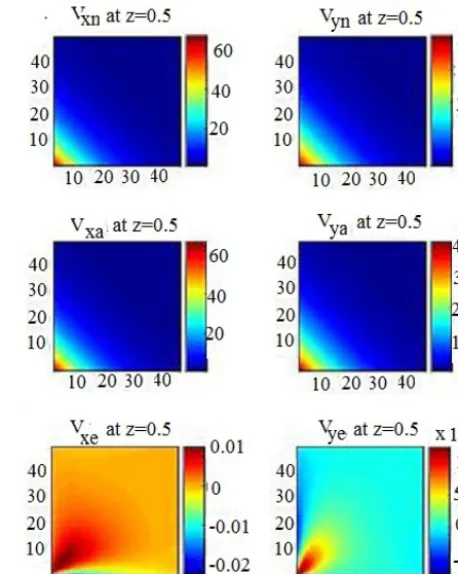
Figure 8. Distribution ofvxandvy; 3-D case, exponentially varying viscosity, high-viscosity contrast (η2=η3=η4=100)vxe=vxn− vxa,vye=vyn−vya.
(i.e., the values of the viscosity at the rectangle corners):
C=η1, a=(log(η3)−log(η1))/xsize,
b=(log(η2)−log(η1))/ysize,
η=Cexp(ax+by), ρ=β1η+β2,
xsize=ysize=1,
Gx=10, Gy=10,
η1=1, β1=1, β2=3×10³.
We examine two cases (low- and high-viscosity contrasts, cf. Supplement). Figures 4–6 present the results for high-viscosity contrast. There are some similarities with the pre-vious case. In particular,L∞error norm gives us the max-imum relative error value among the three considered error norms. However, peculiarities are more interesting. Namely, the numerical scheme works essentially better for the case of exponentially varying viscosity than for linearly varying viscosity. We observe good convergence for both low- and high-viscosity contrasts (compare Figs. 3 and 6, also cf. Sup-plement).
Figure 9. Distribution ofvzandP; 3-D case, exponentially vary-ing viscosity, high-viscosity contrast (η2=η3=η4=100),vze= vzn−vza,Pre=Prn−Pra.
4.2 3-D example
One can note that benchmark solutions for the 3-D case are essentially more rare than for the corresponding 2-D situa-tion. It is, therefore, noteworthy that the suggested approach allows us to obtain such solutions for 3-D Stokes and conti-nuity equations. As earlier, we consider the cases of linearly and exponentially varying viscosity.
4.2.1 Linearly varying viscosity
The statement of the problem is analogous to the previ-ous case. In the 3-D space we consider a parallelepiped
: 0≤x≤xsize,0≤y≤ysize,0≤z≤zsize.We assume that
η=ax+by+cz+e. We will mark the exact solution ob-tained in Sect. 3 asvx,a, vy,a, vz,a, Pa. Due to the uniqueness theorem, it is the solution of the boundary problem in the par-allelepipedwith the following conditions at the boundary
∂= {x=0, x=xsize, y=0, y=ysize, z=0, z=zsize} :
vx|∂=vx,a, vy|∂=vy,a, vz|∂=vz,a.
Let us compute the velocity and the pressure numerically using chosen finite-difference algorithm. The correspond-ing numerical solution is marked asvx,n, vy,n, vz,n, Pn. The deviation of these values from the exact solution (vx,n− vx,a, vy,n−vy,a, vz,n−vz,a, Pn−Pa) is related to the
er-Figure 10. Logarithm of the relative error (logE) via logarithm of the grid step (logH); 3-D case, exponentially varying viscosity, high-viscosity contrast (η2=η3=η4=100); blue lines – pressure, red lines –vx, black lines –vy, green lines –vz; solid lines –L1 -error, dashed lines –L∞-error, solid dotted lines –L2-error.
ror of the numerical scheme. As in the 2-D case, we con-sider three error norms: L∞, L1, L2. We examine cases of low- and high-viscosity contrasts. Coefficientsa, b, c, ein the viscosity formula are determined by given viscosity values (η1=1, η2, η3, η4) at four adjacent parallelepiped vertices.
We choose the following system parameters:
e=η1, a=(η3−η1)/xsize,
b=(η2−η1)/ysize, c=(η4−η1)/zsize.
η=ax+by+cz+e, ρ=β1η+β2,
xsize=ysize=zsize=1,
Gx=10, Gy=10, Gz=0, η1=1, β1=1, β2=3×10³.
Results are presented in the Supplement. It should be men-tioned that the numerical procedure for the 3-D case takes es-sentially greater time than for the 2-D case. Qualitatively, the results are similar to that for the corresponding 2-D case. Bet-ter numerical convergence is again found for low-viscosity contrast.
4.2.2 Exponentially varying viscosity
The system parameters are chosen as follows:
C=η1, a=(log(η3)−log(η1))/xsize,
b=(log(η2)−log(η1))/ysize,
c=(log(η4)−log(η1))/zsize.
η=Cexp(ax+by+cz), ρ=β1η+β2,
xsize=ysize=zsize=1,
Gx=10, Gy=10, Gz=0, η1=1, β1=1, β2=3×10³,
The results are presented in Figs. 7–10 for the case of high-viscosity contrast. Similarly to 2-D results, the numerical procedure converges better for the exponentially varying vis-cosity than for the linearly varying visvis-cosity. The algorithm convergence, i.e., the dependence of the errors on the grid resolution is shown in Fig. 10.
5 Conclusions
In this paper, we developed new, specific analytical solutions for the 2-D and 3-D Stokes flows with both linearly and expo-nentially variable viscosity. We also demonstrated how these solutions can be converted into 2-D and 3-D test problems suitable for benchmarking numerical geodynamic codes. The main advantage of this new generalized approach is that large variety of benchmark problems can be easily generated, in-cluding relatively complex cases with open model bound-aries, non-vertical gravity and variable gradients of viscosity and density fields, which are not parallel to Cartesian axes. These solutions can be very useful for testing numerical al-gorithms aimed at modeling variable-viscosity mantle con-vection and lithospheric dynamics. Examples of respective 2-D and 3-D MatLab codes are provided with the paper.
The Supplement related to this article is available online at doi:10.5194/se-5-461-2014-supplement.
Acknowledgements. The work was made in the framework of Scientific and Technological Cooperation Programme Switzerland– Russia. This work was partially financially supported by the Government of Russian Federation (grant 074-U01), by the Ministry of Science and Education of the Russian Federation (GOSZADANIE 2014/190, Project 14.Z50.31.0031), by a grant of the Russian Foundation for Basic Research and grants of the President of Russia (state contracts 14.124.13.2045-MK and 14.124.13.1493-MK).
Appendix A: Error decreasing with decreasing grid res-olution
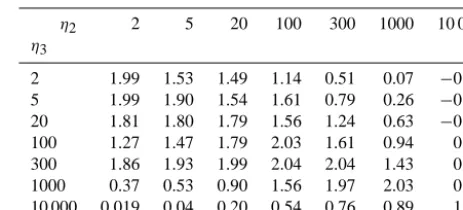
The dependence of the convergence on the viscosity con-trast is shown in the following tables. Namely, the viscosi-tiesη2, η3run through a set of values from 2 to 10 000. For each pair ofη2, η3we perform the benchmarking procedure described above and obtain the curve describing the depen-dence of the logarithm of the error norm on the logarithm of the grid resolution. The tangent of the slope angle of this curve gives us an input of the table. Full set of tables are given in the Supplement. Below, we show several examples of such tables.
Table A1. Tangent of the slope of the curve showing the dependence
of the logarithm ofL2-error for pressureP on the logarithm of the grid step for different viscosity contrasts. Linearly varying viscosity.
η2 2 5 20 100 300 1000 10 000 η3
2 1.42 1.14 1.24 0.86 0.46 0.08 −0.20 5 1.13 1.44 1.03 1.30 0.57 0.23 −0.16 20 1.23 1.03 1.39 1.27 0.83 0.43 −0.01 100 1.14 1.21 1.26 1.36 1.33 0.50 0.26 300 1.27 1.27 1.29 1.33 1.34 1.17 0.40 1000 0.56 0.70 1.03 1.24 1.31 1.36 0.39 10 000 −0.21 −0.19 −0.04 0.23 0.34 0.43 1.27
Table A2. Tangent of the slope of the curve showing the
depen-dence of the logarithm ofL2-error for velocity componentvxon the logarithm of the grid step for different viscosity contrasts. Lin-early varying viscosity.
η2 2 5 20 100 300 1000 10 000
η3
2 1.81 1.99 1.81 1.20 0.70 0.29 0.01 5 1.53 1.61 1.80 1.79 0.91 0.47 0.04 20 1.47 1.54 1.61 1.81 1.09 0.77 0.20 100 1.13 1.39 1.54 1.69 2.04 0.94 0.53 300 1.64 1.63 1.63 1.61 1.70 1.49 0.77 1000 0.56 0.77 1.23 1.57 1.60 1.15 0.90 10 000 −0.19 −0.13 0.01 0.41 0.69 0.96 0.88
Table A3. Tangent of the slope of the curve showing the
depen-dence of the logarithm ofL2-error for velocity componentvy on the logarithm of the grid step for different viscosity contrasts. Lin-early varying viscosity.
η2 2 5 20 100 300 1000 10 000 η3
2 1.99 1.53 1.49 1.14 0.51 0.07 −0.21 5 1.99 1.90 1.54 1.61 0.79 0.26 −0.19 20 1.81 1.80 1.79 1.56 1.24 0.63 −0.03 100 1.27 1.47 1.79 2.03 1.61 0.94 0.34 300 1.86 1.93 1.99 2.04 2.04 1.43 0.60 1000 0.37 0.53 0.90 1.56 1.97 2.03 0.74 10 000 0.019 0.04 0.20 0.54 0.76 0.89 1.23
A1 Linearly varying viscosity
Tables A1–A3 contain log rates ofL2error norm decreasing with decreasing grid resolution (the curve slope in Fig. 3 in the logarithmic scale) for different viscosity contrasts in the case of linearly varying viscosity. Calculations were made for the following system parameters:
xsize=ysize=1, Gx=0, Gy=10, η1=1, β1=102, β2=3×10³,
c=η1, a=(η3−η1)/xsize, b=(η2−η1)/ysize,
A2 Exponentially varying viscosity
Tables A4–6 contain log rates of L2 error norm decreasing with decreasing grid step (the curve slope in Fig. 6 in the log-arithmic scale) for different viscosity contrasts in the case of exponentially varying viscosity. The system parameters are the same as in the case of linearly varying viscosity with re-spective changes:
c=η1, a=(logη3−logη1)/xsize,
b=(logη2−logη1)/ysize,
ρ=β1cexp(ax+by)+β2.
Table A4. Tangent of the slope of the curve showing the
depen-dence of the logarithm ofL2-error for pressureP on the logarithm of the grid step for different viscosity contrasts. Exponentially vary-ing viscosity.
η2 2 5 20 100 300 1000 10 000 η3
2 1.46 1.03 1.20 1.47 1.56 1.53 1.40 5 1.03 1.13 1.23 1.39 1.53 1.51 1.39 20 1.13 1.24 1.31 1.46 1.51 1.46 1.31 100 1.27 1.39 1.39 1.46 1.43 1.37 1.23 300 1.37 1.41 1.39 1.40 1.37 1.31 1.19 1000 1.41 1.41 1.36 1.33 1.30 1.24 1.11 10 000 1.37 1.34 1.26 1.17 1.14 1.11 1.00
Table A5. Tangent of the slope of the curve showing the dependence
of the logarithm ofL2-error for velocity componentvxon the loga-rithm of the grid step for different viscosity contrasts. Exponentially varying viscosity.
η2 2 5 20 100 300 1000 10 000 η3
2 1.92 2.00 1.97 2.03 2.00 1.96 1.91 5 1.66 1.92 1.93 2.09 2.01 1.97 1.90 20 1.63 1.84 2.06 2.09 2.01 1.96 1.87 100 1.71 1.93 2.06 2.04 1.97 1.90 1.83 300 1.87 1.99 2.03 2.00 1.93 1.84 1.74 1000 1.93 2.00 2.03 2.00 1.93 1.84 1.74 10 000 1.76 1.89 1.96 1.94 1.90 1.83 1.67
Table A6. Tangent of the slope of the curve showing the dependence
of the logarithm ofL2-error for velocity componentvyon the loga-rithm of the grid step for different viscosity contrasts. Exponentially varying viscosity.
η2 2 5 20 100 300 1000 10 000 η3
References
Albers, M.: A local mesh refinement multigrid method for 3-D con-vection problems with strongly variable viscosity, J. Comput. Phys., 160, 126–150, 2000.
Blankenbach, B., Busse, F., Christensen, U. Cserepes, L., Gunkel, D., Hansen, U., Harder, H., Jarvis, G., Koch, M., Marquart, G., Moore, D., Olson, P., Schmeling H., and Schnaubelt, T.: A benchmark comparison for mantle convection codes, Geophys. J. Int., 98, 23–38, 1989.
Buiter, S. J. H., Babeyko, A. Y., Ellis, S., Gerya, T. V., Kaus, B. J. P., Kellner, A., Schreurs, G., and Yamada, Y.: The numerical sand-box: comparison of model results for a shortening and an ex-tension experiment, in: Analogue and Numerical Modelling of Crustal-Scale Processes, Geol. Soc., London, Special Publica-tions, 253, 29–64, 2006.
Busse, F. H., Christensen, U., Clever, R., Cserepes, L., Gable, C., Giannandrea, E., Guillon, L., Houseman, G., Nataf, H.-C., Ogawa, M., Parmentier, M., Sotin, C., and Travis, B.: 3-D convection at infinite Prandtl number in Cartesian geometry – a benchmark comparison, Geophys. Astro. Fluid, 75, 39–59, 1993.
Crameri, F., Schmeling, H., Golabek1, G. J., Duretz, T., Orendt, R., Buiter, S. J. H., May, D. A., Kaus, B. J. P., Gerya, T. V., and Tack-ley, P. J.: A comparison of numerical surface topography calcula-tions in geodynamic modelling: an evaluation of the “sticky air” method, Geophys. J. Int., 189, 38–54, 2012.
Dabrowski, M., Krotkiewski, M., and Schmid, D. W.: MIL-AMIN: MATLAB-based finite-element method solver for large problems, Geochem. Geophy. Geosy., 9, Q04030, doi:10.1029/2007GC001719, 2008.
Deubelbeiss, Y. and Kaus, B. J. P.: Comparison of Eulerian and La-grangian numerical techniques for the Stokes equations in the presence of strongly varying viscosity, Phys. Earth Planet. In., 171, 92–111, 2008.
Duretz, T., May, D. A., Gerya, T. V., and Tackley, P. J.: Dis-cretization errors and free surface stabilization in the finite difference and marker-in-cell method for applied geodynam-ics: a numerical study, Geochem. Geophy. Geosy., 12, Q07004, doi:10.1029/2011GC003567, 1–26, 2011.
Gerya, T.: Introduction to Numerical Geodynamic Modelling, Cam-bridge University Press, CamCam-bridge, 2010.
Gerya, T. V. and Yuen, D. A.: Characteristic-based marker-in-cell method with conservative finite-difference schemes for model-ing geological flows with strongly variable transport properties, Phys. Earth Planet. In., 140, 293–318, 2003.
Gerya, T. V. and Yuen, D. A.: Robust characteristics method for modeling multiphase visco-elasto-plastic thermo-mechanical problems, Phys. Earth Planet. In., 163, 83–105, 2007.
Gerya, T. V., May, D. A., and Duretz, T.: An adaptive staggered grid finite difference method for modeling geodynamic Stokes flows with strongly variable viscosity, Geochem. Geophy. Geosy., 14, 1200–1225, 2013.
Hager, B. H. and O’Connell, R. J.: A simple global model of plane dynamics and mantle convection, J. Geophys. Res., 86, 4843– 4867, 1981.
Ismail-Zadeh, A. and Tackley, P.: Computational Methods in Geo-dynamics, Cambridge University Press, Cambridge, 2010.
Kaus, B. J. P.: Factors that control the angle of shear bands in geody-namic numerical models of brittle deformation, Tectonophysics, 484, 36–47, 2010.
Kaus, B. J. P. and Becker, T. W.: Effects of elasticity on the Rayleigh–Taylor instability: implications for large-scale geody-namics, Geophys. J. Int., 168, 843–862, 2007.
Kaus, B. J. P. and Schmalholz, S. M.: 3-D Finite amplitude folding: implications for stress evolution during crustal and lithospheric deformation, Geophys. Res. Lett., 33, L14309, doi:10.1029/2011GC003567, 2006.
Lemiale, V., Muhlhaus, H.-B., Moresi, L. and Stafford, J.: Shear banding analysis of plastic models formulated for incompress-ible viscous flows, Phys. Earth Planetary Interiors, 171, 177–186, 2008.
Lobanov, I. S., Popov, I. Yu., Popov, A. I., and Gerya, T. V.: Nu-merical approach to the Stokes problem with high contrasts in viscosity, Appl. Mathemat. Comput., 235, 17–25, 2014. Moresi, L., Zhong, S., and Gurnis, M.: The accuracy of finite
ele-ment solutions of Stokes’ flow with strongly varying viscosity, Phys. Earth Planet. In., 97, 83–94, 1996.
Moresi, L., Dufour, F., and Mulhaus, H.-B.: A Lagrangian integra-tion point finite element method for large deformaintegra-tion modelin-gof viscoelastic geomaterials, J. Comput. Phys., 184, 476–497, 2003.
Popov, A. and Sobolev, S.: SLIM3D: a tool for three-dimensional thermomechanical modeling of lithospheric deformation with elasto-visco-plastic rheology, Phys. Earth Planet. In., 171, 55– 75, 2008.
Popov, I. Yu. and Makeev, I. V.: A benchmark solution for 2-D Stokes flow over cavity, Z. Angew. Math. Phys., 65, 339–348, 2014.
Ramberg, H.: Instability of layered system in the field of gravity, II, Phys. Earth Planet. In., 1, 448–474, 1968.
Revenaugh, J. and Parsons, B.: Dynamic topography and gravity anomalies for fluid layers whose viscosity varies exponentially with depth, Geophys. J. Int., 90, 349–368, 1987.
Schmeling, H., Babeyko, A. Y., Enns, A., Faccenna, C., Funi-ciello, F., Gerya, T. V., Golabek, G. J., Grigull, S., Kaus, B. J. P., Morra, G., Schmalholz, S. M., and van Hunen, J.: A benchmark comparison of spontaneous subduction models – towards a free surface, Phys. Earth Planet. In., 171, 198–223, 2008.
Schmid, D. V. and Podladchikov, Yu. Yu.: Analytical solutions for deformable elliptical inclusions in general shear, Geophys. J. Int., 155, 269–288, 2003.
Stadler, G., Gurnis, M., Burstedde, C., Wilcox, L. C., Alisic, L., and Ghattas, O.: The dynamics of plate tectonics and mantle flow: from local to global scales, Science, 329, 1033–1038, 2008. Tackley, P. J.: Modelling compressible mantle convection with large
viscosity contrasts in a three-dimensional spherical shell using the yin-yang grid, Phys. Earth Planet. In., 171, 7–18, 2008. Tackley, P. J. and King, S. D.: Testing the tracer ratio
method-for modeling active compositional fields in mantle con-vection simulations, Geochem. Geophy. Geosys., 4, 8302, doi:10.1029/2001GC000214, 2003.
Thieulot, C.: FANTOM: two- and three-dimensional numerical modelling of creeping flows for the solution of geological prob-lems, Phys. Earth Plane. Int., 188, 47–68, 2011.
indentation problems, J. Geophys. Res., 113, B12207, doi:10.1029/2008JB005591, 2008.
Torrance, K. E. and Turcotte, D. L.: Thermal convection with large viscosity variations, J. Fluid Mech., 47, 113–125, 1971. Turcotte, D. L. and Schubert, G.: Geodynamics, Cambridge
Univer-sity Press, Cambridge, 2002.
van Keken, P. E., King, S. D., Schmeling, H., Christensen, U. R., Neumeister, D., and Doin, M.-P.: A comparison of methods for the modeling of thermochemical convection, J. Geophys. Res.-Sol. Earth., 102, 22477–22495, 1997.
van Keken, P. E., Currie, C., King, S. D., Behn, M. D., Cangleon-cle, A., He, J., Katz, R. F., Lin, S.-C., Parmentier, E. M., Spiegel-man, M., and Wang, K.: A community benchmark for subduction zone modeling, Phys. Earth Planet. In., 171, 187–197, 2008.
Zhong, S.: Analytic solutions for Stokes flow with lateral variations in viscosity, Geophys. J. Int., 124, 18–28, 1996.
Zhong, S. and Gurnis, M.: The role of plates and temperature-dependent viscosity in phase change dynamics, J. Geophys. Res., 99, 15903–15917, 1994.