SRef-ID: 1607-7946/npg/2005-12-827 European Geosciences Union
© 2005 Author(s). This work is licensed under a Creative Commons License.
Nonlinear Processes
in Geophysics
Hysteresis-controlled instability waves in a scale-free driven current
sheet model
V. M. Uritsky1and A. J. Klimas2
1Institute of Physics, St. Petersburg State University, Russia
2Code 692, NASA/Goddard Space Flight Center, Greenbelt, MD, USA
Received: 17 May 2005 – Revised: 12 July 2005 – Accepted: 12 July 2005 – Published: 20 September 2005 Part of Special Issue “Nonlinear and multiscale phenomena in space plasmas”
Abstract. Magnetospheric dynamics is a complex multiscale process whose statistical features can be successfully re-produced using high-dimensional numerical transport mod-els exhibiting the phenomenon of self-organized criticality (SOC). Along this line of research, a 2-dimensional driven current sheet (DCS) model has recently been developed that incorporates an idealized current-driven instability with a re-sistive MHD plasma system (Klimas et al., 2004a, b). The dynamics of the DCS model is dominated by the scale-free diffusive energy transport characterized by a set of broad-band power-law distribution functions similar to those gov-erning the evolution of multiscale precipitation regions of en-ergetic particles in the nighttime sector of aurora (Uritsky et al., 2002b). The scale-free DCS behavior is supported by localized current-driven instabilities that can communicate in an avalanche fashion over arbitrarily long distances thus producing current sheet waves (CSW). In this paper, we de-rive the analytical expression for CSW speed as a function of plasma parameters controlling local anomalous resistiv-ity dynamics. The obtained relation indicates that the CSW propagation requires sufficiently high initial current densi-ties, and predicts a deceleration of CSWs moving from inner plasma sheet regions toward its northern and southern bound-aries. We also show that the shape of time-averaged current density profile in the DCS model is in agreement with steady-state spatial configuration of critical avalanching models as described by the singular diffusion theory of the SOC. Over shorter time scales, SOC dynamics is associated with rather complex spatial patterns and, in particular, can produce bi-furcated current sheets often seen in multi-satellite observa-tions.
Correspondence to: V. M. Uritsky
1 Introduction
Earth’s magnetosphere is a driven spatially extended nonlin-ear system whose response to solar wind drive encompasses exceptionally broad ranges of temporal and energy scales. Statistical features of this response are described by robust power-law relations characteristic of critical self-organized avalanching systems (Consolini, 1997; Uritsky et al., 2002b, 2003). It has been suggested (Chapman et al., 1998; Uritsky and Pudovkin, 1998; Klimas et al., 2000) that the avalanch-ing system of the magnetosphere resides in the magneto-tail plasma sheet and is associated with collective behavior of multiple sporadic localized reconnections (Chang, 1999) which are known to appear during all phases of the magne-tospheric substorm development (Angelopoulos et al., 1992; Sergeev et al., 1999; Nakamura et al., 2001; Sergeev, 2004).
slightly below its threshold for excitation: Q (|J|)=
Dmin, |J| < βJc
Dmax, |J| > Jc
(1) ∂D (x, z, t )
∂t =
Q (|J|)−D τ
Here J≡Jy is the y-component of the current density
de-scribing plasma sheet dynamics in thex zplane,Jc– critical
current density,β<1 andτ – some constant parameters. At each spatial location, the quantityQcan take one of two val-ues, Dmax or DminDmax, depending on J, and does not
change within the interval[βJc, Jc].
The hysteretic behavior of the anomalous resistivity is ex-pected to appear in various physical scenarios of current-driven instability. In particular, it may accompany a gener-ation of the electromagnetic wave field in the vicinity and above the ion gyrofrequency that can provide the anoma-lous resistivity necessary to initiate the magnetic reconnec-tion (Yoon and Lui, 1996). As numerical simulareconnec-tions on the DCS model show, the hysteresis has several important consequences. At smallest spatial scales of the order of grid spacing, it influences nonlinear interactions of adjacent cur-rent sheet elements leading to their low-dimensional chaotic behavior characterized by fractional correlation dimension (Uritsky et al., 2002a). At largest scales, it produces global loading-unloading dynamics (Klimas et al., 2004a) reminis-cent of the substorm cycle of Earth’s magnetosphere. In the intermediate range of spatial scales, the DCS dynamics is dominated by scale-free diffusive energy transport character-ized by a set of broadband power-law distribution functions (Klimas et al., 2004b) similar to those observed in the be-havior of multiscale magnetospheric perturbations (Uritsky et al., 2002b).
The scale-free current sheet turbulence implies that in-dividual current filaments can communicate over arbitrar-ily long distances within the available range of scales im-posed by grid spacing and boundary conditions. The under-lying mechanism of such communications manifesting them-selves in current sheet waves (CSW) revealed numerically in DCS simulations (Klimas et al., 2004b) is strongly nonlin-ear. CSWs are active solitary waves accompanied by self-consistent propagation of unstable current sheet regions in the form of moving spatially localized excitations. Until now, however, this intriguing phenomenon has not been investi-gated on a quantitative basis. The present paper is focused on this issue which can be of interest for both theoretical and experimental studies of plasma sheet dynamics. Based on a coarse-grained representation of the magnetic diffusion equation, we derive the expression for CSW speed as a func-tion of hysteresis parameters. The derived relafunc-tion indicates that under certain conditions, current-driven instabilities can propagate over considerable using the free energy accumu-lated in DCS. We demonstrate that such propagation requires sufficiently high initial current densities, and predict a decel-eration of CSWs initiated in the vicinity of the neutral plane and moving toward northern and southern magnetotail lobes. We also show that the shape of time-averaged current density
profile in the DCS model is consistent with steady-state spa-tial configuration of critical avalanching models as described by the singular diffusion theory of self-organized criticality. The results obtained are confirmed by numerical simulations and provide new clues for experimental exploration of mul-tiscale plasma sheet dynamics.
2 Results and discussion
The standard MHD description of spatiotemporal evolution of the current density takes into account the diffusion of the magnetic field lines due to the anomalous resistivity mech-anism as well as the plasma convection (Priest and Forbes, 2000):
∂J ∂t =
c2 4π
∇2(η (J) J)− ∇21
c(V ×B)
(2) It has been shown (Klimas et al., 2004b) that in order to re-produce the broadband scale-free turbulent plasma dynam-ics, the magnetic diffusion should be controlled by very thin current sheets created due to highly nonlinear dependence (Eq. 1) of the diffusion coefficient on local current values. In numerical simulations on the DCS model, the thickness of such transient current sheets appears to be of the order of grid spacing. Our main task will be to deduce the propa-gation speed of such current sheets as a function of plasma parameters.
According to the previous simulation results, the hysteresis-controlled current sheet waves propagate both in bothx andzdirection and are associated with spatial redis-tribution ofJy component of the electric current. It has also
been found that the CSW speedvCSmainly depends on the
z coordinate. On average, vCS gradually decreases as the
excitations moves from the central planez=0 toward upper and lower boundaries located at z=±Lz, and tend to stop
at some small but nonzero distance from the boundaries. To describe these effects, consider a response of the DCS model to a localized perturbation described by the following initial conditions:
D (x, z, t =0)≡Dmin'0,
J (x, z, t=0) > Jc
Q (x, z, t =0)=Dmax
z∈(z0−λ/2, z0+λ/2)
J (x, z, t=0) < β Jc
Q (x, z, t =0)=Dmin
−in all other regions
(3)
Therefore, we assume that at timet=0, the values of the dif-fusion coefficient throughout the system are close to zero, and that the switching parameterQis also negligibly small everywhere except for a thin flat region centered at z=z0
where the current densityJ≡Jyhas just exceeded the critical
valueJc. By dividing the plasma volume into equally spaced
thin layers parallel to the neutral DCS plane, and replacing continuous spatial derivatives with finite differences, Eq. (2) can be reduced to the coupled system of ordinary differential equations
d Ji
dt =(Di−1Ji−1+Di+1Ji+1−2DiJi)
.
i= −Lz/λ, ..., Lz/λ , (4)
in which λis the thickness of current sheet layers indexed by i. Since the instability excitation is a sporadic local-ized phenomenon predominantly controlled by the magnetic diffusion (Klimas et al., 2000), we omitted the convective term. Denote the active current layerz∈(z0−λ/2, z0+λ/2)
withi=kand assign the valueJ0<β Jcto the initial current
density in the adjacent (k+1-th) current layer. For simplic-ity, we shall also assume that the diffusion fluxes in k− 1-th andk-th layers are linearly related through the condition Dk−1Jk−1≈ζ DkJk, withζ∈(0, 1) being a coupling constant.
Using these assumptions, the system given by Eq. (4) can be rewritten for the chosen initial configuration as
d Jkdt=(ζ −2) DkJkλ2,
d Jk+1dt=DkJkλ2.
(5) The obtained equations provide a description of current density redistribution between active (J >Jc) and quiet
(J <β Jc)current layers. During this interaction, the current
density of thek-th layer gradually decreases making the cur-rentJk+1 to increase (in the continuum limit, the opposite
tendencies inJk andJk+1dynamics are due to the opposite
signs of second spatial derivatives in these current layers). Equations (5) are only valid until the time instantt=t1at
whichJk+1becomes greater thanJc. This limitation does not
affect our calculation of the CSW speed since we are focused only on timest≤t1, which allows us to estimatevCSby the
ratioλ/t1without analyzing the subsequentJk+1evolution.
The solution to Eq. (5) depends on nonlinear dynamics of the diffusion coefficientDkwhich behaves differently before
and after the time instantt0when the currentJkdrops below
theβ Jc level. Assuming that the excitation transfer timet1
is much smaller than the characteristic timeτ of the diffu-sion coefficient relaxation, the evolution ofDk as specified
by Eq. (1) can be approximately described as
Dk=
(
Dmax 1−et/τ' Dmaxτ t t ≤t0,
D (t0) e−(t−t0)/τ ' Dmaxτ t0 t > t0,
(6) Inserting Eq. (6) into Eq. (5) and applying the initial condi-tions specified above, the analytic expressions for time evo-lution of current densities in the interacting layers can easily be obtained:
t≤t0:
Jk=Jce
−(2−ζ )Dmax
2λ2τ×t 2
Jk+1=J0+2J−cζ
1−e−(2−ζ )
Dmax 2λ2τ×t
2
,
t >t0:
Jk=β−1Jce
−(2−ζ )Dmax
λ2τ t0×t
Jk+1=J0+2J−cζ
1−β−1e−(2−ζ )
Dmax λ2τ t0×t
. (7)
Timet0 entering the above relations is calculated from the
conditionJk(t=t0)=βJcwhich provides
t0=λ
s
2 ln(1/β) τ (2−ζ ) Dmax
, (8)
0.1 1 10
0 0.2 0.4 0.6 0.8 1
J0 / Jc
VCS
ζ=0.25 ζ=0.50 ζ=0.75 ζ=1.00
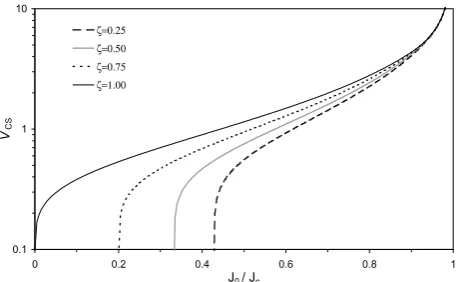
Fig. 1. Analytic dependence of the speed vCS of current sheet
waves (CSW) on normalized initial current density plotted for dif-ferentζvalues. In each case, CSW propagation condition is given by the inequalityJ0/Jc<(1−ζ )/(2−ζ ).
The excitation transfer timet1required to switch the k+
1-th current layer into 1-the excited state wi1-thQ=Dmaxcan be
deduced from the condition
Jk+1(t=t1)=Jc. (9)
In general case, this time may be less or greater thant0. If
t1≤t0, thek+1-th layer switches to the unstable state while
the diffusion coefficientDk continues to grow, and its
dy-namics is described by the first pair of the expressions given in Eq. (7). Otherwise,Dkis roughly constant, and the second
pair of expressions must be used. After the timet1has been
estimated, the CSW speed is evaluated using the relation vavl =
λ
t1(J0, Jc, β, τ, Dmax, ζ )
(10) giving a coarse-grained representation ofvCS as a function
of the initial current density, hysteresis parameters as well as the coupling constantζ. Using this approach, we have found that the CSW speed is given by the following formulas:
vCS=
r (2−
ζ )Dmax
2τln
1 1−(2−ζ )(1−J0/Jc)
, 1− 1−β 2−ζ≤
J0
Jc<1
√
2(2−ζ )Dmaxln(1/β)/τ
ln 1/β
1−(2−ζ )(1−J0/Jc)
, 1−ζ 2−ζ≤
J0
Jc<1−
1−β 2−ζ
(11)
These relations indicate that the wave speed goes down with the initial current density. AsJ0 decreases, the expression
under the logarithm sign in the denominator of the second branch of the solution (11) goes to zero, and the propagation speed becomes negligibly small. This condition corresponds to the limit
J0→ +Jc
1−ζ
2−ζ
(12) By substituting differentζ values, we have built a family of vCS(J0)dependences containing deceleration regions of
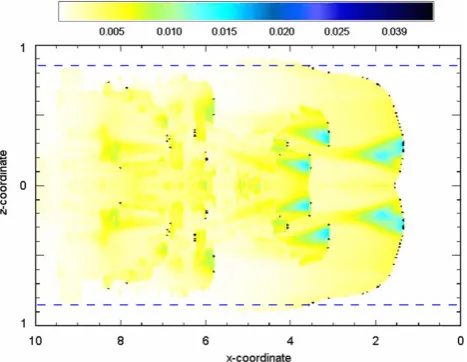
Fig. 2. A sample snapshot of anomalous resistivity distribution in the 2-D driven current sheet model (Klimas et al., 2004b). The SCW propagation region is limited by dashed horizontal lines correspond-ing to the propagation condition described by Eq. (12). Black dots are the unstable grid sites where the excitation conditionQ=Dmax
is fulfilled.
CSW can propagate in regions with the arbitrarily low initial current density. In contrast, for very smallζ, the deceleration region is fairly wide, and CSW can only penetrate into spatial domains where the current is sufficiently high (J0≥0.5Jc).
To verify the obtained formulas, we have studied numer-ical runs of the 2-D driven current sheet model developed by (Klimas et al., 2004b). It has been found that usually, the coupling constant of the DCS model is close to the value ζ≈0.9, which leads to the CSW propagation condition
J0
Jc
> 0.1. (13)
According to our simulation results, the spatial domain in which the instability waves can freely propagate does have a limited width in z direction corresponding to the region where initial current densities exceed the level 0.1Jc
pre-dicted by Eq. (13). Outside this region, the CSW mechanism of excitation transfer turns off, and current sheet dynamics is dominated by plasma convection. The CSW propagation re-gion approximately coincides with the inner turbulent rere-gion of the current sheet where unstable sites withQ > Dmaxcan
exist, the effect clearly seen in our simulations (Fig. 2). We have also found that the transition between “fast” and “slow” solutions given by Eq. (11) should occur atJ0/Jc≈0.9. Such
intense current densities are normally generated in the vicin-ity of the neutral plane.
The range of CSW speeds observed in simulations is also in a reasonable agreement with the theoretical result. To eval-uate this range, we have investigated the motion of anoma-lous resistivity region boundaries using the double threshold condition
Sdiff(x, z, t ) > a ∧ ∂Sdiff(x, z, t )/∂t > b, (14)
Fig. 3. Examples of spatiotemporal CSW propagation on thez t
plane (x=2.5). Black dots show the grid sites satisfying Eq. (14) with the parametersa=1.5×10⁻⁴,b=8.0×10⁻⁴. Approximate es-timates of speed values are given for each wave.
whereSdiff=|(c/4π ) ηJ×B|is the magnitude of the
diffu-sive component of the Poynting flux,a andb are constants thresholds adjusted empirically to provide a reliable repre-sentation of CSW fronts. According to Eq. (14), we were looking for the places where the diffusive energy flux ex-ceeded some constant value, and, at the same time, its time derivative was above some other value. Applying this crite-rion, spatiotemporal CSW traces have been visualized and a speed of about 200 waves has been estimated. It has been found that depending on CSW position and the local current density,vCStake values from the interval between 0 and 3.0
(Fig. 3). This range is consistent with the range of speeds cal-culated based on the relation (11) usingζ=0.9 and varying J0parameter according to simulation results.
The solution (11) is not complete in the sense that it ex-plicitly depends on the initial currentJ0which in its turn is
defined by the prehistory of local magnetic field dynamics. In order to obtain the expression for average SCW speed at different spatial locations in a closed form, a time-averaged current density profileJ (z)characterizing steady-state cur-rent sheet configuration has been chosen as a simplest sub-stitute forJ0. Functional form ofJ (z)can be obtained using
the results of the singular diffusion theory of self-organized critical avalanching models. It has been shown (Montakhab and Carlson, 1998; Carlson et al., 1990) that the long-term spatiotemporal evolution of such models can be described by the equations
∂ ρ
∂ t = ∇ Dsng(ρ) ∇ρ
, Dsng(ρ)=
1 (ρc−ρ)φ
, (15)
in whichρ is the relevant dynamical variable representing the quantity transported by the avalanche process,Dsng– the
singular diffusion coefficient diverging asρ approaches the instability thresholdρc,φ– the order of the pole controlling
the singularity ofDsngin the self-organized critical regime.
In certain cases, the singularity orderφcan be used as a free parameter allowing one to adjust the theory of singular diffu-sion to systems differing in local interaction rules, distribu-tion of energy states and other local characteristics.
It has been found (Carlson et al., 1990) that one-dimensional self-organized critical systems satisfying asym-metric boundary conditions
0.00 0.05 0.10 0.15 0.20 0.25 0.30
0 0.2 0.4 0.6 0.8 1
z
J
(z
)
φ=4 φ=5 φ=6 numerical
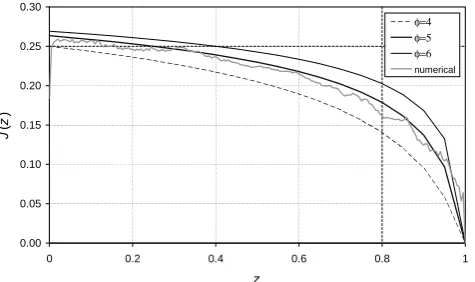
Fig. 4. Numerically estimated steady-state current density configu-ration in the 2-D current sheet model (averaging during one repre-sentative unloading interval) as compared to the singular diffusion solution presented by Eq. (21) with three different singularity orders φ.
are characterized by the following universal asymptotic con-figuration att→∞:
ρ (r, φ>1)=ρc−
h
ρc−(φ−1)+f0 (φ−1) (1−r)
i−φ−11
(17) in whichris the spatial coordinate. The conditions (16) cor-respond to open boundary atr=1 and closed boundary at r=0 where the fixed diffusive flux f0 is applied. In case
when the parameterf0is unknown, it can be estimated
self-consistently from the boundary value of the dynamical vari-ableρ:
f0=
[ρc−ρ (0)]−( φ−1)−ρc−( φ−1)
φ−1 (18)
The singular diffusion formalism has been successfully ap-plied to various avalanching models, including cellular-automaton models of critical gradients (Carlson et al., 1990; Montakhab and Carlson, 1998) used as a discrete proto-type for the DCS model (Lu, 1995; Klimas et al., 2000). In contrast to the nonlinear diffusion Eq. (1) describing a small-scale hysteretic evolution of anomalous resistivity, the solutions to Eq. (15) represent large-scale self-organization of spatial distribution of system’s activity accompanying its evolution toward the critical state.
In the DCS model, the closest analogue toρis the slowly varying current density configuration obtained by averaging over long intervals of time including many current driven in-stabilities. Let us show that the boundary conditions (16) sat-isfy the dependence of DCS current density onzcoordinate. First of these conditions is correct since the current density is always zero atz=1. The applicability of the second con-dition is not so obvious since the current is not fixed atz=0, and its time average appears to be a result of current sheet self-organization toward the stationary critical state in which the rate of the annihilation of oppositely directed magnetic fields along the neutral line is balanced by the rate at which the magnetic flux is pumped into the simulation box (Uritsky
0 0.2 0.4 0.6 0.8 1 1.2 1.4 1.6
0 0.1 0.2 0.3 0.4 0.5 0.6 0.7 0.8 0.9 1
z VCS
ζ=0.25 ζ=0.50 ζ=0.75 ζ=1.00
Fig. 5. Dependence of characteristic CSW speed on the
z-coordinate at several different values of coupling parameterζ plot-ted using the average current density profile described by Eq. (21) calculated based on the singular diffusion approach.
et al., 2002a). At small temporal scale of the order of the relaxation time of individual grid sites, current density vari-ations along the linez=0 have a form of asymmetric pulses with rather steep left fronts evolving on the time scalet0, and
much flatter right fronts reflecting exponential relaxation of the diffusion coefficient with the characteristic timeτ. Ne-glecting the ascending fronts of the current density pulses and assuming that the mean frequency of pulses is of the or-der of 1/τ, the average value ofJat the positionz=0 can be approximately estimated as
hJ (z=0)it ' 1 τ
τ
Z
0
Jce−t /τdt=(1−1/e) Jc, (19)
which after substitutionρc≡Jcleads to the following
depen-dence of the boundary parameterf0on the singularity order:
f0=
Jc−( φ−1) eφ−1−1
φ−1 (20)
Inserting the obtained formula into Eq. (17), we arrive at the asymptotic expression for steady-state current density distri-bution in thezdirection:
ρ(r, φ)≡J (z, φ)=Jc
1−h1+eφ−1−1(1−z)
i−φ−11
(21) By comparing the obtained solution with the results of nu-merical simulations on the DCS model, it has been found that Eq. (21) provides the best fit to average current density pro-files at the singularity orderφ=5 (Fig. 4). Using this value and inserting Eq. (21) into Eq. (11), finally we obtain:
vCS(z)'
q
2(2−ζ ) Dmax ln(1/β)τ
ln 1/β
1−(2−ζ )(1+53.6(1−z))−1/4
. (22)
Jc(1−(1−β)/(2−ζ )) at which the “fast” solution comes
into play. Since we have replaced the initial currentJ0with
the time-averaged quantity J, expression (22) can be con-sidered as the estimation of characteristic CSW speeds at different z-locations (Fig. 5). The fact that actual (instan-taneous) initial current densities may be essentially higher than J leads to underestimation of vCS values of certain
waves. On the contrary, if the actual current density is be-lowJ, the CSW speed appears to be below the character-istic value predicted by Eq. (22). As a result, some of the CSWs observed in numerical simulations (Fig. 3) propagate faster or slower than expected based on Eq. (22). On average, however, the obtained relation provides a reasonable approx-imation to spatialvCSdependence averaged over sufficiently
long time intervals.
3 Conclusions
The propagating current sheets seem to represent a new type of cooperative plasma behavior which may play an important part in the dynamics of the magnetotail plasma sheet. Basic signatures of this type of behavior have been first described in (Klimas et al., 2000) and subsequently generalized to a more complete MHD system in (Klimas et al., 2004b). Our analysis has generated two groups of results that provide a more penetrating insight into this phenomenon in frames of the resistive MHD approximation:
1. Analytical relation for CSW speed as a function of plasma parameters controlling local anomalous resistiv-ity dynamics has been derived that explains several ef-fects discovered earlier in numerical simulations on the 2-D DCS model, such as the dependence of the CSW speed on they-component of the electric current lead-ing to wave deceleration in the vicinity of lower and upper current sheet boundaries, as well as the existence of spatial regions in which CSWs cannot propagate. 2. Asymptotic expression for global steady-state current
density distribution has been found that characterizes average spatial configuration of the turbulent plasma sheet in the vicinity of self-organized critical state. Us-ing this expression, the characteristic speed of current sheet waves as a function of distance from the central neutral plane has been estimated.
Physical mechanism of current sheet waves involves co-operative evolution of multiple current-driven instabilities at the spatial scale of kinetic processes underlying hysteretic response of the anomalous resistivity assumed in the DCS model. This scale defines rather thin current layers which can propagate over considerable distances and create conditions for scale-free evolution of anomalous resistivity regions and multiscale energy dissipation. Thin current sheet structures resembling MHD solutions with a plain singularity have re-ceived a good deal of attention during the last decade. Many theoretical models of thin current sheets have been developed
showing an important role of such structures in magnetic en-ergy storage and release during the substorm development (see e.g. Zelenyi et al., 2002, 2004; Sitnov et al., 2004 and references therein). In additional to these findings, our anal-ysis strongly suggests that under certain conditions, thin cur-rent sheets can also move in a form of solitary self-supporting waves giving rise to complex scale-invariant spatial patterns of activity in vast portions of the magnetotail. Existence of such waves Earth’s magnetosphere can, in principle, be ver-ified using measurement results of multiprobe missions ca-pable to resolve fine 3D features of plasma dynamics and presents a challenging task for future research.
Acknowledgements. The authors are grateful to Dimitris
Vas-siliadis for interesting and productive discussions. The work of V.Uritsky was partly supported by RFBR grant 04-05-64938 and Intergeophysica Russian research program.
Edited by: A. C. L. Chian Reviewed by: two referees
References
Angelopoulos, V., Baumjohann, W., Kennel, C. F., Coroniti, F. V., Kivelson, M. G., Pellat, R., Walker, R. J., Luhr, H., and Paschmann, G.: Bursty Bulk Flows in the Inner Central Plasma Sheet, J. Geophys. Res. – Space Physics, 97, A4, 4027–4039, 1992.
Bak, P., Tang, C., and Wiesenfeld, K.: Self-Organized Criticality, Phys. Rev. A, 38, 1, 364–374, 1988.
Carlson, J. M., Chayes, J. T., Grannan, E. R., and Swindle, G. H.: Self-organized criticality and singular diffusion, Phys. Rev. Lett., 65, 20, 2547–2550, 1990.
Chang, T.: Self-organized criticality, multi-fractal spectra, sporadic localized reconnections and intermittent turbulence in the mag-netotail, Physics of Plasmas, 6, 11, 4137–4145, 1999.
Chapman, S. C., Watkins, N. W., Dendy, R. O., Helander, P., and Rowlands, G.: A simple avalanche model as an analogue for magnetospheric activity, Geophys. Res. Lett., 25, 13, 2397– 2400, 1998.
Consolini, G.: Sandpile cellular automata and magnetospheric dy-namics, in: Cosmic Physics in the Year 2000, edited by: Aiello, S. E. A., SIF, Bologna, 123–126, 1997.
Klimas, A. J., Uritsky, V. M., and Baker, D. N.: Scale-free avalanch-ing and loadavalanch-ing-unloadavalanch-ing cycle in a driven current-sheet model, in: 7th International Conference on Substorms (ICS-7), edited by: Pulkkinen, T., Finnish Meteorological Institute, Levi, Fin-land, 15–22, 2004a.
Klimas, A. J., Uritsky, V. M., Vassiliadis, D., and Baker, D. N.: Reconnection and Scale-Free Avalanching in a Driven Current-sheet Model, J. Geophys Res. – Space Physics, 109, A2, A02218, 1–14, 2004b.
Klimas, A. J., Valdivia, J. A., Vassiliadis, D., Baker, D. N., Hesse, M., and Takalo, J.: Self-organized criticality in the substorm phe-nomenon and its relation to localized reconnection in the magne-tospheric plasma sheet, J. Geophys. Res. – Space Physics, 105, A8, 18 765–18 780, 2000.
Montakhab, A. and Carlson, J. M.: Avalanches, transport, and local equilibrium in self-organized criticality, Phyical Review E, 58, 5, 5608–5619, 1998.
Nakamura, R., Baumjohann, W., Schodel, R., Brittnacher, M., Sergeev, V. A., Kubyshkina, M., Mukai, T., and Liou, K.: Earth-ward flow bursts, auroral streamers, and small expansions, J. Geophys. Res. – Space Physics, 106, A6, 10 791–10 802, 2001. Priest, E. and Forbes, T.: Magnetic reconnection: MHD theory and
applications, 590 pp., Cambridge University Press, Cambridge, 2000.
Sergeev, V. A.: Bursty bulk flows and their ionospheric footprints, in: Multiscale Processes in the Earth’s Magnetosphere: from In-terball to Cluster, edited by: Nemecek, Z., Kluwer Academic Publishers, Netherlands, 289–306, 2004.
Sergeev, V. A., Liou, K., Meng, C. I., Newell, P. T., Brittnacher, M., Parks, G., and Reeves, G. D.: Development of auroral stream-ers in association with localized impulsive injections to the inner magnetotail, Geophys. Res. Lett., 26, 3, 417–420, 1999. Sitnov, M. I., Lui, A. T. Y., Guzdar, P. N., and Yoon, P. H.:
Current-driven instabilities in forced current sheets, J. Geophys. Res. – Space Physics, 109, A03205, 1–15, doi:10.1029/2003JA010123, 2004.
Uritsky, V. M., Klimas, A. J., and Vassiliadis, D.: Multiscale dy-namics and robust critical scaling in a continuum current sheet model, Phys. Rev. E, 65, 4, 046113-1–046113-5, 2002a.
Uritsky, V. M., Klimas, A. J., and Vassiliadis, D.: Evaluation of spreading critical exponents from the spatiotemporal evolution of emission regions in the nighttime aurora, Geophys. Res. Lett., 30, 15, 1813–1816, 2003.
Uritsky, V. M., Klimas, A. J., Vassiliadis, D., Chua, D., and Parks, G.: Scale-Free Statistics of Spatiotemporal Auroral Emissions as Depicted by POLAR UVI Images: Dynamic Magnetosphere is an Avalanching System, J. Geophys. Res. – Space Physics, 107, A12, 1426–1436, 2002b.
Uritsky, V. M. and Pudovkin, M. I.: Low frequency 1/f-like fluc-tuations of the AE-index as a possible manifestation of self-organized criticality in the magnetosphere, Ann. Geophys., 16, 12, 1580–1588, 1998,
SRef-ID: 1432-0576/ag/1998-16-1580.
Yoon, P. H. and Lui, A. T. Y.: Nonlocal ion Weibel instability in the geomagnetic tail, J. Geophys. Res. – Space Physics, 101, A3, 4899–4906, 1996.
Zelenyi, L. M., Delcourt, D. C., Malova, H. V., and Sharma, A. S.: “Aging” of the magnetotail thin current sheets, Geophys. Res. Lett., 29, 12, doi:10.1029/2001GL013789, 2002.
Zelenyi, L. M., Malova, H. V., Popov, V. Y., Delcourt, D. C., and Sharma, A. S.: Nonlinear equilibrium structure of thin current sheets: influence of electron pressure anisotropy, Nonlin. Pro-cesses Geophys., 11, 579–587, 2004,